
DNA Diagnostics Market Size, Share & Global Forecast, 2026-2034
REPORT DETAILS
DNA Diagnostics Market Size and Growth Outlook
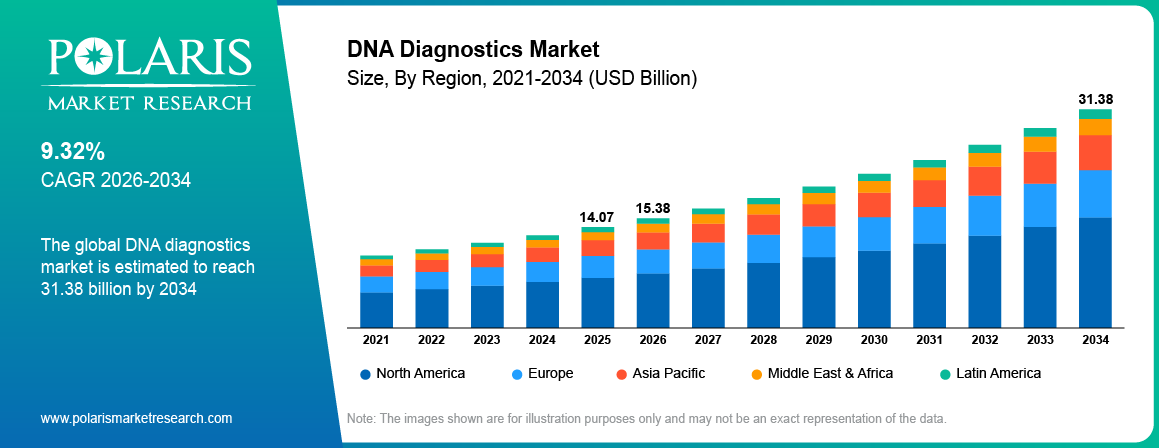
The global DNA diagnostics market size was valued at USD 14.07 billion in 2025. The market is projected to grow at a CAGR of 9.32% from 2026 to 2034. Rising prevalence of genetic disorders and cancers and a global shift toward precision medicine are a few of the key factors driving market growth.
Market Statistics
Key Takeaways
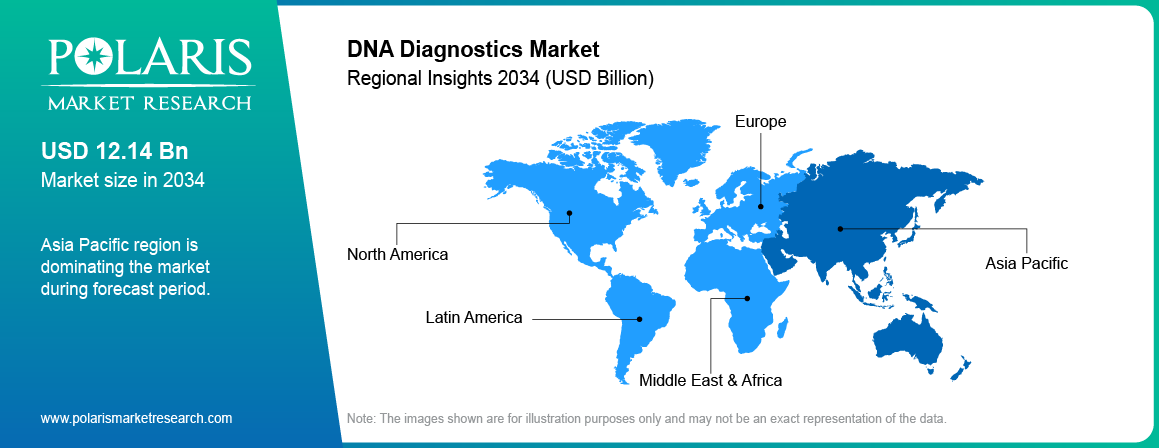
- Asia Pacific led the global DNA diagnostics market with a 38.7% revenue share in 2025. The region's dominance is attributed to rapid advancements in proteomics and genomics, expanding molecular diagnostics capabilities, and increasing healthcare investments.
- North America is expected to register a CAGR of 10.8% during the forecast period. Growth is supported by the presence of several established biotechnology and molecular diagnostics companies, robust research funding, and widespread adoption of advanced genetic testing technologies.
- China is projected to grow significantly at a CAGR of 12.4% during the forecast period. This growth is driven by substantial investments in healthcare infrastructure, expansion of the biotechnology industry, and government initiatives promoting precision medicine and genomic research.
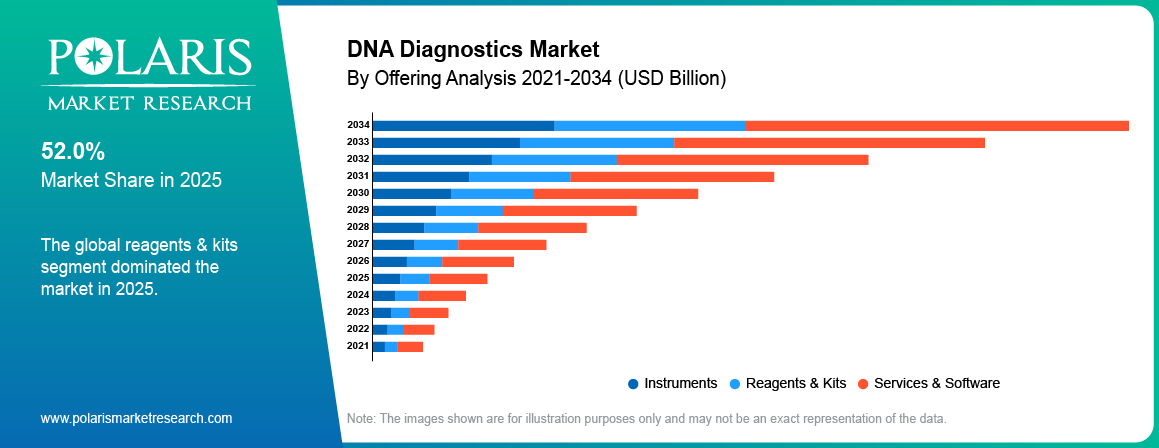
- The Reagents & Kits segment is projected to register a CAGR of 11.2% during the forecast period. The introduction of comprehensive testing kits, increasing demand for consumables in molecular diagnostics, and continuous advancements in genetic testing technologies are driving the segment's growth.
- The Cancer Genetics Tests segment held the largest revenue share of 31.6% in 2025. This dominance is attributed to the rising global prevalence of cancer, growing adoption of precision oncology, and increasing use of genomic profiling for early diagnosis and personalized treatment selection.
Note: Figures and projections outlined in this report are the result of Polaris Market Research’s proprietary analytical processes, grounded in the latest available datasets and market observations.
Industry Dynamics
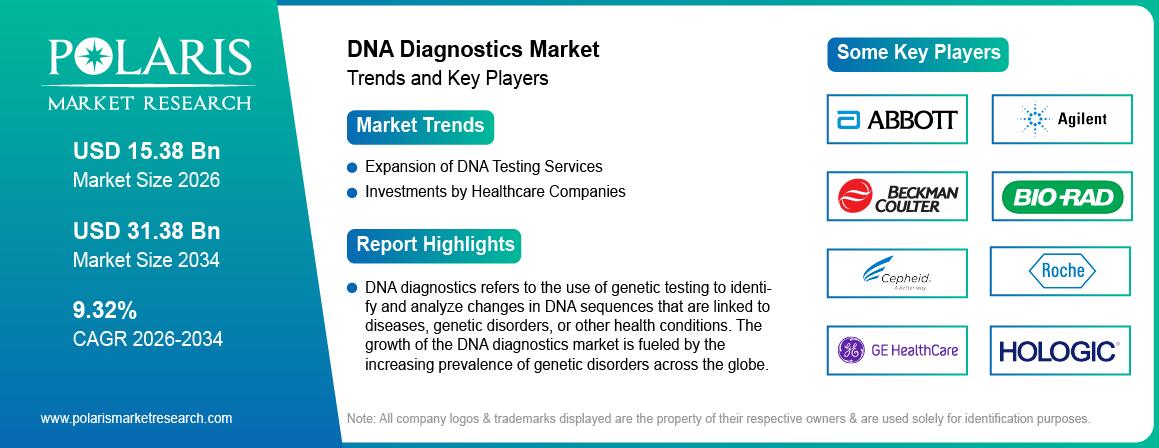
- The expansion of DNA testing market services has broadened access to genetic testing and increased its adoption among diverse populations.
- Rising investments by healthcare companies have resulted in improved testing technologies and enhanced accuracy of DNA diagnostics.
- The focus on the development of non-invasive liquid biopsies and minimal residual disease (MRD) testing is creating several market opportunities.
- High costs of advanced equipment may present market challenges.
AI Impact on DNA Diagnostics Market
- AI assists in improving DNA diagnostics by conducting an analysis of genetic information to detect disease-associated mutations faster and with better precision.
- It facilitates early and accurate diagnosis of diseases by spotting complicated genetic patterns that might not be easy to detect using traditional techniques.
- AI assists in accelerating genome studies and clinical tests by facilitating data analysis.
- It allows for personalized medicine by helping in genetic risk assessment and continuous monitoring of the patient’s health condition.
Source: Polaris Market Research Analysis
To Understand More About this Research: Download Sample Report
DNA Diagnostics in Simple Terms
DNA diagnostic tools are medical procedures that make use of a person's genetic material, or DNA, for detection of any mutations that might be associated with illnesses. These medical procedures assist physicians in the identification of hereditary illnesses, infections, types of cancer, and patient response to certain medications. The process of DNA diagnostics aids in early diagnosis and accurate analysis of a patient's condition.
How DNA Diagnostics Work?
Sample Collection: Sample collection uses blood, saliva, tissues, or cheek cells of the patient.
DNA Isolation: DNA is isolated from the collected sample using different procedures in the laboratory before conducting tests.
Genetic Tests: The DNA is tested using several methods like PCR, NGS, or other molecular tests for genetic variations or genetic markers of diseases.
Interpretation of Test Results: Experts interpret and analyze the test results through genetic databases for detecting any kind of mutation or pathogen in genetics.
Application of the Tests: These results are applied in the diagnosis of the disease, evaluation of genetic risks, choice of therapy, treatment assessment, or prevention.
DNA Diagnostics vs Traditional Diagnostics
| Feature | DNA Diagnostics | Traditional Diagnostics |
| Testing Method | DNA analysis and genetic markers | Symptoms, imaging, cultures, biochemical tests |
| Accuracy | Highly accurate at a molecular level | Accuracy depends on symptoms and lab results |
| Early Detection | Able to diagnose disease before symptoms | Usually detects disease after symptoms occur |
| Predicting Disease | Can predict risk of inherited diseases | Little or no ability to predict disease risk |
| Precision Medicine | Enables precision and targeted treatments | Treatment protocols are based on standard approaches |
| Testing Speed | Fast molecular test for various diseases | Some tests, such as cultures, may take time |
| Examples | Cancer genetic testing, genetic testing, infections, prenatal screenings | Standard health checkups, imaging, blood tests, and physical exams |
Source: Polaris Market Research Analysis
Drivers and Trends
Expansion of DNA Testing Services
The expansion of DNA testing services broadens access to genetic testing and increases its adoption among diverse populations. The proliferation of testing services ranging from clinical diagnostics for disease identification to direct-to-consumer genetic tests for ancestry and health insights has made genetic information more accessible. Several companies are introducing at-home DNA testing services due to the increasing availability of testing options and the integration of these services into routine healthcare practices. For example, in March 2026, Co-Diagnostics extended the commercialization of its PCR DNA diagnostic products (PCR Pro and SARAGENE) in the extremely diverse South Asian market. The DNA test service extension has been done in order to provide comprehensive insights into various aspects of health and wellness.
Investments by Healthcare Companies
Healthcare companies are increasing investments to fuel innovation, research, and the development of new diagnostic technologies. The investments enable companies to advance genomic research, improve testing methodologies, and enhance the accuracy and reliability of DNA diagnostics.For instance, recent funding consolidation trends emphasize multi-analyte blood biomarkers monitoring. It is demonstrated by the $298 million Series B funding raise of Function Health and the $300 million Series A fundraising of Beeline Medicines.
DNA Diagnostics and Personalized Medicine
The use of DNA diagnostics allows physicians to learn about the genotype of an individual and tailor treatments based on it. Rather than having to treat each patient with a uniform method, they can rely on genetics when making their choice. It is possible to determine the risk of developing certain diseases and see how one will react to medications, thus minimizing any potential adverse effects. The technology is widely utilized in oncology, diagnostics of rare conditions, and pharmacogenomics. With the rising trend of personalized medicine, more hospitals, diagnostic centers, and research laboratories are starting to apply DNA personalized medicine diagnostics diagnostics in practice.
DNA Diagnostics in Rare Disease Detection
The use of DNA diagnostics has increased the accuracy of diagnosing rare diseases, which are often caused by inherited genetic abnormalities. Diagnosing such rare diseases with conventional methods can take a long time. However, with the help of DNA diagnosis, such diseases can be detected in a short period and in an accurate manner. PCR and next-generation sequencing are some of the diagnostic tools that enable the identification of genetic mutations that would otherwise not be identified through normal laboratory tests. With early diagnosis, the patient can benefit from effective treatment, genetic counseling, and other aspects of care.
Growth of At-Home DNA Testing
DNA testing at home is gaining popularity among people who want a quick and easy way to understand their state of health and genes. Such tests require a patient to provide a DNA sample through a saliva test or cheek swab, which then undergoes analysis in a laboratory. Increased availability of convenient tests, higher preventive healthcare consciousness, and progress in genetics testing are promoting the use of these tests. There is a wide variety of tests that can give one information about their ancestry, inherited characteristics, carrier status, and some health issues. While offering patients increased access to genetic information, healthcare professionals encourage patients to get help from experts in interpreting such tests. The consumer demand for genetic testing is creating opportunities for the field of DNA diagnostics.
Source: Polaris Market Research Analysis
Segment Insights
DNA Diagnostics Market Breakdown by Offering Insights
The DNA diagnostics market segmentation, based on offering, includes instruments, reagents & kits, and services & software. The reagents & kits segment is projected to register a significant CAGR in the global market due to the introduction of comprehensive suites designed for genetic testing. Several diagnostic companies are launching advanced reagents and kits to facilitate various aspects of DNA analysis, including sample preparation, amplification, and detection, that enhance the efficiency and accuracy of genetic testing.
For instance, in July 2025, Creative Diagnostics introduced an extensive range of Host Cell DNA Assay Kits designed for the detection and quantification of residual host cell DNA impurities in biological products. Such developments of solutions streamline the testing process and improve reliability. Thus, the increasing innovations and availability of kits to address a wide range of genetic testing is expected to drive the significant growth of the reagents & kits segment over the forecast period.
DNA Diagnostics Application Insights
The DNA diagnostics market segmentation, based on application, includes cancer genetics tests, infectious diseases DNA testing, newborn genetic screening, preimplantation & reproductive diagnosis, non-infectious diseases DNA testing, hematology & immunology/identity diagnostics & forensics, pharmacogenomics/drug metabolism, prenatal DNA carrier screening, and others. In 2023, the cancer genetics tests segment held the largest revenue share of the market due to the increasing prevalence of cancer globally. For instance, according to the National Cancer Institute, in 2022, the global incidence of new cancer cases reached nearly 20 million, with 9.7 million cancer-related deaths reported. This rising incidence of cancer has significantly heightened the demand for genetic tests that identify mutations and biomarkers associated with various cancers. Therefore, the increasing demand has driven a substantial revenue share of the cancer genetics tests segment in the global DNA diagnostics market.
| Use Case | How DNA Diagnostics Helps |
| Cancer Screening | Helps in detecting genetic mutations and provides for early detection of cancer and targeted treatment. |
| Diagnosis of Genetic Disorders | Aids in detecting hereditary genetic disorders like cystic fibrosis and sickle cell anemia. |
| Diagnosis of Infectious Diseases | Used to detect bacteria, viruses, and other microbes. |
| Fetal/Neonatal Screening | Used for screening fetuses and newborns for genetic disorders. |
| Pharmacogenomic Testing | Helps in determining the effect of a patient’s genes on his/her reaction to specific drugs. |
| Individualized Medicine | Supports doctors in selecting personalized medicine treatments. |
| Rare Disease Diagnostics | Helps in detecting rare genetic mutations that are difficult to identify by conventional testing methods. |
Source: Polaris Market Research Analysis
Source: Polaris Market Research Analysis
DNA Diagnostics Market Regional Analysis
By region, the study provides the DNA diagnostics market insights into North America, Europe, Asia Pacific, Latin America, and the Middle East & Africa. North America accounted for the largest revenue share in the global DNA diagnostics market due to the presence of several established organizations and a robust healthcare infrastructure in the region. North American market possesses several biotechnology firms and diagnostic companies, such as Abbott; GE HealthCare; Beckman Coulter, Inc.; Bio-Rad Laboratories, Inc.; and Thermo Fisher Scientific, Inc., that drive innovation and advancements in DNA diagnostics. These organizations contribute to the development of technologies, including advanced sequencing platforms and comprehensive genetic testing solutions. Also, North America’s well-established healthcare system supports the widespread adoption of DNA diagnostics through extensive clinical networks, facilitating broad access to genetic testing services. Thus, the combination of a robust industry presence and significant research and development activities in North America has resulted in the dominance of the region in the global DNA diagnostics market.
Source: Polaris Market Research Analysis
Asia Pacific is expected to grow with a substantial CAGR during the forecast period due to the advancement in proteomics and genomics. For instance, in May 2024, SOPHiA GENETICS, a cloud-based healthcare technology firm, collaborated with Microsoft and NVIDIA to leverage their expertise in technology and genomics. This partnership was aimed to introduce an efficient and scalable solution for whole genome sequencing (WGS) analysis in healthcare facilities. Such advancements are resulting in a rising demand for advanced testing services to aid in research, drug development, and personalized medicine.
China DNA diagnostics market is expected to grow significantly due to the country's increasing investment in healthcare infrastructure and biotechnology. The country’s government has prioritized advancements in healthcare as part of its broader responsibility to improve public health and medical services. This focus includes substantial funding for research and development in genetic technologies, as well as initiatives to enhance the availability and quality of diagnostic services. Thus, the development and adoption of advanced DNA diagnostic tools and technologies are accelerating, thereby driving market growth in the country.
Key Market Players & Competitive Insights
The global DNA diagnostics market is dynamic, with several key players driving innovation and growth. Major biotechnology and pharmaceutical companies dominate the market through their extensive portfolios of advanced genetic testing technologies and solutions. These companies invest heavily in research and development to enhance their product offerings and maintain competitive advantages.
The market features a range of specialized firms and startups focused on areas such as personalized medicine, cancer diagnostics, and genetic disease testing. Competition is further intensified by ongoing advancements in genomic technology, decreasing costs of sequencing, and the emergence of new players in both developed and emerging markets. Major players in the DNA diagnostics market include Abbott; Agilent Technologies, Inc.; Avalon GloboCare Corp.; Beckman Coulter, Inc.; Bio-Rad Laboratories, Inc., Cepheid, F. Hoffmann-La Roche Ltd, GE HealthCare, Hologic, Inc., Illumina, Inc., QIAGEN, Siemens Healthcare Private Limited, and Thermo Fisher Scientific Inc.
Thermo Fisher Scientific Inc. offers a wide range of specialty diagnostics, life sciences solutions, laboratory products, analytical instruments, and biopharma services to customers worldwide. The life sciences solutions division offers a comprehensive range of instruments, reagents, and consumables for medical and biological research, disease diagnosis, and drug and vaccine discovery and production. The analytical instruments division provides a broad portfolio of consumables, instruments, software, and services for use in biotechnology, pharmaceutical, academic, environmental, government, and other research and industrial markets, as well as clinical laboratories. In February 2023, Thermo Fisher Scientific announced that its Applied Biosystems TaqPath PCR kits for infectious diseases such as M. tuberculosis complex (MTB), multi-drug-resistant tuberculosis (MTB MDR), hepatitis B virus (HBV), human immunodeficiency virus (HIV), hepatitis C virus (HCV), and for genetic analysis (HLA B27) had been granted licensing rights by the Central Drugs Standard Control Organisation (CDSCO).
Bio-Rad Laboratories, Inc. is a manufacturer and developer of a wide range of products associated with life science and clinical diagnostics. The company is headquartered in Hercules, California, and has a global presence spanning North America, Europe, the Middle East and Africa, Latin America, and Asia Pacific regions. It specializes in life science research, digital biology, and clinical diagnostics. The core offerings of Bio-Rad Laboratories, Inc. include varied products and diagnostic tests such as diabetes testing, infectious disease testing, autoimmune testing, chromatography, and cell isolation & analysis, among others. In addition, the Bio-Rad Laboratories, Inc. platform serves as a combination of varied services, including food and beverage testing, classroom education, molecular testing, and others. In April 2024, Bio-Rad Laboratories, Inc. introduced the ddPLEX ESR1 Mutation Detection Kit and ultrasensitive multiplexed digital PCR assay. This new assay adds to the company's range of ddPCR offerings for the oncology sector, offering multiplexed and sensitive mutation detection assays that play a crucial role in translational research, therapy selection, and disease monitoring.
List of Key Companies
- Abbott
- Agilent Technologies, Inc.
- Avalon GloboCare Corp.
- Beckman Coulter, Inc.
- Bio-Rad Laboratories, Inc.
- Cepheid
- F. Hoffmann-La Roche Ltd
- GE HealthCare
- Hologic, Inc.
- Illumina, Inc.
- QIAGEN
- Siemens Healthcare Private Limited
- Thermo Fisher Scientific Inc.
Future Outlook
The market for DNA diagnostics is forecasted to register steady growth in the coming years owing to the emphasis laid by the healthcare industry on the detection of diseases in their early stages, customized treatment solutions, and prevention measures. Technological advancements made in the field of NGS, PCR, and molecular diagnostics make genetic tests faster, more reliable, and accessible. The increasing application of DNA diagnostics in cancer detection, identification of rare diseases, infectious diseases, and pharmacogenomics drives market growth. Growing research in the field of genomics, increased usage of companion diagnostics, and the increasing need for home genetic tests create new growth opportunities for players operating in this market.
Industry Developments
- March 2026: Abbott announced the completion of the acquisition of Exact Sciences. According to Abbott, the acquisition will establish it as a leader in fast-growing cancer screening and diagnostics segments. It will enable the company to serve millions of additional people.(source: prnewswire.com)
- February 2026: New England Biolabs announced the release of the Monarch Mag Cell-free DNA (cfDNA) Extraction Kit. The company stated that the kit enables consistent and scalable extraction of low-abundance, circulating cell-free DNA (cfDNA) for downstream applications.(source: neb.com)
- July 2024: Avalon GloboCare Corp announced that Laboratory Services MSO, LLC introduced a direct-to-consumer, non-invasive DNA test in the US The test is designed to assess potential genetic predisposition to opioid dependence.
Market Segmentation
By Offering Outlook
- Instruments
- Reagents & Kits
- Services & Software
By Technology Outlook
- In Situ Hybridization
- Mass Spectroscopy
- Microarrays
- Polymerase Chain Reaction (PCR)
- Sequencing
- Others
By Specimen Outlook
- Blood, Serum, and Plasma
- Urine
- Others
By Application Outlook
- Cancer Genetics Tests
- Infectious Diseases DNA Testing
- CT/NG Diagnostic
- HBV Diagnostic
- HCV Diagnostic
- HIV Diagnostic
- HPV Diagnostic
- MRSA Diagnostic
- TB Diagnostic
- Others
- Newborn Genetic Screening
- Preimplantation & Reproductive Diagnosis
- Non-Infectious Diseases DNA Testing
- Cardiovascular Diseases
- CNS & PNS Related
- Lung, Kidney, Liver & GT Related
- Sensory Diseases
- Skeletal, Connective, Ectodermal & Dermal DNA Testing
- Hematology & Immunology/Identity Diagnostics & Forensics
- Pharmacogenomics/Drug Metabolism
- Prenatal DNA Carrier Screening
- Others
By End User Outlook
- Diagnostic laboratories
- Hospitals & clinics
- Others
By Regional Outlook
- North America
- US
- Canada
- Europe
- Germany
- France
- UK
- Italy
- Spain
- Netherlands
- Russia
- Rest of Europe
- Asia Pacific
- China
- Japan
- India
- Malaysia
- South Korea
- Indonesia
- Australia
- Rest of Asia Pacific
- Middle East & Africa
- Saudi Arabia
- UAE
- Israel
- South Africa
- Rest of Middle East & Africa
- Latin America
- Mexico
- Brazil
- Argentina
- Rest of Latin America
DNA Diagnostics Report Scope
| Report Attributes | Details |
| Market size value in 2025 | USD 14.07 billion |
| Market size value in 2026 | USD 15.38 billion |
| Revenue Forecast in 2034 | USD 31.38 billion |
| CAGR | 9.32% from 2026 – 2034 |
| Base year | 2025 |
| Historical data | 2021 – 2024 |
| Forecast period | 2026 – 2034 |
| Quantitative units | Revenue in USD billion and CAGR from 2026 to 2034 |
| Report Coverage | Revenue Forecast, Market Competitive Landscape, Growth Factors, and Trends |
| Segments Covered |
|
| Regional Scope |
|
| Competitive Landscape |
|
| Report Format |
|
| Customization | Report customization as per your requirements with respect to countries, regions, and segmentation. |
Source: Polaris Market Research Analysis
DNA Diagnostics Market FAQs
The global DNA diagnostics market size was valued at USD 14.07 billion in 2025 and is projected to grow to USD 31.38 billion by 2034.
The global market is projected to grow at a CAGR of 9.32% during the forecast period, 2026-2034.
North America had the largest share in the global market
The key players in the market are Abbott, Agilent Technologies, Inc., Avalon GloboCare Corp., Beckman Coulter, Inc., Bio-Rad Laboratories, Inc., Cepheid, F. Hoffmann-La Roche Ltd, GE HealthCare, Hologic, Inc., Illumina, Inc., QIAGEN, Siemens Healthcare Private Limited, and Thermo Fisher Scientific Inc.
The reagents and kits segment is expected to grow with a substantial CAGR in the global market, driven by the development of comprehensive suites tailored for genetic testing.
In 2025, the cancer genetics tests segment accounted for the largest market share because of the increasing prevalence of cancer globally.
DNA diagnostics allow doctors to diagnose illnesses in their early stages based on genetic analysis of a person. They are able to find out about any inherited conditions and help personalize treatment and choose the necessary drugs for the patient. This type of testing is also helpful for better monitoring and making decisions related to health care.
DNA diagnostics can be used to detect various health conditions such as genetic disorders, cancer, infections, and rare inherited diseases. DNA diagnostics is also used to conduct prenatal and newborn testing and to identify genetic mutations that can contribute to increased risks for certain diseases.
There are several factors that contribute to the growth of the DNA diagnostics market. More people are interested in early disease detection and personalized medicine. Secondly, new technological developments like PCR and NGS make DNA diagnostics more effective. Genetic testing is becoming more popular in cancer diagnostics, rare diseases, and infectious disease diagnostics.
Download Sample Report of DNA Diagnostics Market
Please fill out the form to request a customized copy of the research report.


