
Electric Commercial Boiler Market Size, Share, and Forecast 2027 to 2035
REPORT DETAILS
Electric Commercial Boiler Market Summary
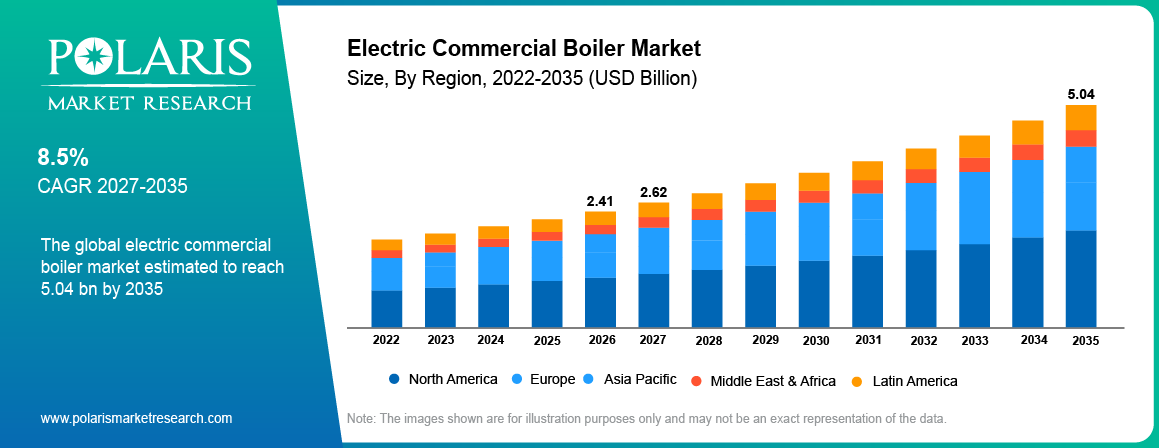
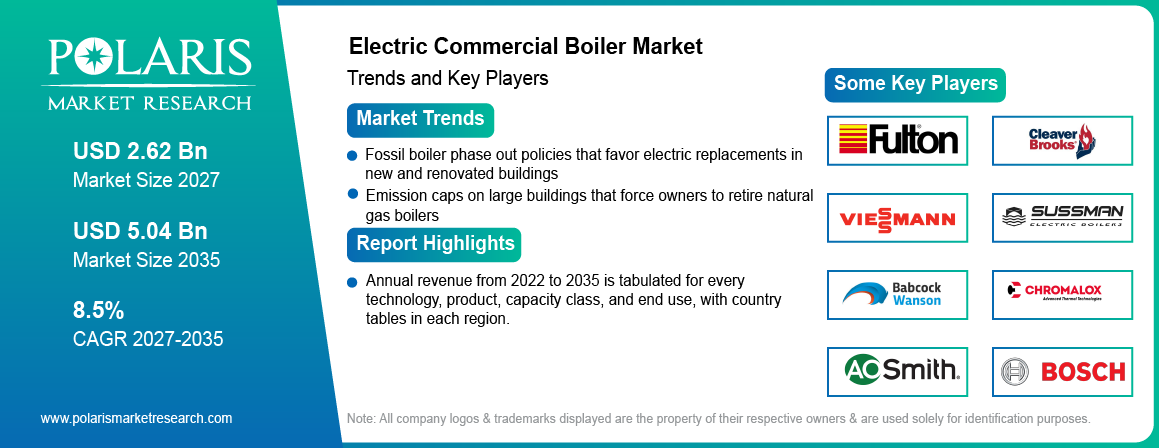
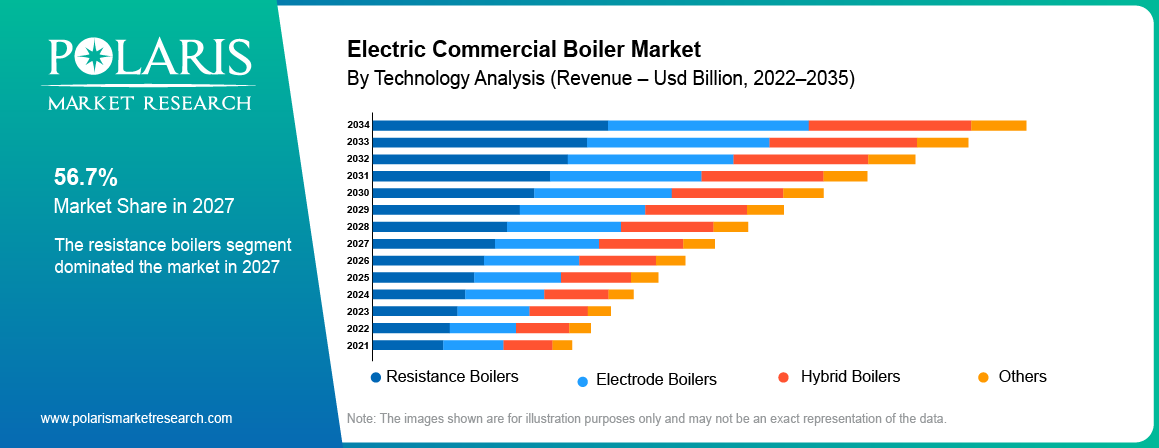
According to Polaris Market Research analysis, the electric commercial boiler market was valued at USD 2.41 Billion in 2026. It is projected to reach USD 5.04 Billion by 2035, growing at a CAGR of 8.5% from 2027 to 2035. Demand comes from hospitals, offices, schools, hotels, and shops that must stop burning natural gas for heat and hot water. Resistance Boilers account for most technology revenue, whereas Hybrid Boilers grow fastest. The market tracks revenue from electric hot water and steam boilers installed in commercial and institutional buildings, and leaves out district heating equipment and industrial process boilers. Europe holds the largest regional share, and Asia Pacific records the fastest growth.
Market Statistics
Key Takeaways
- Regional revenue in 2027 is led by Europe at 34.6%, since building heat regulations and a large stock of natural gas boilers push owners toward electric replacements.
- Asia Pacific heads regional growth at 10.4% annually to 2035, as China, India, and South Korea add large commercial floor space.
- Technology revenue in 2027 is led by Resistance Boilers with 56.7%, owing to their simple design, low purchase price, and fit for small and mid size mechanical rooms.
- Hybrid Boilers show the steepest technology CAGR, 12.7% to 2035, as owners pair electric modules with existing natural gas equipment to protect past investment.
- By product, Hot Water Boilers earn the most in 2027 with USD 1,707.3 Million, while Steam Boilers advance quickest at 10.2% annually.
- Mid Output Boilers take 46.0% of 2027 capacity value, and High Output Boilers rise 10.6% a year as campuses and large hospitals electrify central equipment.
- Healthcare Facilities make up 25.6% of 2027 end use revenue and post the strongest end use growth, at 9.9% annually, because hospitals need heat and steam around the clock.
- India has the fastest growing national market at 14.3% a year, as new building rating regulations and brisk commercial construction lift demand from a modest base.
Note: Figures and projections outlined in this report are the result of Polaris Market Research’s proprietary analytical processes, grounded in the latest available datasets and market observations.
Electric Commercial Boiler Market Definition
The electric commercial boiler market covers electric boilers that make hot water or steam for space heating, hot water supply, and process use in commercial and institutional buildings. It excludes district heating utility boilers, industrial process boilers, heat pumps, and residential boilers.
Outside figures for electric boilers differ widely. Some count every boiler fuel, some count only industrial units, and some add heat pumps or home heaters. Polaris counts electric hot water and steam boilers bought for commercial and institutional buildings, so the total tracks spending on that one equipment class.
Neighboring studies take a wider view. Factory boiler equipment is analyzed in the industrial boiler market study, compressor driven alternatives in the heat pump market study, and wall hung or floor standing units for homes in the space heating boilers market study. A unit counts here only when a commercial or institutional building owner buys it.
Capacity is measured in kilowatts of electrical input. Low Output Boilers run below 300 kW, Mid Output Boilers cover 300 to 1,200 kW, and High Output Boilers exceed 1,200 kW and reach about 5.5 MW for large campuses. Electrode units of tens of megawatts serve industry and district heat and sit outside the scope.
Three technology families generate revenue. Resistance boilers heat water or make steam with immersed elements, electrode boilers pass current through the water itself, and hybrid boilers combine electric modules with a fuel fired boiler or another heat source in one system.
Buying routes take three common forms. Mechanical contractors specify boilers for new buildings, facility teams order replacements when a natural gas boiler fails, and energy service firms bundle electric boilers with controls and maintenance for a monthly fee.
Electric Commercial Boilers vs Gas Fired Commercial Boilers: Key Differences
| Attribute | Electric Commercial Boilers | Gas Fired Commercial Boilers |
| Energy source | Grid electricity, with no on site combustion | Natural gas burnt in the boiler |
| On site emissions | None from the boiler itself | Carbon dioxide and nitrogen oxides from the flue |
| Installation | No flue, natural gas line, or fuel store, so smaller mechanical rooms and lower install cost | Flue, natural gas supply, and combustion air are needed |
| Running cost | Higher where electricity costs several times more than natural gas | Lower where natural gas stays cheap |
| Market treatment | Counted here, with a 8.5% CAGR from 2027 to 2035 | Outside the scope of this report |
Source: Polaris Market Research Analysis
Fuel price and policy usually decide the comparison. Cheap or clean electricity and restricted natural gas favor an electric boiler, while cheap and unregulated natural gas keeps existing equipment in service.
Porter's Five Forces Analysis
| Force | Intensity | Rationale |
| Bargaining power of suppliers | Moderate | Heating elements, vessels, and controls come from open markets, although power controllers and certified pressure vessels depend on a limited set of specialists. |
| Bargaining power of customers | High | Hospital groups, universities, and property owners buy in volume through tenders, so price, efficiency, and warranty terms are negotiated project by project. |
| Threat of new entrants | Moderate | Local assemblers can start with small units, but pressure vessel approvals, electrical safety listings, and field support coverage hold back serious entry in large sizes. |
| Threat of substitutes | High | Heat pumps, natural gas condensing boilers, and district heat can serve the same buildings, so demand shifts when prices or regulations change. |
| Competitive rivalry | High | Global boiler groups, electric specialists, and heating brands chase the same retrofit jobs, so references and delivery times decide share. |
Source: Polaris Market Research Analysis
Reputation outweighs quoted price in this trade. A facility manager whose boiler ran for years without a fault usually places the next order with the same maker, so producers fund service crews and extended warranties next to product development.
Market Dynamics
Driver Impact Analysis
| Driver | Impact on Market Growth | Time Horizon |
| Fossil boiler phase out policies that favor electric replacements in new and renovated buildings | High | Short to Medium Term |
| Emission caps on large buildings that force owners to retire natural gas boilers | High | Medium to Long Term |
Source: Polaris Market Research Analysis
Driver: Fossil Boiler Phase Out Policies Are Increasing Electric Boiler Specifications, Creating Market Demand
Governments are steering building heat away from fossil fuel use. Rules on new and renovated buildings, together with the end of subsidies for natural gas boilers, make a fuel fired replacement harder to justify, so specifiers add electric boilers to their shortlists earlier in design.
For example, in May 2026, the transposition deadline passed for the revised Energy Performance of Buildings Directive in all member states (Source: European Commission). The directive entered into force on 28 May 2024 and aims at a zero emission stock by 2050, and the same page says financial incentives for stand alone fossil fuel boilers ended on 1 January 2025.
Resistance Boilers hold 56.7% of 2027 technology revenue, and Hybrid Boilers climb 12.7% yearly to 2035. Buildings that cannot yet leave natural gas completely use hybrid equipment, whereas new buildings go fully electric, so both families gain from the same regulations.
Clean power makes the case stronger. Owners who sign renewable supply contracts can quote the carbon saving of an electric boiler directly, and listed companies need that figure for climate reports, so finance teams accept a higher running cost in exchange for reportable cuts.
Driver: Emission Caps on Large Buildings Are Speeding Boiler Replacement, Creating Market Demand
Large property owners now face emission limits with fines attached. A natural gas boiler that burns fuel on site is the first item an energy audit flags, so replacement budgets are released well before the end of the boiler life.
For example, in April 2026, the New York City Department of Buildings reported that about 93% of covered privately owned properties had filed reports under Local Law 97 (Source: NYC Department of Buildings). The law applies to buildings above 25,000 gross square feet and requires a 40% emission cut by 2030 and net zero by 2050, so the filing rate shows how widely the rule reaches into the commercial stock.
High Output Boilers hold USD 591.4 Million in 2027 and advance 10.6% a year, as towers, campuses, and hospital blocks replace central natural gas equipment. Offices expand only 6.3% a year, the lowest among end uses, because many tenants already rely on heat pumps or district supply.
Reporting duty adds a second push. Owners must file annual emission data, so they favor equipment that logs electricity use with meter grade accuracy, and vendors that supply such logs win repeat orders.
Restraint: High Electricity to Gas Price Ratios and Grid Connection Limits Are Slowing Adoption, Limiting Growth
Electricity costs far more per unit of energy than natural gas in many countries, and that gap is the main brake on this market. A boiler that is nearly fully efficient still loses on running cost when each kilowatt hour of power costs several times the price of natural gas.
For example, in April 2026, the UK electricity price cap stood at 24.67 pence per kWh against 5.74 pence for natural gas over the April to June quarter, a ratio of 4.3, according to Nesta (Source: Nesta). The International Energy Agency puts typical ratios for buildings and low temperature heat at about 2 to 3.5 across the European Union (Source: IEA).
Grid access is a second limit. The same IEA commentary notes long connection queues for medium sized users, so a hospital that needs several megawatts of new supply may wait longer for the utility than for the boiler itself.
Resistance Boilers still supply 56.7% of 2027 technology revenue yet advance only 7.2% annually, as buyers with high electricity prices lean toward heat pumps and hybrid equipment. Offices expand just 6.3% a year for the same reason.
Producers respond with load management, thermal storage, and time of use controls. Such features cut bills by running boilers when power is cheap, yet they raise project cost and lengthen design time.
Opportunity: Hybrid Add On Systems Are Opening a Retrofit Path for Gas Boiler Owners, Creating New Demand
Many owners fear stranded assets. A natural gas boiler that still has years of life is a sunk cost, so a module that adds electric steam or hot water beside it lets the equipment cut fuel use without a full rebuild.
For example, in May 2026, Babcock Wanson UK launched a Hybrid Add on electric boiler developed by Standard Fasel (Source: Engineering Update). The low voltage modular unit comes in 200, 400, and 800 kW sizes and links to existing natural gas or oil fired steam boilers, with natural circulation and unlimited turndown, according to the same report.
Hybrid Boilers earned USD 404.1 Million in 2027 and are the fastest technology. Steam Boilers grow 10.2% yearly, the quickest product class, since hybrid steam retrofits pull electric modules into hospitals, laundries, and food service kitchens.
A retrofit clears approval faster than a new building. Pipework, pumps, and flues are already in place, so the buyer funds only the electric module and its controls, and payback is judged against one fuel line.
Controls make hybrid equipment work. A supervisory controller reads electricity prices, outdoor temperature, and boiler status, then decides which unit carries the load, so suppliers that sell the controller together with the electric module hold an edge over those that sell metal only.
Opportunity: Dual Energy Support Programs Are Creating New Demand in Hospitals, Schools, and Offices
Public support lowers the cost of the switch. Programs that pay for electric primary heating with natural gas as backup suit hospitals, schools, and offices, because they keep a safety margin on the coldest days while cutting annual natural gas use.
For example, on 10 April 2026, the Quebec government granted CA$163.4 million to the natural gas distributor Énergir for a program that supports heating systems with electricity as the main source and natural gas as backup (Source: Government of Quebec). About 450 commercial and institutional buildings and over 11,000 households are expected to benefit.
Educational Institutions were worth USD 421.9 Million in 2027 and grow 9.2% a year. Among countries, Canada grows quickest in North America, at 9.9% a year, as provinces with cheap hydropower fund electric heating.
Vendors with packaged skids and engineering support can win these projects. Public buyers want fixed price bids, so a supplier that offers standard sizes and short lead times shortens the sales cycle.
Trend: Modular Electric Boilers With Digital Controls Are Spreading Across Commercial Buildings
Boilers are getting smaller per kilowatt and smarter. Makers now ship factory tested modules that pass through a standard doorway, link to building management systems, and stage heating elements to match load, so installers finish mechanical rooms in days rather than weeks.
For example, in January 2026, the Babcock Wanson Group published a brochure covering its electric range, from low voltage immersion units to electrode boilers that deliver steam at up to 85 barg and 75 MW (Source: Industrial Process Engineering Search). The same brochure highlights hybrid add ons for facilities that cannot electrify all at once.
Mid Output Boilers hold 46.0% of 2027 capacity revenue, and Electrode Boilers grow 9.5% a year to 2035. Modular design lets one platform cover several sizes, so makers can serve both hospital wings and large campuses.
Connected controls add to the appeal. Open protocol links, remote alarms, and demand forecasting let operators schedule heating for low price hours, and vendors that bundle such controls can also sell monitoring contracts.
Value Chain Analysis
| Stage | Activities | Representative Participants |
| Components and materials | Supplying heating elements, contactors, power controllers, and pressure vessel steel | Element makers, electrical component firms, and steel mills |
| Boiler manufacturing | Assembling resistance, electrode, and hybrid boilers to pressure vessel codes | Cleaver Brooks, Fulton, Chromalox, Babcock Wanson, and Bosch Industriekessel |
| Distribution and engineering | Specifying, quoting, and supplying boilers through representatives and wholesalers | Mechanical contractors, boiler representatives, and engineering consultants |
| Installation and service | Erecting equipment, wiring, commissioning, and maintaining controls and elements | Installers, vendor service crews, and regional service firms |
| End installations | Running boilers in hospitals, offices, schools, hotels, and shops | Hospital groups, universities, property owners, and hotel operators |
Source: Polaris Market Research Analysis
Profit pools sit in engineering and aftercare. A company that sizes the system, arranges the electrical connection, and guarantees performance earns recurring revenue, whereas a stand alone boiler sale invites undercutting by cheaper makers.
Pressure vessels, power controllers, and testing absorb most of the cost. Shared frame sizes and skids tested before shipment reduce it, so suppliers with repeat designs can bid sooner and keep their margin.
Mechanical contractors stand between manufacturers and owners. They pick the brand, size the electrical feed, and stand behind the installation warranty, so their preference often settles the brand on a project.
Pricing depends on the product class. Wholesalers sell small units one at a time, large units go out as projects with factory witness tests, and service is billed annually, so the mix of new sales and aftermarket decides the revenue path.
Geography matters too. Manufacturing clusters in the United States, Germany, France, and China, contractors work close to their jobs, and service teams are placed around hospital and campus hubs.
Electric Commercial Boiler Market Segmentation Analysis
Segmentation follows the heating technology inside the boiler, the product that leaves it, the electrical capacity of the unit, and the type of building that owns it. Each split changes cost, electrical connection, control needs, and service routes.
Technology Insights
Market share by technology favored Resistance Boilers in 2027, at 56.7% of technology revenue, driven by simple immersed elements, low purchase prices, and easy fit in small mechanical rooms. Replacement of old natural gas units in schools and shops adds steady volume.
Electrode Boilers were worth USD 581.5 Million in 2027, owing to large hospital and campus plants that need high output from a compact vessel. Current passes through the water itself, so response is quick, yet the water needs careful conductivity control.
Hybrid Boilers rise quickest among technologies, at a CAGR of 12.7% from 2027 to 2035, as owners combine electric modules with natural gas equipment or heat pumps. Such layouts cut fuel use while keeping a backup for the coldest days.
For example, in February 2025, Cleaver Brooks introduced its LVR electric hydronic boiler, rated from 90 to 540 kW and nearly 100% efficient, small enough to fit through a 34 inch doorway (Source: Cleaver Brooks). Compact designs of this kind speed up basement and rooftop replacements.
Others brings in USD 149.7 Million in 2027 and covers induction heated and infrared designs, plus special units for labs and cleanrooms. Orders arrive when a site needs a feature that standard elements cannot supply.
Purchasing criteria vary by role. Installers weigh installed price and lead time, building engineers weigh uptime and parts supply, and asset owners weigh lifetime ownership cost including electricity bills.
Electrical load needs planning. Big resistance and electrode units pull heavy current, so designers specify staged steps, gentle ramp up, and demand caps, and the selected control package moves the final price noticeably.
Product Insights
Products divide into hot water boilers for space heating and domestic supply, and steam boilers for humidification, sterilization, kitchens, and laundries. The split follows the temperature and pressure the building needs.
Hot Water Boilers led the product split in 2027 with 65.1% of revenue, driven by hydronic heating loops in offices, schools, and hotels. Many existing buildings already have water pipes and radiators, so an electric unit slots into the old loop.
Steam Boilers are projected to grow at a CAGR of 10.2% from 2027 to 2035, attributed to hospital sterilizers, laundries, and kitchens that need steam on demand. Electric units also avoid flues, a fit for crowded city facilities.
For example, in August 2026, the Fulton product page for its FBZ electric steam boiler listed models from 90 kW and described a 100kA short circuit rating and BACnet capability as standard features (Source: Fulton). Built in connectivity of this kind is becoming a basic purchase requirement.
Others adds USD 108.3 Million in 2027 and covers thermal fluid heaters and small specialty steam generators for labs and clinics.
Product choice decides the supporting equipment. A hot water unit needs pumps, expansion vessels, and mixing valves, whereas a steam unit needs feedwater treatment, blowdown, and condensate return, so each path carries different service work.
Capacity Insights
Capacity is the electrical input rating of each boiler. The low class sits below 300 kW, the mid class spans 300 to 1,200 kW, and the high class starts above 1,200 kW, so each class follows building size and electrical connection.
Low Output Boilers were worth USD 825.6 Million in 2027, owing to small offices, shops, clinics, and schools. Wholesale channels and packaged units shorten installation time at these facilities.
Mid Output Boilers captured 46.0% of 2027 capacity revenue, driven by hospital wings, hotels, and mid rise offices of matching size. Catalog frames hold prices steady.
High Output Boilers are projected to grow at a CAGR of 10.6% from 2027 to 2035, attributed to campuses, towers, and large hospitals that replace central natural gas equipment. Such projects often need new transformers, so electrical work shapes timing.
For example, in December 2025, Sussman Electric Boilers added new EWx models of 30 to 240 kW to a line that now spans 30 to 1,200 kW, with BACnet and Modbus links (Source: ACHR News). A wide range under one platform lets a single supplier serve several building sizes.
Class boundaries blur at times. One big site may cascade several mid size boilers while a small hotel may buy a single large unit, so Polaris places each boiler by its rated electrical input.
Size also sets the sales channel. Wholesalers move small units, mechanical contractors place mid size ones, and the biggest units are negotiated directly with manufacturers and engineering firms.
End Use Insights
Among building types, Healthcare Facilities generated 25.6% of 2027 sales, since hospitals require heat, hot water, and steam round the clock and tolerate no extended outage. Infection control regulations favor sealed electric equipment with no flue gases inside the site.
For example, in February 2026, Dubai Health and Positive Zero announced on site solar above 14.1 MW across 26 healthcare facilities and a first Cooling as a Service project at Al Jalila Children's Hospital (Source: MEED). The report does not mention boilers, yet it shows hospital owners moving energy services toward electric supply.
Offices were worth USD 621.3 Million in 2027, supported by retrofits in older towers. Many tenants already use heat pumps for heating, so electric boilers mostly provide top up or backup heat.
Educational Institutions rise at a CAGR of 9.2% from 2027 to 2035, owing to universities and school districts that set carbon targets and replace aging natural gas boilers. Public funds and long asset lives support these projects.
Hospitality and Lodging brought in USD 314.0 Million in 2027, attributed to hotels and resorts that need large volumes of hot water every morning and evening. Owners value quiet mechanical rooms and guest comfort.
Retail Stores contribute USD 232.0 Million in 2027, mostly from small hot water duties and winter heating in shopping malls and chain outlets.
Others adds USD 363.5 Million in 2027 and spans data centers, laboratories, government offices, and sports venues.
Trials stretch the sales cycle. A hospital engineer new to electric steam generally requests a visit to a working installation, so the supplier arranges tours, shares load logs, and reports yearly running costs before an order is placed.
Purchasing routes differ by site. Public hospitals and universities run formal tenders, hotel groups order through framework agreements, and small property owners buy from local contractors on price and delivery.
Owner type shapes timing. Public hospitals and schools follow budget cycles and tenders, while private hotels and retail chains act quickly once a replacement saves money, so sales teams plan separate pursuit paths for each group.
Uptime wins orders. A breakdown can shut a ward kitchen or a hotel pool, so buyers pay for spare elements, remote diagnostics, and references from comparable buildings.
Electric Commercial Boiler Market Regional Analysis
Regional demand mirrors where natural gas is restricted, where power is affordable, and where commercial floor space is growing. Europe holds the biggest base through building regulations, Asia Pacific grows quickest on new construction, and North America adds orders through emission caps and utility programs.
North America Market
North America draws 28.9% of 2027 revenue, owing to carbon limits in big cities and utility programs that back electric heating. Through 2035 the region lags Asia Pacific at 8.1% annually, since most buildings are already established.
The United States posted USD 604.6 Million in 2027, most of the regional total. Canada grows quickest among the three countries, at 9.9% annually to 2035, as provinces rich in hydropower subsidize electric heating, while Mexico follows at 8.1% with USD 60.6 Million in 2027.
Local Law 97 in New York City and the Quebec dual energy program described above show two policy routes. One sets emission caps on large buildings, while the other pays for electric primary heating, and both point toward electric boilers in hospitals, schools, and offices.
Competition here rewards vendors with local service crews and reference sites close by. Buyers rely on contractors holding spares in stock, so manufacturers partner with them to stay on the specification list.
Utility programs add momentum. Rebates for electric heating and demand response payments for flexible loads improve payback, and boiler makers that help owners file for incentives shorten the road from quotation to order.
Europe Market
Europe accounts for 34.6% of 2027 revenue and expands 7.2% a year, the slowest pace among the five regions, owing to a mature installed base. Germany ranks first on the continent at USD 216.9 Million in 2027.
The United Kingdom grows slowest among the countries named here, at 6.5% a year, with USD 153.4 Million. A price ratio of 4.3 sits above the 2 to 3.5 range that the IEA gives for the European Union, so switching is slower. France stands at USD 109.0 Million, Italy USD 72.6 Million, Spain USD 54.5 Million, Norway USD 45.9 Million, Sweden USD 45.9 Million, and the remaining countries combined USD 209.9 Million.
For example, in July 2026, Germany issued a revised federal funding guideline for efficient buildings (Source: BEG EM guideline). Dated 17 July 2026 and in force from 21 July 2026, it takes a technology open approach and lists eligible heating technologies. Heat pumps are named as eligible, while electric boilers do not appear in the list, so owners lean toward hybrid layouts.
Electricity cost steers demand. Nordic countries with cheap hydropower and nuclear supply favor electric boilers, whereas countries with expensive power rely on heat pumps and hybrids first.
Local manufacturing is deep. Major boiler and heating groups are headquartered in Germany, France, Italy, and the United Kingdom, so nearby supply cuts delivery time and simplifies service.
Asia Pacific Market
Asia Pacific is the fastest growing region, at a CAGR of 10.4% from 2027 to 2035, and it holds 26.5% of 2027 revenue. The gain is attributed to new hospitals, universities, offices, and hotels in China and India.
China is first in the region by value, at USD 250.3 Million in 2027, and India is the quickest at 14.3% a year from a low base. Japan lags the bigger markets at 8.2% since its buildings are older, while South Korea totals USD 69.9 Million and Australia USD 68.8 Million.
For example, in June 2026, India's Ministry of Power circulated a draft notification (Source: Ministry of Power, India). It would require a star rating for new office, commercial, and residential buildings with a floor area from 20,000 square meters upward, with a minimum of three stars. The draft does not mention boilers, but efficiency ratings push designers toward electric equipment.
Smaller Asia Pacific economies together reach USD 125.5 Million in 2027, led by hotels, hospitals, and shopping centers across Southeast Asia.
Domestic makers influence price levels. Chinese suppliers sell inexpensive electric boilers to local builders, whereas foreign groups concentrate on high output and hybrid units, so rivalry varies with unit size.
Latin America Market
The 2027 share of Latin America is 5.0%, and the region expands at 8.5% annually to 2035, owing to hospital, hotel, and office projects in Brazil and Argentina. Brazil is the largest market at USD 58.9 Million, whereas Argentina expands quicker at 8.5% a year.
Other countries in Latin America total USD 52.6 Million in 2027. Many owners purchase via regional distributors, so local revenue follows building starts closely.
For example, in June 2026, Trane Technologies issued a press release from Brazil (Source: Trane). It says the national grid is mostly clean, so cutting heating emissions depends on electrifying fossil fired heat, with heat pumps named as a main lever. Electric boilers fit where heat pumps cannot reach the required temperature.
Currency swings and customs duties distort quotations. Suppliers holding spare elements locally and pricing in local currency protect buyers from import shocks.
Middle East & Africa Market
The Middle East & Africa region accounts for 5.0% of 2027 revenue and grows 8.5% annually, owing to hospital, hotel, and tower projects across Gulf states. Saudi Arabia has the top value at USD 34.4 Million, while the Emirates grow quickest at 9.6% a year.
In 2027 the Emirates come to USD 26.5 Million, Turkey holds USD 23.6 Million, South Africa at USD 18.1 Million, and the residual group at USD 28.6 Million. South Africa grows slowest at 6.6% a year, as commercial construction is slower than in the Gulf states.
For example, in September 2026, Almoosa Health in Saudi Arabia awarded BEC Arabia a mechanical and electrical works contract worth SAR 781.66 million for its Almoosa Specialized Hospital in Alkhobar (Source: Saudi Gulf Projects). The report does not mention boilers, yet mechanical packages on new hospitals normally include heating equipment.
Gulf procurement increasingly rewards bidders that assemble locally, partner with regional firms, and keep stock near the customer.
Wrong sizing is expensive, so capable suppliers request load data at the start. Hot water demand, steam pressure, supply voltage, and ambient heat all alter unit size and control choice, so a loose inquiry seldom yields a firm quote.
Heat sets harder technical demands. Hot ambient air and dusty boiler rooms wear out elements and contactors sooner, so owners request sealed enclosures and strict performance guarantees in large project specifications.
Electric Commercial Boiler Market Competitive Landscape
Suppliers fall into four groups. Boiler specialists such as Cleaver Brooks and Fulton sell steam and hot water equipment that includes electric ranges. Electric heating specialists such as Chromalox and Sussman Electric Boilers focus on elements and electric vessels. Industrial heat groups such as Babcock Wanson and Bosch Industriekessel supply large and hybrid systems, and climate groups such as Viessmann supply commercial heating ranges.
Recent launches cluster around hybrid and compact products. Add on modules for natural gas steam equipment, hot water ranges that reach 1,200 kW, and compact hydronic units all arrived within two years, so rivals now compete on design as well as brand.
Bosch Industriekessel lists an electric boiler of 250 to 5,500 kW per unit (Source: Bosch Industrial). The page cites pressure up to 16 bar, temperature up to 190 degrees Celsius, and uses in building heating, local heat networks, process heat, and backup. Few rivals publish such a wide range on one page.
Suppliers seldom disclose electric commercial boiler revenue on its own, so share rankings here are estimates. Polaris therefore uses launches, product ranges, and project news as indicators of presence rather than as measured sales.
Contests turn on lead time and references. Buyers prefer suppliers holding stock, carrying listed safety approvals, and keeping engineers near the site, so share moves toward firms delivering on time with complete documentation.
Ownership changes alter the field. Diversified Heat Transfer acquired the assets of Sussman Electric Boiler in August 2022, an event older than two years, so that brand draws on a wider financing and service network.
New entrants find room in small units and retrofit packages. Regional builders start with local jobs and graduate to larger facilities after their references mature.
Service quality divides leaders from laggards. A vendor that monitors boilers remotely, stocks spare elements, and reports energy use quarterly builds lasting accounts, whereas a seller of equipment alone depends on the next tender.
Vendor Landscape Snapshot
| Company | Vendor Positioning | Role |
| Cleaver Brooks | Leader | Introduced the LVR electric hydronic boiler of 90 to 540 kW in February 2025 |
| Babcock Wanson | Leader | Launched a Hybrid Add on electric boiler in May 2026 and offers electrode boilers up to 75 MW |
| Fulton | Challenger | Offers the FBZ electric steam boiler from 90 kW with BACnet capability as standard |
| Sussman Electric Boilers | Challenger | Expanded the EWx hot water range to 30 to 1,200 kW in December 2025 |
| Bosch Industriekessel | Niche Player | Lists an electric boiler of 250 to 5,500 kW for heating and hot water |
Source: Polaris Market Research Analysis
Electric Commercial Boiler Market Technology and Innovation Landscape
Technical progress follows four aims: smaller units, higher output per vessel, better control of power draw, and simpler integration with existing equipment. Most progress comes from vessel design, from power electronics, and from control software.
Output range is the first frontier. Bosch Industriekessel lists units from 250 to 5,500 kW and Fulton starts its FBZ steam range at 90 kW. Sussman Electric Boilers covers hot water units from 30 to 1,200 kW, so buyers can match a unit to nearly any commercial building.
Power electronics decide how smoothly a boiler draws current. Staged contactors, solid state relays, and soft start controllers keep inrush low and avoid peak demand charges, so designers evaluate stage count, power factor, and harmonic content before selecting a control package.
Hybrid design is entering mainstream equipment. A modular add on from Babcock Wanson links to existing steam boilers, so owners shift load to electricity when power is cheap and fall back on natural gas when it is not.
Pressure vessel design continues alongside the electrical work. Factory tested vessels built to recognized codes, with hot water and steam units certified for large facilities, reduce site inspection time and ease approval by insurers.
Materials are improving. Corrosion resistant sheaths, scale resistant coatings, and better water treatment extend element life, so owners accept electric boilers in areas with hard water that once shortened service intervals.
Heat pumps both rival and complement this technology. Many facilities pair a heat pump for base load with an electric boiler for peaks, and water heating versions appear in the heat pump water heater market analysis.
Control software is becoming standard. Open protocols and remote alarms feed building management systems that flag element faults and predict load, so operators schedule maintenance ahead of failures.
Proof now sells boilers. Customers request measured case results and load logs, and suppliers who publish them clear approval gates sooner than rivals relying on brochure claims.
Technology and Innovation Landscape Snapshot
| Area | Role | Status and Representative Developers |
| Compact hydronic electric boilers | Replace natural gas boilers in mechanical rooms with limited access | Cleaver Brooks introduced a 90 to 540 kW unit in February 2025 |
| Hybrid add on electric steam modules | Cut fuel use at facilities with existing natural gas or oil steam boilers | Babcock Wanson launched a modular add on of 200 to 800 kW in May 2026 |
| Electrode steam boilers | Deliver high pressure steam from compact vessels | Babcock Wanson lists units up to 85 barg and 75 MW |
| Modular hot water platforms | Cover many sizes with one design and wide control options | Sussman Electric Boilers lists EWx units from 30 to 1,200 kW |
| Connected controls | Link boilers to building systems and load forecasting | Offered by Fulton, Sussman Electric Boilers, and other makers through BACnet and Modbus |
Source: Polaris Market Research Analysis
Use Case Analysis
Hospital Heating and Steam
Hospitals run heat, hot water, and sterilization steam through the year. Electric equipment removes flue gases from the site and is easy to monitor, and owners report steadier temperatures in wards and kitchens.
Redundancy is built in. Designers install two or more boilers in cascade so that one can be serviced while the rest carry the load, and standby power supplies keep key units running during outages.
University Campus Heating
Campuses heat dozens of buildings from a central equipment. Electric boilers can join an existing water loop, and such loops are analyzed in the hydronic HVAC systems market study.
Phased projects suit campuses. Universities swap one building loop at a time, test results, and then extend the plan, so boiler suppliers that support staged delivery build long relationships.
Hotel Hot Water Supply
Hotels need large volumes of hot water at peak hours. Electric boilers paired with storage tanks cover those peaks, and owners value the absence of natural gas lines in guest buildings.
Peak shaving matters here. Guests use hot water in short bursts, so storage plus a smaller electric boiler avoids oversizing, and hotel groups copy the layout across properties once it proves itself.
Office Retrofit and Electrification
Owners of older towers replace natural gas boilers to meet emission regulations. Electric boilers fit narrow mechanical rooms, and wider building systems are analyzed in the HVAC systems market study.
Space is tight in older towers. A compact unit that passes through a standard door saves demolition work, and owners often schedule the swap during quiet summer months to avoid disruption.
Retail and Small Commercial Heating
Chain stores and malls need simple, quiet heating with low maintenance. Small electric boilers meet this need and avoid flue work in leased premises.
Landlords and tenants must agree on cost sharing. Electric boilers lower the capital burden because no flue is needed, and chains replicate one approved design across many outlets.
Backup and Peak Shaving
Sites with heat pumps keep an electric boiler for the coldest days. The boiler runs only when needed, so annual energy use stays low while comfort stays high.
Utilities also benefit. A boiler that can ramp up or down on signal supports grid balancing programs, and building owners who join such programs earn payments that improve project returns.
Proof of savings starts from a baseline. Natural gas consumption ahead of the switch is logged and compared with later months, and suppliers supplying orderly data with weather normalized summaries demonstrate the benefit and win repeat orders.
Maintenance counts in every scenario. Elements get tested, contactors are changed on a schedule, and water treatment is verified, so owners hold spare parts and commit to service plans.
Installed cost often decides the outcome. The boiler has to pay back against natural gas bills, carbon charges, and the expense of rebuilding an aging flue, so finance teams compare several options before approval.
Buyer Needs and Decision Criteria
| Buyer Need | Decision Criteria | Why It Matters |
| Running cost | Electricity to natural gas price ratio and boiler efficiency | Fuel or electricity is the biggest recurring expense for heating equipment |
| Power connection | Available supply, transformer capacity, and staging options | Large electric units may need new switchgear or grid upgrades |
| Reliability | Element life, service record, and warranty terms | A stopped boiler can close wards, kitchens, or hotel floors |
| Controls | Building system links and remote monitoring | Digital control lowers bills and speeds up fault finding |
| Support | Local engineers, spare elements, and training | Slow repairs leave a building without heat |
Source: Polaris Market Research Analysis
Entry is hard for newcomers. Reference sites, safety listings, and a parts network take years to assemble, and owners trust vendors with long operating histories, so entrants begin with small units and minor conversions.
Approval rests on pressure vessel certificates, electrical listings, load calculations, and delivery dates. Suppliers with all four papers ready can save weeks in a buyer review.
Deal scope keeps widening. Owners want the boiler, controls, and aftercare in a single contract, so suppliers able to deliver all three are better placed for the biggest accounts.
Premium Insights and Forward Outlook
Hybrid Systems Will Gain Share
Spending will tilt toward hybrid layouts that keep natural gas for peak days and add electric modules for base load. Producers with proven add on kits and published savings records will win reorders.
Commercial terms will hinge on guarantees. Buyers want a fixed annual number for energy spend or carbon reduction, and a vendor ready to commit that saving in writing can win contracts a plain price offer would lose.
Catalog designs will spread. Preassembled skids, shop tested frames, and ready panels reduce engineering hours, so makers who package their expertise can serve smaller buyers at a profit.
Service income will rise. Owners of electric equipment want remote checks, scheduled element changes, and guaranteed response times, so suppliers will bundle monitoring and upkeep into multi year contracts that steady revenue.
Building Rules Will Drive Large Unit Replacement
Carbon limits and efficiency ratings set by cities and nations will trigger replacement projects. Suppliers with logged results, trained partners, and help on grid connection will gain, as a compliance deadline normally reopens equipment selection.
Grid Capacity Will Shape Product Design
Tight grid connections will push makers toward load management, thermal storage, and staged power draw. Vendors that master these features can win contracts at the biggest facilities.
Electrification Will Run Alongside Heat Pumps
Newly built properties will use heat pumps for base load and electric boilers for peaks and high temperature duty. Hybrid designs with capable controls should secure most of the added revenue.
Specifications will tighten on efficiency and emissions. Metered energy records, emission reports, and noise limits now appear on approval checklists, so suppliers who document them early will clear inspections faster.
Expansion rests on four supports: building regulations, hybrid retrofits, large campus projects, and public backing for dual energy heating. Most new income should land with producers that have proven boilers, regional service, and clear cost guarantees.
Key Players in the Electric Commercial Boiler Market
- Cleaver Brooks
- Babcock Wanson
- Chromalox
- Fulton
- Bosch Industriekessel
- Sussman Electric Boilers
- A. O. Smith
- Viessmann
- Miura
- ACV
- Parker Boiler
- Thermon
- Burnham Commercial
- AERCO
Industry Developments
- July 2026: Germany revised its federal funding guideline for efficient buildings, effective 21 July 2026, with a technology open design (Source: BEG EM guideline).
- May 2026: Babcock Wanson UK introduced a hybrid add on electric boiler line for natural gas and oil fired steam equipment, offered in three sizes up to 800 kW (Source: Engineering Update).
- April 2026: Quebec funded Énergir with CA$163.4 million for heating systems that use electricity first and natural gas second, aimed at about 450 commercial and institutional buildings (Source: Government of Quebec).
- April 2026: New York City said roughly 93% of covered private properties had filed Local Law 97 reports (Source: NYC Department of Buildings).
Electric Commercial Boiler Market Report Segmentation
By Technology
- Resistance Bilers
- Electrde Boilers
- Hybrid Bilers
- Others
- By Product
- Ht Water Boilers
- Steam Bilers
- Others
By Capacity
- Lw Output Boilers
- Mid Output Bilers
- High Output Bilers
- By End Use
- Healthcare Facilities
- Offices
- Educatinal Institutions
- Hspitality and Lodging
- Retail Stres
- Others
By Region
- North America
- United States
- Canada
- Mexico
- Europe
- Germany
- United Kingdm
- France
- Italy
- Spain
- Nrway
- Sweden
- Rest of Europe
- Asia Pacific
- China
- Japan
- India
- Suth Korea
- Australia
- Rest of Asia Pacific
- Latin America
- Brazil
- Argentina
- Rest of Latin America
- Middle East & Africa
- Saudi Arabia
- United Arab Emirates
- Suth Africa
- Turkey
- Rest of Middle East & Africa
Electric Commercial Boiler Market Report Scope
| Report Attribute | Details |
| Market Size in 2026 | USD 2.41 Billion |
| Market Size in 2027 | USD 2.62 Billion |
| Revenue Forecast by 2035 | USD 5.04 Billion |
| CAGR | 8.5% (2027 to 2035) |
| Base Year | 2026 |
| Historical Data | 2022 to 2025 |
| Forecast Period | 2027 to 2035 |
| Quantitative Units | Revenue in USD Billion for the market, USD Million for segments, and CAGR in percent |
| Report Coverage | Revenue Forecast, Growth Factors, Competitive Landscape, Industry Trends, and Strategic Analysis of the electric commercial boiler market |
| Segments Covered | By Technology, By Product, By Capacity, By End Use, and By Region |
| Regional Scope | North America, Europe, Asia Pacific, Latin America, Middle East & Africa |
| Competitive Landscape | Company Profiling, Product Benchmarking, Financial Analysis, Market Developments, and Strategic Initiatives |
| Report Format | PDF and Excel |
| Customization | Available by Country, Region, and Segment |
| Research Team | Polaris Market Research & Consulting, Inc. research team |
| Last Updated | 25 November 2026 |
Source: Polaris Market Research Analysis
Why Choose Polaris Market Research
Polaris builds every value from the ground up. Twenty five country estimates, four of them residual groups, aggregate into five regions, and each segment split is calibrated until it reconciles with the regional total.
Definitions drive headline sizes. Compare any outside figure with this one only after confirming whether that figure covers every boiler energy source, industrial units, heat pumps, or domestic heaters.
Each outside claim is attributed to its publisher, with the page date where available. Evidence is organized by publisher type, so any statement can be linked to a named source.
Custom cuts are available by country, technology, product, capacity class, or end use on request.
Research Methodology
Research Approach
The boundary covers electric hot water and steam boilers purchased for commercial and institutional buildings and campuses. Utility district heat plants, factory process boilers, heat pumps, and home boilers fall outside it.
Secondary Research
Evidence for this edition totals 17 entries: 4 from company pages, 7 from public bodies, and 6 from trade and wire press. 6 of them carry no exact day, and the earliest dated entry is from 2022.
Primary Research
Polaris follows its standard process of primary interviews. These interviews cover manufacturers, distributors and channel partners, and industry experts and consultants. They are used to validate secondary estimates, segment shares, regional trends, and growth drivers.
Data Structuring
Figures are given in United States dollars per calendar period. The scope line was set before any evidence was gathered, and a boiler seen in several sources is counted once.
Market Size Estimation
Bottom up logic runs from countries to regions to the global total, and that total is then allocated across the four segment dimensions.
Outside estimates for nearby scopes were compared before the 2026 base of USD 2.41 Billion was fixed. Their wide spread reflects differing boundaries, so they acted only as cross checks.
Forecasting
Year on year growth tapers gradually through 2035, and the path compounds to the quoted CAGR. Inputs include building regulations, emission caps, hybrid retrofits, and public funding, weighed against costly electricity.
Data Triangulation and Validation
Four tests run on every forecast year: segment shares sum to 100%, countries sum to their region, regions sum to the world, and the first step from 2026 stays plausible.
Limitations
Company reports seldom split out commercial electric boiler sales, so segment and country figures come from models and can change in later editions as products and policies move. A wider boundary covering every boiler fuel would show a larger total. Market figures in this report are Polaris estimates.
Research Methodology Phases
| Phase | Focus | Evidence / Output |
| Scope and Setup | Market boundary, segments, and regions | Fixed scope and segment list |
| Secondary Data Collection | Agency notices, company pages, and news reports | 17 sourced facts with dates |
| Primary Research | Interviews with manufacturers, channel partners, and industry experts | Validated segment shares, regional trends, and growth drivers |
| Data Structuring | Dollar values by calendar period | Each product entered once |
| Bottom Up Estimate | Country and segment estimates | Regional and global totals |
| Top Down Estimate | Global base for 2026 and its segment mix | Base set beside published estimates |
| Forecasting | Annual growth path to 2035 | Stated CAGR |
| Triangulation and Validation | Total reconciliation and growth consistency checks | Tests that passed |
| Output | Report tables and text | One dataset feeding all tables |
Source: Polaris Market Research Analysis
Data Sources by Type
| Type of Source | Named Examples | Used For |
| Company pages (4) | Cleaver Brooks; Fulton; Bosch Industrial; Trane | Product ranges, ratings, and launches |
| Public body and institute pages (7) | European Commission; NYC Department of Buildings; Government of Quebec; IEA; Nesta; Ministry of Power, India | Building regulations, funding, and price ratios |
| News and wire reports (6) | Engineering Update; ACHR News; MEED; Saudi Gulf Projects; Industrial Process Engineering Search | Launches and project news |
Source: Polaris Market Research Analysis
Electric Commercial Boiler Market FAQ's
Electric boilers that produce hot water or steam for building heat, hot water supply, and light process duty in hospitals, offices, schools, hotels, and shops make up this market.
The Polaris estimate for the 2026 electric commercial boiler market is USD 2.41 Billion, counted as sales of electric boilers for hot water and steam. Sales are forecast to climb to USD 5.04 Billion by 2035.
Polaris projects USD 5.04 Billion for the electric commercial boiler market by 2035, a CAGR of 8.5% over 2027 to 2035, supported by heat regulations for buildings, emission limits, hybrid retrofits, and public funding.
Europe ranks first with 34.6% of 2027 spending, since regulations on building heat and an aging natural gas fleet steer owners to electric replacements.
Asia Pacific records the quickest regional expansion, at 10.4% a year to 2035, as fresh hospital, office, and hotel construction rises in China, India, and South Korea.
By 2027 value, 56.7% belongs to Resistance Boilers, the biggest technology, while Hybrid Boilers grow fastest, at a CAGR of 12.7% to 2035.
Cleaver Brooks, Babcock Wanson, Chromalox, Fulton, and Bosch Industriekessel feature most often in the reviewed evidence, with Sussman Electric Boilers also present.
Modular electric boilers, hybrid add on modules for natural gas equipment, connected controls, and compact designs for tight mechanical rooms are spreading, while heat pumps take base load at many facilities.
High electricity prices against natural gas, grid connection queues for large units, and competition from heat pumps slow adoption, while funding regulations that do not name electric boilers add uncertainty in some countries.
Hot Water Boilers lead 2027 value at 65.1%, and Steam Boilers grow fastest, at a CAGR of 10.2% to 2035, since hospitals and laundries need steam on demand.
The largest is Healthcare Facilities, with 25.6% of 2027 value, and the same end use grows fastest, with a CAGR of 9.9% through 2035.
High Output Boilers post the strongest CAGR, at 10.6% through 2035, since campuses and large hospitals swap out central natural gas systems, while Mid Output Boilers lead 2027 value at 46.0%.
An electric boiler turns each unit of electricity into about one unit of heat, whereas a heat pump moves heat and delivers several units per unit of power. Boilers suit peaks, high temperatures, and tight spaces.
The United States is largest at USD 604.6 Million for 2027, ahead of China at USD 250.3 Million, and India is the fastest riser at 14.3% annually.
Fossil boiler phase out policies, emission caps on large buildings, hybrid retrofits at natural gas facilities, and public programs for dual energy heating drive demand.

Download Sample Report of Electric Commercial Boiler Market
Please fill out the form to request a customized copy of the research report.


