
Heat Pump Water Heater Market Size, Share, Trends and Forecast, 2026-2034
REPORT DETAILS
Heat Pump Water Heater Market Overview and Key Insights
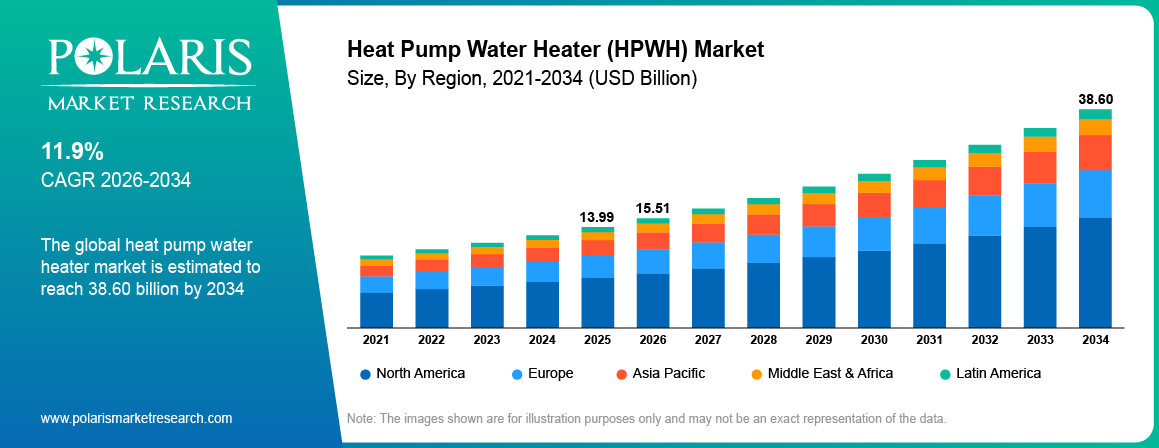
The global heat pump water heater (HPWH) market size was valued at USD 13.99 billion in 2025. The market is expected to grow at a CAGR of 11.90% from 2026 to 2034. Rising energy costs and the implementation of global sustainability goals are a few of the key factors driving market expansion.
Market Statistics
Heat Pump Water Heater Market Key Takeaways
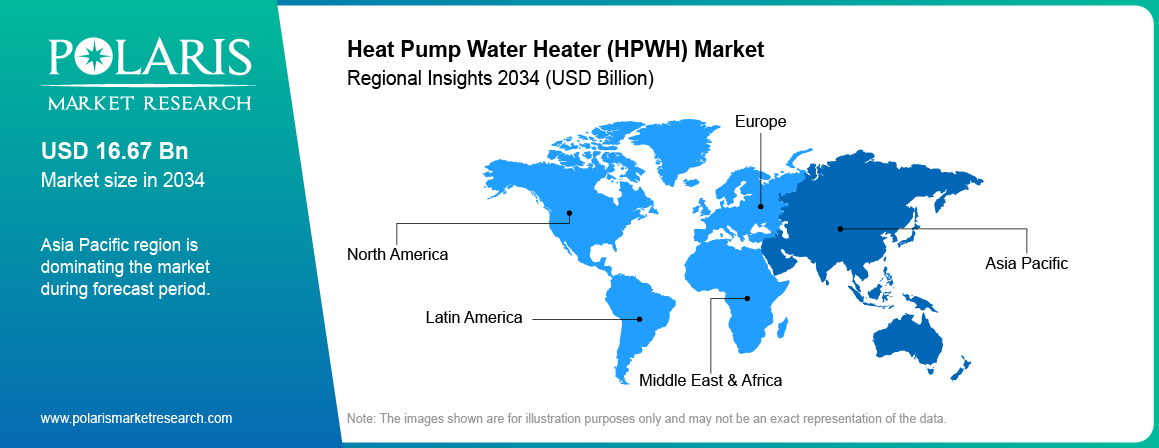
- Asia Pacific led with a 43.21% market share in 2025. Rapid urbanization and increasing energy efficiency regulations drive the regional market dominance.
- North America is projected to witness the fastest growth at a 15.90% CAGR. Increasing regulatory support and rising consumer preference for energy-efficient appliances drive the regional market growth.
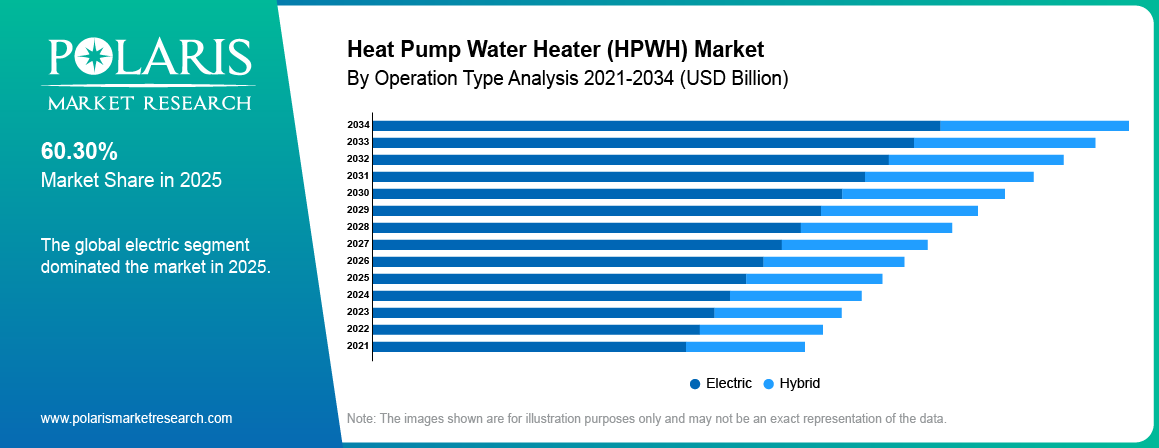
- The electric segment led with a 60.30% revenue share in 2025. This is owing to the widespread adoption of electric heat pump water heaters across commercial and residential sectors.
- The 300 to 500 L segment is projected to register the fastest growth at a 20.2% CAGR. Growing demand from commercial establishments contributes to the segment's growth.
- The air to water segment dominated with a 40.04% market share in 2025. The wide applicability and ease of installation of this technology contribute to its leading market position.
Note: Figures and projections outlined in this report are the result of Polaris Market Research’s proprietary analytical processes, grounded in the latest available datasets and market observations.
Heat Pump Water Heater Market Dynamics
- The growing demand for energy-efficient water heating systems is one of the key factors driving market development.
- Innovations in refrigerants and compressor designs have made heat pump water heaters more efficient. This, in turn, is contributing to the market expansion.
- Increasing residential retrofits and upgrades are expected to create several market opportunities.
- High initial purchase and installation costs may present market challenges.
Impact of AI and Smart Controls on Heat Pump Water Heaters
- The integration of AI increases the efficiency of heat pumps by adjusting the heat based on the consumption of water.
- The use of AI ensures energy conservation by optimizing temperature control and minimizing energy loss.
- The predictive maintenance feature is one of the aspects of artificial intelligence that assists in fault detection.
- Convenience is achieved using features such as monitoring and customization offered by artificial intelligence.
A HPWH is an energy-efficient system that extracts heat from the surrounding air and transfers it to water, reducing electricity consumption compared to conventional water heaters. A September 2021 NEDC report stated that producing hot water and steam for homes, commercial buildings, and low-temperature industrial applications in the US results in 520 million metric tons of carbon emissions annually, equivalent to 113 million cars and 27 percent more than the 410 million metric tons from heating buildings. As global efforts to curb climate change intensify, industries and households are transitioning to sustainable heating solutions.
Source: Polaris Market Research Analysis
To Understand More About this Research: Download Sample Report
Additionally,Policymakers worldwide are implementing subsidies, tax rebates, and strict efficiency standards to encourage the use of low-carbon heating solutions and the adoption HPWHs. For instance, in August 2022, the US Department of Energy (DOE) stated that the IRA offers significant incentives for home energy improvements, including rebates of up to USD 8,000 for heat pumps and USD 4,000 for retrofits. The programs target low-income households with doubled rebates, while tax credits support efficient appliances and energy audits. These initiatives make HPWHs more cost-effective for consumers, and they also contribute to reducing overall energy consumption at a national level. The integration of efficiency standards and financial incentives is driving manufacturers to innovate and enhance product performance, ensuring broader acceptance. Consequently, these regulatory measures are playing a pivotal role in driving the expansion.
Heat Pump vs. Electric Resistance vs. Gas Water Heaters
| Parameter | Heat Pump Water Heater | Electric Water Heater | Gas Water Heater |
| Efficiency | High | Medium | Medium |
| Cost | Less in the long run | More electricity costs | Cost depends on fuel price |
| Carbon Footprint | Low | Medium | Higher |
| Difficulty of Installation | Medium to High | Simple | Moderate |
| Maintenance Needs | Medium | Low | Medium |
| Impact on Environment | Friendly to environment | Average | Higher emissions |
Source: Polaris Market Research Analysis
Heat Pump Water Heater Market Trends
Rising Demand for Energy-efficient Water Heating
Traditional water heating systems, particularly those reliant on electricity or fossil fuels, contribute to high energy expenditures for residential, commercial, and industrial users. Heat pump water heaters offer a cost-effective alternative by utilizing ambient heat to warm water, thereby lowering energy consumption. Businesses and homeowners are increasingly opting for HPWHs to achieve long-term savings with rising energy prices and the growing emphasis on sustainability. This shift towards energy-efficient water heating solutions has driven manufacturers to innovate and introduce new products in emerging countries. For instance, in January 2024, Havells India Limited launched India’s first HPWH, designed for residential use. The technology offers up to 75% energy savings, setting new standards in water heating. Additionally, the higher efficiency of HPWHs compared to conventional systems enhances return on investment, making them a preferred choice for cost-conscious consumers.
Advances in Compressors, Heat Exchangers and Controls
Innovations in compressor design, refrigerants, and control systems have enhanced the efficiency and durability of HPWHs, making them more suitable for diverse climatic conditions. For instance, in November 2024, Daikin launched the EWYE-CZ air-to-water inverter heat pump, utilizing R-454C refrigerant for high energy efficiency and producing hot water up to 70°C, ideal for low-carbon heating needs. These improvements address concerns related to operational performance, such as maintaining efficiency in colder environments and optimizing heat transfer. Enhanced reliability also extends product lifespan, reducing maintenance costs and making HPWHs a more attractive long-term investment. Additionally, smart control features and integration with renewable energy sources are improving the appeal of these systems. Therefore, as technological advancements continue to improve efficiency and adaptability, they are driving broader adoption of HPWHs across residential and commercial applications.
Low-GWP and Natural Refrigerants in Heat Pump Water Heaters
Environmentally friendly refrigerants such as R-290 (propane) and CO2 are becoming popular choices among manufacturers as refrigerant substitutes in the heat pump water heaters due to environmental consciousness and changes in laws regarding energy usage and emissions. The use of traditional refrigerants with high global warming potentials is slowly being phased out in favor of low-GWP refrigerants. Low-GWP refrigerants not only enhance the sustainability of the heat pumps but also make them more efficient. Pressure from the government, the growing interest in green buildings, and demand for environment-friendly heating technology are some factors contributing to this trend.
Source: Polaris Market Research Analysis
Segment Insights
By Operation Type Outlook
The global heat pump water heater market assessment, based on operation type, includes electric and hybrid. The electric segment dominated the in 2025 with 60.30% share due to its widespread adoption across residential and commercial applications. Electric HPWH are preferred for their ease of installation, lower upfront costs compared to hybrid variants, and minimal reliance on fossil fuels. Additionally, improvements in compressor efficiency and refrigerant technology have enhanced the performance of electric HPWHs, making them a viable alternative to conventional electric resistance water heaters. The growing emphasis on decarbonization and energy efficiency has further driven the demand for electric HPWHs as they align with sustainability initiatives. Moreover, government incentives and regulatory mandates promoting energy-efficient appliances have accelerated their adoption, solidifying the segment's leadership.
By Tank Capacity Outlook
The global heat pump water heater market evaluation, based on tank capacity, includes upto 150 L, 150 to 300 L, 300 to 500 L, and above 500 L. The 300 to 500 L segment is expected to witness the fastest growth of CAGR 20.2% during the forecast period, driven by rising demand from commercial establishments and multi-family residential buildings. This capacity range offers an optimal balance between storage volume and operational efficiency, making it suitable for applications requiring a continuous supply of hot water. Hotels, hospitals, and large households increasingly prefer 300 to 500 L HPWHs due to their ability to meet higher water heating demands without increasing energy consumption. Additionally, advancements in system design, such as improved heat exchangers and smart control integration, have enhanced the efficiency of this segment. Thus, as the need for energy-efficient water heating solutions continues to grow, the demand for 300 to 500 L HPWHs is expected to rise significantly.
Source: Polaris Market Research Analysis
Regional Analysis
By region, the report provides the insights into North America, Europe, Asia Pacific, Latin America, and the Middle East & Africa. Asia Pacific dominated the industry revenue in 2025 with 43.21% primarily due to rapid urbanization, increasing energy efficiency regulations, and strong government initiatives promoting sustainable heating solutions. Countries such as China, Japan, and South Korea have been at the forefront of adopting HPWHs, supported by favorable policies and strict environmental targets. Additionally, the region's expanding residential and commercial infrastructure has driven demand for cost-effective and energy-efficient water heating systems. For instance, in September 2024, PHNIX launched the airExpert inverter R290 all-in-one HPWH, using eco-friendly R290 refrigerant (GWP of 3) to reduce carbon footprints and energy costs. It promotes greener heating and accelerates heat pump adoption in homes with a COP of 3.0. The presence of key manufacturers and advancements in local production capabilities have further contributed to the regional dominance by ensuring product availability and affordability. Asia Pacific heat pump water heaters market is leading with rising consumer awareness and a shift toward low-carbon technologies.
The North America heat pump water heaters market is projected to witness the fastest growth of CAGR 15.9% during the forecast period, driven by increasing regulatory support and growing consumer preference for energy-efficient appliances. The US and Canada have introduced strict energy efficiency standards and financial incentives to encourage the adoption of HPWHs, accelerating industry penetration. Additionally, rising electricity costs and heightened awareness of carbon emissions have prompted homeowners and businesses to transition toward sustainable water heating solutions. Technological advancements, such as improved cold-climate performance and smart connectivity features, have made HPWHs more appealing to North American consumers. Therefore, as the region continues to prioritize decarbonization and sustainability, the demand for HPWHs is expected to experience substantial growth.
Source: Polaris Market Research Analysis
Key Players and Competitive Insights
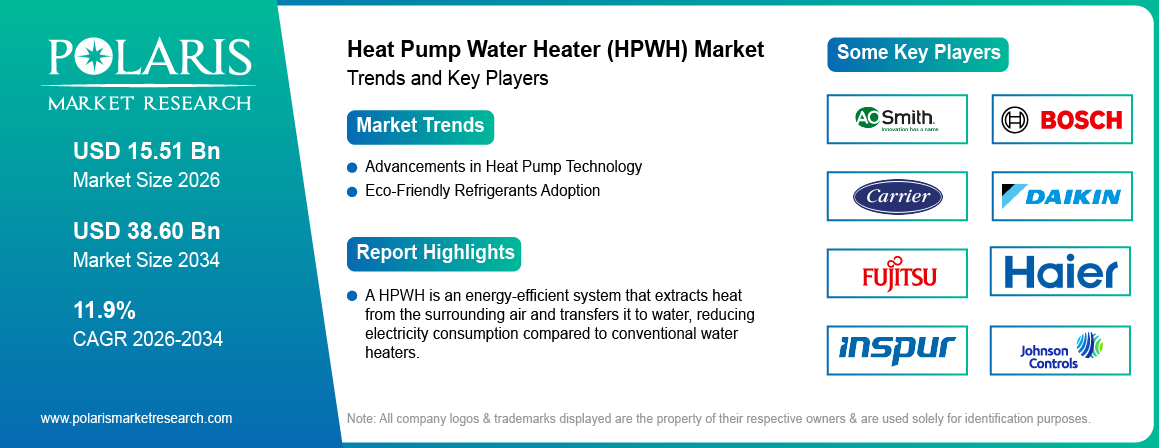
The competitive landscape features a mix of global leaders and regional players aiming to capture share through innovation, strategic partnerships, and geographic expansion. Key global players such as Rheem Manufacturing Company, A. O. Smith Corporation, Daikin Industries, Ltd., and Mitsubishi Electric Corporation leverage strong R&D capabilities and extensive distribution networks to deliver energy-efficient, advanced heat pump water heating systems. arket trends highlight a growing demand for energy-efficient and eco-friendly solutions, driven by increasing awareness of sustainability and the need to reduce carbon footprints. Innovations such as smart HPWH with IoT integration and hybrid systems combining heat pumps with solar thermal technology are gaining traction, reflecting advancements in energy efficiency and user convenience. According to the industry analysis, it is projected to experience substantial growth, fueled by rising energy costs, government incentives for energy-efficient appliances, and stringent environmental regulations.
Regional players are capitalizing on localized needs by offering cost-effective and tailored solutions, especially in emerging countries. This growth is supported by rapid urbanization, rising disposable incomes, and increasing awareness of energy-efficient technologies. The industries competitive strategies include mergers and acquisitions, partnerships with utility companies, and collaborations with government bodies to promote energy-efficient solutions. Additionally, companies are focusing on product differentiation by introducing advanced features such as Wi-Fi connectivity, energy usage monitoring, and compatibility with renewable energy sources. These developments highlight the importance of technological innovation, adaptability, and regional investments in driving the expansion of HPWH industry. A few key major players are A. O. Smith India Water Products Pvt. Ltd.; Bosch Thermotechnology Corp.; Carrier; DAIKIN INDUSTRIES, Ltd.; FUJITSU GENERAL; Haier HVAC Solutions; INSPUR Co., Ltd.; Johnson Controls - Hitachi Air Conditioning Company; LG Electronics; Midea America Corp.; MITSUBISHI HEAVY INDUSTRIES, LTD.; Panasonic Holdings Corporation; Rheem Manufacturing Company; Trane; and Vaillant Group International GmbH.
A. O. Smith India Water Products Pvt. Ltd. is a subsidiary of A. O. Smith Corporation, a water technology company with a 140-year history of providing high-quality, innovative products. A. O. Smith entered the Indian market in 2008. In 2010, the company inaugurated a manufacturing plant in Bengaluru, India, which was expanded in 2014 to include water purification products. A. O. Smith is known for its focus on customer satisfaction, integrity, and innovation. The company has introduced many innovative features to appeal to Indian consumers, such as blue diamond glass lining, glass-coated heating elements, energy-efficient insulation, and multiple color options. In the water purifier market, A. O. Smith was the first to offer instant mineralized hot water purifiers. Their home water filteration product utilize a patented side stream RO membrane and silver charged membrane technology (SCMT) for double protection against microbial contamination. A. O. Smith offers various water heater solutions for commercial needs, such as HPWH, fuel-based water heaters, and natural gas-fired water heaters.
Haier HVAC Solutions has been serving customers in Europe for over 30 years, providing advanced climate control with a focus on energy efficiency and sustainability. They offer a variety of HVAC systems, such as VRF units, chillers, and ducted units, suitable for residential, light commercial, and large commercial applications. Their technology enables precise climate control, improved energy efficiency, and user-friendly operation, such as remote monitoring and automated adjustments. Haier's flexible installation options cater to diverse needs, from individual homes to large buildings. Its Heat Pump Water Heater is an energy-efficient solution that lowers energy consumption, costs, and CO₂ emissions compared to traditional boilers. The company’s Air to Water Heat Pump range utilizes renewable energy from the outside air for heating and hot water. Haier also offers a new high-temperature heating range, including the Super Aqua A2W Monobloc and more. Haier is expanding its trustworthy brand presence in Europe with premium products and strong post-sale support, with a production capacity of over 27 million units annually across 16 factories, including eight abroad.
List of Key Companies
- A. O. Smith India Water Products Pvt. Ltd.
- Bosch Thermotechnology Corp.
- Carrier.
- DAIKIN INDUSTRIES, Ltd.
- FUJITSU GENERAL
- Haier HVAC Solutions
- INSPUR Co., Ltd.
- Johnson Controls - Hitachi Air Conditioning Company
- LG Electronics.
- Midea America Corp.
- MITSUBISHI HEAVY INDUSTRIES, LTD.
- Panasonic Holdings Corporation
- Rheem Manufacturing Company.
- Trane
- Vaillant Group International GmbH
Heat Pump Water Heater Market Recent Developments
-
March 2026: Panasonic Heating & Cooling Solutions introduced the AQUA-G EVO series. The company stated that the series is a part of its ECOi-W commercial heat pumps range. It has been purpose-built for meeting the rising commercial demand for sustainable heating solutions. (source: aircon.panasonic.eu)
-
February 2026: Mitsubishi Electric India increased its manufacturing capability with the commissioning of its new manufacturing plant for compressors and air conditioners. The facility is situated at Chennai, Tamil Nadu, and is equipped to manufacture 650,000 compressors and 300,000 indoor and outdoor room air conditioners. (source: mitsubishielectric.in)
Heat Pump Water Heater Market Segment Analysis
By Technology Outlook (Volume, Thousand Units; Revenue, USD Billion; 2021–2034)
- Air to Water
- Water Source
- Geothermal
By Capacity Outlook (Volume, Thousand Units; Revenue, USD Billion; 2021–2034)
- Upto 20 kW
- 21 to 50 kW
- 51 to 100 kW
- Above 100 kW
By Operation Type Outlook (Volume, Thousand Units; Revenue, USD Billion; 2021–2034)
- Electric
- Hybrid
By Application Outlook (Volume, Thousand Units; Revenue, USD Billion; 2021–2034)
- Residential
- Industrial
- Commercial
By Tank Capacity Outlook (Volume, Thousand Units; Revenue, USD Billion; 2021–2034)
- Upto 150 L
- 150 to 300 L
- 300 to 500 L
- Above 500 L
By Regional Outlook (Volume, Thousand Units; Revenue, USD Billion; 2021–2034)
- North America
- US
- Canada
- Europe
- Germany
- France
- UK
- Italy
- Spain
- Netherlands
- Russia
- Rest of Europe
- Asia Pacific
- China
- Japan
- India
- Malaysia
- South Korea
- Indonesia
- Australia
- Rest of Asia Pacific
- Middle East & Africa
- Saudi Arabia
- UAE
- Israel
- South Africa
- Rest of Middle East & Africa
- Latin America
- Mexico
- Brazil
- Argentina
- Rest of Latin America
Heat Pump Water Heater Market Report Scope and Methodology
| Report Attributes | Details |
| Market Size Value in 2025 | USD 13.99 billion |
| Market Size Value in 2026 | USD 15.51 billion |
| Revenue Forecast by 2034 | USD 38.60 billion |
| CAGR | 11.9% from 2026 to 2034 |
| Base Year | 2025 |
| Historical Data | 2021–2024 |
| Forecast Period | 2026–2034 |
| Quantitative Units | Volume in Thousand Units; Revenue in USD Billion and CAGR from 2026 to 2034 |
| Report Coverage | Revenue Forecast, Market Competitive Landscape, Growth Factors, and Industry Trends |
| Segments Covered |
|
| Regional Scope |
|
| Competitive Landscape |
|
| Report Format |
|
| Customization | Report customization as per your requirements with respect to countries, regions, and segmentation. |
Source: Polaris Market Research Analysis
Heat Pump Water Heater Market FAQ's
• The global heat pump water heater market size was valued at USD 13.99 billion in 2025 and is projected to grow to USD 38.60 billion by 2034.
• The global market is projected to register a CAGR of 11.9% during the forecast period.
• Asia Pacific dominated the heat pump water heater market revenue with 43.21% share in 2025.
• Some of the key players in the market are A. O. Smith India Water Products Pvt. Ltd.; Bosch Thermotechnology Corp.; Carrier; DAIKIN INDUSTRIES, Ltd.; FUJITSU GENERAL; Haier HVAC Solutions; INSPUR Co., Ltd.; Johnson Controls - Hitachi Air Conditioning Company; LG Electronics; Midea America Corp.; MITSUBISHI HEAVY INDUSTRIES, LTD.; Panasonic Holdings Corporation; Rheem Manufacturing Company; Trane; and Vaillant Group International GmbH.
• The electric segment dominated the heat pump water heater market expansion in 2025 with 60.30% share.
A heat pump water heater is an energy-efficient system that extracts ambient air heat and transfers it to water, significantly reducing electricity consumption versus conventional heaters.
Key trends include rising smart IoT-enabled HPWH adoption, growing hybrid system demand, government subsidy programs, eco-friendly refrigerant innovations, and increasing residential decarbonization initiatives worldwide.
Download Sample Report of Heat Pump Water Heater Market
Please fill out the form to request a customized copy of the research report.


