
Essential Oils Market Size, Share, Trends, Industry Analysis Report, 2026 - 2034
REPORT DETAILS
REPORT DETAILS
ABOUT THIS REPORT
Essential Oils Market Summary
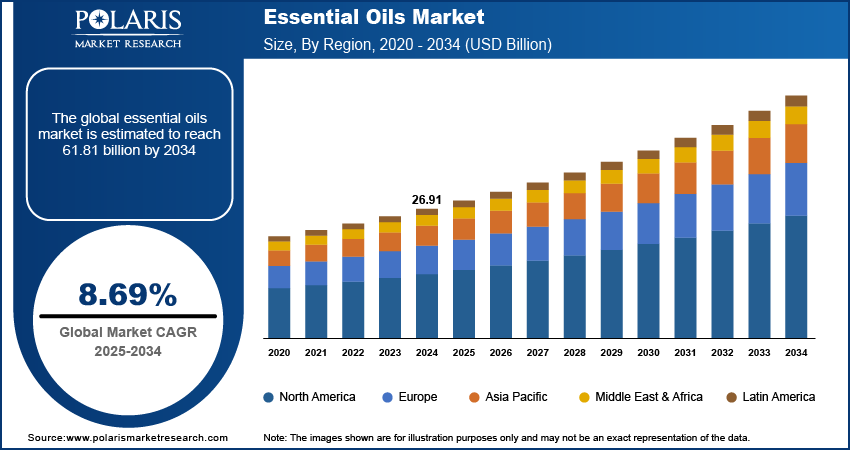
The global essential oils market size was valued at USD 25.61 billion in 2025. The market is projected to grow at a CAGR of 7.3% during 2026 to 2034. Key factors driving demand for essential oils include growing consumer preference for natural and organic products in personal care, food, and beverages, and the expansion of e-commerce.
Market Statistics
Key Takeaways
- The Europe essential oils market led the global market in 2025 with 43.36% share. This growth is attributed to the presence of major cosmetic and fragrance manufacturers, which heavily use essential oils in their products.
- Asia Pacific is projected to grow rapidly in the coming years with CAGR 10.7%. The Asia Pacific essential oils market growth is driven by rising per capita income and increased spending on wellness products.
- Key market insights indicate that the medical segment held the largest market share of 34.1% in 2025. This is due to the increasing use of plant-based active ingredients in pharmaceutical formulations and therapeutic products.
- The food and beverage industry is anticipated to witness the highest growth rate of CAGR 8.2% in the forecast period due to the characteristics of essential oils to preserve the shelf life of packaged foods.
- Based on the essential oils market by product segmentation, the orange oil segment accounted for the largest volume share in 2025 holding 17.2% of the global market.
Industry Dynamics
- Increasing applications in the personal care products industry are driving the demand for essential oils. Natural scents and plant-derived actives are being widely used in personal care products.
- Essential oils are gaining wider acceptance in the pharmaceutical industry. Compounds such as terpenes, phenols, and carvacrol are sought after for their antimicrobial, anti-inflammatory, and metabolic actions.
- The increasing popularity of e-commerce has ensured that essential oils are distributed to a large number of people worldwide. This has increased their adoption in emerging regions.
- Limited availability of raw materials may hamper the market growth.
What are Essential Oils?
Essential oils are compounds obtained in the process of distillation or mechanical methods from plants. These oils are extracted from various parts of plants, including flowers and inflorescences, leaves, peels, fruits, berries, barks, seeds, wood, resins, roots, and rhizomes. Some of the essential oils used in the fragrances include lavender, tea tree, citrus, eucalyptus, linalool, citronellol, frankincense oil, peppermint oil, lemongrass oil, and rosemary oil. Shifting focus toward plant-based organic products, rising demand for aromatherapy, and increasing demand for pure natural ingredients are driving the overall essential oils market.
The essential oils market consists of naturally fragrant compounds sourced from plant materials and used in consumer goods ranging from personal care and beverages to pharmaceuticals and household products. The market for essential oils has been growing steadily, with manufacturers and consumers opting for clean-label foods and plant-based ingredients. As people become increasingly educated about ingredient transparency and sustainability, essential oils are no longer considered specialty wellness ingredients; they are now used across various sectors.
To Understand More About this Research: Download Sample Report
Aromatherapy, a therapy that reduces anxiety and stress and improves sleeping disorders like insomnia, is one of the most important applications of these oils. It is primarily used in industries such as pharmaceuticals, cosmetics, wellness, personal care services, food, and beverages. These oils are also used in disinfectants, room fresheners, mosquito repellents, soaps, and shampoos. Higher oil prices and the unavailability of abundant plants for extraction are some restraining factors for the market.
Types of Oils & Uses
| Type of Oil | Uses | Common Examples |
| Citrus Oils | Used in food flavoring, beverages, cleaning, skincare | Orange oil, Lemon oil, Lime oil |
| Herbal Oils | Used in aromatherapy, digestion, personal care | Peppermint oil, Rosemary oil, Spearmint oil, Cornmint oil |
| Floral Oils | Used in perfumes, cosmetics, relaxation | Lavender oil, Jasmine oil, Geranium oil |
| Medicinal Oils | Used for antimicrobial, respiratory, basic medicinal use | Tea tree oil, Eucalyptus oil |
| Spice Oils | Used in food preservation, flavoring, oral care | Clove leaf oil |
| Household Oils | Used in insect repellents, cleaning, air fresheners | Citronella oil |
Industry Dynamics
Growth Drivers
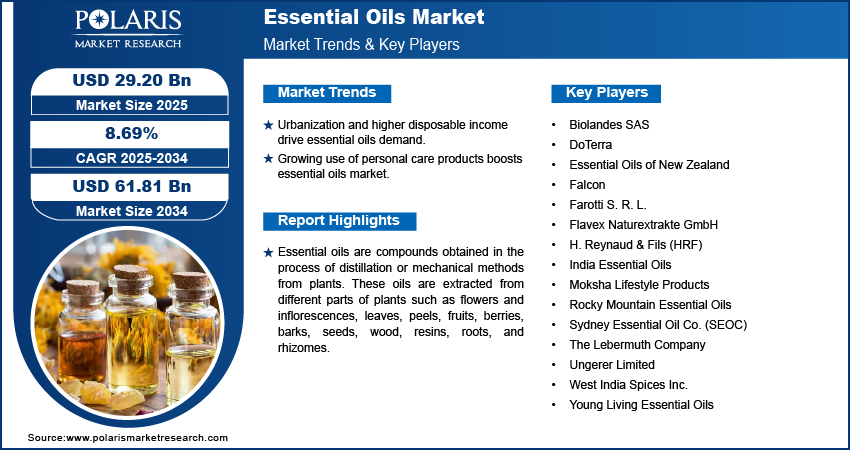
The increasing adoption of personal care products, such as lotions and creams, is driving demand for essential oils. These oils are widely used in personal care products for their natural fragrances. The growing employment rate, especially among women in countries such as India and Indonesia, is further driving the use of personal care products. The high disposable income and awareness of the benefits of these oils in developed regions such as Europe and North America are leading to an increase in market revenue. Moreover, the expansion of e-commerce platforms across the globe and the increasing incidence of type-2 diabetes are creating the need for essential oils. These oils are used in the treatment of type 2 diabetes. E-commerce platforms are making them accessible to every part of the world, leading to market growth.
Which Innovations are Expected to Boost the Essential Oils Market in the Coming Years?
Some key trends in the essential oils market include AI for aroma profiling, intelligent diffuser solutions, nanoencapsulation, and blockchain tracing. The growing need for sustainable solutions, such as regenerative farmed essential oils certified for fair trade, is gaining prominence in the market, particularly in higher-end personal care products. These trends are improving formulation precision and supply chain transparency. So, they are expected to shape market dynamics going forward.
| Innovation Area | Emerging Trends | Application |
| Personalized Blends and Functional Formulations | Tailored essential oils for stress relief, immunity, and sleep
AI and bioinformatics-driven aroma-profiling | Wellness (aromatherapy), sleep/relaxation markets, and personal care |
| Tech-Enabled Delivery and Devices | Smart diffusers (IoT and app-control), wearable diffusers, capsules/roll-ons, and remote/blend scheduling | Home wellness, personal use, spa, and travel kits |
| Sustainable and Ethical Sourcing | Green chemistry, blockchain traceability, regenerative agriculture, and fair-trade/organic certifications | All end uses, especially premium/natural markets |
| Novel Extraction and Formulation Technologies | Encapsulation, nano‐delivery, microemulsions, and lab-grown and bio-synthesized oils | Edibles/nutraceuticals, personal care, functional beverages, and skincare |
| Expanded Application Areas | Use in functional foods/beverages, cleaning/household products, pet care, and healthcare/therapeutics | Food & beverage, pet wellness, home care, and clinical wellness |
| Customization and Niche-Botanical Discovery | Use of less common oils such as Hinoki and Litsea, niche aromatics, and luxury blends | Luxury personal care, fragrance, and premium skincare |
Segment Insights
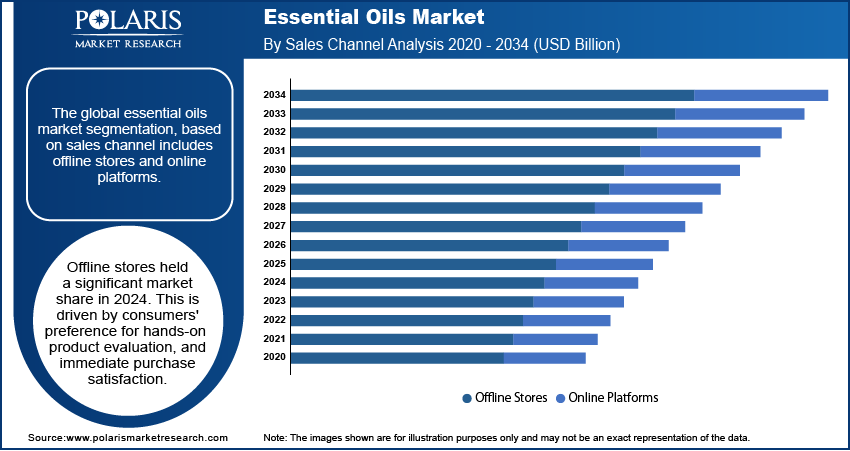
The market for essential oils is segmented based on product type, application, sales channel, and region. The essential oils market segmentation helps understand demand trends for medical, food and beverage, personal care, aromatherapy, and household uses. It also allows analyzing the efficiency of individual oils, such as orange, peppermint, eucalyptus, and lavender, among others.
Orange Oil Segment Accounted for the Largest Market Share in 2025
Based on the essential oils market by product segmentation, the orange oil segment accounted for the largest volume share in 2025. This is due to its antioxidant properties and its high Vitamin C content. These properties help reduce dark spots and wrinkles. Orange oils are widely used in personal beauty care products. This led to the segment's dominance. Moreover, the strong aroma and flavor of orange oils are driving their widespread adoption in many food and beverage products.
Medical Segment Dominated the Revenue Share in 2025
Based on the essential oils market by application segmentation, the medical segment held the largest revenue share in 2025. This is due to the increasing demand for essential oils in the production of pharmaceutical agents and therapeutic drugs. Various compounds, such as terpenes, phenols, and carvacrol, are used to diagnose diseases and improve gut health. These compounds also help reduce inflammation and lower cholesterol levels. Essential oils are also widely used in capsules and tablets, which contributed to the segment's dominance.
The food and beverage industry is anticipated to witness the highest growth in the forecast period due to the shelf-life-extending properties of oils such as lemon, basil, and fennel. Changing consumer preferences towards natural organic preservatives over synthetic ones is also driving segment growth. The growing urbanization is creating a need for packaged foods, which is increasing the use of essential oils in these products to preserve shelf life.
Regional Insights
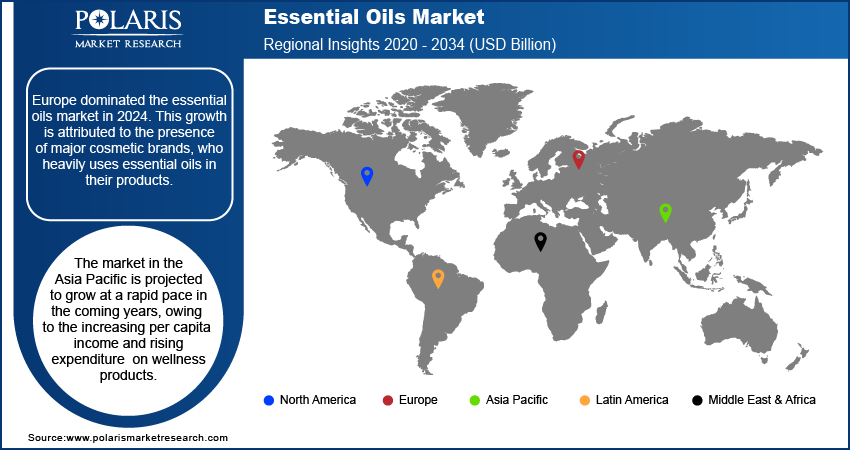
Europe dominated the essential oils market in 2025. This growth is attributed to the presence of major cosmetic brands, which heavily use essential oils in their products. The growing urbanization, high disposable income, and increasing employment rate in the region are also some of the major factors that have driven the demand for essential oils in the region. Moreover, the high healthcare spending and growing pharma industry, along with the development of novel medicine, contributed to the regional market dominance.
The market in the Asia Pacific is projected to grow at a rapid pace in the coming years, owing to the increasing per capita income and rising expenditure on wellness products. Countries like China, India, and Japan have been receiving financial and regulatory support from the government to boost the adoption of these oils in the medical field. The growing demand for packaged food, due to urbanization and increasing disposable income, is also leading to market growth in the region.
Competitive Insights
The essential oils market is characterized by companies that control supply and distribution through an integrated system, often with long-term agreements with suppliers. The major players in the essential oils industry are focusing on traceability, quality, and regulatory compliance. Acquisitions and portfolio expansion are core levers of improvement for companies.
A few of the players in the essential oils market include Biolandes SAS, Sydney Essential Oil Co. (SEOC), India Essential Oils, DoTerra, Essential Oils of New Zealand, Young Living Essential Oils, Flavex Naturextrakte GmbH, West India Spices Inc., Ungerer Limited, H. Reynaud & Fils (HRF), Farotti S. R. L., Rocky Mountain Essential Oils, Falcon, The Lebermuth Company, and Moksha Lifestyle Products.
List of Key Companies
- Biolandes SAS
- Sydney Essential Oil Co. (SEOC)
- India Essential Oils
- DoTerra
- Essential Oils of New Zealand
- Young Living Essential Oils
- Flavex Naturextrakte GmbH
- West India Spices Inc.
- Ungerer Limited
- H. Reynaud & Fils (HRF)
- Farotti S. R. L.
- Rocky Mountain Essential Oils
- Falcon
- The Lebermuth Company
- Moksha Lifestyle Products
Recent Developments
November 2025: Trove Borneo launched a luxury essential oil brand. It focuses on rare and sustainably sourced flora from Sarawak. (Source: theborneopost.com)
August 2025: Saje Natural Wellness partnered with Ulta Beauty as its first national retail partner in North America. The aim is to expand access to plant-based remedies. (Source: finance.yahoo.com)
April 2025: International Flavors & Fragrances expanded its Science of Wellness program. It added AI tools to link natural extracts with cognitive and emotional responses. (Source: perfumerflavorist.com)
March 2025: Dabur India acquired Essential Oils of India for about USD 150 million. This helps its Ayurvedic and natural health portfolio. (Source: dabur.com).
Essential Oils Market Segmentation
By Product Outlook (Revenue, USD Billion, 2021–2034)
- Orange oil
- Lemon oil
- Lime oil
- Geranium oil
- Peppermint oil
- Cornmint oil
- Eucalyptus oil
- Jasmine oil
- Tea tree oil
- Rosemary oil
- Citronella oil
- Spearmint oil
- Clove leaf oil
- Lavender oil
- Others
By Application Outlook (Revenue, USD Billion, 2021–2034)
- Medical
- Pharmaceutical
- Nutraceuticals
- Food & Beverages
- Bakery
- Confectionery
- Dairy
- RTE meals
- Beverages
- Meat, Poultry & Seafood
- Snacks & Nutritional Bars
- Spa & Relaxation
- Aromatherapy
- Massage Oil
- Personal Care
- Cosmetics
- Hair Care
- Skin Care
- Sun Care
- Makeup & Colour Cosmetics
- Toiletries
- Soaps
- Shampoos
- Men's Grooming
- Oral Care
- Baby Care
- Fragrances
- Perfumes
- Body Sprays
- Air Fresheners
- Cleaning & Home
- Kitchen Cleaners
- Floor Cleaners
- Bathroom Cleaner
- Fabric Care
By Sales Channel Outlook (Revenue, USD Billion, 2021–2034)
- Offline Stores
- Online Platforms
By Regional Outlook (Revenue, USD Billion, 2021–2034)
- North America
- US
- Canada
- Europe
- Germany
- France
- UK
- Italy
- Spain
- Netherlands
- Russia
- Rest of Europe
- Asia Pacific
- China
- Japan
- India
- Malaysia
- South Korea
- Indonesia
- Australia
- Vietnam
- Rest of Asia Pacific
- Middle East & Africa
- Saudi Arabia
- UAE
- Israel
- South Africa
- Rest of Middle East & Africa
- Latin America
- Mexico
- Brazil
- Argentina
- Rest of Latin America
Future of Essential Oil Market
The essential oil market is expected to grow steadily due to rising demand for natural and plant-based products across personal care, food, and healthcare. Increasing awareness about wellness and aromatherapy is supporting market expansion. E-commerce platforms are making these products more accessible to a wider consumer base. Innovation in extraction technologies and sustainable sourcing practices is also improving product quality and supply chain transparency. In addition, the use of essential oils in functional foods and pharmaceuticals is increasing. However, problems like raw material availability and price fluctuations may affect growth. Overall, the market will continue to expand with increasing applications and consumer preference for natural ingredients
Essential Oils Market Report Scope
| Report Attributes | Details |
| Market Size in 2025 | USD 25.61 billion |
| Market Size in 2026 | USD 27.44 billion |
| Revenue Forecast by 2034 | USD 48.24 billion |
| CAGR | 7.3% |
| Base Year | 2025 |
| Historical Data | 2022–2024 |
| Forecast Period | 2026–2034 |
| Quantitative Units | Revenue in USD billion and CAGR from 2026 to 2034 |
| Report Coverage | Revenue Forecast, Market Competitive Landscape, Growth Factors, and Trends |
| Segments Covered |
|
| Regional Scope |
|
| Competitive Landscape | Essential Oils Industry Trend Analysis (2025) Company profiles/industry participants profiling include company overview, financial information, product/service benchmarking, and recent developments |
| Report Format | PDF + Excel |
| Customization | Report customization as per your requirements with respect to countries, regions, and segmentation. |
FAQ's
The global essential oils industry was valued at USD 25.61 billion in 2025 and is projected to grow to USD 48.24 billion by 2034.
The global market is projected to register a CAGR of 7.3% during the forecast period.
Europe led the global market in 2025 due to the presence of major cosmetic brands making use of essential oils.
A few of the key players in the market include Biolandes SAS, Sydney Essential Oil Co. (SEOC), India Essential Oils, DoTerra, Essential Oils of New Zealand, Young Living Essential Oils, Flavex Naturextrakte GmbH, West India Spices Inc., Ungerer Limited, H. Reynaud & Fils (HRF), Farotti S. R. L., Rocky Mountain Essential Oils, Falcon, The Lebermuth Company, and Moksha Lifestyle Products.
The medical application segment led the market in 2025. This is due to the increasing demand for essential oils in the production of pharmaceutical agents and therapeutic drugs.
The essential oils market comprises natural aromatic oils extracted from plant sources and used in medical, food & beverages, personal care, aromatherapy, and domestic applications.
Essential oils are used in aromatherapy, personal care, food and beverages, and pharmaceuticals.
Types include citrus oils, floral oils, herbal oils, medicinal oils, and spice oils.
They provide relaxation, antimicrobial effects, skin benefits, and support overall wellness.
They are generally safe when used in proper dilution, but overuse or direct application may cause irritation.
They are used in cosmetics, healthcare products, food preservation, household cleaning, and aromatherapy.
Download Sample Report of essential oil market
Please fill out the form to request a customized copy of the research report.


