
Graphene Battery Market Size, Share, Trends and Forecast, 2026–2034
REPORT DETAILS
Graphene Battery Market Summary
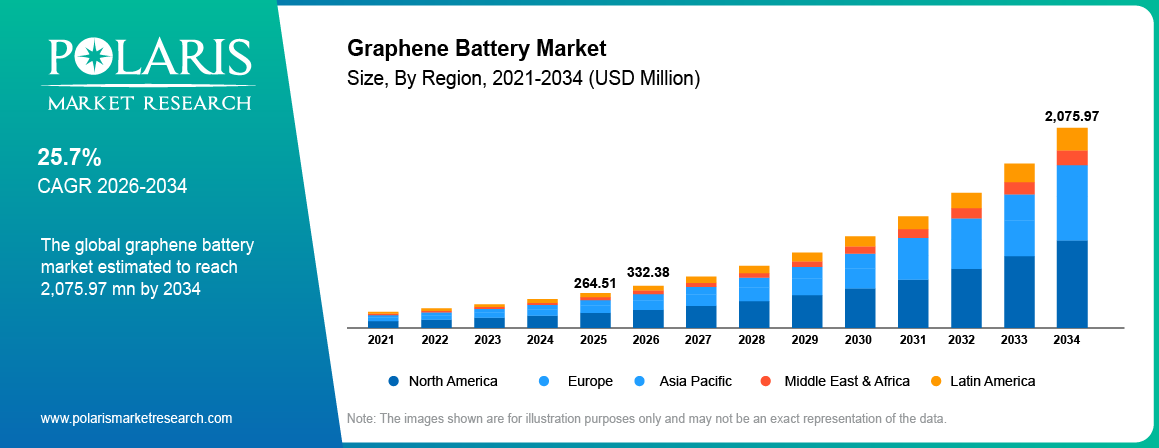
Graphene battery market size was valued at USD 264.51 million in 2025. The market is expected to record a CAGR of 25.7% from 2026 to 2034. Market growth is driven by the rising use of graphene in advanced battery electrodes, emerging chemistries, and hybrid energy storage technologies.
Market Statistics
Key Takeaways
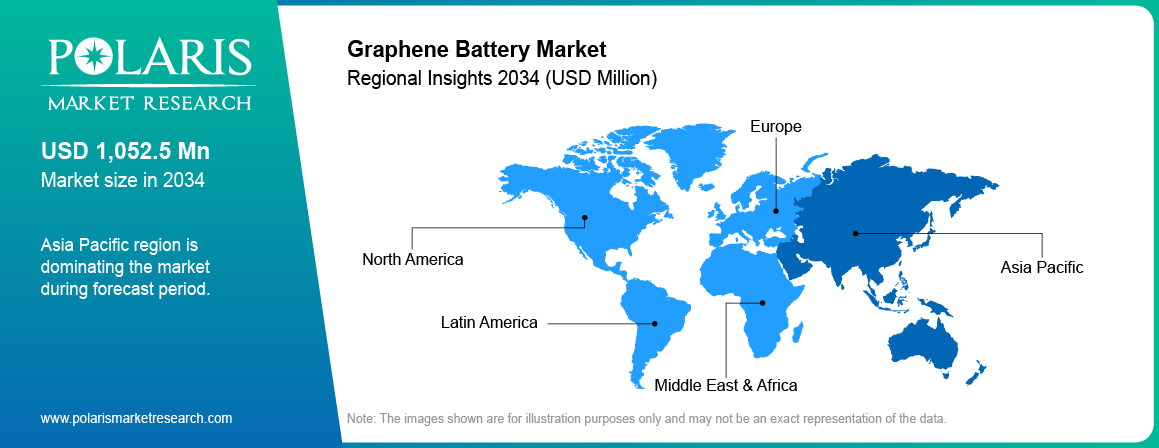
- Asia Pacific accounted for the largest share of 44.90% in 2025, driven by battery research and electric vehicle development.
- The market in North America is projected to record the significant growth, with an 25.20% CAGR during the forecast period. The growth is supported by battery manufacturing and electric mobility demand.
- The lithium ion with graphene segment held 54.10% market share in 2025. The dominance is attributed to its potential to improve battery performance.
- Supercapacitor and hybrid devices are projected to register a 28.40% CAGR during the projected period. The growth is fueled by the increasing demand for rapid power delivery.
- The electric vehicles and mobility segment accounted for 41.80% market share in 2025, driven by demand for fast charging and improved energy density.
Note: Figures and projections outlined in this report are the result of Polaris Market Research’s proprietary analytical processes, grounded in the latest available datasets and market observations.
What is a Graphene Battery Market?
The graphene battery market emphasizes the development, production, and commercialization of batteries and hybrid energy storage devices that use graphene. In these batteries, graphene is used as an active or functional electrode material to perform an electrochemical role. These products use graphene to improve electrode properties and energy storage performance. The market includes lithium-ion batteries with graphene, lithium-sulfur batteries with graphene, graphene-based supercapacitors, hybrid storage devices, aluminum-ion batteries, and other emerging battery chemistries. It also covers graphene electrode materials supplied for use in these battery products. The scope excludes graphene used only in coatings, composites, or other non-battery applications. Conventional batteries that do not use graphene as a functional component also fall outside the market.
Graphene materials play an important role in the development of advanced electrode designs. Their electrical conductivity, surface characteristics, and structural properties make them relevant to battery research and energy storage applications. Manufacturers and researchers are examining different graphene forms, including 3D graphene and curved graphene, to improve electrode performance. The graphene-enhanced battery market covers battery products that incorporate graphene to improve specific performance characteristics, such as charging speed, cycle life, and energy density. The role of graphene differs across product designs. It functions as an active electrode material or as a conductive additive that improves electrical pathways within an electrode. The market assessment considers the material's functional contribution rather than relying only on product labels or marketing descriptions.
Market development is linked to demand for improved energy storage performance across electric mobility, consumer electronics, stationary energy storage, data centers, aerospace, defense, and industrial applications. Research into graphene-based electrodes is creating opportunities for new battery designs that target faster charging, improved power delivery, and longer cycle life. The lithium-ion battery segment represents an important area of development, as graphene integration is being studied to improve electrode conductivity and charging performance. Other emerging chemistries, including lithium-sulfur and aluminum-ion systems, are also under development. However, commercial adoption depends on manufacturing scalability, material consistency, production costs, safety validation, and demonstrated performance at commercial scale. Product readiness and the functional role of graphene remain important factors in assessing the market's development.
Market Dynamics
Driver: Expansion of Graphene Supercapacitor Manufacturing for AI Data Centers
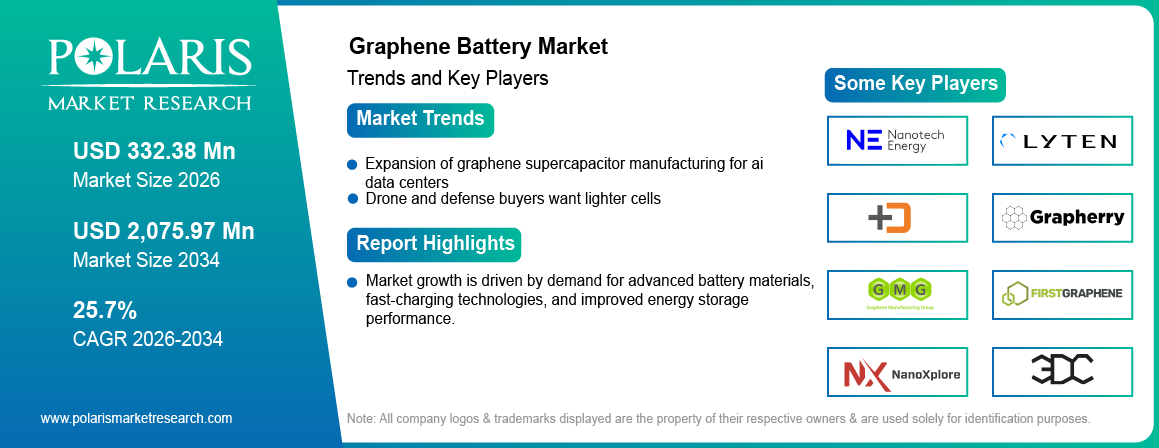
The graphene battery market is gaining opportunities from the expansion of graphene supercapacitor manufacturing for AI data centers. Growing computing requirements are creating demand for energy storage systems that deliver rapid power and manage fluctuations in electricity demand. Graphene supercapacitors offer potential advantages in power delivery, charging speed, and operational life. Manufacturers are exploring advanced graphene structures, including curved graphene, to improve electrode performance. In June 2026, Skeleton Technologies launched GrapheneUPS, a graphene-based supercapacitor UPS designed for AI data center power protection. These developments are creating demand for graphene-based energy storage solutions in data center infrastructure and other applications that require reliable power management(Source: skeletontech.com).
Driver: Drone and Defense Buyers Seek Lighter Cells
Demand for lightweight energy storage systems is creating requirements for graphene-based batteries across drone and defense applications. These platforms require batteries that deliver reliable power without adding excessive weight. Improved energy density can help extend operating time and increase payload capacity. Graphene-based electrode designs are under development to improve battery performance and meet these requirements. Demand from unmanned systems, portable defense equipment, and specialized mobility platforms is creating further scope for advanced battery technologies. Commercial adoption depends on product performance, safety, and operational reliability.
Restraint: Battery Technology Readiness Remains Low, and Claims Run Ahead of Delivery
Graphene-based batteries still face the major hurdle of battery technology readiness level for broader commercialization. There are a number of products and battery designs still in research, testing, and the early manufacturing process. Claims of performance for fast charging, energy density and cycle life are to be validated under real operating conditions. Manufacturers also face challenges of material consistency, production cost control and scaling of electrode manufacturing. These factors create uncertainty for buyers of batteries and hinder the transition from laboratory development to commercial supply. Proven performance and repeatable manufacturing processes are a function of wider adoption.
Opportunity: Graphene Aluminum-Ion Cells for Heavy Mobile Equipment
The development of aluminum-ion cells with graphene will offer possibilities for heavy mobile equipment and industrial applications. These battery designs are being investigated for improving electrode performance and power delivery. Heavy equipment requires reliable energy storage, operational durability, and appropriate charging performance. Graphene integration meets some performance needs for emerging designs of aluminum-ion batteries. Further development will determine the suitability of cell chemistry and manufacturing processes for commercial-scale production of industrial machinery, material handling equipment, and other heavy mobile applications. In October 2026, GMG began supplying its 1.5 Ah graphene aluminum-ion battery cells to potential customers for testing in defense and heavy mobile equipment applications.
Opportunity: Electrode Material Makers are Sampling with Cell Makers
Opportunities for further material integration are being created by the collaboration between graphene material developers and battery cell manufacturers. Suppliers are providing graphene-based electrode material samples for testing in a variety of battery chemistries. These materials are evaluated by cell manufacturers for their conductivity, compatibility, cycle life, and production requirements. If the testing is successful, it opens opportunities to integrate graphene into commercial battery designs. But material suppliers have to prove that they can consistently supply quality materials, at competitive prices, and in a way that is compatible with existing manufacturing processes. The evaluation process is still important to move graphene materials from development to commercial battery production. In August 2026, NanoMalaysia Berhad and Indonesia’s National Battery Research Institute unveiled the Nusantara Battery, a graphene-enhanced NMC lithium-ion pouch cell developed through bilateral collaboration to boost battery manufacturing capabilities of ASEAN.
Graphene Battery Market Segmentation Analysis
The graphene battery market is segmented by type, application, and region to identify key market segments and emerging growth opportunities.
Type Insights
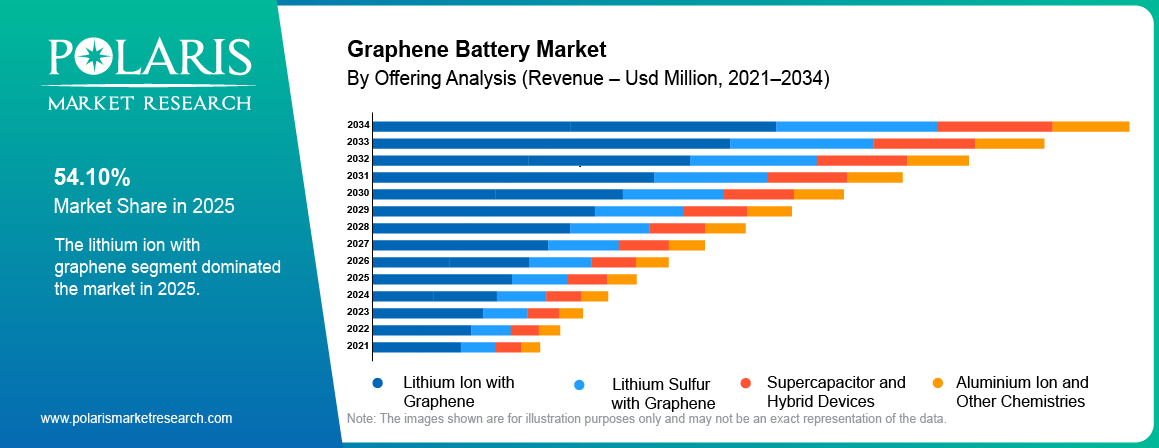
The lithium ion with graphene segment dominated the market with 54.10% share in 2025. This segment includes lithium-ion batteries that use graphene as an active or functional electrode material. The graphene lithium ion battery market growth is driven by research into graphene integration to improve electrode conductivity, charging performance, and cycle life. These batteries target applications that require established lithium-ion technology alongside improved performance. Development focuses on material compatibility, electrode stability, and production consistency. Commercial adoption also depends on manufacturing costs, safety validation, and consistent battery performance across different operating conditions.
Supercapacitor and hybrid devices are projected to register the fastest CAGR of 28.40% during 2026–2034. This segment includes graphene-based supercapacitors, hybrid supercapacitors, and other energy storage devices. A graphene ultracapacitors use graphene-based electrode structures to deliver rapid power output and charging performance. Hybrid supercapacitors combine battery-like energy storage characteristics with capacitor-based power delivery. These technologies target applications that require quick energy release, efficient charging, and repeated charge-discharge cycles. Adoption depends on electrode performance, production costs, operating life, and suitability for commercial energy storage systems.
Lithium sulfur with graphene accounted for 17.80% of the market share in 2025. This segment covers lithium-sulfur battery designs that incorporate graphene into electrode structures. Graphene is examined for its potential to improve electrical conductivity and address selected performance limitations of lithium-sulfur chemistry. Research focuses on electrode stability, energy density, cycle life, and charging performance. These characteristics create potential applications across mobility, aerospace, and portable energy storage. Commercial development depends on improvements in cell durability, material consistency, production costs, and manufacturing feasibility.
Aluminum ion and other chemistries accounted for 9.70% of the market share in 2025. This segment includes emerging battery designs that use graphene as an active or functional material in aluminum-ion and other battery chemistries. Research focuses on electrode conductivity, charging performance, energy storage capacity, and material compatibility. These battery designs address selected requirements across industrial equipment and specialized energy storage applications. However, commercial development depends on improvements in cell performance, safety, production processes, and manufacturing economics.
Application Insights
Electric vehicles and mobility dominated the market with 41.80% share in 2025. This segment includes graphene-based batteries developed for electric vehicles and other mobility platforms. Demand is linked to requirements for fast charging, improved energy density, and longer cycle life. Graphene integration is being examined to improve electrode properties and battery performance. Lithium-sulfur battery designs also offer a potential development area for selected mobility applications. Commercial adoption depends on battery safety, production costs, manufacturing capacity, and compatibility with vehicle platforms. Consistent performance under different operating conditions remains important for wider use.
Energy storage and data centers are projected to register the fastest CAGR of 31.50% during 2026–2034. This segment covers stationary energy storage systems and power management applications across data center infrastructure. Graphene-based batteries and hybrid storage devices are relevant to applications that require efficient energy storage, rapid power delivery, and reliable operation. Growing electricity requirements from digital infrastructure create opportunities for advanced storage technologies. Graphene supercapacitors also serve applications that require quick power delivery. Adoption depends on storage capacity, operating life, system costs, and integration with existing power infrastructure.
Consumer electronics accounted for 25.20% of the market share in 2025. This segment includes graphene-based batteries developed for smartphones, laptops, wearable devices, and other portable electronic products. Demand is linked to compact battery designs, faster charging, longer operating life, and power efficiency. Manufacturers are examining graphene integration to improve electrode conductivity and battery performance. Product development also considers device size, thermal management, safety, and charging requirements. Commercial adoption depends on material costs, manufacturing consistency, and compatibility with existing electronic device designs. Wider use will require reliable performance across different consumer electronics applications.
Aerospace, defense, and industrial accounted for 11.60% of the market share in 2025. This segment includes battery applications across aircraft systems, defense equipment, drones, industrial machinery, and specialized equipment. These applications require reliable power delivery, operational durability, and suitable battery weight. Graphene-based battery designs are being explored for their potential to improve electrode performance and energy density. Lightweight battery systems also benefit unmanned platforms and portable equipment. Adoption depends on safety validation, operating reliability, production costs, and application-specific performance requirements. Manufacturers must demonstrate consistent results under demanding operating conditions before wider deployment.
Graphene Battery Market Regional Insights
The graphene battery market analysis by region covers North America, Europe, Asia Pacific, the Middle East and Africa, and Latin America. Regional market development depends on battery research, material availability, manufacturing capabilities, and demand from major end-use industries. The use of graphene as an electrode material creates opportunities across lithium-ion batteries, lithium-sulfur batteries, supercapacitors, and emerging battery chemistries. Regional adoption also depends on production costs, technical validation, and commercial readiness. Differences in battery manufacturing infrastructure, investment priorities, and energy storage requirements influence the pace of market development across regions.
Asia Pacific Graphene Battery Market Trends
Asia Pacific dominated the graphene battery market share with 44.90% share in 2025. Regional growth is linked to battery manufacturing activity, electric mobility demand, and expanding consumer electronics production. The region's graphene battery manufacturing capacity in 2026 is expected to benefit from investments in advanced electrode materials and research across established and emerging battery chemistries. The development of graphene aluminum-ion batteries also creates opportunities in applications requiring improved graphene aluminum ion battery energy density and charging performance. In September 2026, the University of Southern Queensland received a USD 0.91 million ARC grant to develop self-healing graphene-based sodium-ion battery electrodes using engineered graphene and dynamic polymer networks (Source: UniSQ).
North America Graphene Battery Market Trends
The market in North America is expected to record a CAGR of 25.20% during the forecast period. Regional development is linked to advanced battery research, electric mobility, and demand for energy storage technologies. Research into graphene-based electrode materials and emerging chemistries is creating opportunities across mobility and industrial applications. Aluminum ion battery development also offers potential for applications that require improved charging performance and energy storage capabilities. Regional adoption depends on technical validation, manufacturing investment, material availability, and commercial production capacity. Further progress in battery testing and product development will influence the regional market outlook during the forecast period. In March 2025, America Clean Energy Group (ACE Group) launched its 15 kWh Hybrid-Graphene battery for residential and commercial energy storage, claiming improved cycle life, higher energy density, and enhanced safety compared with conventional lithium-ion batteries.
Europe Graphene Battery Market Trends
Europe accounted for 20.40% of the global market share in 2025. Regional demand reflects interest in advanced battery materials, electric mobility, and next-generation energy storage systems. Research into graphene-based electrodes is creating opportunities across lithium-ion, lithium-sulfur, and hybrid storage technologies. The graphene battery technology market also benefits from demand for improved charging performance, battery efficiency, and energy storage capabilities. Regional market development depends on research investment, material supply, manufacturing capacity, and commercial product readiness. In March 2026, the GRAPHERGIA project launched three pilot demonstrations of graphene-based energy solutions for textiles, aerospace sensors, and CubeSat battery modules.
Middle East and Africa Graphene Battery Market Trends
The Middle East and Africa accounted for 4.30% of the graphene battery market share in 2025. Regional development depends on energy storage requirements, industrial activity, battery imports, and investment in advanced energy technologies. Demand from renewable energy projects, data centers, and industrial applications will create opportunities for graphene-based batteries and supercapacitors. However, market adoption depends on product availability, infrastructure readiness, technical expertise, and competitive pricing. The graphene battery market report assesses regional opportunities through these factors, including the potential for new battery technologies across stationary storage and specialized industrial applications.
Latin America Graphene Battery Market Trends
Latin America accounted for 4.80% of the graphene battery market share in 2025. Regional opportunities are linked to electric mobility, renewable energy storage, and industrial electrification. Demand for advanced battery technologies creates scope for graphene-based lithium-ion batteries, supercapacitors, and emerging battery chemistries. Market development depends on investment in battery infrastructure, access to graphene materials, manufacturing capabilities, and product costs. The graphene battery market report evaluates regional potential through application demand, technology readiness, and commercial adoption conditions. Future growth will depend on the availability of reliable products and their suitability for regional energy storage requirements.
Graphene Battery Market Competitive Landscape
The graphene battery market includes participants developing graphene-based battery cells, electrode materials, conductive additives, and graphene coatings for energy storage applications. The industry covers different commercial approaches, ranging from graphene-enhanced lithium-ion cells to materials designed for integration into existing battery manufacturing processes. NanoXplore operates in graphene materials and battery manufacturing through its subsidiary VoltaXplore. It produces silicon-based, graphene-enhanced lithium-ion cells. NanoXplore's activities include graphene powder development and silicon-graphene-enhanced lithium-ion batteries. These different approaches contribute to the development of the graphene battery industry.
The competitive landscape also includes companies supplying graphene materials for battery applications and those developing technologies for integration into commercial cells. Volexion focuses on graphene encapsulation technology for lithium-ion cathode materials. They are designed to improve battery performance and integrate with existing manufacturing processes. These developments provide examples of different approaches across the graphene battery companies list. However, company participation in graphene materials or battery development does not necessarily indicate commercial leadership in the overall market. The question of which companies make graphene batteries in 2026 requires a distinction between cell manufacturers, material suppliers, and technology developers.
Graphene Battery Vendor Positioning Snapshot
| Rank | Company (Legal Name) & HQ | Value-Chain Role | Graphene Battery Offering / Technology Focus | Commercialization Stage | Key Strengths | Key Challenges / Risks | Market Position |
| 1 | Samsung SDI Co., Ltd. Yongin, South Korea | Tier-1 battery cell manufacturer (EV, ESS, small-format) | Graphene is an R&D-stage enabler rather than a headline product: Samsung's research arm has published 'graphene ball' work for silicon-anode/cathode coating (higher capacity, faster charging). Core business is NCA/NCM prismatic cells; solid-state is the flagship next-gen program. | Mass-scale cell production; graphene content at R&D / selective-integration stage | Global scale, OEM relationships, large R&D budget, ability to industrialize any validated graphene material | No dedicated graphene-battery product line; graphene competes internally with silicon and solid-state roadmaps; limited public disclosure | Leader |
| 2 | Lyten, Inc. San Jose, California, USA | Integrated battery developer and cell manufacturer; 3D graphene materials | Lithium-sulfur cells built on proprietary 3D Graphene, targeting drones, aerospace/defense, EV and ESS; also 3D Graphene for composites and sensors. Expanded manufacturing footprint through acquisition of Northvolt assets. | Early commercial / scaling (specialty applications first) | Strongest vertically integrated graphene-to-cell story; significant funding; weight and supply-chain advantages of Li-S (no nickel/cobalt/graphite) | Capital intensity; integrating acquired assets; Li-S cycle-life and volumetric-density proof at automotive scale | Leader |
| 3 | NanoXplore Inc. Montreal, Quebec, Canada | Graphene powder producer + silicon-graphene Li-ion cell maker (VoltaXplore) | Large-volume graphene powders (wet and dry process) incl. high-purity xGnP D500-HP aimed at conductive-additive use; silicon-graphene anode cells for energy storage, defense and industrial markets. Reports a separate Battery Cells and Materials segment. | Commercial graphene supply; battery cells in early production / contracting | One of the largest graphene producers by capacity; reporting battery segment; dry-process cost advantage; broad patent portfolio | Battery gigafactory plans postponed on market conditions; main revenue still from plastics/composites; margin and debt pressure | Strong Challenger |
| 4 | Skeleton Technologies OÜ Tallinn, Estonia (major operations in Germany) | Ultracapacitor and hybrid energy-storage manufacturer | Patented curved-graphene electrodes for ultracapacitors and the 'SuperBattery' hybrid concept; applications in grid stabilization, rail, automotive and data-center power buffering. | Commercial (ultracapacitor products); hybrid battery offering ramping | Proven revenue-generating graphene product, European manufacturing base, strong power-density and cycle-life credentials | Ultracapacitor focus is adjacent to (not identical with) battery energy storage; energy-density gap vs. Li-ion; capex needs for scale-up | Strong Challenger |
| 5 | Volexion, Inc. Chicago / Evanston, Illinois, USA | Battery materials supplier (cathode active material coating) | Drop-in, chemistry-agnostic graphene encapsulation of cathode active materials to extend cycle life, widen voltage window and lift energy/power density. Northwestern University spin-out. | Commercial sample shipments to tier-1 manufacturers (Aug 2025); qualification stage | Drop-in compatibility with existing cell lines; strong academic IP origin; clear single-product focus | Dependent on customer qualification cycles and long auto-grade validation; small scale; claimed performance gains need third-party validation at volume | Strong Challenger |
| 6 | Graphene Manufacturing Group Ltd. Brisbane, Queensland, Australia | Graphene producer and next-gen battery developer | Graphene aluminium-ion (G+AI) cells co-developed with the University of Queensland under a joint development agreement with Rio Tinto; low-cost graphene produced from natural gas. April 2026 update reported doubled energy density with fast (about 6-minute) charging. | Pre-commercial (coin and pouch cell development) | Differentiated chemistry free of lithium; strategic industrial partner; own graphene production technology | Energy density still below Li-ion; scale-up and manufacturability unproven; funding dependence | Emerging Specialist |
| 7 | Nanotech Energy, Inc. Los Angeles, California, USA | Graphene-based Li-ion cell developer / manufacturer | Graphene-enhanced Li-ion cells with proprietary non-flammable electrolyte, targeting safer stationary storage and other applications. | Early commercial / pilot production | Safety-led differentiation; ability to make cells in-house; venture backing | Limited recent public disclosure; competing with large incumbent cell makers on cost; scale-up status unclear | Emerging Specialist |
| 8 | 3DC Inc. Sendai, Miyagi, Japan | Battery materials developer (conductive additive) | Graphene MesoSponge (GMS), a controllable 3D porous graphene material used as a conductive additive for Li-ion and future solid-state cells (fast-charge, high-power, long life). Tohoku University spin-out founded 2022; backed by Hyundai open-innovation funding and a Toagosei investment (Feb 2026). | Pilot scale; evaluation by global cell makers; series production planned | Strong university IP, OEM and chemical-industry backers, high visibility (CES 2026), NEDO program support | Small team and early-stage manufacturing; adoption depends on cell-maker qualification; cost competition with carbon nanotubes and carbon black | Emerging Specialist |
| 9 | Directa Plus S.p.A. Lomazzo (Como), Italy | Graphene producer (G+ product range) | Industrial-scale G+ graphene nanoplatelets; battery and energy-storage use (conductive additives, electrode materials) is a developing segment alongside core environmental, textile and thermal applications. | Commercial graphene supplier; battery use at development / evaluation stage | Established production site, listed company, mature product portfolio in non-battery uses | Battery revenue contribution small; revenue base limited; must prove cost and consistency versus alternative conductive additives | Emerging Specialist |
| 10 | First Graphene Limited Perth, Western Australia | Graphene producer (PureGRAPH range) | PureGRAPH graphene powders and dispersions, focused mainly on composites, coatings and construction; energy-storage use (battery and supercapacitor additives) is being explored with partners. | Commercial graphene supply; battery application at early development stage | Scalable production capacity and consistent product quality; ASX-listed | Battery is not the core revenue driver; small scale; dependent on external partners for cell-level validation | Emerging Specialist |
| 11 | Grapherry, Inc. Chicago, Illinois, USA | Graphene materials supplier (waste-derived graphene) | Waste-derived graphene made through a proprietary continuous-flow process; being evaluated in battery anode systems with battery partners; also targets agriculture, construction and composites. | Pilot / sampling stage (battery pilots with electrode companies) | Low-cost, circular-economy feedstock; scalable continuous process; university and national-lab collaborations | Very early stage; battery qualification uncertain; diversified across non-battery sectors; licensing of its process to third parties may dilute focus | Emerging Specialist |
Position key: Leader = scale plus credible graphene-battery roadmap; Strong Challenger = commercially active with a differentiated graphene-battery offering; Emerging Specialist = niche, early-stage or battery is a secondary business.
Technology and Innovation Landscape
The graphene battery technology market includes different approaches to integrating graphene into battery electrodes and energy storage systems. Lithium-ion batteries use graphene to improve electrode conductivity and charging performance. Research also examines curved graphene and 3D graphene structures for their potential to improve electrode design and energy storage performance. Skeleton SuperBattery graphene technology demonstrates another approach, using curved graphene in supercapacitors to deliver high-power energy storage. These materials are also being studied across lithium-sulfur, aluminum-ion, and hybrid storage technologies. The use of graphene differs by battery chemistry and product design. Its commercial value depends on improvements in cycle life, energy density, charging performance, and manufacturing feasibility. Graphene-based batteries also differ from solid-state batteries, which use a solid electrolyte rather than a liquid or gel electrolyte.
Use Case Analysis
Electric Vehicles and Mobility: Heavy Mobile Equipment
Electric vehicles and heavy mobile equipment require batteries that deliver reliable power, suitable operating life, and efficient charging. Graphene-based battery designs are being examined for their potential to improve fast charging and energy density. These characteristics benefit equipment used in construction, mining, material handling, and specialized mobility applications. Battery developers assess electrode performance, charging requirements, thermal stability, and durability under demanding operating conditions. The commercial suitability of graphene-based systems depends on their ability to meet equipment power requirements and operate reliably across repeated charging cycles. Manufacturing costs and integration requirements also influence adoption.
Consumer Electronics: Sample Qualification
Consumer electronics manufacturers require battery materials that meet product-specific requirements for charging speed, operating time, safety, and durability. Graphene material suppliers must complete sample qualification before manufacturers consider integration into commercial battery designs. This process involves assessing material consistency, electrode compatibility, charging performance, and cycle life. Qualification also considers production quality and the ability to maintain material specifications across repeated manufacturing batches. Successful testing creates opportunities across smartphones, laptops, wearable devices, and other portable electronics. Commercial adoption depends on technical results, material costs, and compatibility with existing battery production processes.
Energy Storage and Data Centers: GrapheneGPU
Energy storage systems and data centers require reliable power management, rapid power delivery, and suitable operating life. Graphene-based batteries and supercapacitors are being examined for applications that involve power fluctuations and repeated charge-discharge cycles. The graphene enhanced battery market covers these technologies where graphene performs a functional role in energy storage or electrode design. Graphene-based supercapacitors serve applications that require rapid power delivery, whereas battery systems address longer-duration storage requirements. Product selection depends on storage capacity, rated lifetime, safety, operating costs, and integration with existing power infrastructure. Commercial readiness remains an important consideration for wider deployment.
Aerospace, Defens,e and Industrial: Drones
Drones and specialized aerospace and defense equipment require lightweight batteries that deliver reliable power during operation. Lithium-sulfur graphene battery drones are gaining research interest due to graphene's potential to improve electrode conductivity and energy storage performance. These battery designs target longer flight duration, higher payload capacity, and reduced battery weight. Developers also assess graphene battery safety, fast charging, cycle life, and material stability before commercial deployment. Wider adoption depends on successful testing and consistent performance under practical operating conditions.
Buyer Analysis and Market Entry Barriers
Buyer Framework
| Buyer | Typical Need | Decision Criteria | Evidence |
| Cell and pack makers buying graphene materials | An electrode material that changes charge rate or cycle life | Sample results, supply in tonnes | 3DC; Volexion; Directa Plus S.p.A. |
| Data center and industrial power buyers | Power bursts and long cycle life | Rated lifetime, supplier scale | Skeleton customers |
| Defense and drone buyers | Flight time and domestic supply | Wh/kg, made in the U.S. or Canada | Lyten; VoltaXplore |
| Heavy equipment makers | A charge in under 6 minutes | Cycle life at 10C | Graphene Manufacturing Group |
Source: Polaris Market Research Analysis
Market Entry Barriers
- Electrode Material: Battery manufacturers require consistent graphene quality and compatibility with existing electrode production processes. Variations in material properties affect conductivity, charging performance, and cell reliability. Suppliers must demonstrate repeatable results across production batches.
- Manufacturing Costs: Specialized processing requirements and high production costs limit the commercial viability of graphene-based batteries.
- Limited Commercial Supply: Suppliers need to establish reliable production capacity and consistent quality control to meet battery manufacturers' requirements.
- Performance Validation: Manufacturers must demonstrate measurable benefits from graphene integration compared with existing battery materials under practical operating conditions.
Premium Insights and Forward Outlook
The term graphene battery covers different technologies and commercial products. Some products use graphene in supercapacitors, whereas others integrate graphene into lithium-ion or emerging battery chemistries. These products serve different energy storage requirements and follow separate manufacturing processes. A graphene supercapacitor should not be counted as a graphene lithium-ion battery solely on the basis of its graphene content. The same distinction applies to battery materials, electrode coatings, and complete battery cells. Market assessment must therefore consider the product's chemistry, functional role of graphene, and commercial application. This approach helps prevent double counting across different technology categories.
When Will Graphene Batteries Be in Electric Vehicles?
The adoption of graphene batteries in electric vehicles depends on technical validation, manufacturing readiness, material costs, and commercial supply. The graphene battery commercialization status in 2026 reflects progress in graphene integration into existing lithium-ion cells and the development of new battery chemistries. Battery developers need to demonstrate improvements in charging performance, energy density, cycle life, and safety under practical operating conditions. Vehicle manufacturers also assess production scalability, cost per kWh, and compatibility with existing battery systems. The graphene battery EV timeline will depend on successful product qualification and reliable manufacturing. The graphene battery market forecast therefore needs to distinguish early material integration from commercial vehicle battery deployment.
Cost and Pricing Benchmarking Analysis
The graphene battery market includes different battery chemistries and energy storage technologies, each with distinct cost structures. The graphene based battery market covers lithium-ion batteries, lithium-sulfur batteries, and graphene-based supercapacitors. Pricing assessment considers graphene content, electrode material requirements, cell design, manufacturing scale, and production costs. The graphene battery cost per kWh also depends on battery capacity, energy density, cycle life, and charging performance.
List of Key Graphene Battery Players
- 3DC Inc.
- Directa Plus S.p.A.
- First Graphene
- Graphene Manufacturing Group
- Grapherry
- Lyten
- Nanotech Energy
- NanoXplore
- Samsung SDI
- Skeleton Technologies
- Volexion
Graphene Battery Industry Developments
- October 2026: Graphene Manufacturing Group reported a 48% improvement in energy density, doubled cycle life, and 94% energy efficiency in its graphene aluminum-ion battery cells during six-minute fast-charging tests. (Source: GMG)
- September 2026: GMG closed a USD 10 million private placement to finance its graphene technology and business development activities.
- September 2026: NanoXplore and VoltaXplore qualified as suppliers under Canada's Defense Drone Initiative Marketplace for graphene-enhanced composites and lithium-ion battery cells used in defense drone applications.
- September 2026: GMG officially opened its Gen 2.0 graphene manufacturing plant in Queensland, Australia, with planned annual production capacity of up to 10 tonnes after optimization.
- March 2026: NanoMalaysia unveiled a graphene-enhanced sodium-ion battery prototype with reported energy density exceeding 300 Wh/kg, targeting applications in electric mobility and energy storage.
- February 2026: Lyten completed its acquisition of Northvolt's battery manufacturing assets in Sweden, including facilities with 16 GWh of existing capacity. (Source: Lyten)
- January 2026: 3DC showcased its Graphene MesoSponge electrode material at CES 2026, reporting pilot-scale production and a 2026 mass-production target.
Graphene Battery Market Report Segmentation
By Type (Revenue, USD Million, 2021–2034)
- Lithium Ion with Graphene
- Lithium Sulfur with Graphene
- Supercapacitor and Hybrid Devices
- Aluminium Ion and Other Chemistries
By Application (Revenue, USD Million, 2021–2034)
- Electric Vehicles and Mobility
- Consumer Electronics
- Energy Storage and Data Centers
- Aerospace, Defense and Industrial
By Regional Outlook (Revenue, USD Million, 2021–2034)
- North America
- U.S.
- Canada
- Europe
- Germany
- France
- UK
- Italy
- Spain
- Netherlands
- Russia
- Rest of Europe
- Asia Pacific
- China
- Japan
- India
- Malaysia
- South Korea
- Indonesia
- Australia
- Vietnam
- Rest of Asia Pacific
- Middle East & Africa
- Saudi Arabia
- UAE
- Israel
- South Africa
- Rest of Middle East & Africa
- Latin America
- Mexico
- Brazil
- Argentina
- Rest of Latin America
Graphene Battery Market Report Scope
| Report Attributes | Details |
| Market Size in 2025 | USD 264.51 million |
| Market Size in 2026 | USD 332.38 million |
| Revenue Forecast by 2034 | USD 2,075.97 million |
| CAGR | 25.7% from 2026 to 2034 |
| Base Year | 2025 |
| Historical Data | 2021–2024 |
| Forecast Period | 2026–2034 |
| Quantitative Units | Revenue in USD million and CAGR from 2026 to 2034 |
| Report Coverage | Revenue Forecast, Competitive Landscape, Growth Factors, and Industry Trends |
| Segments Covered |
|
| Regional Scope |
|
| Competitive Landscape |
|
| Report Format |
|
| Customization | Report customization as per your requirements with respect to countries, regions, and segmentation. |
Source: Polaris Market Research Analysis
Why Choose Polaris Market Research
Polaris Market Research & Consulting, Inc. provides detailed research on the graphene battery market report. The study covers market definition, technology development, battery chemistries, applications, regional trends, and industry developments. The study examines graphene integration across lithium-ion batteries, lithium-sulfur batteries, supercapacitors, hybrid storage devices, and emerging battery chemistries. It also evaluates the role of graphene in electrode development, charging performance, energy density, and battery manufacturing. This analysis helps clients understand the structure of the graphene battery industry and assess opportunities across different energy storage applications.
Clients can request custom graphene battery market research based on battery type, application, or region. The research can address specific requirements related to technology assessment, battery material analysis, manufacturing capacity, market sizing, pricing benchmarks, and application-level demand. This approach helps clients evaluate commercial opportunities, understand technology readiness, and assess factors influencing the adoption of graphene-based battery solutions.
Research Methodology
Polaris Market Research & Consulting, Inc. follows a structured research process to assess the graphene battery market. The study begins with market definition and scope control. It covers batteries and hybrid energy storage devices in which graphene performs an active or functional role in electrochemical energy storage. The scope includes graphene-based lithium-ion batteries, lithium-sulfur batteries, supercapacitors, hybrid devices, aluminum-ion batteries, and other emerging chemistries. Graphene used only in coatings, composites, or non-battery applications is excluded. Conventional batteries without a functional graphene component also fall outside the study.
The next phases cover secondary research, market estimation, data validation, and analyst review. Secondary research examines company disclosures, product information, technical publications, industry developments, manufacturing announcements, and relevant research studies. Market assessment considers battery type, application, and regional coverage. The estimation process evaluates available information on material integration, production capacity, product readiness, and application demand. Data validation focuses on source reliability, product classification, and the commercial role of graphene in each technology. The final review checks market scope, segment coverage, and consistency across the research before publication.
Research Methodology Phases
| Phase | Activity |
| 1 Scoping | Graphene dependent revenue versus graphene for other uses, overlap check with five Polaris reports |
| 2 Secondary research | Company releases, one SEC filing, agency and trade press |
| 3 Estimation | Revenue sizing on a stated basis |
| 4 Validation | Capacity, readiness, test data and sampling evidence |
| 5 Quality review | Senior analyst review and 40 item checklist |
Source: Polaris Market Research Analysis
Graphene Battery Market FAQ's
The market size accounted for USD 264.51 million in 2025 and is projected to reach USD 2,075.97 million by 2034.
The market is projected to grow at a CAGR of 25.7% during 2026–2034.
Asia Pacific dominated the market with 44.90% share in 2025, due to increasing electric vehicle manufacturing.
Lithium-ion with graphene dominated segment the market with 54.10% share in 2025.
The forecast period of the graphene battery market is 2026–2034, with 2025 as the base year.
Key industry participants include 3DC Inc., Directa Plus S.p.A, Skeleton Technologies, Graphene Manufacturing Group, Lyten, NanoXplore, and First Graphene.
A graphene battery uses graphene as an active or functional electrode material to improve energy storage performance.
Selected graphene-based battery and supercapacitor products are commercially available, but availability varies by technology and application.
Charging speed depends on battery chemistry, electrode design, and charging conditions. No single charging time applies to all graphene batteries.
No. A graphene supercapacitor stores and releases energy differently from a conventional battery, although hybrid devices combine characteristics of both technologies.
Commercial adoption depends on product validation, manufacturing scale, safety, and cost competitiveness.
A lithium-ion battery uses lithium-ion chemistry for energy storage. A graphene battery refers to a battery that incorporates graphene as an active or functional material, including in lithium-ion designs.
High production costs, manufacturing challenges, technical validation, and limited commercial-scale supply restrict wider adoption across the graphene battery industry.
Graphene improves electrode conductivity and charging performance, whereas solid-state batteries use solid electrolytes to improve safety and energy density.
Graphene supercapacitors charge faster and deliver high power, whereas lithium-ion batteries store more energy for longer use.
It uses graphene-based electrodes and aluminium-ion chemistry to target faster charging and longer cycle life.
Yes.Graphene improves electrode conductivity, stabilises sulfur, and helps limit polysulfide movement.

Download Sample Report of Graphene Battery Market
Please fill out the form to request a customized copy of the research report.


