
Greenhouse Irrigation System Market Size, Share, Growth Analysis Report, 2026-2034
REPORT DETAILS
Greenhouse Irrigation System Market Summary
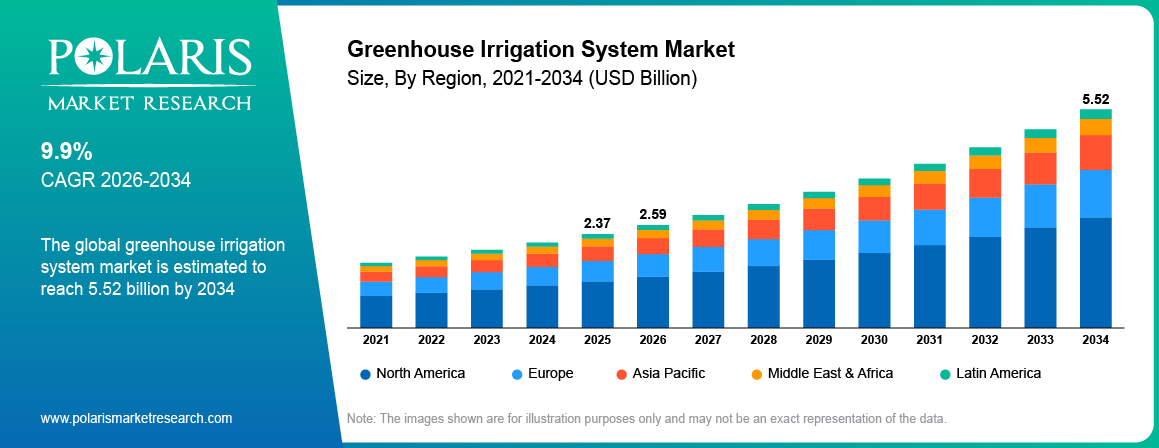
The global greenhouse irrigation system market is estimated around USD 2.37 Billion in 2025, with consistent growth anticipated during 2026–2034. Expansion is driven by increasing adoption of precision agriculture, rising water scarcity concerns, and growing demand for high-efficiency farming systems. The market is projected to grow at a CAGR of 9.9% during the forecast period.
Market Statistics
Key Takeaways
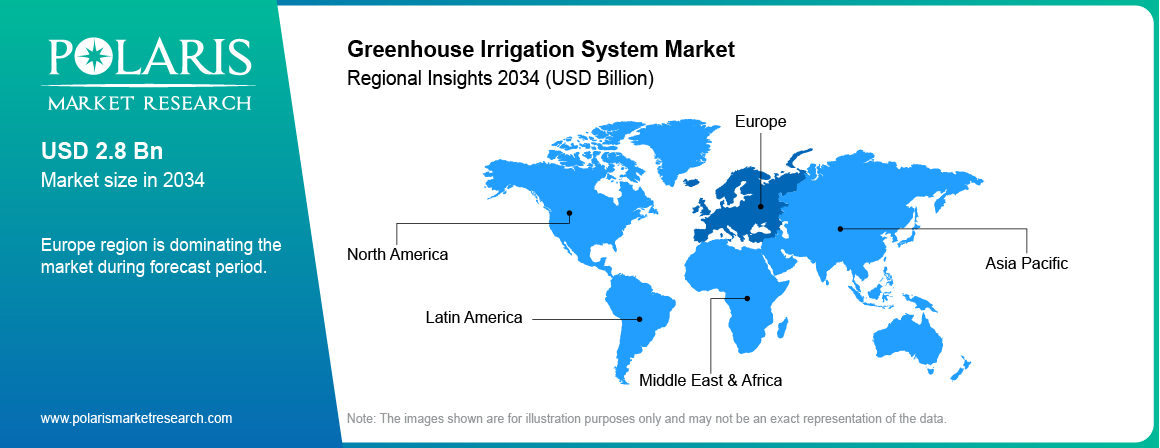
- Europe dominated the market share, accounting for approximately 36.80% due to its advanced greenhouse infrastructure and adoption of precision irrigation solutions.
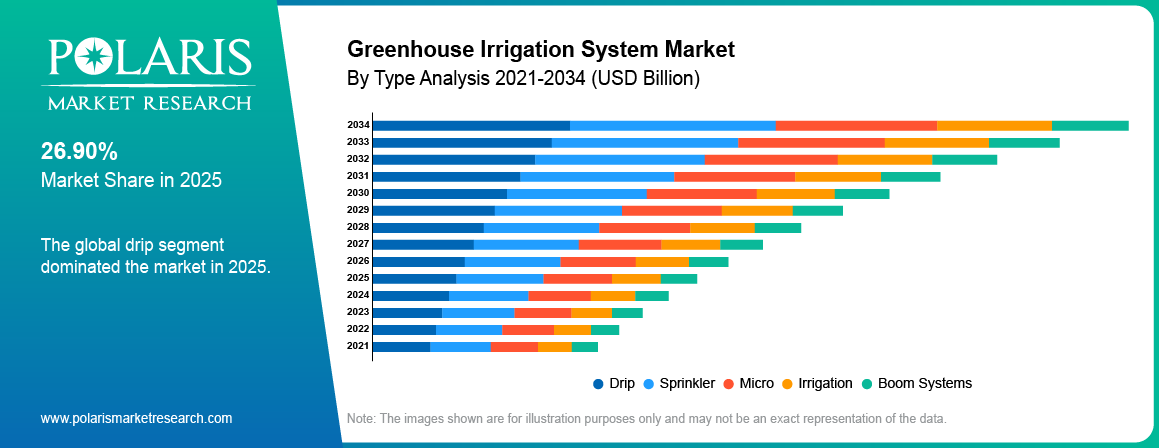
- Drip irrigation system dominated the market, holding approximately 33.45% market share owing to accurate water supply and high efficiency within greenhouse settings.
- Irrigation systems for greenhouses continue to dominate, contributing approximately 38.20% market share as they effectively conserve water and increase crop production.
- Greenhouse agriculture registered a leading market share of approximately 35.75% owing to the wide use of automatic irrigation systems.
- Automatic irrigation systems continue to dominate, accounting for approximately 40.10% market share due to the requirement for constant irrigation.
- IoT-based irrigation solutions are experiencing growth and are projected to register a CAGR of approximately 12.65% owing to the use of real-time data and smart agriculture practices.
Industry Dynamics
- The growing popularity of precision farming and controlled environment agriculture is leading to increased demand for irrigation solutions.
- The problem of water shortages is increasing the adoption of more efficient irrigation systems such as drip and recirculating irrigation systems.
- High costs associated with the installation of irrigation systems are hindering their adoption by small-scale farmers.
- Introduction of IoT, AI, and sensor-based technologies is creating new opportunities in the smart irrigation systems market.
What is the Greenhouse Irrigation System Market?
The greenhouse irrigation system market is considered a specific part of the controlled environment agriculture that provides solutions for efficient and precise watering and fertilizing of greenhouse grown crops. The main types of greenhouse irrigation systems used in practice include drip irrigation systems, micro-sprinklers, foggers, and fertigation units.
Industry analysis of the greenhouse irrigation reveals a high rate of implementation of advanced irrigation systems aimed at saving water resources and ensuring higher yields. Growth is mainly driven by increasing demand for food security and efficient farming.
To Understand More About this Research: Download Sample Report
Market insights shaping greenhouse irrigation market growth:
- Europe is a major contributor owing to its robust greenhouse infrastructure and regulated agriculture techniques.
- Asia Pacific region is projected to grow at the fastest growth rate, attributed to increasing commercial greenhouse farming and governmental support.
- The widespread use of drip irrigation systems is owing to their accuracy and high efficiency levels.
- Technological advancements in irrigation systems such as smart irrigation systems have been adopted rapidly.
- Sustainability practices in agriculture led to growing investments in greenhouse irrigation systems.
Drivers & Opportunities
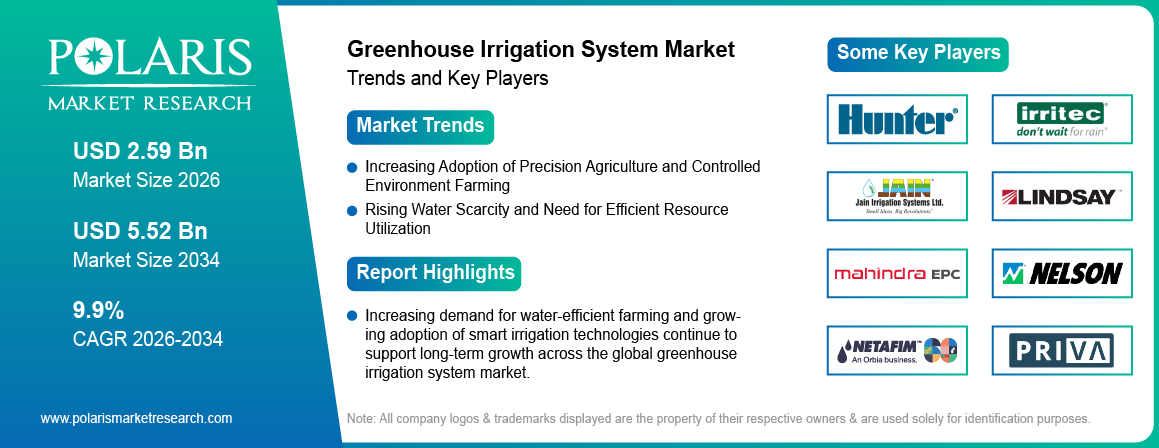
Increasing Adoption of Precision Agriculture and Controlled Environment Farming: Greenhouse operators are adopting data-driven cultivation to improve yield and crop consistency. Precision irrigation systems deliver controlled water and nutrient dosing, which reduces variability and improves output quality in crops such as tomatoes and leafy greens. In February 2025, Yamaha Motor Company established Yamaha Agriculture, Inc., utilizing artificial intelligence and robotics in crop management. This innovation is increasing the need for irrigation systems that offer automation and monitoring capabilities in greenhouses.
Water Scarcity and Efficient Resource Utilization: Water shortages are pushing farmers to employ efficient irrigation technologies. Drip irrigation and closed-loop irrigation systems minimize wastage of water and nutrients. According to UNICEF, nearly two-thirds of the global population faces severe water scarcity for at least one month each year. It leads to higher investments in greenhouse irrigation systems which utilize little water and ensure sustainable agricultural production.
Restraints & Challenges
High Initial Installation Costs and Maintenance Complexity: Greenhouse irrigation systems require heavy costs for installing pumps, filters, and other devices used for irrigation. In addition, maintenance problems such as clogging are relatively difficult. These factors affect return on investment and slow adoption among small and mid-scale growers.
Opportunity
Integration of IoT, AI, and Sensor-Based Irrigation Systems: Smart technologies are improving irrigation precision through real-time data and automation. The AI platforms optimize the use of water and fertilizer through analysis of environmental and plant requirements. In May 2025, Phytech introduced an AI-based irrigation advisor using plant sensors and climate inputs. This advancement is increasing adoption of intelligent irrigation systems in commercial greenhouse operations.
Segmental Insights
This report offers detailed coverage of the greenhouse irrigation system market by type, technology, and application to help readers identify the fastest expanding and most attractive demand segments.
By Type
-
Drip irrigation
Drip irrigation greenhouse systems held the largest share in the greenhouse irrigation system market due to precise water delivery and high resource efficiency. Market growth is attributed to their capacity to provide water and fertilizers directly to plants' roots with minimal wastage.
-
Boom systems
Boom irrigation systems are projected to grow rapidly, due to their growing usage within larger indoor cultivation facilities and intensive greenhouses. These overhead irrigation systems facilitate even distribution of water, leading to increased efficiency through automation.
Comparison (Drip vs Sprinkler vs Boom Systems)
| System Type | Efficiency Level | Water Use Control | Best Use Case |
| Drip Irrigation | High | Precise (root-level) | Horticulture, vegetables, fruits |
| Sprinkler | Moderate | Broad coverage | Floriculture, general crops |
| Boom Systems | High | Automated uniform spray | Indoor farming, large greenhouses |
Source: Polaris Market Research Analysis
By Technology
-
Automated
Automated Irrigation controllers-based systems held prominent market share as these are considered to be the core of irrigation system operation. Irrigation controllers manage irrigation timings, flows, and fertigation systems integration, which helps in producing crops efficiently without requiring much manual effort.
-
IoT
IoT-based greenhouse irrigation systems are expected to witness high growth owing to increasing usage of precision agriculture technology. The use of IoT-based sensors ensures the level of moisture and nutrients in the soil is continuously monitored.
Function of fertigation and hydroponic irrigation: Fertigation systems provide an optimal solution to deliver nutrients along with irrigation to improve absorption and cut down on wastage. Hydroponic irrigation systems utilize water-based nutrient solutions instead of soil, therefore, sophisticated control systems are required.
By Application
-
Commercial
Commercial cultivation of greenhouses was the dominant segment in the market, owing to extensive usage of innovative irrigation systems to maximize yields. Commercial cultivators purchase drip irrigation greenhouse systems and automation irrigation systems to sustain their production and meet logistics requirements.
-
Indoor farming
Indoor farming projected to at a fast pace fueled by the urban agriculture and controlled environment farming trends. Indoor farming irrigation system components depend much on hydroponics irrigation systems market and technologies, using sensor technology for optimization purposes.
Crop-specific irrigation demand: Some types of high-value crops need specific approaches towards irrigation. In particular, horticulture irrigation systems in greenhouses is projected to be focused more on the drip irrigation system usage.
Regional Analysis
Europe Greenhouse Irrigation System Market Assessment
Europe dominated the greenhouse irrigation system market in 2025, due to advanced greenhouse farming in the Netherlands and Spain. These countries use precision irrigation, automation, and water recycling systems. Netherlands greenhouse irrigation benefits from strong technology adoption and sustainability policies. Spain supports growth through large-scale horticulture production. Strict water management regulations continue to drive efficient irrigation practices across the Europe greenhouse irrigation market.
North America Greenhouse Irrigation System Market Overview
North America greenhouse irrigation market is growing steadily supported by increasing adoption of precision agriculture in the US and Canada. Sensors, internet of things (IoT) technology, and automation are used by farmers to boost efficiency. In the US, the greenhouse irrigation industry is fueled by government initiatives. Between 2017 and 2021, the USDA and NSF invested approximately USD 200 million in precision agriculture technology. Financial assistance programs are further encouraging adoption of advanced irrigation technologies.
Asia Pacific Greenhouse Irrigation System Market Insight
Asia Pacific greenhouse irrigation growth is the fastest due to rising food demand and agricultural modernization in China and India. China greenhouse irrigation demand is driven by large-scale farming upgrades. India greenhouse irrigation industry is expanding with growing investments and policy support. The country’s food processing industry is expected to reach around USD 480–490 billion by 2026. Increasing urbanization and limited arable land are accelerating demand for greenhouse irrigation systems.
Rest of the World Greenhouse Irrigation System Market Assessment
Middle East irrigation greenhouse and Latin America greenhouse irrigation markets are growing due to water scarcity and the need for efficient irrigation. The Middle East is adopting greenhouse systems to improve food security. Latin America is enhancing modern irrigation practices in agriculture and exports. The climate and government policies are favoring continuous implementation in these areas.
Competitive Landscape & Pricing Analysis
Key Players & Strategic Developments
The competitive dynamics of the market for greenhouse irrigation systems indicate significant involvement of global leaders in irrigation technology, component suppliers, and greenhouses solutions providers who deliver precision irrigation solutions. Key players in the market for greenhouse irrigation systems compete based on technological advancement in drip irrigation, micro-irrigation, and automation/fertigation systems.
Key players operating in the greenhouse irrigation system market include EPC Industries India Limited, Hunter Industries, Inc., Irritec S.p.A., Jain Irrigation Systems Limited, Lindsay Corporation, Mahindra EPC Irrigation Limited, Nelson Irrigation Corporation, Netafim Ltd., Priva B.V., Rain Bird Corporation, Reinke Manufacturing Company, Inc., Rivulis Irrigation Ltd., The Toro Company, Valmont Industries, Inc., and Weathermatic.
Future Outlook & Premium Insights
Future trends shaping greenhouse irrigation systems
Precision agriculture and efficient utilization are driving the outlook of the greenhouse irrigation market in the coming years. The next generation irrigation system for greenhouse applications concentrate on real-time analysis, flexible irrigation, and integration with climate control solutions. There is rising interest in technology that maximizes output while reducing wastage of water and nutrients, especially in high-end crop cultivation.
Investment opportunities and emerging markets
Investment opportunities for greenhouse irrigation are now arising in countries located in Asia Pacific, Middle East, and Latin America owing to the rise of greenhouse cultivation and water shortages. There are increasing investments in controlled environment agriculture by government bodies and private firms.
High growth markets involve automated drip irrigation systems, fertigation systems, and irrigation solutions that scale up in size for commercial greenhouses.
-
Digital transformation and smart farming integration
The digital irrigation systems market is undergoing significant changes through the integration of artificial intelligence, internet of things, and data analysis capabilities, allowing for predictive and automated irrigation. This is a crucial factor in determining the current trends in smart farming irrigation systems.
-
AI and predictive irrigation
AI technologies assess crop health, climatic factors, and soil composition for efficient irrigation timing. Predictive irrigation minimizes water usage and improves crop yields.
-
Closed-loop irrigation systems
Closed-loop systems recycle water and nutrients, making them more efficient and eco-friendlier. They are becoming popular in areas where there are strict water policies.
-
Sustainability and ESG-driven adoption
Sustainability plays a significant role, with growing use of energy-efficient and water-saving systems. ESG-based investments are contributing to the rapid adoption of smart irrigation technologies, making greenhouse irrigation an essential part of sustainable agriculture.
Key Players
- EPC Industries India Limited
- Hunter Industries, Inc.
- Irritec S.p.A.
- Jain Irrigation Systems Limited
- Lindsay Corporation
- Mahindra EPC Irrigation Limited
- Nelson Irrigation Corporation
- Netafim Ltd.
- Priva B.V.
- Rain Bird Corporation
- Reinke Manufacturing Company, Inc.
- Rivulis Irrigation Ltd.
- The Toro Company
- Valmont Industries, Inc.
- Weathermatic
Industry Developments
- February 2025: Netafim launched the world’s first Hybrid Dripline system, integrating an inline dripline with a built-in outlet to simplify irrigation operations and improve water distribution efficiency. [source: Fruitnet.com]
Greenhouse Irrigation System Market Segmentation
By Type Outlook (Revenue, USD Billion, 2021-2034)
- Drip
- Sprinkler
- Micro
- Irrigation
- Boom Systems
By Technology Outlook (Revenue, USD Billion, 2021-2034)
- IoT
- Sensors
- Automated Controllers
- Fertigation
By Application Outlook (Revenue, USD Billion, 2021-2034)
- Commercial
- Horticulture
- Floriculture
- Indoor Farming
By Regional Outlook (Revenue, USD Billion, 2021-2034)
- North America
- US
- Canada
- Europe
- Germany
- France
- UK
- Italy
- Spain
- Netherlands
- Russia
- Rest of Europe
- Asia Pacific
- China
- Japan
- India
- Malaysia
- South Korea
- Indonesia
- Australia
- Vietnam
- Rest of Asia Pacific
- Middle East & Africa
- Saudi Arabia
- UAE
- Israel
- South Africa
- Rest of Middle East & Africa
- Latin America
- Mexico
- Brazil
- Argentina
- Rest of Latin America
Greenhouse Irrigation System Market Report Scope
| Report Attributes | Details |
| Market Size in 2025 | USD 2.37 Billion |
| Market Size in 2026 | USD 2.59 Billion |
| Revenue Forecast by 2034 | USD 5.52 Billion |
| CAGR | 9.9% from 2026 to 2034 |
| Base Year | 2025 |
| Historical Data | 2021–2024 |
| Forecast Period | 2026–2034 |
| Quantitative Units | Revenue in USD Billion and CAGR from 2026 to 2034 |
| Report Coverage | Revenue Forecast, Competitive Landscape, Growth Factors, and Industry Trends |
| Segments Covered |
|
| Regional Scope |
|
| Competitive Landscape |
|
| Report Format |
|
| Customization | Report customization as per your requirements with respect to countries, regions, and segmentation. |
Source: Polaris Market Research Analysis
Greenhouse Irrigation System Market FAQ's
The global market size was valued at USD 2.37 Billion in 2025 and is projected to grow to USD 5.52 Billion by 2034.
Europe dominated the market due to well-established greenhouse farming practices, strong regulatory focus on water efficiency, and advanced irrigation technologies.
Commercial greenhouse operators account for the largest share due to large-scale adoption of automated irrigation systems.
A few of the key players in the market are EPC Industries India Limited, Hunter Industries, Inc., Irritec S.p.A., Jain Irrigation Systems Limited, Lindsay Corporation, Mahindra EPC Irrigation Limited, Nelson Irrigation Corporation, Netafim Ltd., Priva B.V., Rain Bird Corporation, Reinke Manufacturing Company, Inc., Rivulis Irrigation Ltd., The Toro Company, Valmont Industries, Inc., and Weathermatic.
Growth is fueled by water shortage, adoption of precision agriculture, and demand for effective agricultural systems.
Future trends involve incorporation of IoT, AI-enabled irrigation, irrigation through sensors, and close-loop water system.
Sensors detect moisture levels, temperature, and nutrients in the soil for accurate irrigation.
Yes, they use less water and ensure efficiency in irrigations, promoting sustainable farming practices.
Problems include high cost, maintenance problems, and challenges in managing nutrients and water.
These systems employ sensors, analytics, and automation to provide automatic water and nutrients distribution in real-time.
Download Sample Report of Greenhouse Irrigation System Market
Please fill out the form to request a customized copy of the research report.


