
High-Speed Data Converter Market Size, Share, Trends & Forecast, 2026–2034
REPORT DETAILS
High-Speed Data Converter Market Summary
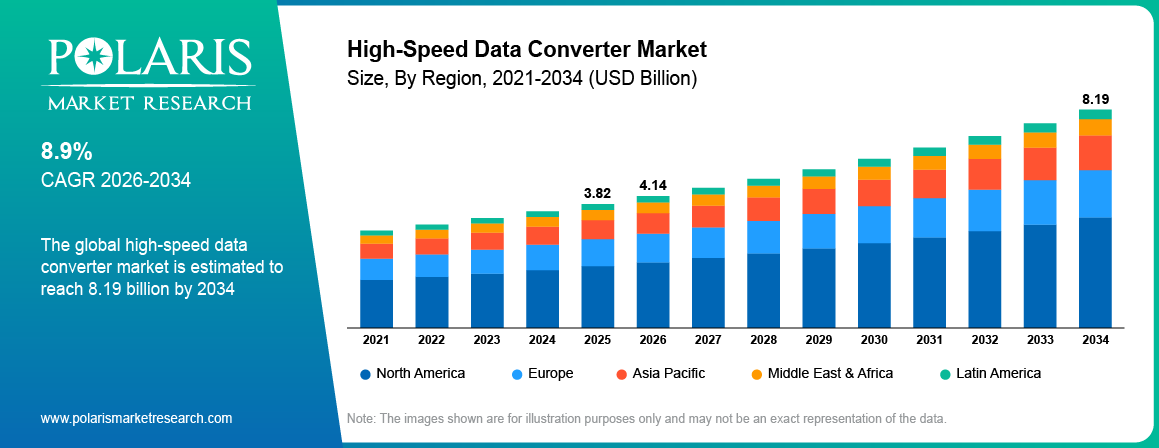
High-Speed Data Converter Market size was valued at USD 3.82 billion in 2025. The market is anticipated to grow from USD 4.14 billion in 2026 to USD 8.19 billion by 2034, exhibiting a CAGR of 8.9% during the forecast period.
Market Statistics
High-speed Data Converter Market Key Takeaways
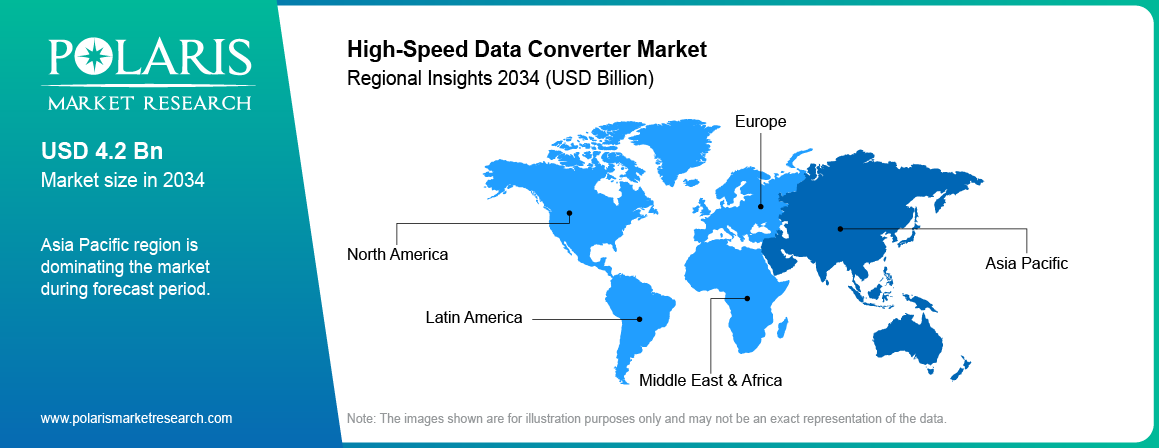
- Asia Pacific led the market in 2025 with a revenue share of 38.60%. The growth was driven by robust demand from communications, consumer electronics, and industrial automation
- North America is expected to register a CAGR of 8.10% during 2026–2034. Increasing demand for test and measurement systems and medical equipment is helping market growth.
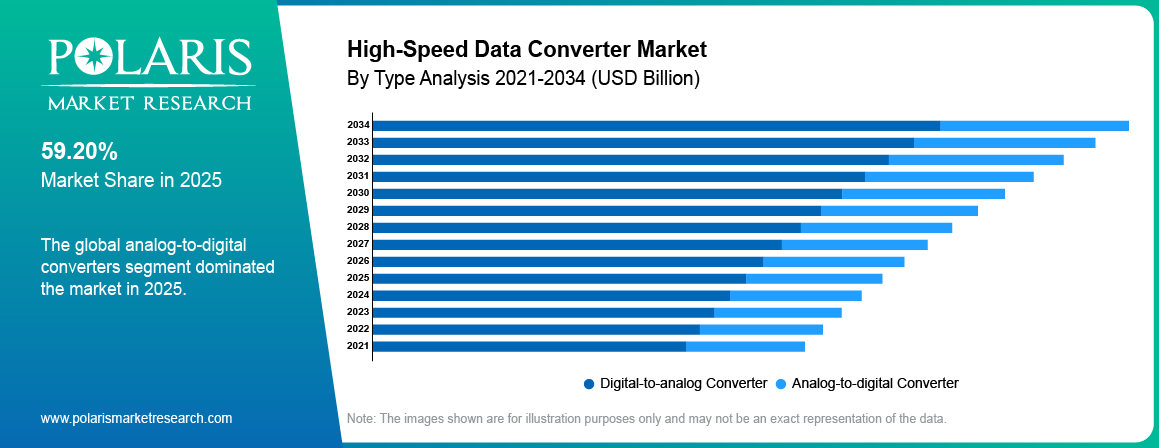
- Analog-to-digital converters (ADCs) held the largest revenue share of 59.20% in 2025. The segment is driven by increasing demand in industrial and medical applications.
- The Medical application contributed the revenue share of 8.70% in 2025. Growing use of imaging and patient monitoring devices supports demand.
- The Communications application is expected to grow at a CAGR of 9.70% during 2026–2034. Rising deployment of high-speed networks and data transmission systems is supporting growth.
- The 125 MSPS to 1 GSPS frequency band is projected to register a CAGR of 8.40% during 2026–2034. The adoption is being driven by its broad use in communications and in industrial and test equipment.
Note: Figures and projections outlined in this report are the result of Polaris Market Research’s proprietary analytical processes, grounded in the latest available datasets and market observations.
What Is the High-Speed Data Converter Market?
High-speed data converters are semiconductor devices that convert analog signals into digital data and digital signals into analog form at very high speeds. They are used in communication systems, medical imaging, aerospace, defense, industrial automation and test and measurement equipment where fast and accurate signal processing is needed.
Utilizing high-speed data converters has become integral for enhancing and shaping the architecture of high-performance electronic systems, opening new application perspectives. State-of-the-art modulators, propelled by emerging circuits and system techniques, continuously push the boundaries of performance, giving rise to successive generations of data converters. The current and future trajectory of this advancement is influenced by a myriad of factors, including the global economy, technological evolution, and marketing strategies.
The market is witnessing increased adoption of technologically advanced data acquisition systems, driven by the need to manage high rates of encoded information in multiple signals. Data acquisition (DAQ) systems have evolved from research-centric applications to modern engineering processes, emphasizing a trend toward modular hardware combined with flexible software. These modern modular systems incorporate suitable signal conditioning and analog-to-digital conversion (ADC), accommodating various interfacing sensors to meet diverse data acquisition requirements.
The traditional approach to specific DAQ tasks is deemed impractical in the face of contemporary requirements. Consequently, the market is transitioning towards a more software-defined approach to DAQ, with a notable emergence of high-speed USB-enabled DAQs
Moreover, the increasing demand for high-resolution images in scientific and medical applications is a driving force in the market. Data converters play a pivotal role in addressing the challenges posed by medical imaging, including dynamic range, resolution, accuracy, linearity, and noise. Achieving a high resolution of at least 24 bits is crucial for producing better and sharper images, coupled with a fast-sampling rate to digitize detector readings as brief as 100 µs in computed tomography (CT) solutions. The ADC sampling rate must also facilitate multiplexing, reducing the need for numerous converters and contributing to the overall system's size and power reduction.
Companies like Analog Devices are at the forefront of addressing these demanding requirements, offering highly integrated solutions for key signal chain functional blocks. Products such as ADAS1135, ADAS1256 (X-ray applications), ADAS1134 (CT applications), and others drive the medical applications market, providing best-in-class solutions for clinical imaging equipment.
How Do High-Speed Data Converters Work?
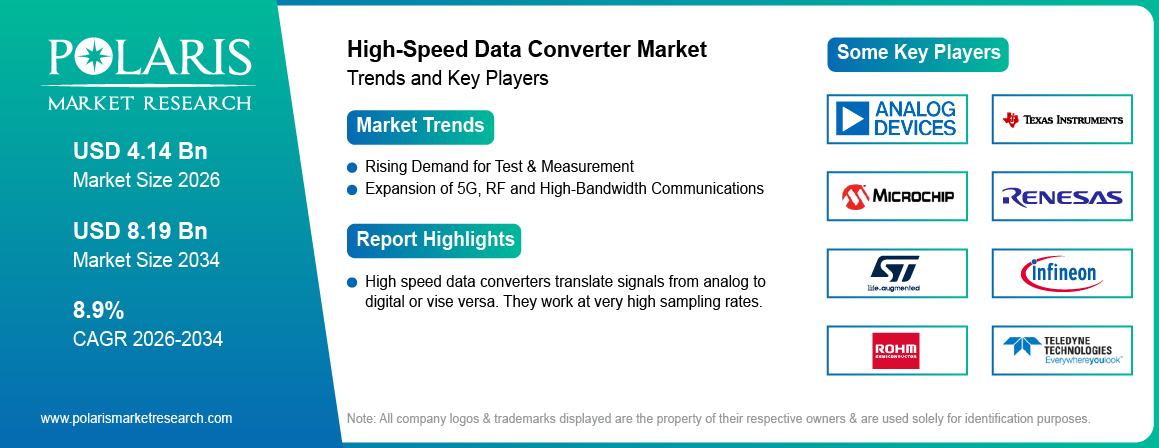
High speed data converters translate signals from analog to digital or vise versa. They work at very high sampling rates.
The process begins with an analog signal. This could come from a sensor, antenna or other source of input. An analog to digital converter (ADC) samples the signal. It then converts the signal to digital data. This data can be processed, analyzed or stored in digital systems.
The digital data is then sent to a computing or a signal-processing system. The system processes the data as needed for its purpose. When an analog output is required, a digital-to-analog converter (DAC) changes the digital data back into an analog signal.
High-speed converters help these systems to process signals quickly and accurately. The output signal can be used in communication systems, medical imaging equipment, radar systems, industrial control systems and other electronic devices.
Source: Polaris Market Research Analysis
To Understand More About this Research: Download Sample Report
High-Speed Data Converter Market Trends, 2026
The high-speed data converter market is seeing steady changes in 2026. New technologies are increasing the need for faster and more accurate data conversion. RF sampling is one important trend. It allows direct processing of high frequency signals by the systems. This is useful in communication, radar and wireless systems.
The growth of 5G is also supporting market demand. 5G systems need fast signal processing and high data rates. The systems handle large volumes of signal data using high-speed ADCs and DACs.
New demand is being driven by artificial intelligence (AI) and high-performance computing (HPC). These systems are capable of processing big data. They require fast and accurate data conversion for better performance. This trend also drives the demand for advanced signal-processing systems.
Medical imaging is another important area. In CT, MRI and ultrasound systems for example, data converters are used to process the signals. Higher speed and accuracy can result in better image processing.
Data acquisition (DAQ) systems are also driving demand. These systems collect signals from sensors and other devices. High-speed converters help process these signals quickly.
Another trend is greater integration. Manufacturers are working to combine converters with other signal-processing functions. This contributes to reducing the size and power consumption of the system and improving the overall system performance. The market growth is expected to be driven by these trends in the coming years.
ADC vs DAC
| Feature | ADC (Analog-to-Digital Converter) | DAC (Digital-to-Analog Converter) |
| Function | Converts analog signals to digital data | Converts digital data to analog signals |
| Primary Use | Signal capture | Signal reconstruction |
| Applications | Sensors, radar, medical devices | Audio systems, RF transmission, displays |
| Market Position | Larger market share | Growing market share |
| Role in Communications | Signal reception | Signal transmission |
Source: Polaris Market Research Analysis
High-Speed Data Converter Market Drivers, Opportunities and Challenges
Market Driver- Rising Demand for Test & Measurement
Demand for test and measurement equipment is increasing as communication and electronic systems become more complex. High-speed ADCs and DACs are used in signal analyzers, oscilloscopes, network analyzers, and other testing tools. Texas Instruments lists high-speed ADCs for wireless, industrial, aerospace, defense, and test applications. Its ADC portfolio includes devices with sampling speeds up to 10.4 GSPS. This points out the necessity of the faster capture and analysis of signals in modern test and measurement systems.
Market Driver- Expansion of 5G, RF and High-Bandwidth Communications
The expansion of 5G networks is increasing the need for high-speed signal conversion. Ericsson reported that 5G networks carried 48% of global mobile data traffic at the end of 2025. The company expects this share to reach 85% by 2031. 5G systems handle large amounts of high-frequency data. High-speed ADCs and DACs help convert and process these signals. Growing 5G traffic is therefore supporting demand for faster and more efficient converter technologies.
Market Opportunity- Growth of Advanced Data Acquisition and Medical Imaging
Advanced data acquisition and medical imaging offer growth opportunities for high-speed data converters. These systems need accurate and fast signal conversion from sensors and imaging devices. Texas Instruments states that its ADC portfolio serves medical, industrial, automotive, communication, and enterprise applications. Its ADC portfolio includes devices with sampling speeds up to 10.4 GSPS. With more detailed signals to be acquired and imaged, the use of higher-speed converters enables manufacturers to improve system performance and accommodate new applications.
Market Opportunity- Opportunity from Integrated Mixed-Signal Platforms
Integrated mixed-signal platforms can create new opportunities for high-speed data converter companies. Combining ADCs, DACs, clocking, interfaces, and signal processing can reduce system size and simplify design. Texas Instruments currently lists high-speed ADCs with JESD204 interfaces, including an 8-channel 14-bit 125-MSPS device. The company also offers RF-sampling ADCs. These products show the move toward more integrated signal chains. This trend can support compact systems with better performance and easier system integration.
Market Restraint- Power, Thermal and Design Complexity
Power consumption remains a key challenge for high-speed data converters. Faster sampling often requires more complex circuits and can increase power use and heat. Low power designs must still maintain good accuracy, speed, and signal quality. For manufacturers this creates a difficult balance. Texas Instruments lists both high-speed and low-power ADC options, showing the importance of this requirement. In battery-powered and compact systems, higher power use can limit product design and overall system efficiency.
High-Speed Data Converter Technology and Architecture
High-speed data converters use different technologies to convert and process signals. ADCs convert analog signals into digital data. DACs convert digital data back into analog signals. RF sampling supports systems process high frequency signals directly. To maintain precise timing signal conversion involves clocking and synchronization. Converter data is sent to FPGAs, processors, and other systems through high-speed digital interfaces. Calibration supports maintain accuracy and stable performance. High-speed operation can increase power use and generate more heat that's why power and thermal design are also important.
High-Speed ADCs
High-speed ADCs convert analog signals into digital data. They sample at very high speeds. The sampling rate is the rate at which the ADC can sample the signals. Resolution is the detail of the conversion. ENOB, SNR, SFDR are important performance measures of the ADC. These factors help to determine signal quality and accuracy.
High-Speed DACs
High-speed DACs convert digital data into analog signals. They are used to generate waveforms and transmit signals. DACs are important in communication and RF systems. High-speed DACs can support fast signal generation. Interpolation can also help increase the effective output rate. These features support high-bandwidth applications.
RF Sampling and Mixed-Signal Front Ends
High frequency signals can be process directly with RF sampling. This can reduce the need for several conversion stages. Mixed-signal front ends combine analog and digital functions. These can be converters, amplifiers, filters and other signal processing components. This can help to reduce the size of the system and simplify the signal chains.
Clocking, Jitter and Synchronization
For signal sampling clocking provides timing. A stable clock is important for accurate conversion. Small timing changes in the sampling clock is referred as jitter. High jitter can reduce signal quality. Synchronization supports different components work at the correct time. This is important in high-speed communication and data acquisition systems.
JESD204 and High-Speed Digital Interfaces
High-speed converters need fast interfaces to move digital data. JESD204 links converters to FPGAs, processors and SoCs. High-speed data transfer between components is possible. These interfaces help systems handle large amounts of converter data. They are used in communication, test and measurement, radar and other high-speed applications.
Calibration, Power Management and Thermal Design
Calibration helps maintain converter accuracy and performance. It can correct errors that occur during signal conversion. In high-speed systems power management is also important. Higher operating speeds can increase power consumption and heat. Good thermal design controls this heat. These factors promote reliable and efficient operation of the converter.
High-Speed Data Converter Technology Stack
| Layer | Role | Example |
| Analog front end | Prepares incoming and outgoing signals. | Amplifiers, filters, drivers, transformers |
| Conversion core | Converts analog signals to digital or digital signals to analog. | SAR, pipeline, time-interleaved ADCs, current-steering DACs |
| Clocking | Provides accurate timing for sampling. | Clock generators, PLLs, synchronization |
| Digital interface | Sends converter data to processing devices. | JESD204, FPGA/SoC links |
| DSP / processing | Filters and processes the converted data. | Digital filters, DDC/DUC, FPGA DSP |
| Calibration / management | Maintains performance and manages device operation. | Background calibration, monitoring, thermal control |
Source: Polaris Market Research Analysis
Source: Polaris Market Research Analysis
Report Segmentation
The market is primarily segmented based on frequency band, type, application, and region.
| By Frequency Band | By Type | By Application | By Region |
|
|
|
|
Source: Polaris Market Research Analysis
By Type: Analog-to-Digital Converters and Digital-to-Analog Converters
The Analog-to-Digital Converter segment held the largest revenue share in 2025, accounting for approximately 59.20% of the market.. ADCs are capable of gauging and transforming real-world signals, such as temperature, pressure, acceleration, and speed, into digital signals. Throughout the conversion process, the ADC assesses the analog input signal in comparison to a known reference input, resulting in the generation of a digital representation of the analog input. To prevent information loss, many systems utilize ADCs with higher resolutions. The precision of the converter, indicated by its accuracy, determines the number of bits in the digital output code that convey useful information about the input signal. Hence, the sampling rate holds a crucial role in ADC devices, influencing how accurately they convert analog signals into digital forms. The increasing adoption of industrial DAQ and medical devices, such as cardiac endoscopes, hemodynamic monitors, monitors, multi-parameter monitors, respiratory monitors, digital thermometers, and ophthalmoscopes, is expected to propel the market for ADCs.The Digital-to-Analog Converter (DAC) segment is expected to grow steadily during the forecast period with 8.30%. DACs are used in communication, audio, industrial and other electronic systems for converting digital signals to analog signals. Demand for high speed signal transmission and waveform generation is expected to increase the adoption of DACs.
By Frequency Band: <125 MSPS, 125 MSPS–1 GSPS and >1 GSPS
The <125 MSPS segment held the largest share of the market in 2025 with share of 25.80%. It is used in systems that need reliable signal conversion at moderate speeds. The 125 MSPS–1 GSPS segment is used in communications, industrial systems, automotive, and test and measurement applications. It provides a good trade off between speed and power consumption. The >1 GSPS segment is expected to register the highest growth rate with a CAGR of 11.20% during the forecast period 2026-2034. This growth is due to increased use of 5G, radar, telecommunications and other systems requiring faster signal processing.
Frequency-Band Comparison
| Frequency band | Typical positioning | Example use cases |
| <125 MSPS | Lower high-speed range | Industrial sensing, instrumentation, communications, and DAQ |
| 125 MSPS–1 GSPS | Mid-range high-speed conversion | Test and measurement, imaging, communications, and embedded systems |
| >1 GSPS | Very high-speed conversion | 5G/RF, radar, advanced instrumentation, and imaging |
Source: Polaris Market Research Analysis
By Application Analysis
- The Medical segment accounted for the 8.70% market share in 2025, with approximately XX% of the market. Monitoring devices like hemodynamic, cardiac, and respiratory monitors necessitate versatile data converters. Conversely, imaging devices such as computed magnetic resonance imaging (MRI) scanners, tomography (CT) scanners, and ultrasound systems may require high-speed data converters for optimal functioning, serving as a significant driver for the segment growth.
The increasing demand for personalized, user-friendly, and advanced medical devices, coupled with the growing adoption of wearable electronics, constitutes major factors contributing to the expansion of the electronic medical devices. These devices are equipped with one or more sensors and probes depending on specific requirements. Data converters play a pivotal role in this landscape, facilitating the conversion of data into digital form for analysis, consequently fostering the growth of the data converter market.The Communication segment is expected to grow steadily from 2026 to 2034 with 9.70%. In wireless networks, optical systems, and other communication equipment high-speed data converters are used. The growth of 5G and higher data traffic is increasing demand for faster signal conversion.
Real-World Applications of High-Speed Data Converters
| Application | Role of High-Speed Data Converters |
| 5G Base Stations | Process high-speed wireless signals |
| Wireless Communication Systems | Enable fast and accurate signal conversion |
| Radar and Defense Systems | Support real-time signal processing |
| Medical Imaging Equipment | Improve image quality and diagnostics |
| Autonomous Vehicle Sensors | Process sensor data for navigation |
| Industrial Automation Systems | Enable accurate monitoring and control |
| Test and Measurement Equipment | Convert signals for analysis and testing |
| Aerospace Electronics | Support high-speed communication and navigation |
| Data Acquisition Systems | Capture and digitize real-world signals |
| Satellite Communications | Enable reliable long-distance signal transmission |
Source: Polaris Market Research Analysis
Application Requirement Comparison
| Application | Converter need | Key performance factors |
| Communications / 5G | Fast conversion of wideband RF and IF signals. | Sample rate, bandwidth, SNR, SFDR, and clock jitter |
| Test & Measurement | Accurate capture and generation of test signals. | Resolution, ENOB, dynamic range, sample rate, and synchronization |
| Medical | Accurate conversion of sensor and imaging signals. | Resolution, noise, linearity, sampling speed, and power |
| Industrial | Conversion of sensor and control signals in DAQ and automation. | Reliability, accuracy, latency, power, and integration |
| Aerospace & Defense | High-speed signal capture and generation for radar and electronic systems. | Wide bandwidth, synchronization, ruggedness, and SFDR |
Source: Polaris Market Research Analysis
Source: Polaris Market Research Analysis
Regional Insights
Asia Pacific
Asia Pacific dominated the global market in 2025, with a 38.60% share. This is attributed to the region's robust demand for communication systems, consumer equipment, and white goods. Additionally, the increasing trend in industrial automation is driving the need for high-speed data converters integrated into sensor-based systems. Key providers of high-speed data converters in the region include Renesas Electronics Corporation (Japan), Corebai Microelectronics (Beijing) Co., ROHM CO., LTD. (Japan), Ltd. (China), and Atom Semiconductor Technologies Limited (China).
North America: Fastest-Growing Regional Market
North America is expected to register the fastest growth, with a CAGR of approximately 8.10% from 2026 to 2034. In North America, end users extensively employ test and measurement solutions to enhance the delivery of video, audio, and data services. The increasing demand for test and measurement equipment is anticipated to be a significant driver for the growth of the high-speed data converter market in the region. Moreover, the well-established medical equipment manufacturing industry in North America is poised to contribute to the demand for high-speed data converters in the upcoming years.
Europe: Significant Regional Market Growth
Europe is an important market for high-speed data converters. Demand is supported by automotive, industrial automation, aerospace, and test and measurement applications. The region is also seeing higher demand for advanced communication and electronic systems. Europe’s high-speed data converter market is expected to grow at a 8.8% CAGR from 2026 to 2034.
U.S.
The U.S. is an important market for high-speed data converters. The demand is supported by 5G networks, aerospace & defense, test and measurement and advanced computing. Increasing use of high-speed communication systems is fueling the need for faster signal conversion. Medical equipment and data acquisition systems are also supporting the market demand.
China
High-speed data converters are a huge market in China. Growth is driven by 5G networks, telecommunications, consumer electronics and industrial systems, along with the expansion of the electronics and semiconductor industries. All are fueling demand for high-speed signal processing.
Japan
Japan has strong demand for high-speed data converters in automotive and industrial applications. The country has a large electronics and semiconductor industry. Data converters are also used in robotics, automation, and test and measurement systems. Growing use of advanced electronic systems is supporting demand.
India
India is observing growing demand for high-speed data converters. Demand is being driven by growing 5G networks and electronics manufacturing. Other important areas are defense, aerospace, telecommunications and industrial applications. Future demand is expected to be supported by increasing investment in electronics and digital infrastructure.
Source: Polaris Market Research Analysis
Competitive Landscape
The High-Speed Data Converter market is fragmented and is anticipated to witness competition due to several players' presence. Major service providers in the market are constantly upgrading their technologies to stay ahead of the competition and to ensure efficiency, integrity, and safety. These players focus on partnership, product upgrades, and collaboration to gain a competitive edge over their peers and capture a significant market share.
Analog Devices offers a broad range of high-speed ADCs and DACs. Its products support RF sampling, communications, radar, instrumentation, and defense applications. The company offers converters with sampling speeds reaching several GSPS.
Texas Instruments provides high-speed ADCs and DACs for communication, industrial, automotive, medical, and test applications. Its portfolio includes ADCs with sampling speeds up to 10.4 GSPS and high-speed RF DACs.
Key Players in the High-Speed Data Converter Market
- Analog Devices, Inc.
- Texas Instruments Incorporated
- Microchip Technology Incorporated
- Renesas Electronics Corporation
- STMicroelectronics N.V.
- Infineon Technologies AG
- ROHM Co., Ltd.
- Teledyne Technologies Incorporated
- Broadcom Inc.
- Cirrus Logic, Inc.
- Asahi Kasei Microdevices Corporation
- NXP Semiconductors N.V.
- Qualcomm Technologies, Inc.
- Realtek Semiconductor Corp.
- Skyworks Solutions, Inc.
- ON Semiconductor Corporation
- Datel, Inc.
- IQ-Analog
- Omni Design Technologies, Inc.
- Synopsys, Inc.
- Caelus Technology Limited
- Faraday Technology Corporation
- VadaTech, Inc.
- TEWS Technologies GmbH
- ADSANTEC
- Agile Analog Ltd.
- Corebai Microelectronics (Beijing) Co., Ltd.
- Data Device Corporation
- Numato Systems Private Limited
- Vervesemi Microelectronics Pvt. Ltd.
Recent Developments
- June 2026: Analog Devices showcased its next-generation high-speed ADC platform with integrated on-chip DSP acceleration at IMS 2026. The new platform delivers faster signal processing, lower latency, and improved power efficiency. It is designed for radar, wireless communications, and high-speed data acquisition applications. (Source: analog.com)
- March 2026: Texas Instruments introduced an 800 VDC power architecture for next-generation AI data centers in collaboration with NVIDIA. The solution improves power efficiency and supports high-performance analog and signal conversion technologies. It is designed to meet the growing power needs of AI infrastructure and advanced electronic systems. (Source: ti.com)
Future of the High-Speed Data Converter Market
The high-speed data converter market is expected to grow steadily. The expansion of 5G networks, AI infrastructure, advanced medical imaging, autonomous vehicles, and aerospace applications are the growth drivers. Better performance and efficiency will be achieved with multi-GSPS architectures, low-power converter designs and AI-assisted signal processing. Further advances in semiconductor technologies will improve the performance of converters. High-speed ADCs and DACs will continue to be a key enabler for next-generation of electronic systems.
High-Speed Data Converter Market Report Scope and Methodology
The report uses 2025 as the base year, with historical data covering 2021–2024 and forecasts from 2026 to 2034. The analysis covers market size, growth trends, key segments, regions, and major countries. Data is gathered from primary and secondary sources and reviewed to support the market estimates and forecasts.
Report Coverage
The High-Speed Data Converter market report emphasizes on key regions across the globe to provide better understanding of the product to the users. Also, the report provides market insights into recent developments, trends and analyzes the technologies that are gaining traction around the globe. Furthermore, the report covers in-depth qualitative analysis pertaining to various paradigm shifts associated with the transformation of these solutions.
The report provides detailed analysis of the market while focusing on various key aspects such as competitive analysis, frequency band, type, application, and their futuristic growth opportunities.
High-Speed Data Converter Market Report Scope
| Report Attributes | Details |
| Market size value in 2025 | USD 3.82 billion |
| Market size value in 2026 | USD 4.14 billion |
| Revenue forecast in 2034 | USD 8.19 billion |
| CAGR | 8.9% from 2026 – 2034 |
| Base year | 2025 |
| Historical data | 2021 – 2024 |
| Forecast period | 2026 – 2034 |
| Quantitative units | Revenue in USD billion and CAGR from 2026 to 2034 |
| Segments Covered | By Type, By Frequency Band, By Application, By Region |
| Regional scope | North America, Europe, Asia Pacific, Latin America; Middle East & Africa |
| Customization | Report customization as per your requirements with respect to countries, region and segmentation. |
Source: Polaris Market Research Analysis
High-Speed Data Converter Market FAQ's
key companies in High-Speed Data Converter Market are ADSANTEC, Agile Analog Ltd., Alphacore Inc., Analog Devices, Inc., Antelope Audio, Atom Semiconductor Technologies Limited
High-Speed Data Converter Market exhibiting the CAGR of 8.9% during the forecast period
The High-Speed Data Converter Market report covering key segments are frequency band, type, application, and region.
key driving factors in High-Speed Data Converter Market are increasing need for end-user test and measurement solutions, contributing to market growth
The global High-Speed Data Converter market size is expected to reach USD 8.19 billion by 2034
A high-speed data converter changes analog signals into digital data or digital data into analog signals. It enables fast signal processing.
An ADC converts analog signals into digital data. A DAC converts digital data into analog signals.
They process high-frequency signals with high speed and accuracy. This supports faster and more reliable 5G communication.
They are used in telecommunications, healthcare, aerospace, defense, and industrial automation. They also support automotive and test equipment.
MSPS and GSPS measure a converter's sampling speed. Higher values allow faster and more accurate signal processing.
Download Sample Report of High-Speed Data Converter Market
Please fill out the form to request a customized copy of the research report.


