
Idiopathic Pulmonary Fibrosis Treatment Market Size, Share, Trends & Forecast, 2026-2034
REPORT DETAILS
Idiopathic Pulmonary Fibrosis Treatment Market Size & Forecast, 2025-2034
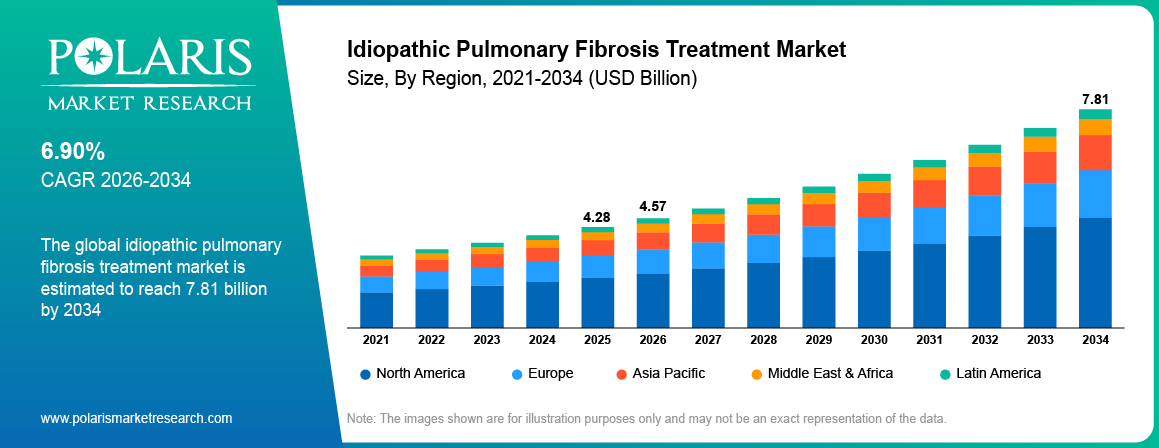
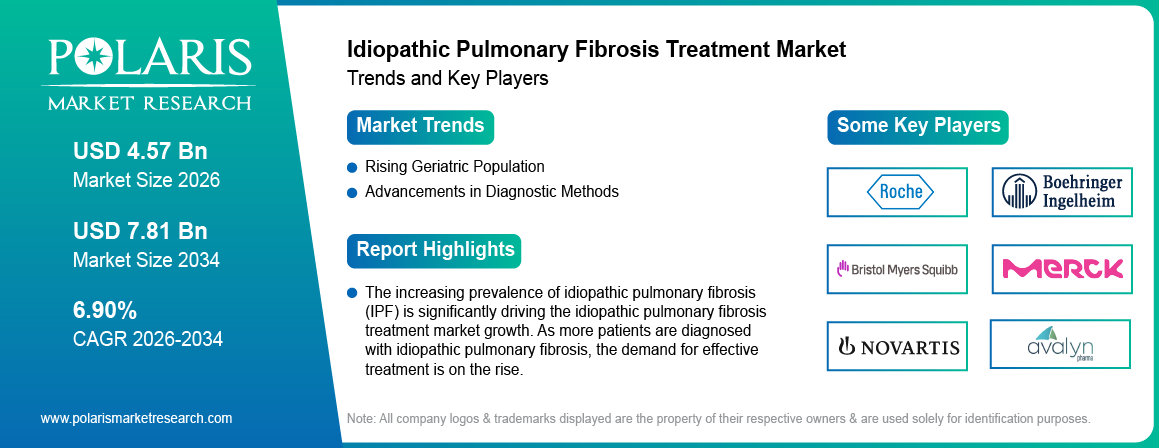
The idiopathic pulmonary fibrosis treatment market size was valued at USD 4.28 billion in 2025. The market is projected to grow from USD 4.57 billion in 2026 to USD 7.81 billion by 2034, exhibiting a CAGR of 6.90% during 2026–2034.
Market Statistics
IPF Treatment Market Key Takeaways: Size, Region, Route & Pharmacy Share
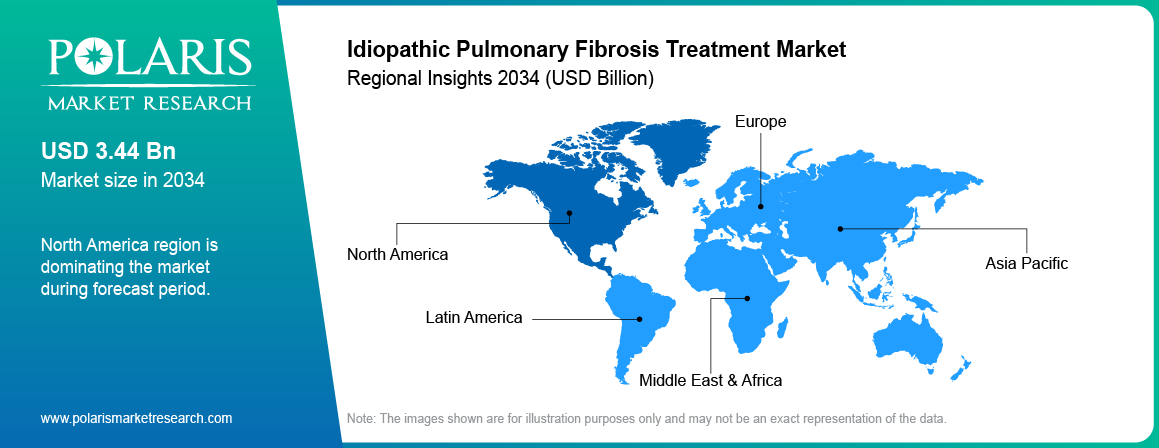
- In 2025, North America held the largest revenue share of 44.1% in the global market. The dominance is attributed to its advanced medical infrastructure.
- The Asia Pacific market is projected to record a significant CAGR of 8.7% during the forecast period. Rising prevalence of idiopathic pulmonary fibrosis would boost the regional market growth.
- The India market would register the highest CAGR of 9.5% in Asia Pacific during the forecast period. The growth is supported by the rising investments in its pharmaceutical manufacturing sector
- The oral segment is expected to exhibit the highest CAGR of 9.1% in the global market during 2025–2034. Increasing approvals for oral therapies would boost the segment growth.
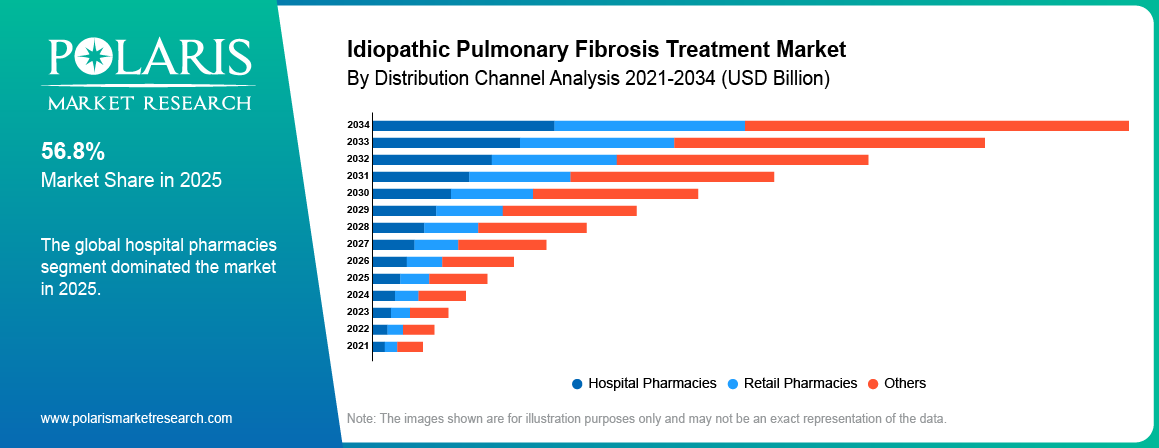
- The hospital pharmacies segment led the market with 56.8% in 2025. This is due to increasing specialized treatment protocols across hospitals customized for IPF patients.
Note: Figures and projections outlined in this report are the result of Polaris Market Research’s proprietary analytical processes, grounded in the latest available datasets and market observations.
IPF Treatment Market Dynamics: Drivers, Opportunities, Restraints & Unmet Needs
- Increasing aging population prone to the idiopathic pulmonary fibrosis drives the market growth.
- Growing prevalence of IPF across the world fuels the growth of the market.
- Availability of limited treatment options hinders the expansion of the market.
- Advancements in antifibrotic therapies would offer lucrative market opportunities in the coming years.
- Rising awareness of interstitial lung diseases would accelerate the market expansion during the forecast period.
What Is Idiopathic Pulmonary Fibrosis (IPF)? Causes, Symptoms & Disease Progression
Idiopathic Pulmonary Fibrosis (IPF) is a chronic lung disease characterized by progressive scarring of lung tissue. The scarring causes difficulty in breathing and decreases oxygen supply. The term "idiopathic" indicates that the exact cause of the condition is unknown, although factors such as age, smoking, and genetic predisposition may lead to the condition.
Source: Polaris Market Research Analysis
To Understand More About this Research: Download Sample Report
The increasing prevalence of idiopathic pulmonary fibrosis (IPF) is significantly driving the idiopathic pulmonary fibrosis treatment market growth. As more patients are diagnosed with idiopathic pulmonary fibrosis, the demand for effective treatment is on the rise. For instance, according to the National Institute of Health, in 2021, the prevalence of IPF was 36 people in a group of 100,000 people in United States. Enhanced awareness and improved diagnostic methods have led to earlier identification of the disease, resulting in a growing patient population seeking effective therapies. Thus, the growing prevalence of idiopathic pulmonary fibrosis, coupled with improved diagnostic methods, is positively impacting the growth of the idiopathic pulmonary fibrosis treatment market.
The idiopathic pulmonary fibrosis treatment market is growing due to changing lifestyle habits, particularly increased smoking rates and exposure to environmental pollutants. Riskier behaviors, such as smoking tobacco and using recreational drugs, along with occupational exposure to harmful substances like asbestos and industrial chemicals, are contributing to a rise in the incidence of idiopathic pulmonary fibrosis (IPF). The increasing awareness of these lifestyle-related risk factors is further fueling the demand for effective IPF treatments, driving market growth.
How IPF Treatment Works: Antifibrotics, PDE4B Inhibition, Oxygen & Rehabilitation
- Diagnosis through clinical evaluation and symptom assessment.
- Lung imaging (CT scan) helps diagnose pulmonary fibrosis.
- Verification of the diagnosis with imaging and pulmonary function test.
- Administration of antifibrotic medications for the prevention of further development of the condition.
- Management of symptoms by means of oxygen therapy.
- Monitoring of the disease with follow-ups and lung function test.
IPF Treatment Market Drivers
Aging Population Expands the Diagnosed and Treatable IPF Population
Elderly individuals are more susceptible to pulmonary fibrosis due to age-related loss of protective stem cells and pericytes, which can lead to fibroblast activation and proliferation. As the global population ages, the incidence of idiopathic pulmonary fibrosis increases. For instance, the European Commission reported that over 21.3% of the European Union's population was older than 65 years. This significant portion of the population highlights the potential risk of IPF, which drives the demand for effective treatment methods. Thus, the increasing population of older adults worldwide boosts the idiopathic pulmonary fibrosis treatment market expansion.
HRCT, Multidisciplinary Diagnosis & Biomarkers Improve IPF Detection
Advancements in diagnostic methods are significantly driving growth in the idiopathic pulmonary fibrosis (IPF) treatment market. Improved imaging techniques, such as high-resolution computed tomography (HRCT), enable earlier and more accurate detection of IPF, facilitating timely intervention.
Additionally, the development of biomarker testing and genetic profiling helps identify at-risk populations, enhancing personalized treatment approaches. These innovations not only improve diagnostic accuracy but also increase awareness among healthcare providers and patients about the disease. As early diagnosis leads to better management and treatment outcomes, the demand for effective therapies in the IPF market continues to rise, further propelling its growth.
Early IPF Diagnosis Supports Earlier Antifibrotic Treatment Initiation
Early and precise diagnosis holds significance in the improvement of the condition of IPF patients. It delays the progress of the disease.
- High resolution CT (HRCT): The key imaging technique that helps diagnose honeycomb and reticular appearance of lungs. It helps in diagnosing IPF patients non-invasively.
- Pulmonary function tests (PFTs): Helps in measuring lung capacity and airflow in order to gauge the severity and disease progression.
- Lung biopsies: Used for complex or uncertain conditions where imaging does not yield results. It helps in differentiating from other interstitial lung diseases.
- Diagnostic team of multidisciplinary members: Helps in making the diagnoses more accurate by including pulmonologists, radiologists, and pathologists.
Increasing detection is expanding the pool of IPF patients who can be treated with antifibrotics over the forecast period.
IPF Patient Management: Oxygen Therapy, Pulmonary Rehabilitation & Monitoring
Management methods other than medication aid in ensuring better patient results for those suffering from IPF.
- Long-term oxygen therapy: Helps with hypoxemia and ensures functioning in daily activities as the ability of lungs to function decreases.
- Rehabilitation programs for the lungs: Specialized exercise and education programs aimed at making breathing more efficient and physically strengthening the body.
- Infection prevention and vaccination: Minimizes chances of getting respiratory infections, which cause exacerbation of the disease among IPF sufferers.
- Lifestyle modifications: Avoidance of smoking and environmental irritants can slow down disease progression.
IPF Treatment Market Unmet Needs: No Cure, Tolerability, Cost & Late Diagnosis
Though demand for treatments is increasing, there are various barriers that prevent the growth of the market.
- No curative treatment available: The currently used antifibrotics can slow down disease progression, but cannot help reverse any damage done to the lungs, which is a gap in the market.
- High cost of antifibrotic drugs: High prices of the available therapies, such as pirfenidone and nintedanib, restrict the number of patients who can use them.
- Late-stage diagnosis: Symptoms of IPF often coincide with the symptoms of other diseases, which leads to late diagnosis.
- Limited effectiveness in advanced disease: Currently available medicines are less effective when the patient suffers from the advanced stages of IPF.
- Side effects affecting adherence: Gastrointestinal and skin reactions can force patients discontinue the treatment.
These challenges propel the need for low-cost next-generation therapies with improved safety and efficacy.
Source: Polaris Market Research Analysis
IPF Treatment Market Segmentation & Segment Insights
IPF Treatment Market by Route: Oral, Injectable & Emerging Inhaled Therapies
The idiopathic pulmonary fibrosis treatment market, based on route of administration, is segmented into oral, injectables, and others. The oral segment is expected to experience the highest CAGR in the global market during the forecast period. Oral medications have several advantages, including ease of use, improved patient compliance, and the potential for outpatient management. As awareness of idiopathic pulmonary fibrosis increases and more therapies receive approval, the oral route is likely to become the major choice due to its convenience and effectiveness.
IPF Treatment Market by Distribution Channel: Hospital, Retail & Specialty Pharmacies
The idiopathic pulmonary fibrosis treatment market segmentation, based on distribution channel, includes hospital pharmacies, retail pharmacies, and others. The hospital pharmacies segment dominated the market in 2023. This is due to the rise in specialized treatment protocols tailored for IPF patients. Hospitals increasingly employ multidisciplinary teams to manage complex cases, ensuring that patients receive comprehensive care. This collaborative approach enhances treatment outcomes and improves patient satisfaction. Additionally, hospital pharmacies are better equipped to manage and dispense medication for advanced therapies, such as antifibrotic medications, which often require careful monitoring and adjustment. The focus on patient-centered care in hospitals further solidifies this segment's role, making it a critical component in the management of idiopathic pulmonary fibrosis.
Jascayd vs Ofev vs Esbriet: IPF Treatment Comparison
| Feature | Pirfenidone | Nintedanib |
| Mechanism | Anti-inflammatory and antifibrotic activity | Tyrosine kinase inhibitor that blocks profibrotic pathways |
| Primary Effect | Slows fibrosis progression | Slows fibrosis progression |
| Common Side Effects | Gastrointestinal issues, rash, photosensitivity | Gastrointestinal issues, especially diarrhea |
| Clinical Usage | Widely used first-line IPF therapy | Widely used first-line IPF therapy |
| Efficacy | Comparable in slowing FVC decline | Comparable in slowing FVC decline |
Source: Polaris Market Research Analysis
Source: Polaris Market Research Analysis
Clinical Use Cases for IPF Treatment: Slowing FVC Decline, Symptom Management & Long-Term Care
| Application | Purpose |
| Slowing lung function decline in IPF patients | Antifibrotic drugs help reduce the rate of lung function deterioration. |
| Managing chronic breathlessness and cough | Symptom-relieving therapies improve daily comfort and quality of life. |
| Oxygen therapy for advanced-stage patients | Supplemental oxygen supports patients with severe breathing impairment. |
| Post-diagnosis long-term disease management | Regular monitoring and treatment help delay disease progression. |
| Clinical trial-based experimental therapies | Patients gain access to emerging therapies under clinical evaluation. |
| Hospital-based respiratory care programs | Multidisciplinary care provides comprehensive respiratory support and rehabilitation. |
Source: Polaris Market Research Analysis
IPF Treatment Market Regional Analysis: North America, Europe, Asia Pacific, Latin America & MEA
North America IPF Treatment Market: 44.1% Share in 2025
By region, the study provides the idiopathic pulmonary fibrosis treatment market insights into North America, Europe, Asia Pacific, Latin America, and the Middle East & Africa. In 2025, North America accounted for the largest revenue share of the global idiopathic pulmonary fibrosis treatment market due to its advanced medical infrastructure. According to the American Hospital Association and Government of Canada, the region has 6,742 hospitals and offers specialized care and innovative therapies. This allows patients access to advanced treatments and clinical trials. Additionally, strong healthcare policies and a focus on research and development also contribute to the idiopathic pulmonary fibrosis treatment market growth in North America.
Asia Pacific IPF Treatment Market to Grow at 8.7% CAGR
The Asia Pacific market is projected to register a substantial CAGR during the forecast period due to the growing prevalence of idiopathic pulmonary fibrosis. For instance, according to the National Institute of Health, the prevalence of idiopathic pulmonary fibrosis ranges from 0.57 to 4.51 per 10,000 people. This increasing incidence is driving the demand for effective treatment options and healthcare infrastructure. Growing awareness and advanced diagnostic methods are expected to fuel the market growth in Asia Pacific during the forecast period.
India IPF Treatment Market to Grow Fastest in Asia Pacific
The idiopathic pulmonary fibrosis treatment market in India is poised for significant growth due to the increased investments in its pharmaceutical manufacturing sector. According to Invest India, the pharmaceutical sector accounts for 3.32% of the total Foreign Direct Investment (FDI) influx, attracting significant resources for research and development. Improved manufacturing capabilities and innovation in drug formulations are expected to improve the availability of effective treatments for idiopathic pulmonary fibrosis, which would boost the idiopathic pulmonary fibrosis market growth in India during the forecast period.
Source: Polaris Market Research Analysis
IPF Treatment Market Competitive Landscape: Approved-Drug Leaders & Pipeline Developers
The idiopathic pulmonary fibrosis treatment market is evolving, with numerous companies striving to innovate and distinguish themselves. Leading global corporations dominate the market by leveraging extensive research and development, advanced manufacturing technologies, and significant capital to maintain a competitive edge. These companies pursue strategic initiatives such as mergers, acquisitions, partnerships, and collaborations to enhance their drug class offerings and expand into new markets.
New companies are positively impacting the industry by introducing innovative medical devices and meeting the needs of specific market sectors. This competitive environment is amplified by continuous progress in drug class offerings and new routes of administration, greater emphasis on sustainability, and the rising requirement for tailor-made single-use drug classes. A few major players in the idiopathic pulmonary fibrosis treatment market are F. Hoffmann-La Roche Ltd; Boehringer Ingelheim International GmbH; Bristol-Myers Squibb Company; Medicinova, Inc; Merck & Co., Inc.; Galapagos NV; Novartis AG; and Fibrogen, Inc.
Roche, officially known as F. Hoffmann-La Roche Ltd, is a biotechnology firm dedicated to advancing medical solutions for various significant ailments. Its focus encompasses the development of drugs and diagnostic tools to combat major diseases, such as cancer, autoimmune disorders, central nervous system conditions, eye-related afflictions, infectious ailments, and respiratory issues. Roche also provides comprehensive diabetes management solutions, in vitro diagnostic systems, and advanced cancer diagnostics based on tissue analysis. The company's operational structure revolves around two key segments: diagnostics and pharmaceuticals. Under the pharmaceutical domain, it concentrates on creating innovative medications in oncology, immunology, ophthalmology, infectious diseases, and neuroscience. Roche specializes in disease identification via in vitro diagnostic procedures in the diagnostic realm. Roche's pursuits extend to pioneering research and exploration of novel disease prevention, detection, and treatment strategies. Its broad range of offerings caters to diverse stakeholders, including hospitals, commercial laboratories, healthcare practitioners, researchers, and pharmacists.
Novartis AG is a Swiss pharmaceutical corporation headquartered in Basel, Switzerland. Established in 1996 from the merger of Ciba-Geigy and Sandoz. The company focuses on medicines, generic pharmaceuticals, vaccines, and consumer health products, reaching over 250 million patients worldwide. The company has a workforce of ∼98,000 associates across more than 140 countries. It has research and development facilities in areas such as oncology, cardiology, and immunology. Notable products include Gleevec for cancer treatment and Entresto for heart failure. Novartis operates through distinct divisions, which include innovative medicines and Sandoz (its generics division).
Leading IPF Treatment Companies & Clinical-Stage Developers
- F. Hoffmann-La Roche Ltd
- Boehringer Ingelheim International GmbH
- Bristol-Myers Squibb Company
- Medicinova, Inc
- Merck & Co., Inc.
- Galapagos NV
- Novartis AG
- Fibrogen, Inc.
- Avalyn Pharma Inc.
- Promedior, Inc.
Recent IPF Drug Approvals & Pipeline Developments
- July 2026: Insilico Medicine initiated the Phase III clinical trial for Rentosertib. Rentosertib, an oral small-molecule inhibitor, targets TNIK to treat idiopathic pulmonary fibrosis (IPF).(Source: insilico.com)
- October 2024: Bristol Myers Squibb announced that the FDA granted Breakthrough Therapy Designation for BMS-986278, an oral LPA1 antagonist, for progressive pulmonary fibrosis. The designation followed positive results from a Phase 2 study demonstrating significant efficacy and safety in patients.
IPF Clinical Pipeline: Phase III Assets, Novel Mechanisms & Combination Strategies
Clinical trials play an important role in extending the IPF treatment field beyond the current range of available antifibrotics.
Active areas of research include:
- New generation antifibrotic compounds that will increase the efficiency of treatment while minimizing the tolerability problems of current drugs.
- Combination treatment approaches, which involve use of new ways of actions in addition to current antifibrotics in order to better inhibit fibrosis.
- Precision medicine by using biomarkers to find patients who are the most responsive to the given treatment.
- Additional studies on outcomes, including survival rate and quality of life assessment.
Recent developments, such as Bristol Myers Squibb's Breakthrough Therapy Designation for BMS-986278, reflect the growing pipeline momentum expected to shape treatment options through 2034.
IPF Treatment Market Future Outlook: New Mechanisms, Combination Therapy & Lung-Targeted Delivery
The idiopathic pulmonary fibrosis treatment industry is projected to experience a rapid expansion during the forecast period. Increasing disease prevalence and improving diagnostic rates would boost the market expansion. The growth will also be driven by ongoing drug innovation. The market will witness future advancements in combination therapies and biologics. These therapies are expected to improve patient outcomes. Moreover, the lack of a curative treatment will propel strong demand for symptom management and disease-slowing therapies globally.
IPF Treatment Market Segmentation by Drug Class, Route, Pharmacy Channel & Region
By Drug Class Outlook (USD Billion, 2021–2034)
- Pirfenidone
- Nintedanib
- Interferon Gammato1b
- Others
By Route of Administration Outlook (USD Billion, 2021–2034)
- Oral
- Injectable
- Others
By Distribution Channel Outlook (USD Billion, 2021–2034)
- Hospital Pharmacies
- Retail Pharmacies
- Others
By Regional Outlook (USD Billion, 2021–2034)
- North America
- US
- Canada
- Europe
- Germany
- France
- UK
- Italy
- Spain
- Netherlands
- Russia
- Rest of Europe
- Asia Pacific
- China
- Japan
- India
- Malaysia
- South Korea
- Indonesia
- Australia
- Rest of Asia Pacific
- Middle East & Africa
- Saudi Arabia
- UAE
- Israel
- South Africa
- Rest of Middle East & Africa
- Latin America
- Mexico
- Brazil
- Argentina
- Rest of Latin America
IPF Treatment Market Report Scope, Segmentation & Forecast Period
| Report Attributes | Details |
| Market Size Value in 2025 | USD 4.28 billion |
| Market Size Value in 2026 | USD 4.57 billion |
| Revenue Forecast by 2034 | USD 7.81 billion |
| CAGR | 6.90% from 2026 to 2034 |
| Base Year | 2025 |
| Historical Data | 2021–2024 |
| Forecast Period | 2026–2034 |
| Quantitative Units | Revenue in USD billion and CAGR from 2026 to 2034 |
| Report Coverage | Revenue Forecast, Market Competitive Landscape, Growth Factors, and Trends |
| Segments Covered |
|
| Regional Scope |
|
| Competitive Landscape |
|
| Report Distribution Channel |
|
| Customization | Report customization as per your requirements with respect to countries, regions, and segmentation. |
Source: Polaris Market Research Analysis
Idiopathic Pulmonary Fibrosis Treatment Market FAQ's
The idiopathic pulmonary fibrosis treatment market size was valued at USD 4.28 billion in 2025 and is projected to grow to USD 7.81 billion by 2034.
The global market is projected to register a CAGR of 6.90% during the forecast period
North America accounted for the largest share of the global market in 2025.
A few key players in the market are F. Hoffmann-La Roche Ltd; Boehringer Ingelheim International GmbH; Bristol-Myers Squibb Company; Medicinova, Inc; Merck & Co., Inc.; Galapagos NV; Novartis AG; and Fibrogen, Inc.
The oral segment is anticipated to record a significant CAGR in the global market during the forecast period. This growth is attributed to its several advantages, including ease of use and potential of outpatient management.
The hospital pharmacy segment dominated the market in 2025 due to increasing hospitalization rates and the availability of specialized care for patients requiring advanced treatments.
The first line of medication for the treatment of idiopathic pulmonary fibrosis (IPF) includes antifibrotic medication such as pirfenidone and nintedanib. The drugs can decelerate the progression of lung functions. Supporting treatments like oxygen therapy and pulmonary rehabilitation improve the symptoms management.
No, idiopathic pulmonary fibrosis is incurable. However, the patient's life quality can be improved with antifibrotic therapy, supportive therapy, pulmonary rehabilitation, and lung transplantation.
Download Sample Report of Idiopathic Pulmonary Fibrosis Treatment Market
Please fill out the form to request a customized copy of the research report.


