
Immersion Cooling Market Size, Share, Trends and Forecast, 2026–2034
REPORT DETAILS
Immersion Cooling Market Summary
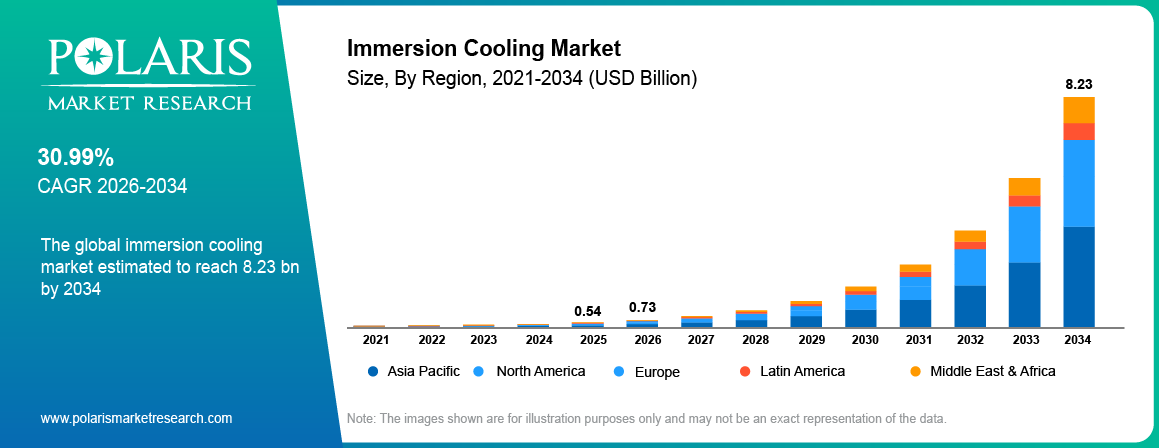
The global immersion cooling market size was valued at USD 0.54 billion in 2025 and is projected to exhibit a CAGR of 30.99% during 2026–2034. The increasing adoption of high-performance data centers and surging demand for heavy electronics devices by various industries are propelling the market demand. The immersion cooling solution manages heat generation by heavy chips, computers, and electronic appliances; thereby, manufacturers worldwide are highly adopting this solution.
Market Statistics
Key Takeaways
- North America held 34.68% market share in 2025 driven by growth in data centers infrastructure, high-density computing, and advanced thermal management investments.
- Asia Pacific is expected to witness a 33.90% CAGR during 2026–2034, fueled by increasing AI infrastructure, hyperscale capability, and energy efficiency needs.
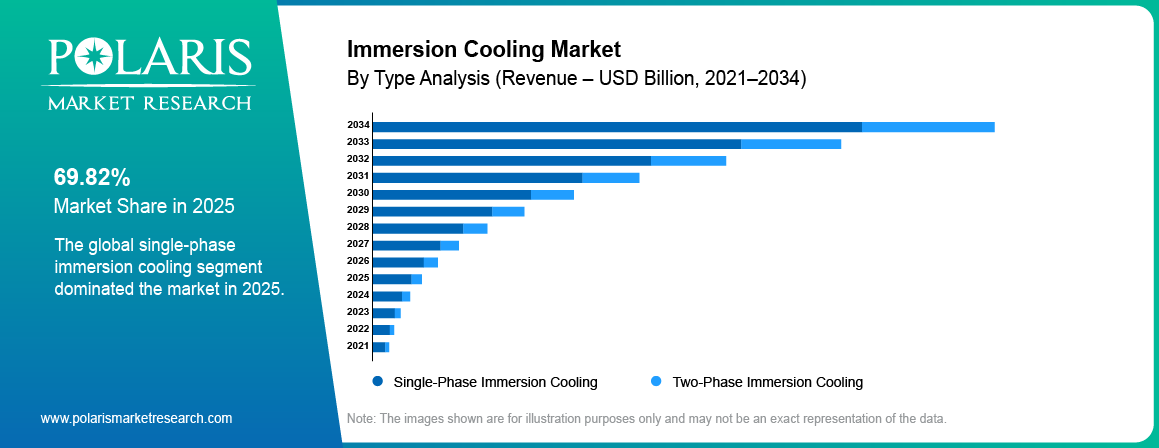
- Single-phase constituted 69.82% of total market revenue in 2025. This is attributed to its relevance in terms of its applicability in meeting cooling needs in high-density computing environments.
- The two-phase technology is anticipated to generate the highest 34.30% CAGR during the projected period because of analysis of efficient thermal management technologies in increasingly dense computing environments.
- The mineral oil accounted for 43.18% of immersion cooling market share in 2025 due to its proven usage in immersion cooling systems.
- The AI data center category held 25.36% market share in 2025 and is emerging as an important demand sector due to increasing rack densities (kW per rack) and thermal needs of accelerators.
Note: Figures and projections outlined in this report are the result of Polaris Market Research’s proprietary analytical processes, grounded in the latest available datasets and market observations.
What is Immersion Cooling?
Immersion cooling is a thermal management technology that places computing equipment directly into a non-conductive dielectric fluid. It takes the heat generated by the processors, memory, storage and other components and transports it through a heat exchanger or other cooling infrastructure. The data center immersion cooling market consists of systems, fluids, infrastructure and services used in this approach. The technology is different from traditional air cooling and is a narrower subset of the wider liquid immersion cooling market and data center liquid cooling ecosystem.
The market consists of single-phase and two-phase immersion cooling systems, which use different heat transfer mechanisms. Single-phase systems circulate liquid coolant through a heat-rejection system while in the liquid state. Two-phase configurations use evaporation and condensation as a part of the thermal cycle. Technology selection is a function of workload density, equipment compatibility, cooling requirements, facility design, fluid characteristics, maintenance practices, and total cost. These variables affect adoption in hyperscale, enterprise, colocation, edge, and specialized computing environments.
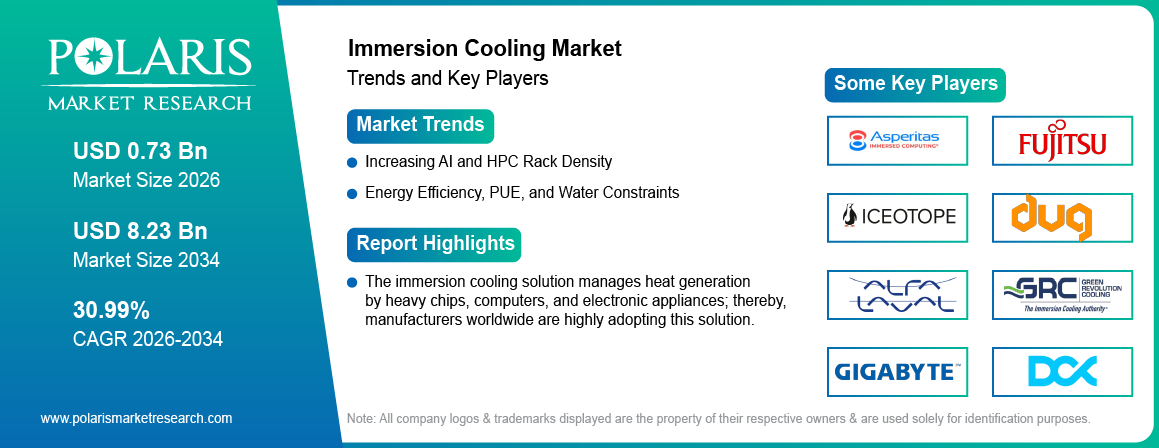
Immersion cooling market trends are more and more tied to AI infrastructure, high-performance computing and the rising thermal demands of advanced processors. Higher accelerator TDP and rack-level power density can increase the limitations of conventional cooling configurations. Operators therefore evaluate immersion alongside direct-to-chip cooling, rear-door heat exchangers, and advanced air systems. The market is also evolving around chassis-level architectures, non-PFAS fluids, equipment qualification, waste heat recovery and integration with existing data center infrastructure.
The immersion cooling market forecast is driven by the growing demand for thermal management systems that can handle dense computing workloads. AI data centers, HPC facilities, colocation sites and edge deployments are important application areas, though adoption will depend on the infrastructure requirements and the operating economics. Thermal performance, material compatibility, lifecycle management, and environmental and regulatory issues are also making the choice of fluid more important for operators. These factors are affecting competition among immersion cooling companies for technology, fluid, infrastructure, and service categories.
How Does Immersion Cooling Work
Immersion cooling starts when the computing equipment is running and generating heat. The dielectric fluid takes the thermal energy directly from the equipment immersed in it, so there is less need for air movement around individual pieces of equipment. In single phase systems, heated liquid is sent to a heat exchanger in which thermal energy is transferred to another cooling loop. In systems with two phases, the fluid turns to vapor from liquid and back to liquid by condensation. The cooled fluid is then returned to the immersion environment and the heat removal cycle continues.
Primary Steps in Immersion Cooling Process
- Server heat generation: Processors, memory, storage, and other components generate heat.
- Fluid heat absorption: The dielectric fluid directly absorbs heat from immersed equipment.
- Circulation or phase change: Heated fluid circulates or changes phase depending on the architecture.
- Heat transfer: Thermal energy moves toward the heat exchanger or facility cooling system.
- Cooling or condensation: The fluid is cooled or vapor is condensed back into liquid.
- Fluid return: The cooled fluid returns to the immersion environment.
Immersion Cooling vs Other Data Center Cooling Technologies
The comparison of immersion cooling vs air cooling is comparing how heat is removed from computing equipment. With immersion cooling, the hardware is directly submerged into the dielectric fluid, while traditional air-cooling infrastructure uses airflow and mechanical cooling to pull heat away from the servers. Rear door heat exchangers extract heat at the rack level and direct to chip systems use cold plates mounted to selected components. Immersion therefore represents one option within a wider cooling technology landscape. Technology selection depends on rack density, facility design, equipment configuration, operating requirements, and total cost.
Air Cooling vs Rear-Door Heat Exchanger vs Direct-to-Chip vs Immersion Cooling
| Dimension | Air cooling | Rear-door heat exchanger | Direct-to-chip (cold plate) | Immersion cooling |
| Heat-removal method | Moves heated air to CRAH/CRAC units. | Heat exchanger in the rack door cools exhaust air. | Cold plates on CPUs/GPUs carry heat to a CDU loop. | Dielectric fluid contacts most or all components and carries heat to a heat exchanger. |
| Residual air cooling | All heat. | Most heat still enters the air first. | Memory, storage and power parts typically still air-cooled. | Little or none; fans largely removed. |
| Rack-density suitability | Practical limit often cited near 50 kW per rack. | Moderate densities; extends air-cooled rooms. | Hyperscale AI racks above 135 kW are liquid-cooled (NVIDIA). | Up to ~250 kW per rack reported |
| Retrofit complexity | None. | Low; door swap. | Moderate; manifolds, CDUs, server redesign. | High; tanks or chassis, fluid handling, floor loading. |
| Facility changes | None. | Facility-water connection. | Secondary fluid loop, CDUs. | Heat exchangers, facility-water loop, containment, service area. |
| Serviceability | Familiar. | Familiar. | Hot-swappable quick-connects; leak management. | New workflows: lifting, draining, cleaning. |
| Hardware compatibility | Universal. | Universal. | OEM-designed liquid-ready servers. | Materials and warranty qualification needed. |
| Water and PUE implications | Highest cooling load. | Reduces air-side load. | Lower fan load; supports warmer facility water. | Lowest fan and chiller load; depends on heat-rejection design. |
| Target workloads | General IT. | Mixed-density halls. | Mainstream AI/HPC racks today. | Extreme density, edge AI, HPC, crypto. |
Source: Polaris Market Research Analysis
Immersion Cooling vs Direct-to-Chip Liquid Cooling
The immersion cooling vs direct-to-chip comparison is increasingly important in AI infrastructure. Direct-to-chip systems use cold plates attached to selected heat-generating components, whereas immersion cooling places most or all relevant computing equipment in dielectric fluid. Direct-to-chip can retain more elements of conventional server architecture, while immersion changes the thermal environment around the equipment. Direct-to-chip currently has a strong position in AI rack deployments, making compatibility, density, facility integration, serviceability, and total cost important factors for immersion providers competing for high-density workloads.
Market Dynamics
Driver: Increasing AI and HPC Rack Density
The rapid growth of AI and HPC workloads is creating thermal management challenges in high-density data centers. As the rack density (kW per rack) increases, AI accelerators and high performance processors generate significant heat, increasing the pressure on conventional air cooling. Immersion cooling of AI data centers enables direct heat extraction from computing equipment into a dielectric coolant, helping with the management of concentrated thermal loads. Higher processor power also has implications for infrastructure planning, due to the increased risk of thermal throttling from higher thermal design power (TDP). In January 2026, Infinium introduced the Infinium Edge platform for high-density AI data center immersion cooling, offering an infrastructure solution optimized for next-generation AI workloads. The rising emphasis on AI data center water and cooling compliance is fueling demand for single-phase immersion cooling, two-phase immersion cooling, and other advanced liquid cooling architectures. (Source: prnewswire.com)
Driver: Energy Efficiency, PUE, and Water Constraints
Rising concerns about energy use in data centers and about water availability are driving interest in advanced cooling technologies. With increasing computing density, traditional cooling infrastructure can require a significant amount of mechanical cooling and airflow management. Immersion systems can decrease the dependence on air movement by direct heat transfer through immersion cooling fluids/dielectric fluid. Therefore, the selection of cooling architectures considers the thermal performance in conjunction with power usage effectiveness (PUE) and water usage effectiveness (WUE). In October 2026, Valeo announced aluminum cooling technology for data centers, which it said would reduce electrical consumption by 25% and improve PUE and CUE. Demand for technologies that support high-density computing while addressing facility-level resource constraints is also driving the immersion cooling market. However, the PUE and WUE results are still subject to full facility design. (Source: Valeo)
Driver: Colocation, Edge and Modular Deployments
The rise of colocation, edge computing, and modular data centers is creating new opportunities for immersion cooling in distributed computing environments. Space, noise, environmental, and cooling infrastructure limitations on edge AI facilities are increasing interest in compact thermal management solutions. Colocation operators also need to accommodate different workloads and increasing rack density (kW per rack) across tenant environments. Immersion cooling in colocation/edge AI applications can provide an alternative architecture for selected high-density deployments. Modular facilities produced at a factory can also include tanks or chassis, heat exchangers, coolant distribution units (CDUs), and associated infrastructure in standardized platforms.
Restraint: Hardware Compatibility and Qualification
One of the major restraints of the liquid immersion cooling market is hardware compatibility, as computing equipment has to work reliably when directly exposed to dielectric fluids. Compatibility testing may be required for components like elastomers, cable insulation, labels, adhesives, connectors, SSDs, memory and optical transceivers before deployment. Server manufacturers can also add additional operator evaluation requirements by specifying qualification requirements for immersion environments. Therefore, immersion cooling warranty/OEM certification can influence purchase decisions, especially for enterprises and colocation providers with mixed server environments. Validating equipment compatibility may extend deployment times, increase qualification costs, and raise operational complexity compared with traditional air cooling or some direct-to-chip arrangements.
Restraint: Infrastructure and Retrofit Complexity
The demand for infrastructure may limit the use of immersion cooling in today’s data centers. Immersion systems at the tank or chassis level may require changes to equipment layouts, floor loading, service areas, heat exchangers, pumps, Coolant Distribution Units (CDUs), and facility water loops. Existing infrastructure (electrical, mechanical, rack, and maintenance) built around traditional cooling technologies at brownfield facilities may require more extensive integration requirements. Immersion infrastructure can be integrated into the initial facility planning for greenfield projects, but retrofit projects will need an additional engineering assessment. These factors impact immersion cooling cost/TCO and can affect payback periods. Operators must therefore consider infrastructure changes, equipment compatibility, maintenance access and lifecycle economics prior to adopting an immersion architecture.
Opportunity: PFAS-Free Fluids and New Architectures
As operators consider environmental, regulatory, and lifecycle factors, PFAS-free dielectric fluid solutions are creating opportunities for immersion cooling providers and fluid manufacturers. Orbital Industries Raises USD 50 Million in Series B Funding to Scale Its AI-Designed, PFAS-Free Cooling Fluid and Modular Data Center Infrastructure for Next-Gen GPUs. There is also interest in alternative architectures out there in the market, like chassis-level systems that offer more flexibility for deployment than larger tank-based configurations. These solutions can expand potential applications across enterprise, edge, colocation, and specialty computing environments. Demand for Novec replacement for immersion cooling is also increasing attention to alternative fluid chemistry. However, replacement fluids require evaluation across thermal performance, material compatibility, equipment qualification, availability, lifecycle management, and applicable regulatory requirements before commercial deployment. (Source: Orbital Industries)
Immersion Cooling Market Segmentation Analysis
The immersion cooling market segmentation includes type, cooling fluid, application, architecture, component, and region. The segmentation distinguishes immersion technologies from other data center liquid cooling systems and captures the increasing diversity of deployment models. The analysis considers single-phase and two-phase systems, different dielectric fluid categories, AI and HPC workloads, cryptocurrency mining, tank-based and chassis-level architectures, and related solutions and services. Regional analysis covers North America, Europe, Asia Pacific, Latin America, and Middle East & Africa.
Type Insights
The single-phase immersion cooling segment dominated the market in 2025, accounting for 69.82% of the immersion cooling market share. The technology circulates a dielectric coolant in liquid form to absorb heat from immersed computing equipment and transfer it to a heat exchanger. Its proven architecture enables applications for enterprise data centers, HPC facilities and high density computing. Demand is affected by rack density, heat rejection requirements, equipment compatibility, fluid characteristics and maintenance requirements. The increasing use of advanced thermal management solutions is strengthening the market position of single-phase systems, as operators seek scalable alternatives to traditional air cooling and evaluate immersion cooling fluids / dielectric fluid for high-density workloads.
The two-phase immersion cooling segment is expected to have the highest CAGR of 34.30% during the forecast period of 2026-2034. The technology removes heat from the computing equipment by using evaporation and condensation as the dielectric fluid goes from liquid to vapor and back to liquid through condensation. This architecture is garnering interest for applications that need intensive thermal management as processor power and rack density (kW per rack) grow. Adoption depends on fluid chemistry, containment, equipment compatibility, maintenance and facility integration. As data center operators consider thermal performance, infrastructure requirements, lifecycle economics and equipment qualification, the single-phase vs two-phase immersion cooling comparison is gaining in importance.
Single-Phase vs Two-Phase Immersion Cooling
| Dimension | Single-phase | Two-phase |
| Heat-removal mechanism | Fluid absorbs heat as sensible heat and carries it to a heat exchanger by natural or pumped convection. | Fluid boils on hot surfaces (latent heat); vapour condenses on a condenser and drips back. |
| Fluid state | Stays liquid throughout. | Cycles between liquid and vapour at a fixed boiling point. |
| Typical fluids | Mineral oil, synthetic hydrocarbons, esters, engineered dielectrics. | Engineered fluorinated fluids (hydrofluoroethers, fluoroketones, hydrofluoroolefins). |
| Fluid characteristics | High boiling and flash points; higher viscosity; lower cost per litre. | Low, fixed boiling point (roughly 30–60 °C for historically used fluids; low viscosity; non-flammable; higher cost. |
| System complexity | Simpler tanks (open or closed), pumps and heat exchanger; no vapour management. | Sealed tanks, condensers and vapour containment; tighter engineering tolerances. |
| Fluid management | Low evaporation; losses mainly from drag-out during servicing; needs filtration and oxidation monitoring. | Vapour loss when tanks are opened; vapour recovery and fluid-loss monitoring required. |
| Maintenance and serviceability | Servers lifted out wet; cleaning and drip handling needed. | Equipment comes out largely dry as fluid evaporates; service workflow depends on vapour handling. |
| Operating temperature | Bath temperature floats with the secondary loop, supporting warm-water heat rejection. | Fixed by the fluid's boiling point, giving a stable component temperature. |
| Heat-flux ceiling | Forced-convection designs target high densities (GRC reports a 100 kW/rack production deployment; Asperitas DFC cites >3.6 kW per U). | Highest heat-flux capability; used for the most extreme chips and dense racks. |
| Regulatory exposure | Hydrocarbon fluids are outside the PFAS debate. | Fluorinated fluids face PFAS-related supply and regulatory pressure after 3M's exit. |
| Market position | Larger share 69.82 | Faster growth 34.30% |
Source: Polaris Market Research Analysis
Cooling Fluid Insights
The mineral oil segment accounted for 43.18% of the immersion cooling market share and dominated the cooling fluid market in 2025. Mineral oil is a well known dielectric coolant for immersion systems that can be used for direct heat removal from computing equipment. Adoption depends on availability of data center liquid cooling fluids, thermal properties, equipment compatibility, handling, maintenance and lifecycle economics. The segment benefits from applications in data centers and other high density computing environments where operators require direct liquid-based heat removal. Mineral oil continues to be an important part of the overall mineral oil / synthetic hydrocarbon / ester / bio-based dielectric fluid landscape as customers evaluate fluid choices.
Synthetic hydrocarbon segment is expected to be the fastest-growing segment in the cooling fluids market with a CAGR of 32.00% during the period of 2026-2034. Operators are evaluating dielectric coolants for thermal performance, material compatibility, operating life, fluid management, and system requirements and synthetic hydrocarbon fluids are receiving attention. High density computing is being more and more deployed and the requirement for cooling fluids capable of withstanding high thermal loads and providing dependable operation is increasing. The segment also forms part of the wider transition toward alternative immersion cooling fluids as customers assess environmental considerations and lifecycle performance. Continued development of fluid formulations can create additional opportunities across AI, HPC, enterprise, and specialized computing applications.
| Class | Chemistry | Thermal / viscosity | Material compatibility | Safety | Environmental / regulatory | Lifecycle needs |
| Mineral oil | Refined hydrocarbon | High flash point; moderate heat capacity; viscosity rises at low temperature | Can swell some elastomers and plastics; test cables, seals, labels | Combustible; low toxicity; spill and slip hazard | Not PFAS; biodegradability varies by grade | Filtration; oxidation monitoring; drag-out recovery |
| Synthetic hydrocarbons (e.g. polyalphaolefin) | Engineered paraffinic fluids | Tighter viscosity range and better purity than mineral oil | Generally similar to mineral oil; verify per fluid | High flash point; low toxicity | Not PFAS; typically higher cost | Filtration; oxidation monitoring |
| Fluorocarbon-based fluids | Fluorinated (hydrofluoroethers, perfluorocarbons, fluoroketones, hydrofluoroolefins) | Low viscosity; fixed boiling point for two-phase; high heat-flux capability | Typically broad plastics compatibility; verify | Non-flammable; exposure and vapour handling controls | PFAS-related regulation; 3M exit from PFAS manufacturing by end-2025; some have high global-warming potential | Vapour recovery; strict loss control; end-of-life disposal |
Source: Polaris Market Research Analysis
Application Insights
The AI data centers segment dominated the application landscape in 2025, accounting for 25.36% of the immersion cooling market share. Increasing deployment of AI accelerators and high-performance processors is raising thermal management requirements across data center infrastructure. Immersion cooling for AI data centers provides a different way to cool than air cooling and direct-to-chip liquid cooling for some high-density workloads, with direct contact between dielectric fluid and computing equipment. Demand for advanced cooling architectures is being driven by increasing thermal design power (TDP) and rack-level power requirements. Adoption is affected by server qualification, facility design, energy economics, workload density, equipment compatibility and operator requirements.
The cryptocurrency mining immersion cooling segment is expected to be the fastest growing application segment with a CAGR of 34.85% during 2026 – 2034. Cryptocurrency mining immersion cooling can offer direct heat removal from continuously running computing equipment and support environments where traditional air cooling creates thermal, acoustic, or space constraints. Demand is a function of mining hardware utilization, electricity costs, operating conditions, equipment density and cooling economics. Immersion systems are available to keep intensive computing workloads under proper operating conditions, but adoption is susceptible to cryptocurrency market conditions and hardware investment cycles. This application is a niche opportunity in the overall data center immersion cooling market and should be assessed separately from AI and enterprise deployments.
Architecture Insights
The tank-based immersion segment dominated the architecture space in 2025, with 82.64% share of the immersion cooling market. Tank-based systems consist of several computing units in a common dielectric fluid environment and have centralized thermal management. The architecture supports high-density deployments where facilities have adequate space for immersion tanks, fluid handling, service access, heat exchangers, and associated infrastructure. Adoption will depend on workload density, facility configuration, maintenance requirements, floor loading and heat rejection capacity. Tank based systems remain an important architecture for large scale deployments as operators evaluate immersion cooling as an alternative to conventional air based thermal management.
The chassis level immersion segment is expected to witness fastest growth in terms of architecture with a CAGR of 36.20% during 2026-2034. Chassis-level immersion cooling moves the technology closer to individual servers or equipment enclosures and can provide more flexibility for some enterprise, edge, and retrofit applications. The architecture can reduce some requirements associated with larger shared tanks and may support deployment where space or infrastructure configuration limits conventional tank-based approaches. The tank-based vs chassis-level immersion comparison is therefore becoming increasingly relevant as operators assess serviceability, physical constraints, equipment density, retrofit requirements, and deployment economics. Growing interest in flexible cooling architectures can support adoption through the forecast period.
Tank-Based vs Chassis-Level Immersion
| Dimension | Tank-based | Chassis-level |
| Concept | Servers submerged in an open or closed bath. | Fluid circulated inside a sealed, rack-compatible chassis. |
| Containment | Tank-level; spills managed at tank and floor. | Chassis-level; sealed per server or per module. |
| Server compatibility | Needs immersion-qualified materials; servers sit in the bath. | Designed or modified chassis; keeps liquid away from the data hall. |
| Rack and floor integration | Horizontal or vertical tanks; floor loading and layout change. | Fits standard rack positions. |
| Serviceability | Lift servers out of fluid. | Service at chassis level; less fluid exposed. |
| Fluid volume | Large. | Smaller per server. |
| Example vendors | GRC, Submer, Asperitas, LiquidStack, Midas Green Technologies | Iceotope (chassis-based precision liquid cooling); LiquidCool Solutions |
Source: Polaris Market Research Analysis
Component Insights
The solutions segment dominated the component landscape in 2025, accounting for 72.36% of the immersion cooling market share. Solutions include immersion tanks or chassis, heat exchangers, fluid circulation systems, monitoring equipment, and other thermal management infrastructure needed for deployment. The demand is coming from data center expansion, AI and HPC workloads, increasing rack density, and the requirement for advanced cooling architectures. Solutions providers must also consider facility integration, equipment compatibility, fluid management and operational requirements. This segment is the core of the immersion cooling ecosystem and is tightly integrated with the coolant distribution units (CDUs), facility-water loops and other supporting infrastructure.
The services segment is projected to be the fastest growing component category and is expected to grow at a CAGR of 33.80% during 2026-2034. Services may include system design, installation, integration, maintenance, monitoring, fluid management, technical support and equipment qualification. With the increased use of immersion systems comes the need for specialized expertise in handling dielectric fluids, immersed hardware, heat rejection systems, maintenance procedures, and facility integration. Service providers can also support brownfield retrofits and help customers evaluate immersion cooling cost/TCO, compatibility and lifecycle requirements. Growth in services is therefore linked to wider technology adoption and the increasing complexity of deploying immersion cooling across enterprise and data center environments.
Key Areas of Immersion Cooling Market
Data Center Infrastructure and Retrofit Considerations
Immersion systems require an infrastructure ecosystem that extends beyond the tank or chassis. Key elements can include heat exchangers, coolant distribution unit (CDU) systems, pumps, facility-water loops, monitoring equipment, service areas, electrical infrastructure, and appropriate floor loading. In greenfield facilities these requirements can be incorporated into the original design. Brownfield facilities may need engineering changes. Operators also must consider equipment movement, maintenance access, fluid handling, spill management and integration with existing cooling systems. These requirements directly influence the economics of deployment and project timelines.
Hence brownfield and greenfield deployments have different commercial considerations. Greenfield facilities can design their cooling architecture around the immersion system they choose from the outset, reducing some integration constraints. Modifications may be needed to existing facilities for tanks or chassis, heat exchangers, fluid systems, service areas and structural needs. For retrofit projects, existing server warranties and maintenance procedures need to be considered too. The economics of the resulting project depend on infrastructure condition, workload density, available space, facility cooling loops, and the relative cost of upgrading conventional cooling infrastructure.
Standards, Compatibility and Qualification
Standards, equipment compatibility and qualification requirements all influence the adoption of immersion cooling across data center environments. Operators need to be confident that computing hardware, materials, fluids, connectors, storage devices, and other components can operate reliably in the chosen cooling environment. Industry requirements may also influence system design and procurement specifications. Technical validation is an important step before commercial deployment as the qualification process has impact on OEM support and warranty conditions. These considerations heighten the need for collaboration between fluid suppliers, server manufacturers, immersion system providers, data center operators, and industry organizations.
OCP and ASHRAE Standards
The Open Compute Project immersion requirements are relevant for efforts to improve consistency in immersion system design and deployment. The OCP Immersion Cooling effort covers technical topics such as system requirements, material compatibility and fluid specifications. Data center cooling practices and infrastructure planning can also be influenced by ASHRAE standards and industry guidelines. Standardization remains important because consistent requirements can reduce qualification uncertainty and help operators compare equipment and system designs.
Material Compatibility, Warranty and Server Qualification
Material compatibility is a critical consideration because immersion fluid directly contacts components that were not necessarily designed for liquid exposure. Pre-deployment evaluation of elastomers, cable insulation, labels, adhesives, connectors, SSDs, memory and optical transceivers may be necessary. Immersion cooling warranty/OEM certification requirements can also influence customer decisions, as operators need to know about equipment support under immersion conditions. This may involve fluid compatibility testing, thermal evaluation, component testing and warranty review. These requirements create a technical pathway that suppliers must address before large-scale adoption.
Energy, Water and Total Cost of Ownership
Energy, water, and total cost of ownership are important considerations in immersion cooling investment decisions. Operators need to evaluate equipment, fluids, heat exchangers, facility modifications, maintenance, service, and cooling energy together rather than comparing only the price of individual cooling equipment. The resulting economics vary by workload density, facility age, energy prices, water constraints, infrastructure design, and deployment scale. Immersion cooling TCO analysis should therefore compare the full lifecycle cost of immersion against alternative cooling configurations for the specific facility and workload.
PUE and WUE Impact
Immersion cooling can influence facility-level PUE / WUE performance by changing the requirements for air movement, mechanical cooling, and water-based heat rejection. The effect depends on the complete data center design, including IT load, cooling infrastructure, climate, facility-water systems, power distribution, and operating practices. Operators should therefore avoid treating a technology-level efficiency claim as equivalent to a guaranteed facility PUE improvement. Measured and dated data should be used for quantitative comparisons, particularly when evaluating investment decisions or comparing greenfield and retrofit facilities.
Waste Heat Reuse
Higher coolant temperatures can increase the potential usefulness of recovered data center heat for suitable downstream applications. Waste heat reuse can support heating or other thermal requirements when an appropriate heat consumer is located near the data center and the recovered temperature matches the application. The commercial opportunity depends on heat demand, infrastructure connectivity, seasonal requirements, and the cost of recovery equipment. Immersion systems can therefore be evaluated as part of broader energy management strategies where local conditions make heat recovery technically and economically practical.
CAPEX, OPEX and Payback
Immersion cooling cost / TCO depends on capital investment, operating requirements, infrastructure changes, and potential efficiency or space benefits. CAPEX may include tanks or chassis, dielectric fluids, heat exchangers, CDUs, pumps, monitoring systems and server modifications. OPEX can be cooling energy, maintenance, fluid handling, monitoring and service. Payback depends on the facility’s workload density, energy costs, cooling requirements, retrofit needs and alternative infrastructure. Capital cost varies by tank design, fluid choice and facility retrofit scope..
Immersion Cooling Market Regional Insights
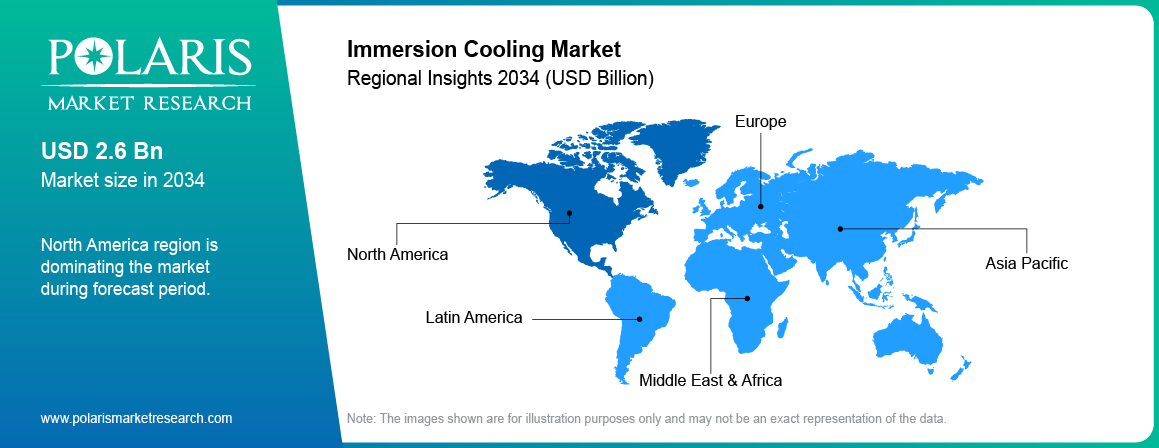
Demand for immersion cooling in a region is driven by AI infrastructure, immersion cooling hyperscale deployments, HPC workloads, energy efficiency, water constraints, and local data center development. North America and Asia Pacific are still key markets for high-density computing, and Europe offers opportunities from energy efficiency and reuse of heat. Digital infrastructure is expanding, and Latin America and the Middle East & Africa provide new opportunities.
North America Immersion Cooling Market Trends
North America accounted for the largest share of the immersion cooling market in 2025 with 34.68% of the market, owing to the hyperscale data center expansion, AI infrastructure, HPC workloads, and advanced computing investments. August 2026 – Unisys and Refroid Technologies Partner to Accelerate High-Performance AI Infrastructure via Integration of Liquid Cooling Technologies with Global Deployment, Commissioning and Lifecycle ServicesThe US is a large market for hyperscale, enterprise, colocation, and AI deployments Higher rack density (kW per rack) and higher thermal design power (TDP) are spurring operators to consider immersion, direct-to-chip and other liquid cooling technologies. Increasing demand for immersion cooling for AI data centers is also creating opportunities for advanced thermal management solutions. The region has a mature technology ecosystem including data center operators, server manufacturers, fluid suppliers and providers of cooling technologies. (Source: Unisys)
Asia Pacific Immersion Cooling Market Trends
Asia Pacific accounted for 28.46% of the immersion cooling market share in 2025 and is projected to register the fastest CAGR of 33.90% during 2026–2034. Growth is driven by hyperscale infrastructure, AI capacity, cloud adoption, HPC workloads and rising data center investments in China, Japan, India, South Korea, Singapore and Australia. In October 2025, LG Electronics, SK Enmove and GRC signed MOU to jointly develop liquid immersion cooling solutions for AI data centers. Increasing regional computing density is fueling the North America / Asia Pacific / India opportunity in the immersion cooling market. The adoption is being aided by the increasing demand for immersion cooling for AI data centers, single phase immersion cooling and two phase immersion cooling. Data center capacity and digital infrastructure is expanding and India is becoming a big market too. (Source: lg.com)
Europe Immersion Cooling Market Trends
In 2025, Europe accounted for 25.72% of the immersion cooling market share, driven by the increasing emphasis on energy efficiency, water management, sustainable data center development, and waste heat reuse. Submer showcased its data center immersion-cooling technology at the EU-Canada Cleantech Innovation Showcase in Vancouver in October 2026. Immersion systems are unlocking doors for increasing workloads of HPC and advanced computing. When adopting advanced cooling technologies, data center operators are considering PUE, WUE, dielectric coolant selection and infrastructure needs. The rise in demand for efficient thermal management across high-density computing environments is also supporting the liquid immersion cooling market in the region. (Source: sustainablebiz.ca)
Latin America Immersion Cooling Market Trends
Latin America immersion cooling market share was 6.12% in 2025 and will witness significant growth on account of increasing data center capacity, cloud infrastructure, digital services and HPC adoption. Brazil and Mexico are important markets for the growing demand for computing in enterprise and data center environments. The increasing rack density (kW/rack) is generating the need for advanced thermal management solutions. The application of immersion cooling is determined by the energy source, equipment compatibility, infrastructure needs, the economics of cooling, and the availability of specialized technical services in the developing data center markets.
Middle East & Africa Immersion Cooling Market Trends
Middle East & Africa accounted for 5.02% of the immersion cooling market share in 2025, supported by data center expansion, AI infrastructure, cloud adoption, and digital transformation. Increasing computing density and thermal requirements are creating opportunities for liquid immersion cooling solutions. Adoption depends on power availability, water constraints, workload density, equipment qualification, and facility infrastructure. Growing interest in energy-efficient thermal management is also creating opportunities for immersion cooling for AI data centers, particularly across emerging high-density computing and advanced data center deployments.
Hyperscaler and Enterprise Deployments
Hyperscalers and enterprises approach immersion cooling from different infrastructure and procurement perspectives. Hyperscale facilities can evaluate cooling architecture across large computing environments where rack density, scalability, energy efficiency, and standardization are important. Enterprises may focus more heavily on compatibility with existing servers, warranties, serviceability, retrofit requirements, and integration with established facility systems. Colocation providers sit between these models because they need to support different workloads and tenant requirements. These differences create multiple adoption pathways for immersion cooling rather than one uniform deployment model.
| Operator | Technology | Detail |
| Hyperscale cloud operator | Two-phase immersion | Production tank deployment in Washington; reported as an early production deployment of two-phase immersion cooling. |
| Cloud service operator | Single-phase immersion | Reported testing of single-phase immersion cooling with 36% lower energy use and PUE of 1.07. |
| Enterprise / data center operator | Single-phase immersion | Reported production deployment reaching approximately 100 kW per rack, demonstrating immersion cooling for high-density computing. |
| Data center operators | Two-phase immersion | Reported adoption of two-phase immersion cooling across selected data center deployments. |
| Colocation and enterprise operators | Single-phase immersion | SmartPod-type immersion systems reported across selected colocation and enterprise applications. |
| HPC and enterprise operators | Immersion cooling | Immersion cooling tested for HPC and enterprise data center applications, including evaluation of multi-phase fluids for potential energy reuse. |
| Edge AI operators | Compact immersion-cooled systems | Compact immersion cooling is being evaluated for edge AI applications, including systems showcased at industry events. |
Source: Polaris Market Research Analysis
Competitive Insights
The immersion cooling companies landscape includes providers of immersion tanks and chassis, dielectric fluids, heat exchangers, CDUs, monitoring systems, servers, infrastructure integration, and lifecycle services. Competitive positioning depends on technology architecture, fluid chemistry, equipment compatibility, qualification, service capabilities, and the ability to support high-density workloads. Suppliers are also developing solutions for AI and HPC environments, edge deployments, and retrofit projects. The market is therefore becoming an ecosystem competition in which partnerships across multiple parts of the value chain can influence commercial adoption.
Immersion-Ready Servers, Fluid Suppliers and Value Chain
The immersion cooling value chain extends from fluid chemistry to the final data center operator. The principal sequence is fluid chemistry → tank/chassis → heat exchange → compatible servers → facility integration → monitoring/service → operator. Fluid suppliers influence thermal and material characteristics, while system providers design the immersion environment. Equipment readiness is determined by OEM qualification and server compatibility. The facility integrators hook the system into the site infrastructure. The monitoring and service providers help with operation. This interconnected structure is important to an ecosystem coordinated in a large-scale commercial deployment.
List of Key Players
- Asperitas B.V.
- DCX Polska Sp. z o.o.
- DUG Technology Ltd.
- Fujitsu Limited
- GIGA-BYTE Technology Co., Ltd.
- Green Revolution Cooling, Inc.
- Iceotope Technologies Limited
- LiquidCool Solutions, Inc.
- LiquidStack Holding B.V.
- Midas Green Technologies LLC
- Schneider Electric SE
- STULZ GmbH
- Submer Technologies S.L.
- Vertiv Holdings Co.
- Wiwynn Corporation
Vendor Landscape Snapshot
| Tier | Company (Legal Name) | Headquarters | Category | Immersion Cooling Market Positioning |
| 1 | Submer Technologies S.L. | Barcelona, Spain | Pure-play | Single-phase immersion systems (SmartPod / MegaPod class) for hyperscale, colocation and HPC/AI; broad OEM and data-centre partner ecosystem. |
| 2 | Green Revolution Cooling, Inc. (GRC) | Austin, Texas, USA | Pure-play | Single-phase immersion pioneer (ICEraQ / ICEtank); strong in HPC, AI, crypto-mining and modular data centres. |
| 3 | LiquidStack (a Trane Technologies company) | Carrollton, Texas, USA | Pure-play (now OEM-backed) | Single- and two-phase immersion plus CDUs and direct-to-chip. Trane Technologies announced the acquisition on 17 Feb 2026; completion reported by 4 Mar 2026. |
| 4 | Iceotope Technologies Limited | Sheffield, UK | Pure-play | Precision (chassis-level) liquid cooling, positioned as precision immersion; enterprise, edge and HPC focus. |
| 5 | Asperitas B.V. | Amsterdam, Netherlands | Pure-play | Immersed Computing: natural convection and Direct Forced Convection systems; partners include Shell, Cisco, UNICOM Engineering and STULZ Modular; closed an investment round in 2025. |
| 6 | Midas Green Technologies LLC | Austin, Texas, USA | Pure-play | Markets as Midas Immersion Cooling; single-phase tank solutions for data centres and HPC. |
| 7 | LiquidCool Solutions, Inc. | Rochester, Minnesota, USA | Pure-play | Sealed-chassis, server-level immersion technology; smaller, technology-licensing oriented player. |
| 8 | DCX Polska Sp. z o.o. | Poland | Pure-play | Markets as DCX Liquid Cooling Systems; immersion solutions for data centres. |
| 9 | DUG Technology Ltd. | Perth, Australia | Pure-play / HPC operator | DUG Cool immersion technology developed alongside its own HPC and seismic-processing operations. |
| 10 | Wiwynn Corporation | Taipei, Taiwan | Server OEM/ODM | Hyperscale server maker with immersion-ready systems and cooling partnerships; strong cloud-provider relationships. |
| 11 | GIGA-BYTE Technology Co., Ltd. | New Taipei City, Taiwan | Server OEM | Immersion-compatible servers; collaborations with immersion vendors (e.g., Asperitas). |
| 12 | Fujitsu Limited | Tokyo, Japan | System vendor | Immersion-cooled system offerings, largely partner-led. |
| 13 | Vertiv Holdings Co. | Westerville, Ohio, USA | Diversified thermal | Broad data-centre thermal portfolio; immersion is one part, with greater strength in direct-to-chip and facility cooling. |
| 14 | Schneider Electric SE | Rueil-Malmaison, France | Diversified energy / cooling | Liquid cooling push via Motivair acquisition and partnerships; immersion presence is partner-led. Verify immersion specifics. |
| 15 | STULZ GmbH | Hamburg, Germany | Cooling / modular DC | Confirmed cooperation with Asperitas (STULZ Modular + Asperitas immersion modular data centre). |
Source: Polaris Market Research Analysis; Tiers are qualitative and do not represent market share
Recent Developments
- May 2026, Iceotope raised USD 26 million in Series B Funding to grow engineering, IP, and ecosystem partnerships to scale advanced liquid cooling solutions. (Source: HPCwire)
- March 2026, GRC and UNICOM Engineering unveiled fully integrated immersion-cooled AI solutions for AI, HPC, GPU-as-a-service, high-density computing and edge applications. (Source: UNICOM Engineering)
- February 2026, Trane Technologies signed a definitive agreement to acquire LiquidStack, a global company offering liquid cooling technology for data centers, headquartered in Carrollton, Texas. (Source: Trane Technologies)
- February 2026, Perstorp added new PFAS-free Synmerse DC immersion cooling fluids an Synplate DC cold-plate fluids to data center cooling portfolio. (Source: Perstorp)
- February 2026, Asperitas and UNICOM Engineering entered a commercial agreement to provide immersion cooling systems and immersion-ready servers through a single contract. (Source: Asperitas)
Immersion Cooling Market Segmentation
By Type Outlook (Revenue, USD Billion, 2021–2034)
- Single-Phase Immersion Cooling
- Two-Phase Immersion Cooling
By Architecture Outlook (Revenue, USD Billion, 2021–2034)
- Tank-Based Immersion Cooling
- Chassis-Level Immersion Cooling
By Cooling Fluid Outlook (Revenue, USD Billion, 2021–2034)
- Mineral Oil
- Synthetic Hydrocarbon Fluids
- Fluorocarbon-Based Fluids
- Ester-Based Fluids
- Bio-Based Dielectric Fluids
- Others
By Application Outlook (Revenue, USD Billion, 2021–2034)
- AI Data Centers
- High-Performance Computing (HPC)
- Enterprise Data Centers
- Colocation Data Centers
- Cryptocurrency Mining
- Edge Computing
- Others
By Component Outlook (Revenue, USD Billion, 2021–2034)
- Solutions
- Services
By Regional Outlook (Revenue, USD Billion, 2021-2034)
- North America
- U.S.
- Canada
- Europe
- Germany
- France
- UK
- Italy
- Spain
- Netherlands
- Russia
- Rest of Europe
- Asia Pacific
- China
- Japan
- India
- Malaysia
- South Korea
- Indonesia
- Australia
- Vietnam
- Rest of Asia Pacific
- Middle East & Africa
- Saudi Arabia
- UAE
- Israel
- South Africa
- Rest of Middle East & Africa
- Latin America
- Mexico
- Brazil
- Argentina
- Rest of Latin America
Immersion Cooling Market Report Scope
| Report Attributes | Details |
| Market Size in 2025 | USD 0.54 Billion |
| Market Size in 2026 | USD 0.73 Billion |
| Revenue Forecast by 2034 | USD 8.23 Billion |
| CAGR | 30.99% from 2026 to 2034 |
| Base Year | 2025 |
| Historical Data | 2021–2024 |
| Forecast Period | 2026–2034 |
| Quantitative Units | Revenue in USD Billion and CAGR from 2026 to 2034 |
| Report Coverage | Revenue Forecast, Competitive Landscape, Growth Factors, and Industry Trends |
| Segments Covered |
|
| Regional Scope |
|
| Competitive Landscape |
|
| Report Format |
|
| Customization | Report customization as per your requirements with respect to countries, regions, and segmentation. |
Source: Polaris Market Research Analysis
Future Outlook
The immersion cooling market growth outlook is closely linked to the continued increase in AI and HPC computing density. Single-phase systems are positioned for broader scale-up, while chassis-level architectures can expand deployment flexibility. Non-PFAS fluid development can create new product opportunities, and higher coolant temperatures can improve the potential for heat reuse. Standardization around OCP and ASHRAE requirements can support qualification. At the same time, immersion cooling will continue to coexist with direct-to-chip systems, creating a diversified liquid cooling market rather than a single technology pathway.
Research Methodology
The immersion cooling market report uses secondary research, market estimation, primary validation, forecasting, and data triangulation to assess market trends, technologies, applications, fluids, architectures, and regional opportunities.
Secondary Research & Data Collection
The study reviews company information, technical publications, industry sources, standards, regulatory materials, and data center developments to establish market structure and identify relevant trends.
Market Estimation & Modelling
The market revenue is estimated by type, cooling fluid, application, architecture, component, and region. Forecast assumptions include AI and HPC growth, rack density, data center investment, energy efficiency, water constraints, and technology adoption.
Primary Validation
Industry inputs from technology providers, fluid suppliers, server manufacturers, data center operators, and specialists are leveraged to validate adoption trends, technology preferences, qualification requirements and market assumptions.
Data Triangulation & Final Review
Company data, industry developments, infrastructure investments and regional indicators validate market estimates. The final review verifies market figures, CAGR, segmentation, regional positions, and supporting evidence before publication.
Immersion Cooling Market FAQ's
The global immersion cooling market size was valued at USD 0.54 Billion in 2025 and covers immersion systems and related technologies for data centers and high-density computing.
The market is anticipated to grow at a CAGR of 30.99% during 2026-2034, fueled by AI and HPC workloads, higher computing density, and advanced cooling requirements.
North America dominated the global market in 2025 with 34.68% market share, driven by expanding data center infrastructure, AI workloads, and high-density computing.
Immersion cooling market in Asia Pacific is expected to exhibit the highest CAGR of 33.90% during 2026-2034, owing to AI infrastructure, hyperscale data centers & advanced computing.
Single-phase immersion cooling accounted for the largest share of 69.82% in 2025, due to its rising use in high-density computing environments.
Immersion cooling is the process of submerging computing equipment directly into a non-conductive dielectric fluid that absorbs and carries away heat.
Single-phase systems keep the coolant liquid, while two-phase systems use evaporation and condensation for heat transfer.
Immersion cooling uses dielectric fluid to cool computing equipment while direct-to-chip cooling uses cold plates on selected components.
Common options are mineral oils, synthetic hydrocarbons, esters, bio-based fluids, and fluorocarbon-based fluids. There is growing interest in PFAS-free dielectric fluids for environmental and regulatory reasons.
Yes, they can be used after checks of compatibility and qualification only. Components and fluids for OEM warranty/certification requirements are evaluated prior to deployment.
Yes, immersion cooling supports high-density AI workloads. The advantages and disadvantages of immersion cooling include efficient heat removal and reduced cooling demands, versus challenges related to hardware compatibility, fluid management, maintenance, infrastructure, and TCO.
Liquid cooling uses fluids to remove heat, while immersion cooling submerges servers directly in non-conductive dielectric fluid.
Yes, servers can be submerged in non-conductive dielectric fluids designed for immersion cooling, provided their components are compatible.

Download Sample Report of Immersion Cooling Market
Please fill out the form to request a customized copy of the research report.


