
Industrial HVAC Controls Market Size, Share, and Forecast 2027 to 2035
REPORT DETAILS
Industrial HVAC Controls Market Summary
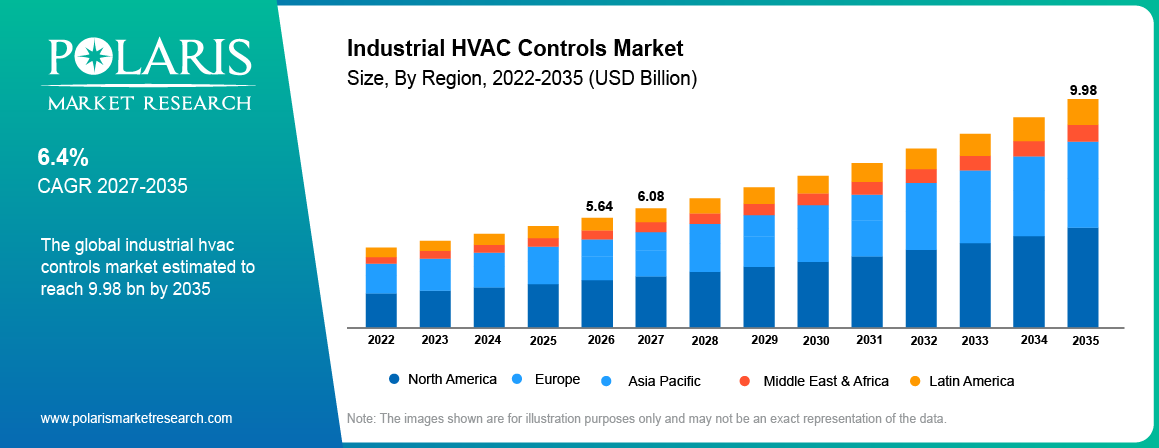
According to Polaris Market Research analysis, the industrial hvac controls market was valued at USD 5.64 Billion in 2026. It is projected to reach USD 9.98 Billion by 2035, growing at a CAGR of 6.4% from 2027 to 2035. Demand comes from plant operators, data center builders, drug makers, and cold chain owners that need tight control of temperature, humidity, airflow, and pressure inside large facilities. Controllers and Panels hold the largest component share, while Software and Analytics expand quickest. The market tracks revenue from controllers, sensors, actuators, and software that run heating, ventilation, and cooling plant in industrial sites, and leaves out the heating and cooling equipment itself. North America is the leading market. Asia Pacific is the fastest growing region.
Market Statistics
Key Takeaways
- Regional revenue in 2027 is led by North America at 31.8%, since the largest base of data center campuses, drug plants, and factory retrofits sits in the United States.
- Asia Pacific is the pace setter among regions with 8.1% yearly growth to 2035, as China opens new plants and India builds factories and data centers at speed.
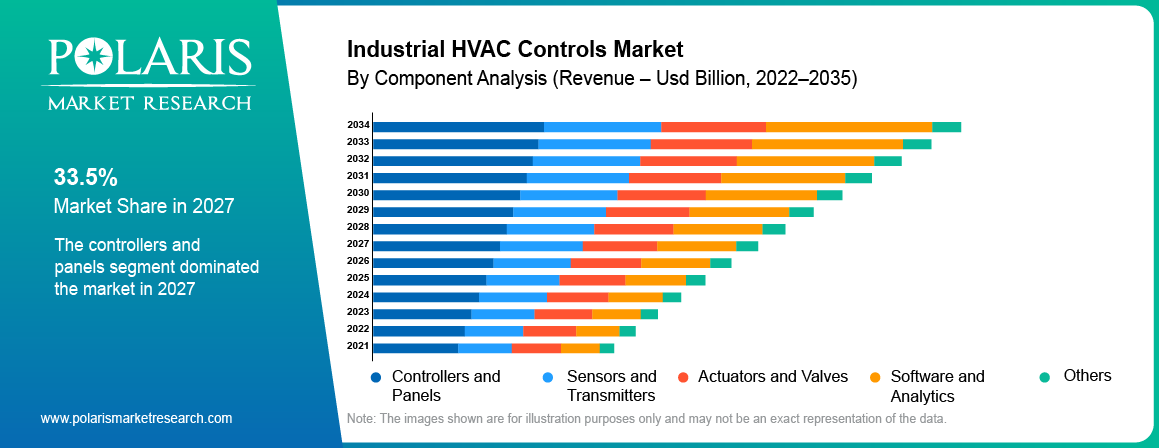
- Component revenue in 2027 is led by Controllers and Panels with 33.5%, owing to their role as the logic unit of each loop in a plant.
- Software and Analytics post the highest component CAGR, 11.6% through 2035, as plant owners buy optimization and fault detection on top of installed controllers.
- Among systems, Building and Facility Management Systems ranks first for 2027 at 30.1%, whereas Chiller and Central Plant Control leads growth among systems at 7.4% a year.
- Wired links give Connectivity 59.9% of 2027 value. Wireless gains 10.6% yearly and outruns the other connectivity types, since retrofit crews skip new cable pulls.
- End use revenue in 2027 goes mostly to Discrete and Process Manufacturing at 37.5%, and Data Centers climb 12.2% a year, the highest rate of any end use, as artificial intelligence loads raise cooling demand.
- Pharmaceuticals and Life Sciences expand 6.3% yearly off a moderate base, since auditors expect recorded room pressure, humidity, and temperature.
Note: Figures and projections outlined in this report are the result of Polaris Market Research’s proprietary analytical processes, grounded in the latest available datasets and market observations.
Industrial HVAC Controls Market Definition
The industrial hvac controls market covers controllers, sensors, actuators, valves, and software that regulate heating, ventilation, air conditioning, and cooling plant in industrial facilities such as factories, data centers, drug plants, and cold stores. It excludes the chillers, boilers, fans, and compressors that these controls operate.
Published estimates for this field diverge widely, as few vendors disclose this slice alone. Some analysts count building automation as a whole, while others add process control or equipment sales. Polaris counts the control layer for HVAC plant at industrial sites, so the total tracks what plants spend on control hardware and software.
Adjacent fields have their own studies. Wider building control platforms are covered in the building automation system market, and measurement and control for plants belongs to the process automation and instrumentation market. A product counts here once its main job is to sense, decide, or drive an HVAC loop in an industrial site.
Four product families generate revenue. Controllers and panels hold the logic, sensors and transmitters report temperature, humidity, pressure, and airflow, and actuators and valves move dampers and water flow. Software and analytics sit on top to schedule, tune, and diagnose each loop.
Commercial terms vary with the buyer. Large plant owners sign multi year agreements with controls vendors, contractors purchase panels and field devices project by project, and operators renew software through annual licenses or subscriptions.
Site duty changes the economics. Data halls and drug plants demand tight control limits and redundancy, while warehouses and food plants prize rugged devices and low cost of ownership, so price per point differs from one site to the next.
HVAC Equipment vs HVAC Controls: Key Differences
| Attribute | HVAC Equipment | HVAC Controls |
| Output | Moves heat, air, or water | Senses conditions and commands the equipment |
| Typical items | Chillers, boilers, fans, and compressors | Controllers, sensors, actuators, and software |
| Buying cycle | Project based and tied to plant build | Project, retrofit, and recurring software renewal |
| Main benefit | Capacity to heat or cool | Lower energy use, tighter setpoints, and fewer faults |
| Market treatment | Outside the scope of this report | Counted here, with a 6.4% CAGR from 2027 to 2035 |
Source: Polaris Market Research Analysis
Buyers often purchase the two together, since a chiller arrives with its own panel. Polaris counts the control content in this study and leaves machine content to equipment research.
Porter's Five Forces Analysis
| Force | Intensity | Rationale |
| Bargaining power of suppliers | Moderate | Chips, sensors, and enclosures come from open markets, although software platforms and protocol stacks are held by only a few vendors. |
| Bargaining power of customers | High | Large plant owners and data center builders buy at scale and compare bids across vendors, so price and service terms are negotiated on each project. |
| Threat of new entrants | Moderate | Software startups enter with cloud tools, yet field service networks, installed bases, and cyber security approvals slow credible entry into plant duty. |
| Threat of substitutes | Moderate | Equipment makers bundle their own panels and cloud tools, and general automation controllers can run HVAC loops, so some demand shifts between vendor types. |
| Competitive rivalry | High | Global controls groups, HVAC makers, and regional integrators chase the same projects, so installed base, open protocols, and service reach decide share. |
Source: Polaris Market Research Analysis
Installed base and open protocols frequently outweigh list price. A plant with a working building network tends to stay with its vendor for upgrades, so producers invest in backward compatible devices and service teams along with new hardware.
Market Dynamics
Driver Impact Analysis
| Driver | Impact on Market Growth | Time Horizon |
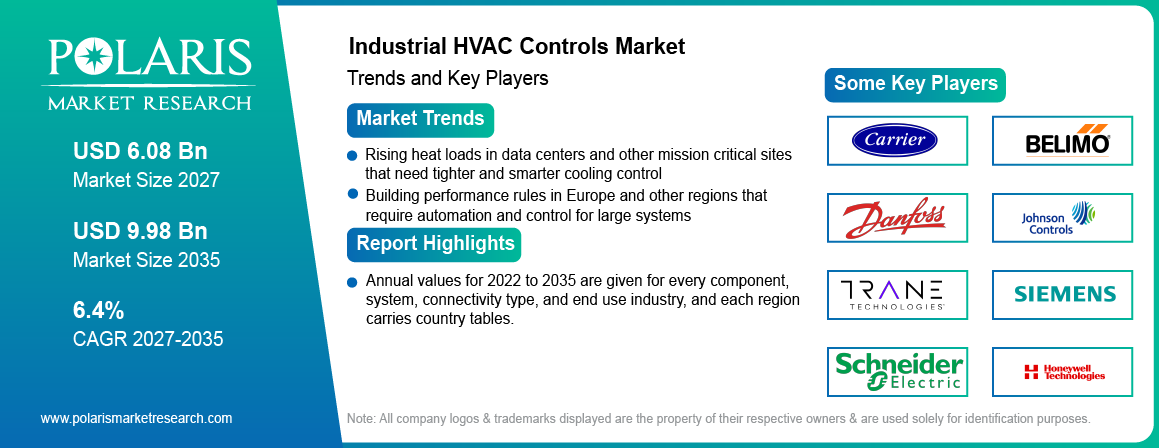
| Rising heat loads in data centers and other mission critical sites that need tighter and smarter cooling control | High | Short to Medium Term |
| Building performance rules in Europe and other regions that require automation and control for large systems | Moderate | Medium to Long Term |
Source: Polaris Market Research Analysis
Driver: Rising Heat Loads in Data Centers Are Increasing Demand for Advanced Cooling Controls, Creating Market Demand
Racks built for artificial intelligence pull much more power than older designs, and almost all of it leaves as heat. Cooling plant must then respond within seconds to load swings, so operators buy controllers, sensors, and software that coordinate pumps, chillers, and fans together.
For example, in July 2026, Johnson Controls published an absorption chiller design guide that models up to 44% lower cooling related electric demand and a power usage effectiveness as low as 1.23 (Source: Johnson Controls). The company says the results are illustrative and not guaranteed, yet the design needs coordinated control of heat recovery, chillers, and loads.
Computing halls expand quickest among end uses, at 12.2% a year through 2035, and they bring in USD 1,353.8 Million in 2027. Chiller and Central Plant Control grows 7.4% a year, owing to central plants that serve dense computing halls.
Redundancy requirements add to unit demand. Mission critical halls specify duplicate controllers, dual power feeds, and extra sensors, so each megawatt of cooling carries more control points than a comparable factory load. Operators also want alarms and trend logs that explain a fault within minutes.
Driver: Building Performance Rules Are Requiring Automation and Control Systems, Creating Market Demand
Energy rules for buildings are moving from guidance to obligation. Large non residential systems must increasingly carry automation that monitors and adjusts energy use, and that requirement turns a voluntary upgrade into a compliance purchase.
For example, in June 2026, Build Up, the portal of the European Commission, noted that the transposition deadline of the recast buildings directive passed on 29 May 2026 (Source: European Commission Build Up). The Netherlands released its first tranche on 7 May 2026, and the page lists automation duties for non residential systems that step down to 70 kilowatts by the end of 2029.
At 5.2% a year, the region grows slower than any other, so compliance projects supply welcome momentum in an older installed base. Boiler and Heating Control is a mature system line, with growth of 4.5% a year, although efficiency rules support replacement of old regulators.
Documentation is a second effect. Owners must show that systems were commissioned and tuned, so vendors that supply trend logs, test records, and energy reports earn repeat business after the first project.
Restraint: Legacy Systems and Fragmented Protocols Are Slowing Upgrades, Limiting Adoption
A plant may run controls bought over three decades, from several vendors, speaking different protocols. Replacing them all at once is costly and risky for sites that cannot stop production, so many owners patch instead of upgrading, and that delays purchases of new controllers and software.
For example, in February 2026, Siemens told AHR Expo visitors that modernization should proceed in stages across management systems, panels, and networks, using open platforms (Source: Siemens). The advice reflects how long legacy equipment stays in service and why a full replacement is rare.
Wired links still carry 59.9% of 2027 connectivity revenue and grow just 3.3% annually, the weakest pace among connectivity types, since existing cabling and panels stay in service. Discrete and Process Manufacturing grows 3.6% a year, as many factories hold old systems that work well enough.
Skills compound the problem. Few technicians can commission modern networked controls and cyber security settings, so projects slip, and some owners postpone upgrades until a failure forces the decision.
Producers respond with backward compatible hardware, protocol gateways, and staged upgrade kits that keep a plant running during work. Those offers protect revenue, although they also stretch project timelines and blur the line between new sales and service.
Opportunity: AI Enabled Retrofit and Service Offerings Are Opening Recurring Revenue From Installed Controls
Plant owners are asking vendors to run analytics on controls they already own. Software that ranks faults, tunes setpoints, and predicts failures can be added to existing panels, so a vendor can turn a one time hardware sale into a yearly subscription.
For example, in November 2026, Honeywell Technologies launched EBI One at its Accelerate 2026 event, adding alarm prioritization and natural language access to building data to a platform used in more than 30,000 buildings (Source: Honeywell Technologies). The company says some early deployments cut implementation time from months to days.
Analytics software outpaces every other component, with 11.6% growth from 2027 to 2035, and it reached USD 1,173.3 Million in 2027. Hybrid and Cloud Connected systems add 9.8% a year, as analytics move to remote servers.
Service contracts carry the margin. A vendor that monitors hundreds of sites learns which faults repeat, and that knowledge improves each new release, so recurring revenue grows faster than hardware shipments.
Opportunity: New Data Center and Industrial Projects in Asia, the Middle East, and Latin America Are Creating New Demand
New industrial capacity is arriving outside the traditional hubs. Governments and developers are funding data centers, drug plants, and logistics parks in Asia, the Gulf, and Latin America, and each site specifies a full control layer from the first day.
For example, in September 2026, Yokogawa Engineering Asia joined a National University of Singapore consortium that is scaling a tropical data center testbed into a multi megawatt pilot, offering its industrial automation skills (Source: Yokogawa). The release gives no megawatt figure for the testbed.
No region moves faster than Asia Pacific, which compounds at 8.1% across the forecast. Among countries India moves fastest, compounding at 12.2% across 2027 to 2035 from a base of just USD 184.1 Million in 2027.
Greenfield sites favor wireless and cloud tools, since they carry no legacy cabling. Vendors with local engineering teams and regional stock win those projects, whereas remote suppliers struggle with commissioning support.
Trend: Wireless, Cloud, and Standardized Control Sequences Are Spreading Across Industrial Sites
Controls are becoming lighter to install and easier to standardize. Wireless sensors cut cable cost in retrofits, cloud platforms link many sites, and pre engineered control sequences shorten programming time on air handling and chiller loops.
For example, in January 2026, Delta Electronics said its LOYTEC ASHRAE Guideline 36 ready HVAC control uses pre engineered logic and parameter based workflows instead of custom programming (Source: Delta Electronics). Standard sequences reduce engineering hours and make results easier to repeat.
Wireless is the fastest growing connectivity type, at 10.6% a year, and Hybrid and Cloud Connected systems hold 24.8% of 2027 connectivity revenue. Wired links stay the base, so most sites run a mix for years.
Cyber security is the condition for this trend. Owners ask for secure protocols and a documented update process before any plant control joins a cloud, so vendors that prove their security win approvals faster.
Value Chain Analysis
| Stage | Activities | Representative Participants |
| Components and software | Supplying chips, sensors, enclosures, and control software platforms | Semiconductor firms, sensor makers, and software developers |
| Controls manufacturing | Building controllers, field devices, actuators, and valves, and writing application software | Honeywell Technologies, Johnson Controls, Siemens, Schneider Electric, Belimo, Danfoss, Azbil, and Delta Electronics |
| Integration and engineering | Designing, programming, and commissioning control systems on site | Systems integrators, mechanical contractors, and vendor project teams |
| Operation and service | Monitoring, tuning, and maintaining controls through service contracts and subscriptions | Vendor service arms, facility managers, and managed service firms |
| End installations | Running and tuning controls inside plants and mission critical sites | Factories, data centers, drug plants, and cold stores |
Source: Polaris Market Research Analysis
Value gathers in engineering and service. A vendor that designs the control sequences and then monitors the plant earns repeat revenue for the life of the site, whereas hardware alone faces price competition from lower cost makers.
Costs concentrate in engineering hours, commissioning, and cyber security work. Standard sequences and pre tested panels cut those hours, so suppliers that package repeatable designs quote faster and protect margin.
Contractors sit between vendors and owners. They size panels, pull cable, and program logic, and they influence brand choice on many projects because they carry the risk of commissioning delays.
Pricing follows the product. Field devices sell per piece, controllers sell per point or per panel, and software sells per site or per year, so the mix of hardware and subscriptions sets the revenue path.
Geography shapes the chain. Device manufacturing clusters in Europe, Japan, China, and the United States, systems integrators work close to each project, and vendors place service staff near large clusters of data centers and plants to meet response times.
Industrial HVAC Controls Market Segmentation Analysis
Segmentation follows the part of the control stack, the system it serves, the way it is connected, and the type of site where it is installed. Each split changes cyber security needs, engineering hours, service terms, and the time a new product needs for approval at a plant.
Component Insights
Market share by component favored Controllers and Panels in 2027, at 33.5% of component revenue, driven by their place at the center of every air handling, chiller, and boiler loop. A controller reads sensors, runs the control sequence, and commands actuators, so no loop runs without one.
Sensors and Transmitters were worth USD 1,319.1 Million in 2027, owing to the large number of temperature, humidity, pressure, and airflow points in a plant. Drug plants and data halls specify calibrated and redundant sensors, so point counts per site keep rising.
Actuators and Valves are projected to grow at a CAGR of 5.1% from 2027 to 2035, attributed to pressure independent valves and smart dampers that report their own position and flow. Those devices cut balancing time and improve plant efficiency.
Software and Analytics rise quickest among components, at a CAGR of 11.6% from 2027 to 2035, as owners buy fault detection, optimization, and reporting on top of installed controllers. Subscriptions also give vendors a steady revenue line.
For example, in May 2026, Siemens launched Asset Performance Advanced, an AI enabled service inside its Building X ecosystem that watches HVAC systems and automation devices and ranks problems by their effect on comfort, energy, and uptime (Source: Siemens). Such services add software revenue to existing controllers.
Others brings in USD 352.4 Million in 2027 and covers gateways, wiring accessories, and specialty modules outside the leading product groups. Orders appear when a plant must bridge protocols or add a small control function.
Buyers compare products using different yardsticks. Contractors judge installation time and open protocol support, plant engineers judge accuracy and reliability, and owners judge total cost of ownership and software features.
Calibration and drift deserve attention. A sensor that moves out of tolerance can waste energy for months before anyone notices, so suppliers add self checks, drift alerts, and simple calibration routines to their products.
Boundaries between components are shifting. A smart valve carries a controller, a sensor, and an actuator in one body, so Polaris assigns revenue to the function that gives the product its main value.
System Insights
Building and Facility Management Systems accounted for 30.1% of system revenue in 2027, driven by site wide platforms that tie air handling, chillers, boilers, and alarms into one interface. Operators use them to see all plant status and to schedule equipment.
Air Handling and Ventilation Control are projected to grow at a CAGR of 5.9% from 2027 to 2035, owing to clean rooms, paint shops, and production halls that need tight airflow and pressure control. Fan speed and damper loops are the core duty.
Chiller and Central Plant Control is the fastest growing system segment, at a CAGR of 7.4% from 2027 to 2035, attributed to data centers and process plants that run large cooling plants around the clock. Plant sequencing, staging, and optimization save energy at scale, as covered in the chillers market report.
For example, in September 2026, Azbil presented an intelligent building management system and a chiller plant digital twin in Singapore, with the twin testing energy strategies and flagging anomalies (Source: Azbil). Digital twins let operators try a new sequence before they apply it to live plant.
Boiler and Heating Control were worth USD 858.1 Million in 2027, supported by process heat, steam, and hot water systems in factories and food plants. Efficiency and emission rules push owners to replace old regulators.
Remaining items in Others add USD 363.3 Million in 2027 and cover humidity, heat recovery, and refrigeration controls.
Energy tools tie these systems together. Plants link controls to metering and demand response so that cooling and heating follow tariffs and carbon goals, and that wider layer is covered in the energy management systems market report.
Systems differ in duty. A chiller plant runs for years with few changes, an air handling unit follows production schedules, and a management platform changes whenever the site adds equipment, so vendors tailor service plans to each type.
Connectivity Insights
Wired links accounted for 59.9% of connectivity revenue in 2027, due to installed cabling, panels, and field buses that plants reuse for decades. Wired networks are valued for deterministic timing and for resistance to interference.
Hybrid and Cloud Connected systems brought in USD 1,510.0 Million in 2027, supported by plants that keep local control and send data to remote platforms for analytics. Edge devices carry out real time control, and the cloud handles modeling and fleet comparison.
Wireless is the fastest growing connectivity segment, at a CAGR of 10.6% from 2027 to 2035, owing to sensors and controllers that avoid new cable runs in retrofits and large halls. Battery and energy harvesting sensors lower installation cost.
For example, in July 2026, Carrier acquired 75F, a maker of cloud native, wireless, AI enabled building automation, to add retrofit and light commercial capability and to extend its WebCTRL, Abound, and Nlyte platforms (Source: Carrier). The release names data centers and retrofits among the target applications and discloses no financial terms.
Security determines how fast these types grow. Owners accept wireless and cloud links only when devices support secure protocols and updates, so vendors that certify cyber security gain approvals.
Protocol choice matters as much as the medium. Open standards such as BACnet let a plant mix vendors, and secure versions of that protocol are entering new controllers, as Siemens showed with its Desigo PXC family at AHR Expo in February 2026.
End Use Insights
Discrete and Process Manufacturing held 37.5% of end use revenue in 2027, as factories require steady temperature, humidity, and air quality for machinery and staff. Replacement and retrofit orders add to new plant demand.
Data Centers climb fastest among end uses, at a CAGR of 12.2% from 2027 to 2035, attributed to artificial intelligence workloads that raise rack power and cooling duty. Controls must balance air and liquid cooling loops, as covered in the data center cooling market report.
In July 2026, Mitsubishi Electric acquired two Dutch HVAC sales, installation, and maintenance groups, APAC and COMPAC, to grow its data center cooling business in Europe (Source: Mitsubishi Electric). The release gives no financial figures, but it shows that vendors want installation and service reach next to equipment.
Pharmaceuticals and Life Sciences were worth USD 839.4 Million in 2027, owing to clean rooms and storage areas that need recorded temperature, humidity, and pressure. Quality rules favor controllers with audit trails.
Food and Cold Chain brought in USD 919.8 Million in 2027, backed by cold stores, processing halls, and logistics sites where refrigeration controls protect product quality. Energy cost and refrigerant rules guide purchases.
Remaining items in Others add USD 686.6 Million in 2027 and cover warehouses, mining sites, and chemical plants with smaller control budgets.
Purchasing routes differ by site. Factories order from approved vendor lists under annual contracts, data center developers work with design partners when a campus starts, and cold chain operators frequently go through refrigeration contractors.
Uptime is the final test. A control failure in a data hall or drug plant can ruin product or stop service, so buyers pay for redundancy, support response, and proven installations.
Industrial HVAC Controls Market Regional Analysis
Regional demand mirrors where plants are built, data centers are commissioned, and old systems are renewed. North America and Europe offer big installed bases that fuel retrofit and compliance orders, whereas Asia Pacific pulls in most new construction and grows quickest.
North America Market
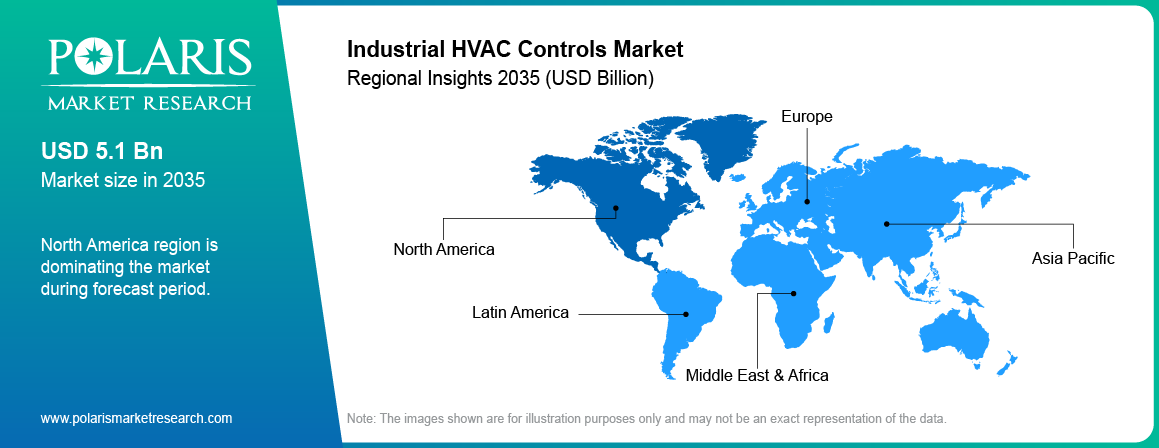
North America is the leading market, with 31.8% of 2027 revenue, owing to the deepest concentration of data center campuses, drug plants, and factories that upgrade controls. Its CAGR of 5.6% through 2035 trails Asia Pacific, since the base is already large.
United States revenue reached USD 1,600.7 Million in 2027, the bulk of the regional figure. Among North American countries, Mexico expands quickest at 6.9% a year over 2027 to 2035 since factories are relocating nearer to United States buyers, while Canada adds 5.6% annually.
In February 2026, Johnson Controls launched the YORK YDAM air cooled magnetic bearing chiller, with up to 3.5 MW of cooling and up to 20% more capacity density, for multistory data centers and AI factories (Source: Johnson Controls). Each large chiller needs plant controls and sequencing, so equipment launches pull control content behind them.
Competition in North America rewards vendors with big installed bases and service networks. Established firms bundle controls with equipment and maintenance, while software specialists compete on analytics, so winners pair open protocols with field support.
Europe Market
Europe supplies 26.7% of 2027 revenue, with growth of 5.2% a year that trails every other region owing to an older installed base. Germany is the biggest European market, at USD 420.4 Million in 2027.
Russia grows slowest of the regional markets, at 2.6% a year, held back by limited access to imported controls. Next come the United Kingdom at USD 194.9 Million, France at USD 178.6 Million, Italy at USD 146.2 Million, and Spain at USD 97.4 Million, while smaller markets combined add USD 507.0 Million.
For example, in February 2026, Belimo presented newer connected field devices and a data center section at MCE 2026, saying the devices can cut energy use by up to 55% (Source: Belimo). The company also lists wider support for advanced liquid cooling.
Policy sets the pace for demand. Building directive rules push owners of large systems to add automation, and Dutch rules took effect on schedule, so controllers, valves, and monitoring software are in demand across the region.
Energy prices add pressure on owners. Plants that pay high rates for power and gas look for control upgrades with short payback, so tuning, metering, and heat recovery projects often come before large equipment replacement.
Asia Pacific Market
Asia Pacific is the fastest growing region, at a CAGR of 8.1% from 2027 to 2035, and it holds 29.0% of 2027 revenue, owing to new factories, data centers, and drug plants in China and India.
China is the biggest country at USD 701.0 Million in 2027, while India moves fastest at 12.2% yearly off a modest base. Japan lags the large markets, at 5.2%, since its building stock is older. South Korea contributes USD 141.0 Million and Australia USD 70.5 Million.
For example, in June 2026, the Ministry of Power in India issued a draft notification to amend its Energy Conservation and Building Code Rules. It proposes that buildings of 20,000 square meters or more obtain a Bureau of Energy Efficiency rating of at least 3 stars. Rated buildings need efficient controls, so the draft supports automation demand, although it does not name HVAC controls directly.
Other Asia Pacific countries add USD 424.9 Million in 2027, mostly from electronics, data center, and food plants in Southeast Asia.
Local engineering capacity decides how quickly projects convert. Vendors that train partner integrators in China, India, and Southeast Asia can commission more sites per year, and those with regional stock avoid import delays that stall plant start ups.
Latin America Market
The 2027 share of Latin America is 5.5%, and the region grows at a CAGR of 7.0% over 2027 to 2035, owing to data center, food, and mining projects in Brazil and Mexico. Brazil leads with USD 154.3 Million and also grows faster than Argentina.
Remaining Latin American countries add USD 142.0 Million in 2027. Many owners buy controls through multinational equipment suppliers, so local revenue follows plant projects closely.
For example, in October 2026, the operator ODATA started installing DeltaFlow liquid cooling at campuses coded SP04 in Brazil and QR03 in Mexico under a USD 630 million first phase (Source: Intelligent CIO). The sites combine liquid and air cooling, so operational controls must work together with cooling and power gear.
Exchange rate swings and tariffs affect price quotes. Suppliers that assemble and stock locally can price in local currency and shield buyers from import shocks.
Middle East & Africa Market
Middle East & Africa contributes 7.0% of 2027 revenue and grows 5.9% yearly, owing to giga projects, industrial cities, and data centers around the Gulf. Saudi Arabia is the biggest country at USD 119.5 Million, while the United Arab Emirates grows quickest at 6.9%.
Remaining markets include the United Arab Emirates at USD 94.1 Million, Turkey at USD 50.8 Million, South Africa at USD 58.3 Million, and others at USD 100.7 Million in 2027. Heat and humidity make cooling control a core requirement.
For example, in November 2026, Mannai IT KSA took a combined mechanical, electrical, plumbing, and technology package on a Riyadh giga project for China Harbour Engineering Company, with a two year fast track timeline (Source: Saudi Gulf Projects). The scope includes HVAC and building management, but the report does not name HVAC controls and gives no value.
Gulf buyers more often link awards to local assembly, training, and joint ventures, which favors vendors with local offices and stock.
Climate adds a technical requirement. High ambient heat and dust lower the efficiency of cooling plant, so controls that stage equipment carefully and flag fouled coils earn a place in specifications for large industrial and logistics sites.
Industrial HVAC Controls Market Competitive Landscape
Suppliers fall into four groups. Controls specialists are led by Honeywell Technologies, Johnson Controls, Siemens, and Schneider Electric. HVAC makers such as Carrier, Trane Technologies, Daikin, and Mitsubishi Electric sell controls with their equipment. Component houses such as Belimo and Danfoss supply valves, actuators, and drives, and automation firms such as Azbil, Yokogawa Electric, ABB, Emerson, and Delta Electronics bring plant control skills.
Honeywell Technologies launched EBI One in November 2026, and Carrier bought 75F in July 2026. Siemens added an AI enabled service in May 2026, Johnson Controls issued a data center design guide in July 2026, and Mitsubishi Electric bought Dutch installation groups the same month.
Belimo showed new connected field devices in February 2026, and Delta Electronics presented digital twin and Guideline 36 ready control tools in January 2026. Schneider Electric unveiled its liquid cooling portfolio with Motivair in September 2025 after taking a controlling interest in the company in February 2025.
No vendor reports industrial HVAC controls revenue on its own line, so every market share ranking is approximate. Polaris reads launches, deals, and project news as signs of presence rather than measured revenue.
Contests turn on installed base and service reach. Buyers lean toward suppliers with open protocols, security records, and engineers near the plant, and share shifts to firms that deliver on time with full documentation.
Ownership changes alter the field. Carrier now owns 75F outright after backing it as an investor, and Schneider Electric holds a controlling stake in Motivair, so each group draws on added software and cooling skills.
New entrants find room in software, analytics, and wireless devices. Startups win retrofit projects first, then widen to full sites once references are in hand.
Service models separate winners from followers. Vendors that monitor plant remotely, dispatch technicians on alarms, and report savings each quarter build long relationships, whereas suppliers that sell only hardware depend on the next project cycle.
Vendor Landscape Snapshot
| Company | Vendor Positioning | Role |
| Honeywell Technologies | Leader | Launched EBI One at Accelerate 2026 in November 2026, with alarm prioritization and natural language access to building data |
| Johnson Controls | Leader | Launched the YORK YDAM chiller in February 2026 and published an absorption chiller reference design guide in July 2026 |
| Siemens | Leader | Showed Desigo PXC controllers with BACnet Secure Connect in February 2026 and launched Asset Performance Advanced in May 2026 |
| Schneider Electric | Challenger | Unveiled a liquid cooling portfolio with Motivair in September 2025 after taking a controlling interest in February 2025 |
| Carrier | Challenger | Acquired 75F in July 2026 to add cloud native wireless building automation |
| Belimo | Niche Player | Showed connected field devices and a data center section at MCE 2026 in February 2026 |
Source: Polaris Market Research Analysis
Industrial HVAC Controls Market Technology and Innovation Landscape
Technical progress follows four aims: lower energy use, simpler installation, better visibility, and stronger security. Most progress comes from smarter field devices, from analytics software, and from standard control sequences.
Field devices are getting smarter. Valves and actuators increasingly report flow, position, and temperature differences, and Belimo showed newer connected field devices at MCE 2026.
Analytics are moving from dashboards to action. Services such as Siemens Asset Performance Advanced prioritize faults by impact on occupant comfort, power use, and availability, and Honeywell Technologies added alarm prioritization to EBI One.
Standard sequences are spreading. ASHRAE Guideline 36 ready logic from LOYTEC, shown by Delta Electronics, lets engineers set parameters instead of writing code, and that shortens commissioning.
Digital twins are entering plant duty. Azbil showed a chiller plant twin that tests optimization strategies, and Delta Electronics presented a twin based engineering platform, so operators can test changes before they touch live equipment.
Liquid cooling needs its own control layer. Schneider Electric pairs its Motivair liquid cooling units with EcoStruxure software for air and liquid cooling, so pump and valve control becomes a growth area.
Security is moving into hardware. Siemens named BACnet Secure Connect in its Desigo controllers, and owners now check update processes and encryption support before a plant control joins any network.
Materials and refrigerants also shape design. Refrigerant rules push leak detection and tighter charge monitoring into refrigeration and cooling controls, so sensors and alarms gain value.
Proof of performance is turning into a sales tool. Customers want case studies with measured energy savings, and suppliers that publish clear results clear approvals sooner than rivals that rely on brochure claims.
Technology and Innovation Landscape Snapshot
| Area | Role | Status and Representative Developers |
| AI enabled operations platforms | Prioritize alarms and answer questions on building data | Honeywell Technologies launched EBI One in November 2026 |
| Managed analytics services | Rank HVAC faults by comfort, energy, and uptime impact | Siemens launched Asset Performance Advanced in May 2026 |
| Standard control sequences | Cut programming time with pre engineered logic | Delta Electronics showed Guideline 36 ready controls in January 2026 |
| Chiller plant digital twins | Test energy strategies and flag anomalies | Azbil showed a chiller plant twin in September 2026 |
| Liquid cooling controls | Coordinate coolant distribution units and plant loops | Schneider Electric unveiled its Motivair portfolio in September 2025 |
Source: Polaris Market Research Analysis
Use Case Analysis
Data Center Cooling Control
Operators of large data halls use controllers to stage chillers, set pump speed, and hold supply temperature as loads change. Duplicate sensors and controllers keep the plant steady, and for deeper coverage of coolant loops see data center liquid cooling analysis.
Clean Room and Process Air Control
Drug and electronics plants need controlled pressure, humidity, and temperature in each room. Controllers log every reading, so audits can confirm that conditions stayed within limits.
Cold Storage Refrigeration Control
Food and logistics sites use controllers to run compressors, defrost cycles, and door alarms. Leak detection and energy logs help owners meet refrigerant rules and cut power bills.
Factory Ventilation and Heating Control
Production halls use air handling and heating controls to hold comfort and remove fumes. Demand based ventilation adjusts airflow with occupancy and process output, and that saves fan energy.
Central Plant Optimization
Chiller and boiler plants use sequencing software to stage equipment at the best efficiency point. Operators see lower energy bills and fewer unplanned stops once optimization is tuned.
Retrofit and Remote Monitoring
Owners add wireless sensors and cloud analytics to old plant without shutting production. Remote teams then watch fleets of sites and send technicians only when a fault needs a visit.
Savings are measured against a baseline. Owners record energy use before the upgrade and compare it with later months, so vendors that supply clean data and weather adjusted reports can prove value and win follow on work.
Upkeep matters in all of these uses. Controls are checked for sensor drift, recorded by site, and updated on a cycle, so operators hold spares and agree service terms with suppliers.
Installed cost settles the choice. An upgrade has to beat the energy bill, downtime risk, and engineering cost of keeping an old system, so owners compare payback across several options before approval.
Buyer Needs and Decision Criteria
| Buyer Need | Decision Criteria | Why It Matters |
| Reliability | Redundancy, uptime record, and service response | A control failure can stop a plant or spoil product |
| Compatibility | Open protocols, gateways, and backward support | Plants mix vendors and keep equipment for decades |
| Security | Secure protocols, signed firmware, and patch routine | Owners will not connect unsecured controls to networks |
| Energy savings | Measured results, analytics, and optimization tools | Energy cost is a large share of plant operating spend |
| Support | Local engineers, training, and spare stock | A late fix can stall a plant |
Source: Polaris Market Research Analysis
Barriers to entry include installed base, service reach, cyber security approvals, and customer references. Owners stay with suppliers whose controls have run for years, so newcomers begin with pilots and small retrofits.
Approval hinges on test reports, security papers, price per point, and delivery terms, and a vendor holding all four on file can shorten diligence by weeks.
Contract scope keeps widening. Owners increasingly request controls, analytics, and service in a single agreement, which helps vendors with a complete range land bigger accounts.
Premium Insights and Forward Outlook
Software and Services Will Gain Share
Owners will move spending from hardware to analytics and managed services, and suppliers will add AI tools to installed controllers. Producers with clear savings data and open interfaces will win repeat orders.
Subscriptions will change how deals are struck. Plant owners want predictable yearly fees tied to results, and a vendor offering monitoring with guaranteed savings can win work that a hardware only quote would lose.
Standard offers will spread. Packaged control sequences, pre tested panels, and template dashboards cut engineering time, so vendors that package their know how can serve smaller sites at a profit and widen the addressable customer base.
Compliance Will Drive Retrofit Cycles
Building directives in Europe and energy codes in India and elsewhere will trigger control upgrades. Suppliers with documentation, commissioning tools, and trained partners will gain, because a compliance project usually brings fresh equipment choices.
Data Centers Will Shape Product Design
Liquid cooling, heat recovery, and redundant plant will add control points per megawatt. Vendors that master pump, valve, and chiller coordination will win campus scale contracts.
Wireless and Cloud Will Share the Plant With Wired
Greenfield sites will lean toward wireless and cloud tools, while existing plants keep wired links for core loops. Hybrid designs with strong security will carry most added revenue.
Energy and refrigerant rules will shape specifications. Leak detection, metering, and reporting are becoming checklist items at approval, and suppliers that record these functions early will pass audits more quickly.
Growth rests on more data center cooling, steady retrofit orders, standard sequences, and rising demand for analytics in drug and food plants. Most added revenue should flow to producers with open products, regional service, and software that proves savings.
Key Players in the Industrial HVAC Controls Market
- Honeywell Technologies
- Johnson Controls
- Siemens
- Schneider Electric
- Carrier
- Trane Technologies
- Danfoss
- Belimo
- Azbil
- Delta Electronics
- Yokogawa Electric
- Mitsubishi Electric
- Daikin
- ABB
- Emerson
Industry Developments
- November 2026: Honeywell Technologies introduced EBI One, an operations platform with AI assisted alarm handling, at its Accelerate 2026 customer event (Source: Honeywell Technologies).
- July 2026: Carrier completed its purchase of 75F, a cloud native wireless building automation firm (Source: Carrier).
- July 2026: Mitsubishi Electric closed its purchase of two Dutch HVAC installation groups to extend service reach in Europe (Source: Mitsubishi Electric).
Industrial HVAC Controls Market Report Segmentation
By Component
- Cntrollers and Panels
- Sensrs and Transmitters
- Actuatrs and Valves
- Sftware and Analytics
- Others
By System
- Air Handling and Ventilatin Control
- Chiller and Central Plant Cntrol
- Biler and Heating Control
- Building and Facility Management Systems
- Others
By Connectivity
- Wired
- Wireless
- Hybrid and Clud Connected
- By End Use Industry
- Discrete and Prcess Manufacturing
- Data Centers
- Pharmaceuticals and Life Sciences
- Fod and Cold Chain
- Others
By Region
- North America
- United States
- Canada
- Mexico
- Europe
- Germany
- United Kingdm
- France
- Italy
- Spain
- Russia
- Rest of Europe
- Asia Pacific
- China
- Japan
- India
- Suth Korea
- Australia
- Rest of Asia Pacific
- Latin America
- Brazil
- Argentina
- Rest of Latin America
- Middle East & Africa
- Saudi Arabia
- United Arab Emirates
- Suth Africa
- Turkey
- Rest of Middle East & Africa
Industrial HVAC Controls Market Report Scope
| Report Attribute | Details |
| Market Size in 2026 | USD 5.64 Billion |
| Market Size in 2027 | USD 6.08 Billion |
| Revenue Forecast by 2035 | USD 9.98 Billion |
| CAGR | 6.4% (2027 to 2035) |
| Base Year | 2026 |
| Historical Data | 2022 to 2025 |
| Forecast Period | 2027 to 2035 |
| Quantitative Units | Revenue in USD Billion for the market, USD Million for segments, and CAGR in percent |
| Report Coverage | Revenue Forecast, Growth Factors, Competitive Landscape, Industry Trends, and Strategic Analysis of the industrial hvac controls market |
| Segments Covered | By Component, By System, By Connectivity, By End Use Industry, and By Region |
| Regional Scope | North America, Europe, Asia Pacific, Latin America, Middle East & Africa |
| Competitive Landscape | Company Profiling, Product Benchmarking, Financial Analysis, Market Developments, and Strategic Initiatives |
| Report Format | PDF and Excel |
| Customization | Available by Country, Region, and Segment |
| Research Team | Polaris Market Research & Consulting, Inc. research team |
| Last Updated | 25 November 2026 |
Source: Polaris Market Research Analysis
Why Choose Polaris Market Research
The workbook holds 24 country level lines, 5 of them residual blocks. Adding countries gives regional totals, and each segment breakdown is tuned to agree with those totals.
Boundaries move the total. Before setting this figure against another published number, check whether that source included whole building automation, process control, or the heating and cooling equipment itself.
Each outside fact is recorded with the body that published it and the date shown on its page, if any. Sources fall into public body, company, or press classes, so a reviewer can check each statement against the page behind it.
Buyers may order tailored studies for one country, component, system, connectivity type, or end use industry.
Research Methodology
Research Approach
The count covers control hardware and software for HVAC plant at industrial sites. Chillers, boilers, fans, compressors, and general process control stay outside the boundary.
Secondary Research
In total 16 sourced facts are logged. Companies supply 11, public bodies 2, and trade press and wire services 3. Of these, 1 lacks an exact page date, every page was opened in full, and nothing is older than two years.
Primary Research
Polaris follows its standard process of primary interviews. These interviews cover manufacturers, distributors and channel partners, and industry experts and consultants. They are used to validate secondary estimates, segment shares, regional trends, and growth drivers.
Data Structuring
Values appear in US dollars, with periods measured in calendar years. The scope boundary was frozen before gathering started, and any product reported by several sources is entered only once.
Market Size Estimation
Estimates climb from country lines to regions and then to the world total, after which each total is divided across the four dimensions.
Published sizes for adjacent scopes were reviewed before the 2026 base of USD 5.64 Billion was set. Those sizes vary a lot, since scope lines differ and few reports isolate industrial HVAC controls, so they informed judgment without fixing the answer.
Forecasting
Yearly growth eases gradually toward 2035, and compounding the full series reproduces the stated CAGR. The path reflects data center cooling build out, building performance rules, retrofit demand, and a shift of spending toward software and wireless devices.
Data Triangulation and Validation
Every forecast year faces four tests. Segment shares must total 100%, country lines must add up to regions, regions must add up to the global value, and early year movement from 2026 must look credible.
Limitations
Suppliers seldom disclose industrial HVAC controls revenue, so segment and country values come out of the model instead of company reports, and later editions can shift as launches and project plans change. The result also depends on scope, because a wider boundary taking in whole building automation or equipment content would lift the total. Market figures in this report are Polaris estimates.
Research Methodology Phases
| Phase | Focus | Evidence / Output |
| Scope and Setup | Market boundary, segments, and regions | Fixed scope and segment list |
| Secondary Data Collection | Public bodies, trade groups, company pages, and press | 16 sourced facts with dates |
| Primary Research | Interviews with manufacturers, channel partners, and industry experts | Validated segment shares, regional trends, and growth drivers |
| Data Structuring | Dollar values by calendar period | Each product entered once |
| Bottom Up Estimate | Country and segment estimates | Regional and global totals |
| Top Down Estimate | Global base for 2026 and its segment mix | Base set beside published estimates |
| Forecasting | Annual growth path to 2035 | Stated CAGR |
| Triangulation and Validation | Total checks, aggregation, and growth path tests | Tests that passed |
| Output | Report tables and text | One dataset feeding all tables |
Source: Polaris Market Research Analysis
Data Sources by Type
| Type of Source | Named Examples | Used For |
| Company pages (11) | Honeywell Technologies; Johnson Controls; Carrier; Siemens; Mitsubishi Electric; Yokogawa; Delta Electronics; Belimo; Schneider Electric | Product launches, acquisitions, and service offers |
| Public body and trade group pages (2) | European Commission Build Up portal; Ministry of Power, India | Building performance rules and energy codes |
| News and wire reports (3) | Intelligent CIO; Saudi Gulf Projects; Malay Mail | Project news and trade show announcements |
Source: Polaris Market Research Analysis
Industrial HVAC Controls Market FAQ's
The market spans the devices and programs that regulate heating, ventilation, and cooling plant in sites such as foundries, server halls, drug plants, and cold stores.
The Polaris estimate for the 2026 industrial hvac controls market is USD 5.64 Billion, counted as revenue from HVAC control hardware and software at industrial sites. Sales are forecast to climb to USD 9.98 Billion by 2035.
Polaris projects USD 9.98 Billion for the industrial hvac controls market by 2035, a CAGR of 6.4% over 2027 to 2035, supported by data center cooling, building performance rules, retrofits, and analytics software.
North America is the leading market, holding 31.8% of 2027 spending, since the United States combines data center campuses, drug plants, and a large base of aging controls.
Asia Pacific leads regions on CAGR, at 8.1% through 2035, as factories and data centers go up across China and India.
By 2027 value, 33.5% belongs to Controllers and Panels, the biggest component, while Software and Analytics grow fastest, at 11.6%, as owners add optimization and fault detection.
Honeywell Technologies, Johnson Controls, and Siemens recur most in the register, and Schneider Electric, Carrier, Belimo, Azbil, and Mitsubishi Electric contribute controls and field devices.
AI enabled operations platforms, standard control sequences, digital twins, and wireless and cloud links are spreading, while liquid cooling adds a new control layer in data centers.
Legacy systems and mixed protocols slow upgrades, skilled commissioning staff are scarce, and cyber security concerns delay cloud links, while price pressure limits margins on plain hardware.
The top system by 2027 value is Building and Facility Management Systems at 30.1%, and Chiller and Central Plant Control grows fastest, at a CAGR of 7.4% to 2035, owing to large cooling plants in data centers.
The largest is Discrete and Process Manufacturing, with 37.5% of 2027 value, and Data Centers grow fastest, with a CAGR of 12.2% through 2035, as artificial intelligence loads raise cooling demand.
Wireless gains most, with a CAGR of 10.6% through 2035, since retrofits avoid new cable runs, while Wired stays the largest at 59.9% of 2027 value.
Equipment moves heat, air, or water. Controls sense conditions and command that equipment, so Polaris counts only the control layer in this report.
The United States ranks first at USD 1,600.7 Million for 2027, China is next at USD 701.0 Million, and India grows fastest among countries, at 12.2% annually.
Data center cooling growth, building performance rules, retrofit programs, and energy cost pressure all add demand for better plant controls.

Download Sample Report of Industrial HVAC Controls Market
Please fill out the form to request a customized copy of the research report.


