
Medical Device Design and Development Services Market Trends and Revenue, 2026-2034
REPORT DETAILS
Medical Device Design and Development Services Market Summary
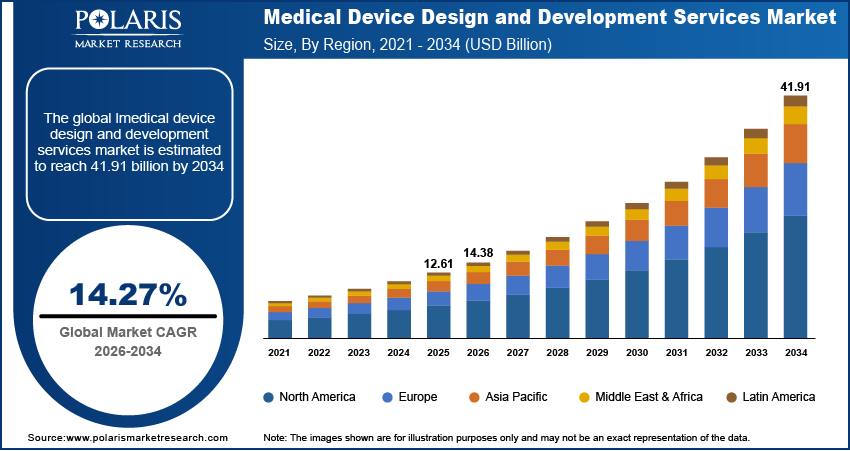
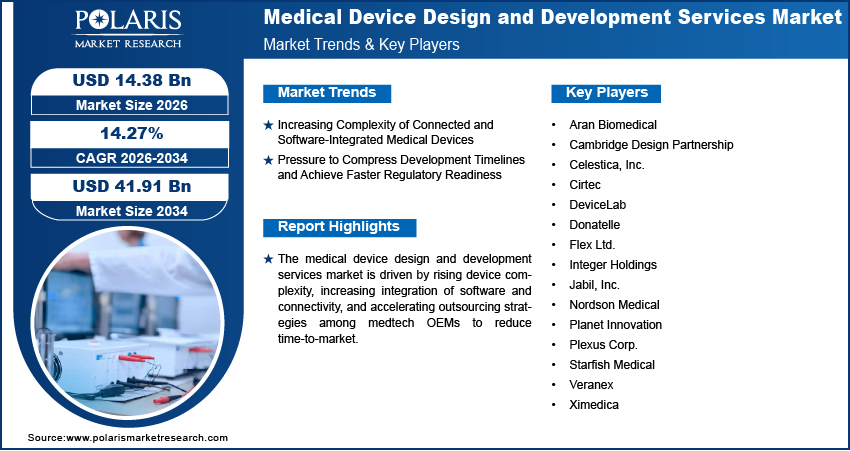
The global medical device design and development services market is estimated around USD 12.61 billion in 2025,with consistent growth anticipated during 2026–2034. The market is projected to grow at CAGR of 14.27% during the forecast period driven by rising device complexity, accelerated regulatory pathways, and strategic outsourcing across medtech OEMs.
Market Statistics
Key Takeaways
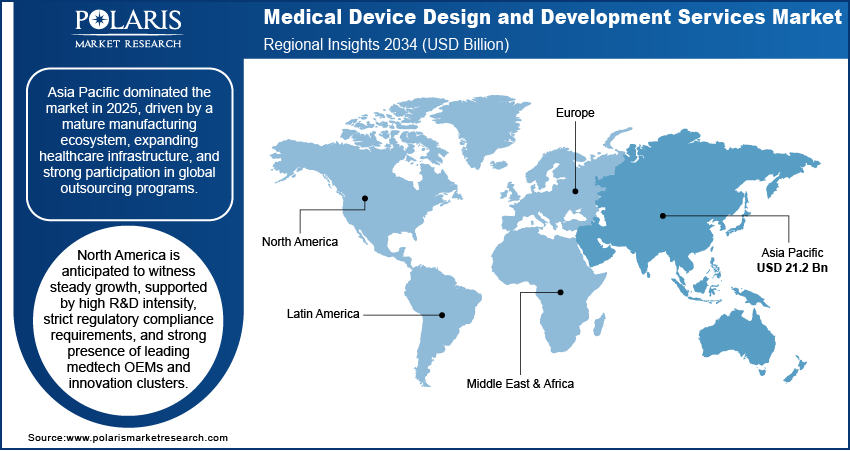
- Asia Pacific accounted for the largest regional share of around 41.1% in 2025, supported by integrated manufacturing ecosystems, expanding healthcare infrastructure, and strong participation in global outsourcing programs.
- North America is anticipated to witness the highest growth at a CAGR of 9.1%, driven by regulatory intensity, FDA-aligned validation requirements, and dense medtech innovation clusters.
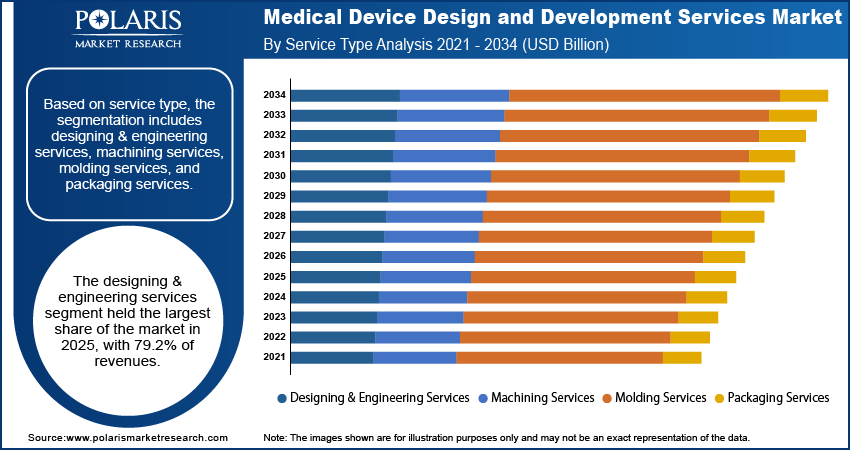
- By Service Type, Designing & Engineering Services segment accounted for the largest share of 79.2% in 2025, driven by early-stage concept development, system architecture planning, electronics integration, and comprehensive risk management documentation.
- By Medical Device Type, Drug Delivery Devices segment is projected to grow at a CAGR of 9.6%, driven by increasing combination product pipelines, rising adoption of autoinjector platforms, and strong demand for user-centric device design solutions.
Industry Dynamics
- Increasing advancements in connected and software-integrated medical devices
- Acceleration of outsourcing to compress time-to-market
- Regulatory documentation burden and compliance-driven design cycles
- Growth in combination products and decentralized diagnostic platforms
Future Demand Scenarios
- Base scenario: Steady growth driven by expanding OEM pipelines, more stringent regulatory standards, and rising outsourcing in drug delivery devices, diagnostics, cardiovascular, and orthopedic devices.
- Upside scenario: Rapid growth fueled by SaMD adoption, connected devices, surgical robotics, and collaborative early-stage engineering partnerships.
- Conservative scenario: Gradual growth impacted by pricing constraints, regulatory hurdles, and longer development cycles for high-risk and complex device platforms.
What is Medical Device Design and Development Services and Why It Matters
The medical device design and development services market encompasses the structured pathway that converts a clinical concept into a market-ready product. It encompasses medical device design services like concept validation, industrial design, usability engineering, and prototyping, followed by medical device development services like engineering optimization, verification and validation, and design for manufacturing. Medical device engineering services encompass electronics integration, software development, material selection, and risk management to ensure safety and performance compliance. The medical device R&D services market functions as a core enabler of medtech innovation by connecting clinical demand, technical execution, regulatory requirements, and commercialization readiness. Rising device complexity, tighter regulatory frameworks, and compressed product timelines continue to strengthen its role within the global medical technology value chain.
To Understand More About this Research:Download Sample Report
Drivers & Opportunities
Increasing Complexity of Medical Devices Driving Outsourced Engineering Demand
The rising advancements in complex medical devices is increasing dependence on external engineering partners across the global medical device design services market. The current platforms involve the integration of embedded systems, connectivity, advanced product architecture, and regulated software layers, which increases the demands for system integration and validation. This trend is further fueled by the evolution of Software as a Medical Device and the hybrid therapeutic approach. For instance, in October 2024, Click Therapeutics introduced Click SE, that merges digital therapies with conventional treatments. This drives innovation by bridging the gap between physical medical hardware and regulated software environments. This evolution of connected medical devices, are increasing the need for multidisciplinary implementation, thus directly contributing to the growth of the medical device development services market.
Pressure to Shorten Time-to-Market Accelerating Strategic Outsourcing
The rising need to reduce commercialization cycles, along with the regulatory environment, is accelerating the outsourcing trend in the global medical device design services market. Delays in commercialization reduce revenue generation and undermine competitive advantage. Thus increasing the need for outsourced medical device prototyping services, early design verification, and design validation planning to gain regulatory compliance quickly. As of June 2023, the FDA’s Center for Devices and Radiological Health (CDRH) has granted 831 devices as Breakthrough Devices and approved 77 for commercialization under the program, indicating its widespread adoption. The growing demand for optimizing development cycles and performance is pushing the need for improved efficiency, thus fueling the growth of the market.
Restraints & Challenges
Stringent Regulatory Approval Processes and Longer Development Cycles
The complex regulatory approval processes in FDA, CE mark, and ISO regulations limit growth of medical device design and development services market. Regulatory requirements include extensive design documentation, risk management files, clinical evaluation reports, and verification and validation processes. This increases development timelines and elevates project costs. Delays in regulatory approvals and additional data requirements affect the commercialization schedules and increase the return-on-investment periods for OEMs.
Emerging Opportunities
Growth in Drug Delivery and Diagnostic Device Development
The growing need for drug delivery device development and POC diagnostic devices are creating substantial opportunity for the medical device design and development services market. Growth in self-administration therapies increases demand for autoinjector design, infusion systems, and complex combination products that require precise dosing and user-centered design. These platforms depend on structured usability testing, material compatibility assessment, and repeat design optimization, which drives recurring outsourced engineering demand.
The POC diagnostic devices further enhance this opportunity as there is a shift in healthcare delivery towards decentralized and near-patient environments. The engineering of diagnostic devices now integrates miniaturization, connectivity, and rapid result capabilities in a compact solution. Service providers that integrate product architecture with high-volume production planning are well positioned to secure long-term contracts in these high-growth segments.
Segmental Insights
This report provides granular coverage of the medical device design and development services market by service type, device type, and end use, enabling stakeholders to identify the high-margin and most profitable demand pockets.
By Service Type
-
Designing & Engineering Services
Designing and engineering services represent the largest revenue contributor within the market. These services range from requirements definition, system architecture, medical device industrial design, mechanical engineering, and electronics design, all under formal design controls and risk management ISO 14971 frameworks. The service providers also handle the overall design documentation and preparation of DHF, ensuring regulatory readiness from concept to verification.
-
Machining Services
Medical device machining services play a crucial role in the production of high-precision medical implants, surgical instruments, and diagnostic device subassemblies. Advanced CNC machining medical devices, tight tolerance manufacturing, and processing of medical-grade materials define this segment. Both prototype machining and full-scale production machining support OEM scalability while avoiding capital-intensive infrastructure investments.
-
Molding Services
Medical device molding services, especially injection molding of medical devices, represent the largest proportion of polymer-based component production. The important areas include tooling design, mold validation, and design for molding to ensure reproducibility in high-volume production of medical devices made of polymer materials.
-
Packaging Services
Medical device packaging services are becoming increasingly complex, moving from a logistics process to a regulated engineering discipline. Areas of key expertise include packaging validation, labeling regulations, shelf-life testing, and distribution simulation. Proficiency of advanced packaging engineering is useful in improving regulatory submissions and minimizing risk in the post-market environment.
By Medical Device Type
-
Drug Delivery Devices
Drug delivery devices, including autoinjector development, infusion pump development, and inhaler systems, are important drivers of outsourcing depth and complexity. Complex combination product development, dose delivery accuracy, and usability engineering are crucial.
-
Point-of-Care Diagnostic Equipment
Point-of-care diagnostics involve rapid development cycles and optimized manufacturing costs. The development of point-of-care devices, point-of-care diagnostics, and hardware and software integration are conduct using microfluidics and rapid prototyping.
-
Cardiovascular Devices
Cardiovascular device development involves advanced cardiac engineering, implantable devices knowledge, reliability engineering, and biocompatibility validation. Regulatory needs require accurate development, making the outsourcing of specialized engineering modules an attractive option.
-
Orthopedic Devices
Orthopedic device design involves the integration of biomechanics, materials engineering, and surgical workflow compatibility. Implant development, precision machining, and surgical instrument development are facilitated through outsourced development platforms.
-
Surgical Robotics
Surgical robotics represents a high-growth, high-complexity segment. Medical robotic devices have engineering, software validation, system testing, and advanced medical robotics design support.
By End Use
-
Medical Device Companies
Medical device companies and medtech OEMs account for the largest end-use category for outsourced development services. The steady expansion of their pipelines and the need to maintain competitive product renewal cycles fuel the demand for outsourced product development. The use of external engineering partners allows OEMs to maintain flexibility in capacity, leverage engineering expertise, and scale development, thus enabling them to handle fluctuating project volumes without having to build fixed overhead structures.
-
Biotechnology Companies
Biotechnology companies are increasingly in need of device engineering expertise to support drug-device combinations and advanced delivery systems. Many biotechnology companies maintain lean operations with a focus on therapeutic innovation rather than hardware development. Biotech outsourcing and co-development partnerships allow these companies to leverage expertise in industrial design, system engineering, and regulatory documentation while maintaining capital efficiency and focus.
Regulatory and Compliance Landscape Impacting the Market
Regulatory intensity is boosting the medical device design and development services Market. The increasing need for clinical evidence, documentation, and multi-region approvals is transforming the development of devices right from the start. OEMs are relying more on FDA-compliant medical device design services, medical device design control services, and ISO 14971-compliant medical device risk management services. ISO 13485-certified medical device development services are improving audit readiness, and the growing trend of fragmentation in regions is fueling the need for medical device regulatory consulting services to align global filings. The more layers of compliance, the more the scope of outsourcing, solidifying engagement models for service providers.
Market Impact Highlights
- Growing regulatory requirements make FDA-compliant medical device design services essential in the early stages of product development.
- Design controls and risk management standards according to ISO 14971 drive the demand for medical device design control services.
- Partnership with ISO 13485-certified companies is preferred due to their readiness for audits and maturity of their quality management system.
- Regional approvals make medical device regulatory consulting services essential for managing submission harmonization.
- Compliance integration changes the nature of outsourcing from being a support function to a strategic partnership.
Technology, Innovation, and Emerging Trends in Medical Device Design and Development Services Market
Technology is changing the way medical devices are conceptualized, designed, validated, and brought to market. Service providers integrate software architecture, cybersecurity validation, AI-driven modeling, and system-level interoperability into unified development frameworks. This transition expands the technical depth of the medical device design and development services market while raising the competitive threshold for engineering partners.
Technology & Innovation Impact Matrix
| Innovation Area | What Is Changing | Market Impact |
| Digital & Connected Devices | Integration of hardware, cloud, mobile, and cybersecurity in device architecture | Increases demand for digital health device design services and connected medical device development services |
| IoT-Enabled Monitoring | Real-time data capture and remote patient monitoring capabilities | Drives demand for IoT medical device development services |
| AI-Driven Engineering | Predictive simulation, automated testing, digital twins | Strengthens AI-enabled medical device design services and accelerates validation cycles |
| Smart Device Integration | Embedded sensors, analytics engines, adaptive interfaces | Increases demand for smart medical device design services |
| Automation & Documentation Tools | Automated traceability and risk documentation generation | Improves compliance efficiency and shortens time-to-market |
| Modular & Scalable Design | Platform-based architectures for faster product extensions | Enhances long-term outsourcing partnerships and recurring service models |
Source: Polaris Market Research Analysis
Regional Analysis
Asia Pacific Medical Device Design and Development Services Market Insights
Asia Pacific represented the largest market share for medical device design services, owing to the increasing manufacturing and healthcare infrastructure in the region. According to the International Trade Administration, China is the second-largest healthcare market in the world, valued at over USD 1 trillion in 2024 and is expected to reach USD 1.5 trillion by 2029. At present, about 60% of the total healthcare expenditure in the country is invested by the government. Active engagement in global outsourcing initiatives drives the need for contract engineering services in areas such as product architecture, embedded systems, and manufacturing transfer. Countries such as China, Japan, India, and South Korea combine cost advantages with growing technical depth, which strengthens regional growth momentum.
North America Medical Device Design and Development Services Market Assessment
North America medical device design services market remains a central innovation corridor, driven by advanced R&D programs and high regulatory scrutiny. According to the MedTech Association, the U.S. represents the largest medical device market globally, accounting for more than 40% of the total worldwide medtech industry. The U.S. medical device development ecosystem emphasizes FDA compliance, human factors engineering, and structured validation frameworks. The presence of leading OEMs, venture-backed startups, and specialized engineering services providers sustains consistent outsourcing demand. Companies prioritize external expertise for rapid prototyping, regulatory documentation, and commercialization readiness. This concentration of innovation capability positions North America as a high-value engineering and regulatory-aligned services market.
Europe Medical Device Design and Development Services Market Overview
The Europe medical device engineering services market benefits from structured EU regulatory compliance requirements and established medtech clusters across Germany, Ireland, Switzerland, and the Nordic region. According to the European Medical Technology Industry, based on manufacturer prices, Europe accounts for approximately 26.4% of the global medical device market. This makes it the second-largest market worldwide, following the U.S., which holds a 46.4% share. CE marking standards and evolving MDR obligations increase the need for experienced engineering partners capable of managing documentation, verification, and lifecycle updates. Outsourced medical device design services in Europe are focused on redesign programs and packaging that are aligned with regional mandates. The region has a steady demand, which is fueled by strong institutional healthcare systems and a high level of device specialization.
India Medical Device Design and Development Services Market Insights
India is emerging as a fast-expanding node within global medical device outsourcing frameworks. India medical device outsourcing activity now extends beyond manufacturing support into full-scale product development, embedded systems integration, and regulatory documentation services. According to the Department of Pharmaceuticals, Ministry of Chemicals and Fertilizers, Government of India, the country’s medical devices market is projected to reach USD 51.43 billion by 2030, registering a CAGR of 10.86% during the forecast period. Engineering services India providers combine cost-effective development models with growing expertise in scale-up support and validation planning. The availability of talent and infrastructure development is propelling India to emerge as a strategic destination for outsourced medical device design services.
Heat Map Analysis
| Region | Demand Intensity | Therapy Adoption | Reimbursement Strength | Clinical Trial Activity | Growth Momentum |
| Asia Pacific | Very High | High | Medium–High | High | Very High |
| North America | Very High | Very High | Very High | Very High | High |
| Europe | High | High | High | High | Medium |
Source: Polaris Market Research Analysis
Key Players & Competitive Analysis Report
The medical device design and development services market exhibits moderate consolidation, led by specialized engineering firms and vertically integrated manufacturing partners serving global medtech OEMs. A focused group of providers secures a significant share of project revenue, fueled by multi-disciplinary engineering expertise, regulatory integration know-how, and production transfer capability. Competition centers on designing and engineering services, complex system integration, human factors validation, and compliance-aligned development under ISO 13485 frameworks. The intensity of service offerings rises in the high-growth areas of surgical robotics, drug-device combinations, and health IT platforms, where the integration of mechanical, electronic, and software components overlaps. Strategic positioning increasingly depends on end-to-end capability spanning concept development, verification testing, regulatory documentation, and manufacturing scale-up. Mergers, strategic alliances, and capability-driven acquisitions continue to be active as companies extend geographic presence, digital health acumen, and risk management expertise.
Key Players
- Aran Biomedical
- Cambridge Design Partnership
- Celestica, Inc.
- Cirtec
- DeviceLab
- Donatelle
- Flex Ltd.
- Integer Holdings
- Jabil, Inc.
- Nordson Medical
- Planet Innovation
- Plexus Corp.
- Starfish Medical
- Veranex
- Ximedica
Premium Insights: Competitive Strategy Trends
- Growing emphasis on design and engineering as the core value driver, with increasing spending on front-end engineering to expedite regulatory approval.
- Earlier integration of design control and traceability to lower the risk of redesign and enhance readiness for submission.
- Strong alignment of product needs with scalable and manufacturable system architectures.
- Increasing need for regulatory-ready design directly integrated into early engineering work.
- Strategic acquisitions to enhance engineering expertise, digital know-how, and worldwide regulatory knowledge.
Drug Delivery and Diagnostics Drive Recurring Demand
High-growth areas like drug delivery and diagnostics continue to sustain high outsourcing intensity due to their short innovation cycles and continuous optimization. Drug delivery outsourcing increases as combination products require usability optimization, dose verification, and regulatory harmonization for lifecycle extensions. In a similar manner, diagnostics R&D programs in point-of-care technologies need constant software upgrades, hardware calibration, and cost minimization. Such steady engineering requirements integrate contract players into lifecycle management strategies, thus providing stable revenue streams for service companies.
Asia Pacific’s Structural Advantage
Asia Pacific dominance in the services landscape is anchored in established outsourcing hubs, integrated supply networks, and deep engineering talent pools. The region’s supplier network has component production, tooling, and production transfer capabilities that are strongly integrated into industrial clusters. Such structural fit establishes strong competitiveness. Manufacturing expansion, regulatory expertise, and cross-functional integration further reinforce the Asia Pacific leadership position as the preferred outsourcing destination for global OEMs seeking development flexibility and production scalability.
Industry Developments
- September 2025: Tata Elxsi launched the ‘Bayer Development Centre in Radiology’ at its Pune facility to help with the engineering and development of advanced radiology systems. The development centre was primarily engaged in product development, software integration, and regulatory-ready solutions, thereby enhancing competencies in the medical device design and development services market.
- March 2025: Archimedic launched OpenQMS, a free web-based quality management system that provides templates and forms to assist in the documentation process necessary during the development of medical devices. The resource helped device developers align design and regulatory processes with quality standards, enhancing compliance support within Medical Device Design and Development Services
Medical Device Design and Development Services Market Segmentation
By Service Type Outlook (Revenue, USD Billion, 2021-2034)
- Designing & Engineering Services
- Machining Services
- Molding Services
- Packaging Services
By Medical Device Type Outlook (Revenue, USD Billion, 2021-2034)
- Drug Delivery Devices
- Point-of-Care Diagnostic Equipment
- Cardiovascular Devices
- Orthopedic Devices
- Surgical Robotics
By End Use Outlook (Revenue, USD Billion, 2021-2034)
- Medical Device Companies
- Biotechnology Companies
By Regional Outlook (Revenue, USD Billion, 2021-2034)
- North America
- US
- Canada
- Europe
- Germany
- France
- UK
- Italy
- Spain
- Netherlands
- Russia
- Rest of Europe
- Asia Pacific
- China
- Japan
- India
- Malaysia
- South Korea
- Indonesia
- Australia
- Vietnam
- Rest of Asia Pacific
- Middle East & Africa
- Saudi Arabia
- UAE
- Israel
- South Africa
- Rest of Middle East & Africa
- Latin America
- Mexico
- Brazil
- Argentina
- Rest of Latin America
Medical Device Design and Development Services Market Report Scope
| Report Attributes | Details |
| Market Size in 2025 | USD 12.61 Billion |
| Market Size in 2026 | USD 14.38 Billion |
| Revenue Forecast by 2034 | USD 41.91 Billion |
| CAGR | 14.27% from 2026 to 2034 |
| Base Year | 2025 |
| Historical Data | 2022–2024 |
| Forecast Period | 2026–2034 |
| Quantitative Units | Revenue in USD Billion and CAGR from 2026 to 2034 |
| Report Coverage | Revenue Forecast, Competitive Landscape, Growth Factors, and Industry Trends |
| Segments Covered |
|
| Regional Scope |
|
| Competitive Landscape |
|
| Report Format |
|
| Customization | Report customization as per your requirements with respect to countries, regions, and segmentation. |
Source: Polaris Market Research Analysis
Medical Device Design and Development Services Market FAQ's
• The global market size was valued at USD 12.61 billion in 2025 and is projected to grow to USD 41.91 billion by 2034.
• Asia Pacific region holds the largest share in the medical device design and development services market, supported by a mature manufacturing ecosystem and expanding healthcare infrastructure.
• Designing & engineering services is the primary service type fueled by high outsourcing intensity in front-end development and regulatory-ready design frameworks.
• A few of the key players in the market are Aran Biomedical, Cambridge Design Partnership, Celestica, Inc., Cirtec, DeviceLab, Donatelle, Flex Ltd., Integer Holdings, Jabil, Inc., Nordson Medical, Planet Innovation, Plexus Corp., Starfish Medical, Veranex, and Ximedica.
• Key factors include increasing complexity of medical devices coupled with pressure to reduce time-to-market accelerating strategic outsourcing.
Download Sample Report of Medical Device Design and Development Services Market
Please fill out the form to request a customized copy of the research report.


