
Global Micro LED Market Size, Share, Trends & Forecast, 2026–2034
REPORT DETAILS
Micro LED Market Summary
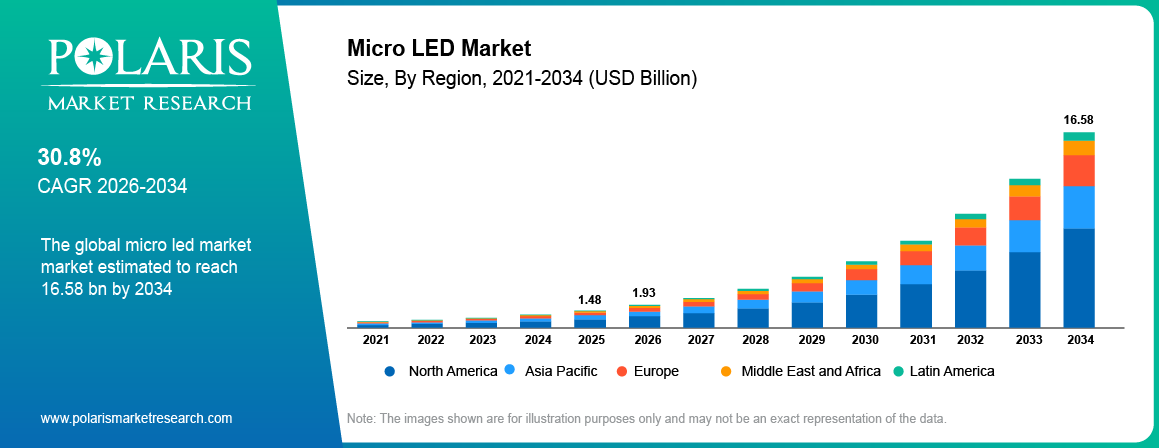
The global micro LED market size was valued at USD 1.48 billion in 2025. The market is projected to account for an 30.8% CAGR from 2026 to 2034. The rising consumption of on-demand content and growing integration of micro LEDs into consumer electronics are a few of the key factors driving the micro LED market growth.
Market Statistics
Key Takeaways
- Asia Pacific accounted for a 61.37% share of the micro LED market in 2025. The rising demand for high-quality electronic products contributes to the region’s major market share.
- North America is projected to grow at a 29.47% CAGR. The rising integration of micro LED displays into consumer electronics drives the regional market growth.
- By technology, the active matrix micro LED segment held a 57.36% share in 2025. This is owing to the high resolution and enhanced refresh rates of this technology.
- By display type, the television segment accounted for a 41.73% share in 2025. The use of micro LEDs ensures excellent picture quality and energy efficiency in televisions.
- By end user, the healthcare segment is projected to grow at a 36.25% CAGR. The segment’s growth is propelled by surgical procedures needing high luminance with minimal temperature rise.
Note: Figures and projections outlined in this report are the result of Polaris Market Research’s proprietary analytical processes, grounded in the latest available datasets and market observations.
What is Micro LED?
Micro LED technology is a type of display technology that uses microscopic LEDs to create images without needing a backlight system. The LEDs function as pixels on their own. This provides high brightness and excellent contrast. The micro LED technology can be used for various products such as televisions, wearables, automotive displays, and AR/VR products.
How Does Micro LED Works?
Micro LED displays work by using tiny LEDs to create each pixel. Images in these displays are produced by controlled emission of light. The micro LED manufacturing process involves the following steps:
LED Formation: Gallium nitride (GaN) is used to make microscopic LEDs, which are capable of emitting light upon electrical activation.
Chip Preparation: The LED chips are created, tested, and ready to be placed on a display backplane.
Micro LED Mass Transfer: Millions of micro LEDs are transferred from a source wafer to a recipient substrate. Micro LED mass transfer facilitates placing each individual red, green, and blue LED accurately.
Pixel Assembly: The LEDs are formed into pixels, with each color being controlled by a different emitter.
Electrical Control: Driver circuits control the brightness of each LED depending on an image signal.
Image Formation: The emission of the LEDs produces an image with high brightness and contrast.
Micro LED vs OLED vs LCD
The micro LED vs OLED comparison starts with the light emission technology of both. Micro LED has miniature inorganic LEDs, while OLED has organic pixels capable of emitting light on their own. LCD technology requires backlighting. These differences influence the way light, as well as brightness and blacks, are controlled in each display type. The brightness of micro LED can be very high. OLED displays are capable of deep blacks because the pixels are completely turned off in those spots. Micro LEDs have the potential for longer display longevity. The technology of producing micro LED displays remains complex. OLED has already become an established production technology for some consumer electronics. LCD has the most developed production technology among the three technologies.
| Parameter | Micro LED | OLED | LCD |
| Light Source | Inorganic micro LEDs | Organic self-emissive pixels | LED backlight |
| Black Level | True black | True black | Limited by backlight |
| Brightness | Very high potential | High | High |
| Response Time | Very fast | Fast | Moderate |
| Durability | High potential | Material aging can occur | Generally high |
| Manufacturing | Complex micro LED mass transfer process | Established for major applications | Highly mature process |
| Cost | High micro LED production cost | Moderate to high | Generally lower |
| Applications | Micro LED TV, wearables, automotive displays, AR/VR | TVs, smartphones, wearables | TVs, monitors, laptops |
Source: Polaris Market Research Analysis
Market Dynamics
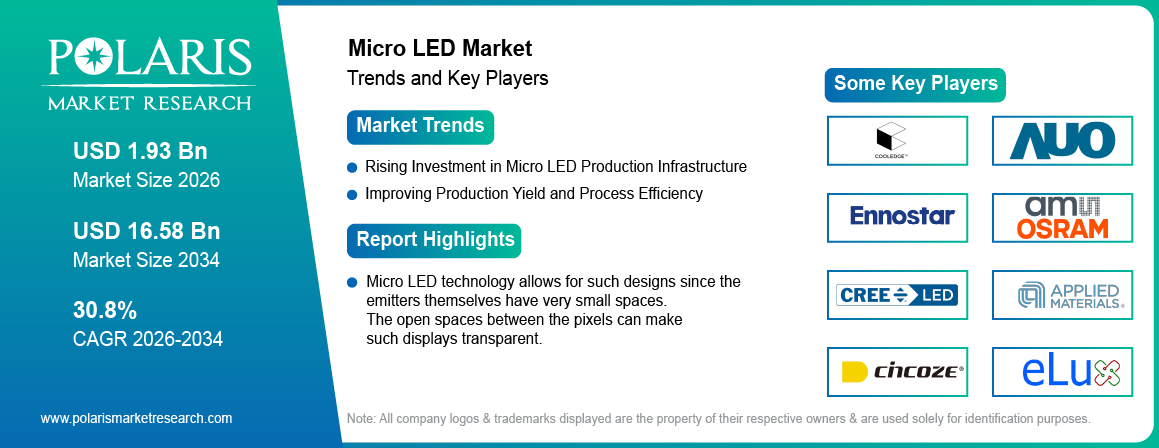
Drivers : Rising Investment in Micro LED Production Infrastructure
Investments in the production facilities are helping build the supply base for Micro LED products. Micro LED technology requires special semiconductor processes. Moreover, suitable wafer and module production capacity is required for Micro LED production. Building new production facilities can help increase access to the necessary inputs. Moreover, such investments may enable local manufacturing of display components. In May 2026, the Government of India approved a project by Crystal Matrix Limited in Gujarat. The firm will be establishing a compound semiconductor facility for mini/micro LED display modules. Moreover, GaN epitaxy wafers will be produced at the facility. The proposed annual capacity of the project is 72,000 sqm of Mini/Micro LED display panels. Moreover, 24,000 sets of RGB GaN wafers will be produced as part of the project (source: pib.gov.in). Such investments can strengthen the supply base for GaN micro LED products. They also contribute to the broader micro LED market manufacturing ecosystem.
Drivers : Improving Production Yield and Process Efficiency
Production yield continues to be a significant aspect concerning the commercialization of micro LED. Every panel is made up of an extremely large number of tiny LEDs. Any fault that arises in the process of transfer/bonding can influence the final display. Therefore, manufacturers are developing new techniques of inspecting and repairing in order to minimize losses of materials and maximize the amount of functional panels obtained from each batch. In 2026, MicroLED Connect emphasized high-throughput mass transfer and production yield improvement. The September 2026 program focused on Micro LED inspection, testing, repair, in-line metrology, and pilot-line scale-up (source: microledconnect.com). All these areas are directly linked to manufacturing efficiency. Increased process control can help minimize manufacturing losses and facilitate consistent production in large volumes.
Restraints & Challenges : High Manufacturing Cost and Complex Production
The high cost of manufacturing micro LED is due to the many microscopic LEDs used to make up a single display. These LEDs should be positioned in their right places on the surface of the display. There can also be defects during the transfer process. Defect identification and repair become another factor in the manufacturing process. These processes can lower production yield and increase material usage. The high micro LED production cost may lead to an increased final cost of the product compared with OLED and LCD competitors. The manufacturing process becomes more difficult with larger screen sizes and higher pixel densities. Improvements in transfer accuracy and manufacturing yield can help lower those costs. Until then, manufacturing complexity will continue to be one of the main challenges in micro LED commercialization.
Opportunities : Development of Full-Color Microdisplay Development
Full-color microdisplays are one area where Micro LED technology could see further growth. Small displays must have very high pixel density. Additionally, they require efficient color production in a very small space. Researchers and companies are exploring ways to achieve RGB production in small Micro LED devices. One such method is quantum dot color conversion. Another approach is a vertical RGB structure. In April 2026, Polar Light Technologies received €1.1 million in funding from the EU Eurostars program for a dual-color Micro LED microdisplay application project. This project involves research into technologies that can be used in next-generation near-eye displays (source: polar-light-technologies.com). These developments can help make smaller full-color displays possible. They can also help increase the suitability of Micro LED for use in future micro LED AR/VR devices. The opportunity lies in moving beyond monochrome microdisplays to full-color microdisplays.
Opportunities : Shift Towards Micro LED Optical Interconnects
There is opportunity for micro LEDs to extend beyond their use in conventional display products. One such application is optical interconnections. Data centers require faster optical connections due to increased computing loads. Optical connections have the ability to transfer large amounts of data at high speed while allowing for a compact design. Micro LEDs can be used as small light sources in such designs. Their small size enables them to achieve a high density of optical components. This opens up new markets for micro LED manufacturers in the data communication segment. The technology can also be used in optical interconnections of semiconductor chips within the computing elements. Research in this area is expected to widen the addressable market of micro LEDs beyond displays and wearable devices.
Trends : Growing Focus on Energy-Efficient Display Designs
The need for energy efficiency is growing as the use of displays increases in consumer and commercial products. Micro LED technology does not need a backlight system to control individual pixels. The pixels can be turned off if they are not required. In some display modes, this can result in reduced emission of unnecessary light. Power consumption also depends on display brightness, display content, and display configuration. For this reason, improvements in LED efficiency at the pixel level are being studied by manufacturers. Efficient light extraction can help create greater brightness without increasing power consumption accordingly. Advances in driver circuitry can contribute to efficiency. These improvements are relevant for devices where battery life and cost of operation are important factors. Energy efficiency can strengthen the long-term position of micro LED against competing display technologies.
Trends : Rising Interest in Transparent and Flexible Displays
Display producers have been seeking designs that go beyond conventional flat screens. Transparent display technologies will let viewers see objects behind the screen. Flexible displays enable installation on curved or even odd-shaped surfaces. Micro LED technology allows for such designs since the emitters themselves have very small spaces. The open spaces between the pixels can make such displays transparent. Flexible substrates are an alternative to developing curved display products. These properties can be applied to products ranging from retail to vehicles and wearable technology. This trend will encourage the development of thin substrates and adaptive display structures. With the evolution of this technology, transparent and flexible displays will be another area of interest for the micro LED technology industry.
Micro LED Market Report Segmentation
| Segmentation Axis | Segments |
| By Technology | Active Matrix Micro LED · Passive Matrix Micro LED · Reflective Micro LED · Transparent Micro LED |
| By Display Type | Television · Smartphone & Tablet · Smartwatch · Monitor & Laptop · Digital Signage · AR/VR Devices · Head-Up Display |
| By Panel Size | Less than 10-inch · 10–50-inch · Above 50-inch |
| By Pixel Density | Less than 3,000 ppi · 3,000–5,000 ppi · More than 5,000 ppi |
| By Application | Display · Lighting |
| By End User | Consumer Electronics · Automotive · Aerospace & Defense · Healthcare · Retail |
| By Region | North America (US, Canada) · Europe (Germany, France, UK, Italy, Spain, Netherlands, Russia, Rest of Europe) · Asia Pacific (China, Japan, India, Malaysia, South Korea, Indonesia, Australia, Vietnam, Rest of Asia Pacific) · Middle East & Africa (Saudi Arabia, UAE, Israel, South Africa, Rest of Middle East & Africa) · Latin America (Mexico, Brazil, Argentina, Rest of Latin America) |
Source: Polaris Market Research Analysis
By Technology
The active matrix micro LED segment accounted for the largest market share of 57.36% in 2025. In the case of an active matrix panel, there is a switch used to control each individual pixel. As a result, the display has the ability to control the amount of light emitted by the device accurately. It also provides fast response times and high-resolution images, which are necessary in some types of displays. The technology is able to accommodate small-sized pixels without relying on a shared control structure. This enables the technology to be considered for advanced display configurations with high pixel counts. Additionally, improvements in backplane integration are assisting manufacturers in meeting the technical demands of active matrix panels. With advancements in manufacturing processes, active-matrix micro-LED can support high-performance display devices.
The reflective micro LED segment is projected to grow at an 32.15% CAGR. Reflector-type micro LED technology works on the principle of reflecting the ambient or external light to create the image. It can minimize the need to emit light continuously through the display. Reduced energy consumption makes the technology suitable for applications where power consumption is a concern. Reflectors can further facilitate thin and compact display form factors. The technology is being explored for applications where there is a need for viewing clarity while keeping power consumption low. Enhanced optical performance can help address issues associated with brightness and viewing environment. Management of reflected light could further improve image quality in various environments. Such improvements could help the use of reflective micro LEDs in specialized displays in the forecast period.
By Display Type
The television segment accounted for an 41.73% micro LED market share in 2025. Large-size televisions present a strong application for micro LEDs because of their capability to offer high levels of brightness and control at the pixel level. Micro LEDs have the ability to provide a high level of contrast in large-size viewing spaces as well. All of these features are appropriate for premium television products, which mainly concentrate on picture quality and screen performance. Increasing demand for home entertainment systems is driving the adoption of micro LED in premium television products. Advances in panel manufacturing are enabling manufacturers to build larger panels with better performance. All of these factors are positioning televisions in the micro LED market.
The smartphone & tablet segment is projected to grow at an 31.25% CAGR. Mobile devices require displays that can fit into a small form factor without compromising image quality. Micro LED has the ability to accommodate extremely small pixel arrangements, which helps with higher resolutions. The self-luminous characteristic eliminates the requirement of a backlighting layer in the display panel. The reduced size of the display can provide some leeway to the manufacturers while designing slim devices. Another power-saving benefit is also relevant for battery-operated devices, where reduced power consumption is possible by reducing the number of pixels emitting light. These features have spurred research into micro LED displays for next-generation smartphones and tablets. It may become increasingly popular among manufacturers once it meets the manufacturing demands for small screens.
By Panel Size
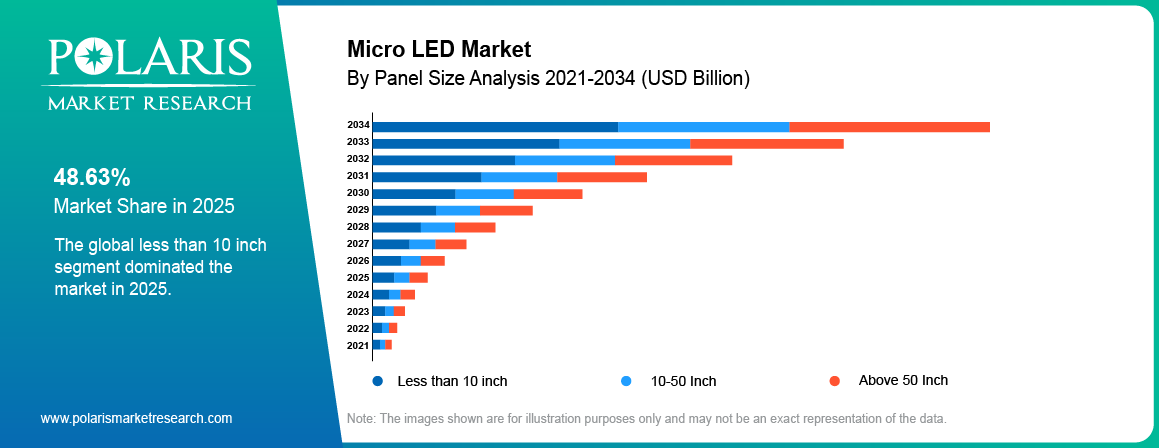
The less than 10 inch segment accounted for an 48.36% micro LED market share in 2025. Small panels are becoming increasingly popular as display sizes are shrinking. This panel range enables companies to install displays in devices that have limited space and also provides them with more freedom when making smaller and lighter devices. The category covers panel formats where screen size is not the main focus. Instead, the goal is to incorporate the display in an overall compact device design. Demand for small panels is closely tied to the creation of new portable display products. Companies are trying to improve panel quality while keeping them small enough. This is contributing to the rapid adoption of this panel size segment.
The 10–50-inch segment is projected to account for an 29.05% CAGR. This size category lets displays provide more screen space while remaining convenient for a variety of products. It creates an intermediate solution between small panels and large screens. It can accommodate various display configurations without the need for space that would be required by large panels. Therefore, the size category becomes important for manufacturers creating products for both indoor and personal use. There is also interest in mid-sized displays due to the requirement for additional screen space in compact designs. With increased availability of micro LED panels on the market in terms of their size range, the 10–50-inch range may see wider adoption. Advances in the manufacture of panels may result in additional variety of products within this size category.
By Pixel Density
The less than 3,000 ppi segment held the largest micro LED market share of 46.18% in 2025. This segment comprises displays with a relatively smaller pixel density as compared to other segments. This kind of density is ideal for products in which the screen will be seen from a distance. It may also give extra space between the pixels, which would make the arrangement of pixels in the display easier. This segment is relevant to large-screen sizes where extremely high pixel density is not necessary. It gives manufacturers flexibility in designing display panels for various viewing distances and screen sizes. It may enable a wider variety of displays without necessarily having the small pixel densities seen in high-density panels. As the micro-LED products get into more display formats, the segment is expected to retain its strong position in the market.
The more than 5,000 ppi segment is projected to grow at an 34.65% CAGR. It includes displays that have a very high density of pixels and extremely fine pixel spacing. These types of displays are suitable for applications where images have to be displayed sharply when viewed at short distances. This segment is especially important for smaller screens where higher numbers of pixels have to be accommodated in less display space. It can support detailed visual output in high-end displays. High-density panels are also under consideration for near-eye displays, where the display is placed very close to the eyes of viewers. Requirements of such specific applications could drive growth in this segment during the forecast period. Future developments in high-density display technology could enhance applications of micro LED in this segment.
By Application
The display segment accounted for an 88.42% micro LED market share in 2025. Display applications include the use of Micro LED in any application where the visual content has to be displayed on a screen. The segment benefits from the wide adoption of screens in various modern electronic devices and machines. The technology is under consideration in devices where manufacturers need better screen capabilities as part of the targeted design of the product. This creates potential for micro LED technology in both small and large display devices. As manufacturers become more interested in commercial micro LED production, display applications are expected to continue to grow.
The lighting segment is projected to grow at an 34.15% CAGR. Micro LED may serve as a small-scale light source when an application requires exact control over the light emission. The small size of this device makes it possible to arrange several emitters on a limited surface area. In this way, the technology becomes useful for special lighting and small-scale electronics. The segment is seeing development as researchers explore new applications for Micro LEDs beyond conventional display products. Growing interest in small light sources is expanding the number of application fields. Manufacturers are also considering new designs that will help enhance light distribution and overall system performance. In this way, lighting can become an important part of the micro LED market during the forecast period.
By End User
The consumer electronics segment held an 53.48% micro LED market share in 2025. This segment includes devices bought for personal and household consumption. The segment has several product categories in which the screen technology constitutes a significant portion of the total product design. Consumer purchase behavior creates a strong link between new display technology and product development. In this way, the high-end devices act as a market for newer display technologies. Product launches, shifts in design trends, and competition among device manufacturers could therefore affect demand in this segment. As more consumer products use advanced screens, there is more room to use micro LED. These factors support the position of consumer electronics as a key end-user segment.
The healthcare segment is projected to account for an 36.25% CAGR. The healthcare industry needs to have displays capable of providing clear information related to diagnostics, monitoring, and treatment processes. Micro LED display technology can be deployed in medical displays where there is a need for consistent performance of the visual output. Micro LED displays can also be employed in equipment deployed in operating rooms and other clinical environments. The demand in this segment is driven by developments in the use of medical equipment and imaging solutions. There is also a trend among hospitals and healthcare facilities towards deployment of equipment capable of providing more visual information. As medical display systems become more specialized, micro LED will have room to grow in select areas of the healthcare industry.
Micro LED Use Cases
| Use Case | Market Application |
| Consumer Electronics & TVs | Premium televisions are an important commercial application, with Micro LED positioned for high-end home entertainment and larger-screen products. |
| AR/VR and Wearables | Smartwatches and near-eye displays may make use of micro LED display technology, as well as companies designing smaller optical systems. Augmented reality glasses are another application domain that is being researched at the moment. |
| Micro LED Automotive Displays | The interior of automobiles offers several possible applications, such as dashboards, infotainment screens, passenger displays, and HUDs. |
| Micro LED Digital Signage | Retail locations, airports, stadiums, corporate facilities, and other entertainment locations may find the use of micro LEDs applicable for large visuals and advertisements. |
| Medical Displays | Medical imaging and surgery systems can be seen as an example of specialized application, where precise visual information presentation is essential. |
| Aerospace and Defense | Cockpit interfaces, mission displays, and other special equipment provide some examples of possible application domains. |
| Industrial Systems | Factories and their equipment, and inspection systems provide another option to consider. |
| Optical Communication | Beyond displays, micro LED emitters are being explored for optical data transmission. This could extend the technology into selected semiconductor and communication applications. |
| Specialized Lighting | Lighting represents a smaller emerging application, particularly for designs that require individually controlled microscopic light sources rather than conventional LED arrangements. |
Source: Polaris Market Research Analysis
Regional Insights
Asia Pacific
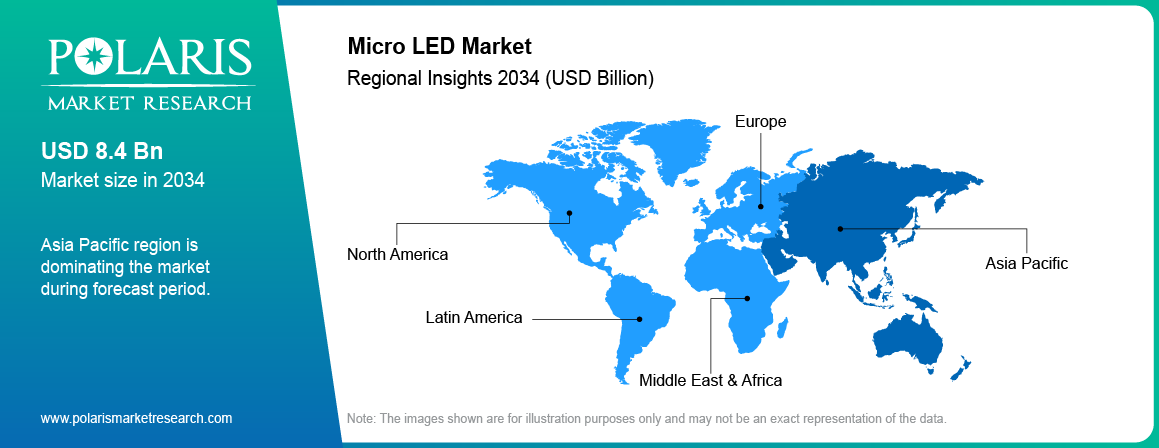
Asia Pacific accounted for an 61.37% share of the micro LED market in 2025. The region is dominant within the display and semiconductor sectors due to its existing manufacturing infrastructure. Nations such as China, Japan, South Korea, and Taiwan have active electronics industries that can support the development of Micro LED products. The region has a sizeable number of consumer electronics manufacturers and component suppliers. Investment in the development of new displays is providing further opportunities for manufacturing and product development. Applications in TVs, mobile devices, wearables, and automotive electronics increase the market base of the region. Studies are further being carried out on micro LED technology concerning materials, manufacturing processes, and panel designs. All of this contributes to Asia Pacific’s position as a major regional market.
North America
North America is projected to grow at an 29.47% CAGR. The region has a solid foundation of technology companies and electronics developers. This helps in research activities that focus on developing next-generation display technologies. The U.S. also has a sizable market for high-end consumer electronics. Micro LEDs are being used for televisions, wearable products, automotive displays, and other applications. The region also has a rising interest in AR/VR devices. These applications would help drive demand for innovative display technologies. Research activities by universities and technology companies are contributing to regional developments. Investments in micro LEDs manufacturing and associated technologies will help foster the market in North America.
Europe
Europe accounted for an 14.23% share of the micro LED market in 2025. It has a well-established ecosystem of automotive component and manufacturing companies. This makes the market suitable for micro LED applications in vehicle interior design as well as driver information systems. Europe also has a well-established foundation of research related to photonics and semiconductors. Research organizations are exploring ways of creating new materials and manufacturing processes for cutting-edge displays. Germany, France, the United Kingdom, and the Netherlands are quite active in this area of technology. There is also a demand for high-end consumer goods and specialized equipment in this region. This may offer potential use cases for the products based on micro LED technology.
Latin America
The Latin America micro LED market is projected to grow at an 30.12% CAGR. The area has increased usage of digital screens in retail and business establishments. The large retailers are enhancing their store display systems to make them engaging for customers. Larger digital screen advertisements by advertising firms in large urban areas have also been observed. The manufacture of automobiles in regions like Mexico has opened up another market segment for advanced display systems. The consumer electronics sales market is also growing. But the deployment of micro LED is still at an early stage across most countries in the region. The high cost of the product could reduce its adoption in markets outside premium applications. As production becomes more accessible, the technology will find increased applications in commercial displays and selected consumer products.
Middle East & Africa
The Middle East & Africa micro LED market is anticipated to account for an 32.37% CAGR. With development in modern retail and commercial infrastructures, there is rising demand for advanced digital display systems. Mall spaces, airports, hotels, and entertainment parks are some of the important applications that can help make use of these large displays. Countries in the Gulf have also been implementing some smart city programs that utilize digital displays and infrastructure. Another segment that can benefit from the application of the technology is the automotive industry, especially when it comes to premium cars. In Africa, implementation is more related to commercial displays and the development of digital infrastructure.
Key Market Players & Competitive Landscape
There are various participants in the micro LED market, including display makers, semiconductor firms, and technology developers. There are efforts being made by companies to enhance chip fabrication, transfer in bulk, color performance, and panel assembly. Micro LED market key players are also engaging in efforts aimed at cutting down production costs and enhancing manufacturing yields. Different participants are involved in the development of micro LED solutions for use in televisions and other large display units. Some participants have been focusing on wearable devices, automobile displays, and near-eye display units. Collaborations between the technology innovators and display makers are also helping with product development. As the technology matures towards commercial adoption, there are efforts being made by firms to increase efficiency in the production process and extend the application base.
Vendor Positioning
| Company | Primary strength | Key applications |
| LED and optical semiconductor expertise | Micro LED, automotive lighting, optical systems | |
| Applied Materials | Semiconductor and display manufacturing equipment | Micro LED manufacturing, display production |
| AUO Corporation | Advanced display panel development | TVs, automotive displays, commercial displays |
| Cincoze Co., Ltd. | Rugged industrial computing and display systems | Industrial displays, embedded systems |
| Cooledge Lighting, Inc. | LED lighting solutions and flexible lighting technology | Architectural lighting, specialty lighting |
| High-performance LED chip and component technology | Displays, lighting, specialty LED applications | |
| eLux, Inc. | Micro LED display technology and mass transfer | Micro LED displays, large-format displays |
| Ennostar | LED epitaxy and chip manufacturing | Micro LED, displays, LED applications |
| Europa Science Ltd. | Scientific and technical equipment expertise | Research systems, display technology development |
| Innolux Corporation | Large-scale display panel manufacturing | TVs, monitors, automotive displays |
| KYOCERA Corporation | Advanced materials and electronic components | Displays, electronic devices, industrial applications |
| LEYARD | Fine-pitch LED display systems | Digital signage, commercial displays, large-format displays |
| LG Electronics | Premium display products and consumer electronics | TVs, monitors, automotive displays |
| PlayNitride | Micro LED technology and display development | Micro LED displays, large-format displays, wearables |
| Samsung Electronics Co., Ltd. | Premium display technology and product development | TVs, digital signage, wearables |
| Sony Corporation | Advanced display systems and imaging technology | Professional displays, entertainment, digital signage |
| Unilumin | LED display systems and large-format solutions | Digital signage, commercial displays, entertainment venues |
| VueReal | Micro LED manufacturing and integration technology | Micro LED displays, AR/VR, automotive displays |
Source: Polaris Market Research Analysis
Recent Developments (2026 Commercialization Milestones)
| Company | Date | Development | Commercialization Relevance |
| Raysolve | September 2026 | Raysolve completed nearly RMB 100 million in Pre-A4 financing to accelerate commercialization of micro LED near-eye displays and optical interconnects. (source: raysolve.com) | Provides funding for product development and industrialization in AR and optical communication applications. |
| AUO Corporation | August 2026 | AUO announced a system-level micro LED co-packaged optics module for high-speed optical communication at SEMICON Taiwan 2026. (source: auo.com) | Extends micro LED into AI data-center optical interconnects beyond conventional display applications. |
| ams OSRAM | August 2026 | ams OSRAM reported key development milestones for its RGB Micro LED light engines for next-generation AR smart glasses and said the technology was advancing toward mass-production readiness. (source: ams-osram.com) | Indicates progress toward commercial micro LED light engines for AR glasses. |
Research Methodology
This micro LED market report estimates are built on a combination of primary and secondary research rather than desk research alone. Primary research consists of structured interviews with executives, product managers, and technical specialists across the Micro LED value chain. These include chip manufacturers, mass-transfer and bonding equipment suppliers, panel integrators, and end-brand product teams. Primary research helps validate demand signals, pricing trends, and near-term commercialization timelines that public filings do not fully capture.
Secondary research draws on company annual reports and investor presentations, regulatory and customs trade data, patent filings, industry-association publications, and paid and open-access industry databases, used to triangulate unit shipments, revenue by segment, and regional demand.
Market sizing follows a bottom-up approach: company-level revenue and shipment data are aggregated by segment and by region, then reconciled against top-down macro indicators (consumer electronics spend, automotive production volumes, AR/VR device shipments) for consistency.
Forecast assumptions (growth drivers, restraints, technology-adoption curves, and regulatory or trade-policy risk) are documented explicitly for each segment and revisited at each refresh cycle. A final validation pass cross-checks the resulting figures against distributor, manufacturer, and industry-association inputs before publication.
Micro LED Market Report Scope
| Report Attributes | Details |
| Market Size Value in 2025 | USD 1.48 billion |
| Market Size Value in 2026 | USD 1.93 billion |
| Market Forecast 2034 | USD 16.58 billion |
| CAGR | 30.8% from 2026 to 2034 |
| Base Year | 2025 |
| Historical Data | 2021–2024 |
| Forecast Period | 2026–2034 |
| Quantitative Units | Revenue in USD billion and CAGR from 2026 to 2034 |
| Report Coverage | Revenue Forecast, Market Competitive Landscape, Growth Factors, and Industry Trends |
| Segments Covered |
|
| Regional Scope |
|
| Competitive Landscape |
|
| Report Format |
|
| Customization | Report customization as per your requirements with respect to countries, regions, and segmentation. |
Source: Polaris Market Research Analysis
Micro LED Market FAQ's
The micro LED market size was valued at USD 1.48 billion in 2025. The market is projected to reach USD 16.58 billion by 2034.
The market is projected to account for an 30.8% CAGR from 2026 to 2034.
Asia Pacific held an 61.37% share of the micro LED market in 2025. This is owing to the rising demand for high-quality electronic products in the region.
The healthcare segment is anticipated to grow at an 36.25% CAGR. The segment’s growth is driven by surgical procedures needing high luminance with minimal temperature rise.
A few of the key market players include ams OSRAM; Applied Materials; AUO Corporation; Cincoze Co., Ltd.; Cooledge Lighting, Inc.; Cree LED; eLux, Inc.; Ennostar; Europa Science Ltd.; Innolux Corporation; KYOCERA Corporation; LEYARD; LG Electronics; PlayNitride; Samsung Electronics Co., Ltd.; Sony Corporation; Unilumin; and VueReal.
Micro LED could be considered when there is a need for a bright display with good contrast ratio, durability, and precise pixel control. Nevertheless, the costly production process and limited choice of products available on the market make micro LED technology more suitable for premium solutions than for everyday use.
Micro LED technology works on the basis of inorganic LEDs being used as light sources. In turn, OLED works with organic light-emitting pixels. Micro LED provides high levels of brightness and durability, while OLED technology is more mature and widely used.

Download Sample Report of Micro LED Market
Please fill out the form to request a customized copy of the research report.


