
Multi Cancer Early Detection Market Size, Growth Report 2026-2034
REPORT DETAILS
Multi Cancer Early Detection Market Summary
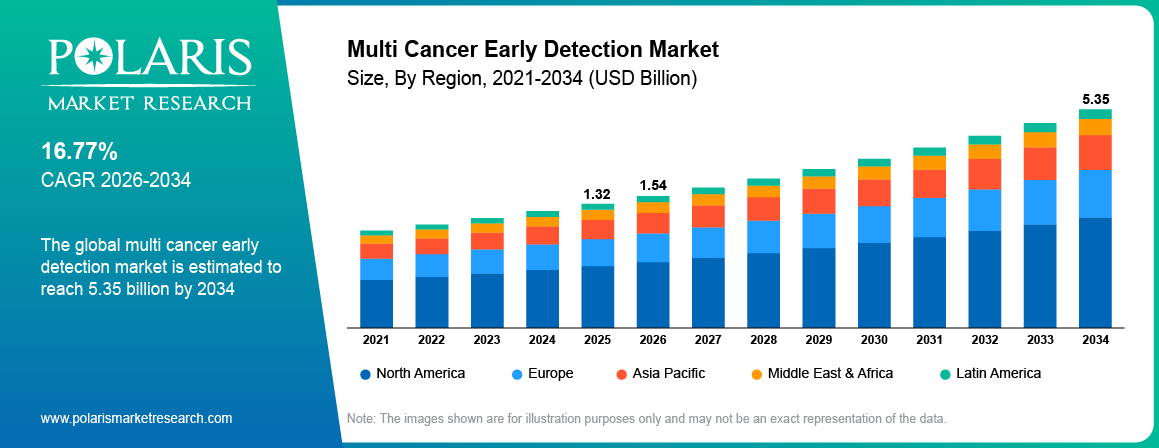
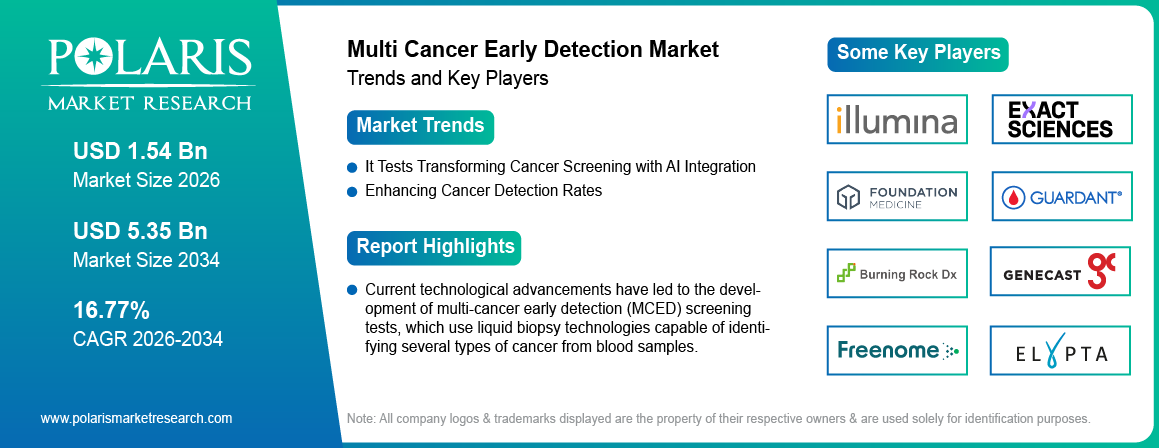
The global Multi-Cancer Early Detection (MCED) market was valued at USD 1.32 Billion in 2025 and is projected to grow from USD 1.54 Billion in 2026 to USD 5.35 Billion by 2034, registering a CAGR of 16.77% during the forecast period.
Market Statistics
Key Takeaways
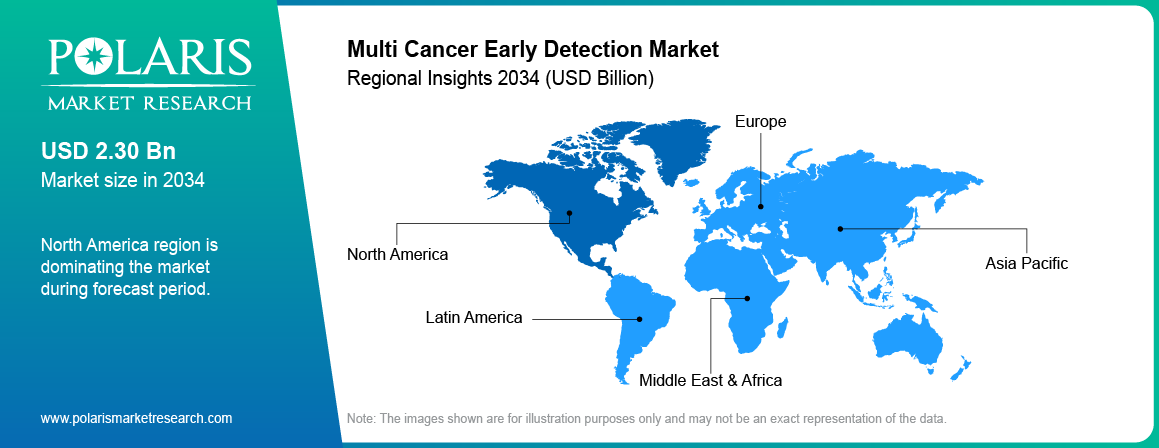
- North America dominated the market with 43.0% revenue share in 2025. The share is due to the presence of advanced diagnostic facilities, a large number of cancer cases, and high investment in research and development.
- Asia Pacific is expected to record the highest CAGR of 18.1% during 2026-2034. This is due to improved healthcare infrastructure and increasing adoption of early cancer screening.
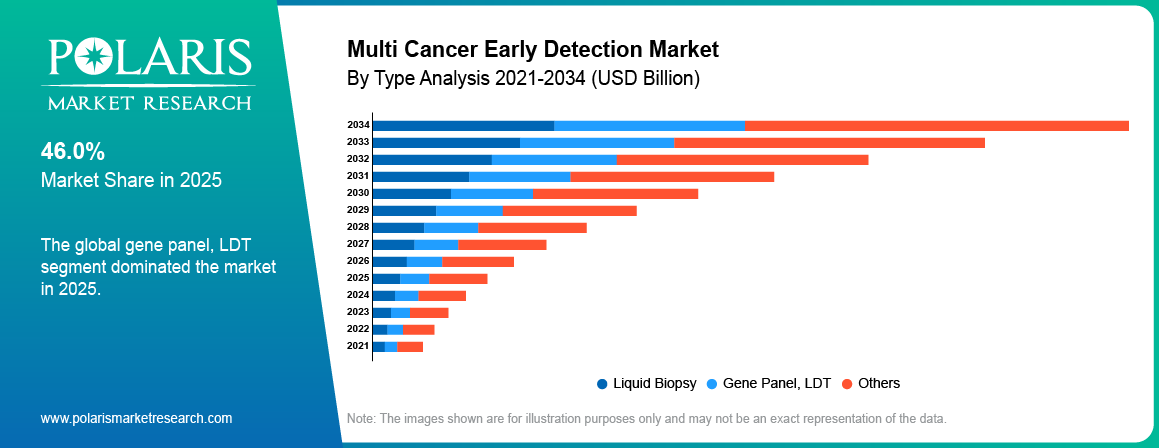
- Gene Panel, LDT segment held the largest revenue share of 46.0% in 2025.This was mainly because NGS-based gene panels are increasingly used for personalized cancer diagnosis.
- The Liquid Biopsy segment is expected to grow at the highest CAGR of 17.2% during 2026–2034.The growth is driven by the increasing demand for minimally invasive and accurate cancer detection.
- With a 47.0%, the Hospitals segment held the largest market share in 2025. This was due to the growing use of multi-cancer early detection tests for patient evaluation.
- The Diagnostic Laboratories segment is expected to grow at a CAGR of 17.3% during 2026–2034. This growth has been due to increasing use of blood based screening tests and advanced diagnostic technologies.
Note: Figures and projections outlined in this report are the result of Polaris Market Research’s proprietary analytical processes, grounded in the latest available datasets and market observations.
Multi Cancer Early Detection Market Drivers, Opportunities and Challenges
- Growing use of MCED tests is driving the market by helping detect multiple cancers from a single blood sample.
- The use of AI in MCED tests is improving test accuracy and making cancer screening more effective.
- Rising demand for early cancer detection is increasing the adoption of MCED tests and supporting market growth.
- More research funding and new product development are helping expand the market.
- High testing costs, strict regulations, and the chance of incorrect results are limiting market growth.
AI Impact on the Multi-Cancer Early Detection Market
- AI improves the early detection of cancer by analyzing blood sample data better.
- AI improves the accuracy of tests in identifying types of cancer.
- AI reduces the time it takes to analyze test results, which results in faster screening.
- AI assists researchers in the better detection of cancer, which helps in the development of better MCED tests.
Source: Polaris Market Research Analysis
To Understand More About this Research:Download Sample Report
What is Multi-Cancer Early Detection?
Multi-cancer early detection (MCED) is a screening approach that uses a single blood sample to detect signs of multiple types of cancer. It analyzes biomarkers including circulating tumor DNA (ctDNA) and proteins to identify cancer at an early stage. With the help of MCED doctors begin treatment sooner and improve patient outcomes.
How Multi-Cancer Early Detection Works?
Multi-cancer early detection (MCED) begins with collecting a small blood sample from the patient. The sample is tested for cancer related biomarker. It includes cell-free DNA (cfDNA), circulating tumor DNA (ctDNA), and proteins. Advanced laboratory testing checks these biomarkers for signs of cancer. If a cancer signal is found, the test estimates where the cancer may have started in the body. Doctors then confirm the results with additional tests. These tests are imaging or a biopsy, before planning the most suitable treatment.
Multi Cancer Early Detection Market Size and Growth Outlook
Current technological advancements have led to the development of multi-cancer early detection (MCED) screening tests, which use liquid biopsy technologies capable of identifying several types of cancer from blood samples. These screening tests aim to identify cancer-associated signals in their early stages, covering a spectrum of cancers, including those not typically targeted by standard screening modalities.
Tests recently in development are expected to serve multiple purposes, including complementing existing standard screening procedures. Standard screening activities among individuals undergoing MCED screening tests are important to understanding the impact and implications of these recent technologies. They essentially influence shifts in screening activities and play a crucial role in the future of cancer prevention and detection technology.
In February 2024, the NIH initiated a research network to evaluate emerging cancer screening technologies. This initiative supported the Biden-Harris administration's Cancer Moonshot agenda by exploring methods to detect cancers earlier, potentially making them more manageable to treat.
Blood-based multi-cancer early detection tests hold the potential to improve cancer survival rates by expanding population screening efforts. Leveraging genome sequencing and machine learning, these tests have been developed to complement single-cancer screening techniques. By analyzing circulating cell-free DNA, this multi-cancer early detection (MCED) test can detect common cancer signals among several types of tumors.
For instance, in September 2023, the Eone-Diagnomics Genome Center (EDGC) is poised to introduce a blood-based multi-cancer early detection test. The aim was to scale up this test to detect numerous cancer types and explore potential applications beyond cancer detection.
MCED vs. Traditional Cancer Screening
| Feature | Multi-Cancer Early Detection (MCED) | Traditional Cancer Screening |
| Cancer Detection | Detects multiple cancers with one test | Detects one type of cancer per test |
| Test Method | Single blood test | Imaging or procedure-based tests, such as mammograms or colonoscopies |
| Invasiveness | Minimally invasive | May involve imaging or invasive procedures |
| Regulatory Status | Still emerging with limited approvals | Widely validated and commonly used in clinical practice |
Source: Polaris Market Research Analysis
Importance of Early Cancer Detection
Early cancer detection supports find the disease before symptoms appear or before it spreads to other parts of the body. This could lead to better care and better patient survival rates. It could also lead to a reduced need for more complex treatments and lower healthcare costs. Early diagnosis enables physicians to start treatment earlier which can lead to improved patient outcomes.
Screening in Asymptomatic Populations
MCED tests are designed for people who do not have any signs or symptoms of cancer. They help detect cancer at an early stage, before symptoms develop. This expands cancer screening beyond traditional methods that usually focus on specific cancers. Early screening can help doctors begin treatment sooner and improve patient outcomes.
Growth Drivers
Multi-Cancer Early Detection (MCED) Tests Transforming Cancer Screening with AI Integration
In the healthcare sector, MCED tests have become an important screening tool, with molecular analysis of tumor-related indicators in bodily fluids with advanced artificial intelligence (AI) algorithms. This novel technique enables the simultaneous detection of various cancers while precisely determining the specific cancer type. Rapidly advancing AI technology, the merging of MCED with AI has emerged as a prominent trend, encouraging the development of a diverse range of MCED AI products. This convergence creates new opportunities for personalized medicine and patient care while also improving the effectiveness of cancer screening.
Enhancing Cancer Detection Rates
MCED tests are designed with the purpose of maintaining high specificity levels while efficiently detecting common signals present in several types of cancer. This accuracy makes a notable increase in the total cancer detection rate within the population. By implementing multi-cancer early detection strategies, businesses stand poised to significantly increase cancer detection rates within general populations, preferably identifying cases at earlier stages when treatment options and prognoses are more favorable.
Additionally, in November 2023, GRAIL initiated the REACH Study to evaluate the clinical impact of the Galleri Multi-Cancer Early Detection (MCED) Test among the Medicare population.
Restraining Factors
Potential Risks and Uncertainties Surrounding Multi-Cancer Early Detection Tests
Despite the promising potential of multi-cancer early detection tests, several risks and uncertainties restrain their widespread adoption. The high cost of development and testing can limit accessibility and affordability. Moreover, regulatory hurdles and the need for extensive clinical validation pose significant challenges. False positives and negatives also present risks, potentially leading to unnecessary treatments or missed diagnoses. Additionally, ethical concerns regarding patient privacy and data security complicate implementation. These factors, coupled with varying healthcare infrastructure and reimbursement policies, create uncertainties that must be addressed to realize the benefits of multi-cancer early detection technologies fully.
Source: Polaris Market Research Analysis
Multi Cancer Early Detection Market Segment Analysis
The market is primarily segmented based on type, end user, and region.
By Type | By End User | By Region |
|
|
|
Source: Polaris Market Research Analysis
By Type Analysis
The gene panel, LDT segment held the largest share of the market during the forecast period. This dominance is due to the incorporation of clinically target sequences into NGS-based gene panel assays, which resulted in practical diagnostic tools that facilitate personalized cancer patient care. It offers clinical utility by examining multiple aspects, including the genetic basis for an individual's response to therapy, like signaling pathways linked to specific treatments, microsatellite instability, hypermutated phenotypes, and deficiencies in the DNA double-strand break repair pathway.
The liquid biopsy segment is poised for rapid growth over the forecast period. This growth is due to the pivotal role of liquid biopsies in early detection in improving quality of life, survival rates, and reducing the cost burden of cancer therapies. There is a pressing need for liquid biopsies with heightened sensitivity.
By End Use
In 2023, the hospitals segment held the largest share. This is because MCEDs in hospitals play an important role in providing comprehensive diagnostic assessments in patients with positive MCED test results. MCED innovative tests screen for a multitude of cancers, including colorectal, breast, cervical, and prostate cancers, with a single blood sample.
Diagnostic laboratories will grow rapidly due to the main use of blood samples, offering several advantages for screening as an emerging health technology. Multi-cancer early detection technologies have the potential to interrupt conventional models of cancer screening, offering significant opportunities for diagnostic laboratories to adapt and capitalize on this evolving landscape.
Real-World Applications of Multi-Cancer Early Detection (MCED)
| Application | Description |
| Early cancer detection | Helps find lung, breast, colorectal, and other cancers at an early stage. |
| High-risk patient screening | Screens people who have a higher risk of developing cancer, even without symptoms. |
| Rare cancer detection | Helps detect cancers that do not have regular screening tests. |
| Regular health checkups | Can be used as part of routine health checkups for early cancer screening. |
| Cancer recurrence monitoring | Helps check if cancer has returned after treatment. |
| Population screening | Being tested for use in large community cancer screening programs. |
| Along with standard screening | Used together with mammograms, colonoscopies, and other screening tests. |
| Cancer research | Used in clinical studies to improve early cancer detection methods. |
Source: Polaris Market Research Analysis
Source: Polaris Market Research Analysis
Multi Cancer Early Detection Market Regional Analysis
North America dominated the global market in 2025. The North America multi-cancer early detection market is experiencing significant growth, driven by advancements in diagnostic technologies and a rising emphasis on early cancer detection. This market encompasses a range of innovative diagnostic tests designed to detect multiple types of cancer at early stages using various biomarkers, including genetic, proteomic, and epigenetic markers. The objective is to improve patient outcomes through early intervention and more effective treatment strategies.
Several driving factors are propelling the growth of this market. Firstly, the increasing prevalence of cancer in North America underscores the urgent need for early detection methods. According to the American Cancer Society, there are an estimated 1.8 million new cancer cases diagnosed annually in the United States alone, highlighting the critical demand for advanced diagnostic tools. Secondly, technological advancements in genomic and molecular diagnostics have significantly enhanced the accuracy and reliability of multi-cancer detection tests. These innovations enable the identification of cancer at much earlier stages than traditional methods, often before symptoms appear.
Furthermore, substantial investments in research and development by both public and private sectors are accelerating the commercialization of multi-cancer early detection tests. Government initiatives and funding aimed at improving cancer screening programs contribute to market expansion. Additionally, growing awareness among healthcare providers and patients about the benefits of early cancer detection is fostering the adoption of these advanced diagnostic tools.
Source: Polaris Market Research Analysis
Multi Cancer Early Detection Market Competitive Landscape
Strategic Partnerships, Clinical Collaborations and Product Launches
The multi cancer early detection market is fragmented. The ongoing expansion initiatives, including partnerships, acquisitions, and collaborations, are fueling competition in the marketplace. For instance, in July 2023, PredOmix Technologies & CORE Diagnostics collaborated to launch OncoVeryx-F, a state-of-the-art multi-cancer early detection test designed for high-risk & asymptomatic women.
Some of the major players operating in the global market include:
- Illumina, Inc. (GRAIL, LLC)
- Exact Sciences Corp.
- Foundation Medicine, Inc.
- AnchorDx
- Guardant Health
- Burning Rock Biotech Ltd.
- GENECAST
- Beijing Lyman Juntai International Medical Technology Development Co.
- Freenome Holdings, Inc.
- Elypta AB
Challenges in MCED Adoption
- Limited regulatory approvals: Many MCED tests are still waiting for broader regulatory approval.
- False positive results: Some test results may require additional testing to confirm the diagnosis.
- High testing cost: The cost of MCED tests can limit access for many patients.
- Limited insurance coverage: Reimbursement for these tests is still limited in many regions.
- Need for follow-up tests: Positive results must be confirmed with imaging, biopsy, or other diagnostic tests.
- More clinical evidence needed: Ongoing clinical studies are required to confirm the long-term benefits of MCED tests.
Future of The Multi Cancer Early Detection Market
The multi-cancer early detection market is expected to grow in the coming years. Better liquid biopsy, genomics, and AI technologies are improving the accuracy of these tests. The market growth will be driven by increased clinical studies and increased adoption of early cancer screening. Lower testing costs and more regulatory approvals will support boost the adoption of MCED tests globally.
Recent Developments in the Industry
- January 2026: GRAIL submitted its Galleri multi-cancer early detection blood test to the U.S. FDA for review. This is an important step toward wider clinical use of the test. (Source: https://grail.com)
- March 2026: Guardant Health launched its Shield Multi-Cancer Detection blood test in Hong Kong, Singapore, and the Philippines through a partnership with Manulife. The launch expands access to early cancer screening in Asia. (Source: https://investors.guardanthealth.com)
Report Coverage
The multi cancer early detection market report emphasizes on key regions across the globe to provide better understanding of the product to the users. Also, the report provides market insights into recent developments, trends and analyzes the technologies that are gaining traction around the globe. Furthermore, the report covers in-depth qualitative analysis pertaining to various paradigm shifts associated with the transformation of these solutions.
The report provides detailed analysis of the market while focusing on various key aspects such as competitive analysis, product, component, caliber, guidance mechanism, application, lethality, and their futuristic growth opportunities.
Report Scope
| Report Attributes | Details |
| Market size value in 2025 | USD 1.32 Billion |
| Market size value in 2026 | USD 1.54 Billion |
| Revenue forecast in 2034 | USD 5.35 Billion |
| CAGR | 16.77% from 2026 – 2034 |
| Base year | 2025 |
| Historical data | 2021 – 2024 |
| Forecast period | 2026 – 2034 |
| Quantitative units | Revenue in USD million and CAGR from 2026 to 2034 |
| Segments covered |
|
| Regional scope |
|
| Competitive Landscape |
|
| Report Format |
|
| Customization | Report customization as per your requirements with respect to countries, region, and segmentation. |
Source: Polaris Market Research Analysis
Multi Cancer Early Detection Market FAQs
Multi Cancer Early Detection Market Size Worth $ 5.35 Billion By 2034
The top market players in Multi Cancer Early Detection Market are Illumina, Sciences Corp., Foundation Medicine
North America contribute notably towards the Multi Cancer Early Detection Market
Multi Cancer Early Detection Market exhibiting the CAGR of 16.77% during the forecast period
Multi Cancer Early Detection Market report covering key segments are type, end user and region
MCED is a blood-based screening test that looks for signs of multiple cancers at the same time using a single blood sample.
MCED tests analyze cancer-related biomarkers in a blood sample to detect possible cancer signals and estimate where the cancer started.
MCED tests can detect several cancers, including lung, breast, colorectal, liver, ovarian, and pancreatic cancers, depending on the test used.
Download Sample Report of Multi Cancer Early Detection Market
Please fill out the form to request a customized copy of the research report.


