
Neobanking Market Size, Share, Trends & Forecast, 2026–2034
REPORT DETAILS
Neobanking Market Summary
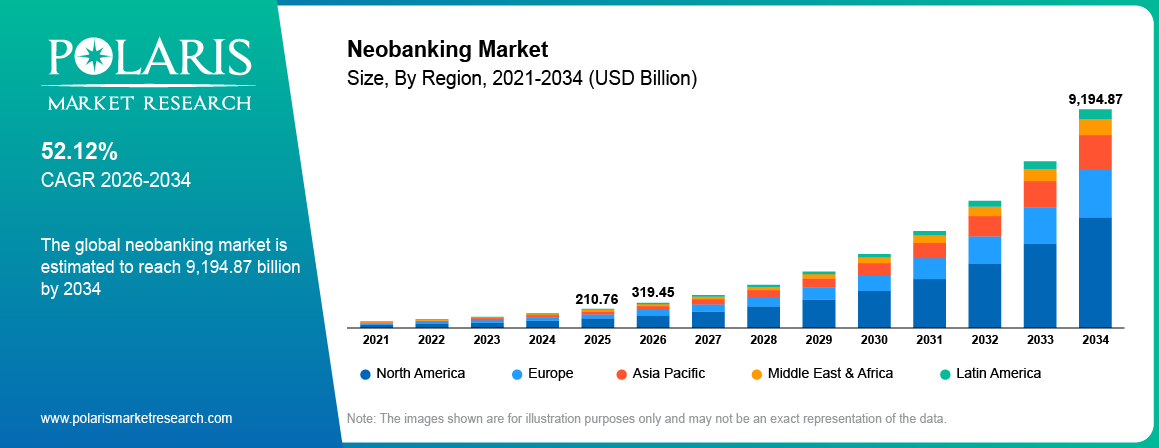
The global neobanking market was valued at USD 210.76 billion in 2025 and is expected to grow at a CAGR of 52.12% during the forecast period. Increasing demand for convenience among banking customers drives the market growth. Increasing adoption of smartphones and affordable internet services, especially in developing countries, fuels the market expansion.
Market Statistics
Neobanking Market Key Takeaways
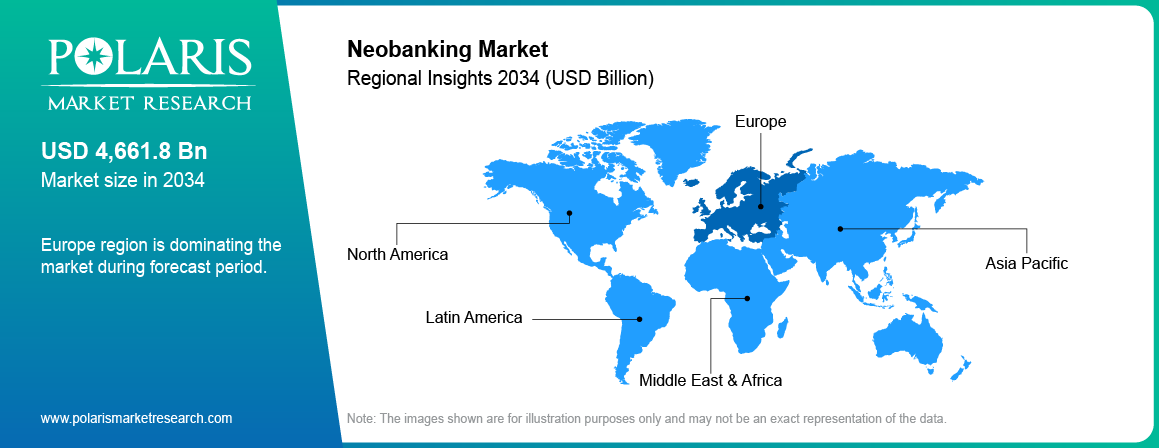
- Europe held 31.8% of the market revenue in 2025. The region’s early adoption of digital banking and continued fintech market growth helped it lead the market.
- The Asia Pacific market is expected to register a significant CAGR of 64.5% during 2026–2034. The increasing number of smartphone users and the rise of digital banks are supporting the market growth.
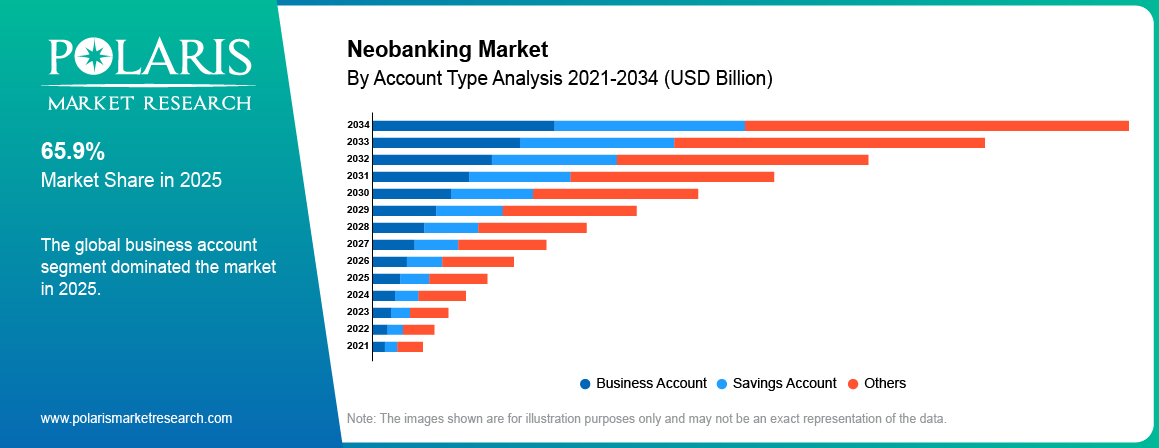
- The Business Account segment held 65.9% of the market revenue in 2025. Neobanks are increasingly being used by businesses for their payments and finance management.
- As per our neobanking market forecast, the Savings Account segment is expected to grow at a 66.6% CAGR from 2026 to 2034. The growth is driven by the convenience of account access and secure online banking.
- The Enterprise segment held 58.7% of the market revenue in 2025. To manage transactions and finances more efficiently businesses are adopting neobanking services.
- The Personal segment is expected to grow at a 66.9% CAGR during 2026–2034. More users are coming for simple mobile banking and easy account setup.
Note: Figures and projections outlined in this report are the result of Polaris Market Research’s proprietary analytical processes, grounded in the latest available datasets and market observations.
What is neobanking?
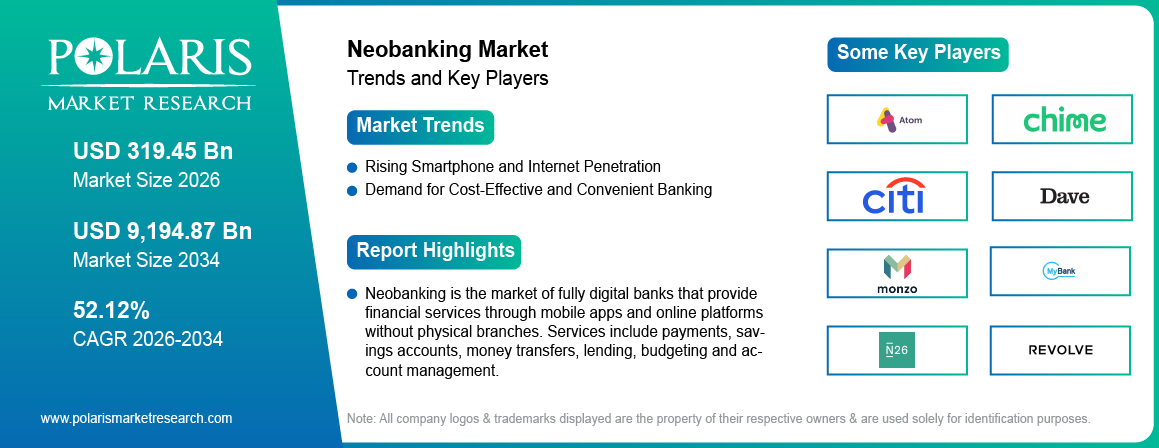
Neobanking is the market of fully digital banks that provide financial services through mobile apps and online platforms without physical branches. Services include payments, savings accounts, money transfers, lending, budgeting, and account management. As more consumers and businesses seek fast, convenient, digital-first banking solutions, the market is growing faster.
How Does Neobanking Work?
- Through a mobile app or website customers can open an account without visiting a bank.
- Digital KYC confirms their identity online.
- Cloud systems store and manage account information, balances, and transactions.
- APIs connect neobanks with payment systems and other financial services.
- AI and data analytics assist neobanks in identifying fraud and understanding customer needs.
- To view balance, transfer money, make payments, and manage their accounts, customers are able to use the app or website.
Traditional Banking vs. Neobanking
| Parameter | Traditional banking | Neobanking |
| Operating model | Branch-led with digital channels | Digital-first with mobile/web channels |
| Physical infrastructure | Branches and physical service points are core to the model | Generally no branch network or limited physical presence |
| Account opening | May involve branch or digital onboarding depending on bank | Typically app/web-based onboarding and digital KYC |
| Customer experience | Combination of branch, web and mobile interactions | Mobile-first, self-service and app-centric |
| Fees and pricing | May include branch/network and account-related fees | Often positioned around lower-cost digital services, subject to product and provider |
| Payments and transfers | Cards, online banking, branches and payment networks | Integrated digital payments, transfers and wallet/API capabilities |
| Personalization | Increasing use of analytics and digital tools | Strong emphasis on real-time analytics and personalized app experiences |
| Technology model | Often combines legacy core systems with modern digital layers | Typically cloud-native or cloud-enabled digital infrastructure |
| Best-fit use cases | Broad full-service banking and customers needing physical access | Mobile-first consumers, SMEs, freelancers and digitally oriented users |
Source: Polaris Market Research Analysis
Source: Polaris Market Research Analysis
Neobanking Market Overview
A neobank is a financial technology that offers banking services through a mobile application or website. These services include electronic money transfers, bill payments, and direct deposits or mobile check deposits. Neobanks generally offer better rates and lower fees compared to traditional banks. Neobanks provide banking solutions devoid of the necessity for traditional physical branches or offices. These financial institutions enable users to authenticate their service offerings instantly through online channels and mobile platforms.
For instance, in January 2025, Finvasia partnered with YES Bank to launch Jumpp. It is an AI-driven financial super app. It allows users to open savings accounts and manage financial accounts. It allows users to pay, invest, and borrow through one platform.
The number of partnerships between banks and organizations to launch neobank platforms is increasing. These partnerships aim to provide customers with a better experience. They also help improve safety and stability (Source: economictimes.indiatimes.com).
With a significant increase in internet penetration worldwide and technological advancements, financial service providers can offer novel digital services to customers. Additionally, the growth in digital banking platforms has been driving the demand for online banking.
The increasing penetration of smartphones and cheap internet services, especially in developing countries, has led to an increase in acceptance of neo-banking services. Neobanks have become a popular choice amongst young adults who are opening their first bank account.
Neobanking Technology and Digital Transformation
To provide banking services through mobile apps and websites, neobanks use digital technologies. These technologies help improve customer service, security, and daily banking operations. AI, cloud systems, APIs, data analytics, digital identity, and automation are becoming important parts of neobanking platforms. Neobanks use these tools to speed up service and manage customer accounts digitally.
AI-Powered Banking & Automation
Neobanks use AI to automate many banking functions. It enhances customer service through chatbots and virtual assistants. For fraud detection and risk assessment, AI is also used. Banks can use customer data to offer more personalized products and services. Automation can reduce the manual work and speed up the delivery of services.
Open Banking and API Integration
Open banking allows neobanks to connect with other financial services through APIs. To access different services through one platform, these connections are useful for customers. APIs can help payments, account information, and other financial services. Secure API connections also support neobanks working with banks and third-party providers.
Embedded Finance and Banking-as-a-Service
Embedded finance allows financial services to be offered through non-banking platforms. This allows customers to use digital platforms for payments, accounts, credit, and other services. Banking-as-a-Service allows companies to offer banking products via their existing platforms. These models can help neobanks to reach further and expand their services.
Cybersecurity and Fraud Prevention
Neobanks handle sensitive customer and financial data and need to be concerned with cybersecurity. They use encryption, biometrics, identity verification, and fraud detection tools to protect customer accounts. Data analytics is key in detecting unusual transactions and potential fraud. Strong security practices help build customer trust and enhance the security of the digital banking environment.
Market Dynamics
Market Driver—Rising Smartphone and Internet Penetration
The growing use of smartphones and the Internet is supporting neobanking adoption. Customers can access banking services through mobile apps and websites. In 2025, 6 billion people, or 74% of the world’s population, were using the Internet, according to ITU’s 2025 Internet Use statistics, and this increasing access is also fueling mobile-first banking (Source: www.itu.int).
Market Driver—Demand for Cost-Effective and Convenient Banking
Simple and convenient banking services are the growing trend of customers. Neobanks allow users to manage accounts without visiting a branch. They provide payment, money transfer and account services through digital platforms and lower fees can be attractive to customers seeking better value. The demand for neobanking solutions is growing as people are more focused on simple services and easy access.
Market Opportunity – Growth of Digital Payments and Fintech Ecosystem
Neobanks may capitalize on the growth of digital payments and fintech services. The 2025 Global Findex, published by the World Bank, confirms the increasing importance of mobile technology in financial services. Neobank services include payments, wallets, savings and other services on one platform. They can expand their customer base by partnering with banks and fintech companies (Source: www.worldbank.org).
Market Opportunity—Growth in Digital Financial Services
Digital financial services are reaching more people in markets. The Global Findex 2025 used data from roughly 148,000 adults across 141 economies. The growing access to digital channels is creating opportunities for neobanks. Providers can deliver savings, payments, credit and other services through mobile platforms. This can help them tap into new customer groups (Source: www.worldbank.org).
Market Restraint—Regulation, Cybersecurity, and Profitability Challenges
Neobanks face challenges from regulations, cybersecurity risks, and data privacy requirements. They manage sensitive customer and financial information. Strong security systems are therefore important. The cost of technology, compliance, and customer acquisition can also affect profitability. To maintain long-term growth, neobanks must balance these costs with competitive fees and simple services.
Source: Polaris Market Research Analysis
Segment Analysis
The market is primarily segmented based on account type, service type, application, and region.
By Account Type Analysis
The business account segment accounted for the largest revenue share of 65.9% in 2025. Neobanking has become a popular method for businesses worldwide to make large-scale payouts. The streamlined processes and user-friendly features of neobank platforms not only improve the efficiency of disbursals to vendors and other stakeholders but also contribute to growth by reducing the need for manual intervention.
Neobanks use a user-friendly interface that is designed to protect against cyber threats and improve the online savings account environment. They are also equipped to quickly detect and respond to cyber-attacks within the banking network. Furthermore, customers can securely make international transactions with enhanced safety measures.
By Service Type Analysis
The Mobile Banking Segment Accounted for 43.8% of the Revenue Share in 2025. Mobile banking allows customers to manage their accounts through smartphones and other digital devices. Customers can check balances, make payments, transfer money, and manage banking activities through mobile applications. Neobanks also offer loans, payments and money transfers, checking and savings accounts, and other financial services through digital platforms. These services reduce the need to visit physical bank branches. The simple and convenient nature of mobile banking supports its adoption.
Neobanking Service Comparison
| Service | What It Provides | Primary User Need |
| Mobile Banking | App-based account access and transactions | Convenience and real-time account management |
| Payments and Money Transfer | Domestic and international transfers and digital payments | Fast and convenient movement of money |
| Checking and Savings Accounts | Deposits, balance checks, savings, and everyday transactions | Core money management |
| Loans | Digital credit applications and lending services | Access to financing |
| Other Financial Services | Insurance, investments, budgeting, and other financial products | Broader financial management |
Source: Polaris Market Research Analysis
By Deployment Analysis
Cloud-Based and API-Integrated Models Support Digital Banking Services.
Cloud-based and API-integrated models help neobanks manage digital banking services and connect with other financial platforms. Cloud-based solutions accounted for 61.7% of the digital banking platform market in 2025. Cloud systems support account management, transactions, and customer services. APIs help connect neobanks with banks, payment systems, and third-party financial providers.
By Application Analysis
The enterprise segment accounted for the largest market share of 58.7% in 2025. These platforms offer services customized for enterprises, such as credit management, transaction management, and asset management. Neobank service providers, which cater to small and medium-sized enterprises (SMEs), are actively expanding their product offerings by acquiring businesses with the aim of enhancing the overall customer experience.
The personal segment is anticipated to experience significant growth at 66.9% throughout the forecast period. The popularity of smartphones has enabled consumers to easily adopt neobanking services, which are known for their user-friendly interfaces and convenience. Through mobile apps, these services offer a hassle-free experience for money transfers and payments. The simplified account opening and management process is expected to drive the adoption of neobanking in this sector in the forecast period.
Real-World Applications of Neobanking
| Application | Use |
| Personal Digital Banking | Enables users to manage accounts, savings, payments, and transfers through mobile apps. |
| SME and Business Banking | Helps businesses manage payments, expenses, and business accounts online. |
| Cross-border Money Transfers | Allows users to send and receive international payments quickly. |
| Digital Payments and Wallets | Supports cashless payments through mobile wallets and digital payment platforms. |
| Budgeting and Financial Management | Provides tools to track spending, savings, and monthly budgets. |
| Gig Economy and Freelancer Banking | Offers flexible banking services for freelancers and gig workers to manage income and payments. |
Source: Polaris Market Research Analysis
SME and Enterprise Neobanking
Neobanks offer digital banking services to SMEs and large businesses. These services include expense tracking, invoicing, payroll, and account management. They also offer digital lending services. Companies can manage their banking on one platform. It can reduce time and manual work.
Financial Inclusion and Accessibility
Neobanking can improve access to banking services. Customers can open and manage accounts through mobile apps. This is useful for people with limited access to traditional banks. Lower-cost services can also make banking more affordable. Through mobile-first services neobanks can reach more underbanked customers.
Digital Payments and Wallet Integration
Digital payments are an important part of neobanking. Neobanks provide real-time payments, digital wallets, QR payments, and P2P transfers. Mobile apps let customers transfer money. Integration of payments and wallets make day to day banking faster and more convenient.
Source: Polaris Market Research Analysis
Regional Insights
Europe
In 2025, Europe accounted for the largest market share of 31.8%. The growth of the regional market can be attributed to the emergence of innovative technologies and the early adoption of these technologies. Furthermore, companies are focused on launching new product platforms and forming partnerships to strengthen their position in the market. In addition, various neobanks in the region have established brick-and-mortar distribution channels, creating opportunities for growth in the market through an online-to-offline distribution model.
Asia Pacific
The Asia Pacific region is expected to register the highest CAGR of 64.5% during the forecast period. The growing adoption of Internet services, coupled with the increased use of smartphones, is expected to accelerate the market growth. In addition, factors such as easy and convenient banking services and the rise in digital-only banks across countries, including Japan, India, and China, are expected to contribute further to regional market growth. Additionally, the young demographics of the region are anticipated to be an additional benefit for the adoption of neobanks.
North America
North America is witnessing growing demand for digital banking services. In 2025, the region accounted for 26.8% of the global neobanking market. The U.S. is experiencing a wider use of mobile banking and digital payments. Neobanks are also expanding services for individuals and businesses. Fintech investment and new digital financial products are supporting market growth in the region.
Latin America and the Middle East & Africa
Latin America and the Middle East & Africa are adopting mobile-first financial services. Digital payments and fintech platforms are becoming more common in these regions. Neobanks can help reach customers with limited access to traditional banking. The growth of mobile technology is also supporting digital financial services.
Source: Polaris Market Research Analysis
Competitive Landscape
The market is characterized by intense competition, with established players relying on advanced technology, high-quality products, and a strong brand image to drive revenue growth. These companies employ various strategies such as research and development, mergers and acquisitions, and technological innovations to expand their product portfolios and maintain a competitive edge in the market.
Chime Financial, Inc., Dave Inc., and Monzo Bank Ltd. focus on mobile banking, payments, savings, and personal financial services. N26 GmbH and Revolut Ltd. offer digital banking, payments, foreign exchange, and other financial services through mobile platforms. Atom Bank PLC and Starling Bank focus on digital banking, savings, lending, and business banking. Ubank Limited provides digital banking and home loan services, while WeBank and MyBank focus on technology-based banking and digital lending.
Chime is a major U.S. digital banking provider focused on simple, mobile-first financial services. Its offerings include spending accounts, savings tools, payments, and credit-building products. In 2026, Chime reported strong growth in active members and revenue, highlighting its strong position in the U.S. digital banking market.
Revolut is one of the global digital banking companies. It combines banking, payments, foreign exchange, investing, and other financial services in one app. In 2026, Revolut had more than 75 million customers and continued expanding its banking operations across major international markets.
List of Leading Neobanking Companies
- Atom Bank PLC
- Chime Financial, Inc.
- Citigroup Inc.
- Dave Inc.
- Monzo Bank Ltd.
- MyBank
- N26 GmbH
- Revolut Ltd.
- Starling Bank
- Ubank Limited
- Upgrade, Inc.
- WeBank Co., Ltd.
- Nubank
Competitive Positioning Table
| Vendor / Category | Representative Names | Positioning |
| Consumer-Focused Digital Banking | Revolut, Monzo, N26, Chime | Mobile-first banking, payments, cards, savings, and personal financial management |
| SME / Business-Oriented Digital Banking | Starling Bank and selected business-focused neobank offerings | Business accounts, expense management, digital payments, integrations, and business finance |
| Digital Banking / Fintech Ecosystem Players | WeBank and similar digital banking platforms | Digital account services, payments, savings, lending, and partnerships with financial institutions |
| Personal Finance / Credit-Oriented Digital Players | Dave, Upgrade | Digital financial products, credit services, payments, and money-management tools |
Source: Polaris Market Research Analysis
Emerging Neobanking Market Trends
As customers expect faster and simpler digital services, neobanking is changing. AI assistants are being used to answer customer questions and support daily banking tasks. Embedded finance allows banking services to be offered through shopping and other digital platforms. Banking-as-a-Service (BaaS) allows companies to offer banking products through digital systems, and biometric security is increasingly being used to access accounts and secure payments. Neobanks are also looking at crypto-enabled services and personalized wealth management to give customers more options.
Future Outlook
With the rising adoption of digital banking, fintech services, and mobile payments, the neobanking market is expected to grow steadily. Demand for convenient and mobile-first banking solutions will continue to grow in both consumer and business segments. The expansion of open banking, embedded finance, cloud platforms, and personalized financial services are expected to fuel market growth over the coming years.
Recent Developments
-
July 2026: X launched X Money, an invite-only digital banking platform. It offers real-time money transfers, an X-branded Visa debit card, and high-yield savings features. The launch marks X's entry into digital financial services and payments. (Source: economictimes.indiatimes.com)
-
March 2026: DNERO launched a borderless neobank focused on the US–Latin America financial corridor, offering remittances, payments, and financial management through a single digital wallet at a flat USD 2 transfer fee, targeting underbanked Latino communities in the United States and Mexico.
-
January 2026: Slice introduced three UPI-first banking solutions. These include a savings account linked to the RBI repo rate, a UPI credit card, and wealth management features. In India's neobanking market, the launch expanded Slice's digital banking services. (Source: theprint.in)
Segmentation Outlook
By Account Type Outlook (Revenue, USD Billion, 2021–2034)
- Business Account
- Savings Account
- Others
By Service Type Outlook (Revenue, USD Billion, 2021–2034)
- Mobile Banking
- Loans
- Payments and Money Transfer
- Checking/Savings Account
- Others
By Application Outlook (Revenue, USD Billion, 2021–2034)
- Enterprise
- Personal
- Others
By Deployment Outlook (Revenue, USD Billion, 2021–2034)
- Cloud-Based Models
- API-Integrated Models
By Regional Outlook (Revenue, USD Billion, 2021–2034)
- North America
- U.S.
- Canada
- Europe
- Germany
- France
- UK
- Italy
- Spain
- Netherlands
- Russia
- Rest of Europe
- Asia Pacific
- China
- Japan
- India
- Malaysia
- South Korea
- Indonesia
- Australia
- Vietnam
- Rest of Asia Pacific
- Middle East & Africa
- Saudi Arabia
- UAE
- Israel
- South Africa
- Rest of Middle East & Africa
- Latin America
- Mexico
- Brazil
- Argentina
- Rest of Latin America
Neobanking Market Report Scope
| Report Attributes | Details |
| Market size value in 2025 | USD 210.76 billion |
| Market size value in 2026 | USD 319.45 billion |
| Revenue forecast in 2034 | USD 9194.87 billion |
| CAGR | 52.12% from 2026 – 2034 |
| Base year | 2025 |
| Historical data | 2021 – 2024 |
| Forecast period | 2026 – 2034 |
| Quantitative units | Revenue in USD billion and CAGR from 2026 to 2034 |
| Segments Covered | By Account Type, By Service Type, By Application, By Region |
| Regional scope | North America, Europe, Asia Pacific, Latin America, Middle East & Africa |
| Customization | Report customization as per your requirements with respect to countries, region, and segmentation |
Source: Polaris Market Research Analysis
Neobanking Market FAQ's
Neobanking Market report covering key segments are account type, service type, application, deployment and region.
Neobanking Market Size Worth $ 9,194.87 Billion By 2034
The global neobanking market is expected to grow at a CAGR of 52.12% during the forecast period.
Europe held 31.8% of the market revenue in 2025.
The key driving factors in Neobanking Market are Increasing demand for digital banking solutions will facilitate the market growth
Neobanking is digital banking without physical branches. It offers banking services through mobile apps and websites.
Neobanks operate through digital platforms. Customers can manage accounts, payments, and transfers online.
Neobanks offer fast, convenient, and low-cost banking services. They also provide easy access through mobile devices.
Traditional banks use physical branches, while neobanks are fully digital. Neobanks offer faster and more convenient banking services.
Growing demand for digital banking is driving the market. Rising smartphone use and fintech adoption also support growth.
Download Sample Report of Neobanking Market
Please fill out the form to request a customized copy of the research report.


