
Omni-channel Retail Solutions Market Share, Size, Trends, Industry Analysis Report, 2025 - 2034
REPORT DETAILS
Omni-channel Retail Solutions Market Summary
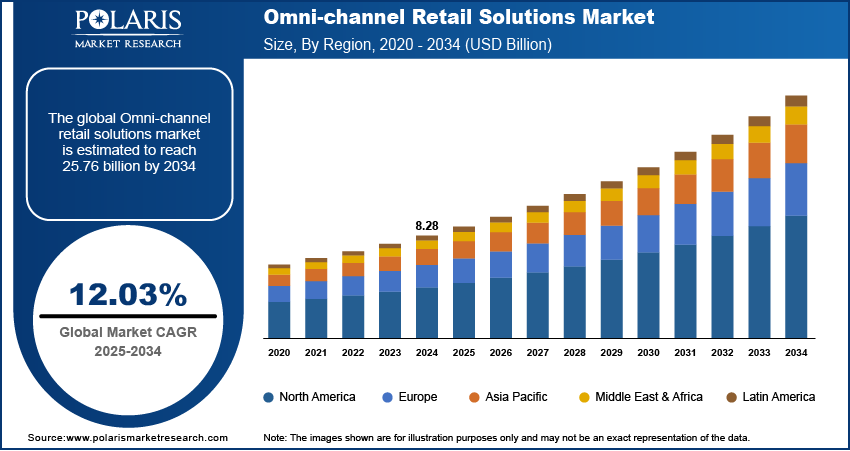
The global Omni-channel retail solutions market was valued at USD 8.28 billion in 2024 and is expected to grow at a CAGR of 12.03% during the forecast period. The goal of the Omni-channel retail software is to provide a seamless shopping experience for customers across any physical store and online marketplace.
Market Statistics
Key Takeaways
- The solution segment led the market in 2024. This is due to rising demand in advanced retail tech and AI-driven personalization.
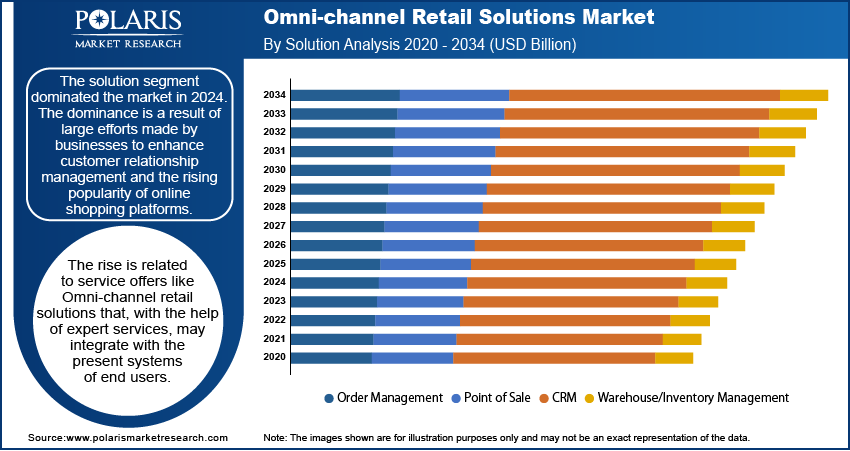
- Order management dominated the market in 2024. As businesses are focusing on improving real-time inventory tracking and streamlining fulfillment.
- Professional services captured largest market share in 2024, driven by retailers needing expert help with system integration, consulting, and ongoing support to make the most of their omni-channel investments.
- North America held the largest market share in 2024, supported by its well-established retail infrastructure, tech-savvy consumers, and major investments in digital and mobile shopping solutions.
- Asia Pacific is expected to grow at fastest CAGR during the forecast period, fueled by rising smartphone users, growing need for e-commerce platform, and increasing incomes in emerging markets driving demand for better retail experiences.
Industry Dynamics
- Retailer channels are adopting omni-channel strategy driven by growth in urban population and changing consumer lifestyles.
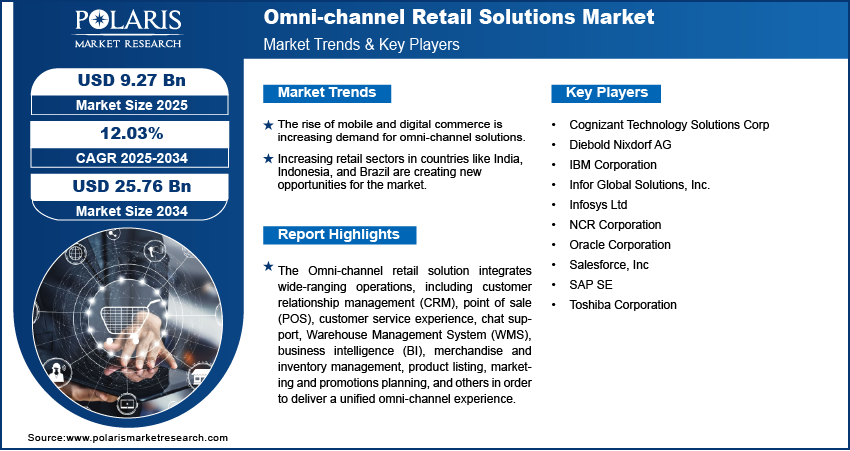
- The rise of mobile and digital commerce is increasing demand for omni-channel solutions.
- Increasing retail sectors in countries like India, Indonesia, and Brazil are creating new opportunities for the market.
- The high complexity and cost of integration including system upgrades, data synchronization, and staff training may hinder the growth of the market.
AI Impact on Omni-channel Retail Solutions Market
- AI helps retailers deliver personalized experiences by analyzing customer behavior across channels to recommend the right products at the right time.
- AI-powered chatbots improve customer service by providing instant, 24/7 support across websites, apps, and messaging platforms.
- AI makes inventory management smarter by accurately predicting demand and ensuring the right products are available across all sales channels.
- AI enhances marketing efforts by segmenting audiences and automating campaigns based on real-time customer data and interactions.
Know more about this report: Download Sample Report
The Omni-channel retail solution integrates wide-ranging operations, including customer relationship management (CRM), point of sale (POS), customer service experience, chat support, Warehouse Management System (WMS), business intelligence (BI), merchandise and inventory management, product listing, marketing and promotions planning, and others in order to deliver a unified omni-channel experience.
The growth of e-commerce, the introduction of omnichannel retailing, and consumers' increasing preference for online shopping all contribute to the industry growth of omnichannel retail software. Retailers are investing heavily in integrating numerous successful sales channels for a pleasant online shopping experience, propelling the market's growth. The development of the Omni-channel retail software market is fueled by the attention of e-commerce behemoths like Amazon and Alibaba on improving their Omni channel platform.
The importance of convenience and shopping methods has increased, which has increased the momentum surrounding the consumer experience. Today's shoppers consider more factors than only price and product quality due to the retail industry's fast evolution.
However, the danger to data security and privacy restrains the market for omni-channel retail solutions from expanding. Omni-channel software gathers crucial data and client information, which may provide businesses with useful insights but may put customers' data privacy at risk.
The COVID-19 epidemic has increased the pace of digitalization. Customers worldwide have come to rely on online shopping for anything from daily necessities to trip arrangements and more. The 2021 Shopping Index poll indicates that there has been a 58.0% increase in worldwide e-commerce since last year.
Retailers are currently growing their companies into e-commerce and focusing on providing their items on different platforms in order to stay up with the evolving buying habits.
Know more about this report: Download Sample Report
Growth Drivers
The market is expanding due to an increase in demand for centralized data points, the requirement for conventional firms to enter the e-commerce space, and the advantages offered by omni-channel analytics.
Retailers may obtain a centralized view of their customers, finances, inventory, and other information with omni-channel solutions, which offer a centralized data point. Due to the quick development of technology, conventional retailers are no longer limited to solely in-store offers and have expanded their product lines to many platforms.
Retailers may more easily keep track of things and provide their customers with sophisticated customer experiences thanks to omni-channel retail systems that can aggregate data from various platforms under one roof. Additionally, it gives merchants the ability to swiftly and successfully grow their enterprises.
The omni-channel market is expanding as a result of omni-channel retail solutions' capacity to consolidate all data sources and information into a single platform. Additionally, it makes it convenient for clients to get goods and services in the best and most efficient manner.
During the anticipated period, the market for omni-channel retail solutions is expected to expand due to the constantly shifting retail environment and increased client expectations. Digitalization is also one of the factors driving the market growth for omni-channel retail solutions.
Report Segmentation
The market is primarily segmented based on offering, solution, services and region.
| By Offering | By Solution | By Services | By Region |
|
|
|
|
Source: Polaris Market Research Analysis
Know more about this report: Download Sample Report
The solution segment dominated the market share in 2024
The solution segment dominated the market in 2024. The dominance is a result of large efforts made by businesses to enhance customer relationship management and the rising popularity of online shopping platforms. Therefore, firms have started using e-commerce and other distribution methods to reach potential clients. Additionally, retailers are fusing their in-store and online platforms to encourage customers to access online purchasing in an effort to boost sales, which is accelerating the growth of the market for retail omnichannel commerce platforms.
During the projected period, it is predicted that the services category will expand the quickest. The rise is related to service offers like Omni-channel retail solutions that, with the help of expert services, may integrate with the present systems of end users.
In addition, clients of today anticipate frictionless encounters regardless of the channels or devices they employ. Omni-channel services, anticipated to drive the segment's growth, involve several contacts between a consumer or potential customer and a product or service provider across multiple touch points.
The order management segment dominated the market share in 2024
The order management sector led the market in 2024. The capabilities that Omni-channel retail solutions providers, such as client order management, online returns, and data & reporting across many sales channels, such as physical stores, websites, social media, and online marketplaces, can be credited with the increase.
Additionally, it integrates the necessary data needed for point-of-sale and e-commerce systems to operate effectively. The order management system also incorporates a customer care platform, giving retailers access to a full business picture and real-time analytics in one place.
The professional services segment dominated the market share in 2024
In 2024, the professional services market sector held a commanding revenue share. These services support the deployment and integration of the necessary solution by the merchants to allow omni-channel services. A growing need for omni-channel solutions in the ever-expanding e-commerce sector creates a demand for professional services like platform installation and integration. These services also make it simpler to comprehend the technical aspects of omni-channel solutions.
During the projection period, the managed services category is anticipated to grow at the quickest CAGR. It offers specialized solutions that boost earnings and cut expenses without compromising quality. Additionally, it offers the whole spectrum of services, from front-office client support to back-office management.
North America accounted for the largest market share in 2024
In 2024, North America held a commanding revenue share in the global market for Omni-channel retail solutions. The use of omni-channel commerce solutions by merchants in the area has increased due to the region's fast internationalization and commercialization. Several market participants are expanding their product offerings to fuel new customer experiences. For instance, In december 2024, Oracle launched the Retail Xstore Office Cloud Service to centralize back-office store operations, enhance inventory visibility, and support omni-channel retailing, enabling retailers to improve efficiency and adapt to changing consumer preferences. Retailers may fully employ cloud technologies on-premises, including key point-of-service operations, with Oracle Retail Xstore Office Cloud Service integrated.
During the projected period, the Asia Pacific is predicted to increase at the quickest rate. The expansion of the regional market may be ascribed to increased internet usage and the growth of the online retail industry in numerous nations, including China, India, and Japan, among many others. The significant e-commerce business and rising use of click-and-collect systems are also contributing to the region's growth.
Additionally, the pandemic was one of the key factors that propelled the transformation of the retail industry and led to an increase in the demand for Omni-channel retail solutions in the area.

Competitive Insight
The competitive landscape of the omni-channel retail solutions market is driven by rapid technological innovation and a strong focus on enhancing customer experience. Market leaders are standing out from others by improving platform integration and expanding service offerings. Companies emphasize personalized, seamless shopping across digital and physical channels to meet growing consumer expectations. Strategic partnerships with retailers and investments in AI and data analytics support the development of tailored, efficient solutions. Geographic expansion and a commitment to data privacy and sustainability also shape the market, as providers aim to strengthen their global reach while building consumer trust.
Some of the major producers include NCR Corporation; Diebold Nixdorf AG; Infosys Ltd.; Toshiba Corporation; Oracle Corporation; SAP SE; IBM Corporation; Cognizant Technology Solutions Corp.; Salesforce, Inc.; Infor Global Solutions, Inc.
Key Companies in the Omni-channel Retail Solutions Market:
- NCR Corporation
- Diebold Nixdorf AG
- Infosys Ltd.
- Toshiba Corporation
- Oracle Corporation
- SAP SE
- IBM Corporation
- Cognizant Technology Solutions Corp.
- Salesforce, Inc.
- Infor Global Solutions, Inc.
Recent Developments
- In January 2025, Salesforce launched Agentforce for Retail, an AI-powered platform for tasks like order management and appointment scheduling, alongside Retail Cloud with Modern POS to unify online and offline data for more personalized shopping experiences.
- In August 2024, Salesforce acquired PredictSpring, a leading omnichannel retail POS platform, to enhance Customer 360 capabilities.
Omni-channel Retail Solutions Market Report Scope
| Report Attributes | Details |
| Market size value in 2024 | USD 8.28 billion |
| Market size value in 2025 | USD 9.27 billion |
| Revenue forecast in 2034 | USD 25.76 billion |
| CAGR | 12.03% from 2025 - 2034 |
| Base year | 2024 |
| Historical data | 2020 - 2023 |
| Forecast period | 2025 - 2034 |
| Quantitative units | Revenue in USD billion and CAGR from 2025 to 2034 |
| Segments Covered | By Offering, By Solution, By Services, By Region |
| Regional scope | North America, Europe, Asia Pacific, Latin America; Middle East & Africa |
| Key companies | NCR Corporation; Diebold Nixdorf AG; Infosys Ltd.; Toshiba Corporation; Oracle Corporation; SAP SE; IBM Corporation; Cognizant Technology Solutions Corp.; Salesforce, Inc.; Infor Global Solutions, Inc. |
Source: Polaris Market Research Analysis
Omni-channel Retail Solutions Market FAQ's
• The omni-channel retail solutions market is projected to grow at a CAGR of 12.03% from 2025 to 2034, reaching USD 25.76 billion by 2034.
• The global market is projected to register a CAGR of 12.03% during the forecast period.
• North America dominated the market in 2024
• A few of the key players in the market are NCR Corporation; Diebold Nixdorf AG; Infosys Ltd.; Toshiba Corporation; Oracle Corporation; SAP SE; IBM Corporation; Cognizant Technology Solutions Corp.; Salesforce, Inc.; Infor Global Solutions, Inc.
• The solution segment dominated the market revenue share in 2024.
• The managed services segment is projected to witness the fastest growth during the forecast period.
Download Sample Report of Omni-channel Retail Solutions Market
Please fill out the form to request a customized copy of the research report.


