
Patient Handling Equipment Market Size, Global Analysis Report, 2026-2034
REPORT DETAILS
Patient Handling Equipment Market Summary
The patient handling equipment market stood at USD 12.47 billion in 2025. The market is projected to account for a CAGR of 5.8% between 2026 and 2034.
Market Statistics
Key Takeaways
- The bariatric care segment accounted for the largest market share in 2025. This is primarily due to the growing global prevalence of obesity.
- The homecare segment is registering the fastest growth. The rising trend of in-home care, particularly among the elderly and those with chronic conditions, is driving the segment’s growth.
- North America holds the largest market share. The presence of an advanced healthcare infrastructure and high healthcare expenditure contribute to the regional market dominance.
- Asia Pacific is projected to witness rapid growth. Increasing healthcare investments and expanding healthcare infrastructure drive the regional market growth.
The market for patient handling equipment comprises the production and sale of tools and equipment used to assist healthcare professionals in the safe transfer and repositioning of patients. The market usually comprises equipment used in acute care hospitals, long-term care facilities, rehabilitation facilities, and home healthcare environments, where patient transfer and repositioning are critical to patient recovery and caregiver safety. From an industry perspective, patient handling equipment encompasses products such as patient lifts (ceiling, floor, and sit-to-stand), slings, stretchers, medical beds, wheelchairs and transport chairs, bathroom and toilet assist devices, as well as transfer aids used for lateral transfer and repositioning.
Industry Dynamics
- The global elderly population, which is more vulnerable to falls and injuries, has increased the demand for patient handling equipment.
- The rise in chronic diseases and disabilities is another major factor contributing to the growth of the market.
- The growing shift towards home-based care is expected to present several market opportunities in the coming years.
- High operational costs associated with patient handling equipment may hinder market growth.
Source: Polaris Market Research Analysis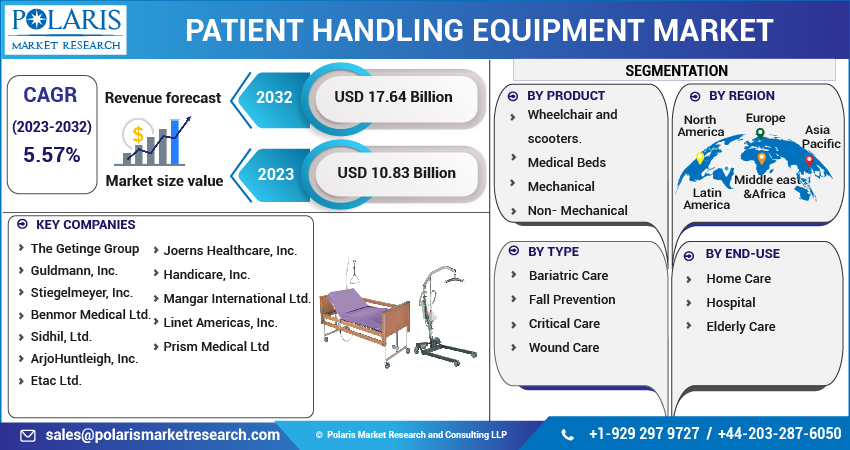
To Understand More About this Research:Download Sample Report
The major forces driving the market for patient handling equipment include the aging global population, rising cases of chronic diseases, and the growing need for patient safety and ergonomic support for healthcare professionals. Moreover, advancements in automation technology and the growing use of home healthcare services are key trends influencing the market for patient handling equipment. The use of patient handling equipment is also driven by regulations aimed at preventing injuries in healthcare settings. The increasing adoption of formal safe patient handling programs in hospitals and facilities also drives demand. These programs are increasingly turning to mechanical lifting and transfer devices rather than manual handling to reduce the risk of caregiver injuries and ensure patient safety.
Product Taxonomy & Use-Case Mapping
Patient handling equipment can be classified into four broad categories:
- Lifting and vertical transfer (ceiling, floor, and sit-to-stand lifts)
- Lateral transfer (transfer sheets, boards, and repositioning devices)
- Transport and mobility aids (wheelchairs, transport chairs, and stretchers)
- Support and hygiene assistance (medical beds and bathroom or toilet assist devices)
The adoption of patient handling equipment also varies by healthcare facility. Hospitals emphasize speed and safety, while long-term care facilities emphasize mobility assistance. The focus of homecare facilities is on ease of use and space savings.
Market Dynamics
Aging Global Population
A key factor driving the patient handling equipment market is the global aging population. As people grow older, they tend to experience physical deterioration. This makes it difficult for them to move or change positions independently. According to the United Nations, the number of seniors aged 60 and older is projected to reach 2.1 billion by 2050, nearly doubling from 2017. This trend creates a substantial need for patient handling equipment that provides safe, efficient mobility assistance. Seniors are prone to injuries and falls, thereby creating a substantial demand for patient handling equipment, such as patient lifts, wheelchairs, and transfer aids, to minimize the risk of accidents and improve patient care. In practical terms, an aging population also creates a demand for repositioning devices such as slings and lift-assisted turning devices. Such devices can help reduce the risk of falls and provide comfort and support for mobility in long-term care facilities and home healthcare settings.
Increase in Chronic Diseases and Disabilities
The rise in chronic illnesses and disabilities is another key market driver. In major healthcare markets, a major percentage of the adult population has at least one chronic disease. Chronic illnesses such as arthritis, diabetes, and heart disease may affect the mobility and independence of a patient. This increases the need for safe transfer assistance and patient handling equipment. Patients with physical disabilities, such as those caused by chronic illnesses and injuries, need specialized equipment to facilitate safe patient transfer. This driver is especially valuable in the home healthcare market, where the need for small and simple-to-use devices is a priority. Devices such as sit-to-stand lifts, transport chairs, and bathroom assist devices can make patient transfers easier and safer.
Focus on Patient and Healthcare Worker Safety
The growing concern for patient and healthcare worker safety is driving the patient handling equipment market forward. There has been an increase in work-related injuries because workers need to handle patients manually. The Bureau of Labor Statistics published a 2020 report that showed that healthcare workers, including nurses, experienced more musculoskeletal disorders because they had to lift and transfer patients. Healthcare facilities implement stricter patient-handling regulations to eliminate this problem. The Occupational Safety and Health Administration (OSHA) recommends the use of mechanical patient-lifting devices to assist with patient transfers. Concern for patient safety is influencing purchasing decisions in favor of powered patient lifts, ceiling lift systems, and universal slings. It is also increasing spending on training and monitoring. This is reflected in the impact on high-volume transfer areas such as ICUs, orthopedic, and post-op units.
Source: Polaris Market Research Analysis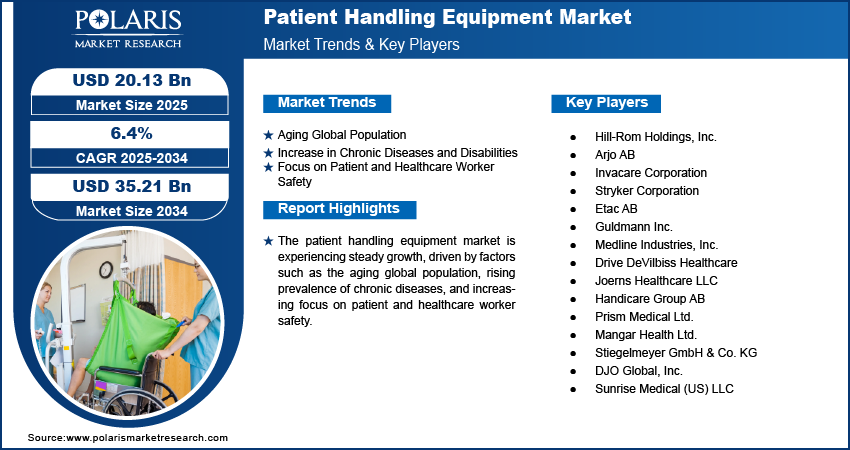
Segment Insights
Patient Handling Equipment Market Assessment by Application
The patient handling equipment market segmentation, by application, includes bariatric care, acute care, long-term care, rehabilitation, and others. The bariatric care segment has the largest market share because of the rising global incidence of obesity. With the rising incidence of obesity, there is a growing need for specialized equipment to handle bariatric patients, such as bariatric patient lifts and stretchers. The bariatric care segment is driven by the need for equipment that can support higher weights and ensure the safety of both the patient and the caregiver. Acute care is also growing at a substantial rate. It is driven by the rising number of patients requiring hospitalization due to serious illnesses. In acute care settings, patient handling equipment is critical for ensuring rapid, efficient patient transfer and positioning. This is especially true for emergencies. The market is driven by technological advancements, such as the development of powered and automated equipment, to improve the efficiency of patient handling in emergencies.
The long-term care segment is also growing at the fastest rate. This is due to the increasing number of older patients. A rising number of patients who need constant care due to chronic conditions also contributes to the segment’s growth. The adoption of patient handling equipment is also increasing among long-term care facilities due to the constant demand for assistance with patient mobility. Rehabilitation applications are also contributing to market growth. This is especially as interest in rehabilitation and mobility assistance for patients who have undergone surgery or been injured increases. The others segment, which includes applications in home care and adult day care, is also increasing, although at a relatively slower rate than the other market segments focused on primary care. However, the growing trend toward home healthcare is expected to drive this market segment's growth. This is as patients increasingly opt for homecare options that still require patient-handling equipment.
Patient Handling Equipment Market Assessment by Type
The patient handling equipment market, by type, is segmented into patient lifts, medical lifting slings, wheelchairs, transport chairs, stretchers, medical beds, and toilet & bathroom assist devices. The patient lifts segment has the largest market share in patient handling equipment because of the important role that these products play in helping with the transfer and positioning of patients. These products are also important in preventing injuries to patients as well as healthcare professionals. In the lifts sector, ceiling lifts are sometimes preferred in high-volume wards because they enhance workflow and minimize the need to move equipment from one room to another. Nonetheless, floor lifts are still in use in facilities where installing ceiling tracks is costly. Therefore, ceiling and floor lifts are a major consideration in procurement. In addition, technological advancements, such as wireless or battery-powered lifts, are also contributing to the growth of this market. Wheelchairs and transport chairs are also important parts of the patient handling equipment market, and the demand for these products is driven by the growing need for mobility assistance, especially among the elderly and disabled. With the growing global aging population, the use of both manual and powered wheelchairs is increasing, and this is contributing to the growth of the market.
The medical lifting slings segment is also growing at the fastest rate due to the increasing use of slings in conjunction with patient lifts to offer additional support and comfort to patients during the transfer process. The rising interest in patient safety and ergonomics among healthcare professionals is also fueling the growth of this market.
Patient Handling Equipment Market Evaluation by End Use
The patient handling equipment market, by end use, is segmented into hospitals, homecare, elderly care, and other healthcare. The hospitals segment has the largest market share because of the immense demand for patient handling equipment in these institutions. Hospitals need a variety of equipment, including patient lifts, wheelchairs, and stretchers. This is to enable efficient patient transfer, especially in intensive care units, emergency wards, and operation theaters. The rising number of admissions in hospitals and the development of medical technology are factors that are currently driving the demand for such equipment. The hospital segment is also gaining from the rising awareness of patient and healthcare worker safety, which is pushing the adoption of automated and ergonomic solutions that can minimize injuries associated with manual patient handling. Hospitals are now looking for a complete patient handling solution ecosystem that integrates medical beds, transport stretchers, lifts, and slings into a single solution. Such solutions are also accompanied by services such as maintenance and training programs to reduce the downtime of equipment and minimize safety-related events.
The homecare segment is also experiencing the fastest growth. It is fueled by the rising trend of home healthcare, particularly among the elderly and patients suffering from chronic ailments. With more patients choosing home healthcare for recovery and long-term care, demand for homecare-related patient-handling equipment, such as patient lifts and mobility aids, has increased substantially. This can be attributed to the preference for personalized care and the cost-effectiveness of home healthcare compared to institutional healthcare. The segment for elderly care facilities is also rising steadily, with the rising number of senior citizens who need assistance with mobility and daily living activities. The other healthcare segment, which includes rehabilitation facilities and outpatient facilities, is also rising. However, the growth rate is lower since these facilities require specialized equipment to aid patients in their rehabilitation and recovery programs.
Source: Polaris Market Research Analysis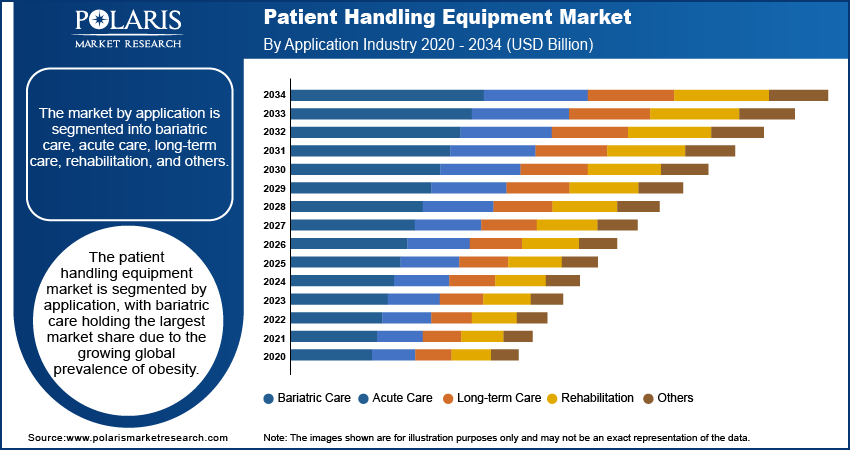
Buyer & Procurement Playbook
For procurement teams, the criteria for choosing a system typically include patient weight capacity (including bariatric patients), the frequency of patient transfers, the number of caregivers, and the possibility of installing ceiling lifts. Other important criteria include training needs, service response times, battery life for powered equipment, and total cost of ownership. Additionally, the compatibility of the equipment, such as lifts, slings, beds, and stretchers, is also considered.
Standards, Safety & Programs
The role of safe patient handling initiatives is increasing in promoting the adoption and standardization of mechanical assistance. The facilities that have adopted safe patient handling initiatives generally emphasize risk assessments at the department level, equipment protocols according to levels of patient mobility, training and retraining of staff, and metrics for injury reduction and compliance. This approach has continued to promote the demand for mechanical lifting equipment, ergonomic transfer devices, and standardized slings.
Regional Insights
By region, the study provides patient handling equipment market insights into North America, Europe, Asia Pacific, Latin America, and the Middle East & Africa. The North America patient handling equipment market accounted for the largest market share. This is due to the region’s advanced healthcare infrastructure and high healthcare expenditure. The regional market also benefits from a growing elderly population. The US, in particular, contributes significantly to this dominance because chronic diseases are becoming more common, people now understand patient safety better, and medical facilities must follow strict regulations requiring them to use patient handling equipment. Europe also represents a substantial share because its aging population and healthcare safety standards create market conditions similar to those in the US. The Asia Pacific region is developing into a major growth market as healthcare systems expand, medical tourism increases, and countries like China and India build more healthcare facilities.
Europe holds a significant share. This is supported by the region's aging population and stringent healthcare regulations, which aim to improve patient and worker safety. The market receives major support from Germany, the UK, and France, as these countries have established healthcare systems and their healthcare professionals increasingly use advanced patient handling solutions. The European Union's commitment to reducing workplace injuries in healthcare environments creates a greater demand for these devices. The regional commitment to improving care standards in both long-term care facilities and homecare environments drives the growth of the patient handling equipment market. In Europe, demand is supported by strong worker-safety regulations, ongoing modernization of long-term care facilities, and the expansion of homecare services. The adoption of patient lifts, transfer aids, and medical beds in both institutional and home environments is increasing due to these factors.
The Asia Pacific patient handling equipment market is experiencing rapid growth. The regional market is driven by increasing healthcare investments and expanding healthcare infrastructure in countries such as China, India, and Japan. The rising incidence of chronic diseases and the growing elderly population have created a high demand for patient handling devices. Government initiatives to improve healthcare services and the growth of medical tourism further contribute to the regional market's expansion. In addition, the increasing adoption of advanced technologies in healthcare facilities and the rising awareness of patient and caregiver safety drive market growth in the region. The Asia Pacific region experiences both additional development and persistent workforce recruitment challenges. Hospitals in major urban centers are experiencing increased patient numbers, which forces hospitals to make patient transfer operations their top priority. The organization is working to implement advanced patient movement systems that will reduce staff workload while enhancing safety measures.
Source: Polaris Market Research Analysis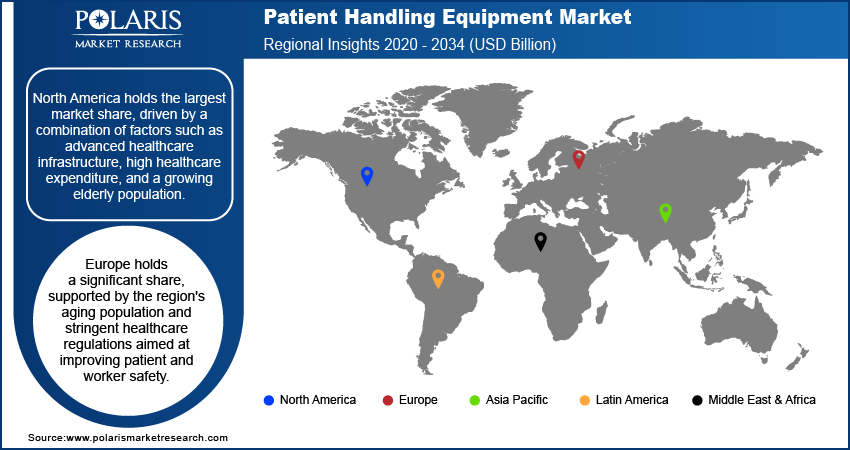
Key Players and Competitive Insights
Key players in the patient handling equipment market include Hill-Rom Holdings, Inc.; Arjo AB; Invacare Corporation; Stryker Corporation; Etac AB; Guldmann Inc.; Medline Industries, Inc.; Drive DeVilbiss Healthcare; Joerns Healthcare LLC; Handicare Group AB; Prism Medical Ltd.; Mangar Health Ltd.; Stiegelmeyer GmbH & Co. KG; DJO Global, Inc.; and Sunrise Medical (US) LLC. These companies are actively engaged in the development and supply of a range of patient handling devices, including lifts, wheelchairs, and transfer aids. They serve healthcare facilities worldwide.
Competitive differentiation in this industry is being driven by four key considerations: the range of product offerings in lifts, beds, and stretchers; the depth of service infrastructure and training initiatives; the simplicity of integration with existing workflows; and the extent of distribution networks, especially in home care channels. This has led to the increasing importance of product portfolio comparisons, service capabilities, and channel strength over price in competitive landscape analysis.
Acute care-focused portfolios typically feature intelligent medical beds, transport stretchers, and high-throughput transfer solutions suited to a busy hospital setting. On the other hand, homecare-focused portfolios are likely to feature mobility aids, compact lifts, and bathroom assist devices that are more suited for a home environment.
Hill-Rom Holdings, Inc. and Stryker Corporation compete in the market through their extensive product ranges, which they provide to hospitals, where they deliver advanced solutions for patient mobility and safety. Arjo AB develops ergonomic products while maintaining a strong market presence in both acute healthcare facilities and extended care environments. Invacare Corporation offers a wide range of products that serve both mobility and homecare needs in the market. The companies compete through continuous development of new products to meet increasing customer requirements for safe and comfortable healthcare solutions.
Market analysis shows that competition is driven by technological advancements, partnerships, and a focus on building distribution channels. Organizations are investing in research and development to create products that improve the user experience and efficiency. Moreover, there is a trend toward partnerships with healthcare organizations to develop solutions that address patients' needs, thereby increasing competition in the patient handling equipment market.
Hill-Rom Holdings, Inc. is one of the major competitors in the patient handling equipment market. The company provides different products such as patient lifts, hospital beds, and mobility aids. With its innovative solutions, the company aims to enhance patient safety and care.
Stryker Corporation is a major producer of medical technologies. The company provides patient-handling equipment, including stretchers, medical beds, and transport chairs. The company is recognized for its dedication to enhancing patient and caregiver safety through its ergonomic, user-friendly products.
List of Key Companies
- Hill-Rom Holdings, Inc.
- Arjo AB
- Invacare Corporation
- Stryker Corporation
- Etac AB
- Guldmann Inc.
- Medline Industries, Inc.
- Drive DeVilbiss Healthcare
- Joerns Healthcare LLC
- Handicare Group AB
- Prism Medical Ltd.
- Mangar Health Ltd.
- Stiegelmeyer GmbH & Co. KG
- DJO Global, Inc.
- Sunrise Medical (US) LLC
Market Developments
- March 2025: GF Health Products, Inc. introduced the new Hausted 5B800ST All Purpose Bariatric Electric Stretcher. The stretcher has been developed to improve comprehensive patient handling. It is built for smooth compatibility with every care stage. The stretcher begins with preoperative workflows and continues through the postoperative treatment and recovery phases.
- November 2024: Stryker launched a new series of transport stretchers. The new stretchers are created to reduce the physical strain on healthcare workers while enhancing patient comfort during transfers.
Market Segmentation
By Type Outlook (Revenue, USD Billion, 2021–2034)
- Patient Lifts
- Medical Lifting Slings
- Wheelchairs
- Transport Chairs
- Stretchers
- Medical Beds
- Bathroom & Toilet Assist Devices
By Application Outlook (Revenue, USD Billion, 2021–2034)
- Bariatric Care
- Acute Care
- Long-Term Care
- Rehabilitation
- Others
By End Use Outlook (Revenue, USD Billion, 2021–2034)
- Hospitals
- Homecare
- Elderly Care
- Other Healthcare
By Regional Outlook (Revenue, USD Billion, 2021–2034)
- North America
- US
- Canada
- Europe
- Germany
- France
- UK
- Italy
- Spain
- Netherlands
- Russia
- Rest of Europe
- Asia Pacific
- China
- Japan
- India
- Malaysia
- South Korea
- Indonesia
- Australia
- Vietnam
- Rest of Asia Pacific
- Middle East & Africa
- Saudi Arabia
- UAE
- Israel
- South Africa
- Rest of Middle East & Africa
- Latin America
- Mexico
- Brazil
- Argentina
- Rest of Latin America
Patient Handling Equipment Report Scope
| Report Attributes | Details |
| Market Size in 2025 | USD 12.47 billion |
| Market Size in 2026 | USD 13.18 billion |
| Revenue Forecast by 2034 | USD 20.70 billion |
| CAGR | 5.8% |
| Base Year | 2025 |
| Historical Data | 2021–2024 |
| Forecast Period | 2026–2034 |
| Quantitative Units | Revenue in USD billion, and CAGR from 2026 to 2034 |
| Report Coverage | Revenue Forecast, Market Competitive Landscape, Growth Factors, and Trends |
| Segments Covered |
|
| Regional Scope |
|
| Competitive Landscape | Patient Handling Equipment Industry Trend Analysis (2025) Company profiles/industry participants profiling include company overview, financial information, product/service benchmarking, and recent developments |
| Report Format | PDF + Excel |
| Customization | Report customization as per your requirements with respect to countries, regions, and segmentation. |
Source: Polaris Market Research Analysis
Methodology in Brief
Market sizing analysis is usually a combination of secondary research, including publicly available information, company literature, and healthcare data, with primary validation from industry interviews. The information is then validated by cross-checking using both supply-side and demand-side metrics. Forecasts are based on current usage trends in the hospital, long-term care, and homecare settings, as well as the trend towards more powered and automated patient handling devices.
How is the Report Valuable for an Organization?
Workflow/Innovation Strategy
The patient handling equipment market has been segmented into detailed segments of type, application, and end use. Moreover, the study provides the reader with a detailed understanding of the different segments at both the global and regional levels.
Growth/Marketing Strategy
The growth plan for the patient handling equipment market includes innovation, partnerships, and distribution networks. Firms are investing in research and development to design innovative and ergonomic products that improve patient safety and efficiency. Marketing plans include partnerships with healthcare institutions to provide customized solutions and participation in trade shows to demonstrate new technologies. In addition, firms are using online marketing to reach a wider audience, especially in developing countries where healthcare infrastructure is growing rapidly.
Patient Handling Equipment Market FAQ's
The patient handling equipment market stood at USD 12.47 billion in 2025. The market is projected to reach USD 20.70 billion by 2034.
The patient handling equipment market is projected to account for a CAGR of 5.8% between 2026 and 2034.
North America accounted for the largest market share in 2025. This is due to the region’s advanced healthcare infrastructure and high healthcare expenditure.
A few of the key players in the market include Hill-Rom Holdings, Inc.; Arjo AB; Invacare Corporation; Stryker Corporation; Etac AB; Guldmann Inc.; Medline Industries, Inc.; Drive DeVilbiss Healthcare; Joerns Healthcare LLC; Handicare Group AB; Prism Medical Ltd.; Mangar Health Ltd.; Stiegelmeyer GmbH & Co. KG; DJO Global, Inc.; and Sunrise Medical (US) LLC.
Bariatric care led the market in 2025 due to the growing global prevalence of obesity.
Patient handling equipment refers to devices and tools created to assist healthcare providers in safely moving, transferring, or repositioning patients. These include patient lifts, wheelchairs, stretchers, transport chairs, medical beds, and bathroom and toilet assist devices.
A few of the key trends shaping the market development include technological advancements and rising demand for home healthcare.
A few key trends in the market are described below: Technological Advancements: Development of automated and smart patient handling devices with integrated monitoring systems. Rising Demand for Home Healthcare: Increased adoption of patient handling equipment for in-home care, driven by an aging population and preference for personalized care. Focus on Ergonomics and Safety: Growing emphasis on ergonomic designs to reduce healthcare worker injuries and improve patient safety. Regulatory Compliance: Implementation of strict regulations and guidelines promoting the use of mechanical lifting equipment in healthcare settings
A new company entering the patient handling equipment market could focus on developing innovative, technology-driven solutions such as smart patient lifts and automated transfer systems to enhance safety and efficiency. Emphasizing ergonomic designs that reduce caregiver strain and improve patient comfort would also be key. Additionally, targeting emerging markets with affordable, high-quality products could offer significant growth opportunities. Building strong partnerships with healthcare providers for tailored solutions and investing in digital marketing and e-commerce platforms to expand reach would further help the company stay ahead of the competition. Prioritizing compliance with healthcare regulations and sustainability practices could also differentiate the company in the market.
Companies manufacturing, distributing, or purchasing Patient Handling Equipment and related products, and other consulting firms must buy the report.
Download Sample Report of Patient Handling Equipment Market
Please fill out the form to request a customized copy of the research report.


