
Plasma Processing in Mining Market Share, and Future Demand Dynamics, 2026-2034
REPORT DETAILS
Market Statistics
Overview
The global plasma processing in mining market is estimated around USD 2.62 billion in 2025, with consistent growth anticipated during 2026–2034. Rising decarbonization targets and ESG compliance requirements are driving adoption of plasma processing in mining, as electrified systems support lower emissions and cleaner operations. The market is projected to grow at a CAGR of 7.4% during the forecast period.
Key Insights
- Thermal plasma led the 2025 market share due to strong use in smelting and refining.
- Non-thermal plasma is projected to grow fastest due to mineral separation applications.
- Asia Pacific led the 2025 market, driven by large scale mining activity.
- North America is expected to record the highest CAGR driven by critical minerals demand.
Industry Dynamics
- Mining decarbonization targets are increasing adoption of electrified plasma processing systems.
- Energy transition programs are accelerating demand for low emission mineral processing routes.
- High capital investment and power cost sensitivity are limiting rapid large scale deployment.
- Growth in mine waste reprocessing is creating opportunities for plasma based metal recovery.
Market Statistics
- 2025 Market Size: USD 2.62 billion
- 2034 Projected Market Size: USD 4.97 billion
- CAGR (2026-2034): 7.4%
- Asia Pacific: Largest market in 2025
What is Plasma Processing & How It Works in Mining?
Plasma processing in mining refers to the use of high temperature plasma to treat ores, concentrates, and mining waste through electrically generated ionized gas. This technology enables rapid heating and controlled reactions, which improves mineral liberation, metal recovery, and waste treatment while supporting mining decarbonization goals. Plasma mineral processing diminishes the reliance on furnaces with combustion of fossil fuels, hence aligning operations with zero emission mineral extraction strategies.
Plasma systems operate on the principle of creating high-temperature plasma through electricity and process gases that interact with feedstock minerals within reactors or furnaces. The process system allows for the complex and low-grade ores, refractory materials, and hazardous tailings, which represent difficult streams to process with conventional thermal processing. Energy efficiency, reduction of emissions, and recovery from secondary resources are sustaining market drivers for plasma-based mining technologies.
Source: Polaris Market Research Analysis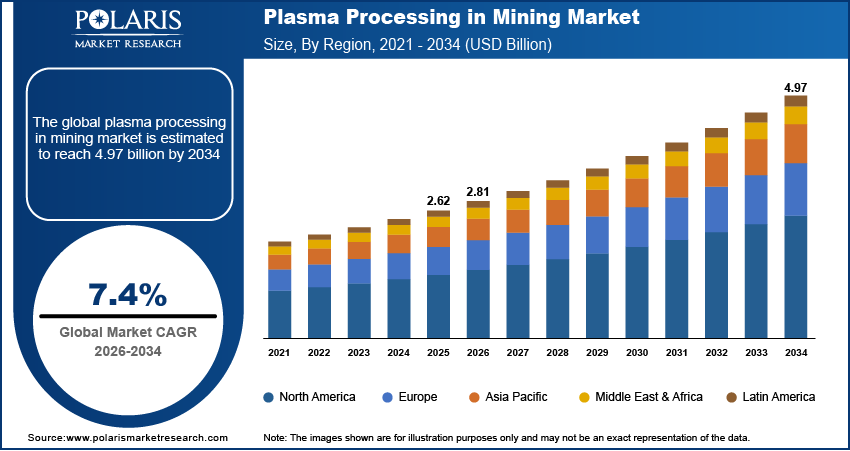
The market is expanding due to government policies supporting clean industrial technologies, which are strengthening adoption of plasma processing across mining operations. Energy transition programs are accelerating low emission mineral processing routes, which is increasing investment in electrified plasma systems for ore treatment and metal recovery. In the process, policy focus on sustainable resource development is supporting long-term growth potential for plasma processing in the mining industry.
Plasma Processing in Mining vs NdFeB vs SmCo Magnet Comparison
| Magnet Type | Magnetic Strength | Temperature Stability | Cost Level | Common Use Cases |
| Plasma Processing in Mining (Ceramic) | Medium | Good | Low | EV components, appliances, speakers |
| NdFeB | Very High | Moderate | Medium to High | High torque motors, precision electronics |
| SmCo | High | Very High | High | Aerospace, high temperature devices |
Source: Polaris Market Research Analysis
Drivers & Opportunities
Mining Decarbonization Targets: The rising demands for the upgrading of decarbonization targets in the mining operations accelerate the adoption of the electrified plasma processing system in the mining industry as the companies strive to reduce carbon intensity in their mineral processing and smelting operations. According to the United Nations, the planet has already warmed by about 1.2°C, and meeting the 1.5°C target requires cutting emissions 45% by 2030 and reaching net zero by 2050. Plasma mineral processing also allows for high temperature treatment, without combustion of fossil fuel-containing feedstocks, and is hence compatible with mining decarbonization goals and zero-emission mineral extraction policy. Increasing regulatory expenses and ESG disclosures drive the adoption of plasma routes for the processing of minerals.
Energy Transition Initiatives: Global energy transition initiatives are placing increasing focus on low-carbon industrial processing across all energy-intensive sectors, mining, and metallurgy. International Energy Agency stated that global clean energy investment will be more than triple to about USD 4 trillion per year by 2030 if the goal of net zero emissions by 2050 is to be reached. High-temperature plasma technologies support electrified processing routes that are in line with renewable power integration and long-term emission reduction strategies. The adoption of plasma processing is becoming increasingly viable for the low-emission mineral processing pathway under the promotion of clean industrial technologies by governments in energy transition frameworks.
Restraints & Challenges
High Capital Investment: High capital investment requirements at the onset are primarily holding large-scale adoption of plasma processing back among mid-tier miners, as electrified plasma systems have major upfront costs related to power infrastructure, reactors, and integration. Project profiles with high capital intensiveness have increased the perception of financial risks, slowing down decision-making or lengthening payback expectations. Limited access to project financing for emerging processing technologies is further constraining widespread commercial deployment.
Source: Polaris Market Research Analysis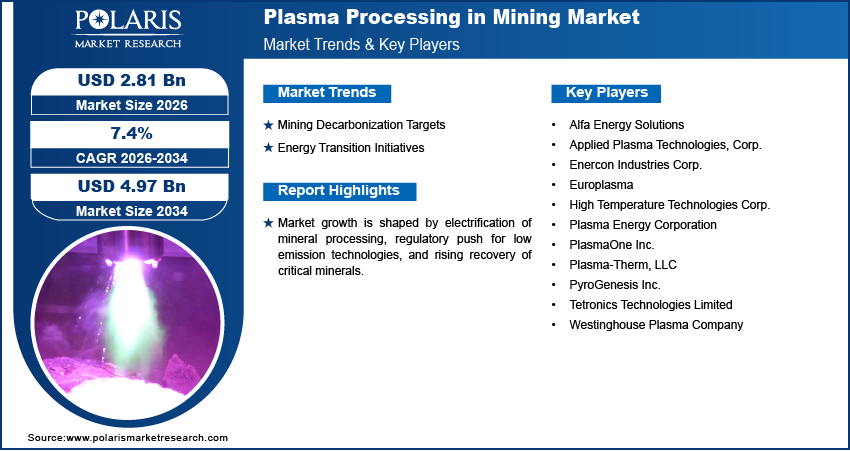
Segmental Insights
This report offers detailed coverage of the plasma processing in mining market by technology and feedstock type to help readers identify the fastest expanding and most attractive demand segments.
By Technology
-
Thermal
By technology type, the thermal plasma segment accounted for the largest share in 2025, due to application in plasma smelting furnaces and high temperature metallurgical refining. Thermal plasma mining systems use plasma arc torches to generate an arc column inside reactors, which enables rapid melting and controlled refining of ores and concentrates. This approach supports energy efficient ore refining while reducing dependence on conventional pyrometallurgy.
Key Applications
-
Plasma smelting of copper, nickel, and iron concentrates
- Refining of refractory ores using plasma arc torches
- Slag cleaning and metal recovery in plasma furnaces
Key Benefits
- High temperature capability above conventional furnaces
- Improved metal recovery from complex ore
- Lower direct fossil fuel usage compared to pyrometallurgy
-
Non-Thermal
In terms of technology, the non-thermal plasma segment is projected to grow at the fastest CAGR during the forecast period, due to increasing use in surface activation and mineral separation processes. Non-thermal plasma systems operate at lower bulk temperatures and surface level reactions inside plasma reactors, hence improving the efficiency in mineral separation and selective processing.
Key Applications
- Surface modification for enhanced mineral separation
- Plasma assisted beneficiation processes
- Pre-treatment prior to downstream refining
Key Benefits
- Lower energy intensity compared to thermal plasma
- Improved selectivity in mineral processing
- Suitable for integration into existing processing lines
Technology Comparison Matrix
| Parameter | Thermal Plasma | Non-Thermal Plasma |
| Capital Expenditure | High due to plasma smelting furnaces and power systems | Medium due to modular reactors and retrofit potential |
| Operating Expenditure | Medium to high due to electricity intensive operation | Low to medium due to lower power consumption |
| Energy Source | Fully electrified with grid or renewable integration | Electrified with lower load requirement |
| Emission Reduction Potential | 30 to 60 percent reduction versus conventional pyrometallurgy | 20 to 40 percent reduction through process optimization |
| Fossil Fuel Substitution | High | Moderate |
| Retrofit Flexibility | Moderate | High |
Source: Polaris Market Research Analysis
By Feedstock Type
-
Primary Ores
In terms of feedstock type, the primary ores segment accounted for the largest share of the market in 2025 due to the use of plasma extraction in copper, nickel, and refractory gold ores. Plasma extraction is known to upgrade difficult-to-convert ores. It also assists in obtaining rare earths, titanium, and PGM.
Key Use Cases
- Plasma beneficiation of iron ore
- Refractory ore processing technology for gold
- Critical minerals recovery from REE and PGM ores
In terms of feedstock type, the waste streams and tailings segment is projected to grow at the fastest CAGR during the forecast period, due to rising focus on hazard reduction and metal recovery. The plasma treatment of tailings allows vitrification, detoxification, and recovery of residual valuable metals from legacy wastes.
Key Use Cases
- Plasma treatment of mining tailings
- Recovery of critical metals from waste stream
- Environmental risk reduction and compliance
Secondary and scrap recovery is increasing with the development of mining company projects related to a circular economy. Plasma e-waste recycling enables metal recovery from black mass and difficult-to-process scrap materials.
Key Use Cases
- Plasma e-waste recycling and black mass processing
- Recovery of copper, nickel, and cobalt from scrap
- Circular economy opportunities in metals processing
Adoption Level of Plasma Processing by Feedstock
| Feedstock Type | Current Adoption Level | Adoption Trend | Key Adoption Rationale |
| Primary Ores | High | Stable to moderate growth | Need for efficient processing of copper, nickel, refractory gold, and critical minerals |
| Waste Streams and Tailings | Medium | High growth | Focus on metal recovery, hazard reduction, and ESG compliance |
Source: Polaris Market Research Analysis
Source: Polaris Market Research Analysis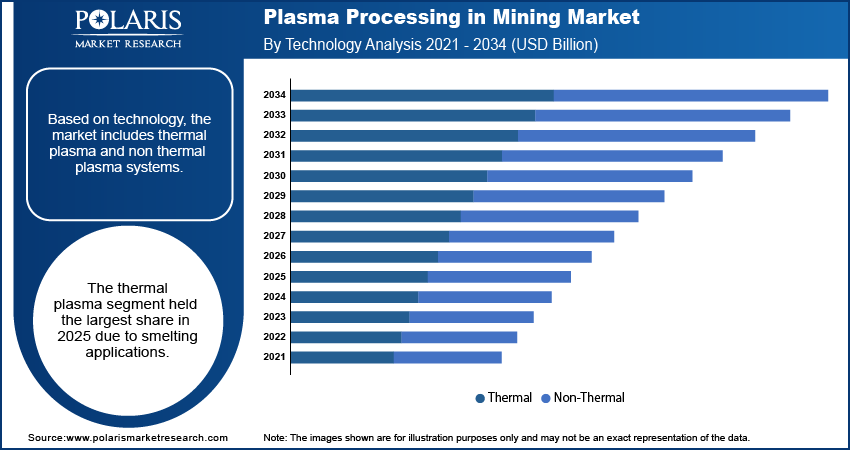
Regional Analysis
Asia Pacific Market Assessment
Asia Pacific accounted for a leading position in this industry in 2025 due to robust demand for mining modernization plasma in large-scale mineral processing facilities, and further due to innovation in mining in Asia Pacific through pilots and urban mining deployments. In addition, government led clean technology programs are accelerating adoption.
China Plasma Processing in Mining Market Insight
China market led owing to large scale pilot deployment of plasma mineral processing aligned with urban mining and critical resource recovery programs. Moreover, strong state funding supports rapid technology validation. In addition, national decarbonization targets are accelerating electrified processing routes. China’s 2034 NDC report sets a target to reduce greenhouse gas emissions by 7% to 10% from peak levels by 2034.
North America Plasma Processing in Mining Market Insights
North America is anticipated to witness the highest growth during forecast period. This is owing to strong regional demand from the North America critical minerals market. Moreover, copper and EV battery ecosystem demand is supporting investment in advanced plasma processing. In addition, mining operators are prioritizing low emission technologies.
The U.S. Plasma Processing in Mining Market Overview
The U.S. is held the predominating share in North America owing to growing copper and battery mineral supply chain security. Global Business Reports added that domestic mine output surged 8.29% to 209,000 tons in early 2024, with Kennecott production up 30% in Q2 2024. Additionally, federal clean energy incentives are making project economics even stronger.
Europe Plasma Processing in Mining Market Overview
The Europe growth in the plasma processing in mining market is attributed to its strong regulatory push for low carbon processing across energy intensive mining and metallurgy operations. Moreover, strict emission compliance frameworks are pushing electrified plasma solutions. In addition, industrial decarbonization funding is accelerating deployment.
Source: Polaris Market Research Analysis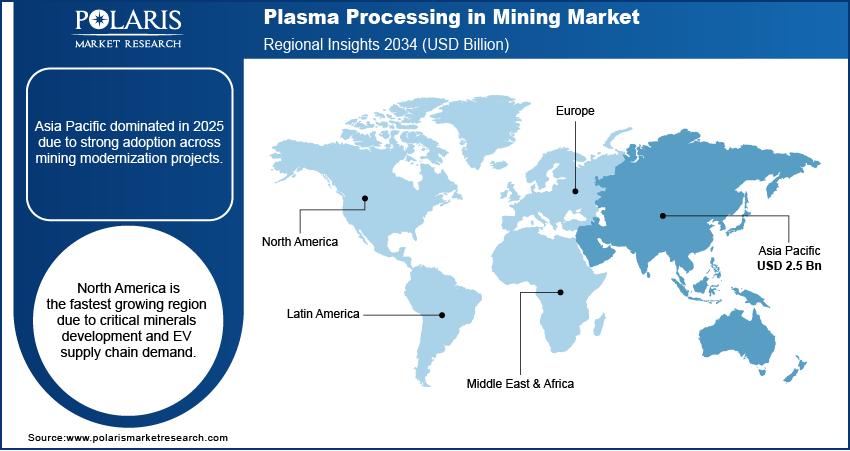
Key Players & Competitive Analysis Report
The plasma processing in mining market is moderately consolidated, with a small number of technology providers leading system development and deployment. The competition is driven by improving the plasma reactor efficiency and system integration. The companies are focusing on energy efficiency, scalability, and pilot validation to support wider adoptions in mining applications.
Major companies operating in the plasma processing in mining industry include Applied Plasma Technologies, Corp., Tetronics Technologies Limited, Alfa Energy Solutions, Europlasma, Enercon Industries Corp., High Temperature Technologies Corp., Plasma Energy Corporation, PlasmaOne Inc., Plasma‑Therm, LLC, PyroGenesis Inc., Westinghouse Plasma Company, among others.
Key Players
- Alfa Energy Solutions
- Applied Plasma Technologies, Corp.
- Enercon Industries Corp.
- Europlasma
- High Temperature Technologies Corp.
- Plasma Energy Corporation
- PlasmaOne Inc.
- Plasma-Therm, LLC
- PyroGenesis Inc.
- Tetronics Technologies Limited
- Westinghouse Plasma Company
Vendor Archetypes and Technology Differentiators
| Vendor Archetype | Core Focus Area | Key Technology Differentiators |
| Plasma Furnace Manufacturers | High temperature smelting and refining systems | Plasma torch durability, power efficiency, reactor design |
| Engineering and EPC Providers | System integration and plant retrofit execution | Integration capability with existing mining infrastructure |
| Emerging Technology Specialists | Modular and pilot scale plasma systems | Compact reactor design, faster testing, phased adoption |
Source: Polaris Market Research Analysis
Innovation Pipelines, Patents, and TRL Progress
| Innovation Area | Focus of Development | Current TRL Direction |
| Plasma Torch Design | Extended lifespan and stable operation | Advancing from pilot to early commercial |
| Energy Efficiency | Reduced power consumption and improved control | Demonstration to early commercial stage |
| Reactor Configuration | Advanced and hybrid plasma processing routes | Pilot and validation stage |
| Waste to Metal Recovery | Plasma based recovery from tailings and waste | Pilot to demonstration stage |
Source: Polaris Market Research Analysis
Where Is Investment Flowing in the Next 5–10 Years?
R&D investment in mining technology is increasingly flowing toward electrified plasma systems aligned with low carbon processing strategies. Plasma furnace manufacturers are being channeled towards capital for developing scalable and retrofit ready solutions for existing smelters. Investment is also increasing in plasma-based waste and tailings treatment projects, as mining operators prioritize recovery of critical minerals and long term ESG compliance.
Industry Developments
- December 2025: PyroGenesis signed a contract to supply fine cut titanium powder produced using plasma technology to a US additive manufacturing company for metal 3D printing.
- December 2025: Henniker Plasma introduced a compact benchtop plasma system that provides industrial grade surface treatment capabilities for research and small-scale production.
Plasma Processing in Mining Market Segmentation
By Technology Outlook (Revenue, USD Billion, 2021-2034)
- Thermal
- Non-Thermal
By Feedstock Type Outlook (Revenue, USD Billion, 2021-2034)
- Primary Ores
- Waste Streams & Tailings
- Secondary & Scrap Recovery
By Regional Outlook (Revenue, USD Billion, 2021-2034)
- North America
- US
- Canada
- Europe
- Germany
- France
- UK
- Italy
- Spain
- Netherlands
- Russia
- Rest of Europe
- Asia Pacific
- China
- Japan
- India
- Malaysia
- South Korea
- Indonesia
- Australia
- Vietnam
- Rest of Asia Pacific
- Middle East & Africa
- Saudi Arabia
- UAE
- Israel
- South Africa
- Rest of Middle East & Africa
- Latin America
- Mexico
- Brazil
- Argentina
- Rest of Latin America
Plasma Processing in Mining Market Report Scope
| Report Attributes | Details |
| Market Size in 2025 | USD 2.62 Billion |
| Market Size in 2026 | USD 2.81 Billion |
| Revenue Forecast by 2034 | USD 4.97 Billion |
| CAGR | 7.4% from 2026 to 2034 |
| Base Year | 2025 |
| Historical Data | 2021–2024 |
| Forecast Period | 2026–2034 |
| Quantitative Units | Revenue in USD Billion and CAGR from 2026 to 2034 |
| Report Coverage | Revenue Forecast, Competitive Landscape, Growth Factors, and Industry Trends |
| Segments Covered |
|
| Regional Scope |
|
| Competitive Landscape |
|
| Report Format |
|
| Customization | Report customization as per your requirements with respect to countries, regions, and segmentation. |
Source: Polaris Market Research Analysis
Plasma Processing in Mining Market FAQ's
The global market size was valued at USD 2.62 billion in 2025 and is projected to grow to USD 4.97 billion by 2034.
Asia Pacific dominates due to large scale mining activity and early plasma technology deployment.
Applications include ore pretreatment, smelting and refining, tailings treatment, and metal recovery.
A few of the key players in the market are Applied Plasma Technologies, Corp., Tetronics Technologies Limited, Alfa Energy Solutions, Europlasma, Enercon Industries Corp., High Temperature Technologies Corp., Plasma Energy Corporation, PlasmaOne Inc., Plasma Therm, LLC, PyroGenesis Inc., and Westinghouse Plasma Company.
Growth is driven by mining decarbonization targets and energy transition programs.
Download Sample Report of Plasma Processing in Mining Market
Please fill out the form to request a customized copy of the research report.


