
Recombinant Proteins Market Size, Share, Trends, Industry Analysis Report, 2026 - 2034
REPORT DETAILS
Recombinant Proteins Market Summary
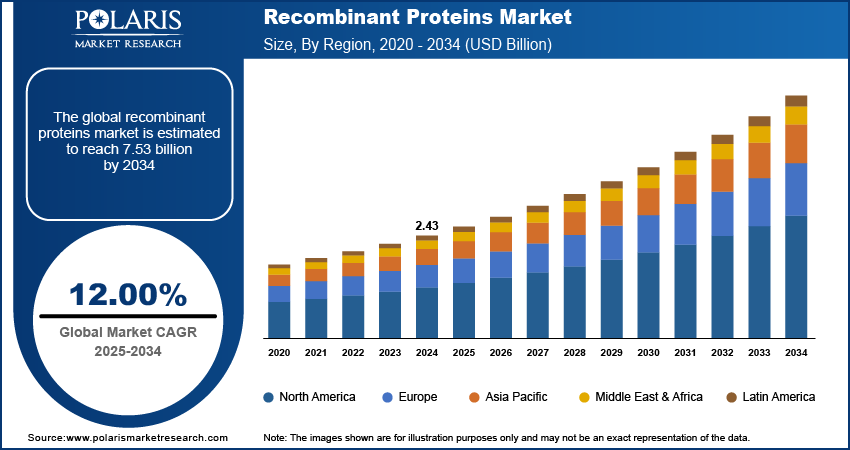
The global recombinant proteins market size was valued at USD 2.71 billion in 2025. The market is projected to grow at a CAGR of 12.00% during 2026 to 2034. Key factors driving demand for recombinant proteins include the increasing global burden of chronic and genetic diseases and significant investments in biopharmaceutical research and development.
Market Statistics
Key Takeaways
- Among all the products, the enzymes segment accounted revenue share of 15.6% in 2025, owing to its usage in several research domains.
- The pharmaceutical & biotech companies segment is expected to dominate the industry with 54.5% revenue share, owing to the rise in demand for recombinant proteins in predicting, prognosis, and diagnosing drug research.
- The therapeutics segment holding 42.5% revenue share in the global recombinant proteins market, mainly driven by the central role of recombinant proteins in modern medicine, especially biologics.
- North America dominated the global recombinant proteins market in 2025 by 41.28% revenue share, due to increasing cases of infectious and chronic diseases.
- The market in the Asia Pacific is growing with 13.0% CAGR, owing to increasing chronic illness in particular countries, such as India.
Note: Figures and projections outlined in this report are the result of Polaris Market Research’s proprietary analytical processes, grounded in the latest available datasets and market observations.
Industry Dynamics
- The recombinant proteins market is expected to grow in the coming years, owing to rising cases of chronic diseases and growing R&D programs.
- The launch of new products and innovative biotechnology activities is also leading to market growth.
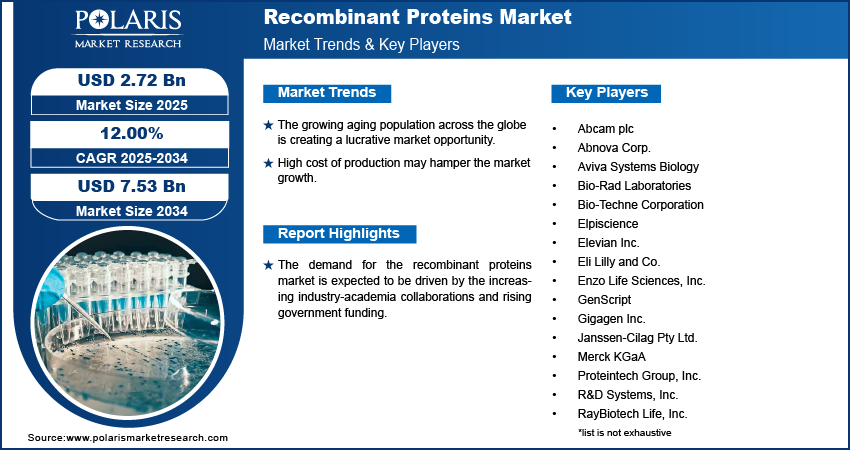
- The growing aging population across the globe is creating a lucrative market opportunity.
- High cost of production may hamper the market growth.
Source: Polaris Market Research Analysis
AI Impact on the Recombinant Proteins Market
- AI helps in the design and testing of recombinant proteins.
- AI models predict protein folding and stability.
- AI improves production yields.
- AI tailors recombinant protein therapies to patient-specific genetic.
What are Recombinant Proteins?
Recombinant proteins are genetically engineered proteins. They are produced using recombinant DNA technology. Specific genes are inserted into host cells such as bacteria, yeast, or mammalian cells. Recombinant proteins are widely used in therapeutics, diagnostics, vaccines, and research. They support innovation across the biotechnology, pharmaceutical, and healthcare industries.
Comparison Between Recombinant Proteins Vs Traditional Biologics
| Parameter | Recombinant Proteins | Traditional Biologics |
| Production Method | Produced using recombinant DNA technology in engineered host cells | Derived from natural biological sources such as blood, tissues, or microorganisms |
| Consistency | High batch-to-batch consistency due to controlled genetic engineering | Greater variability due to dependence on natural extraction processes |
| Scalability | Easier large-scale production with optimized cell culture systems | More complex scaling due to source limitations and purification challenges |
| Purity | Higher purity and targeted protein expression | May contain impurities from natural biological materials |
| Safety | Lower risk of contamination and pathogen transmission | Higher risk of contamination from biological source materials |
| Cost Efficiency | More cost-effective in long-term commercial production | Often higher production and purification costs |
Source: Polaris Market Research Analysis
The demand for the recombinant proteins market is expected to be driven by the increasing industry-academia collaborations and rising government funding. The production procedure of recombinant protein requires a technology called recombinant DNA (rDNA) technology which then produces a large number of proteins and other commercial products. Increasing levels of chronic diseases and markets focusing more on protein curatives can also be considered to drive market growth. Furthermore, the rise in demand for biological products, production of recombinant DNA from various sources, and alternatives of basic proteins is likely to complement market growth.
The COVID-19 pandemic had a positive impact on the market growth for the proteins. With the rise in COVID infection, it was suggested that recombinant protein vaccines might come up with a combination of subunits of various adjuvants and antigens, which will be more effective on SARS-CoV-2 infections and will be easily available in the center.
Source: Polaris Market Research Analysis
Real-World Examples of Recombinant Proteins
| Application Area | Type | Purpose |
| Diabetes Treatment | Recombinant insulin production | Used to regulate blood glucose levels in diabetic patients |
| Cancer Therapy | Monoclonal antibodies | Used for targeted treatment of cancers such as breast cancer and lymphoma |
| Vaccine Development | Recombinant hepatitis B vaccine | Helps stimulate immune response and prevent infectious diseases |
| Diagnostics | Enzyme-based diagnostic proteins | Used in test kits for disease detection and laboratory analysis |
| Biologics Development | Gene therapy and recombinant biologics | Supports advanced treatment development for genetic and chronic diseases |
Source: Polaris Market Research Analysis
Industry Dynamics
Growth Drivers
The recombinant proteins market is expected to grow with more chronic disease incidences, more R&D programs, and favorable funding from the government. The market is also driven, due to new products and innovative biotechnology activities. Growing R&D programs and development of new healthcare technologies is further contributing to the market growth. According to a recent report, the market for proteins is expected to witness a huge influx of R&D expenditure and favorable funding, with India and China facing several untreated diseases, will have the advantage of expanding and coming up with new solutions of recombinant protein.
Report Segmentation
The market is primarily segmented based on product & services, application, end use, and region.
| By Product & Services | By Application | By End Use | By Region |
|
|
|
|
Source: Polaris Market Research Analysis
The Enzymes Segment Accounted for the Largest Share in 2025
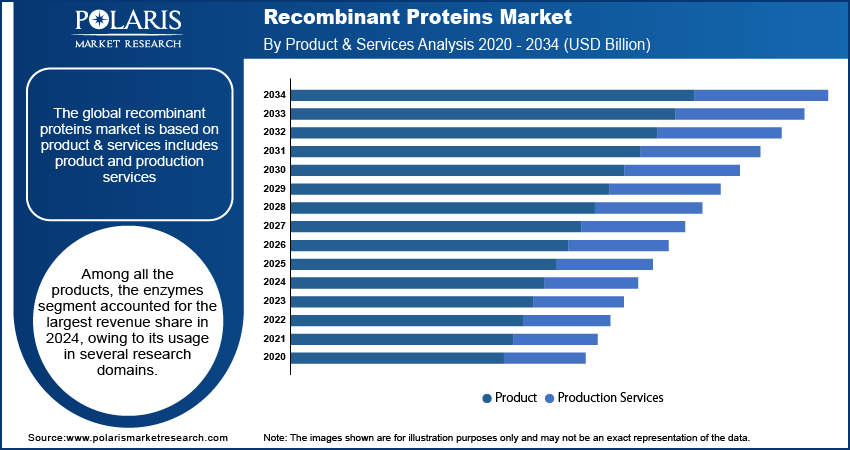
Among all the products, the enzymes segment accounted revenue share of 15.6% in 2025, owing to its usage in several research domains. It is also expected to witness fastest growth over the forecast period. Several research initiatives, such as wound repair, transplantation, oncology, and even COVID-19, are the primary disease that will require attention, and enzymes have the advantage of growing in this sector. Enzymes have been aslo used in the treatment of chronic conditions such as diabetes. Similarly, in cancer, enzymes can be helpful and improve chemotherapy.
Source: Polaris Market Research Analysis
The Pharmaceutical & Biotech Companies Segment is Expected to Account for the Largest Share in 2034
The pharmaceutical & biotech companies segment is expected to dominate the industry with 56.5% revenue share owing to the rise in demand for recombinant proteins in predicting, prognosis, and diagnosing drug research which acquires a major portion of the market. Furthermore, the rising competition in the market, accurate measurements in drugs in research & development, and multiple collaborations have resulted in proliferating the growth of recombinant protein.
North America Accounted for the Largest Revenue Share in 2025
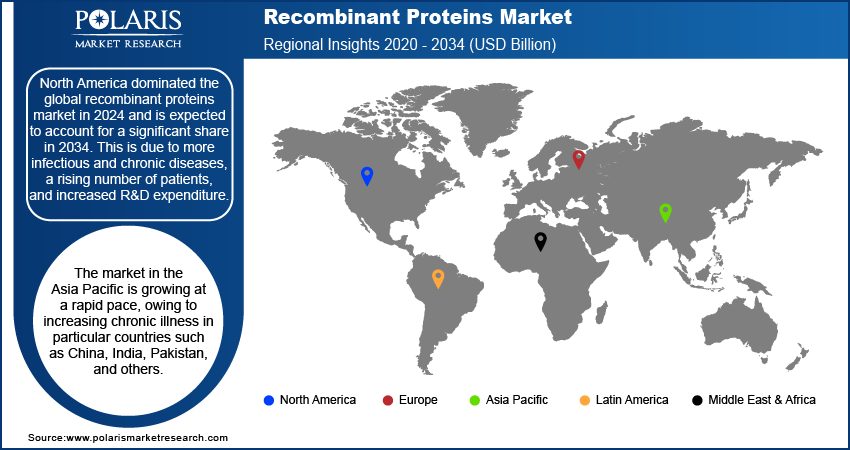
North America dominated the global recombinant proteins market in 2025 by 41.28% revenue share and is expected to account for a significant share in 2034. This is due to more infectious and chronic diseases, a rising number of patients, and increased R&D expenditure. The growing healthcare spending in the region, particualry in the U.S. also propelled the market growth. Moreover, government in the region are covering medical charges for certain chronic diseases, which contributed to the regional dominance.
The market in the Asia Pacific is growing with 13.0% CAGR, owing to increasing chronic illness in particular countries such as China, India, Pakistan, and others. The presence of high geriatric population in countries such as Japan and China is also leading to the market growth. Moreover, governments in the region are investing in the development of hospitals, clinics, and other medical contact centers to overcome chronic illness conditions. This is increasing the demand for recombinant proteins.
Source: Polaris Market Research Analysis
Competitive Insight
Companies in the market are competing to capture the major revenue share. These companies are also expanding their operation and investing in product development to cater the growing demand. Some of the major players operating in the global market include Abcam plc, Abnova Corp, Aviva systems biology, Bio-Techne corporation, Bio-Rad laboratories, Elpiscience, Elevian inc, Eli lilly and co, Enzo life sciences, Inc, Gigagen inc, Genscript, Janssen-Cilag pty ltd, Merck KGaA, Proteinrech Group, Inc, R&D System, Inc, Raybiotech Life Inc, Stemcell Technologies Inc, Sino Biological Inc, Thermo Fisher Scientific, U Protein Express.
Recent Developments
-
November 2025: Bio-Techne Corporation announced a licensing agreement with Monod Bio. With the agreement, Bio-Techne gained exclusive commercial rights to a specific subset of Monod's NovoBody™ Duo molecules. It is a new class of AI-designed bispecific binding proteins. (Source: bio-techne.com)
-
September 2025: ARCHIMED acquired a majority stake in ExcellGene and Magellan Biologics & Consulting. With this, the company focuses on gene transfer, cell line development, and cell culture-based manufacturing. It will enable high-performance production of recombinant proteins and other advanced therapeutics. (Source: archimed.group)
Recombinant Proteins Market Report Scope
| Report Attributes | Details |
| Market size value in 2025 | USD 2.71 billion |
| Market size value in 2026 | USD 3.03 billion |
| Revenue forecast in 2034 | USD 7.53 billion |
| CAGR | 12.00% |
| Base year | 2025 |
| Historical data | 2021 - 2024 |
| Forecast period | 2026 - 2034 |
| Quantitative units | Revenue in USD Billion and CAGR from 2026 - 2034 |
| Segments covered |
|
| Regional scope |
|
| Key companies | Abcam plc, Abnova Corp, Aviva systems biology, Bio-Techne corporation, Bio-Rad laboratories, Elpiscience, Elevian inc, Eli lilly and co, Enzo life sciences,Inc, Gigagen inc, Genscript, Janssen-Cilag pty ltd, Merck KGaA, Proteinrech Group, Inc, R&D System, Inc, Raybiotech Life Inc, Stemcell Technologies Inc, Sino Biological Inc, Thermo Fisher Scientific, U Protein Express |
Source: Polaris Market Research Analysis
Recombinant Proteins Market FAQ's
The global market size was valued at USD 2.71 billion in 2025 and is projected to grow to USD 7.53 billion by 2034.
The global market is projected to register a CAGR of 12.00% during the forecast period.
North America dominated the global recombinant proteins market in 2025 by 41.28% revenue share.
• A few of the key players in the market are Abcam plc, Abnova Corp, Aviva systems biology, Bio-Techne corporation, Bio-Rad laboratories, Elpiscience, Elevian inc, Eli lilly and co, Enzo life sciences,Inc, Gigagen inc, Genscript, Janssen-Cilag pty ltd, Merck KGaA, Proteinrech Group, Inc, R&D System, Inc, Raybiotech Life Inc, Stemcell Technologies Inc, Sino Biological Inc, Thermo Fisher Scientific, and U Protein Express.
The product segment dominated the market revenue share in 2025 by holding 76.7% revenue share.
Download Sample Report of Recombinant Proteins Market
Please fill out the form to request a customized copy of the research report.


