
RegTech Market Overview | Size, Share & Revenue Forecast, 2026 - 2034
REPORT DETAILS
RegTech Market Summary
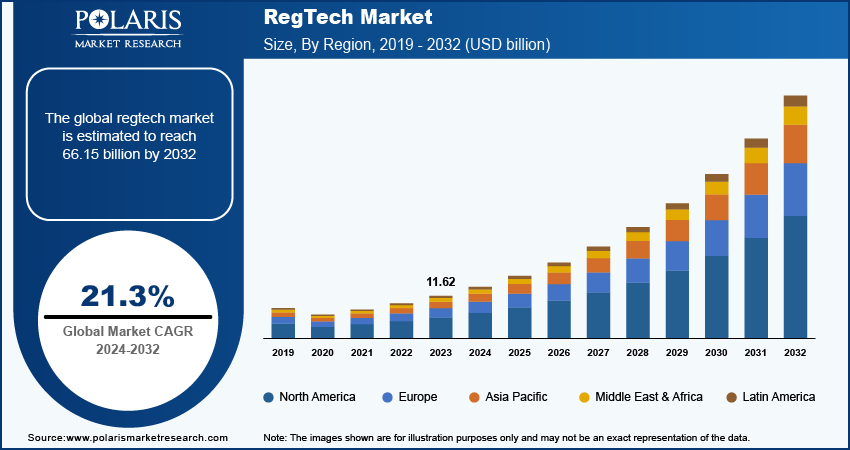
The global RegTech market was valued at USD 17.12 billion in 2025 and is anticipated to register a CAGR of 21.5% from 2026 to 2034. Digital transformation in regulatory compliance and risk management is a key growth driver.
Market Statistics
Key Takeaways
- The cloud-based deployment dominated the RegTech industry. Cloud deployment model offers significant advantages, such as exceptional scalability and flexibility. These features enable organizations to allocate resources based on demand. It propels the demand for cloud-based RegTech solutions.
- The risk & compliance segment held the largest share of the regulatory technology market in 2025. The segment growth is driven by the growing need to manage complex procedures in the banking sector. Risk and compliance software is used to improve compliance management.
- Large enterprises are the dominant adopters of RegTech solutions. These organizations face complex regulatory requirements due to their scale and international operations, driving the need for comprehensive compliance and risk management systems.
- North America held the largest revenue share in the global market in 2025. The presence of several established and emerging RegTech companies boosts the North America industry growth.
- The Asia Pacific RegTech market is expected to register the highest CAGR during the forecast period. Increasing demand for effective digital payment services and the presence of well-established fintech hotspots drive regional market growth.
Industry Dynamics
- Surging regulatory complexity across the world drives the demand for RegTech solutions.
- Increasing integration of technological advancements, including artificial intelligence (AI), machine learning (ML), blockchain, and cloud computing will drive the market expansion.
- High costs and environmental concerns are hindering the RegTech industry growth.
- There is a rising number of cybersecurity threats. Due to these rising incidences, advanced RegTech solutions are adopted to manage and mitigate threats of cybersecurity in RegTech.
AI Impact on RegTech Market
- Automation of Compliance: Artificial technology is used to automate rule interpretation, document analysis, and compliance workflows. The integration streamlines regulatory monitoring, reporting, and audits. It significantly reduces manual efforts and the risk of errors in regulated industries.
- Advanced Risk & Fraud Detection: Machine learning facilitates real-time detection of fraud, AML risks, and market abuse. The technology helps analyze high volumes of transactional and behavioral data with accuracy and fewer false positives.
- Regulatory Change Management: NLP-enabled AI tools monitor and interpret frequent regulatory updates across various jurisdictions. The tools assist organizations stay compliant amid increasing regulatory complexity.
- Cost and Efficiency Gains: AI in RegTech helps reduce compliance costs and enhance operational efficiency. Using this technology, compliance teams can shift their focus from routine, repetitive tasks toward managing strategic risks.
- AI and machine learning (ML) are used for entity resolution, risk scoring, adverse media screening, and alert triage. They help reduce false positives and shorten investigation times.
What is RegTech?
RegTech, or regulatory technology, includes software and tech-driven solutions. Organizations use these tools to automate compliance, facilitate real-time monitoring, provide audit trails, and simplify reporting. It helps them meet regulatory standards. RegTech solutions offer automation, real-time monitoring, and fraud prevention. The digital transformation in financial markets increased during the COVID-19 outbreak pandemic. The surging emphasis on Environmental, Social, and Governance (ESG) compliance boost the demand for RegTech tools. Strong venture capital funding and regulatory support, including testing sandboxes for innovations, drove the market growth. This makes RegTech essential for businesses dealing with complex regulatory environments.
In practice, businesses often adopt RegTech to modernize important compliance workflows. These workflows include AML transaction monitoring, sanctions screening, KYC/KYB onboarding, regulatory reporting automation, and keeping track of policy changes. Buyers are looking at RegTech vendors more closely. They consider factors such as data residency options, encryption while stored and during transfer, and role-based access controls. Audit logging, incident response readiness, and security certifications, including SOC 2 and ISO 27001, are also being considered. These aspects are essential for managing risks from third parties and for regulated businesses operating across different jurisdictions.
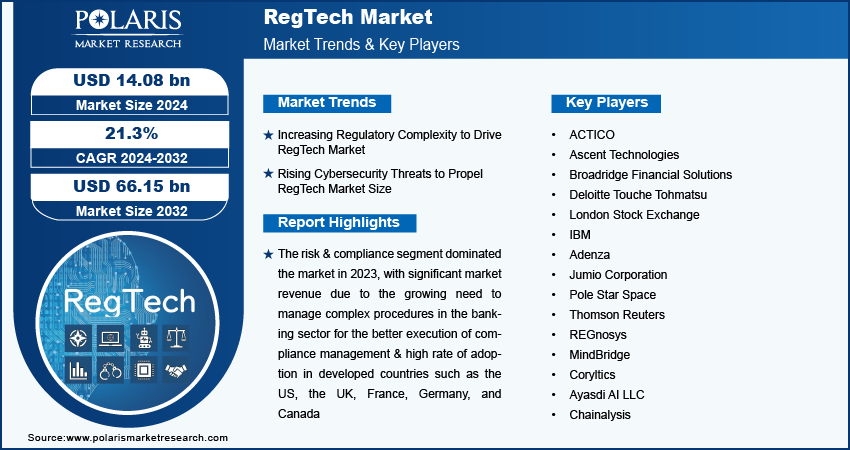
The growing complexity of regulatory compliance accelerates the requirement for RegTech solutions. Also, the increasing use of technologies such as AI, ML, blockchain, and cloud computing drives the RegTech market growth. As financial markets evolve, they face high pressure to comply with stringent global regulations. Manual compliance processes are getting more costly and less efficient. Automating tasks like continuous compliance monitoring, fraud prevention, compliance data management, and anti-money laundering will propel the demand for RegTech solutions in the coming years.
RegTech Vs GRC Vs SupTech: Scope, Users, Technologies, and Regulatory Roles
RegTech focuses on automating compliance tasks like screening, reporting, and monitoring. In contrast, GRC platforms handle wider governance and internal controls throughout the organization. Regulators use SupTech to improve oversight. Understanding these differences helps buyers choose the right compliance technology for their needs.
| Dimension | RegTech (Regulatory Technology) | GRC (Governance, Risk & Compliance) | SupTech (Supervisory Technology) |
| Primary Focus | Technology solutions to help regulated organizations comply with laws and regulations | Enterprise framework to manage governance, risk, and compliance holistically | Tools used by regulators/supervisors to monitor and enforce compliance |
| Users/Stakeholders | Banks, insurers, FinTechs, corporations, and compliance teams | Enterprises of all sizes, risk managers, and internal auditors | Central banks, financial regulators, and supervisory agencies |
| Key Use Cases | AML/KYC automation, transaction monitoring, and regulatory reporting | Risk assessments, compliance program management, and policy governance | Market surveillance, systemic risk monitoring, and automated oversight |
| Core Technologies | AI/ML, NLP, robotic process automation (RPA), and analytics | Workflow engines, dashboards, and reporting platforms | Big data analytics, AI/ML, and data aggregation & visualization |
| Objective | Reduce cost and complexity of compliance tasks; increase accuracy | Align governance with risk appetite; ensure integrated risk-compliance controls | Improve supervisory effectiveness & real-time oversight |
| Data Scope | Organizational internal & regulatory datasets | Internal risk, compliance reports & metrics | Sector-wide & macro regulatory data, filings, market activity |
| Regulatory Interaction | Responds to rules set by regulators | Helps sustain internal governance under regulatory expectations | Directly supports regulators in enforcement & policy evaluation |
| Output Delivered | Automated compliance alerts, reports, and risk scores | Risk registers, compliance dashboards, and audit trails | Supervisory reports, risk signals, and alerts to regulated entities |
| Market Drivers | Regulatory complexity, cost pressures, and tech innovation | Need for integrated risk view and corporate governance demands | Regulatory digitization and need for real-time supervision |
| Example Benefits | Faster onboarding, reduced false positives, and cost savings | Better risk control and improved accountability | Faster detection of systemic issues and enhanced regulator transparency |
| Challenges | Data integration, model explainability, and privacy concerns | Siloed data and cultural adoption barriers | Standardizing data from firms, tech skills, and governance for AI |
Source: Polaris Market Research Analysis
RegTech Market Drivers
Increasing Regulatory Complexity
There is a rise in regulatory requirements and compliance standards around the world. Businesses face growing challenges related to anti-money laundering, know-your-customer (KYC) rules, data privacy, and financial reporting. RegTech solutions that use technologies like AI, ML, and blockchain are essential for automating compliance processes, cutting risks, and ensuring they keep up with changing regulations. In February 2024, NAPIER AI secured USD 56 million in funding from Crestline Investors to support its ongoing growth in AI-based financial crime compliance. Napier announced the investment from Crestline Investors, a U.S.-based alternative asset manager, to drive its growth. This highlights the changing landscape in the industry for KYC automation and AML compliance solutions. As regulations change faster, firms are turning to RegTech solutions to standardize controls, automate evidence gathering, and keep an audit trail. This approach helps them lower manual efforts and boost audit readiness in AML compliance, KYC/KYB verification, and regulatory reporting. Therefore, increasing regulatory complexity is fueling growth in the RegTech industry.
Increasing Cybersecurity Threats
The rise in cyber threats increase the demand for robust compliance and risk management solutions within the RegTech sector. Cyberattacks, including ransomware, phishing, and data breaches, became more advanced, posing serious risks to sensitive financial and personal data. Organizations prioritize RegTech platforms with advanced security features and real-time monitoring to guard against threats. For instance, ComplyAdvantage, a company that uses AI for fraud and anti-money laundering (AML) risk detection, introduced new security improvements to its AML and Know-Your-Customer (KYC) solutions in January 2023. The updated platform now includes AI-driven threat detection and real-time monitoring features to better identify and reduce potential risks from cyber threats. Due to the rising cybersecurity threats, the technology has become important to manage and reduce cybersecurity risks. Beyond detection, RegTech tools support continuous controls monitoring, suspicious activity workflows, and case management features. These advantages help compliance teams document investigations and meet regulatory requirements more quickly. Thus, rising number of cybersecurity threats boosts the adoption of RegTech solution.
RegTech Market Challenge
Data security and privacy concerns are critical challenges in the RegTech space, since these solutions often handle a vast amount of sensitive financial and personal data. Capita, a UK-based outsourcing company that offers a range of services such as RegTech solutions, experienced a major cyberattack in April 2023. In the attack, they lost more than USD135.5 million. The breach compromised client data, including sensitive financial and regulatory information. This incident raised concerns about the security of third-party data as Capita collaborates with various financial institutions. The breach underscored the risks associated with depending on external vendors for compliance and data management services. Thus, to mitigate these concerns, RegTech providers and users are required to implement robust cybersecurity measures, adhere to data protection regulations, and continuously monitor for vulnerabilities since data security and privacy will remain central as RegTech industry grows and evolves.
Segment Insights
By Deployment Type
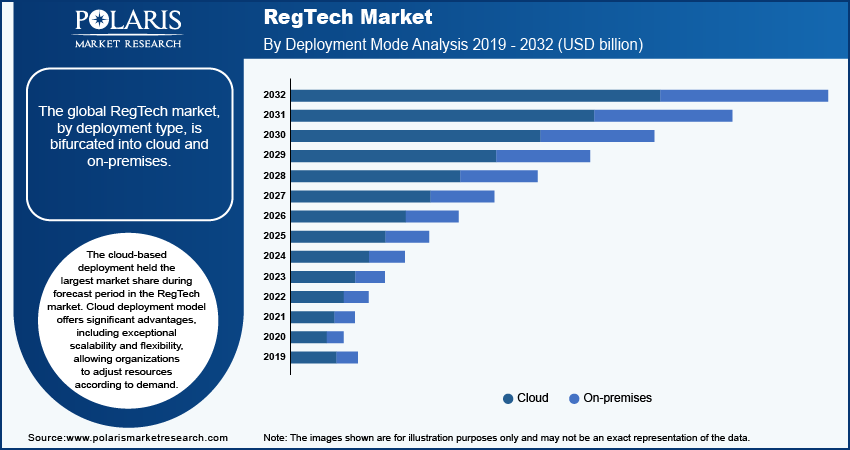
The global RegTech market, by deployment type, is bifurcated into cloud and on-premises. The cloud-based deployment held the largest market share in 2025. Cloud deployment offers significant advantages, including exceptional scalability and flexibility. These benefits enable organizations to adjust resources in response to demand. This deployment type eliminates the need for substantial upfront hardware investments. Also, a subscription-based pricing model aligns costs with usage. The cost-efficiency of cloud-based solutions is clear. The integration of technologies like AI and ML with cloud-based solutions allows for advanced features. It provides benefits such as real-time risk monitoring and predictive analytics. The market for this segment is expected to show a significant CAGR, as more sectors adopt it, especially in financial services where regulatory requirements are strict.
On-premises deployment offers organizations more control and better data security. It provide ability to customize solutions as per requirements. Businesses with specific security needs prefer on-premise deployment solutions. However, this segment is growing more slowly than the cloud-based segment. It shows a trend toward more flexible and cost-effective cloud solutions.
By Application
The RegTech market, by application, is bifurcated into risk & compliance, identity management, regulatory reporting, regulatory intelligence, AML and fraud management. The risk & compliance segment dominated the market in 2025, with significant revenue due to the growing need to manage complex procedures in the banking sector for the better execution of compliance management & high rate of adoption in developed countries such as the U.S., the UK, France, Germany, and Canada. In addition, the rising frequency of adoption of RegTech solutions into the existing technology platforms is projected to improve operational efficiency, financial transparency, and agility and lower the overall compliance costs of financial institutions.
Risk and compliance solutions help organizations manage regulatory risks and ensure adherence to legal requirements by providing tools for monitoring and reporting risk exposures. Identity management solutions verify and manage identities to meet Know Your Customer (KYC) and anti-fraud regulations. This area is growing rapidly due to increasing security needs. Regulatory reporting automates the process of reporting to authorities. This automation streamlines tasks and reduces costs for industries such as finance and healthcare. Regulatory intelligence provides current information on changes in laws and standards. It helps businesses stay compliant by offering timely insights into new regulations and enforcement trends. Anti-money laundering (AML) and fraud management use analytics and AI to spot suspicious activities and ensure compliance with AML regulations. Identity management assists with KYC/KYB verification during onboarding. Regulatory intelligence tracks rule changes and maps them to internal policies. In addition, regulatory reporting automation reduces errors and improves submission timeliness.
The regulatory intelligence segment is likely to register the highest growth rate during the forecast period owing to a rapid increase in adoption across various fields such as banking, financial services, and insurance as it helps in monitoring, gathering, and analyzing and ease of tracking down the developments in a rapidly changing environment.
Key RegTech Use Cases Across Major Regulatory and Compliance Applications
| Application Area | Key Use Cases | Primary End Users | Business Impact |
| Risk & Compliance | Continuous compliance monitoring, policy management, risk scoring, and internal controls automation | Banks, insurers, asset managers, and FinTechs | Reduced compliance costs, improved audit readiness, and real-time risk visibility |
| Identity Management | Digital KYC, customer due diligence (CDD), biometric verification, and identity lifecycle management | Banks, FinTechs, and payment providers | Faster onboarding, reduced identity fraud, and improved customer experience |
| Regulatory Reporting | Automated data aggregation, regulatory filing generation, cross-jurisdiction reporting, and data validation | Banks, capital markets firms, and insurers | Lower reporting errors, faster submission cycles, and improved regulatory transparency |
| Regulatory Intelligence | Regulatory change tracking, impact analysis, and rule interpretation using AI/NLP | Compliance teams and legal departments | Proactive compliance, reduced regulatory risk, and faster response to rule changes |
| AML & Fraud Management | Transaction monitoring, sanctions screening, fraud detection, and behavioral analytics | Banks, payment processors, and neobanks | Reduced false positives, enhanced financial crime detection, and regulatory risk mitigation |
Source: Polaris Market Research Analysis
By Organization Size
The RegTech market, by organization size, is bifurcated into large enterprises and small and medium-sized enterprises (SMEs). Large enterprises held a significant share of global revenue in 2025. Companies in highly regulated industries like banking, financial services, and insurance are major users of RegTech solutions. These organizations are required to comply with stringent regulations because of their size and global presence. Consequently, they increasingly need effective compliance and risk management systems. Large firms deploy RegTech solutions to automate compliance tasks, reduce regulatory violation risks, and enhance operational efficiency with abundant resources. Large companies often adopt technologies early, including AI, ML, and cloud-based RegTech platforms.
The SMEs segment witnesses steady growth. The growing need for cost-effective, accessible compliance solutions propels the segment growth. RegTech for SMEs address regulatory demands while minimizing costs. Many SMEs need more internal resources to manage compliance effectively and benefit from scalable, cloud-based solutions that offer affordability and ease of use. RegTech platforms provide these smaller organizations with the tools they need to remain compliant without extensive in-house compliance teams. SMEs adopt modular RegTech solutions delivered via SaaS with usage-based pricing. However, large companies emphasize company-wide governance and integration with core banking systems. They emphasize advanced case management to standardize compliance across business units.
RegTech Regional Insights
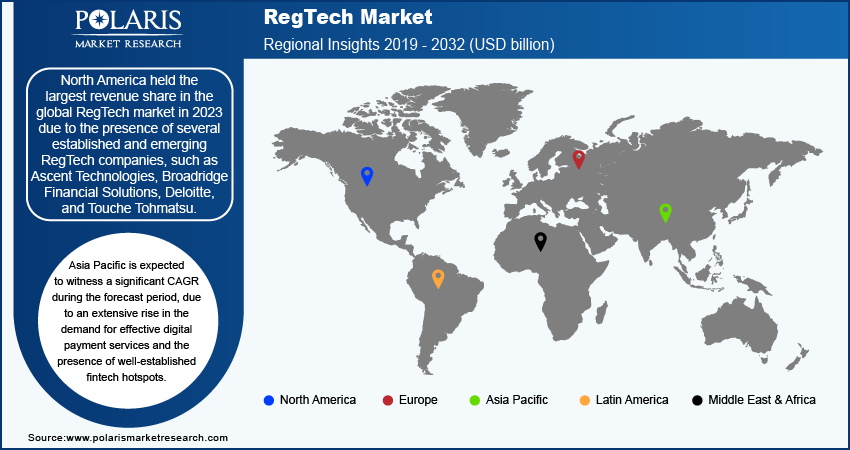
The RegTech industry is segmented into North America, Europe, Asia Pacific, Latin America, and the Middle East & Africa. North America led the revenue share in the global market in 2025. The presence of several established and emerging RegTech companies fuels the regional regulatory technology market growth. Also, the large number of financial institutions and regulatory bodies in the region propels the demand for advanced regulatory technology solutions. The strict compliance requirements from agencies such as the Securities and Exchange Commission (SEC) and the Financial Industry Regulatory Authority (FINRA) have increased the adoption of RegTech solutions in the U.S.
Goldman Sachs & Co. has settled charges with the Securities and Exchange Commission (SEC) for failing to provide complete and accurate securities trading information, also known as blue sheet data. The prominent financial institution has agreed to pay a USD 6 million penalty to resolve the SEC's allegations. Strong enforcement, mature financial markets, and high compliance technology budgets drive consistent demand for AML compliance, regulatory reporting, and surveillance modernization across large institutions and fast-growing fintech across North America. Thus, the region's well-developed infrastructure that promotes technological advancements fueled the dominance of the North America RegTech market.
The market in Asia Pacific is expected to witness significant growth at the highest CAGR during the forecast period. An extensive rise in the demand for effective digital payment services, the presence of well-established fintech hotspots, and a growing emphasis on virtual currencies such as cryptocurrency mainly drive regional market growth. In 2024, Fano Labs, a language AI solution provider, announced the successful closure of its series B funding round with HSBC for utilizing language AI to enhance compliance and customer experiences. Thus, the Asia Pacific RegTech market is anticipated to grow significantly over the next ten years.
The Europe RegTech market growth is fueled by GDPR compliance requirements and cross-border regulatory harmonization efforts. Increasing demand for standardized risk and compliance reporting across multinational institutions supports the high adoption of regulatory intelligence and reporting automation tools, including RegTech solutions.
Key Players and Competitive Insights
The RegTech market has a variety of global and regional companies. These companies focus on gaining a significant market share through innovation, partnerships, and expansion. Key players in this market are IBM, MetricStream, Thomson Reuters, and Broadridge Financial Solutions. These companies are creating new solutions that combine AI, ML, and cloud technologies to simplify regulatory processes like compliance management, risk management, and fraud prevention.
Competitive strategies often include mergers & acquisitions that are shaped by innovations in AI, ML, and blockchain technology, which streamline regulatory processes, risk management, and fraud detection. A few major RegTech companies are ACTICO, Ascent Technologies, Broadridge Financial Solutions, Deloitte Touche Tohmatsu, London Stock Exchange, IBM, Jumio Corporation, Pole Star Space, Thomson Reuters, REGnosys, MindBridge, Coryltics, Ayasdi AI LLC., and Chainalysis.
The RegTech vendor landscape can be categorized into AML/KYC & financial crime compliance, regulatory reporting & data management, regulatory intelligence & change management, identity verification & onboarding, and crypto compliance and blockchain analytics. It helps buyers align tools with priority obligations.
What is Vendor Selection Criteria?
Buyers shortlist RegTech platforms based on regulatory coverage, configurability, and explainability of alerts. They also evaluate integration depth (data sources and case management), audit trail quality, and security posture (SOC 2/ISO readiness, encryption, and access controls). Including these criteria strengthens purchase confidence and reduces evaluation time.
List of Key Companies
- ACTICO
- Ascent Technologies
- Broadridge Financial Solutions
- Deloitte Touche Tohmatsu
- London Stock Exchange
- IBM
- Adenza
- Jumio Corporation
- Pole Star Space
- Thomson Reuters
- REGnosys
- MindBridge
- Coryltics
- Ayasdi AI LLC
- Chainalysis
RegTech Industry Developments
- April 2025:Innovate Finance launched the UK RegTech Strategy Group with City of London and EY to boost RegTech growth, cut compliance costs, and position the UK as a global regulatory technology leader.
- September 2024: Upsolve secured USD 4.2 million Gates Foundation grant. The grant will be utilized to launch financial counseling AI for low-income citizens. The organization aims to deliver financial guidance by analyzing user profiles using AI. The analysis will help it offer personalized advice on debt management, credit improvement, and access essential financial resources.
- April 2024: Dot Compliance, a RegTech startup, raised USD 17.5 million in a Series B funding round. IGP Capital and Vertex Ventures led this round, with additional support from TPY Capital.
RegTech Market Segmentation
By Deployment Type Outlook, 2021–2034 (USD Billion)
- Cloud
- On-Premises
By Application Type Outlook, 2021–2034 (USD Billion)
- Risk & Compliance
- Identity Management
- Regulatory Reporting
- Regulatory Intelligence
- AML and Fraud Management
By Organization Size Outlook, 2021–2034 (USD Billion)
- Large Enterprises
- SMEs
By Component Outlook, 2021–2034 (USD Billion)
- Solution
- Services
By Region Outlook, 2021–2034 (USD Billion)
- North America
- US
- Canada
- Europe
- Germany
- France
- UK
- Italy
- Spain
- Netherlands
- Russia
- Rest of Europe
- Asia Pacific
- China
- Japan
- India
- Malaysia
- South Korea
- Indonesia
- Australia
- Rest of Asia Pacific
- Middle East & Africa
- Saudi Arabia
- UAE
- Israel
- South Africa
- Rest of Middle East & Africa
- Latin America
- Mexico
- Brazil
- Argentina
- Rest of Latin America
RegTech Market Report Scope
| Report Attributes | Details |
| Market Size in 2025 | USD 17.12 billion |
| Market Size in 2026 | USD 20.79 billion |
| Revenue Forecast in 2034 | USD 99.07 billion |
| CAGR | 21.5% from 2026 to 2034 |
| Base Year | 2025 |
| Historical Data | 2022–2024 |
| Forecast Period | 2026–2034 |
| Quantitative Units | Revenue in USD Billion, 2021–2034 and CAGR from 2026 to 2034 |
| Report Coverage | Revenue Forecast, Market Competitive Landscape, Growth Factors, and Trends |
| Segments Covered |
|
| Regional Scope |
|
| Competitive Landscape |
|
| Report Format |
|
| Customization | Report customization as per your requirements with respect to countries, regions, and segmentation. |
Source: Polaris Market Research Analysis
RegTech Market FAQ's
The RegTech industry is expected to grow from USD 17.12 billion in 2025 to USD 99.07 billion by 2034. It is projected to register a CAGR of 21.5% from 2026 to 2034.
RegTech uses automation, AI, and ML. The technology helps financial organizations streamline compliance processes and reduce regulatory risks. It also assists in improving transaction monitoring accuracy and lowering operational costs.
RegTech automates manual compliance tasks and eliminates redundant processes. It reduces penalties through better accuracy and decreases reliance on external legal consultants. These advantages significantly lower overall compliance expenditures.
RegTech deployment in banks requires 6–12 months. Legacy system integration and complexity influence the deployment period. FinTechs deploy RegTech solutions faster. It often takes 6–16 weeks, using cloud-native architectures.
Effective RegTech deployment requires transaction data, customer KYC documentation, and sanctions and watchlists. It also needs organizational workflows, historical alerts and compliance cases, and internal risk and audit data. Regulatory standards are also being considered.
Major RegTech applications are risk management, identity verification, regulatory reporting, and anti-money laundering. Also, other applications include fraud detection, transaction monitoring, cybersecurity, and governance compliance requirements across financial institutions globally.
Increasing regulatory complexity, rising compliance fines, and higher regulatory standards boost the market growth. Also, rising cloud adoption and surging digitalization preferences boost the RegTech demand. Further, increasing requirements for efficient automated compliance management solutions in financial institutions fuels the expansion.
Asia Pacific experiences fastest growth due to digital transformation investments, emerging economies adopting innovative technologies, infrastructure development, and rising GDP in countries such as China, India, Japan, and Singapore.
AI and ML algorithms are used in RegTech solutions. It helps analyze behavioral patterns, contextual data, and risk scores. AI and ML integration significantly reduces unnecessary investigations and false positives.
Download Sample Report of RegTech Market
Please fill out the form to request a customized copy of the research report.


