
Restaurant Management Software Market Size Report 2026-2034
REPORT DETAILS
Restaurant Management Software Market Summary
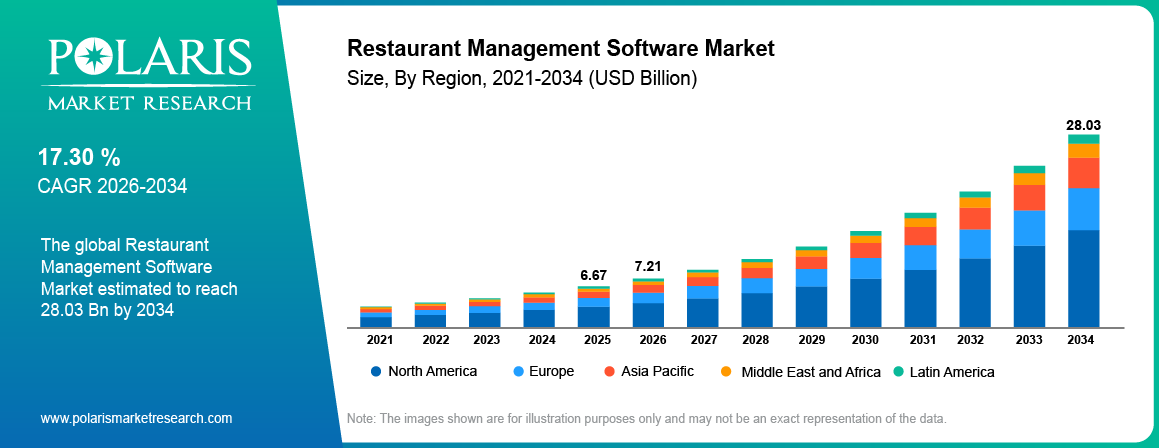
The global restaurant management software market size was valued at USD 6.67 billion in 2025. The market is projected to grow at a CAGR of 17.3% from 2026 to 2034. The surge in digital and omnichannel delivery and the shift towards cloud-based systems are a few of the key factors driving market growth.
Market Statistics
Restaurant Management Software Market Key Takeaways
- North America led with a 40.8% revenue share in 2025. Advanced technological infrastructure and high digital adoption rates contribute to the regional market dominance.
- Asia Pacific is expected to witness the highest CAGR of 18.9%. This is due to the rapid expansion of cloud kitchens and the growing digitalization of restaurant operations across the region.
- The cloud segment led with a 67.5% market share in 2025. This is primarily owing to its scalability, cost-effectiveness, and ease of deployment.
- The on-premise segment is expected to witness the highest CAGR of 16.2%. Heightened data security concerns and greater control over IT infrastructure are driving the growth of this segment.
- The full service restaurant segment accounted for the largest market share of 43.6% in 2025. This is owing to the increasing need for advanced software solutions to manage reservations, inventory, customer engagement, and operations.
Note: Figures and projections outlined in this report are the result of Polaris Market Research’s proprietary analytical processes, grounded in the latest available datasets and market observations.
Industry Dynamics
- The rising consumer preference for digital transactions is driving the adoption of restaurant management software.
- Growing consumer disposable income worldwide is another factor shaping the market landscape.
- The shift towards cloud-based operations is expected to create several market opportunities.
- High implementation and integration costs may present market challenges.
AI Impact on Restaurant Management Software Market
- AI helps restaurant management software automate order entry, table reservation, and staff scheduling, thereby saving both time and labor.
- AI helps restaurants manage inventory better with its capabilities to forecast demand based on historical sales data and to monitor inventory status and trigger purchase orders automatically.
- AI can be used to make more targeted offers to customers and personalized recommendations to customers. The use of AI can deliver a more automated customer service or an enhanced customer experience.
- Business owners are able to gain more insight into real-time data, enabling them to make more appropriate and better business decisions.
What is Restaurant Management Software?
The restaurant management software market encompasses digital solutions designed to streamline operations, enhance customer experience, and optimize business efficiency in the food service industry. These platforms integrate functionalities such as point-of-sale (POS) systems, inventory tracking, order management, analytics, and customer relationship management (CRM) to improve restaurant performance and profitability.
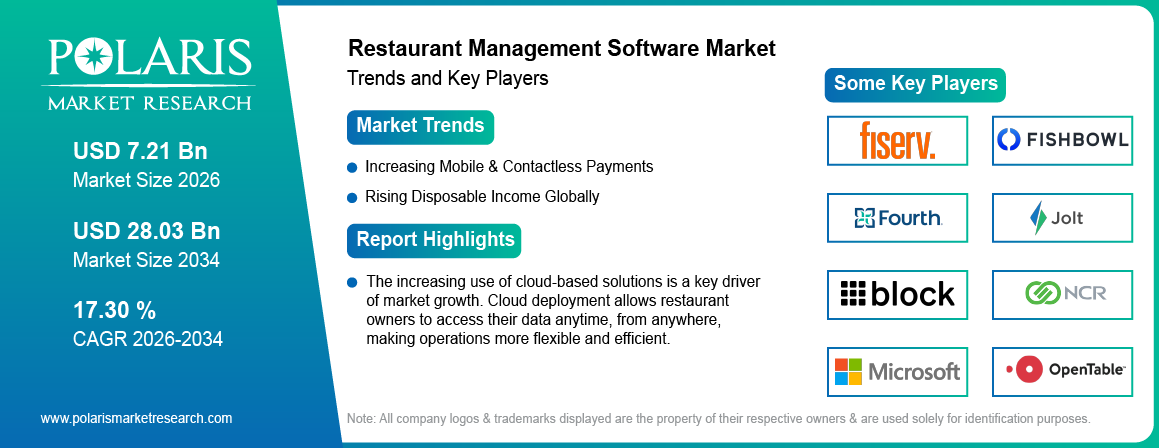
The restaurant management software market is growing as more restaurants adopt digital solutions to improve their operations. Restaurants are using advanced software to manage orders, track inventory, handle payments, and enhance customer service. This shift helps businesses run more smoothly, reduce errors, and save time. Another key factor driving market growth is the increasing use of cloud-based solutions. Cloud deployment allows restaurant owners to access their data anytime, from anywhere, making operations more flexible and efficient. It also improves data security, scalability, and system updates, ensuring businesses stay up to date with the latest technology. The demand for restaurant management software is expected to rise further in the coming years as restaurants look for ways to improve efficiency and customer experience.
Advanced software solutions tailored for personalized customer experiences are driving the restaurant management software market development. Additionally, strategic partnerships and mergers between software providers and restaurant chains are enhancing market outlook, boosting innovation, and expanding service capabilities to meet evolving industry demands and optimize operational efficiency.
Market Dynamics
Increasing Mobile & Contactless Payments
The growing consumer preference for digital transactions is accelerating restaurant management software market growth, with mobile and contactless payments becoming essential for enhancing customer convenience and operational efficiency. For instance, according to the Monetary Authority of Macao, in China, transactions via local mobile payment tools rose by 13.5% quarter-on-quarter, reaching 100 million in Q4 2024. The transaction value increased by 8.4%, totaling 8.2 billion. This growing demand for seamless, secure, and fast payment solutions is driving software adoption and expanding market size. Integrated payment processing capabilities are enabling restaurants to streamline transactions, reduce wait times, and improve overall customer experience, further fueling market demand.
Rising Disposable Income Globally
Rising disposable income has significantly contributed to the restaurant management software market expansion. For instance, according to the Ministry of Statistics & Programme Implementation, India's Gross National Disposable Income (GNDI) showed a growth of 14.5% for the year 2022-23. Increasing consumer spending power has led to a shift in dining preferences, resulting in more frequent visits to restaurants and a heightened demand for higher-quality service. This surge in consumer expectations drives the need for advanced software solutions that streamline operations, enhance customer experiences, and manage resources efficiently. Restaurants are adopting these technologies to improve order management, inventory tracking, and customer relationship management, thereby improving operational efficiency. Consequently, the rise in disposable income is fueling demand for dining services and expanding the market for restaurant management software solutions.
Customer Engagement and Loyalty Program Integration
The emphasis on customer engagement is driving restaurants to adopt technologies and techniques that promote customer relationships and customer retention. Current restaurant management software incorporates CRM features that record customer preferences, order histories, and dine-out preferences, allowing restaurants to individualize promotions, offer discounts, and run tailored marketing campaigns at a personal level, creating more of a personalized dining experience. Restaurants can build customer loyalty with rewards programs such as points, coupons, or other special treatments. Feedback systems use technology to record comments and respond to problems quickly. Combining all of these technologies helps to increase customer satisfaction, customer retention and business growth.
Sustainability and Food Waste Reduction Benefits
Operational efficiency, food waste reduction, and the sustainability trend continue to shape development. Management software supports these goals by assisting in stock taking, ordering, and forecasting. Digital inventory management, demand prediction, and ordering automate stock management to maintain optimal levels through prevention of excess and waste in terms of raw ingredients and perishable goods by providing real time data on the usage of individual ingredients, their value, and customer forecast. Demand prediction tools help managers anticipate the quantity of each ingredient required based on sales patterns and seasonal purchasing patterns. Therefore, resources are managed, food waste is minimized, and efficient stock management supports these green and financial goals.
Segment Insights
Assessment by Deployment Outlook
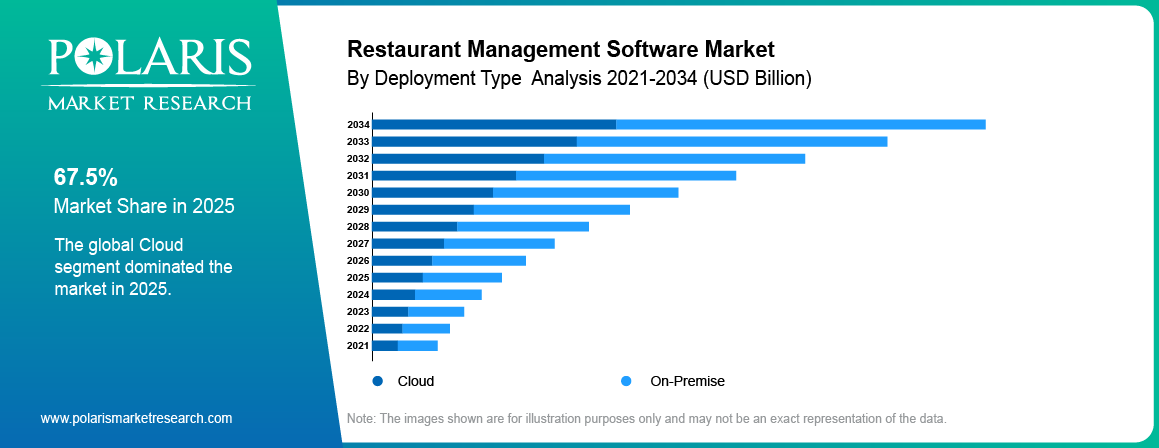
The global restaurant management software market segmentation, based on deployment, includes on-premise and cloud. In 2025, the cloud segment accounted for the largest market share of 67.5% due to its scalability, cost-effectiveness, and real-time accessibility. The rising adoption of software-as-a-service (SaaS) solutions among restaurant operators is driving growth, as businesses prioritize centralized data management, automated updates, and remote monitoring. Cloud deployment is streamlining multi-location operations, improving inventory control, and enabling seamless integration with third-party platforms. Additionally, the increasing reliance on digital transformation strategies and demand for contactless solutions has contributed to the segment’s dominance, with cloud-based systems offering enhanced security and compliance features.
The on-premise segment is expected to witness highest CAGR of 16.2% from 2026 to 2034 due to heightened data security concerns and the need for complete control over software customization. High-end restaurants and enterprise-level food service businesses are investing in dedicated servers and advanced security infrastructure. The demand for on-premise solutions is increasing in regions with limited cloud adoption or stringent regulatory requirements. Additionally, businesses operating in remote areas with unreliable internet connectivity are fueling segmental growth, as on-premise solutions provide uninterrupted operations without dependency on cloud access.
Evaluation by End Use Outlook
The global restaurant management software market segmentation, based on end use, includes full service restaurant (FSR), quick service restaurant (QSR), institutional, and others. In 2025, the full service restaurant segment accounted for the largest market share of 43.6% due to the increasing need for advanced software solutions to manage reservations, table turnover, and personalized customer experiences. The demand for comprehensive restaurant management platforms is rising as operators seek to enhance operational efficiency, optimize workforce management, and streamline billing processes. The integration of artificial intelligence and machine learning for predictive analytics and menu optimization is contributing to the expansion of this segment, enabling full-service restaurants to enhance customer engagement and maximize revenue.
The quick service restaurant segment is expected to register the highest CAGR 15.30% during the forecast period due to the growing demand for automation, digital ordering, and drive-thru efficiency. The increasing adoption of AI-powered self-service kiosks, mobile ordering apps, and automated kitchen workflows is boosting segmental growth. The rapid expansion of fast-food chains and franchise models is driving investment in data-driven restaurant management software to improve service speed, optimize staffing, and enhance inventory control. Rising consumer expectations for faster service and seamless digital interactions are further strengthening the outlook for quick service restaurant software solutions.
Regional Analysis
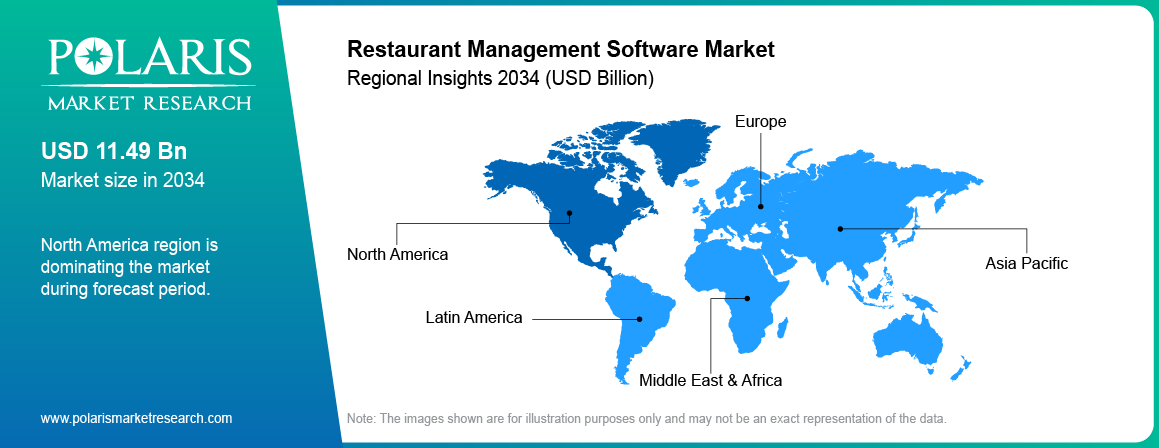
By region, the study provides the restaurant management software market insights into North America, Europe, Asia Pacific, Latin America, and the Middle East & Africa. In 2025, North America accounted for the largest market share of 40.8% due to high digital adoption rates, advanced technological infrastructure, and increasing investments in automation across the food service industry. The strong presence of major quick-service and full-service restaurant chains is contributing to market expansion, as businesses prioritize data-driven decision-making, AI-powered analytics, and cloud-based solutions to enhance operational efficiency. For instance, in October 2023, Starbucks significantly expanded its North American presence, reaching a total of 17,810 stores. This comprised 10,628 company-operated stores and 7,182 licensed stores. Stringent labor regulations and rising labor costs are further driving demand for automated workforce management and inventory tracking solutions. Additionally, the rapid integration of mobile ordering, contactless payments, and loyalty program management is strengthening market value across the region.
The Asia Pacific restaurant management software market is expected to witness the highest CAGR of 18.9% during the forecast period due to the rapid expansion of cloud kitchens, increasing smartphone penetration, and the growing influence of food delivery platforms. For instance, according to the Press Information Bureau, in 2022, the number of smartphone users has increased dramatically from 150 million to 750 million in the last eight years in India, showcasing the rapid adoption of mobile technology and the growing reliance on mobile internet services. The surge in urbanization and rising disposable income are accelerating market growth, as restaurants invest in AI-driven software solutions to optimize order management, enhance customer engagement, and streamline supply chain operations. Government initiatives promoting digital payments and smart city projects are further supporting market expansion. The competitive landscape is evolving with regional players leveraging advanced automation, IoT integration, and localized software customization to meet dynamic consumer preferences.
Key Players and Competitive Insights
The competitive landscape of the restaurant management software market is characterized by intense market penetration efforts, strategic alliances, and continuous technology advancements. Leading players are actively engaging in mergers and acquisitions to expand their product portfolios, enhance scalability, and strengthen their global footprint. Post-merger integration strategies are becoming a key focus, enabling companies to streamline operations and accelerate innovation. Joint ventures and partnerships between software providers and restaurant chains are driving the development of AI-driven analytics, cloud-based platforms, and integrated payment solutions, enhancing operational efficiency and customer experience. The evolving technological landscape is pushing market participants to invest heavily in automation, machine learning, and IoT-enabled restaurant solutions to gain a competitive edge.
Competition strategy revolves around customization, data-driven insights, and seamless omnichannel integration, catering to the diverse needs of full-service and quick-service restaurants. The rising adoption of SaaS-based platforms has further intensified market rivalry, prompting companies to refine their service models through subscription-based pricing and flexible deployment options. Additionally, global brands are prioritizing cybersecurity enhancements and compliance-driven innovations to address regulatory challenges. Businesses are leveraging strategic collaborations and ecosystem partnerships to drive sustained restaurant management software market expansion and long-term revenue growth.
Oracle Corporation provides products and services that address enterprise information technology environments globally. Oracle Fusion cloud enterprise performance management, Oracle Fusion cloud supply chain, as well as manufacturing management, enterprise resource planning (ERP), Oracle Advertising, NetSuite applications suite, Oracle Fusion cloud human capital management, and Oracle Fusion Sales, Service, and Marketing, are few of the cloud software programs included in the company's Oracle software as a service. The company also provides licensed cloud-based business infrastructure solutions, middleware (which contains tools for development and other purposes), and enterprise databases like Oracle and Java. Also, the company provides Generative AI powered by state-of-the-art LLMs from Cohere, ensuring unparalleled data security, trusted performance, and versatile deployment options for text generation. Oracle's four main business divisions – cloud, license, hardware, and services – provide its database management systems and cloud-engineering services and solutions. In addition, the company also offers cloud-based industrial solutions for numerous industries, support services for Oracle licenses, and licenses for Oracle application software. Oracle Corporation offers Oracle MICROS restaurant management software, providing POS systems, inventory management, online ordering, reporting, and analytics. Its cloud-based solutions help restaurants improve efficiency, enhance customer service, and streamline operations.
Microsoft is a multinational technology company headquartered in Redmond, Washington. Microsoft offers various products and services, including operating systems, productivity software, gaming consoles, and cloud-based solutions. Its flagship product, Microsoft Windows, is the world's most widely used operating system. Other popular products include Microsoft Office, Skype, and the Xbox gaming console. Microsoft has also developed several AI-based products and services, including the Azure Machine Learning platform, which allows developers to build, deploy, and manage machine learning models at scale. The company has also developed AI tools for healthcare, such as Microsoft Healthcare Bot, which helps patients get answers to their health-related questions. Microsoft offers restaurant management software solutions through Microsoft Dynamics 365, providing tools for POS systems, inventory management, customer engagement, analytics, and cloud integration, helping restaurants improve efficiency, streamline operations, and enhance customer experiences. Microsoft offers restaurant management software solutions through Microsoft Dynamics 365, providing tools for POS systems, inventory management, customer engagement, analytics, and cloud integration, helping restaurants improve efficiency, streamline operations, and enhance customer experiences.
List of Key Companies
- Block, Inc.
- Fiserv, Inc.
- Fishbowl Inc.
- Fourth Enterprises LLC.
- Jolt
- Microsoft
- NCR Corporation
- OpenTable, Inc.
- Oracle Corporation
- Revel Systems
- TouchBistro
Industry Developments
-
June 2026: CHR Group announced the acquisition of technology companies, Rmoni and Andy. According to CHR Group, these acquisitions are aimed at establishing itself as a leading digital partner for the foodservice industry. (source: prnewswire.com)
-
April 2026: Advantech highlighted edge AI computing on restaurant POS and kiosk systems at the National Restaurant Show. Advantech states the new tech is focused on the ability to dynamically personalizing the menu and automating the ordering process within Quick Service Restaurants. (source: prnewswire.com).
Segmentation
By Type Outlook (Revenue, USD Billion, 2021–2034)
- Front End Software
- Accounting & Cash Flow
- Purchasing & Inventory Management
- Table & Delivery management
- Employee Payroll & Scheduling
- Others
By Deployment Outlook (Revenue, USD Billion, 2021–2034)
- On-Premise
- Cloud
By End Use Outlook (Revenue, USD Billion, 2021–2034)
- Full Service Restaurant (FSR)
- Quick Service Restaurant (QSR)
- Institutional
- Others
By Regional Outlook (Revenue, USD Billion, 2021–2034)
-
North America
- US
- Canada
- Europe
- Germany
- France
- UK
- Italy
- Spain
- Netherlands
- Rest of Europe
- Asia Pacific
- China
- Japan
- India
- South Korea
- Indonesia
- Rest of Asia Pacific
- Middle East & Africa
- Saudi Arabia
- UAE
- South Africa
- Israel
- Rest of Middle East & Africa
- Latin America
- Mexico
- Brazil
- Argentina
- Rest of Latin America
Report Scope
| Report Attributes | Details |
| Market Size Value in 2025 | USD 6.67 billion |
| Market Size Value in 2026 | USD 7.21 billion |
| Revenue Forecast by 2034 | USD 28.03 billion |
| CAGR | 17.3% from 2026 to 2034 |
| Base Year | 2025 |
| Historical Data | 2021–2024 |
| Forecast Period | 2026–2034 |
| Quantitative Units | Revenue in USD billion and CAGR from 2026 to 2034 |
| Report Coverage | Revenue Forecast, Market Competitive Landscape, Growth Factors, and Trends |
| Segments Covered |
|
| Regional Scope |
|
| Competitive Landscape |
|
| Report Format |
|
| Customization | Report customization as per your requirements with respect to countries, regions, and segmentation. |
Source: Polaris Market Research Analysis
Restaurant Management Software Market FAQ's
The global restaurant management software market size was valued at USD 6.67 billion in 2025 and is projected to grow to USD 28.03 billion by 2034.
The global market is projected to register a CAGR of 17.3% during the forecast period
In 2025, North America accounted for the largest market share of 40.8% due to high digital adoption rates, advanced technological infrastructure, and increasing investments in automation across the food service industry.
Some of the key players in the market are Block, Inc.; Fiserv, Inc.; Fishbowl Inc.; Fourth Enterprises LLC; Jolt; Microsoft; NCR Corporation; OpenTable, Inc.; Oracle Corporation; Revel Systems; and TouchBistro.
In 2025, the cloud segment accounted for the largest market share of 67.5% due to its scalability, cost-effectiveness, and real-time accessibility.
In 2025, the full service restaurant segment accounted for the largest market share of 43.6% due to the increasing need for advanced software solutions to manage reservations, table turnover, and personalized customer experiences.
Download Sample Report of Restaurant Management Software Market
Please fill out the form to request a customized copy of the research report.


