
Rotary Pumps Market Size, Share, Global Analysis Report, 2026-2034
REPORT DETAILS
Rotary Pumps Market Summary
The global Rotary Pumps Market was valued at USD 4.47 billion in 2025 and is expected to grow at a CAGR of 6.80% from 2026 to 2034. Industrial process efficiency demands and fluid handling needs are supporting growth.
Market Statistics
Key Takeaways
- Asia Pacific dominated the global market with 41.28% revenue share in 2025. Rapid industrialization and the rising need for fluid handling in various countries contributed to the dominance.
- The Middle East & Africa rotary pumps market is projected to register a CAGR of 6.3% during the forecast period. The growth is attributed to the well-established oil & gas and power generation industries across the region.
- The gear pumps segment held the largest share of 35.4% in 2025. It is due to their widespread applications across diverse industries, including hydraulic systems, lubrication systems, fuel transfer, and chemical processing.
- The screw pump segment is expected to exhibit the highest CAGR of 7.3% during 2026–2034. These pumps play a crucial role in the oil & gas industry. They are majorly used to transfer crude oil & refined products during refinery processes. This factor boosts segment growth.
- In 2025, the oil & gas segment led the market with 29.5% share. This is attributed to the critical role of rotary pumps in the segment, owing to their reliability, versatility, and ability to handle a broad spectrum of fluids.
Note: Figures and projections outlined in this report are the result of Polaris Market Research’s proprietary analytical processes, grounded in the latest available datasets and market observations.
Industry Dynamics
- Growing demand from oil & gas and chemical industries due to increasing fluid handling requirements propels market expansion.
- Rising need for efficient and reliable fluid handling systems boosts adoption of rotary pumps across diverse industrial applications.
- Increasing emphasis on wastewater treatment is accelerating demand for rotary pumps in municipal and industrial sectors.
- Surging adoption of energy-efficient pumps supports sustainability goals and reduces operational costs.
- Higher initial and maintenance costs than centrifugal pumps limit the adoption of rotary pumps in cost-sensitive industries.
- High focus on automation and digitalization in process industries is expected to enhance demand for advanced rotary pump systems.
AI Impact on the Rotary Pumps Market
- AI-based predictive maintenance enables early fault detection. It reduces unplanned downtime in rotary pump systems.
- Real-time condition monitoring uses sensors and analytics. It improves operational reliability and asset performance.
- AI optimizes pump efficiency by adjusting parameters such as flow rate, pressure, and energy consumption.
- Integration with IoT and smart factory systems will boost automation in process industries using rotary pumps.
- Data-driven decision-making help enhance maintenance planning and reduces costs. It improves overall productivity.
What are Rotary Pumps?
Rotary pumps are a type of positive displacement pump. The pumps are used to move fluid by trapping a fixed volume and transferring it through rotating components such as gears, screws, or vanes. They enable efficient handling of high-viscosity, corrosive, and shear-sensitive fluids across different industrial applications.
Comparison Between Rotary Vs. Centrifugal Pumps
Rotary and centrifugal pumps serve distinct roles across different industrial fluid handling applications. Their selection depends on fluid properties and operating conditions. Understanding their differences in performance, efficiency, and use cases helps industries choose the most suitable pump type.
| Parameter | Rotary Pumps (Positive Displacement) | Centrifugal Pumps |
| Flow Consistency | Delivers a constant flow regardless of pressure variations | Flow varies with pressure and system conditions |
| Viscosity Handling | Highly efficient for high-viscosity and thick fluids | Best suited for low-viscosity fluids like water |
| Pressure Capability | Provides high pressure at low flow rates | Designed for high flow rates at relatively lower pressure |
| Efficiency | Maintains efficiency across varying conditions | Efficiency drops with changes in flow and head |
| Industrial Use Cases | Oil & gas, chemicals, food processing, lubrication, and fuel transfer | Water supply, HVAC, irrigation, and general fluid circulation |
| Maintenance | Requires precise maintenance due to tight internal clearances | Easier maintenance with simpler design and fewer moving parts |
Source: Polaris Market Research Analysis
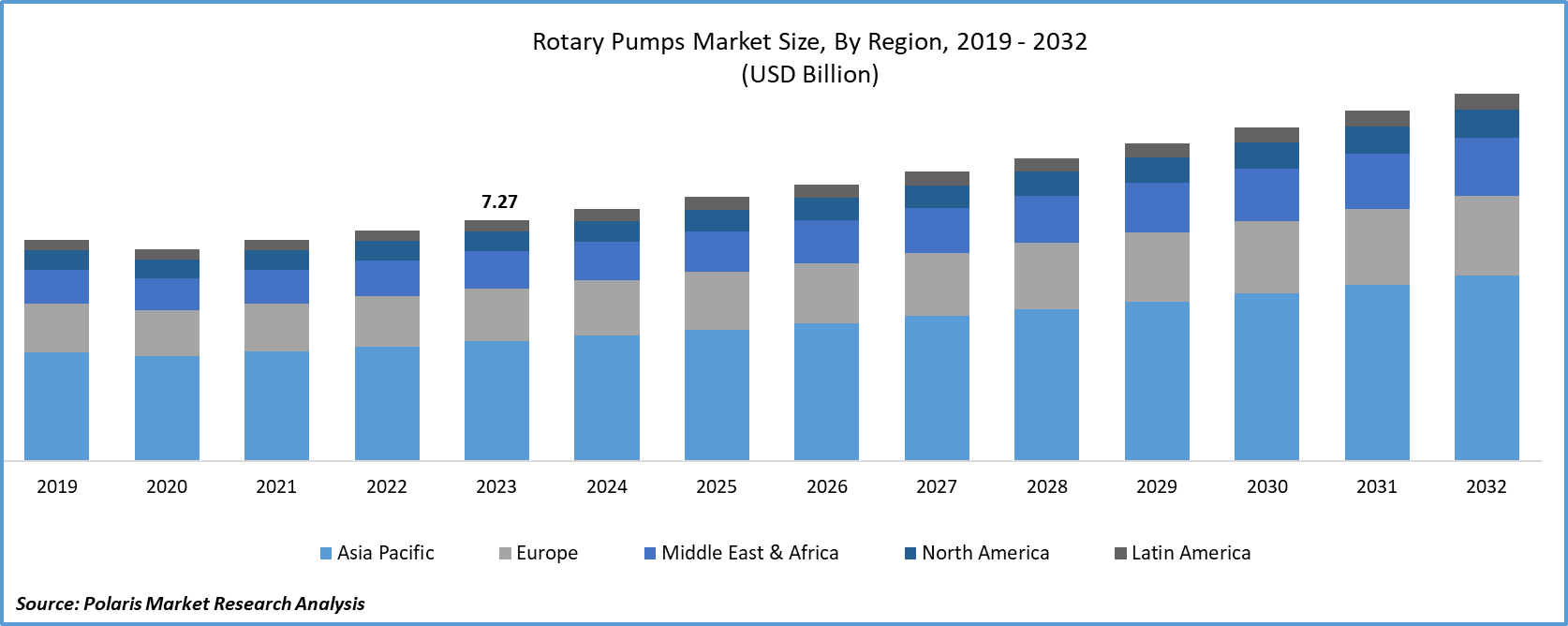
The market is experiencing growth primarily due to the escalating fluid handling requirements in industries like oil & gas, chemicals, & waste-water treatment. Rotary pumps, known for their flexibility in handling fluids with varying viscosities, are becoming increasingly preferable in meeting these diverse requirements. With companies facing heightened pressure to minimize their carbon footprint, there is a growing trend towards strategic investments in environmentally friendly technologies, particularly energy-efficient rotary pumps. These investments have proven successful in reducing both energy consumption and emissions.
Source: Polaris Market Research Analysis
To align with sustainable corporate practices and environmental objectives, organizations are placing a higher priority on product usage to enhance the carbon efficiency of their facility operations. In essence, the market growth is fueled by the need for versatile fluid handling solutions, coupled with a strategic shift towards environmentally friendly and energy-efficient technologies to meet sustainability goals in various industries.
Major players in the industry are creating pumps that are not only more energy-efficient but also have a reduced carbon footprint. The newly designed pumps come equipped with variable speed drives (VSDs), enhancing their capabilities, and contributing to the overall market development. Certain sectors, like chemical processing, necessitate specialized rotary pumps capable of handling highly corrosive, viscous, and acidic fluids. As a solution, manufacturers are providing customization options and leveraging their expertise to meet the specific demands of these industries.
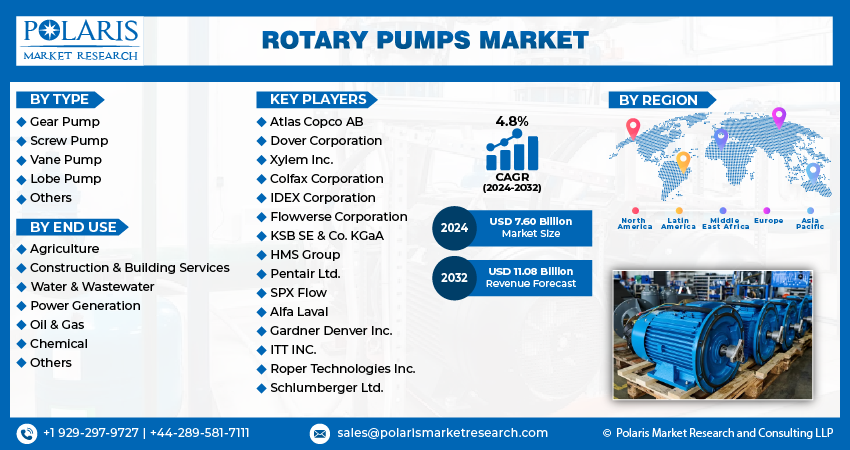
Furthermore, as digitalization and the Internet of Things (IoT) become more prevalent, businesses are introducing IoT-based solutions for pumps to augment the capabilities of rotary pumps. The market is characterized by intense competition and a concentration of numerous players with specialized expertise in product design and development. Key industry players are making substantial investments in research and development (R&D) activities, allowing them to not only maintain but also expand their market share, thereby achieving deeper penetration within the industry.
Source: Polaris Market Research Analysis
Growth Drivers
-
Growth in infrastructure projects, such as construction, water treatment, and oil and gas exploration, can boost the demand for rotary pumps
The rotary pumps market is poised for significant growth, driven by the extensive use of rotary pumps in the oil & gas industry for fluid transport within the refining process. Additionally, these pumps play a crucial role in transferring fluids with varying densities in the manufacturing processes, especially as the chemical processing industry experiences an upswing in operations. The dynamic nature of end-use industries, coupled with a growing emphasis on energy efficiency and sustainability, points toward future market trends.
In the oil & gas sector, rotary pumps are essential for the transportation of fluids during the refining process. This critical application contributes to the anticipated growth of the market. Moreover, as the chemical processing industry expands its operations, there is an increased demand for rotary pumps to handle the transfer of fluids with different densities, further boosting market prospects.
Report Segmentation
The market is primarily segmented based on type, end use, and region.
| By Type | By End Use | By Region |
|
|
|
Source: Polaris Market Research Analysis
Source: Polaris Market Research Analysis
By Type Analysis
-
Gear pumps segment held the largest share
The gear pumps segment held the largest share of 35.4% in 2025. The fundamental concept behind gear pumps involves capturing and moving fluid by leveraging the spaces formed between the teeth of these rotating gears. These pumps find widespread application across diverse industries, including hydraulic systems, lubrication systems, fuel transfer, and chemical processing. Notably, they are well-suited for handling fluids with varying corrosiveness, viscosity, and density. Renowned for their reliability in maintaining a consistent flow rate, gear pumps are also known for their low maintenance requirements.
Screw pump segment expected to grow at the significant pace. A screw pump, falling under the category of positive displacement rotary pumps, operates by utilizing rotating screws to convey fluid from the input point to the output point. Screw pumps come in different types, such as single screw pumps or multi-screw pumps. Within the oil & gas industry, they play a crucial role in transferring crude oil & refined products during refining processes in refineries.
By End Use Analysis
-
Oil & gas segment held the significant market revenue share in 2025
In 2025, the oil & gas segment led the market with 29.5% share. Rotary pumps play a crucial role in the oil and gas industry, serving various critical functions owing to their reliability, versatility, and capability to handle a broad spectrum of fluids, including both crude oil and refined products. Additionally, these pumps are employed for the transfer of crude oil from the well-heads to the storage tanks, & for loading and un-loading from tankers & pipelines. Their suitability in managing the diverse viscosities & abrasive characteristics of crude oil is particularly noteworthy. In the oil & gas industry, maintaining a consistent discharge rate is of paramount importance.
The discharge rate of rotary pumps is directly linked to the revolutions per minute (RPMs). By employing suitable control systems, it becomes possible to manage the RPMs and, consequently, uphold both the discharge rates and reliability. Moreover, given the continuous variation in the viscosity of crude oil throughout the refining process, rotary pumps find extensive use in the industry.
Chemical segment will grow at the rapid pace. Rotary pumps are utilized in the chemical industry because of their capacity to manage an extensive variety of chemical substances, encompassing corrosive and viscous liquids. Gear and screw pumps play a vital role in transferring diverse chemicals between containers or vessels, ensuring precise and regulated flow rates. The quality of chemical processing often hinges on the accurate metering of chemicals to enhance product quality by controlling process variables like discharge rates and fluid pressure. Rotary pumps, given their ease of control over these variables, are frequently employed in mixing chemicals and creating blends for various manufacturing processes, including cosmetics.
Real-World Applications of Rotary Pumps
| Application Area | Pump Type | Use Case Description |
| Oil & Gas (Refineries) | Gear Pumps, Screw Pumps | Used for efficient transfer of high-viscosity crude oil and petroleum products. |
| Chemical Processing | Lobe Pumps, Peristaltic Pumps | Enables safe handling and transfer of corrosive and hazardous fluids. |
| Wastewater Treatment | Progressive Cavity Pumps | Applied in sludge pumping, dosing, and handling of semi-solid waste materials. |
| Food & Beverage Processing | Lobe Pumps, Peristaltic Pumps | Handles viscous and shear-sensitive products like syrups, sauces, and dairy items. |
| Lubrication Systems | Gear Pumps | Ensures precise and continuous delivery of lubricants such as oils and greases. |
| Fuel Transfer Applications | Vane Pumps, Gear Pumps | Supports reliable movement of fuels including diesel, gasoline, and biofuels. |
Source: Polaris Market Research Analysis
Regional Insights
-
Asia Pacific region held the largest share of the global market in 2025
Asia Pacific dominated the global market with 41.28% revenue share in 2025. The adoption of the product has been facilitated by rapid industrialization and the increasing need for fluid handling in various countries. Pumps play a crucial role as essential inputs in the agriculture sector, as ensuring a sufficient water supply to watershed areas is impractical without their utilization. Additionally, numerous countries in the region are anticipated to experience growth, thanks to the heightened investments by governments in the agriculture, power generation, & the construction sectors.
MEA projected to grow at the rapid pace. This is primarily due to the well-established oil & gas and power generation industries. This region serves as a significant hub for oil & gas production, where rotary pumps play a crucial role in the transfer and refining processes of crude oil. Additionally, there is substantial investment in the construction of facilities in Middle Eastern countries to generate potable water from saline sources, with rotary pumps being employed in water treatment plants for water transfer purposes.

Source: Polaris Market Research Analysis
Key Market Players & Competitive Insights
Manufacturers employ a range of strategies, such as acquisitions, mergers, joint ventures, advancements in new materials, and geographical expansions, to augment market penetration and address the evolving needs of diverse end-use industries. Several major companies have taken initiatives like technological upgrades and increased investments in research and development activities to establish a stronger foothold in the market.
Some of the major players operating in the global market include:
- Atlas Copco AB
- Dover Corporation
- Xylem Inc.
- Colfax Corporation
- IDEX Corporation
- Flowverse Corporation
- KSB SE & Co. KGaA
- HMS Group
- Pentair Ltd.
- SPX Flow
- Alfa Laval
- Gardner Denver Inc.
- ITT INC.
- Roper Technologies Inc.
- Schlumberger Ltd.
Recent Developments
- In June 2025, PSG, an operating company of Dover Corporation, acquired ipp Pump Products GmbH. Headquartered in Bersenbrück, Germany, ipp Pump Products GmbH is a notable player in the global rotary lobe pump industry. (Source: psgdover.com)
- In April 2025, Roto Pumps launched a new compact P Range, targeting $100 million revenue by 2028. These durable pumps serve oil, gas, mining, wastewater, and food sectors with high performance and efficiency. (Source: cnbctv18.com)
Rotary Pumps Market Report Scope
| Report Attributes | Details |
| Market size value in 2025 | USD 4.47 billion |
| Market size value in 2026 | USD 4.76 billion |
| Revenue forecast in 2034 | USD 8.08 billion |
| CAGR | 6.80% from 2026 – 2034 |
| Base year | 2025 |
| Historical data | 2021 – 2024 |
| Forecast period | 2026 – 2034 |
| Quantitative units | Revenue in USD million/billion and CAGR from 2026 – 2034 |
| Segments covered | By Type, By End Use, By Region |
| Regional scope | North America, Europe, Asia Pacific, Latin America, Middle East & Africa |
| Customization | Report customization as per your requirements with respect to countries, region, and segmentation. |
Source: Polaris Market Research Analysis
Rotary Pumps Market FAQ's
The rotary pumps market report covering key segments are type, end use, and region.
Rotary Pumps Market Size Worth US$8.08 Billion By 2034
The global rotary pumps market is expected to grow at a CAGR of 6.80% during the forecast period.
Asia Pacific dominated the global market with 41.28% revenue share in 2025.
key driving factors in rotary pumps market are Growth in infrastructure projects, such as construction, water treatment, and oil and gas exploration, can boost the demand for rotary pumps
Download Sample Report of Rotary Pumps Market
Please fill out the form to request a customized copy of the research report.


