
Silicone Market Report Size, Share & Global Trends, 2026-2034
REPORT DETAILS
Silicone Market Overview and Key Insights
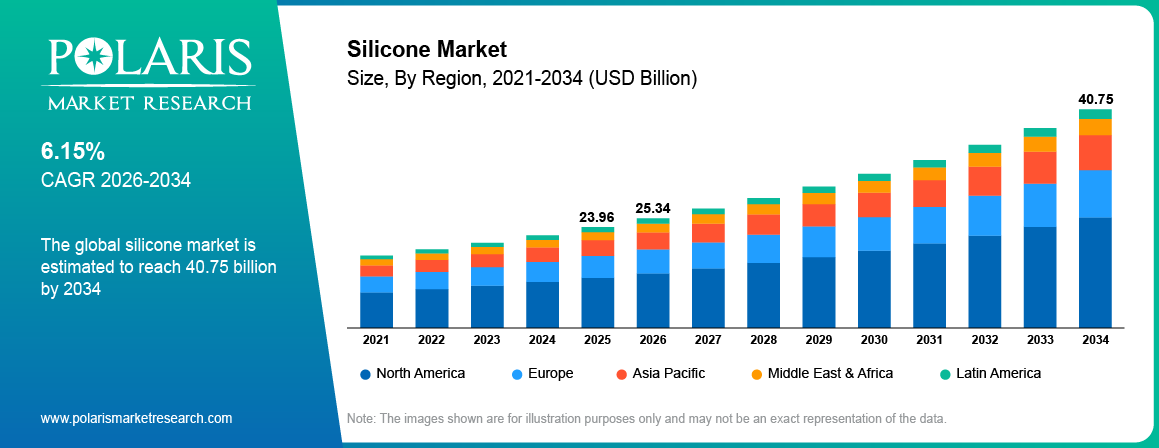
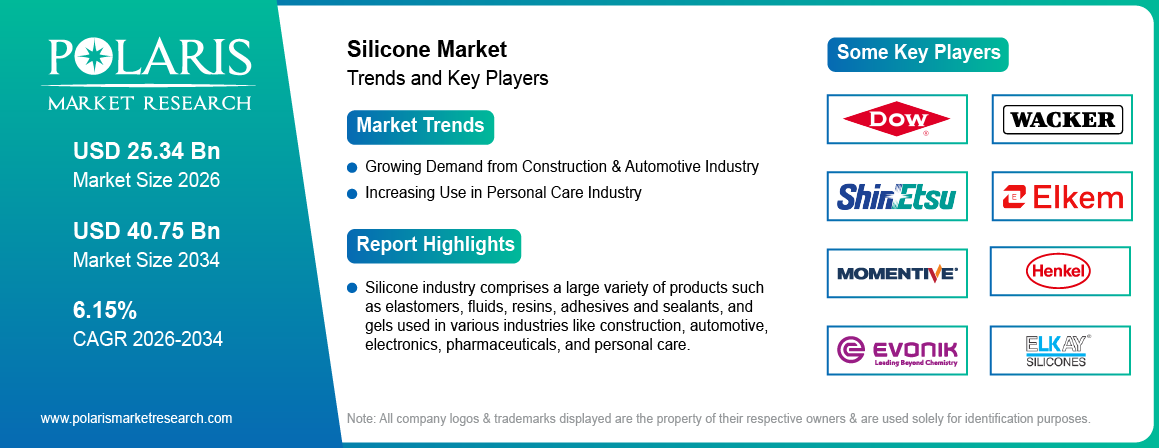
The silicone market was valued at USD 25.34 Billion in 2026, growing at a CAGR of 6.15% from 2026-2034. The growing demand from construction & automotive industry and increasing use in personal care industry is driving the growth of silicone market.
Market Statistics
Silicone Market Key Insights
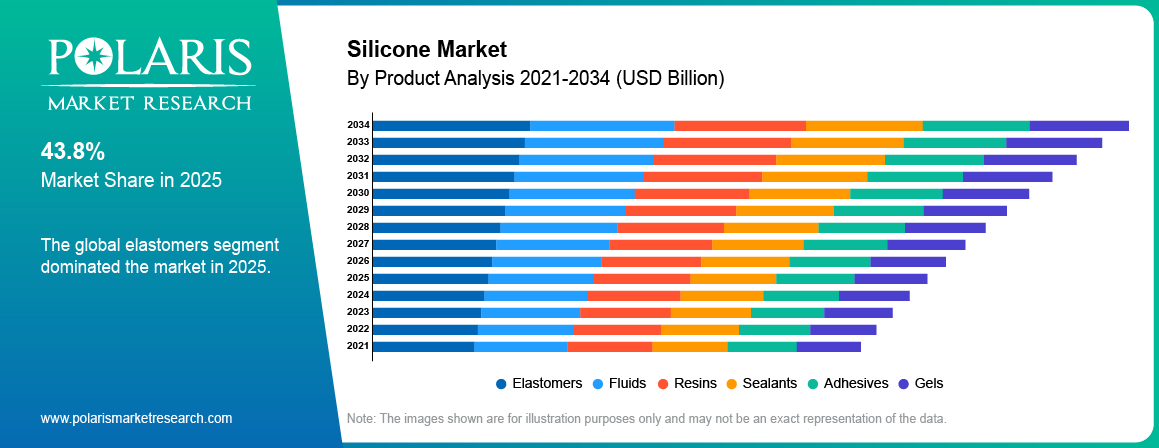
- Elastomers segment dominated in 2025 by 43.8% share due to high use in automotive gaskets and seals.
- Personal care segment to grow fastest at CAGR of 6.5%, driven by rising silicone use in hair, skin, and cosmetic products.
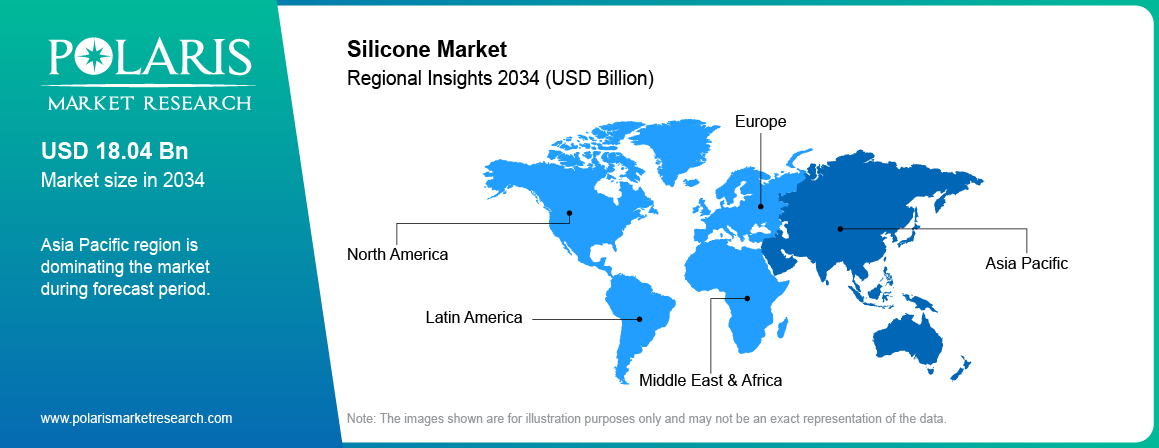
- Asia Pacific led the global market by holding 42.5% share in 2025 due to strong manufacturing infrastructure.
- China dominated Asia Pacific in 2025 by 78.3% of revenue due to robust production base and government investments.
- North America to record fastest growth rate of 6.9% CAGR, driven by demand from automotive and healthcare sectors.
Note: Figures and projections outlined in this report are the result of Polaris Market Research’s proprietary analytical processes, grounded in the latest available datasets and market observations.
Silicone Market Dynamics
- Growing demand from construction & automotive industry is driving the growth of silicone market.
- Increasing use in personal care industry is driving the growth of silicone market.
- Growing demand of silicone in the healthcare industry creates opportunity for silicone market in the coming years.
- High raw material and production costs restraints the growth of silicone industry.
Silicone industry comprises a large variety of products such as elastomers, fluids, resins, adhesives and sealants, and gels used in various industries like construction, automotive, electronics, pharmaceuticals, and personal care. Major applications include architectural sealants and coatings, automotive gaskets and lubricants, electrical insulation in electronics, and personal care formulations like skin and hair products. These solutions are targeted to manufacturers, industrial customers, healthcare professionals, and cosmetic companies, meeting new production and maintenance requirements.
In real-world uses, silicone products blend chemical stability with functional versatility to optimize product performance and durability. Silicone sealants give weather resistance and structural flexibility in building, automotive gasket and lubricants enhance vehicle efficiency and longevity, and silicone-based formulations in cosmetics provide smooth textures and lasting effects.
Source: Polaris Market Research Analysis
The market for silicone is growing robustly with increasing demand from application industries and advances in product formulation technologies. Urbanization and building construction, the drive toward electric cars, and the increasing emphasis on premium personal care products are major drivers of silicone industry growth. Additionally, advances in bio-based and ultra-high purity silicones are opening up new application opportunities in the healthcare, electronics, and green technology markets. For instance, in July of 2025, Stratasys and Shin-Etsu launched P3 Silicone 25A, a high-performance silicone material for additive manufacturing. It provides the strength and flexibility of conventional silicone to the precision of 3D printing applications. Leading companies are introducing advanced silicone solutions that combine sustainability, durability, and efficiency that is strengthening market adoption globally.
Silicone vs. Plastic vs. Rubber: Properties, Performance and Applications
Silicone, plastic, and rubber are widely used across electronics, automotive, healthcare, construction, and consumer goods industries. These materials offer versatility. They differ significantly in terms of thermal resistance, durability, flexibility, and chemical stability. Silicone is highly preferred for high-temperature and harsh-environment applications. However, plastics dominate cost-sensitive mass manufacturing. Rubber is increasingly used for elasticity and impact absorption applications.
| Parameter | Silicone | Plastic | Rubber |
| Thermal Resistance | Excellent; withstands extreme temperatures (-60°C to 230°C or higher) | Moderate; many plastics deform under high heat | Moderate; lower heat tolerance than silicone |
| Flexibility | Highly flexible and elastic across wide temperature ranges | Generally rigid to semi-flexible depending on polymer type | Very flexible with strong elasticity |
| Durability | Outstanding UV, ozone, and weather resistance with long lifespan | Good mechanical strength but may crack or degrade over time | Good abrasion resistance but vulnerable to aging and weathering |
| Chemical Stability | Highly resistant to oxidation, moisture, and many chemicals | Varies by polymer type; some plastics degrade with chemicals or UV exposure | Moderate chemical resistance; sensitive to oils, solvents, and ozone |
| Temperature Performance | Maintains properties in extreme hot and cold environments | Performance declines at elevated temperatures | Elasticity affected by temperature fluctuations |
| Weather Resistance | Excellent outdoor stability | Moderate; often requires stabilizers | Lower than silicone; prone to cracking and hardening |
| Mechanical Strength | Lower tensile strength than engineering plastics | High rigidity and structural strength | Strong elasticity and tear resistance |
| Common Applications | Medical devices, seals, cookware, electronics, automotive gaskets | Packaging, consumer goods, automotive parts, appliances | Tires, hoses, seals, industrial dampeners |
| Cost | Higher material and processing cost | Cost-effective for mass production | Moderate cost depending on rubber type |
Source: Polaris Market Research Analysis
Drivers & Opportunity
Growing Demand from Construction & Automotive Industry
The global silicone market is experiencing growth due to the growing demand from construction & automotive industry. In the building industry, silicones find extensive applications in sealants, adhesives, and coatings due to its weather resistance and durability. In the automotive market, silicones play a critical role in gaskets, lubricants, and electric insulation, facilitating the transition towards electric and hybrid cars. As per the international energy agency (IEA) global EV outlook report 2024, the worldwide EV sales rose to 17.3 million vehicles in 2024 from 6.5 million vehicles in 2021, i.e., an enormous 166% rise in the past 3 years, which depicts the rise in silicone market growth.
Increasing Use in Personal Care Industry
Silicone market is growing owing to increasing applications in the personal care sector. Silicones are utilized in skincare and cosmetic products owing to its smooth feel, durable outcome, and capacity to improve product performance. The Indian cosmetic market is expected to grow to USD 20 billion by 2025 with a growth rate of 25%, as per a report by Indian Brand Equity Foundation (IBEF), thus fueling the expansion of the silicone industry.
Eco-Friendly & High-Performance Silicone Trends
The silicone industry is increasingly emphasizing eco-friendly and high-performance innovations. This is driven by sustainability goals and demand for durable materials. Manufacturers are developing bio-based silicones with the used of renewable raw materials. It helps them reduce dependence on fossil-based resources.
| Trend Area | Short Information |
| Bio-Based Silicone Development | Manufacturers emphasize developing silicone materials using renewable and bio-based raw materials. It helps them reduce dependence on fossil fuels while maintaining performance characteristics. |
| Low-Emission Formulations | Waterborne and low-VOC silicone products are gaining adoption. This is due to stricter environmental regulations and growing demand for sustainable manufacturing solutions. |
| High Durability Benefits | Silicone offers long lifespan, excellent UV resistance, thermal stability, and weather resistance. The features reduce maintenance and replacement frequency. |
| Energy & Industrial Applications | High-performance silicones are increasingly used in electric vehicles, electronics, renewable energy systems, healthcare devices, and advanced industrial applications. |
| Sustainability Advantage | Longer product lifecycle and resistance to harsh environmental conditions. It helps minimize material waste and improve overall sustainability performance. |
Source: Polaris Market Research Analysis
Source: Polaris Market Research Analysis
Silicone Market Segment Analysis
Silicone Market, by Product Type
Based on product, the segmentation includes elastomers, fluids, resins, sealants, adhesives, and gels. The elastomers segment dominated in 2025 by 43.8% share due to extensive usage in automotive, construction, and industrial segments as a result of flexibility, toughness, and high-heat resistance. Increasing demand for high-performance molded parts, sealants, and gaskets also enhanced the use of elastomers in major industries worldwide.
The gels segment is expected to expand at the highest CAGR throughout the forecast period due to increasing application in personal care, healthcare, and electronics sectors where cushioning, sealing, and protective characteristics are paramount. Worldwide growth across all segments is driven by increasing demand for high-performance and specialty silicone products.
Silicone Market, by End-use Industry
Based on end user, the segmentation includes automotive, aerospace, healthcare, personal care, construction, electronics industries, and others. The automotive sector led the market by 24.1% share in 2025 due to the growing application of silicone in gaskets, seals, lubricants, and electrical parts. The production of electric vehicles and hybrid vehicles, along with the demand for long-lasting and high-performance materials, is enhancing the use of silicone products in the automotive industry.
The personal care segment to grow fastest at CAGR of 6.5% during the forecast period, due to the expanding use of silicone in hair care, skincare, and cosmetic formulations. Silicones improve texture, spread ability, and long-lasting effects in products, while growing consumer awareness and preference for premium personal care solutions are driving the market growth of personal care segment.
Source: Polaris Market Research Analysis
Silicone Market Regional Analysis
The Asia Pacific led the global market by holding 42.5% share in 2025, driven by rapid industrialization and expanding construction activities in the region. In developing countries such as China, Japan, and India, the increasing growth in the construction segment drives the demand for silicone industry. Moreover, growing automotive production in developing countries further strengthened market growth of silicone industry.
China Silicone Market
The China dominated Asia Pacific in 2025 by 78.3% of revenue due to robust demand from the automotive industries. In addition, continuous investments in specialty and high-performance silicone formulations are fueling innovation and positioning China as a prime location for production and consumption of silicone products. In May 2025, WACKER chemie AG spread its portfolio in silicone industry by setting up a new plant to expanded its silicone production facility in China.
Europe Silicone Market
The Europe silicone market accounted for a significant share in 2025 due to strong demand from construction, automotive and healthcare sectors. Escalating use of silicone sealants in green building and increasing applications in electric vehicle parts are fueling regional market growth. During September 2025, Elkem introduced a new solvent-free silicones produced wholly from recycled material, with the same performance level but a 70% reduced carbon footprint. Further, rising application of medical-grade silicones in medical applications and continued investment by leading manufacturers are underpinning market growth in Germany, France, and the UK.
North America Silicone Market
The North America to record fastest growth rate of 6.9% CAGR, driven by rising demand from healthcare and skincare industries. Increasing adoption of high-performance silicones in personal care products is fueling the growth of North America silicone market. For example, Dow launched low-carbon silicone elastomer blends under the Decarbia platform in June 2024 to enable sustainable innovation in skin, hair, and color cosmetics. The new formulations ensure reduced carbon footprint with high performance and sensory appeal in beauty applications.
U.S. Silicone Market
The U.S. is the fastest-growing country in the North America silicone market. The growth is driven by strong demand from the healthcare, and personal care sectors. The rise in the number of aging populations in the country driving the growth of skincare and personal care segment that further drives the growth of silicone market. Moreover, the presence of major manufacturers and advanced R&D facilities further accelerate the silicone market in the country.
Source: Polaris Market Research Analysis
Silicone Market Competitive Landscape
The silicone market is moderately competitive, with several global and regional players. While a few major companies hold significant market shares, some smaller firms contribute to the diversity and competitiveness of the market.
Major companies operating in the silicone market include Dow Inc., Wacker Chemie AG, Shin-Etsu Chemical Co., Ltd., Elkem ASA, Momentive Performance Materials Inc., Henkel AG & Co. KGaA, Evonik Industries AG, KCC Corporation, Elkay Chemicals Pvt. Ltd., Supreme Silicones, Silchem Inc., and Armols Polymers Pvt. Ltd.
Leading Silicone Manufacturers and Product Portfolios
- Dow Inc.
- Wacker Chemie AG
- Shin-Etsu Chemical Co., Ltd.
- Elkem ASA
- Momentive Performance Materials Inc.
- Henkel AG & Co. KGaA
- Evonik Industries AG
- KCC Corporation
- Elkay Chemicals Pvt. Ltd.
- Supreme Silicone
- Silchem Inc.
- Armols Polymers Pvt. Ltd.
Silicone Market Recent Developments
- February 2026: DuPont launched Liveo C6-8XX Liquid Silicone Rubber (LSR). It is a new USP Class VI (C6) series of medical-grade, two-part silicone elastomers. The product is engineered to fulfil the stringent requirements of medical device applications. (Source: dupont.com)
- June 2025: WACKER launched POWERSIL 1900 A/B, a two-component high-consistency rubber designed to improve spiral-extrusion production of composite insulators. (Source:wacker.com )
- May 2025: Shin-Etsu Chemical introduced KF-6070W water-soluble silicone wax and KSG-16-SF/KSG-19-PF elastomer gels to enhance light diffusion in personal-care formulations. (Source: shinetsu.co.jp)
Silicone Market Segmentation and Forecast
By Product (Revenue, USD Billion, 2021–2034)
- Elastomers
- Fluids
- Resins
- Sealants
- Adhesives
- Gels
By End User (Revenue, USD Billion, 2021–2034)
- Automotive industry
- Aerospace industry
- Healthcare industry
- Personal care industry
- Construction industry
- Electronics industry
- Others
By Region (Revenue, USD Billion, 2021–2034)
- North America
- The U.S.
- Canada
- Europe
- Germany
- France
- UK
- Italy
- Spain
- Netherland
- Russia
- Rest of Europe
- Asia Pacific
- China
- India
- Japan
- Malaysia
- South Korea
- Indonesia
- Australia
- Rest of Asia Pacific
- Latin America
- Mexico
- Brazil
- Argentina
- Rest of Latin America
- Latin America
- Saudi Arabia
- UAE
- South Africa
- Israel
- Rest of South Africa
Silicone Market Report Scope and Methodology
| Report Attributes | Details |
| Market Size in 2025 | USD 23.96 Billion |
| Market Size in 2026 | USD 25.34 Billion |
| Revenue Forecast by 2034 | USD 40.75 Billion |
| CAGR | 6.15% from 2026-2034 |
| Base Year | 2025 |
| Historical Data | 2021-2024 |
| Forecast Period | 2026-2034 |
| Quantitative Units | Revenue in USD Billion and CAGR from 2026-2034 |
| Report Coverage | Revenue Forecast, Competitive Landscape, Growth Factors and Industry Trends |
| Segments Covered |
|
| Regional Scope |
|
| Competitive Landscape |
|
| Report Application |
|
| Customization | Report customization as per your requirements with respect to countries, regions and segmentation. |
Source: Polaris Market Research Analysis
Silicone Market Frequently Asked Questions
The global market size was valued at USD 23.96 billion in 2025 and is projected to grow to USD 40.75 billion by 2034.
The global market is projected to register a CAGR of 6.15% during the forecast period.
Asia Pacific led the global market by holding 42.5% share in 2025.
A few of the key players in the market are Dow Inc., Wacker Chemie AG, Shin-Etsu Chemical Co., Ltd., Elkem ASA, Momentive Performance Materials Inc., Henkel AG & Co. KGaA, Evonik Industries AG, KCC Corporation, Elkay Chemicals Pvt. Ltd., Supreme Silicones, Silchem Inc., and Armols Polymers Pvt. Ltd.
Elastomers segment dominated in 2025 by 43.8% share.
Personal care segment to grow fastest at CAGR of 6.5%, owing to the expanding use of silicone in hair care, skincare, and cosmetic formulations.
Download Sample Report of silicone market
Please fill out the form to request a customized copy of the research report.


