
Small Drones Market Size, Share, Trends & Forecast, 2026–2034
REPORT DETAILS
Small Drone Market Summary
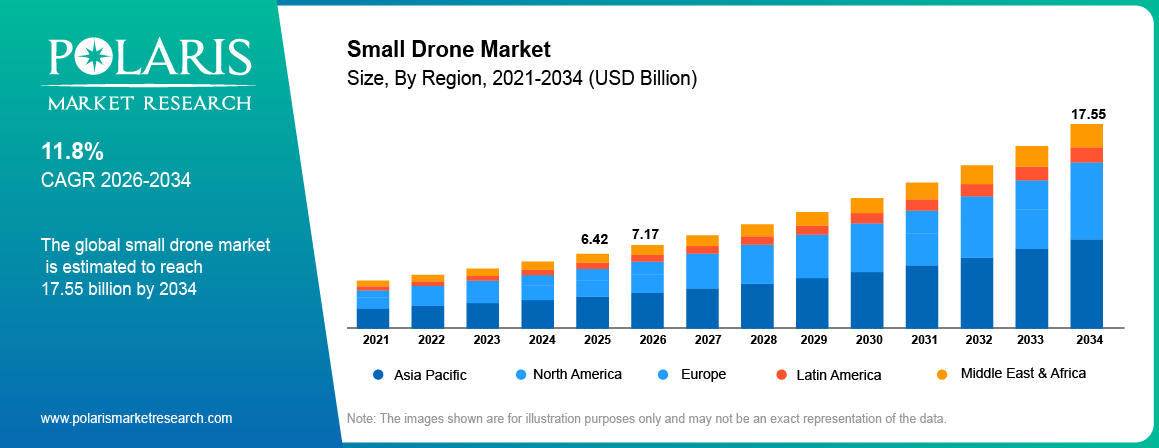
The global small drone market was valued at USD 6.42 billion in 2025 and is projected to reach USD 17.55 billion by 2034, growing at a CAGR of 11.8% from 2026 to 2034. The growing demand for the small drone is expected to be driven by the increasing demand for improved surveillance in commercial & defense sectors and rising government investment in small drone technology advancement.
Market Statistics
Small Drone Market Key Takeaways
-
Asia Pacific dominated with the largest share of 31.59% in 2025, owing to the growing adoption in the commercial and military sectors.
-
The North American small drone market is expected to witness a CAGR of 12.6% during the forecast period, driven by Part 107, Remote ID, Part 108, Blue UAS, and domestic manufacturing.
-
The Europe small drone market is expected to record a CAGR of 11.2% during the forecast period, propelled by the C-class regime and defense procurement.
-
The civil and commercial segment, by platform, led the small drone market share of 63.5% in 2025. The dominance is attributed to its low maintenance cost, high mobility, and easy deployment.
-
The hybrid segment is expected to register a CAGR of 13.4% during the forecast period. The increasing need to combine the advantages of fixed-wing and rotary-wing aircraft drives the segment growth.
Note: Figures and projections outlined in this report are the result of Polaris Market Research’s proprietary analytical processes, grounded in the latest available datasets and market observations.
What is a small drones?
A small drones, also known as a mini-copter or micro-copter (Micro drones), is a scaled-down, unmanned aerial vehicle (UAV). The drones are usually smaller, simpler to operate, and cheaper to build and maintain than their larger commercial and military counterparts. Small drones carry a wide range of applications, from photography and cinematography to agriculture and surveying. Such devices are typically lightweight unmanned aircraft with an optional ground-based control system and can either be remote-controlled or partially automated.
How Small Drone Works?
A small drone works by using motors and propellers to create lift and move through the air. A battery provides power to the motors and other parts. The drone has sensors that help it maintain balance, direction, and height. A controller or mobile app sends commands to the drone. The flight control system processes these commands and adjusts the motors. Some small drones also use cameras and GPS. Other drone sensors support navigation, photography, and other tasks.
Small drones are replacing military aircraft, as they are better at reconnaissance and are controlled automatically by computers or remotely by people, driving their importance in the defense industry. In addition, this unmanned aerial vehicle (UAV) operates for a longer time, up to 30 hours, and doesn't require refueling, increasing demand in the military & defense sector.
Moreover, they have wide applications in commercial sectors such as medical and product delivery, agriculture monitoring, wildlife, atmospheric research, and aerial remote sensing, which are expected to impact the market positively.
Moreover, Small medical drones were used for many applications during the COVID-19 pandemic. owing to their compact nature and high endurance, they could carry a heavy load and cover significant areas. In addition, vaccines, blood, and PPE kit delivery were feasible in low- and middle-income countries, and technical inspection with contactless performance was also made possible, alleviating the market.
Small drones have a wide application in the military and defense sector and are a sophisticated technology that runs on various algorithms and programs. Thus, this technology is vulnerable to hackers, where private information can be leaked and retrieved, and the drone's control system could be hacked, which is one of the major factors restraining the small drone market growth.
Impact of AI on Market
- AI enables drones to fly and perform missions with less human control.
- The technology helps drones identify people, vehicles, buildings, and other objects.
- It also allows drones to process information and make decisions in real time.
- Integration of AI improves flight safety by detecting obstacles and supporting collision avoidance.
- It helps analyze images and videos collected during inspection, mapping, and surveillance.
- AI reduces operator workload and can improve overall mission efficiency.
Industry Dynamics
Driver: Military Procurement and Public Safety
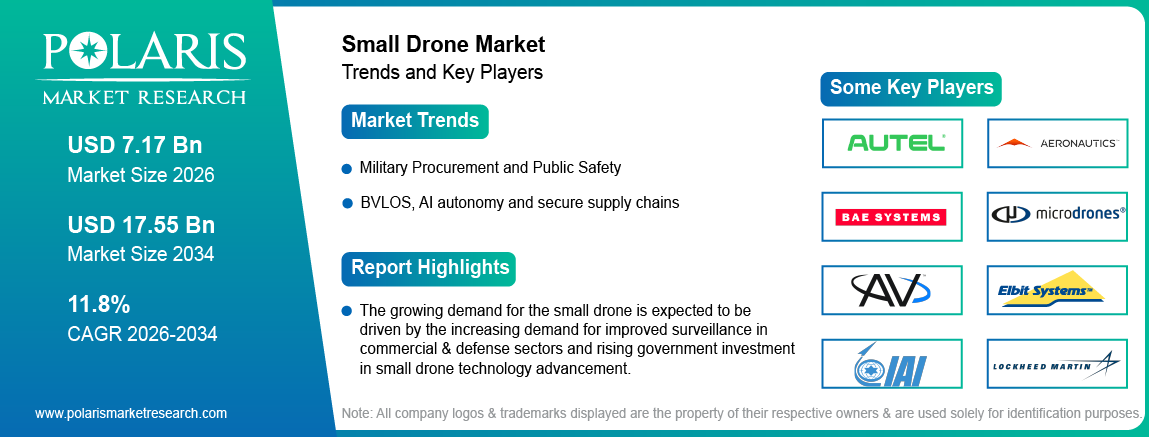
Military agencies are witnessing a rise in the procurement of small drones for surveillance, reconnaissance, and monitoring purposes. Additionally, public safety agencies are adopting the product for search and rescue operations, disaster management and emergency response, and surveillance and monitoring. Small drones are a cost-effective solution compared to other aerial vehicles. This factor fuels the growth of the market.
Driver: BVLOS, AI autonomy and secure supply chains
The ability to operate beyond visual line of sight (BVLOS) has improved the applicability of small drones in delivery, inspection, and monitoring. Similarly, the development of artificial intelligence autonomy has allowed the product to perform a multitude of tasks independently. Manufacturers of small drones are working towards establishing secure supply chains in order to minimize the risk of shortage of essential components, thereby driving the market growth.
Restraint: Regulatory fragmentation and operator shortage
The regulatory fragmentation is restraining the industry growth as regulations governing small drones vary across geographical regions. As a result, manufacturers and operators need to invest significantly in order to meet the requirements imposed by various regulatory bodies. Additionally, there is a shortage of trained drone operators. In the absence of a sufficient talent pool, organizations are unable to scale operations, at least in the short term, due to the inaccessibility of a standardized training curriculum.
Restraint: Cybersecurity, weather, and GNSS jamming
Small drones are susceptible to a range of cybersecurity threats, which, in turn, impacts their ability to operate safely and securely. Similarly, adverse weather conditions such as high winds, heavy rain, and extreme heat impact flight safety and must be avoided during flight. GNSS jamming can disrupt satellite-based navigation and affect accurate positioning. Thereby restraining the small drone market growth
Opportunity: Docked operations, drone-as-a-service, and software revenue
Docked operations enable small drones to take off, carry out operations, return to the dock, and recharge with minimal human intervention. Docking stations are required to carry out such operations. Docked operations allow uninterrupted surveillance while reducing the cost of operations. Furthermore, the concept of drone-as-a-service minimizes the capital expenditure incurred by a customer. As such, the aspects allow manufacturers and operators of small drones to generate recurrent revenues from customers in the form of subscriptions. Furthermore, drone software revenues from flight operations, data analytics and processing, automation and control, mapping and monitoring solutions is expected to further fuel the market expansion
Technology Trends: Drone as First Responder (DFR)
DFR is becoming an essential trend as police and other authorities are adopting drones that help them respond to emergency calls faster. Due to DFR, the drone can reach the scene of an accident first and observe and collect evidence. Thus, the responder reduces the time between the call and the arrival at the scene, shortening the overall response time. Small drone market trends towards increased use in public safety and emergency management will grow due to DFR adoption.
Technology Trends: Edge AI
Due to the ability of Edge AI to process information on a chip rather than in the cloud, this technology can be applied to make small devices, including drones. The processing power, which Edge AI brings to drones, allows them to carry out several functions independently, including object detection. As a result, one can apply Edge AI in security, inspection, and defense to make faster decisions and operate independently.
Technology Trends: FPV Mass Production
There is a rise in demand for FPV drones in the defense and racing sectors, as well as in training and entertainment purposes. These technologies can enable mass production and cheaper products with an increase in investment in production. With better components, simplified assembly, and a robust supply chain, FPV will be produced at a higher rate, thereby driving the market growth.
Technology Trends: Remote Operations
Remote operations are enabled by emerging communication technologies that allow people to operate drones from a distance. This trend is growing as operators can avoid being at the same location with the drone. It has enabled monitoring and control of drones from a distance with remote operations, and the application of this technology is growing in inspection and surveillance. Connectivity innovations and remote operations is expected to boost commercial drone operations.
Military and Defense: Battlefield Use Cases
| Use case | What small drones do | Evidence to cite |
| Tactical ISR | Squad and platoon reconnaissance, target observation | U.S. Army Skydio X10D order in Mar 2026 (per Skydio); NATO NSPA ANAFI UKR call-offs from Mar 2026 (per Parrot) |
| FPV strike | Low-cost first-person-view drones used as expendable systems | Ukraine's National Security and Defense Council cites capacity above 8 million FPV drones a year (2026). Russian output plans (7.3 million FPV, per Ukrainian intelligence via Bloomberg) are contested claims. |
| Logistics and casualty evacuation | Small-payload resupply and evacuation support | Ukraine's commander-in-chief reported drones handle over 60% of battlefield logistics tasks (Kyiv Post, May 2026). |
| Loiter, then strike | AKSI Aerospace unveiled its “Agni Kalash” loitering munition concept at the PanIIT Andhra Pradesh Summit 2026. | |
| Counter-UAS and electronic-warfare resilience | Detect and defeat hostile drones; keep flying without GNSS | ANAFI UKR marketed for contested electromagnetic environments. |
| Border and maritime patrol | Persistent surveillance of borders and coastlines | - |
Source: Polaris Market Research Analysis
Commercial and Civil Use Cases
Inspection
Small commercial UAVs are increasingly used to inspect buildings, bridges, power lines, pipelines, and other infrastructure. They can capture images and videos from difficult or unsafe locations. This reduces the need for workers to enter risky areas. Drone-based inspection can also save time and lower costs. Regular drone inspections help companies identify damage, wear, and maintenance needs more efficiently.
Mapping
Small drones are widely used for mapping land, roads, construction sites, and other areas. They capture aerial images that can be used to create detailed maps and site information. Drone mapping is faster and can cover large areas with fewer workers. It supports land planning, surveying, environmental monitoring, and infrastructure development while reducing time and fieldwork costs.
Construction
Construction companies use small drones to monitor project progress, inspect sites, measure areas, and track materials. Regular aerial images help managers compare actual progress with project plans. Drones can also access difficult or unsafe locations without putting workers at risk. Their use can improve site visibility, reduce manual work, and support better planning and project management throughout the construction process.
Mining
Small drones are used in mining for site mapping, stockpile measurement, inspection, and monitoring. They can quickly collect aerial data from large and difficult areas. This reduces the need for workers to enter hazardous locations. Drone data helps mining companies track changes, measure materials, and monitor operations. Their use can improve safety, reduce surveying time, and support more efficient mine management.
Regulation and Policy Landscape
United States: Part 107, Remote ID, Proposed Part 108 and EO 14307
The U.S. regulates small drones under FAA Part 107 (pilot certification, VLOS, daylight-only, 55 lb. limit), while part 89 requires Remote ID broadcast of most drones in U.S. airspace. Proposed Part 108 (created by EO 14307 in June 2025) will create a framework for routine BVLOS operations using operating permits or certificates instead of case-by-case waivers. Simultaneously, EO 14307 promotes UAS, including eVTOL, adoption by advancing operations and enforcement around critical infrastructure.
Europe: C0–C4 Classes and A1–A3 Subcategories
The EU’s “open” category includes drones of varying risk levels that may be flown over people (A1, but not assemblies), near people (A2) or distant from people (A3). C0-C4 class drones (C0<250 g, C1<900g, C2<4kg, C3/C4<25kg) must display a CE mark indicating their category and permitted operations. From 2024, C1–C3 and specific-category drones under 120 m must broadcast a Remote ID while A3 operations must keep 150 m away from residential/commercial/industrial areas with no uninvolved people on the ground.
Airspace Integration: UTM and Detect-and-Avoid
In the U.S., UTM is a collaborative ecosystem that provides services to manage low-altitude drone traffic. It is formed by regulations and service providers that facilitate strategic de-confliction, with operators remaining responsible for avoiding crewed aircraft and other drones. UTM itself is not a DAA, but some services may contribute to surveillance, conflict detection and resolution, and guidance for drones to remain compliant with airspace users. The FAA is working to integrate UTM into the broader aviation system while also promoting safe, scalable BVLOS operations under the new Part 108.
Blue UAS and Secure Government Procurement
The U.S. “Blue UAS” is a list of DoD-certified drones considered secure for sensitive operations. It helps federal agencies acquire and operate drones that are compliant with the NDAA sections 848 (FY20), 817 (FY23) and the 2024 American Security Drone Act. This list addresses potential supply chain and cybersecurity concerns by limiting the government’s purchases to machines on the list. Blue UAS updates periodically to reflect the DoD’s current requirements.
Privacy, Cybersecurity, and Insurance
Although privacy regulations are generally left to individual states, federal rules are starting to restrict drone flights over critical infrastructure and increase enforcement against reckless and invasive operations. Cybersecurity requirements are being imposed for government contracting (through Blue UAS) and Remote ID compliance and may also impact data transmission and storage. Insurance is often required by clients, municipalities and for BVLOS/Part 108 operations, and may be necessary for liability and cyber security coverage.
Small Drone Market Segmentation Analysis
By Platform Analysis
The civil and commercial segment dominated the small drone market size of 63.5% in 2025 owing to its low maintenance cost, high mobility, and easy deployment. In addition, the growing adoption of small drones for various commercial projects, such as in agriculture, medical, law & enforcement, wildlife monitoring, aerial photography, construction, and transportation purposes, is expected to drive the market's growth. Moreover, the growing demand for water and power utility infrastructure is also creating a lucrative opportunity that is expected to boost market growth.
The Defense & Government segment is expected to grow at a CAGR of 12.4% during the forecast period due to growing need for surveillance, reconnaissance, border management, public safety, and emergency response. Defense agencies use the drones to obtain real-time information while also reducing risk to their personnel. Government agencies also use small drones for disaster response and law enforcement. Moreover, the rising defense market and increased defense spending will also drive demand for small drones within the military sector. Furthermore, the need for cost-effective and easily transportable systems is also promoting the adoption of small drones in defense and government sectors.
By Type Analysis: Fixed-wing vs Multirotor drones
The fixed-wing segment is expected to witness growth of CAGR 12.1% during the forecast period owing to its high endurance, mobility, and efficiency. In addition, this drone type works majorly on vertical take-off and landing (VTOL), which makes it energy-efficient, flexible, and highly maneuverable, which is the primary reason for driving the market growth. Moreover, fixed-wing drones can cover large distances, long-range, and hover for longer periods, which is likely to complement market growth.
Rotary wing segment dominated the small drone market share with 58.6% driven by the need for flexible flight and easy launch/recovery capabilities, the Rotary Wing segment is segmented into single rotor and multi-rotor aircraft. The former uses one rotor for lift, while the latter uses two or more rotors for lift and maneuverability. Bicopters have two rotors, tricopters have three rotors, quadcopters have four rotors, hexacopters have six rotors, and octocopters have eight rotors. The segment is growing due to the ability of rotor-wing aircraft to take off and land vertically and also hover over a point making it ideal for inspections, surveying, and other applications that require operations in confined spaces.
Hybrid segment is expected to grow at a CAGR of 13.4% during the small drone market forecast 2034 driven by the need to combine the advantages of fixed-wing and rotary-wing aircraft, the Hybrid segment offers VTOL capabilities to fixed-wing aircraft, giving them the ability to take off and land vertically. The segment is witnessing growing demand for its ability to combine the maneuverability of rotary-wing aircraft and the longer-range capabilities of fixed-wing aircraft. Advancements in drone technologies are also projected to augment the segment growth in the forecast period.
Fixed-wing (CTOL) vs fixed-wing VTOL / hybrid vs multirotor
| Attribute | Multirotor | Fixed-wing CTOL | Fixed-wing VTOL / hybrid |
| Hovering | Yes | No; needs forward airspeed | Yes in vertical phases, then transitions to cruise |
| Launch and recovery | Vertical; small footprint | Runway, hand launch, catapult, net or parachute recovery | Vertical; no runway |
| Endurance | Shortest of the three; minutes to about an hour on battery (Indago 4 up to 50 min; ANAFI UKR up to 70 min | Longest for its size; hours on tactical platforms | Between the two |
| Range and coverage | Short; limited area per sortie | Wide area | Wide area without launch space |
| Payload | Small to moderate, mission-specific | Moderate; aerodynamic efficiency helps | Moderate; transition hardware takes payload share. |
| Mapping efficiency | Good for small sites | Best per hectare on large areas and corridors | Strong on large areas from confined sites |
| Inspection suitability | Best: close-up, vertical structures | Poor for close-in work | Suits linear infrastructure |
| Operating complexity | Low | Higher: launch and recovery site | Medium to high: transition failure modes |
| Named examples | Mavic 3 Enterprise, Matrice 4, Skydio X10, ANAFI | Raven B, Puma 3 AE | Puma VTOL, Aerosonde Mk. 4.8 Hybrid Quad, Wander B-VTOL |
Source: Polaris Market Research Analysis
By Application Analysis
The military segment dominate the market in 2025 with a 54.8% share owing to the growing global tension among countries and increasing R&D investment to strengthen military forces. The heavy payload capacity of small drones has increased the demand to resupply on the battlefield. Moreover, AI drone navigation is in huge demand as they provide proper guidance and are helpful in target identification from higher altitudes, which is expected to drive the growth of military small drones over the forecast period.
The commercial segment is expected to witness growth of CAGR of 12.7% during the forecast period driven by the growing need for inspection, surveying, construction, mining, precision agriculture, photography, and other commercial applications. The commercial segment is witnessing significant adoption of small drones. These drones are being used in a variety of applications, including aerial surveys and inspections, which provide valuable insight into various processes. The use of drones in complex and hard-to-reach environments can also reduce the overall operational cost and increase efficiency. Furthermore, the reduction in cost and enhanced capabilities of small drones will also drive their adoption in a variety of commercial applications.
The government and law segment is expected to witness a CAGR of 11.5% during the forecast period driven by the growing need for public safety and homeland security. The government and law segment is witnessing significant adoption of small drones. The drones are being used across a variety of applications, including public safety, law enforcement, emergency response, border security, and disaster management. Small drones provide real-time information from the air, including those that were previously inaccessible, aiding the government agencies in taking timely decisions. The need for better public safety and enhanced emergency response is driving demand for small drones across government agencies.
Military vs commercial small drone demand
| Attribute | Defense and military | Public safety and government (civil) | Commercial and consumer |
| Primary buyers | Armed forces, defense ministries, NATO agencies | Police, fire, emergency services, and border and coast agencies | Utilities, construction, mining, agriculture, media, consumers |
| Typical missions | Tactical ISR, squad reconnaissance, resupply, low-cost strike | Incident assessment, search and rescue, DFR, traffic and disaster response | Inspection, mapping, photogrammetry, crop scouting, content creation |
| Example platforms | Puma 3 AE, Skydio X10D, ANAFI UKR, Black Widow | Skydio X10, Matrice 4, docked DFR systems | Mavic 3 Enterprise, Mini 3 Pro, LiDAR drones |
| Regulatory frame | Military rules; export controls; U.S. buyers apply NDAA and Blue UAS | Part 107 or public-aircraft rules; BVLOS waivers; Remote ID | Part 107 and Remote ID (U.S.); EU C-class and Open category |
| Security and procurement | Trusted components, encrypted links, secure supply chain | Growing NDAA and data-residency requirements | Cost, reliability, software ecosystem |
| Autonomy needs | GNSS-denied navigation, contested links | Remote and docked operation, obstacle avoidance | Automated mapping missions |
| Revenue model | Large framework orders; sustainment | Fleet plus software subscription | Unit sales; software; drone-as-a-service |
Source: Polaris Market Research Analysis
By Mode of Operation Analysis
The fully autonomous segment is expected to witness the fastest growth of CAGR 14.2% over the forecast period owing to its higher power capacity and flexibility. In addition, this drone can operate at higher altitudes with less human intervention and has improved propulsion, higher endurance, and large cargo capacity, which is a significant factor in fueling the market growth. Moreover, due to its cost-effectiveness, it is used in various applications ranging from medical delivery to defense operations which is expected to have a positive impact on the market growth over the forecast period.
Remotely piloted segment is expected to witness growth of CAGR 10.9% driven by the need for direct human control of the drone during its operation, the Remotely Piloted segment offers maximum control to the operator in terms of direction, height, and camera controls. The mode of operation is majorly used in applications that require human input during the operation. Moreover, the growing adoption of drones across military, government, and commercial applications is also projected to drive the segment growth. The mode of operation has an established technology and simple operating model that also contribute to its adoption.
Optionally Piloted dominated the small drone industry with 46.3% share driven by the need for enhanced flexibility during drone operations, the Optionally Piloted segment offers greater flexibility to the operators. The system can be optionally piloted or flown without a pilot. As the name suggests, the drones in this segment can be optionally piloted, giving the operators an option to choose between an optionally piloted flight and a fully autonomous flight. The technology is ideal for applications that require both human input and automated operations
| Level | Label | What the system does | Human role | Examples | Legacy label |
| 0 | Manual | Pilot controls all axes | In the loop | Hobby and FPV flying | Remotely piloted |
| 1 | Assisted flight | Stabilization, hold position, return-to-home | In the loop | Consumer camera drones | Remotely piloted |
| 2 | Waypoint automation | Flies pre-planned routes and mapping grids | Monitors | Photogrammetry missions | Semi-autonomous |
| 3 | Onboard avoidance | Senses obstacles, tracks subjects, re-routes | Supervises | Skydio-class enterprise drones | Semi-autonomous |
| 4 | Supervised autonomy | Mission-level tasks, automated launch, landing and charging | On the loop (remote) | Docked DFR and inspection systems | Fully autonomous |
| 5 | Higher autonomy | Onboard decision support in degraded or GNSS-denied conditions; fleet orchestration | Authorizes and oversees | Contested-environment ISR | Fully autonomous |
Source: Polaris Market Research Analysis
By Power Source Analysis
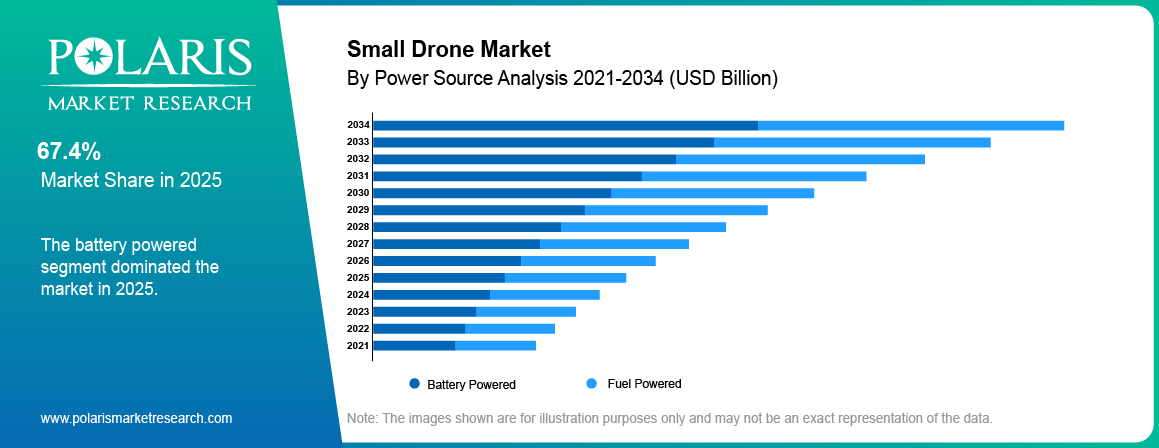
Battery powered segment dominated with the largest share of 67.4% over the forecast period owing to the feasibility with which it is operated and is less noisy compared to turbo engine drones. In addition, lithium-ion batteries are in high demand due to their flexible design, high-energy, and high-power density, which is expected to show evolution in small drones and drive market growth. Moreover, the adoption of the battery-powered source is increasing because of the long-life cycle and ability to operate in extreme conditions with a single-power battery which positively impacts the revenue growth over the forecast period.
Fuel Powered segment is expected to grow at a CAGR of 9.8% during the forecast period driven by the need for extended range and endurance, the Fuel Powered segment offers greater flexibility to the operators. Unlike battery-powered drones, fuel-powered drones provide extended flight time, which makes them ideal for applications such as defense and others. The demand for longer-range operations is also spurring the growth of this segment. The need for longer endurance in applications that require drones to cover a larger area.
| Category | Sub-type | Strengths | Limits | Typical use |
| Battery-electric | Lithium-ion / lithium-polymer | Quiet, low cost, simple operation, swappable or dockable | Endurance, cold-weather performance, thermal management | Most multirotors |
| Battery-electric | NiMH / NiCd | Legacy | Low energy density; include only if revenue is material | Legacy and toys |
| Fuel-powered | Piston, turbine, pulsejet | Longer flights, heavier payload | Noise, complexity, refueling | Larger tactical fixed-wing |
| Hydrogen fuel cell | Separate category, not a battery type | Longer endurance than lithium-ion | Cost, refueling infrastructure | Niche endurance missions |
| Hybrid-electric | Range-extender architectures | Range without full fuel-engine noise | Complexity, weight | Emerging long-range |
Source: Polaris Market Research Analysis
Regional Analysis
Asia Pacific Small Drone Market: Largest Regional Share
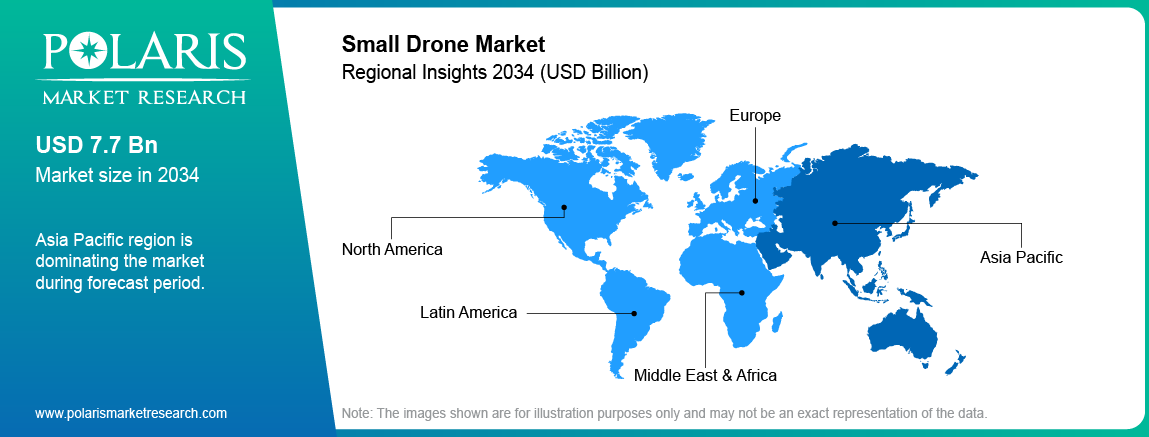
The small drone market in Asia Pacific dominated with the largest share of 31.59% in 2025 owing to the growing adoption in the commercial and military sectors. In addition, several government initiatives for encouraging investments in drone technology and a rise in defense expenditure due to the increasing incidence of terrorism in regions like China, India, and Japan are expected to drive demand over the forecast period. Moreover, the small drone has created a lucrative opportunity. Many manufacturers are increasing their focus on developing drones that can operate in different temperatures and environmental conditions with long-life batteries, which will contribute to the revenue growth of the market.
North America Small Drone Market: Part 107, Remote ID, Part 108 and Blue UAS
The North American small drone market is expected to witness growth of CAGR 12.6% during the forecast period driven by Part 107, Remote ID, Part 108, Blue UAS, and domestic manufacturing. Part 107 supports commercial drone operations, while Remote ID improves drone identification and monitoring. Part 108 is supporting the development of rules for expanded drone operations. Blue UAS programs are increasing demand for trusted drone systems for government and defense use. Growing domestic manufacturing is also supporting local production, supply security, and government procurement.
Europe Small Drone Market Outlook: 11.2% CAGR Through 2034
The Europe small drone market is expected to witness a CAGR of 11.2% during the forecast period, driven by the C-class regime and defense procurement. The C-class regime provides a common framework for placing drones into different operational categories and supports wider market adoption. Clearer product requirements can help manufacturers develop drones for specific operating environments. Defense procurement is also increasing demand for small drones used in surveillance, reconnaissance, and security operations. Growing European focus on defense capabilities and local drone production is further supporting regional market development.
Middle East & Africa Small Drone Market: Border Security and Defense Spending
The Middle East and Africa small drone market is expected to witness a CAGR of 10.6% during the forecast period driven by defense spending, border security, infrastructure development, and surveillance needs. Middle Eastern countries are increasing procurement of military drone and drones for security applications. Drones are also being used to monitor large and remote areas across energy, construction, mining, and infrastructure projects. The need for cost-effective aerial monitoring is supporting commercial adoption. Government investment in defense technology, smart infrastructure, and local drone capabilities is further driving demand across the region.
Latin America Small Drone Market: 10.9% CAGR Growth Outlook
The Latin American small drone market is expected to witness a CAGR of 10.9% during the forecast period driven by public safety, agriculture, mining, infrastructure monitoring, and environmental surveillance. Governments are adopting drones for security, emergency response, and monitoring large areas. Mining and agriculture are also increasing drone use for mapping, inspection, and operational monitoring. Growing infrastructure development is creating additional demand for aerial data and inspection. Increasing availability of drone services and improvements in drone technology are helping businesses and government agencies adopt small drones across the region.
Competitive Insight
The small UAV market is highly competitive and fragmented, with different companies focusing on defense, government, commercial, and consumer applications. Defense-focused companies compete through autonomy, secure communication, surveillance, payload integration, and manufacturing capacity. Commercial players compete through price, camera quality, ease of use, software, and autonomous features. Companies are also expanding through new product launches, partnerships, acquisitions, and local manufacturing.
List of Key Players
- Aeronautics Group
- AeroVironment, Inc.
- Autel Intelligent Technology Corp., Ltd.
- BAE Systems Plc
- Elbit Systems Ltd.
- Israel Aerospace Industries Ltd.
- Lockheed Martin Corporation
- Microdrones GmbH
- Northrop Grumman Corporation
- Parrot Drones SAS
- RTX Corporation
- Saab AB
- Shenzhen Hubsan Technology Co. Ltd.
- Skydio, Inc.
- SZ DJI Technology Co., Ltd.
- Teledyne Technologies Incorporated (Teledyne FLIR)
- Textron Inc.
- Thales Group
- Turkish Aerospace Industries Inc.
Small drones platforms
| Company | Market role | Airframe | Platforms to name |
| SZ DJI Technology Co., Ltd. | Consumer and enterprise OEM | Multirotor | Mavic 3 Enterprise, Matrice 4 series, Mini 3 Pro (2022) |
| Autel Robotics | Consumer and enterprise OEM | Multirotor | EVO Nano (EU C0, Dec 2024) |
| Skydio, Inc. | Enterprise, public safety, defense | Multirotor | X10, X10D, DFR Command software |
| Parrot Drones SAS | Enterprise and defense micro-sUAS | Multirotor | ANAFI UKR (current); ANAFI USA and ANAFI Ai (legacy) |
| AeroVironment, Inc. | Tactical defense sUAS | Fixed-wing, VTOL | Puma LE, Puma 3 AE, Puma VTOL, P550, Raven B, VAPOR 55 MX |
| Red Cat Holdings / Teal Drones | Tactical and FPV | Multirotor | Black Widow, Teal 2, FANG (FPV) |
| Teledyne FLIR | Payloads and platforms | Payload | Thermal camera for Black Widow (Oct 2024) |
| Israel Aerospace Industries Ltd. | Tactical defense | Fixed-wing, VTOL | BirdEye 650D, Mini Panther, Wander B-VTOL |
| Lockheed Martin Corporation | Defense prime | Multirotor | Indago 4 (up to 50 min) |
| Textron Inc. (Textron Systems) | Defense | Hybrid VTOL | Aerosonde Mk. 4.8 Hybrid Quad |
| Microdrones GmbH | Survey and mapping | Multirotor | Mapping platforms |
Source: Polaris Market Research Analysis
Recent Developments
-
July 2026: Red Cat Holdings, through its subsidiary Teal Drones, received a USD 2.49 million firm-fixed-price contract from the U.S. Air Force for Black Widow small unmanned aircraft systems, training, and related support. The systems will be used to assess Black Widow as a potential successor to the Air Force Security Forces’ current Teal 2 fleet. (Source: ir.redcatholdings.com)
-
July 2026: DJI Agriculture launched the Agras T55 and T100 Dual Battery Spraying System globally. The company introduced the drones for precision farming, offering improved spraying, spreading, lifting, obstacle detection, and operational efficiency for small plots, orchards, and large-scale agricultural applications. (Source: dji.com)
-
July 2026: Skydio’s X10, Dock for X10, and R10 were added to the Pentagon’s Blue UAS Cleared List, joining the X10D cleared in 2024, which made Skydio the first manufacturer to have its complete active lineup on the list. (Source: dronexl.co)
-
April 2026: Red Cat Holdings announced that a NATO ally selected its Black Widow sUAS through a competitive tender facilitated by the NATO Support and Procurement Agency (NSPA), with deliveries scheduled during 2026. Each system includes two aircraft and a ground control station. (Source: ir.redcatholdings.com)
-
April 2026: Skydio raised USD 110 million at a USD 4.4 billion valuation, which strengthens its position in the U.S. defense and public safety small drone market. (Source: dronexl.co)
-
March 2026: The U.S. Army placed an order worth more than USD 52 million for over 2,500 Skydio X10D drones, the largest small UAS procurement from a single manufacturer in the Army’s history. The order moved from bid to award in less than 72 hours and was placed through Atlantic Diving Supply (ADS). (Source: prnewswire.com)
-
March 2026: Parrot announced that the first call-off orders had been placed through the NATO Support and Procurement Agency (NSPA) for its ANAFI UKR micro-UAV systems, with Q1 2026 shipments in tranches of 100–500 units and volumes expected to reach the thousands. The initial orders cover the Finnish Defence Forces and a second NSPA-eligible defense customer. (Source: parrot.com)
-
February 2025: Parrot Drone S.A.S. announced a partnership with the Belgian Army to supply its ANAFI USA drone for reconnaissance missions. The platform features 32× optical zoom and integrates FLIR Boson thermal imaging drone technology to enhance operational efficiency. (Source: parrot.com)
-
January 2025: SZ DJI Technology Co. Ltd., a leading developer of small unmanned aerial systems, launched a new compact drone named Flip, offering up to 30 minutes of flight time. The launch also included the Flip Parallel Charging Hub, enabling simultaneous charging of two batteries to support extended operational use. (Source: indianexpress.com)
Small Drone Market Segmentation
By Platform Outlook (Revenue – USD Billion, 2021–2034)
-
Civil & Commercial
-
Micro (250g-2 Kg)
-
Small (2kg-25kg)
-
-
Defense & Government
-
Nano (<25 G)
-
Micro (25g-5kg)
-
Mini (5kg-150kg)
-
By Type Outlook (Revenue – USD Billion, 2021–2034)
-
Fixed Wing
-
CTOL
-
VTOL
-
-
Rotary Wing
-
Single
-
Multi
-
Bicopters
-
Tricopters
-
Quadcopters
-
Hexacopters
-
Octocopters
-
-
Hybrid
By Application Outlook (Revenue – USD Billion, 2021–2034)
-
Military
-
UCAV
-
ISR
-
Delivery
-
-
Commercial
-
Inspection & Monitoring
-
Remote Sensing
-
Surveying & Mapping
-
Product Delivery
-
Aerial Imaging
-
Industrial Warehousing
-
-
Government & Law
-
Border Management
-
Traffic Monitoring
-
Firefighting & Disaster Management
-
Search & Rescue
-
Police Operations & Investigation
-
Maritime Security
-
Consumer
-
By Mode of Application Outlook (Revenue – USD Billion, 2021–2034)
-
Remotely Piloted
-
Optionally Piloted
-
Fully Autonomous
By Power Source Outlook (Revenue – USD Billion, 2021–2034)
-
Fuel Powered
-
Battery Powered
-
Fuel Cell
-
Lithium-ion
-
Nickel
By Regional Outlook (Revenue – USD Billion, 2021–2034)
-
North America
-
US
-
Canada
-
-
Europe
-
Germany
-
France
-
UK
-
Italy
-
Spain
-
Netherlands
-
Russia
-
Rest of Europe
-
-
Asia Pacific
-
China
-
Japan
-
India
-
Malaysia
-
South Korea
-
Indonesia
-
Australia
-
Rest of Asia Pacific
-
-
Middle East & Africa
-
Saudi Arabia
-
UAE
-
Israel
-
South Africa
-
Rest of Middle East & Africa
-
-
Latin America
-
Mexico
-
Brazil
-
Argentina
-
Rest of Latin America
-
Report Scope
| Report Attributes | Details |
| Market size in 2025 | USD 6.42 billion |
| Market size in 2026 | USD 7.17 billion |
| Revenue forecast in 2034 | USD 17.55 billion |
| CAGR | 11.8% from 2026 – 2034 |
| Base year | 2025 |
| Historical data | 2021 – 2024 |
| Forecast period | 2026 – 2034 |
| Quantitative units | Revenue in USD billion and CAGR from 2026 to 2034 |
| Segments Covered |
|
| Regional scope |
|
| Competitive Landscape |
|
| Report Format |
|
| Key Companies | Aeronautics Group, Aerovironment Inc., Autel Intelligent Technology Co., Bae Systems Plc, Elbit Systems Ltd, Israel Aerospace Industries Ltd., Lockheed Martin Corp., Microdrones Gmbh, Northrop Grumman Corp., Parrot Drones SAS, Raytheon Technologies Corp., Saab Ab, Shenzhen Hubsan Technology Co.Ltd., Skydio Inc., SZ DJI Technology Co. Ltd., Teledyne Technologies Inc., Thales Group, And Turkish Aerospace Industries Inc. |
Source: Polaris Market Research Analysis
Future Outlook
The small drone market is expected to grow as demand increases across defense, public safety, inspection, mapping, construction, mining, and agriculture. Wider use of BVLOS operations, AI autonomy, remote operations, and docked systems can support new applications. Battery improvements may increase flight time, while secure supply chains can improve production. Drone-as-a-Service and software-based services may create recurring revenue opportunities. Government procurement, domestic manufacturing, and growing commercial adoption are also expected to support market expansion in the coming years.
Research Methodology
- Market estimates are derived using a blend of primary and secondary research, validated through weighted-average and combined top-down/bottom-up modeling approaches.
- Secondary research covers company filings, defense and civil aviation regulatory frameworks, drone registration and airspace policy data, industry journals, and paid third-party databases to build baseline estimates.
- Primary research includes interviews with key industry participants such as drone manufacturers, defense procurement officials, commercial drone service operators, and regulatory authorities, to validate accuracy and capture forward-looking insights.
- Base year considered is 2025, with a forecast provided through 2034; revenues are expressed in USD Billion.
- Parent market is identified as the global unmanned aerial vehicle market; the addressable segment is narrowed using small drone adoption rates across military, commercial, and government applications.
- Bottom-up model aggregates regional small drone demand across platform, type, application, mode of operation, and power source, validated against vendor revenue disclosures from DJI, AeroVironment, Lockheed Martin, Skydio, Elbit Systems, and others.
- Regional coverage spans North America, Europe, Asia Pacific, Middle East & Africa, and Latin America, further segmented by major countries.
- Projected 11.8% CAGR reflects weighted analysis of rising military modernization and ISR requirements, growing commercial adoption for inspection and delivery, expanding use in border security and disaster management, and advancements in autonomous flight and battery technologies.
- Findings are cross-validated across multiple estimation methods to ensure consistency, accuracy, and reliability of the final market sizing.
Small Drones Market FAQ's
A small drone generally refers to an unmanned aircraft weighing under 55 pounds, though definitions vary by country and regulation.
A small drone is a type of UAV. UAV is the broader term covering unmanned aircraft of different sizes and capabilities.
The military segment leads the small drone market, with a 54.8% share in 2025, driven by demand for ISR, tactical reconnaissance, battlefield resupply, and low-cost FPV systems. The commercial segment is growing faster, at a projected CAGR of 12.7% from 2026 to 2034, as drones are increasingly used for inspection, mapping, construction, mining, and precision agriculture.
Small drones support surveillance, reconnaissance, target observation, intelligence gathering, situational awareness, and other battlefield missions while reducing personnel exposure.
BVLOS means Beyond Visual Line of Sight. Part 108 concerns expanded BVLOS operations; its final regulatory status should be checked with the FAA.
In the U.S., drones that require registration generally must comply with Remote ID, with certain exceptions and operating conditions.
Fixed-wing drones generally offer longer range, while multirotors provide vertical takeoff, hovering, and better maneuverability in confined areas.
Blue UAS refers to drones and components vetted under the U.S. Defense Innovation Unit’s cybersecurity and policy requirements for government use.
An autonomous drone can perform flight and mission tasks with limited human control using onboard sensors, software, navigation, and artificial intelligence.
Leading manufacturers include DJI, AeroVironment, Skydio, Parrot, Autel, IAI, Elbit Systems, Teledyne, Northrop Grumman, and Lockheed Martin.
The global small drone market was valued at USD 6.42 billion in 2025 and is expected to reach USD 7.17 billion in 2026. It is projected to grow to USD 17.55 billion by 2034, at a CAGR of 11.8% from 2026 to 2034. Asia Pacific held the largest regional share, at 31.59% in 2025, while North America is the fastest-growing region, at a 12.6% CAGR.
Download Sample Report of Small Drones Market
Please fill out the form to request a customized copy of the research report.


