
Technology Solutions in The U.S. Healthcare Payer Market Report, 2026-2034
REPORT DETAILS
Technology Solutions in The U.S. Healthcare Payer Market Summary
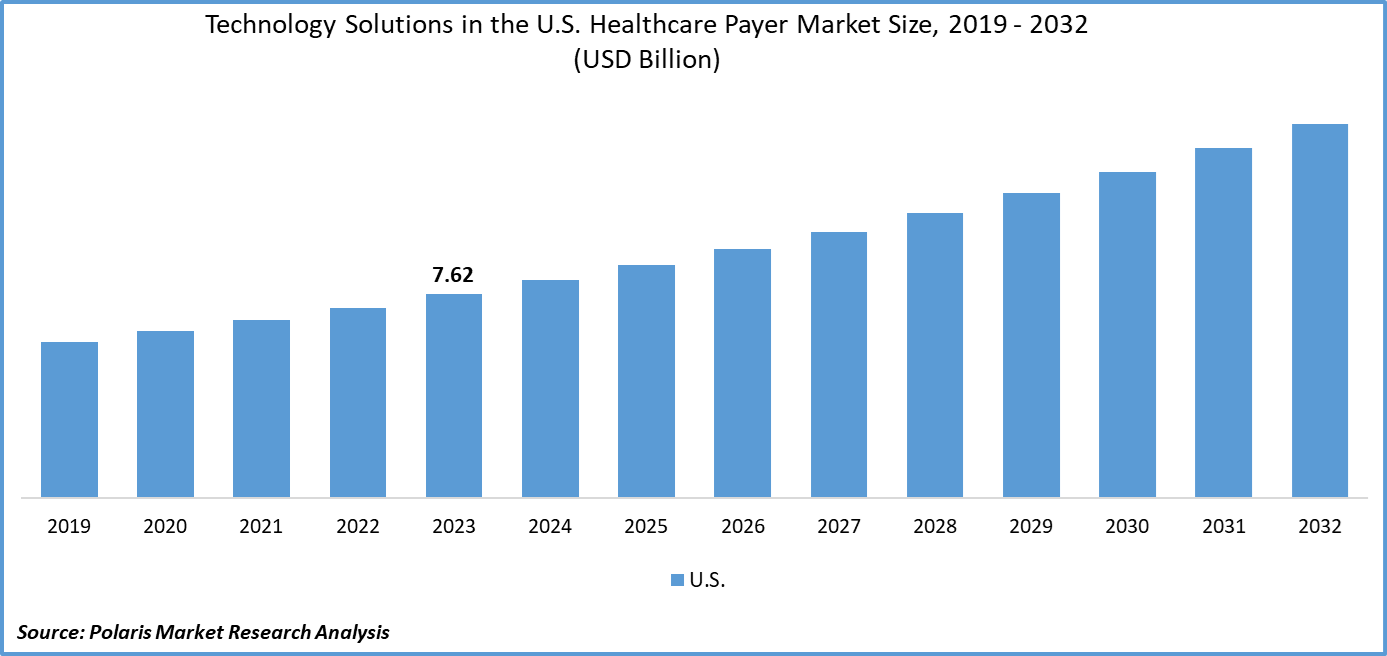
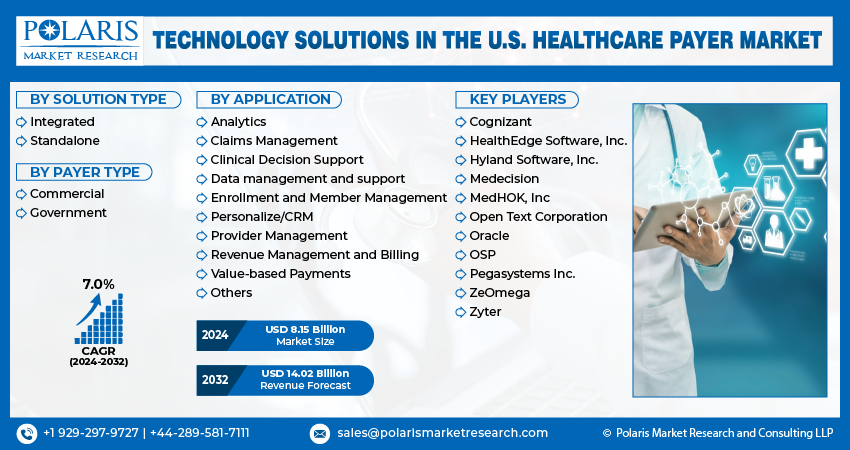
The technology solutions in the U.S. healthcare payer market size was valued at USD 8.89 billion in 2025. The market is anticipated to grow from USD 9.52 billion in 2026 to USD 16.65 billion by 2034, exhibiting a CAGR of 7.2% during the forecast period.
Market Statistics
Key Takeaways
- The integrated segment held 58.6% market share in 2025. Growth is supported by connected payer functions, reduced data silos, and streamlined workflows.
- The commercial segment held the dominant market share of 68.4% in 2025. Growth is driven by increasing demand for enrollment, claims processing, and member management technologies.
- The government segment is projected to grow at a CAGR of 7.8% during the forecast period. Growth is supported by digitalization, efficient claims processing, data management, and regulatory compliance.
- During the forecast period, the Revenue Management and Billing segment is projected to grow at a CAGR of 7.5%. Growth is driven by rising healthcare costs, billing automation, and improved revenue management.
- The Claims Management segment generated a revenue share of 31.9% in 2025. Growth is supported by automated claims processing, faster adjudication, reduced errors, and improved payment accuracy.
Note: Figures and projections outlined in this report are the result of Polaris Market Research’s proprietary analytical processes, grounded in the latest available datasets and market observations.
What are Healthcare Payer Technology Solutions?
Healthcare payer technology solutions are digital tools used by health insurance companies. They help payers manage claims, member enrollment, billing, provider networks, and healthcare data.
The solutions help payers to control costs better, improve member services, process claims, and facilitate better communication with healthcare providers by eliminating manual processes and accelerating and improving the accuracy of everyday processes.
For instance, in May 2026, Aetna launched the second generation of its AI-powered Claims Assist Manager (CAM). It is useful to streamline claims processing and improve payment accuracy. To reduce processing time for complex claims requiring manual review the platform uses AI agents, highlighting the growing use of automation in healthcare payer operations.
The driving factors, including regulatory mandates, are compelling payers to invest in technology solutions to ensure compliance, data security, and interoperability. The growing focus on consumerism and member engagement is prompting payers to adopt digital health tools, mobile apps, and telehealth platforms to deliver personalized experiences and empower members to take control of their health.
However, the adoption of technology solutions in the U.S. healthcare payer services market is affected by the complexity and fragmentation of the healthcare ecosystem, which poses interoperability challenges and impedes seamless data exchange between payers, providers, and patients.
How Healthcare Payer Technology Solutions Work
Healthcare payer technology solutions help insurance companies manage claims, members, providers, and payments through digital systems. From enrollment systems, providers, and other healthcare sources member data is collected. Claims are submitted and checked for eligibility, coverage, errors and correct payment details. Automated tools and analytics are used to flag unusual information and process claims. When claims are approved, payments are managed and sent to providers. These solutions also help members with services, reporting, and communication with providers.
Source: Polaris Market Research Analysis
To Understand More About this Research: Download Sample Report
Artificial Intelligence Transforming Healthcare Payers
Artificial intelligence is becoming an important part of healthcare payer technology. To automate routine tasks, analyze large amounts of data, improve claims processing, detect unusual activities, and support faster decision-making, payers are using AI. These applications can help reduce administrative work, improve operational efficiency, and improve services for members and providers. AI is also being used in payment integrity, risk assessment, customer support, and healthcare data analysis.
AI in Claims Processing
Different stages of the claims process can be managed with AI. It can also analyze claim data, verify eligibility and coverage, detect errors, and help accelerate claims adjudication. In addition, AI tools can flag unusual or complicated claims for further review helping to reduce manual work and improve payment accuracy.
Generative AI in Payer Operations
Generative AI is being used in the claims review process, customer support, and documentation. It can summarize claim information and help answer common member questions. To improve workflow efficiency Generative AI support routine administrative tasks.
Market Dynamics
Driver: Increasing Healthcare Spending Drives Technology Adoption
According to CMS, U.S. healthcare spending reached $5.3 trillion in 2024, increasing 7.2% from the previous year. Private health insurance spending grew 8.8% to $1.64 trillion. Higher healthcare costs are pushing payers to use technology to improve claims processing, billing, data management and other operations.
Driver: Regulatory Requirements Support Payer Technology Adoption
The need for digital payer systems are increasing with regulatory requirements. Under the CMS interoperability rule, impacted payers must report certain Patient Access API metrics starting in 2026, while several API requirements are scheduled for 2027. These requirements are encouraging payers to improve data exchange, prior authorization, and interoperability.
Opportunity: Growth of Digital Member Engagement
Digital member engagement offers a strong opportunity for healthcare payers. In 2026, Aetna introduced a digital benefits onboarding experience for 4 million members. The increased messaging capabilities also resulted in 80% growth in member engagement and 26% decrease in opt-out rates. These findings point to an increasing demand for mobile apps, digital portals, messaging, and self-service options. This allows members to manage benefits and health care services.
Opportunity: Expansion of Interoperability and Data Exchange
Interoperability creates new opportunities for payer technology providers. CMS mandates required payers to support Provider Access, Payer-to-Payer, and Prior Authorization APIs, with key requirements taking effect in 2027. For platforms that support data exchange, claims information sharing and electronic prior authorization these changes can create higher demand.
Restraint: Security and Privacy Concerns
Data security remains a major challenge for healthcare payers. Payer systems contain sensitive health and member data and are thus a primary target for cyber attacks. Security concerns can slow adoption of cloud platforms and data sharing technologies. When connecting different systems and sharing healthcare data payers also need to meet privacy and compliance requirements.
Key Technology Areas Driving Payer Transformation
Telehealth & Virtual Care Management
Telehealth and virtual care are expanding access to care and supporting improved care coordination. Medicare is extending coverage of eligible telehealth services, including services delivered in patients’ homes, through December 31, 2027. CMS also added new payment support for care coordination through its ACCESS model in 2026. These developments can create opportunities for payers to improve reimbursement, access to virtual care, and coordination between patients and providers.
Personalized CRM & Member Experience Solutions
Personalized CRM solutions help healthcare payers build stronger relationships with members. These platforms bring member information together and help targeted communication across different channels. Based on member needs payers can use them to send relevant updates, reminders, and benefit information. Better communication can improve member satisfaction and support retention.
Provider Network Management Solutions
Provider network management solutions support payers in managing provider contracts, credentialing, performance, and reimbursement. They keep provider information organized and updated. To track contracts and monitor provider performance, these solutions are important. Better network management can improve coordination between payers and providers. It can also support accurate reimbursement and smoother network operations.
Cloud-Based Healthcare Payer Platforms
Cloud-based platforms help healthcare payers manage applications and data through flexible digital systems. They can handle claims, member management, billing and other payer functions. To scale systems as business needs change, cloud deployment is important. It also enables integration with other healthcare platforms. This can help payers enhance system access, reduce infrastructure needs and manage operations more efficiently.
Population Health Management Technologies
Population health management technologies help payers understand the health needs of different member groups. These solutions support risk identification, health monitoring, and care coordination. To identify people who may need additional support, payers can use member and clinical data. They can also help coordinate care between members, providers, and care teams. This helps better health management and more efficient use of healthcare resources.
Healthcare Data Management & Analytics
Healthcare data management and analytics solutions support payers collecting, organizing, and using large amounts of healthcare data. They support data from claims, members, providers, and other sources. Analytics can help identify risks, track costs, and support business decisions. Better data management also improves the quality and access of data, which helps payers make informed decisions and improve their operations.
Regulatory Compliance & Healthcare Technology
Healthcare payers must follow changing regulations related to data privacy, security, and healthcare operations. For payer organizations, HIPAA and the ACA are important requirements. Interoperability rules are also increasing the need for better data exchange. Technology can assist payers with managing records, reporting, data sharing, and compliance processes. Keeping systems up to date helps payers respond to regulatory changes and reduce compliance-related challenges.
Emerging Technologies in the Healthcare Payer Market
To improve operations and manage growing data volumes, healthcare payers are adopting new technologies. Machine learning, robotic process automation, cloud platforms, and interoperability solutions are being used across payer functions. These technologies can assist with claims processing, data management, member services, and workflow automation. Generative AI is also finding its way into the market, but adoption is still evolving. The focus is still on increasing efficiency, accuracy, and digital connectivity.
Real-World Healthcare Payer Technology Use Cases
| Use Case | Technology Use | Benefit |
| Claims Management | Claims processing and review | Faster claims processing |
| Fraud Detection | Claims and payment checks | Helps find suspicious claims |
| Enrollment | Digital enrollment systems | Easier member enrollment |
| Provider Management | Provider data and network management | Better provider coordination |
| Revenue Management | Billing and payment systems | Better payment management |
| Telehealth | Virtual care platforms | Better access to care |
| CRM & Member Services | Member communication tools | Better member support |
| Risk Management | Member health data analysis | Better risk management |
Source: Polaris Market Research Analysis
Source: Polaris Market Research Analysis
Market Segmentation
By Payer Type Insights
Based on payer type analysis, the market is segmented on the basis of commercial and government. In 2025, the commercial segment emerged as the dominant segment, accounting for 68.4% of the technology solutions in the U.S. healthcare payer market share. This is because commercial payers cater to a diverse range of clients, including large corporations, small businesses, and individual consumers, necessitating robust technology solutions to manage the complexities of enrollment, claims processing, and member management efficiently.
Also, commercial payers operate in a highly competitive landscape, where differentiation through technological innovation is crucial for attracting and retaining customers. These payers often leverage advanced technologies such as data analytics, artificial intelligence, and telehealth platforms to enhance member experience, improve operational efficiency, and stay ahead of the competition. Along with this, commercial payers typically have greater financial resources and flexibility to invest in cutting-edge technology compared to government counterparts, further fueling their dominance in the adoption of technology solutions in the U.S. healthcare payer market.
The government segment is projected to grow at a CAGR of 7.8% during the forecast period. Growth is supported by the increasing need to modernize public healthcare programs and improve administrative efficiency. For claims management, member enrollment, data management, billing, and regulatory compliance, government payers are adopting technology solutions. These solutions can help improve service delivery and manage healthcare operations more efficiently.
By Solution Type Insights
The integrated segment accounted for 58.6% of the market share in 2025 and is projected to grow at a CAGR of 7.6% during the forecast period. Integrated solutions bring together a number of payer capabilities on one platform. They help cut down on data silos, streamline workflows, and coordinate better between different operations. The ability to support connected processes is likely to drive continued adoption.
The standalone segment is projected to grow at a CAGR of 6.6% during the forecast period. Standalone solutions aim on specific payer functions, such as claims management, billing, member management, or analytics. They can be useful for payers that need to upgrade individual processes without replacing their existing systems. Their focused functionality can support flexible technology adoption based on specific operational needs.
Integrated vs. Standalone Healthcare Payer Solutions
| Dimension | Integrated Solutions | Standalone Solutions |
| Functionality | Combines several payer functions in one platform. | Handles one specific payer function. |
| Scalability | Can support growth across different functions. | Can support growth within one function. |
| Implementation | May take more time to set up. | Usually easier to set up. |
| Cost | May cost more at the start but can reduce the need for multiple systems. | Usually costs less for a specific need. |
| Data Integration | Connects data across different functions. | May need other tools to connect data. |
| User Experience | Provides one connected experience. | Provides a focused experience. |
| Long-Term Value | Can reduce the need for multiple systems. | Useful for specific business needs. |
Source: Polaris Market Research Analysis
By Application Insights
Based on application analysis, the market has been segmented on the basis of analytics, claims management, clinical decision support, data management and support, enrollment and member management, personalized/CRM, provider management, revenue management and billing, value-based payments, and others. During the forecast period the Revenue Management and Billing segment is projected to grow at a CAGR of 7.5%. Healthcare costs continue to rise, increasing pressure on payers to improve financial operations. Technology solutions can streamline revenue management and billing processes, support better revenue capture, and help reduce revenue loss.
Advanced technology solutions offer automation, accuracy, and efficiency in revenue management tasks such as claims processing, coding, and billing, leading to improved financial performance for payers. Also, regulatory changes and evolving reimbursement models necessitate adaptable and agile revenue management systems capable of supporting complex billing requirements and ensuring compliance with industry standards.
The Claims Management segment accounted for 31.9% of revenue in 2025. Claims management solutions help payers to process claims, verify information, and manage payments more efficiently. These solutions can reduce processing time and errors while supporting timely reimbursement. They also help payers to manage increasing claim volumes and enhance payment accuracy. The rising need for effective claims processing is expected to fuel the segment’s growth.
Role Within the Healthcare Ecosystem
Healthcare payer technology connects payers with providers, hospitals, pharmacies, telehealth services, and members. These solutions help manage claims, member information, provider networks, payments, and healthcare data. They also help communication and data sharing between different participants. This helps payers coordinate services, improve daily operations, and provide better support to members and healthcare providers.
Source: Polaris Market Research Analysis
Competitive Landscape
The competitive landscape for technology solutions in the U.S. healthcare payer market is characterized by intense rivalry among key players striving to innovate and differentiate themselves in a rapidly evolving industry. Established technology vendors, including software providers, data analytics firms, and telehealth platforms, compete alongside emerging startups and niche players, offering specialized solutions tailored to the unique needs of healthcare payers. Key competitive factors include the breadth and depth of product offerings, technological capabilities, scalability, interoperability, regulatory compliance, and pricing strategies. Market leaders continuously invest in research and development to stay at the forefront of technological advancements while also focusing on strategic partnerships, mergers, and acquisitions to expand their market presence and enhance their competitive position.
Cognizant is a major technology provider serving healthcare payers through its TriZetto portfolio. Its solutions support core administration, claims, member and provider services, interoperability, and reimbursement. The company supports more than 200 million members and works with 200+ health plans. Its payer solutions help organizations improve operational efficiencies, control costs, and support better member and provider experiences.
HealthEdge provides technology solutions for healthcare payers. Its portfolio covers claims administration, care management, payment integrity, member engagement, and provider data management. The company’s solutions serve more than 110 million covered lives across 130+ health plan customers. Its platforms help payers manage claims, improve payment accuracy, coordinate care, and strengthen member services.
Some of the major players operating in the market include
- Cognizant
- HealthEdge Software, Inc.
- Hyland Software, Inc.
- Medecision
- MHK (formerly MedHOK)
- OpenText
- Oracle
- OSP
- Pegasystems Inc.
- ZeOmega
- Zyter|TruCare
Vendor Positioning in the U.S. Healthcare Payer Technology Market
| Vendor | Market Positioning |
| Cognizant | Payer administration, claims, interoperability, and healthcare technology solutions. |
| Oracle | Cloud platforms, payer applications, billing, and data management solutions. |
| Pegasystems | Workflow management, CRM, automation, and payer process solutions. |
| HealthEdge Software | Payer administration, care management, payment integrity, and member services. |
| ZeOmega | Population health and care management solutions. |
| Hyland Software | Healthcare content and information management solutions. |
| Medecision | Care management and healthcare payer technology solutions. |
| MHK | Payer and pharmacy technology solutions, including member and enrollment management. |
| OpenText | Information, content, and data management solutions for healthcare organizations. |
| OSP | Healthcare technology and payer-focused solutions and services. |
| Zyter|TruCare | Healthcare and payer platforms supporting connected care and data exchange. |
Source: Polaris Market Research Analysis
Recent Developments
- June 2026: Cognizant was named a Leader in Everest Group’s 2026 Healthcare Payer Digital Services assessment. The recognition highlights its work in claims, member services, provider networks and care management.
- May 2026: Aetna launches the second generation of its Claims Assist Manager. The solution speeds up processing for complex claims and improves payment accuracy.
- February 2025: HealthEdge partnered with ECHO Health to connect its payer platform with ECHO’s payment services. The partnership supports health plans manage claims payments and remittance processes more efficiently.
Future Outlook
The U.S. healthcare payer technology market is anticipated to continue its growth as payers adopt digital solutions. Cloud platforms, data analytics, automation and interoperability will be the basis of this growth. Payers will probably increase their focus on faster claims processing, improved member services and more efficient operations. The increasing use of AI will continue to support these areas and influence the future of payer technology.
Research Methodology
The study of the U.S. healthcare payer technology market uses a combination of primary and secondary research. Secondary research includes information from company websites, industry reports, government sources, regulatory publications, and other reliable public sources. Primary research includes inputs from industry participants and relevant stakeholders.
The market is analyzed by solution type, payer type, and application. Historical data is reviewed to understand market trends and growth patterns. The study also considers factors such as technology adoption, healthcare spending, regulatory changes, digital transformation, and changing payer needs.
Market estimates and forecasts are developed using the collected data and industry analysis. The findings are cross-checked to improve accuracy and provide a clear view of the market size, growth opportunities, competitive landscape, and future outlook.
Technology Solutions in The U.S. Healthcare Payer Market Report Scope
| Report Attributes | Details |
| Market size value in 2025 | USD 8.89 billion |
| Market size value in 2026 | USD 9.52 billion |
| Revenue Forecast in 2034 | USD 16.65 billion |
| CAGR | 7.2% from 2026 – 2034 |
| Base year | 2025 |
| Historical data | 2021 – 2024 |
| Forecast period | 2026 – 2034 |
| Quantitative units | Revenue in USD billion and CAGR from 2026 to 2034 |
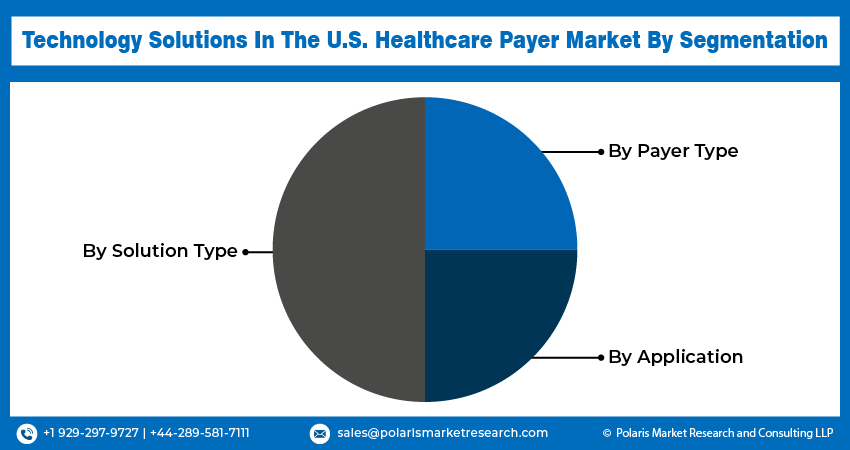
| Segments Covered | By Solution Type, By Payer Type, By Application |
| Country Scope | The U.S. |
| Customization | Report customization as per your requirements with respect to countries, regions, and segmentation. |
Source: Polaris Market Research Analysis
Technology Solutions in The U.S. Healthcare Payer Market FAQ's
The Technology Solutions in The U.S. Healthcare Payer Market report covering key segments are solution type, payer type, and application.
Technology Solutions in the U.S. Healthcare Payer Market Size Worth USD 16.65 Billion by 2034
Technology solutions in the U.S. healthcare payer market exhibiting a CAGR of 7.2% during the forecast period
key driving factors in Technology Solutions in The U.S. Healthcare Payer Market are 1. Compliance with regulations drives the adoption of technology solutions in the U.S. healthcare payer market
Healthcare payer technology solutions are digital tools used by health insurance companies. They help manage claims, members, providers, billing, and healthcare data.
Technology helps payers reduce manual work and improve daily operations. It also supports better services for members and providers.
The main types include integrated and standalone solutions. They support functions such as claims, billing, analytics, enrollment, and provider management.
These solutions help payers process and review claims. They can also help check eligibility, identify errors, and manage payments.
Technology helps payers manage member records, enrollment, and communication. Digital platforms also make it easier for members to access services.
Technology helps payers manage provider information, contracts, and credentialing. It also supports provider networks and reimbursement processes.
Healthcare payers are expected to use more cloud platforms, data tools, and connected systems. These technologies can support faster processes and better member services.
Download Sample Report of Technology Solutions in The U.S. Healthcare Payer Market
Please fill out the form to request a customized copy of the research report.


