
Temperature Sensors Market Share, Size, Analysis Report, 2026-2034
REPORT DETAILS
Temperature Sensors Market Summary
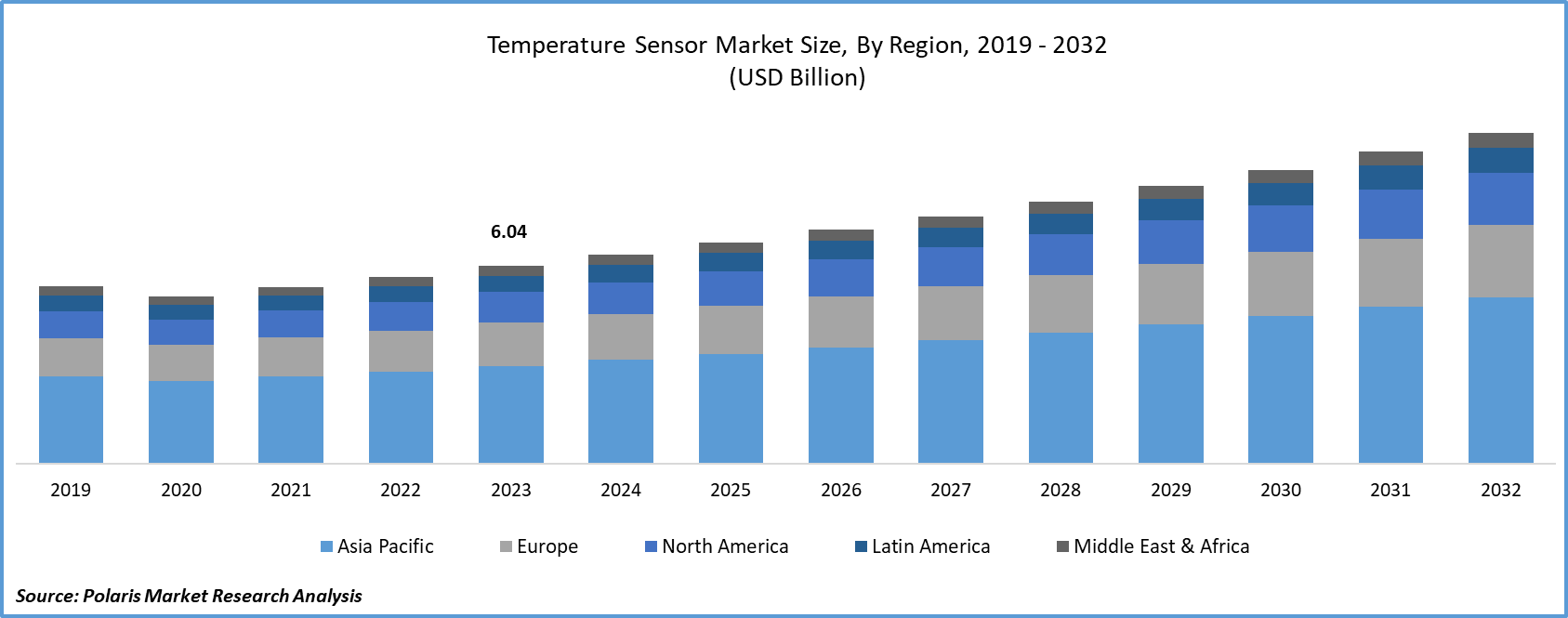
The global Temperature Sensors Market was valued at USD 9.36 billion in 2025 and is forecasted to grow at a CAGR of 6.19% from 2026 to 2034. Widespread use in industrial automation, HVAC systems, and consumer electronics, along with IoT integration, is driving sustained demand.
Market Statistics
Key Takeaways
- Asia Pacific led with a 34.0% market share in 2025. This is owing to the consistent demand for cost-effective and highly efficient temperature sensors across various sectors.
- China accounted for a 35.50% market share in 2025. Rapid industrialization and increased investments in renewable energy sources drive market growth in the country.
- North America is projected to witness the fastest growth at a 7.45% CAGR. The regional market growth is driven by the presence of well-established manufacturers.
- The temperature sensor ICs segment held the largest revenue share of 24.0% in 2025. This is due to the rising usage of temperature sensor ICs across industries.
- The non-contact temperature sensors segment accounted for the largest market share of 7.30% in 2025. The segment’s leading position is attributed to the use of these sensors for small, mobile, and hard-to-reach objects or sources.
Note: Figures and projections outlined in this report are the result of Polaris Market Research’s proprietary analytical processes, grounded in the latest available datasets and market observations.
Industry Dynamics
- The increasing adoption of portable healthcare devices is contributing to the rising demand for temperature sensors.
- The growing preference for green building practices is another factor fueling market development.
- The push for real-time analytics in the process industries and heavy manufacturing is creating several market opportunities.
- High initial investment and maintenance costs may present market challenges.
AI Impact on Temperature Sensor Market
- AI improves the precision of temperature sensors using data analysis and error correction in measuring temperatures.
- AI contributes to predictive maintenance through the detection of abnormal temperatures before the equipment malfunctions.
- AI helps in the optimization of industrial and electronic devices due to real-time monitoring of temperature.
- Energy efficiency and improved performance of devices can be achieved through AI.
What is Temperature Sensor?
A temperature sensor is a device designed to measure the degree of hotness or coldness of an object or environment and convert it into a readable signal. It works by detecting changes in physical properties such as resistance, voltage, or radiation, which vary with temperature. These sensors can be broadly classified into contact types, which touch the object directly, and non-contact types, which measure temperature from a distance. The resulting signal is then processed and displayed in units such as Celsius, Fahrenheit, or Kelvin. Temperature sensors are widely used across industries, from household appliances to industrial automation, ensuring precise monitoring and control of thermal conditions.
Major drivers of the temperature sensor market include the rising adoption of HVAC modules in the automotive industry and various industrial end-user applications. The growing demand for consumer electronics is also expected to contribute to market expansion. Additionally, increased global attention to security and surveillance, along with government initiatives promoting safety norms, is likely to foster the adoption of temperature sensors.
The widespread use of wireless temperature sensors in diverse industries is primarily attributed to their non-contact measurement features, allowing them to reach locations where physical deployment is challenging. In the oil and gas industry, temperature sensors find critical applications in various areas, including flare systems, wellhead tanks, chemical tanks, pipeline data collection, and compressors. Given the industry's nature, the use of temperature sensors is crucial for monitoring temperature changes and ensuring safe working conditions, especially in instances where installing wired devices inside pipes or tanks is inefficient due to high operating temperatures.
Source: Polaris Market Research Analysis
To Understand More About this Research: Download Sample Report
Moreover, trends in the personal computing industry, such as faster processors, smaller system sizes, and the need to support more advanced applications, underscore the importance of monitoring and controlling heat. This trend, coupled with robust sales and advancements in desktop and portable computers, is expected to sustain the growth of temperature sensors.
The rising utilization within the automotive sector to uphold vehicle safety, enhance engine performance, and mitigate emissions is propelling market expansion. Leading industry players are employing diverse organic and inorganic strategies to innovate advanced products and solutions, specifically tailored for the automotive industry. These sensors assume a vital role in overseeing the hot exhaust gas flow and protecting temperature-sensitive components, like turbochargers, from overheating. Furthermore, government regulations enforcing safety and emission control standards for vehicles have prompted automotive companies to incorporate these sensors into their vehicles, leading to an increased demand in the automotive sector.
Source: Polaris Market Research Analysis
Market Dynamics
Increasing Adoption of Portable Healthcare Devices is Projected to Spur the Product Demand
Temperature sensors play a crucial role in healthcare applications, including body temperature monitoring and medical equipment, contributing to the demand for these sensors. The rising elderly population and the increase in diseases will drive the demand for advanced portable medical devices. These devices, known for their precision in temperature measurement and monitoring, are incorporating thermal sensors. Medical devices equipped with built-in sensors are employed for monitoring body temperature in RF hyperthermia treatments and measuring patient surface temperature during fMRI, MRI, or other specialized electro-surgical procedures.
The growing utilization of these sensors in patient monitoring systems, digital temperature measurement systems, and life-support machines is contributing to the increased demand for such sensors in the healthcare sector. Furthermore, rapid technological advancements in healthcare and the desire for equipment miniaturization will enhance the revenue of the temperature sensor market.
Growing Usage in Energy and Power Systems Monitoring
Temperature sensors play an important role in monitoring power and energy systems. These sensors enable accurate tracking and help ensure the systems remain within their safe operating limits. They help increase efficiency and prevent equipment breakdowns. Temperature sensors have become popular in power plants, transformers, substations, wind energy generation, solar energy generation, and energy storage systems to track temperatures constantly. In the case of batteries, temperature sensors ensure that there is no thermal runaway due to overheating. Temperature sensors in industrial power plants ensure turbine efficiency and the protection of electrical systems from any damage. As more and more renewable energy and smart grid technologies become popular, temperature sensors that are wireless and IoT-enabled become common.
Market Restraints
The Shrinking PC Market are Likely to Impede the Market Growth
Within personal computers, these sensors play a role in controlling and overseeing the CPU temperature, with laptops and desktops typically incorporating 3 to 5 temperature sensor ICs. Nevertheless, the sales of personal computers have experienced a decline in recent years, attributed to the growing preference for portable devices like tablets and smartphones. The necessity for these sensors in such portable devices varies. As a result, the increasing adoption of tablets and smartphones has had a negative impact on the distribution of these sensors.
Source: Polaris Market Research Analysis
Report Segmentation
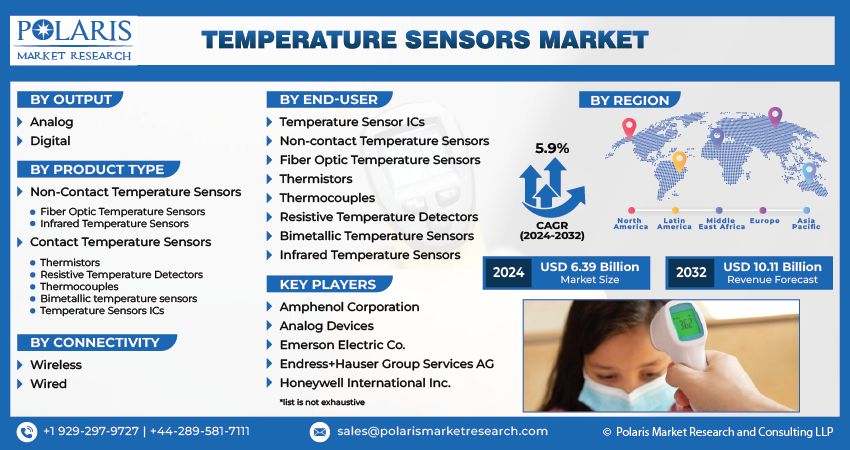
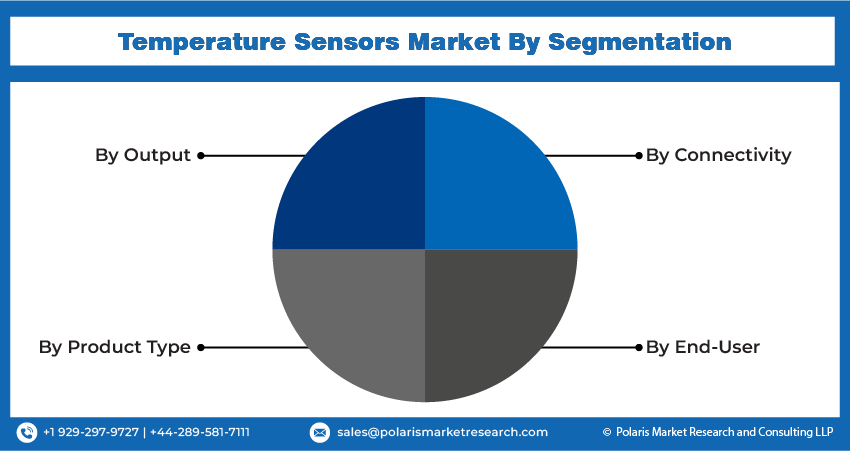
The market is primarily segmented based on output, product type, connectivity, end-user, and region.
| By Output | By Product Type | By Connectivity | By End-User | By Region |
|
|
|
|
|
Source: Polaris Market Research Analysis
To Understand the Scope of this Report: Request Customization
Segmental Analysis
By End-Users Analysis
- The Temperature Sensor ICs segment held the largest revenue share of 24.0% in 2025. The prevalence of this category is linked to the rising usage of temperature sensor ICs across diverse applications such as industrial, automotive, and consumer electronics. The escalating need for compact and cost-effective temperature sensing solutions is propelling the expansion of this segment. Infrared Temperature Sensors are anticipated to exhibit consistent growth, given their high accuracy, non-contact operation, and the growing demand for temperature sensing solutions in a variety of industrial and consumer applications.
- Thermocouples Sensors are projected to exhibit 5.80% CAGR owing to their robustness, dependability, and extensive temperature measurement capabilities.
By Product Type Analysis
- The Non-Contact Temperature Sensors segment is expected to witness 7.30% CAGR during the forecast period. These sensors gauge the surface temperature of an object or body without establishing any physical contact between the sensor and the measured object. Primarily employed for small, mobile, and hard-to-reach objects or sources, non-contact temperature sensors encompass infrared and fiber optic temperature sensors. Notable companies providing non-contact temperature sensors include, TE Connectivity (Switzerland), OMEGA Engineering (US), Keyence Corporation (Japan), and Melexis (Belgium).
Contact vs Non-Contact Temperature Sensors
| Aspect | Contact Thermometers | Non-Contact Thermometers |
| Principle of Measurement | The measurement of temperature using direct contact with the substance or its surface. | The measurement of temperature without touching the substance. |
| Principle of Operation | The detection of temperature due to changes in resistance, voltage, or material properties. | The detection of temperature due to infrared radiation or thermal emission of the object. |
| Accuracy | Provide precise measurements of temperature for surface and internal temperatures of objects. | Fast response but accuracy can be dependent on distance, surface properties, and environment. |
| Response time | Tend to be slower as sensors need to heat/cool together with the substance. | Faster due to lack of physical contact. |
| Types of Sensors | RTDs, thermocouples, and thermistors. | Infrared and thermal imaging sensors. |
| Applications | Machines, automotive engines, HVAC units, and medical devices. | Machine parts, moving parts, safety checks, and hazardous environments. |
| Safety and Conveinence | Provides direct physical contact with the substance. | Safe to use for hot, moving and inaccessible surfaces. |
Regional Insights
-
The Asia Pacific region dominated the global market with the largest market share in 2025
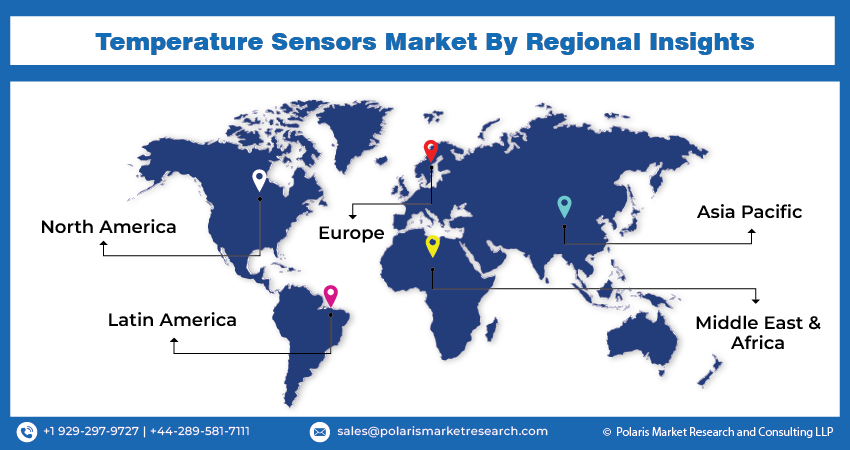
Asia Pacific lead with a 34.0% market share in 2025 driven by the adoption of temperature sensor products and solutions, driven by a consistent demand for cost-effective and highly efficient temperature sensors across various industries such as chemicals, consumer electronics, metals, oil and gas, automotive, energy and power, healthcare, and mining. The region's automotive sector, contributing to the world's passenger car production, and the flourishing electrical and electronics industry further support the growth of the temperature sensor market.
China with 35.50% share in 2025, as the largest consumer of electricity in the Asia Pacific, primarily due to rapid industrialization and a large population, is a significant contributor to the region's growth. The increasing demand from the energy and power sector, along with substantial investments in renewable energy resources, is expected to drive the demand for temperature sensors in China. The utilization of temperature sensors in transformer monitoring systems is also on the rise in the country, further fueling the demand for temperature sensors in the upcoming years.
North America is expected to witness rapid growth with 7.45% CAGR in the temperature sensors market, driven by substantial investments from well-established manufacturers focused on advancing and enhancing existing sensor technologies. The increasing adoption of smart manufacturing, industrial automation, connected devices, and advanced monitoring systems is further accelerating the demand for high-precision temperature sensing solutions. In addition, growing deployment across automotive, healthcare, aerospace, consumer electronics, and energy applications is encouraging manufacturers to develop more reliable, compact, and technologically advanced temperature sensors.
Companies in the region, such as Emerson Electric Co., provide thermocouple temperature sensors known for their resilience and durability in challenging process environments. Additionally, entities like Vernier Software and Technology offer thermocouple temperature sensors capable of measuring temperatures ranging from -200°C to 1400°C, including the measurement of flame temperatures reaching up to 1400°C or liquid nitrogen temperatures as low as -196°C.
Source: Polaris Market Research Analysis
Competitive Landscape
The Temperature Sensors market is fragmented and is anticipated to witness competition due to several players' presence. Major service providers in the market are constantly upgrading their technologies to stay ahead of the competition and to ensure efficiency, integrity, and safety. These players focus on partnership, product upgrades, and collaboration to gain a competitive edge over their peers and capture a significant market share.
Some of the major players operating in the global market include:
- Amphenol Corporation
- Analog Devices
- Emerson Electric Co.
- Endress+Hauser Group Services AG
- Honeywell International Inc.
- Microchip Technology Inc.
- Siemens
- TE Connectivity
- Texas Instruments Incorporated
- WIKA Alexander Wiegand SE & Co. KG
Recent Developments
- September 2026: Sensata Technologies launched an R290 Pressure + Temperature Sensor for electrified vehicle thermal management. It supports automotive OEMs adopting R290 refrigerant, addressing flammability and leakage concerns through accurate pressure and temperature measurement. (Source: sensata.com)
- May 2026: Emerson announced the launch of the Emerson Synchros Industrial Internet of Things (IIoT) platform. The initial release includes the Rosemount Synchros Wireless Repeater and the Rosemount Synchros Temperature Monitor. These new solutions together provide scalable wireless monitoring capability. (source: emerson.com)
Report Coverage
The Temperature Sensor market report emphasizes on key regions across the globe to provide better understanding of the product to the users. Also, the report provides market insights into recent developments, trends and analyzes the technologies that are gaining traction around the globe. Furthermore, the report covers in-depth qualitative analysis pertaining to various paradigm shifts associated with the transformation of these solutions.
The report provides detailed analysis of the market while focusing on various key aspects such as competitive analysis, output, product type, connectivity, end-user, and their futuristic growth opportunities.
Temperature Sensor Market Report Scope
| Report Attributes | Details |
| Market size value in 2025 | USD 9.36 billion |
| Market size value in 2026 | USD 9.92 billion |
| Revenue forecast in 2034 | USD 16.07 billion |
| CAGR | 6.19% from 2026 – 2034 |
| Base year | 2025 |
| Historical data | 2021 – 2024 |
| Forecast period | 2026 – 2034 |
| Quantitative units | Revenue in USD billion and CAGR from 2026 to 2034 |
| Segments Covered | By Output, By Product Type, By Connectivity, By End-user, By Region |
| Regional scope | North America, Europe, Asia Pacific, Latin America, Middle East & Africa |
| Customization | Report customization as per your requirements with respect to countries, region, and segmentation. |
Source: Polaris Market Research Analysis
The Temperature Sensors Market report details key market dynamics to help industry players align their business strategies with current and future trends. It examines technological advances and breakthroughs in the industry and their impact on the market presence. Furthermore, a detailed regional analysis of the industry at the local, national, and global levels has been provided.
Browse Our Top Selling Reports
Optical Imaging Systems Market Size, Share 2024 Research Report
Pharmaceutical Grade Lactose Market Size, Share 2024 Research Report
Garbage Truck Bodies Market Size, Share 2024 Research Report
FAQs
The global Temperature Sensor market size is expected to reach USD 16.07 billion by 2034
Key players in the market are Amphenol Corporation, Analog Devices, Emerson Electric Co., Endress+Hauser Group Services AG
Asia Pacific led with a 34.0% market share in 2025.
Temperature Sensors Market exhibiting the CAGR of 6.19% during the forecast period
The Temperature Sensor Market report covering key segments are output, product type, connectivity, end-user, and region.
A temperature sensor is a device that measures and monitors heat levels in industrial, automotive, healthcare, and consumer electronics applications, delivering analog or digital output signals.
Key trends include rising IoT-enabled wireless sensor adoption, growing healthcare and automotive applications, increasing industrial automation demand, and expanding use of non-contact infrared temperature sensing solutions.

Download Sample Report of Temperature Sensors Market
Please fill out the form to request a customized copy of the research report.


