
Terahertz Technology Market Share, Size, Trends, Industry Analysis Report, 2026 - 2034
REPORT DETAILS
What is the Current Market Size?
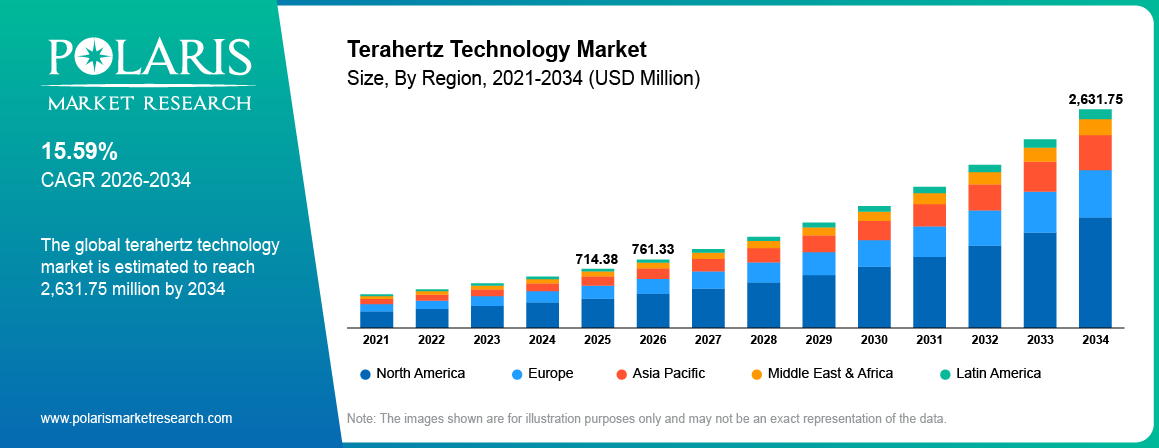
The global terahertz technology market size was valued at USD 714.38 million in 2025. The market is projected to grow at a CAGR of 15.59% from 2026 to 2034. Expansion of healthcare and pharmaceutical sectors, coupled with growth in high-speed wireless communication, is propelling the market growth.
Market Statistics
Terahertz Technology Market Key Takeaways
- North America led the global market with a 39.8% revenue share in 2025. This is due to robust growth in security screening and non-destructive testing applications.
- The U.S. led with a 78.4% share in 2025. This is due to government-sponsored innovation initiatives that are driving the terahertz commercialization process.
- Asia Pacific is expected to exhibit the highest growth rate of 17.2%. Fast-paced industrialization and the growth of high-value manufacturing and electronics industries contribute to the regional market expansion.
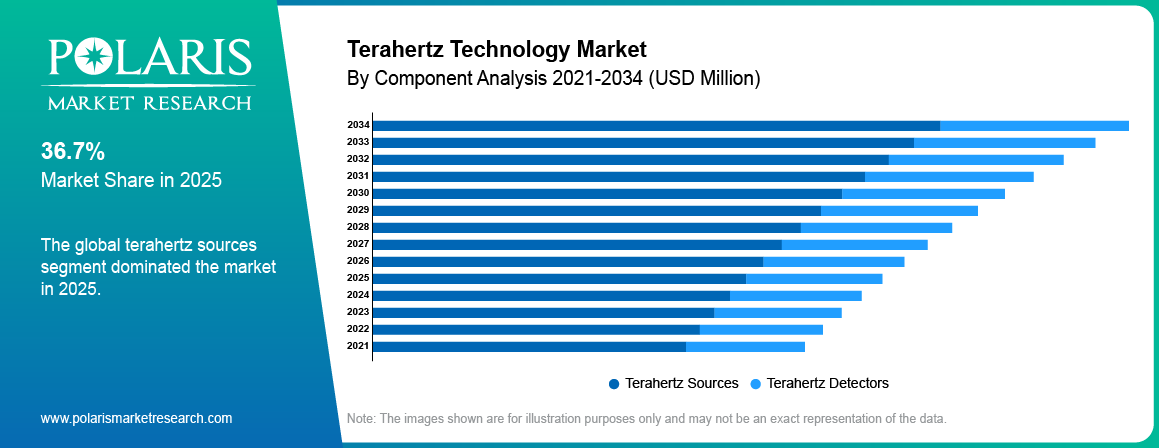
- The terahertz sources segment held the largest share of 36.7% in 2025. This is due to their pivotal position in facilitating high-resolution imaging and ultra-fast wireless communication applications.
- The spectrometers segment is expected to grow at a 16.8% CAGR. Increasing demand coming from pharmaceutical testing and chemical analysis drives the segment’s growth.
Note: Figures and projections outlined in this report are the result of Polaris Market Research’s proprietary analytical processes, grounded in the latest available datasets and market observations.
AI Impact on Terahertz Technology Market
- Artificial intelligence can be instrumental in analyzing terahertz data more efficiently and accurately by processing complex information from imaging and sensing.
- It is useful for enhancing the ability to detect by identifying any patterns or anomalies in security, semiconductor inspection, and medical imaging applications.
- Artificial intelligence optimizes systems by optimizing signal processing, image processing, and measurements.
- AI can help promote research and commercial development through fast data interpretation and the design of optimized systems.
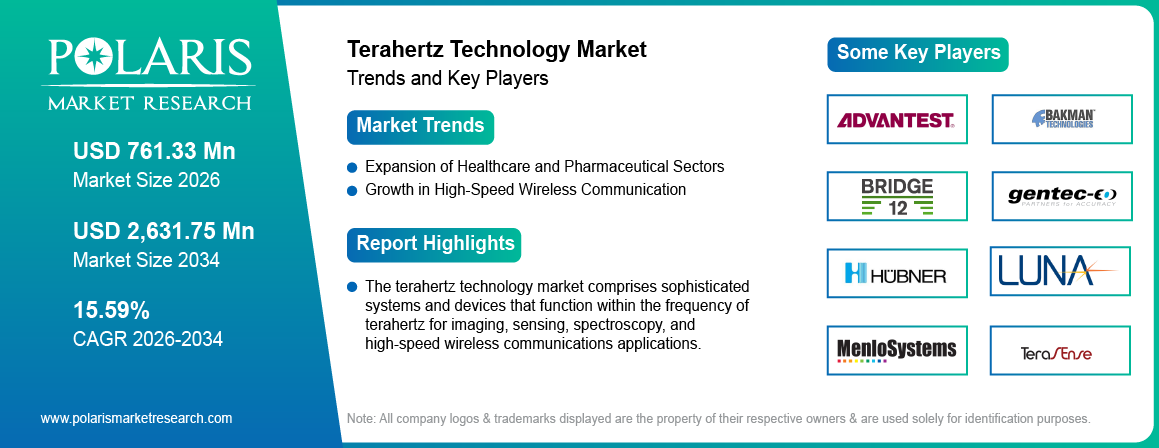
The terahertz technology market comprises sophisticated systems and devices that function within the frequency of terahertz for imaging, sensing, spectroscopy, and high-speed wireless communications applications. These solutions contains extensive applications in security screening, non-destructive testing, medical diagnosis, semiconductor inspection, and scientific research owing to their penetration capability without inducing ionizing radiation damage.
High investments by government organizations and private stakeholders in terahertz technology research are driving product innovation and commercialization worldwide. These investments are helping to drive the development of next-generation imaging, sensing, and spectroscopy applications, enabling businesses to take products to market more quickly.
Source: Polaris Market Research Analysis
Rapid industrial infrastructure growth and urbanization in emerging markets are generating high demand for sophisticated imaging, sensing, and inspection technologies. A United Nations report estimates that urbanization to add an extra 2.5 million people into cities by 2050 as the world shifts from rural to urban lifestyles. The growing rate of urbanization is fueling the use of terahertz-based technology in industrial and business applications.
Terahertz vs Microwave vs Infrared Technology
| Aspects | Terahertz Technology | Microwave Technology | Infrared Technology |
| Frequency Range | 0.1-10 THz | Less than the frequency range of terahertz | Greater than the frequency range of terahertz |
| Material Penetration | Able to penetrate materials like plastics, papers, clothes and packages | Good penetration, less imaging resolution | Surface analysis only |
| Imaging Resolution | High Imaging Resolution | Low imaging resolution | High surface imaging resolution |
| Non-Ionizing or Ionizing | Non-Ionizing | Non-Ionizing | Non-Ionizing |
| Primary Uses | Imaging, Spectroscopy, Semiconductor inspection and 6G communications | Radar, Wireless communication Satellite communication systems | Thermal imaging, environmental monitoring |
| Major Strength | Penetration combined with molecular analysis | Long distance communications | Effective temperature sensing |
Source: Polaris Market Research Analysis
Market Dynamics
Driver: Expansion of Healthcare and Pharmaceutical Sectors
Increasing need for non-invasive medical diagnostic services, drug testing, and quality checks is driving the terahertz market. According to the International Federation of Pharmaceutical Manufacturers & Associations (IFPMA), the pharmaceutical industry's direct GDP contribution has increased over 20% in the last ten years, from USD 623 million in 2012 to USD 755 million in 2022. The trend identifies the increasing role of terahertz technology in improving healthcare and pharmaceutical competence.
Driver: Growth in High-Speed Wireless Communication
The international move towards 6G and ultra-high-frequency communication technologies is boosting the adoption of terahertz frequencies for transmitting data. As per 5G America, the global wireless telecommunication industry accounted for 2.25 million 5G connections in 2024. Development of wireless communications is turning terahertz technology into a pillar of future high-speed data networks.
Driver: Increased Use in Semiconductor Inspection and Electronics Testing
The rapid pace of semiconductor technology, especially in advanced packaging, 3D chips, and small nodes, demands efficient inspection and test techniques to achieve the extremely high accuracy required. Terahertz inspection is one of such advanced techniques that have proven themselves useful in semiconductor manufacturing because it allows penetration into non-conductive substances and provides comprehensive inspection of complex internal structures, which cannot be examined using traditional approaches. Manufacturers employ terahertz tools in order to perform wafer testing, packaging integrity assessment, identification of possible defects, measuring layer thickness, and ensuring quality throughout production. Early discovery of microscopic cracks, delaminations, and other faults leads to improving yields, minimizing errors, increasing reliability, and designing more sophisticated electronic devices.
Source: Polaris Market Research Analysis
What are the Segmental Insights?
By Component
In terms of component, the terahertz technology market is divided into terahertz sources and terahertz detectors. Terahertz sources led the market in 2025 with 36.7% share due to their vital contribution to supporting imaging, spectroscopy, and high-speed communication applications.
Terahertz detectors are anticipated to record robust growth during the forecast period fueled by the growing usage in security screening, non-destructive testing, and biomedical diagnostics in which accuracy in signal detection and sensitivity are of utmost significance.
By Product Type
Based on product type, the market is divided into imaging scanners, imaging cameras, antennas, spectrometers, and body scanners. Imaging scanners held dominating share in 2025, due to widespread usage in security screening, quality inspection, and industrial process monitoring.
Spectrometers are projected to grow at a high rate of CAGR 16.8%, propelled by increasing application in pharmaceutical testing, chemical analysis, and scientific research.
By Application
By application, the market is categorized into imaging, communications, and spectroscopy. Imaging held the largest market share in 2025 as terahertz imaging is widely used for security screening, medical imaging, and defect detection in the manufacturing industry.
Communications segment is anticipated to grow at a robust pace, fueled by breakthroughs in 6G and ultra-high-speed wireless technologies.
By End-use
By end-use, the market is divided into IT & telecom, medical & healthcare, laboratory research, defense & security, semiconductor testing, and others. The IT & telecom segment held dominating proportion in 2024, driven by increasing investments in next-gen wireless communication technologies.
The medical & healthcare industry is anticipated to experience robust growth, driven by increasing use of terahertz systems to detect cancer, image tissues, and make non-invasive diagnoses.
Source: Polaris Market Research Analysis
Which Regional Factors Contributed to the Market Growth?
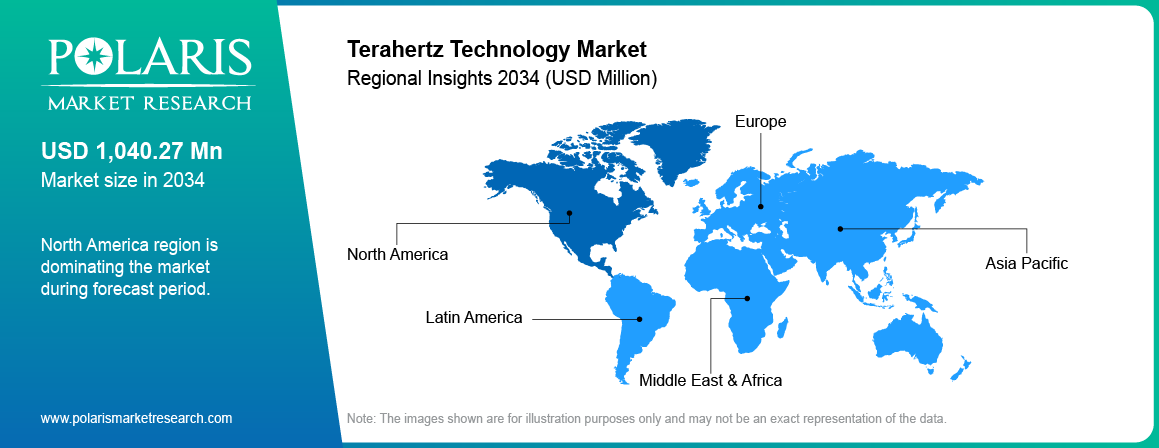
North America dominated the market with 39.8% share due to growing use of terahertz imaging and spectroscopy in security and defense systems, particularly for airport checkpoints and screening in public venues. Growing investments by government bodies and private companies in healthcare diagnostics are hastening the application of non-invasive terahertz imaging in the early detection of diseases.
The U.S. Terahertz Technology Market Overview
The U.S. led the North America market with 78.4% share due to the presence of high-class research institutions and universities driving innovation in terahertz technologies. In February 2024, MIT researchers created terahertz-driven anti-tampering tags that are more compact and affordable than radio-frequency identification (RFID), solidifying the nation's dominance in cutting-edge terahertz R&D and supply chain protection solutions.
Asia Pacific Terahertz Technology Market Insights
Asia Pacific projected to grow rapidly at a CAGR of 17.2%, driven by speedy industrialization and high-value manufacturing industries' expansion. The technology is also increasingly finding utility in new medical imaging applications as healthcare modernization gains momentum throughout the region.
China Terahertz Technology Market Analysis
China led the Asia Pacific market, due to the aggressive move towards next-generation telecommunication, including pioneering-stage 6G trials. In July 2025, China Mobile recorded 280 Gbps download speeds during a 6G test, downloading a 50GB file in 1.4 seconds showing the future commercial potential of terahertz communication.
Europe Terahertz Technology Market Assessment
Europe maintained substantial market share in terahertz technology propelled by the growing adoption of terahertz technology for industrial testing, material analysis, and process monitoring in automotive and aerospace manufacturing. European Union R&D programs' strong support further drives innovation in this technology. For example, in February 2024, an ERC project that was funded by the EU successfully established a method for ultra-accurate spatiotemporal control of terahertz waves by employing disordered materials demonstrating Europe's leading role in cutting-edge terahertz research and industrial application maturity.
Source: Polaris Market Research Analysis
Competitive Analysis
The terahertz technology market globally is moderately competitive, with firms highlighting developments in high-resolution imaging, non-destructive testing, and ultra-fast communication technologies. Innovation in products is concentrated on increasing sensitivity, miniaturization, and real-time scanning to enable applications within healthcare diagnostics, security screening, semiconductors, material inspection, and wireless communications.
Key companies operating in the global terahertz technology market include Advantest Corporation, Bakman Technologies LLC, Bridge12 Technologies, Inc., Gentec Electro-Optics Inc., HÜBNER GmbH & Co. KG, Luna Innovations Incorporated, Menlo Systems GmbH, Microtech Instrument, Inc., QMC Instruments Ltd., TeraSense Group, Inc., TeraVil Ltd., TeraView Limited, Thorlabs, Inc., TOPTICA Photonics AG, and Traycer Systems, Inc.
Key Players
- Advantest Corporation
- Bakman Technologies LLC
- Bridge12 Technologies, Inc.
- Gentec Electro-Optics Inc.
- HÜBNER GmbH & Co. KG
- Luna Innovations Incorporated
- Menlo Systems GmbH
- Microtech Instrument, Inc.
- QMC Instruments Ltd.
- TeraSense Group, Inc.
- TeraVil Ltd.
- TeraView Limited
- Thorlabs, Inc.
- TOPTICA Photonics AG
- Traycer Systems, Inc.
Terahertz Technology Industry Developments
-
January 2026: Teradar debuted the industry's first long-range (300 meters) high-resolution terahertz vision sensor, Teradar Summit, at CES 2026. With the launch, the company aims to make ADAS and autonomous driving more reliable in poor weather conditions. (source: prnewswire.com)
-
November 2025: Bruker Corporation announced the launch of its benchtop vacuum Fourier-Transform Infrared (FT-IR) spectrometer, the VERTEX NEO Ultra. According to Bruker, the spectrometer combines full automation and high spectral performance to provide faster results in industrial and academic research. (source: bruker.com) .
Terahertz Technology Market Segmentation
By Component Outlook (Revenue, USD Million, 2021–2034)
- Terahertz Sources
- Terahertz Detectors
By Product Type Outlook (Revenue, USD Million, 2021–2034)
- Imaging Scanner
- Imaging Cameras
- Antennas
- Spectrometer
- Body Scanner
By Application Outlook (Revenue, USD Million, 2021–2034)
- Imaging
- Communications
- Spectroscopy
By End-Use Outlook (Revenue, USD Million, 2021–2034)
- IT & Telecom
- Medical & Healthcare
- Laboratory Research
- Defense & Security
- Semiconductor Testing
- Others
By Regional Outlook (Revenue, USD Million, 2021–2034)
- North America
- U.S.
- Canada
- Europe
- Germany
- France
- UK
- Italy
- Spain
- Netherlands
- Russia
- Rest of Europe
- Asia Pacific
- China
- Japan
- India
- Malaysia
- South Korea
- Indonesia
- Australia
- Vietnam
- Rest of Asia Pacific
- Middle East & Africa
- Saudi Arabia
- UAE
- Israel
- South Africa
- Rest of Middle East & Africa
- Latin America
- Mexico
- Brazil
- Argentina
- Rest of Latin America
Terahertz Technology Market Report Scope
| Report Attributes | Details |
| Market Size in 2025 | USD 714.38 Million |
| Market Size in 2026 | USD 761.33 Million |
| Revenue Forecast by 2034 | USD 2,631.75 Million |
| CAGR | 15.59% from 2025 to 2034 |
| Base Year | 2024 |
| Historical Data | 2021–2024 |
| Forecast Period | 2026–2034 |
| Quantitative Units | Revenue in USD Million, Volume in Kilotons and CAGR from 2026 to 2034 |
| Report Coverage | Revenue Forecast, Competitive Landscape, Growth Factors, and Industry Trends |
| Segments Covered |
|
| Regional Scope |
|
| Competitive Landscape |
|
| Report Format |
|
| Customization | Report customization as per your requirements with respect to countries, regions, and segmentation. |
Source: Polaris Market Research Analysis
Terahertz Technology Market FAQ's
The global market size was valued at USD 714.38 million in 2025 and is projected to grow to USD 2,631.75 million by 2034.
The global market is projected to register a CAGR of 15.59% during the forecast period.
North America dominated the market with 39.8% share in 2025.
A few of the key players in the market are Advantest Corporation, Bakman Technologies LLC, Bridge12 Technologies, Inc., Gentec Electro-Optics Inc., HÜBNER GmbH & Co. KG, Luna Innovations Incorporated, Menlo Systems GmbH, Microtech Instrument, Inc., QMC Instruments Ltd., TeraSense Group, Inc., TeraVil Ltd., TeraView Limited, Thorlabs, Inc., TOPTICA Photonics AG, and Traycer Systems, Inc.
The terahertz sources segment dominated the market revenue with 36.7% share in 2025.
The spectrometers segment is projected to witness the fastest growth of CAGR 16.8% during the forecast period.
Terahertz technology comprises sophisticated systems operating within terahertz frequencies for imaging, sensing, spectroscopy, and high-speed wireless communications, with broad applications in security screening, medical diagnosis, and semiconductor inspection without causing ionizing radiation damage.
Key trends include growing adoption in 6G wireless communication, AI-driven hyperspectral imaging, expanding pharmaceutical and healthcare diagnostics applications, and rising government and private investments accelerating terahertz commercialization worldwide.
Download Sample Report of Terahertz Technology Market
Please fill out the form to request a customized copy of the research report.


