
U.S. Integrated Delivery Network Market Size, & Trend Analysis Report, 2026-2034
REPORT DETAILS
U.S. Integrated Delivery Network Market Summary
The global U.S. integrated delivery network market is estimated around USD 23.97 Billion in 2025,with consistent growth anticipated during 2026–2034. Market growth is driven by healthcare consolidation and rising adoption of digital tools to improve care coordination and operational efficiency. The market is projected to grow at a CAGR of 10.12% during the forecast period.
Market Statistics
Key Takeaways
- The services segment dominated the market in 2025 with 54.0% share, due to rising integration and consulting demand.
- The population health management segment dominated the market in 2025 accounting for 31.0% share, due to rising value-based care adoption.
- Large hospital systems dominated the market with revenue share valued at 54.0% in 2025 due to strong acquisition activity.
- The Northeast US dominated the market with 24.0% share in 2025 due to strong healthcare infrastructure.
- Major companies include Ascension Health, Cleveland Clinic, CommonSpirit Health, Geisinger Health, HCA Healthcare, and others.
Industry Dynamics
- Rising healthcare consolidation is increasing integrated care adoption.
- Value-based reimbursement models are improving demand for coordinated healthcare systems.
- Interoperability challenges continue to create operational inefficiencies.
- AI-based healthcare analytics creates long-term growth opportunities.
What is the U.S. Integrated Delivery Network Market?
Integrated delivery networks refer to healthcare systems that combine hospitals, physician groups, outpatient facilities, rehabilitation centers, pharmacies, and specialty care providers under one operational framework. These networks improve patient care coordination while reducing duplicate services and improving financial performance.
The value chain comprises software companies in healthcare, cloud computing companies, durable medical equipment manufacturers, hospitals, physicians’ practices, insurers, pharmacies, and ultimately the patients. Technology companies offer solutions in interoperability, analytics, and workflow management to facilitate coordinated delivery of health care.
The indU.S.try is expanding owing to increasing healthcare costs, shortage of physicians, pressures from reimbursements, and increasing demands for patient-centered care. Health care organizations are increasingly developing large and coordinated health care systems in order to boost efficiency and revenue performance.
Source: Polaris Market Research Analysis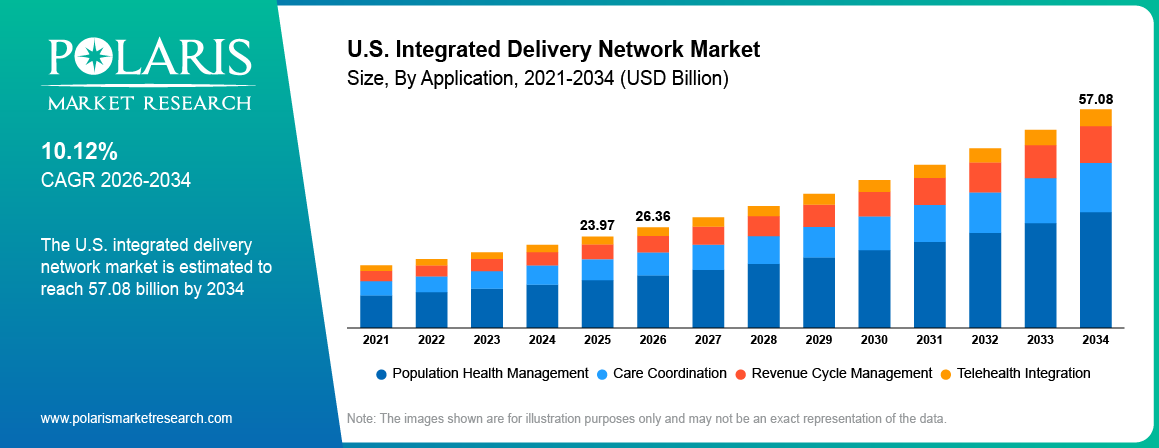
Drivers & Opportunities
Rising Shift Toward Value-Based Care: The healthcare organizations have adopted the value-based payment models from the fee-for-service payment models. Hospitals are now evaluated by the patient outcomes, readmission rates, and cost effectiveness. In February 2026, the Centers for Medicare & Medicaid Services is expanding its value-based payment models in order to enhance care coordination and cost effectiveness hence there is need for the integrated delivery networks.It assists the healthcare providers to improve the coordination among hospitals, physicians, and the outpatient facilities. This ensures no duplication in treatment and effective monitoring of the patients.
Rising Healthcare Consolidation Activities: Large hospital networks keep buying physician practices, specialty clinics, and ambulatory centers to boost their capabilities. Integration allows providers to enhance economies of scale and procurement efficiency. Many healthcare companies have been expanding their networks to enhance patient retention and coverage of services. The integration of operations continues driving demand for delivery systems.
Restraints & Challenges
Interoperability Complexity is Limiting Market Growth: Several healthcare institutions still run IT systems that are out of date, thU.S. creating data integration problems. Many hospitals have patient information stored on different systems. The integration of operational, financial, and clinical systems also calls for substantial costs. There are also cybersecurity threats posed by growing interconnected systems within the healthcare indU.S.try.
Opportunity
AI-Driven Healthcare Optimization Creates Opportunity: AI is generating tremendoU.S. opportunities in the integrated healthcare system. In February 2026, Optum introduced its AI-based platform known as Value Connect, which aims to promote care coordination, cost reduction, and value-based care within integrated healthcare networks. As AI tools help providers improve staffing efficiency, patient scheduling, diagnostic workflows, and revenue cycle management. Growing adoption of automation tools is expected to create long-term growth opportunities.
Source: Polaris Market Research Analysis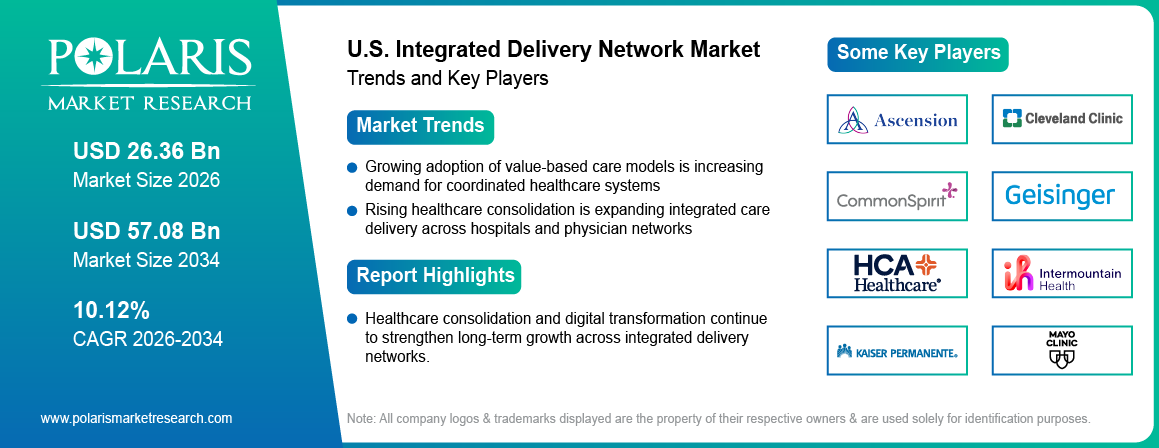
Segmental Insights
The report provides a comprehensive analysis of the U.S. integrated delivery network market by component, service model, end U.S.er to identify key revenue generating and high-growth segments.
By Component
-
Services
The services segment dominated the market with 54.0% in 2025, driven by rising demand for consulting, implementation, cloud migration, and interoperability integration services. Healthcare providers rely on third-party service firms to modernize infrastructure and improve operational efficiency. Rising outsourcing activities continue supporting segment growth.
-
Software
The software segment is projected to grow at the fastest CAGR of 11.5% during the forecast period due to rising adoption of electronic health records, patient engagement platforms, and AI-based analytics software. Healthcare organizations are spending more money on centralized software systems for decision making.
By Service Model
-
Population Health Management
Population health management emerged as the dominant segment capturing 31.0% share in 2025 due to increasing interest in chronic disease management and value-based care. Analytics tools are U.S.ed by healthcare systems to track the population and reduce re-admissions.
-
Telehealth Integration
The telehealth integration segment is expected to register the highest CAGR of 12.2% during the forecast period owing to the increasing demand for remote consultations and virtual care services. The healthcare organizations are investing in digital health care delivery platforms.
By End U.S.er
-
Large Hospital Systems
Large hospitals systems held the largest share valued at 54.0% in 2025 due to high financial strength and acquisition policies. These providers continue investing in digital transformation and centralized procurement systems.
-
Ambulatory Care Centers
The ambulatory care centers segment is projected to grow at the fastest CAGR of 11.8% during the forecast period due to rising outpatient care demand. Healthcare providers are expanding referral coordination between outpatient centers and hospitals.
Source: Polaris Market Research Analysis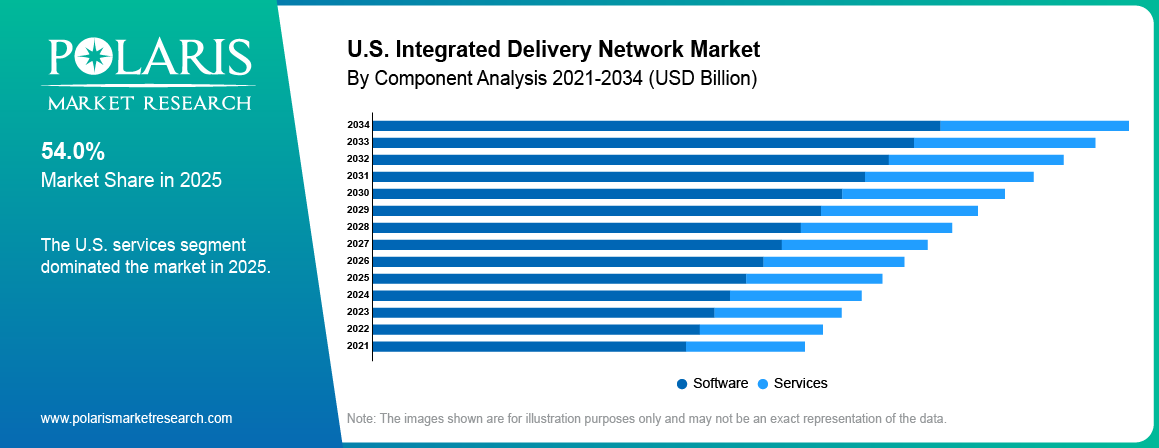
Regional Analysis
Northeast U.S. Integrated Delivery Network Market Overview
The Northeast U.S. dominated the market capturing 24.0% share of NA in 2025 due to strong healthcare infrastructure and the presence of major academic medical centers. States such as New York, MassachU.S.etts, and Pennsylvania continue investing in digital healthcare transformation. New York announced U.S.D 2.6 Billion healthcare investment is strengthening hospital infrastructure and expanding care networks.ThU.S., this is supporting the growth of integrated delivery networks across the state.
Southern U.S. Integrated Delivery Network Market Insights
The Southern U.S. is projected to grow at the fastest CAGR of 10.9% during the forecast period due to rising population growth and healthcare infrastructure investments. According to the Texas Demographic Center, Texas population reached 30.5 million, marking a 4.7% increase from April 2020 to July 2023.States such as Texas and Florida continue expanding hospital networks and outpatient care systems.
Midwest U.S. Integrated Delivery Network Market Assessment
The Midwest market is witnessing stable growth with 22.0% share in 2025 due to expanding hospital consolidation activities across Illinois, Ohio, and Michigan. Healthcare providers are increasing investments in operational efficiency tools and patient coordination systems.
Western U.S. Integrated Delivery Network Market Overview
The Western U.S. market is growing at a CAGR of 10.5% due to rising healthcare innovation and strong adoption of AI tools. California and Washington remain major hubs for digital healthcare investments and integrated care development.
Source: Polaris Market Research Analysis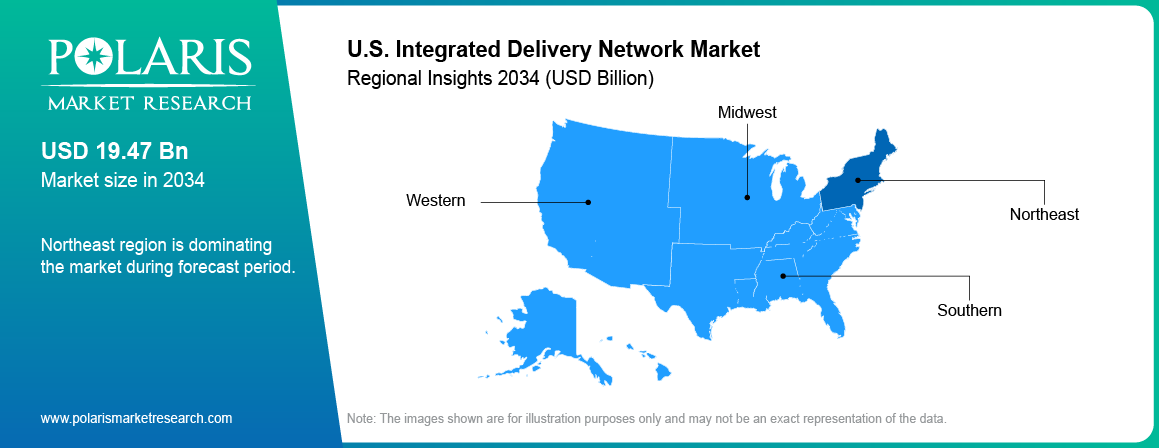
Competitive Landscape
The market is moderately consolidated due to the presence of large healthcare systems and regional hospital networks. The key competition factors include service offerings, technology, cU.S.tomer retention, and efficiency. Companies are relying on acquisitions, partnerships, artificial intelligence, and digitalization to build competitive advantage.
Major companies operating in the U.S. integrated delivery network market include Ascension Health, Cleveland Clinic, CommonSpirit Health, Geisinger Health, HCA Healthcare, Intermountain Health, Kaiser Permanente, Mayo Clinic, Providence, Sutter Health, Tenet Healthcare, UPMC, and others.
Premium Insights
AI-Powered Healthcare Ecosystems
The U.S. integrated delivery network market is moving toward AI-driven care coordination, cloud interoperability, and real-time patient intelligence platforms. Healthcare organizations are increasingly adopting connected care delivery solutions to enhance patient results and lower operational expenses.
Growth of Remote Care Models
Hospital-at-home services, remote patient monitoring, and virtual care platforms are adopted by many healthcare networks. This assists in alleviating the hospital's workload and increasing patient access.
Operational Efficiency FocU.S.
Healthcare organizations are adopting workflow automation, cybersecurity, and workforce management solutions to enhance operational efficiency and lower administrative expenses.
Personalized Preventive Care
Integrated healthcare systems are increasing focU.S. on preventive care programs and personalized treatment pathways to improve patient retention and long-term care outcomes.
Key Players
- Ascension Health
- Cleveland Clinic
- CommonSpirit Health
- Geisinger Health
- HCA Healthcare
- Intermountain Health
- Kaiser Permanente
- Mayo Clinic
- Providence
- Sutter Health
- Tenet Healthcare
- UPMC
Industry Developments
- January 2025: Arrive Health announced partnership with Amazon Web Services and to launch a generative AI solution that improves and speeds up medication access. [source: arrivehealth.com]
U.S. Integrated Delivery Network Market Segmentation
By Component Outlook (Revenue, U.S.D Billion, 2021-2034)
- Software
- Services
By Application Outlook (Revenue, U.S.D Billion, 2021-2034)
- Population Health Management
- Care Coordination
- Revenue Cycle Management
- Telehealth Integration
By End U.S.e Outlook (Revenue, U.S.D Billion, 2021-2034)
- Large Hospital Systems
- Ambulatory Care Centers
- Specialty Clinics
- Physician Groups
By Regional Outlook (Revenue, U.S.D Billion, 2021-2034)
- Northeast U.S.
- Southern U.S.
- Midwest U.S.
- Western U.S.
U.S. Integrated Delivery Network Market Report Scope
| Report Attributes | Details |
| Market Size in 2025 | U.S.D 23.97 Billion |
| Market Size in 2026 | U.S.D 26.36 Billion |
| Revenue Forecast by 2034 | U.S.D 57.08 Billion |
| CAGR | 10.12% from 2026 to 2034 |
| Base Year | 2025 |
| Historical Data | 2021–2024 |
| Forecast Period | 2026–2034 |
| Quantitative Units | Revenue in U.S.D Billion and CAGR from 2026 to 2034 |
| Report Coverage | Revenue Forecast, Competitive Landscape, Growth Factors, and IndU.S.try Trends |
| Segments Covered |
|
| Regional Scope |
|
| Competitive Landscape |
|
| Report Format |
|
| CU.S.tomization | Report cU.S.tomization as per your requirements with respect to countries, regions, and segmentation. |
Source: Polaris Market Research Analysis
U.S. Integrated Delivery Network Market FAQ's
The global market size was valued at USD 23.97 Billion in 2025 and is projected to reach USD 57.08 Billion by 2034 at a CAGR of 10.12%.
Northeast US dominated the market in 2025 capturing 24.0% share, due to the presence of large healthcare systems and high adoption of digital healthcare platforms.
Major companies operating in the market include Ascension Health, Cleveland Clinic, CommonSpirit Health, Geisinger Health, HCA Healthcare, Intermountain Health, Kaiser Permanente, Mayo Clinic, Providence, Sutter Health, Tenet Healthcare, UPMC
Market growth is driven by rising healthcare consolidation, growing adoption of value-based care models, and increasing investments in healthcare analytics platforms.
The telehealth integration segment is expected to witness highest growth rate in terms of CAGR of 12.2% owing to the growing adoption of virtual care and remote patient monitoring solutions.
The software segment is projected to grow at the fastest CAGR of 11.5% during the forecast period.
The market is expected to witness steady growth due to rising AI adoption, cloud interoperability investments, and expansion of preventive healthcare models.
Download Sample Report of U.S. Integrated Delivery Network Market
Please fill out the form to request a customized copy of the research report.


