
Virtual Event Platform Market Share, Size, Trends, Industry Analysis Report, 2022 - 2030
REPORT DETAILS
The global virtual event platform market was valued at USD 10.37 billion in 2021 and is expected to grow at a CAGR of 13.0% during the forecast period. The surging adoption of digital media marketing platforms to expand the audience base, the shift of businesses from on the role to remote working approaches, the rise in popularity of online streaming to replace in-person presentations are expected to drive the industry growth. Further, cloud services are gaining traction in SMEs and surging demand for accurate customer information, thereby enhancing the virtual event platform market growth.
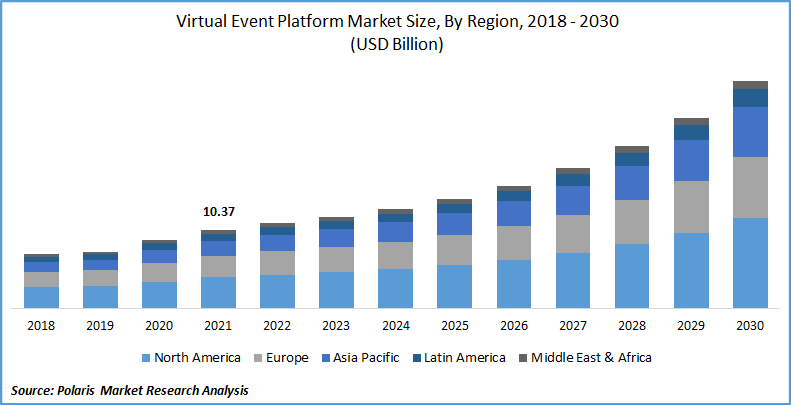
Source: Polaris Market Research Analysis
Know more about this report: Download Sample Report
These platforms are used to build new business relationships. It's easy to host and attend virtual events. They provide a higher return on investment (ROI) as they demand less money. Clients and organizations regard events or functions to be an important and useful means of communication. Companies, colleges, governments, public/private organizations, agencies, and the hospitality industry all have occasions on a regular basis, which can help the virtual event platform market grow faster.
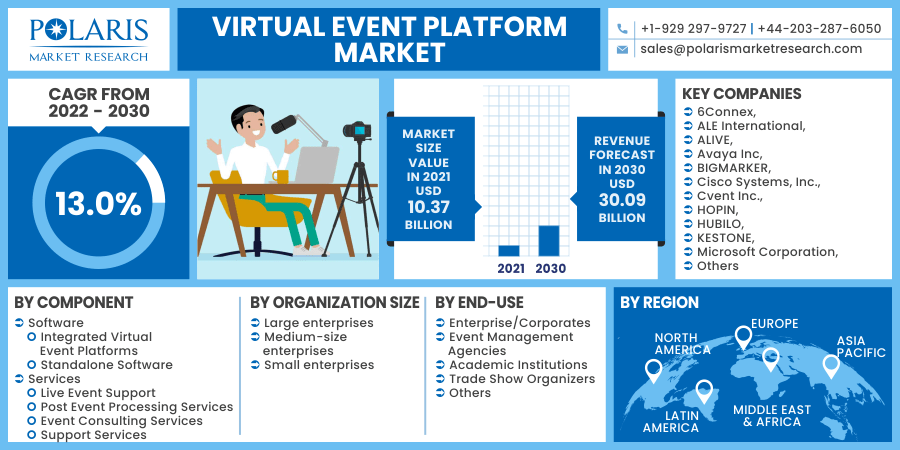
Source: Polaris Market Research Analysis
Know more about this report: Download Sample Report
Industry Dynamics
Growth Drivers
Businesses have implemented virtual software solutions for online marketing because of the rise in smartphone use and internet penetration. Furthermore, the COVID-19 epidemic prompted a spike in virtual marketing meetings to avoid real gatherings and expand the client base. Aside from that, the changing lifestyles of consumers prompted businesses to seek out new ways to create theme-based functions that could be attended from anywhere.
The firm is looking for a shift in its IT investment due to the extraordinary speed of digital transformation in 2021 to meet the problems posed by the emergence of COVID-19. Throughout the function, the audience is kept engaged and linked through the digital media platform. Marketers are focusing on online marketing methods such as new product launches, email marketing, brand promotion, advertising campaigns, and product demos as the popularity of social media grows. As a result, digital marketing efforts are on the rise.
Furthermore, technological advancements such as online conferences and software-as-a-service-based virtual events have emerged as easy, fast, and cost-effective alternatives. Through podcasting, instant messaging, and a virtual product experience, the cloud-based technology allows end-users to give an engaging experience while increasing the overall sales experience. Furthermore, live streaming is another method that has a favorable impact on the growth of the industry. More people can access information resources and better align with context thanks to living streaming events. As a result, the growing adoption of the industry by over 80% of event organizers is driving considerable growth in the global virtual event platform market.
Report Segmentation
The market is primarily segmented based on the basis of component, organization size, end-use, and region.
| By Component | By Organization Size | By End-Use | By Region |
|
|
|
|
Source: Polaris Market Research Analysis
Know more about this report: Download Sample Report
Insight by Component
The software segment holds the majority of the industry share during 2021. The software enables virtual communication from faraway locations by developing technologies such as augmented reality and 3D simulation to recreate in-person experiences. Thousands of people can share information in real-time because of the software's interactive capabilities, including a live chat box, live polls, and one-to-one video and audio chats.
Insight by Organization Size
The large enterprises' segment obtained the greatest revenue share in 2021owing to the increased demand for the deployment of digital platforms in large corporations. The growing tendency of large corporations adopting "local" strategies, with clients, employees, and other business stakeholders spread across multiple geographic regions, has increased demand for the industry in this sector. Large-scale organizations need virtual communication and collaborative platforms since it is critical to maintaining a smooth workflow across multiple locations. Following the Covid-19 pandemic, this software has allowed businesses to continue working efficiently despite any physical obstacles.
Small businesses are focusing on acquiring industry share through various growth methods and adapting to customer requests, resulting in widespread adoption of cloud services. In comparison to major organizations, these businesses confront greater obstacles in terms of restricted budgets for marketing and sales operations. They demand better approaches to resolve complications to improve the cost optimization of their business processes. However, during the projected period, the small businesses segment is expected to increase at a faster CAGR. Small businesses benefit from these platforms because they lower the overall cost of hosting a real seminar, conference, or meeting. Virtual functions are also simple to organize, affordable, and link relevant people to meetings regardless of their geographical location. Small businesses are projected to use these platforms at a quick rate as a result of these considerations.
Geographic Overview
In 2021, North America had the highest revenue share, and it is likely to continue to dominate the virtual event platform market over the forecast period. This can be attributed to the U.S and Canada's technical breakthroughs, stable economies, and advanced digital infrastructure. North America is seen as a business hub, with a higher rate of adoption of new and advanced technology.
Over the projected period, the rising usage of digitally simulated platforms, particularly in the healthcare business, is expected to move Canada's economy forward significantly. For several decades, companies like Apple, Microsoft, and Cisco Systems Inc. have been at the forefront of the North American market. These companies provide complex and cutting-edge virtual platforms with high bandwidth and stability.
Asia Pacific is predicted to be the fastest-growing industry, with a CAGR of over 14.7%. The growing awareness of this industry, increasing demand to adhere to stringent laws, the growing presence of virtual event platform suppliers, increasing government initiative and support, and improving return on investments contribute to the industry expansion. The public and private sectors are investing heavily in asset management, increasing demand for such advanced solutions and services.
Competitive Insight
List of Key Virtual Event Platform Companies Studied:
- 6Connex,
- ALE International,
- ALIVE,
- Avaya Inc,
- BIGMARKER,
- Cisco Systems, Inc.,
- Cvent Inc.,
- HOPIN,
- HUBILO,
- KESTONE,
- Microsoft Corporation,
- On24,
- REMO,
- vFairs,
- ZOOM
Recent Developments:
In January 2026: Zoom Video Communications upgraded its AI Companion to automatically create meeting summaries and action points within its Events platform.
In December 2025: Microsoft added generative AI translation for live events in Teams Premium, supporting more than 40 languages.
In November 2025: Cvent acquired Splash for USD 200 million, adding branded microsite and email marketing tools to its platform.
In October 2025: Cisco introduced Webex Hologram, displaying life-size 3D avatars for meetings without the need for headsets.
In May 2025, AMS (Atlanta Media Services), a major media production and streaming firm announced the launch of a new hybrid event service named Hybridley. The virtual event platform aims to connect live and online audiences by offering customized experiences for organizers based on their brand and goals.
In April 2025, In The Room, a well-known player in the events industry launched a new virtual event platform in the United States. The service helps organizations host immersive, live online events to engage audiences using modern technology.
In February 2025, RingCentral, a leading communication and collaboration provider announced the launch of Studio to upgrade its RingCentral Events platform. The professional production solution is designed to improve virtual event experiences for users in Australia and New Zealand.
Virtual Event Platform Market Report Scope
| Report Attributes | Details |
| Market size value in 2021 | USD 10.37 billion |
| Revenue forecast in 2030 | USD 30.09 billion |
| CAGR | 13.0% from 2022 - 2030 |
| Base year | 2021 |
| Historical data | 2018 - 2020 |
| Forecast period | 2022 - 2030 |
| Quantitative units | Revenue in USD million and CAGR from 2022 to 2030 |
| Segments covered | By Component, By Organization Size, By End-Use, By Region |
| Regional scope | North America, Europe, Asia Pacific, Latin America, Middle East & Africa |
| Key Companies | 6Connex, ALE International, ALIVE, Avaya Inc, BIGMARKER, Cisco Systems, Inc., Cvent Inc., HOPIN, HUBILO, KESTONE, Microsoft Corporation, On24, REMO, vFairs, ZOOM |
Source: Polaris Market Research Analysis
Virtual Event Platform Market FAQ's
The global Virtual Event Platform Market is expected to reach USD 30.09 Billion by 2030, growing at a CAGR of 13.0% during the forecast period.
The market was valued at USD 10.37 Billion in the base year, reflecting solid growth potential through digital event adoption.
Rising demand for remote collaboration, virtual meetings, webinars, and hybrid events is pushing companies and organizations to adopt scalable event technologies.
These platforms reduce event costs, expand audience reach, enable interactive engagement, and offer analytics for performance tracking across digital events.
Virtual event platforms leverage cloud infrastructure, live streaming, real-time chat, analytics dashboards, and interactive multimedia features to enhance virtual experiences.
Virtual event platforms are used for corporate conferences, trade shows, webinars, product launches, training sessions, and hybrid industry gatherings.
Hybrid events combine physical and digital participation, allowing organizations to engage both in-person and remote attendees, boosting flexibility and event ROI.
Download Sample Report of Virtual Event Platform Market
Please fill out the form to request a customized copy of the research report.


