
Wave and Tidal Energy Market Share, Size, Trends, Industry Analysis Report, 2026 - 2034
REPORT DETAILS
Wave and Tidal Energy Market Summary
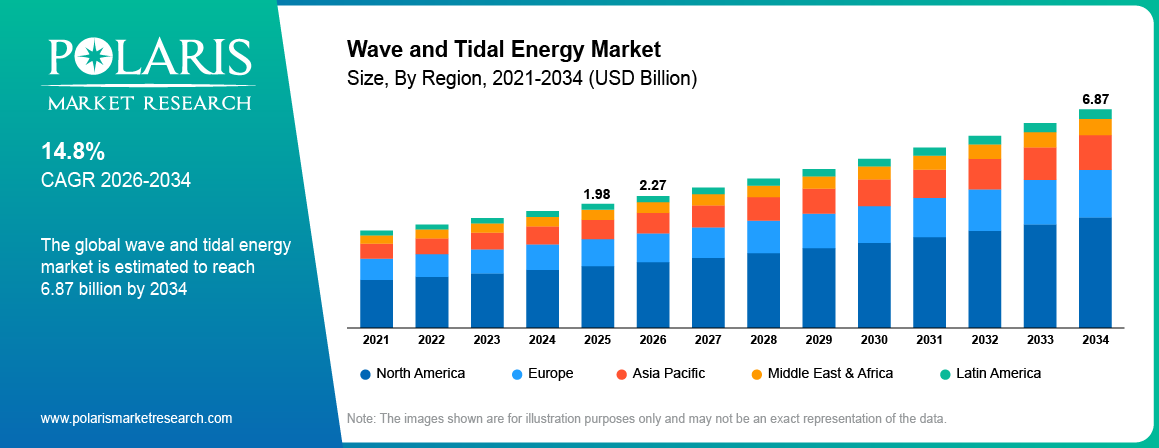
The global wave and tidal energy market was valued at USD 1.98 billion in 2025. The market is expected to grow at a CAGR of 14.8% from 2026 to 2034. The growing need to replace existing energy sources and rising funding from the public and private sectors are key factors driving market development.
Market Statistics
Key Takeaways
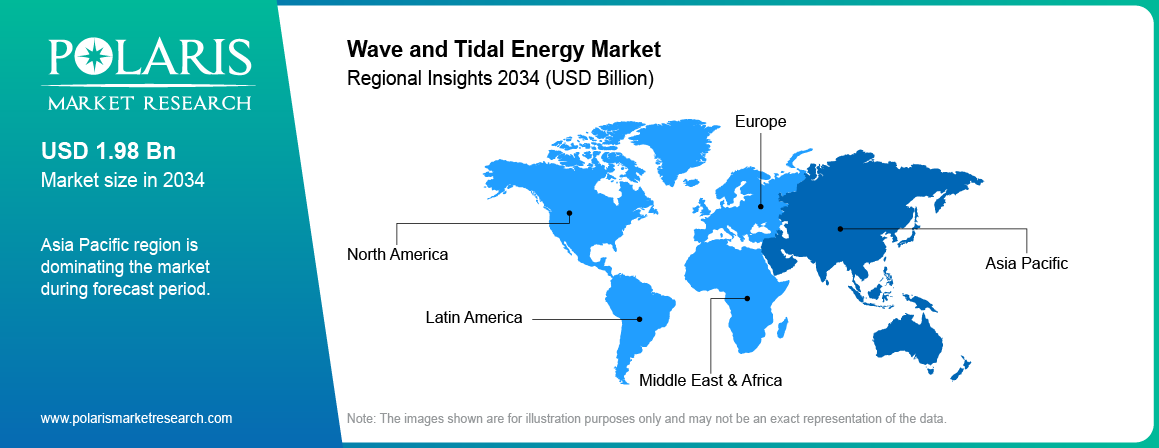
- Asia Pacific held substantial share of 28.9% in 2025. This is due to the growing number of environmental regulations and public funding programs.
- North America is projected to witness the fastest growth at a 34.5% CAGR. Rising awareness of green energy resources is contributing to regional market growth.
- The tidal stream generator segment is expected to witness significant growth at a 33.7% CAGR. This is due to a rising shift toward cleaner fuel sources.
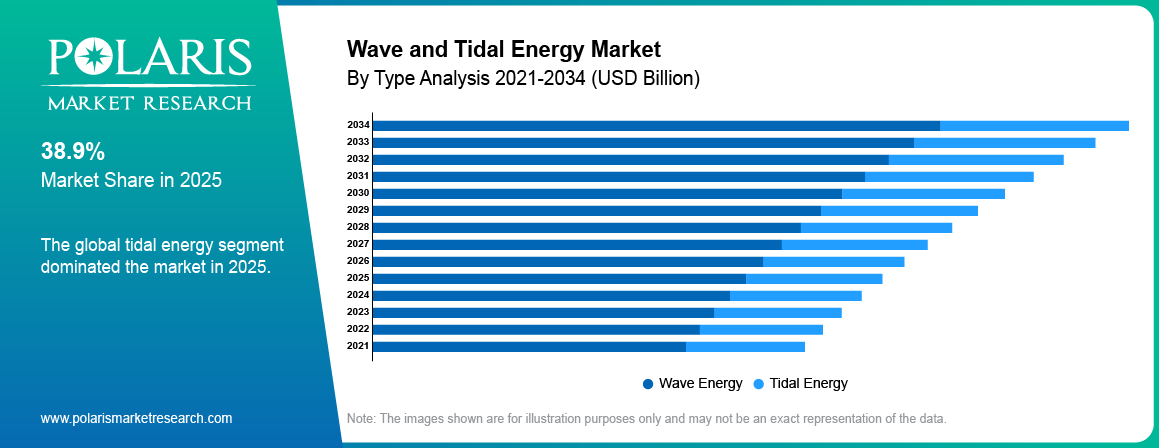
- The tidal energy segment accounted for the share of 38.9% in 2025. The segment’s dominance is driven by increase in awareness towards green energy.
- The desalination segment is projected to grow at a 33.6% CAGR. This is because seawater is being increasingly used for producing portable drinking water.
Note: Figures and projections outlined in this report are the result of Polaris Market Research’s proprietary analytical processes, grounded in the latest available datasets and market observations.
AI Impact on Wave and Tidal Energy Market
- The use of AI technology enables optimal production of wave and tidal energy by assessing oceanographic variables and optimizing the system’s functions.
- AI allows for the prediction of machine problems to avoid downtimes at marine energy plants.
- AI assists in predicting wave and tidal energy, thereby improving power production.
- AI improves energy forecasting, enabling more efficient energy production.
To Understand More About this Research: Download Sample Report
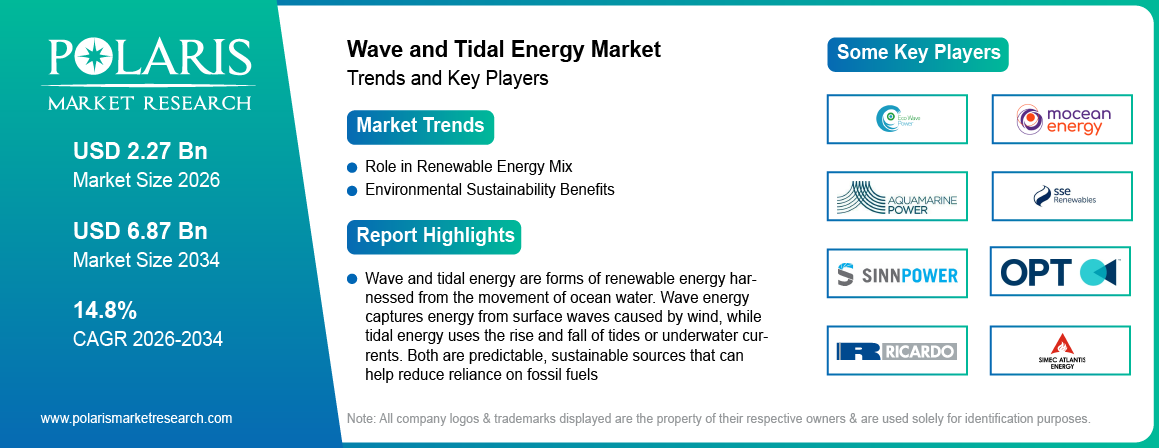
Wave and tidal energy are forms of renewable energy harnessed from the movement of ocean water. Wave energy captures energy from surface waves caused by wind, while tidal energy uses the rise and fall of tides or underwater currents. Both are predictable, sustainable sources that can help reduce reliance on fossil fuels
Technological advancements and ease of development deployed along with growing funding from the public & private sectors in the wind and tidal industry have resulted in higher adoption of the market worldwide. For instance, in October 2022, the U.S. Department of Energy, announced the funding of USD 35 million, for the advancements of the existing river and tidal energy systems. Various structure and component developers in the market are undertaking several cost-cutting initiatives, which include the use of advanced materials, environmental monitoring, and better control of software and systems. Moreover, various upcoming development activities in the globally especially in developed countries such as France, Canada, United Kingdom, and Sweden are expected to fuel the growth. For instance, in June 2021, EcoWave Power announced the installation of a wave conversion device at Jaffa, Israel. The project is funded by Israel’s Energy Ministry & EDP project collaborates with the EDF renewables IL. It will be located on land, which has enabled better and easy access for operations and maintenance.
Market Dynamics
Growth Drivers
What are the Factors Driving the Market Growth?
The rapid increase in power generation with the help of renewable energy sources to meet the global demand and rising power generation capacity globally are factors driving the growth. Energy conversion by the several oceans wave is considered one of the leading technologies for generating over 1,000-10,000 GW of electrical power, which is projected to foster market growth and propel large growth opportunities to produce electricity with ocean wave power. Furthermore, the high transformation of energy around the world is fueling the renewable sector through growing development priorities, technological progress, and others owing to increasing environmental concerns and the high exhaustion of fossil fuels. The United Kingdom is the country expected to have the highest potential for wave power & produced around 20% of its electric energy from ocean waves, in 2020. Countries such as the U.K. have initiated various strategies for the development and growth of clean energy including a reduction in carbon emissions, advancement in leading technology, and cost reduction in technology, thereby driving the growth.
Role in Renewable Energy Mix
The relevance of wave and tidal power as sources of energy is on the rise worldwide amid efforts by states to diversify energy sources and enhance electricity grid security. While wind and solar energies are subject to variability, tidal energies operate within cycles that can easily be predicted ahead of time. Predictable tidal energies make it easier for utility companies to match electricity production with consumer demands without relying heavily on conventional sources of energy. The rising popularity of renewable sources of energy presents an opportunity for wave and tidal energy technologies to work in conjunction with other renewable energy sources, such as solar and wind energy.
Environmental Sustainability Benefits
Wave energy and tidal energy have numerous environmental advantages in that they generate electricity using the movement of oceans without emitting any form of greenhouse gases into the atmosphere. Wave energy and tidal energy play an important role in helping countries minimize dependency on fossil fuels while dealing with climate change and moving towards clean energy sources. Besides the emission of low amounts of carbon, wave and tidal energy do not need fuel, nor do they involve the extraction of fuel, transportation, or combustion of fuel. Wave and tidal energy have become increasingly popular in light of the Sustainable Development Goals and zero-emissions objectives that countries aim to achieve.
Report Segmentation
The market is primarily segmented based on technology, application, and region.
| By Type | By Application | By Technology | By Region |
|
|
|
|
Source: Polaris Market Research Analysis
Know more about this report: Download Sample Report
Which Segment by Type Dominated with Largest Share in 2025?
The tidal energy segment accounted for the share of 38.9% in 2025 due to a rapid increase in awareness towards green energy. Growing stringent government rules and regulations on the emission of greenhouse gases are driving the awareness regarding green energy. Tidal energy is an alternative for the generation of energy from fossil fuels without harming the environment which is compelling companies to seek these types of pollution-free energy generation methods and fostering the segment market growth in recent years.
Why desalination is expected to Register Significant Growth?
The desalination segment is expected to grow over the anticipated period as the emergence of seawater as a practice to produce portable drinking water and the wide utilization of these systems due to their more resilient nature are major reasons propelling the growth of the segment. Moreover, the ability of the desalination process to provide fresh water for various purposes including human consumption and agriculture as it removes salt and other types of unwanted content from the seawater is further fueling its adoption, thereby driving the segment growth.
Regional Insights
How Asia Pacific Captured Market Share in 2025?
Asia Pacific held substantial share of 28.9% in 2025 due to a growing number of environmental regulations, public funding programs, and various government favorable policies and initiatives to promote the use of pollution-free renewable energy resources. Major countries in region such as China has turned into a major market in the wave and tidal energy sector due to various national test sites and a growing focus on the development of the electricity generation process, thereby driving the growth in Asia Pacific.
What is the Reason for North America's Fastest Growth?
North America is projected to witness the fastest growth at a 34.5% CAGR, owing to the availability of highly developed technology and growing awareness of green energy resources in the region. Countries such as Canada has presence of a strong legislative framework and national public funding for tidal energy. For instance, Nova Scotia is one of eastern Canada’s Maritime Provinces in the enhancement and development of FORCE, the leading research center of in-stream tidal energy, with a contribution of USD 11 million, along with the support for a wide range of strategic research projects in the marine energy sector. Consequently, driving the growth in the region.
Competitive Insight
- Eco Wave Power
- Mocean Energy
- Aquamarine Power
- SSE Renewables
- Wello Oy
- SINN Power
- Ocean Power Technologies
- Orbital Marine Power
- Ricardo
- SIMEC Atlantis Energy
- Tidal Lagoon
- Andritz Hydro Hammerfest
- Tenax Energy
- CorPower Ocean
- ocean energy.
Recent Developments
- May 2026: Eco Wave Power U.S. Inc., a wholly owned subsidiary of Eco Wave Power Global AB, joined the NVIDIA Inception program. The program will enable the company to access NVIDIA's technical resources and ecosystem to advance AI-driven renewable energy infrastructure. (source: ecowavepower.com)
- March 2026: Eco Wave Power Global AB announced the submission of the final project completion report to Shell International Exploration and Production Inc. According to Eco Wave Power, the submission marks the completion of the wave energy pilot objectives under thePilot Test Agreement signed between the companies in 2024. (source: ecowavepower.com)
- February 2025: Eco Wave Power and Bharat Petroleum signed an MoU to explore wave-energy projects along India’s coast, conducting feasibility studies and pilot schemes to support India’s shift toward marine-based renewable power. (Source: ecowavepower.com)
Wave and Tidal Energy Market Report Scope
| Report Attributes | Details |
| Market size value in 2025 | USD 1.98 billion |
| Market size value in 2026 | USD 2.27 billion |
| Revenue forecast in 2034 | USD 6.87 billion |
| CAGR | 14.8% from 2026 – 2034 |
| Base year | 2025 |
| Historical data | 2021 – 2024 |
| Forecast period | 2026 – 2034 |
| Quantitative units | Revenue in USD billion and CAGR from 2026 to 2034 |
| Segments covered | By Type, By Application, By Technology, By Region |
| Regional scope | North America, Europe, Asia Pacific, Latin America; Middle East & Africa |
| Key companies | Eco Wave Power, Mocean Energy, Aquamarine Power, SSE Renewables, Wello Oy, SINN Power GmbH, Ocean Power Technologies, Orbital Marine Power, Tacardo B.V., SIMEC Atlantis Energy, Tidal Lagoon Plc, Andritz Hydro Hammerfest, Tenax Energy, CorPower Ocean AB, and OceanEnergy. |
Source: Polaris Market Research Analysis
Wave and Tidal Energy Market FAQ's
The market size was valued at USD 1.98 Billion in 2025 and is projected to grow to USD 6.87 Billion by 2034.
The market is projected to register a CAGR of 14.8% during the forecast period
A few of the key players in the market are Eco Wave Power, Mocean Energy, Aquamarine Power, SSE Renewables, Wello Oy, SINN Power GmbH, Ocean Power Technologies, Orbital Marine Power, Tacardo B.V., SIMEC Atlantis Energy, Tidal Lagoon Plc, Andritz Hydro Hammerfest, Tenax Energy, CorPower Ocean AB, and OceanEnergy.
The tidal energy segment accounted for the share of 38.9% in 2025.
The desalination segment is projected to grow at a 33.6% CAGR
Wave and tidal energy are renewable forms of energy harnessed from ocean water movement wave energy captures surface wave power, while tidal energy utilizes rising and falling tides or underwater currents.
Key trends include rising renewable power demand, technological advancements, growing public and private funding, stricter greenhouse gas regulations, and expanding applications in power generation and desalination globally.
Download Sample Report of Wave and Tidal Energy Market
Please fill out the form to request a customized copy of the research report.


