
Wireless Charging Market Size, Share, Growth Global Analysis Report, 2026-2034
REPORT DETAILS
Wireless Charging Market Summary
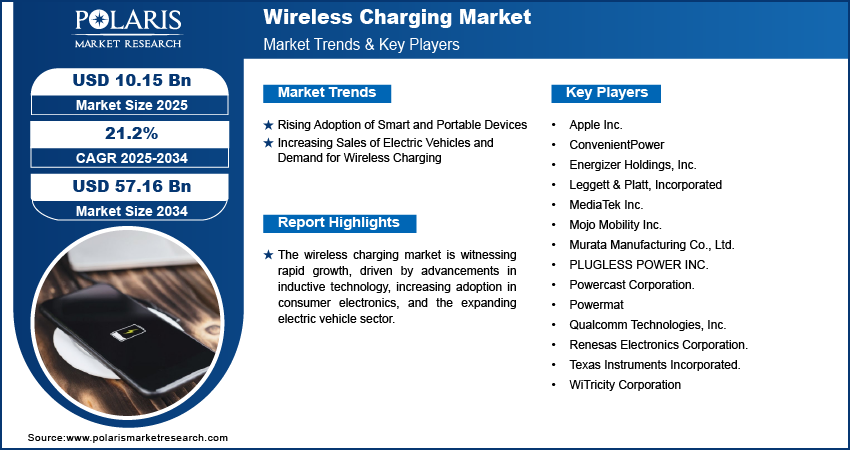
The wireless charging market size was valued at USD 10.15 billion in 2025. The market is projected to grow from USD 12.28 billion in 2026 to USD 57.16 billion by 2034, exhibiting a CAGR of 21.2% from 2026 to 2034. The market is driven by increasing adoption of smartphones, electric vehicles, and wearable devices, and growing demand for convenience and cable-free charging. The market is also benefiting from advancements in charging technology, rising consumer awareness, and expanding infrastructure in public and commercial spaces.
Market Statistics
Key Takeaways
- North America is expected to witness the highest growth rate of 22.1%. This is due to the high penetration of advanced consumer electronic devices and the shift towards integrating wireless charging in personal devices.
- Asia Pacific accounted for the largest market share of 41.35% in 2025. The rapid adoption of smartphones and other wireless-enabled devices contributes to the regional market growth.
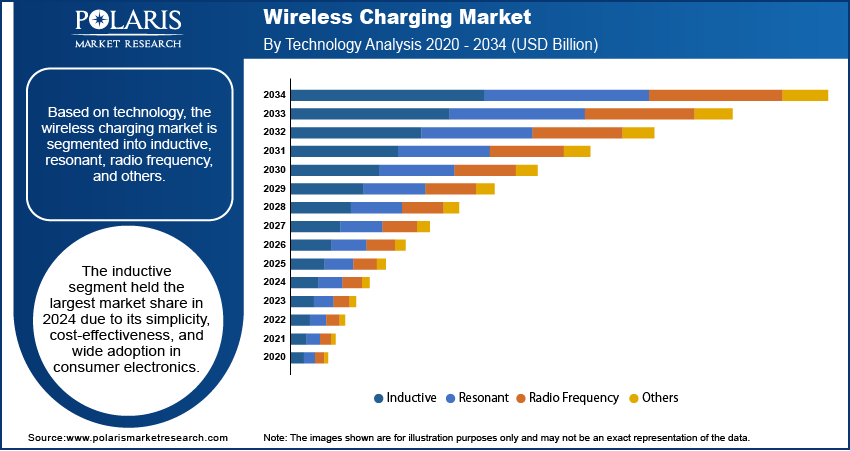
- The inductive segment led with a 55.4% revenue share in 2025. The simplicity and cost-effectiveness of inductive wireless charging contribute to the segment’s leading market position.
- The consumer electronics segment is poised for the fastest growt at a 22.3% CAGR. It is driven by rising demand for cable-free charging in smartphones, wearables, and other portable devices.
- The receivers segment accounted for the market share of 34.7% in 2025. This is owing to the high integration of wireless charging receivers into consumer electronics.
Note: Figures and projections outlined in this report are the result of Polaris Market Research’s proprietary analytical processes, grounded in the latest available datasets and market observations.
Industry Dynamics
- The rising demand for convenient charging in smartphones and wearables is fueling the adoption of wireless technologies across consumer electronics.
- The increasing integration of wireless charging in electric vehicles is enhancing the user experience and supporting the shift toward sustainable mobility.
- High implementation costs and slower charging speeds compared to wired alternatives are limiting the widespread adoption of this technology.
- Growing investment in long-range and fast wireless charging technologies presents a significant opportunity for market expansion and innovation.
Source: Polaris Market Research Analysis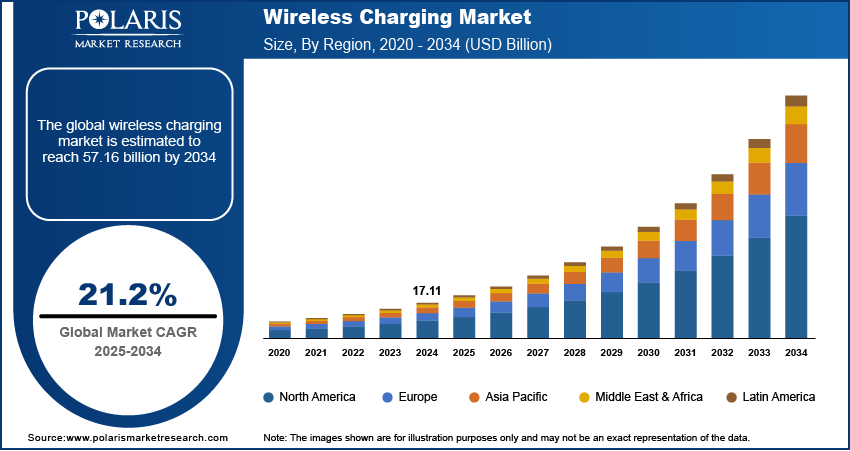
Wireless charging, also referred to as “inductive charging,” is an innovative technology that allows for the convenient charging of devices without a charging cable. The widespread adoption of wireless charging in consumer electronics such as smartphones and tablets drives the wireless charging market growth. This technology offers a convenient, cable-free solution to power devices, with applications expanding into the automotive, healthcare, industrial, and defense sectors. Wireless charging systems have become more efficient, supporting faster charging speeds and improved energy transfer, which enhances user experience as technology advances. Wireless charging is also transforming wearable technology by enabling compact, waterproof, and fully sealed designs. The emerging trend toward smaller gadgets and consumer demand for flexible, faster charging solutions would fuel the market growth in the coming years. Despite its advantages, wireless charging is generally more expensive than wired charging, with compatibility limited to Qi-enabled devices. For instance, in April 2023, the wireless power consortium (WPC) released the Qi2 standard following the approval of the Qi v. 2.0 Interface Specification. The new standard enhances energy efficiency, faster charging, and broader compatibility for mobile devices and wearables, addressing consumer demand for sustainable and reliable products. However, as charging pads become more compact and durable, consumer preference for wireless solutions is expected to rise during the forecast period, reshaping the way devices are powered across various sectors.
Wireless Charging vs Wired Charging
| Factors | Wireless Charging | Wired Charging |
| Convenience | High | Moderate |
| Cable Usage | Not required | Required |
| Charging Speed | Moderate to High | High |
| Wear and Tear on Port | None | Possibility |
| Ease of Placement | Easy | Requires plug |
Source: Polaris Market Research Analysis
Market Dynamics
Rising Adoption of Smart and Portable Devices
The growing use of smartphones, tablets, wearables, and other portable electronics has boosted the demand for wireless charging solutions. The elimination of tangled wires and the ease of simply placing devices on a charging pad have become key selling points as consumers increasingly seek convenience. The trend toward smaller, more compact devices further amplifies this demand, as wireless charging enables manufacturers to create sleeker, more streamlined products without compromising functionality. In September 2024, Apple introduced the iPhone 16 Pro Max Titanium, featuring a 4,865mAh battery with support for 15W wireless charging. The device takes approximately 2 hours and 20 minutes to achieve a full charge using a compatible 15W wireless charger. This shift toward smart and portable devices is a primary driver for the industry's growth.
Increasing Sales of Electric Vehicles and Demand for Wireless Charging
The rise in electric vehicle (EV) sales is driving demand for more innovative charging solutions, including wireless charging systems. Both consumers and manufacturers are seeking more efficient, user-friendly ways to charge vehicles with the growing adoption of EVs. In November 2024, InductEV highlighted its three-year program with Volvo Cars at the World of Volvo Experience Center in Gothenburg, Sweden. The initiatives are a part of Volvo's Green City Zone project, which showcased 20 electric XC40 taxis using InductEV's wireless, in-ground charging technology, achieving 100% uptime and seamless performance under various conditions, marking a milestone for future autonomous taxi fleets. Wireless charging offers the advantage of eliminating the need for physical connectors and cables, providing a more seamless and convenient charging experience. The market demand is poised for continued growth, supporting the broader adoption of electric mobility as EV infrastructure expands and charging systems become more advanced.
Key Aspects of Wireless Charging
Inductive Charging: This is the most popular form of wireless charging technology that involves the use of electromagnetic coils for charging devices such as phones and other wearables. The use of this technology is popular for home, office, and public charging locations due to its convenience.
Resonant Charging: Unlike inductive charging, resonant charging technology enables charging of devices from greater distances and charging several devices simultaneously. Hence, it is best applied in locations where several devices are required to charge simultaneously.
Radio Frequency Charging: The radio frequency charging technology involves the transmission of energy using RF waves to charge devices such as sensors and IoT devices. It is suitable for devices requiring continuous low power.
Wireless EV Charging: The innovation incorporates the use of wireless charging technology to power electric vehicles. This is accomplished conveniently via parking charging or road charging.
Fast Wireless Charging: Significant progress has been made in the innovation towards enhancing charging speed and efficiency. Demand for fast, efficient chargers has greatly increased their adoption.
Source: Polaris Market Research Analysis
Segment Analysis
By Technology Outlook
The global wireless charging market segmentation, based on technology, includes inductive, resonant, radio frequency, and others. The inductive segment led with a 55.4% revenue share in 2025 due to its simplicity, cost-effectiveness, and wide adoption in consumer electronics. Inductive charging works through electromagnetic induction, where an electric current is transmitted between two coils, enabling efficient power transfer. This technology is well-established and has been integrated into devices such as smartphones, wearables, and home appliances. Its widespread use in everyday consumer devices and compatibility with the Qi standard further solidifies its market leadership, making it the most popular choice in wireless charging solutions.
By Application Outlook
The global wireless charging market segmentation, based on application, includes automotive, consumer electronics, industrial, healthcare, defense, and others. The consumer electronics segment is poised for the fastest growt at a 22.3% CAGR during the forecast period due to the high demand for convenient, cable-free charging solutions in smartphones, tablets, wearables, and other portable devices. Wireless charging technology has gained significant traction in this sector as consumers increasingly prioritize convenience and aesthetics. The growth of the IoT technology and the trend toward smaller, more compact devices further drive this demand. Consumer electronics continues to lead the market in terms of volume and innovation with the widespread adoption of wireless charging standards such as Qi.
Source: Polaris Market Research Analysis
Regional Insights
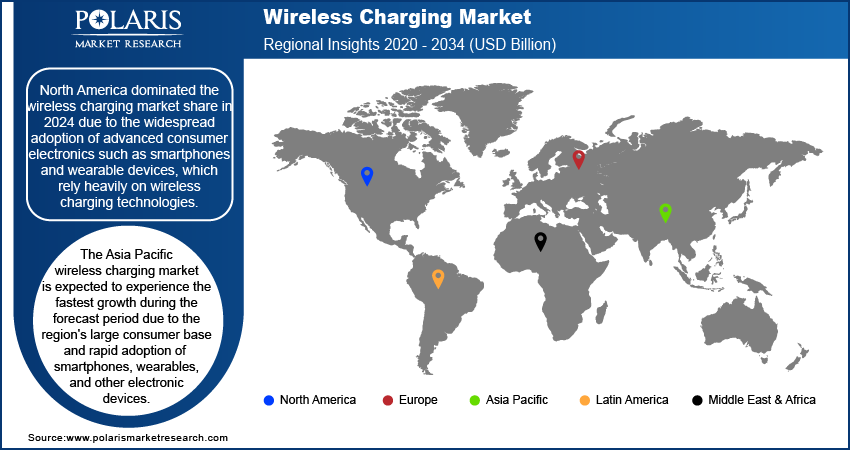
By region, the study covers North America, Europe, Asia Pacific, Latin America, and the Middle East & Africa. North America is expected to witness the highest growth rate of 22.1% due to the widespread adoption of advanced consumer electronics, such as smartphones and wearable devices, which rely heavily on wireless charging technologies. The region's strong focus on research and development, backed by investments from technology giants, further fueled innovation in this sector. Additionally, the growing demand for electric vehicles (EVs) in the US and Canada boosted the adoption of wireless charging solutions for EVs, enhancing the regional market growth. The California Energy Commission (CEC) is investing up to USD 100 million annually through its Clean Transportation Program to develop charging infrastructure and support the transition to zero-emission vehicles (ZEVs) in California. This initiative aligns with the state’s climate goals, including achieving 1.5 million ZEVs by 2025 and 100% ZEV sales by 2035. The presence of a well-established technology infrastructure and early adoption of innovative solutions positioned North America as a leader in the global market. Moreover, supportive government policies and increasing collaborations among key industry players contributed to its market dominance.
Source: Polaris Market Research Analysis
The wireless charging market in Asia Pacific accounted for the largest market share of 41.35% in 2025 due to the region's large consumer base and rapid adoption of smartphones, wearables, and other electronic devices. Countries such as China, Japan, and South Korea are leading innovation, driven by their robust electronics manufacturing industries and investments in wireless charging technologies. The growing electric vehicle (EV) market in the region, supported by government incentives and increasing EV infrastructure development, is also propelling the regional market growth. Additionally, rising disposable incomes and urbanization have boosted consumer demand for advanced technologies. Collaborations between global and local players further contribute to the wireless charging market expansion in the region.
Key Players and Competitive Analysis
The competitive landscape of the wireless charging market features a mix of global leaders and regional players competing to capture market share through innovation, strategic partnerships, and regional expansion. Key global players such as Qualcomm, Samsung, and Powermat Technologies leverage their strong R&D capabilities and extensive distribution networks to deliver advanced wireless charging solutions. Industry trends show increasing demand for technologies such as fast-charging solutions, Qi-enabled devices, and wireless charging for electric vehicles (EVs), driven by advancements in electronics & consumer goods plastics and EV infrastructure. The market is projected to experience significant growth, particularly in regions such as Asia Pacific, which is expected to record the highest CAGR. Regional players capitalize on localized needs by offering cost-effective and customized solutions, especially in emerging markets. Competitive strategies include mergers and acquisitions, collaborations with technology providers, and the introduction of innovative products to meet growing consumer demand for convenience and sustainability. These developments highlight the importance of technological innovation, market adaptability, and regional investments in driving the expansion of the wireless charging industry. Apple Inc.; ConvenientPower; Energizer Holdings, Inc.; Leggett & Platt, Incorporated; MediaTek Inc.; Mojo Mobility Inc.; Murata Manufacturing Co., Ltd.; PLUGLESS POWER INC.; Powercast Corporation; Powermat; Qualcomm Technologies, Inc.; Renesas Electronics Corporation; Texas Instruments Incorporated; and WiTricity Corporation are a few key major market players.
Apple Inc., an American multinational technology company headquartered in Cupertino, California, has evolved from its origins as a personal computer manufacturer into a leader in consumer electronics, software, and services. The company's flagship products include iPhone, iPad, Mac computers, Apple Watch, and AirPods. One of Apple's significant innovations is its approach to wireless charging. Introduced with the iPhone 8 and iPhone X in 2017, Apple adopted the Qi wireless charging standard, allowing users to charge their devices without plugging in cables. This technology utilizes electromagnetic fields to transfer energy between a charging pad and the device, enhancing user convenience and promoting a cleaner design devoid of ports. Apple's wireless charging ecosystem includes accessories such as the MagSafe Charger for iPhones and the AirPods charging case. In addition to convenience, Apple emphasizes safety and efficiency in its wireless charging solutions. The MagSafe technology aligns magnets within the charger and device for optimal placement, ensuring efficient energy transfer while preventing overheating. This innovation improves charging speeds and it also enhances user experience by simplifying the process of connecting devices to power sources.
Qualcomm Technologies, Inc. is an American multinational corporation headquartered in San Diego, California, specializing in wireless technology. Established in 1985 by Irwin Jacobs and a group of co-founders, Qualcomm has pioneered advancements in digital wireless communications, particularly through its development of CDMA technology which became integral to mobile communication standards such as 3G and 4G. The company operates primarily as a semiconductor fabless manufacturer, focusing on designing and marketing integrated circuits and system software for various wireless applications, including smartphones, laptops, and IoT devices. In addition to its core semiconductor business, Qualcomm has made significant strides in the realm of wireless charging technology. The company acquired HaloIPT in 2011, a firm specializing in wireless electric vehicle charging solutions. This acquisition underscored Qualcomm's commitment to expanding its influence in the automotive sector and enhancing the convenience of charging electric vehicles without physical connections. Qualcomm's wireless charging technologies are designed to enable efficient energy transfer through electromagnetic fields, allowing devices to charge simply by being placed on a compatible surface. This innovation simplifies the user experience and aligns with the growing demand for sustainable and convenient energy solutions in a world increasingly reliant on mobile and connected devices.
List of Key Companies
- Apple Inc.
- ConvenientPower
- Energizer Holdings, Inc.
- Leggett & Platt, Incorporated
- MediaTek Inc.
- Mojo Mobility Inc.
- Murata Manufacturing Co., Ltd.
- PLUGLESS POWER INC.
- Powercast Corporation.
- Powermat
- Qualcomm Technologies, Inc.
- Renesas Electronics Corporation.
- Texas Instruments Incorporated.
- WiTricity Corporation
Industry Development
- April 2026: ROHM Semiconductor launched an ultra-compact wireless power chipset comprising the ML7670 receiver and the ML7671 transmitter. The company stated that the chipset is designed specifically for small wearables, such as smart rings and bands. It uses NFC technology for 13.56 MHz charging. (source: rohm.com)
- March 2026: Powercast demonstrated its wireless power technology as a "backbone" for battery-free sensing and continuous data collection at the edge. The technology supports the massive data influx required by modern AI models. (source: powercastco.com)
- July 2025: Belkin, a leading consumer electronics brand and contributor to the Qi standard, announced on its official press site that it had obtained Qi2 25W certification for its upcoming wireless charging products. (Source: belkin.com)
- January 2024: Valeo launched Ineez Air Charging, a wireless EV charging solution operating at a low frequency of around 3kHz. This system offers high efficiency, compatibility with various grids and vehicles, and Vehicle-to-Grid (V2G) functionality. It is designed for public and private charging locations. (Source: valeo.com)
- May 2024: Innovative step forward for electric vehicle technology, WiTricity, a pioneer in wireless charging solutions, joined forces with International Transportation Service LLC (ITS) to kickoff a groundbreaking pilot program at the Port of Long Beach. This six-month initiative will put WiTricity’s cutting-edge wireless charging technology to the test in real-world scenarios, helping to assess its effectiveness and efficiency. (Source: prnewswire.com)
Market Segmentation
By Component Outlook (Revenue, USD Billion, 2021–2034)
- Transmitters
- Receivers
By Technology Outlook (Revenue, USD Billion, 2021–2034)
- Inductive
- Resonant
- Radio Frequency
- Others
By Application Outlook (Revenue, USD Billion, 2021–2034)
- Automotive
- Consumer Electronics
- Industrial
- Healthcare
- Defense
- Others
By Regional Outlook (Revenue, USD Billion, 2021–2034)
- North America
- US
- Canada
- Europe
- Germany
- France
- UK
- Italy
- Spain
- Netherlands
- Russia
- Rest of Europe
- Asia Pacific
- China
- Japan
- India
- Malaysia
- South Korea
- Indonesia
- Australia
- Vietnam
- Rest of Asia Pacific
- Middle East & Africa
- Saudi Arabia
- UAE
- Israel
- South Africa
- Rest of Middle East & Africa
- Latin America
- Mexico
- Brazil
- Argentina
- Rest of Latin America
Future of Wireless Charging Market
Wireless charging is anticipated to witness robust growth due to increasing preference for a convenient cable-less solution. Innovations in quick charging, long-range charging, and multi-device charging are likely to boost market acceptance. Market growth will be fueled by developments in smart homes, smart cars, and wireless charging stations. In addition, standardization and improved energy efficiency are expected to fuel market expansion.
Report Scope
| Report Attributes | Details |
| Market Size Value in 2025 | USD 10.15 billion |
| Market Size Value in 2026 | USD 12.28 billion |
| Revenue Forecast by 2034 | USD 57.16 billion |
| CAGR | 21.2% from 2026–2034 |
| Base Year | 2025 |
| Historical Data | 2021–2024 |
| Forecast Period | 2026–2034 |
| Quantitative Units | Revenue in USD billion and CAGR from 2026–2034 |
| Report Coverage | Revenue Forecast, Market Competitive Landscape, Growth Factors, and Trends |
| Segments Covered |
|
| Regional Scope |
|
| Competitive Landscape |
|
| Report Format |
|
| Customization | Report customization as per your requirements with respect to countries, regions, and segmentation. |
Source: Polaris Market Research Analysis
Wireless Charging Market FAQ's
The global wireless charging market size was valued at USD 10.15 billion in 2025 and is projected to grow to USD 57.16 billion by 2034
The global market is projected to register a CAGR of 21.2% during the forecast period
North America is expected to witness the highest growth rate of 22.1%.
A few key players in the market are Apple Inc.; ConvenientPower; Energizer Holdings, Inc.; Leggett & Platt, Incorporated; MediaTek Inc.; Mojo Mobility Inc.; Murata Manufacturing Co., Ltd.; PLUGLESS POWER INC.; Powercast Corporation; Powermat; Qualcomm Technologies, Inc.; Renesas Electronics Corporation; Texas Instruments Incorporated; and WiTricity Corporation.
The inductive segment led with a 55.4% revenue share in 2025
The consumer electronics segment is poised for the fastest growt at a 22.3% CAGR
Key trends include rising smartphone and EV adoption, growing demand for cable-free convenience, fast-charging innovations, Qi2 standard expansion, IoT integration, and increasing wireless charging infrastructure in public and commercial spaces globally.
Download Sample Report of Wireless Charging Market
Please fill out the form to request a customized copy of the research report.


