
Open Radio Access Network (Open RAN) Market Size, Share, Trends and Forecast, 2026–2034
REPORT DETAILS
Open Radio Access Network (Open RAN) Market Summary
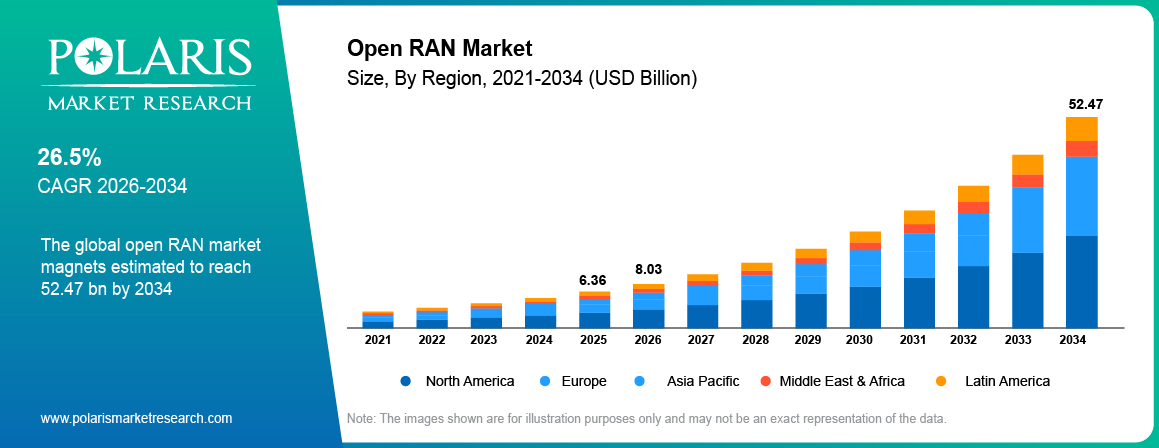
The Open Radio Access Network (Open RAN) market size was valued at USD 6.36 billion in 2025. The market is projected to account for a CAGR of 26.5% from 2026 to 2034. The global expansion of 5G network rollouts has resulted in operators seeking highly adaptable network architectures. Governments supporting vendor-diversification policies are also contributing to the open radio access network market growth.
Market Statistics
Key Takeaways
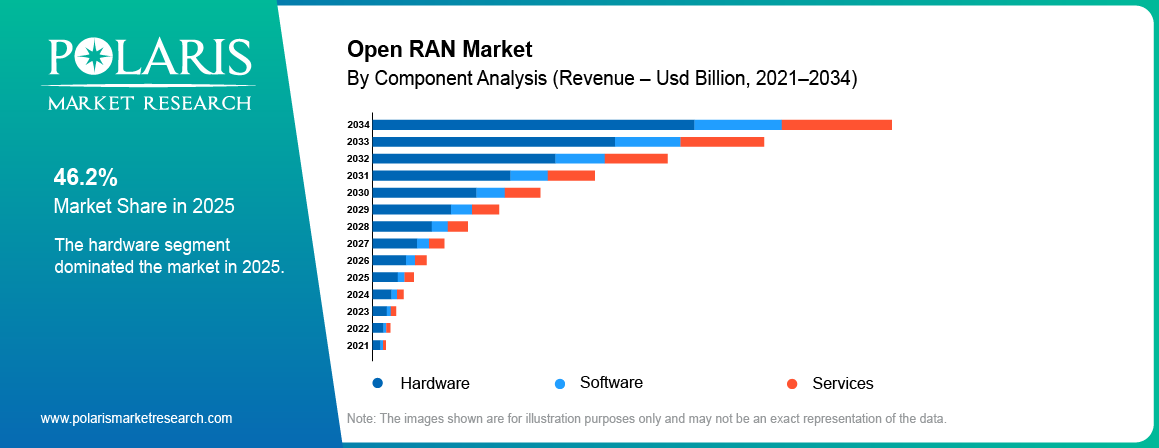
- North America leads the global Open RAN market. The regional Open RAN market size was 40.9% of total revenue share in 2025. The region’s early adoption of advanced solutions contributes to its market dominance.
- Asia Pacific is projected to witness the fastest growth at an 29.4% CAGR. Rising demand for advanced telecom infrastructure and favorable government policies drive the regional growth.
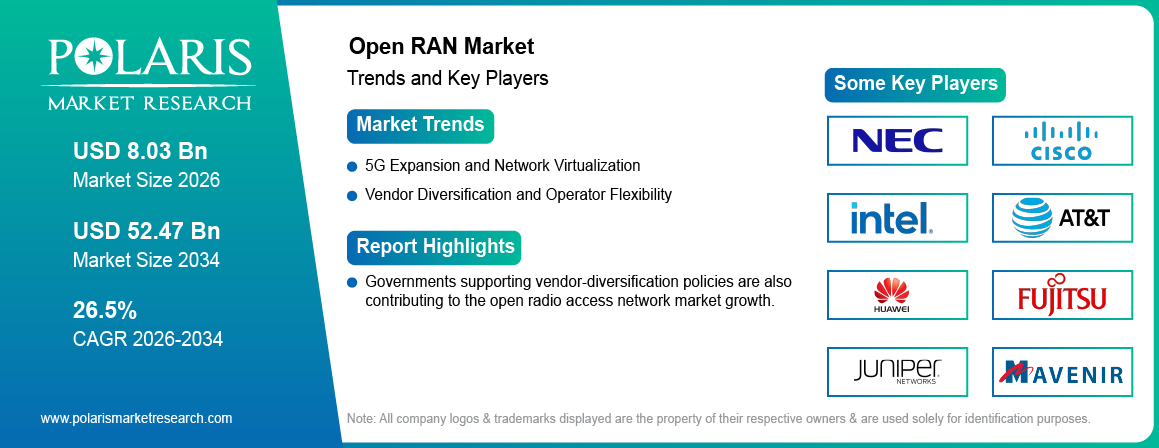
- By component, the hardware segment held an 46.2% market share in 2025. This is because hardware enables superior and flexible data and voice services to end-users.
- By unit, the radio unit segment is projected to register rapid growth at an 27.8% CAGR. The increased usage of radio units for enhancing network performance contributes to the segment’s growth.
- By deployment, the hybrid cloud segment led with an 34.6% Open RAN market share in 2025. Hybrid cloud deployment offers the flexibility of public cloud and the security of private cloud.
- By network, the 5G segment dominated with an 58.7% share in 2025. This is owing to the shift from 4G to 5G networks across several countries globally.
Note: Figures and projections outlined in this report are the result of Polaris Market Research’s proprietary analytical processes, grounded in the latest available datasets and market observations.
What Is Open RAN?
Open RAN refers to the approach for developing mobile networks where open interfaces are used for connecting radio access network devices supplied by different vendors.
In a conventional RAN, operators usually purchase most of their equipment from a single vendor. With the Open RAN architecture, these components are decoupled, and the operator can buy them from different vendors. This is what is called a disaggregated RAN.
The O-RAN Alliance creates technical specifications for open interfaces and network functions that are intended to ensure multi-vendor interoperability. Testing is needed to verify the compatibility of such solutions in real deployments.
Moreover, open RAN architecture may help avoid vendor lock-in issues. Operators will be able to select various suppliers or upgrade their network components. However, the integration and further management processes can get more complicated since the equipment is provided by various vendors.
How Does Open RAN Work
In Open RAN, there is a division of the radio access network into individual components. Such components interact with each other through open interfaces. This makes it possible for operators to mix components from different vendors. The network handles radio traffic of mobile devices and connects them to the mobile network. Software will help operators control the performance of the network and its capacity.
How the Signal Path Works:
- Device: Mobile device generates radio signals and receives them.
- Radio Unit (RU): RU transmits and receives radio signals in the air.
- Distributed and Central Units (DU/CU): DU/CU processes traffic and connections.
- Open Interfaces: Standardized connections enable components to communicate.
- Software Control: Network software manages functions of the network. It also helps optimize performance.
- Monitoring: Operators track the performance of the network and identify issues.
Architecture: RU, DU, CU and RIC
The O-RAN Alliance provides the specifications for an open and disaggregated radio access network.
O-RU (Radio Unit): This part transmits and receives radio signals. Moreover, it performs radio frequency processing.
O-DU (Distributed Unit): Processes time-critical radio functionalities. In addition, it manages lower-level radio protocols.
O-CU (Central Unit): Manages higher-level protocols and connections with the core network.
RIC (RAN Intelligent Controller): The RAN intelligent controller uses software and data to improve network performance.
An open fronthaul interface connects O-RU and O-DU. This interface makes it possible to ensure interoperability of compatible equipment from various vendors. Other interfaces interconnect network functionality and management systems.
Near-RT RIC is used for near-real-time control. Non-RT RIC performs long-term optimization and policy management.
Open RAN vs Traditional RAN vs vRAN
Open RAN, traditional RAN, and vRAN differ in how network components are built and managed. The table compares their architecture, vendor flexibility, and potential impact on costs.
| Comparison factor | Traditional RAN | Open RAN | vRAN / Cloud RAN |
| Architecture | Hardware and software are usually supplied as one integrated system. | A disaggregated RAN uses separate components connected through open interfaces. | RAN functions run as software on virtualized computing infrastructure. |
| Vendor choice | Operators often use equipment from a single vendor. | Operators can select compatible equipment from different vendors, supporting multi-vendor interoperability. | Vendor choice depends on software and infrastructure compatibility. |
| Vendor lock-in | Proprietary systems can make switching vendors difficult. | Open interfaces can help reduce vendor lock-in. | Switching depends on platform and infrastructure requirements. |
| Deployment | Uses integrated equipment designed for a specific vendor's system. | Combines compatible components from different suppliers. | Runs network functions on general-purpose computing hardware. |
| Cost considerations | Costs depend on the vendor's equipment and service model. | Open RAN cost savings depend on equipment choices, integration, and ongoing maintenance. | Virtualization can improve hardware utilization, depending on the deployment. |
| Main focus | Integrated hardware and software | Open interfaces and vendor choice | Software-based network functions |
Source: Polaris Market Research Analysis
Open RAN Market Dynamics
The Open RAN market is driven by 5G growth and the requirement for flexibility in networks. Companies are exploring cost management and supplier diversification. However, security and integration issues remain. The emergence of private 5G and IoT provides additional opportunities.
Driver: 5G Expansion and Network Virtualization
The deployment of 5G networks is increasing the need for flexible radio access networks. As operators upgrade their networks, they must also manage equipment and maintenance costs. With the disaggregated RAN, they can buy their radio and processing parts separately. Virtualization enables them to implement network functionalities in software on general-purpose hardware. Thus, they can benefit from greater flexibility while scaling up their networks. Deployments of private 5G networks are adding to this demand, especially from companies that require exclusive wireless services. In March 2026, AT&T announced that over 50% of its network traffic traveled through open-capable devices. AT&T also reported the installation of live Cloud RAN systems in two cities (source: att.com). These announcements reflect how network operators are preparing their current infrastructure for an open and software-defined architecture. Open RAN can assist them in adapting to changing connectivity requirements.
Driver: Vendor Diversification and Operator Flexibility
The telecom operators are considering Open RAN solutions to widen their choice of equipment providers. Proprietary solutions may create lock-in conditions that limit operators’ ability to change providers due to specific technology used. Open interfaces provide multi-vendor interoperability through compatible components provided by different vendors. Diversification of telecom supply chains initiated by the government is another reason for this interest. Operators strive to gain more flexibility in terms of procurement and future upgrades. As an example, in September 2026, NTT DOCOMO started operations of Nokia base stations equipped with radio units from several different providers following O-RAN Alliance specifications (source: docomo.ne.jp). This example provides operators with practical evidence of multi-vendor solutions in action. Nevertheless, before scaling up the operations, they must analyze compatibility and integration issues.
Restraints and Challenges: Integration and Cost Challenges
Open RAN can provide operators with more flexibility, but it may not be easy to manage the equipment that comes from various vendors. The components have to interact with each other while maintaining the quality of network services. There is also the need to ensure the consistency of the service quality within the network. Security management becomes another challenge. The components and interfaces have to be configured and managed correctly. This adds to network engineers' workload. The initial cost can also be high. There can be a need for investment by operators in new infrastructure and staff training. This may take time to realize any monetary benefits of its implementation. Open RAN cost savings depend on the trade-off between these initial costs and the overall cost of ownership (TCO). The cost advantages may be realized through better supplier options and flexibility in upgrades. However, continued integration and maintenance costs may reduce those gains.
Market Opportunities: Private 5G, Rural Connectivity, and IoT Expansion
Private 5G networks offer an opportunity to adopt Open RAN technology. Corporations can select their network parts based on connectivity requirements. Open interfaces provide operators with increased flexibility in extending the coverage of rural areas. Nevertheless, cost factors and the availability of the backhaul connection remain important considerations. The development of connected devices is increasing the need for flexible networking solutions. The implementation of Open RAN will help IoT applications within factories and intelligent infrastructure. With edge computing, companies can process data in close proximity, thus increasing the speed of the application’s response. IoT analytics can help convert data from connected devices into operational intelligence.
Open RAN Market Trends
Open RAN trends are moving from openness of interfaces to network management through software. Cloud-native approach, improved security control, enterprise connection, and energy efficiency are some factors influencing its deployment.
Trend: Cloud-Native Architecture, Virtualization and Edge
Cloud native architecture is changing the way operators build and operate radio access networks. vRAN allows operating network software on a standardized computing platform and not binding every operation to specialized equipment. In cloud RAN, some of the processing operations will take place in a centralized or shared cloud. Containerizing software into smaller components makes deployment and upgrades easier. Automation can handle routine operations such as configuration, scalability, and recovery. Edge computing shapes network architecture as well. Functions at the edge can reduce latency for nearby users and devices. Operators can allocate processing among central, regional, and edge sites depending on requirements for particular services. Network function virtualization is an example of the same approach where network functions are separated from dedicated hardware. Operators need to handle software complexity and maintain predictable performance.
Trend: Security, Zero-Trust and Architecture Control
Different manufacturers may provide Open RAN components and interfaces, which adds complexity to security management. The operators require the same controls regarding authentication, authorization, software updates, logging, and traffic protection. Supplier management and regular testing should be included in the deployment strategy. A zero-trust model does not trust a device, a user, or any functionality of the network by default. Access is verified according to the identity, access permissions, and security policy. This model allows operators to control access between the components and analyze abnormal behavior. The O-RAN Alliance Security Working Group develops security requirements, protocols, and test specifications for the O-RAN systems. Their work covers architectural components and interfaces. However, having specifications alone does not guarantee security. Operators and vendors need to configure their systems properly and coordinate updates across multi-vendor environments.
Trend: Private 5G and Enterprise Networks
Private 5G is useful for enterprise customers who want wireless access that is designed for their particular sites. In the case of factories, private 5G networks can be used to connect devices used in production, inspection, and mobile robots. Private 5G networks can also be used in logistics companies for their connected vehicles and scanning machines. In some cases, healthcare providers may require such connections for their connected medical devices, and mines require connections across large, changing sites. Open RAN offers another option for selecting radio and software components for private 5G networks. This depends on site coverage, capacity, latency, and reliability requirements. Compatibility with existing IT systems is another factor. Some enterprises rely on telecom partners to operate their private networks. Others manage more of the infrastructure within their organizations.
Trend: Energy Efficiency and Sustainability
Energy use is now being considered when designing Open RAN networks. AI-powered energy savings can control the energy used by radios and computing by balancing the traffic needs. The software can lower the energy utilization during low traffic times without affecting the service levels. The cloud resource management system can enhance computing capacity management in network functionalities. Consolidation can result in reducing the idleness of hardware, but this will depend on the traffic and infrastructure. It is crucial for operators to monitor energy consumption alongside performance. Energy conservation must not create coverage gaps or degrade services.
AI Impact on the Open RAN Market
Artificial intelligence is changing the way network operators manage and optimize their radio access networks. Its major use cases are:
- Network optimization: Optimizing the network’s resources according to demand.
- Predictive maintenance: Detecting possible issues before they interrupt services.
- Energy management: Lowering energy consumption during low-demand periods.
- Automated operations: Decreasing manual network planning and configuration.
Ericsson and SoftBank revealed in August 2026 that an AI native RAN trial on the commercial 5G network of SoftBank increased the spectrum efficiency and downlink user throughput by about 10% on average (source: ericsson.com). These results demonstrate that AI can boost the efficiency of the network without rebuilding the whole infrastructure.
AI-RAN and the RAN Intelligent Controller (RIC)
AI-RAN applies artificial intelligence to radio access network operations. It can help operators improve resource allocation and respond to changing traffic conditions. The longer-term direction is an AI-native RAN, where AI is built into network functions and management rather than added as a separate tool.
The RAN intelligent controller (RIC) provides a framework for intelligent network optimization. It has two main forms. The Non-RT RIC handles longer-term optimization, policy management, and AI model lifecycle tasks. It works with the Service Management and Orchestration (SMO) framework. Applications called rApps run within this environment and can support functions such as performance analysis and policy optimization.
The Near-RT RIC supports faster control loops. It uses network data to guide actions such as traffic steering and radio resource optimization. Applications called xApps run on this controller and can respond to changing network conditions. The two controllers work together through defined interfaces, with the Non-RT RIC providing policies and guidance to the Near-RT RIC. The O-RAN Alliance RIC specifications describe the architecture and its intended functions.
However, defined architecture does not automatically mean widespread production use. A June 2026 audit found no named production Near-RT xApp deployment with published results (source: 5g6gacademy.com). This evidence gap makes it important to distinguish technical specifications and trials from independently documented operational outcomes. AI-RAN development is advancing, but the maturity of specific applications still needs to be assessed.
2026 Update: Policy and Carrier Trials
The Open RAN 2026 landscape exhibits ongoing government support and developments in commercialization. However, adoption varies among operators and markets.
Policy and Funding
Government spending continues to be a crucial means of financing Open RAN innovation. In the UK, the Open Networks Ecosystem competition has been allocated about £80.5 million to support projects dealing with open interfaces, network performance, and diversified suppliers (source: gov.uk). The initiative supports the research and development of software, hardware, and live trials. It aims to address technical challenges that could hinder implementation of the technology on a larger scale. The UK targets 35% of mobile traffic to go through open and interoperable infrastructure by 2030 (source: gov.uk).
Carrier Deployments and Trials
Several operators advanced their Open RAN programs in 2026. Samsung and Orange announced plans to expand their virtualized RAN and Open RAN sites in Europe. The next phase builds on earlier pilots and aims to extend deployment across additional sites.
Rakuten Mobile also progressed its network rollout. 1Finity reported that Rakuten had completed deployment of its 5G radio units within its virtualized Open RAN network. The operator plans to introduce additional massive MIMO radios to improve network capacity (source: 1finity.com).
In Germany, Vodafone continued its Open RAN program with Samsung. The companies have been expanding deployments beyond their initial test site, with Wismar identified as a key step in the rollout. Their work combines open network architecture with newer processing technology.
These developments reflect different stages of adoption. They also show that Open RAN deployments by operators vary by market and network strategy. Trial results and live commercial networks should be assessed separately when evaluating progress across the industry.
Earlier Developments (2024–2025)
Developments during 2024 and 2025 helped establish the foundation for later deployments. Vodafone advanced its commercial Open RAN program, including deployments in the UK and activity through its innovation hub in Spain. In March 2025, the O-RAN Alliance showcased 33 demonstrations of technologies based on open RAN specifications at Mobile World Congress. The demonstrations covered RAN Intelligent Controllers, interoperability, and security (source: o-ran.org). Later that year, the Alliance's Fall Global PlugFest involved 64 companies and institutions across 19 laboratories. The work focused on automation, network optimization, energy efficiency, and security (source: prnewswire.com). These activities helped mature the ecosystem before further carrier initiatives in 2026.
Open RAN Market Segmentation
| Segmentation Axis | Segments |
| By Component | Hardware · Software · Services |
| By Network | 5G · 4G · Others |
| By Unit | Radio Unit · Distributed Unit · Centralized Unit · RAN Intelligent Controller |
| By Frequency | Sub-6 GHz · mmWave |
| By Deployment | Private · Hybrid Cloud · Public Cloud |
| By Region | North America (US, Canada) · Europe (Germany, France, UK, Italy, Spain, Netherlands, Russia, Rest of Europe) · Asia Pacific (China, Japan, India, Malaysia, South Korea, Indonesia, Australia, Vietnam, Rest of Asia Pacific) · Middle East & Africa (Saudi Arabia, UAE, Israel, South Africa, Rest of Middle East & Africa) · Latin America (Mexico, Brazil, Argentina, Rest of Latin America) |
Source: Polaris Market Research Analysis
By Component
The hardware segment accounted for the largest Open RAN market share of 46.2% in 2025. This segment includes the physical devices required to set up radio access networks. It includes the radio devices, processing devices, and other pieces of infrastructure that would be required for transmission, reception, and processing of the network signals. Demand varies with the size of the network setup and requirements at each location. Selection of hardware also depends on the compatibility of the hardware with open interfaces and other network components. As the telecommunications operators continue to increase the size of their network infrastructure, the hardware constitutes a significant portion of deployment costs. Its market position reflects the requirement for physical equipment across Open RAN deployments.
The services segment is projected to witness rapid growth at an 27.8% CAGR. Telecommunications providers require external assistance in designing and deploying Open RAN networks. This is especially the case when utilizing equipment from several vendors. Consulting services include the evaluation of network needs and selection of appropriate solutions. Implementation services involve the installation, configuration, and testing of the equipment. Support and maintenance services address technical problems and ensure that the network functions properly after installation. The demand for such services is influenced by the presence of competent network engineers. Telecommunications companies that lack these engineers may rely on specialized service providers.
By Network
The 5G segment held the largest Open RAN market share of 58.7% in 2025. Telecom providers are implementing open networking solutions as they extend 5G services and enhance their network capacity. The 5G product category comprises devices and software that will be utilized by fifth-generation mobile networks. Telecom operators can opt for components that are compatible with their needs in terms of coverage and performance. The demand for the solution is also influenced by the level of development of 5G technology in each individual market. In the markets where 5G infrastructure is already established, network enhancements could be the priority; however, in others, coverage area expansion will take place. These requirements drive the need for Open RAN technology suitable for 5G networks.
The 4G segment is projected to witness rapid growth at an 24.6% CAGR. The majority of operators still use 4G networks to offer mobile broadband solutions in both urban and rural zones. Open RAN can serve as an alternative way to replace old equipment or extend the current network. It covers network devices that can offer LTE services and interact with appropriate infrastructure. Additionally, some operators can utilize 4G networks as a means to get used to open interfaces before implementing them in other networks. Demand depends on the condition of the current network, the schedule of upgrades, and the costs of replacing the old equipment. The continued need to maintain 4G services supports investment in this segment.
By Unit
The distributed unit segment led the Open RAN market with an 32.8% share in 2025. The functions of the distributed unit (DU) include the performance of time-critical baseband processing and lower-layer radio protocol management. The DU is quite crucial in performing baseband processing in the communication between the radio unit and the central unit. The need for DUs is influenced by the needs of network capacity, the structure of the sites, and the amount of traffic processed by each base station. Open RAN provides operators with the option of selecting compatible DU hardware and software from various suppliers. This gives them more choice when planning network upgrades or replacing existing equipment.
The radio unit segment is projected to grow at an 27.8% CAGR. Radio units facilitate the transmission and reception of wireless communications between mobile devices and the network infrastructure. Their demand is driven by the need to extend coverage areas, build new sites, and upgrade existing radio infrastructures. In addition, operators require radio units that fit the frequency bands and network technologies chosen. Open RAN allows the procurement of such units independently of other network components, based on interfaces and tests. The growing range of available equipment helps operators in choosing radios according to their needs.
By Frequency
The sub-6 GHz segment held the largest Open RAN market share of 72.4% in 2025. The range of these frequency bands is larger compared to mmWave, thus allowing for the development of rural and urban network infrastructure using these frequencies. In addition, they may help increase signal penetration into buildings, depending on the frequency and environment surrounding them. Telecom operators deploy sub-6 GHz spectrum to increase coverage of 5G networks without the need for denser site networks of higher frequencies. The demand for Open RAN equipment in this category is shaped by spectrum availability and network expansion needs. Demand is also driven by improvements in coverage of current service areas.
The mmwave segment is expected to grow at an 29.6% CAGR. Such frequencies have enough bandwidth and can transmit data at very high speeds where there is sufficient network connectivity. They can be used in high-foot-traffic areas. These include stadiums, transport terminals, and business districts. However, millimeter waves travel shorter distances and could be impeded by buildings. The operators would need additional radio equipment in order to ensure reliable connectivity. The Open RAN technology offers an alternative way to get compatible radio equipment while creating high-capacity mmWave networks.
By Deployment
The hybrid cloud segment led the market with an 34.6% share in 2025. The use of this deployment model involves private and public cloud resources. Operators of telecommunication services will have an option to maintain their sensitive network functions in private clouds and rely on public cloud resources for other purposes. It enables the operators to have greater control over the location of processing the network data and even to vary computing resources according to their network needs. Hybrid cloud deployment demand depends on infrastructure and data management requirements and control over network functions.
The private cloud segment is projected to witness rapid growth at an 28.3% CAGR. A private cloud implementation will give operators more control over the computing environment as well as the data on their network. It can be ideal for operators who require dedicated computing or have security and performance requirements. A private cloud platform lets them implement network function management within their own computing environment or through a dedicated provider. As Open RAN networks are more dependent on software, network functions can be managed through private cloud resources.
Open RAN Use Cases
| Use Case | Recent Example |
| Automated network operations | In February 2026, Rakuten Mobile and Rakuten Symphony announced nationwide deployment of RAN Intelligent Controller applications. The initiative supports automated network management and third-party application integration. (source: rakuten.com) |
| Multi-vendor radio integration | In July 2026, Rakuten Mobile confirmed the commercial deployment of 1Finity radios in its virtualized network. The radios work with Rakuten Symphony's centralized and distributed units. (source: 1finity.com) |
| Cloud-based network infrastructure | In February 2026, Samsung and Orange announced plans to expand their vRAN and Open RAN deployments in Europe. The next phase builds on earlier field trials and live network integration. (source: samsung.com) |
| Affordable fixed wireless access | In November 2025, OREX SAI and SURGE launched a full-scale 5G fixed wireless access deployment in Indonesia. The project uses Open RAN-based technology to extend broadband access. (source: docomo.ne.jp) |
| Open RAN security | In March 2026, OREX SAI, KCCTech, and Palo Alto Networks partnered to introduce a secure Open RAN solution for commercial deployment in Singapore. The project addresses security requirements in open network environments. (source: kcctech.com) |
Source: Polaris Market Research Analysis
Open RAN Regional Insights
Open RAN adoption varies by region. Market growth depends on telecom companies’ investments and upgrade plans. While some regions prioritize 5G expansion, other regions seek to reduce reliance on a single vendor. These factors shape regional demand for Open RAN technology.
North America
North America accounted for the largest Open RAN market share of 40.9% in 2025. The telecom operators in the region are upgrading their networks and offering 5G services. The U.S. accounts for a considerable portion of regional demand owing to investments made in its telecommunications infrastructure. Operators have opted for open network architectures in order to achieve greater flexibility when choosing equipment providers. Open RAN enables them to choose compatible components from various vendors. Canada also contributes to regional demand through investments in next-generation mobile networks. Expansion of 5G coverage and the requirement for flexible network infrastructure will drive Open RAN growth in North America during the forecast period.
Europe
Europe held an 27.6% Open RAN market share in 2025. The Open RAN market in Europe is driven by initiatives to encourage competition among telecom equipment vendors. Some telecom operators in Europe are considering open network systems in order to gain greater vendor flexibility. In addition, the adoption of Open RAN technology also aligns with Europe’s focus on developing a diversified telecommunications supply chain. Countries including Germany, the UK, and France have well-developed telecom sectors that can drive demand for network upgrades. The introduction of 5G networks is another driver of Open RAN in the region. Telcos are evaluating open network options as they upgrade their existing networks and plan for future rollouts.
Asia Pacific
Asia Pacific is projected to witness rapid growth at an 29.4% CAGR. Asia Pacific is an important market for Open RAN, and India and Japan are driving regional demand. The Indian telecom players are seeking flexible networking options to roll out 5G. Open RAN India also has prospects in rural areas, as telecom players require cost-effective options to roll out mobile connectivity. The Japanese region has a well-established Open RAN ecosystem, with the participation of telecom players and technology providers. Investment is being made in open network infrastructure to boost coverage and increase network capacity. Multi-vendor networks are playing an important role in the adoption of commercial Open RAN in Japan. Regional demand will be influenced by 5G investments and coverage expansion initiatives.
Latin America and Middle East & Africa
Latin America and the Middle East & Africa are projected to grow at a CAGR of 25.8% and 24.2%, respectively. Brazil and Mexico are key markets for Open RAN technology owing to increased 5G rollouts and upgrading of legacy network infrastructure. This gives operators an increased level of flexibility while choosing radio equipment from other vendors. It may also assist operators in tailoring networks to local coverage needs. Saudi Arabia and the United Arab Emirates are making investments in telecommunication infrastructure to provide advanced mobile services. In certain regions of Africa, rural coverage remains a challenge. Open RAN technology might assist operators in extending services in these areas through flexible equipment selection.
Open RAN Competitive Landscape
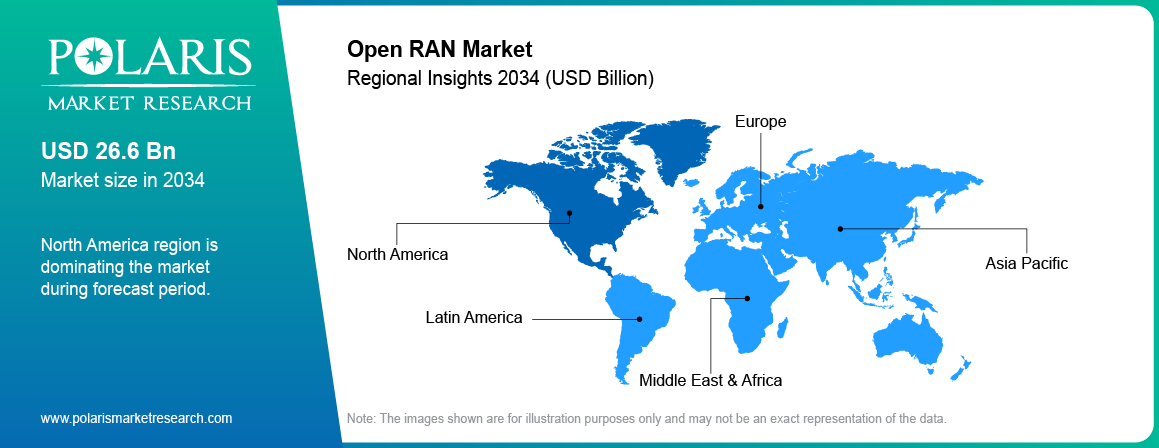
Participants in the Open RAN market include telecom equipment manufacturers, software firms, and network service providers. These participants cater to different components of the network. Some specialize in radio equipment while others specialize in software and integration. This provides the telecom operators with more flexibility in establishing open networks. Open RAN market shares differ according to product and geographic segment. Competitiveness among firms is dependent on the quality of their products, interoperability, and the ability to integrate with hardware from different manufacturers. The market is moderately fragmented, with several firms catering to various segments of the value chain.
Vendor Positioning
| Open RAN Vendors | Role | Open RAN offerings |
| AT&T Inc. | Telecom operator | Open RAN deployment, multi-vendor network integration, and open radio access infrastructure. |
| Cisco Systems, Inc. | Network equipment and software provider | Network routing, transport infrastructure, and solutions for open and virtualized RAN environments. |
| Fujitsu Limited | Telecom equipment and network solutions provider | Open RAN radio units, radio access equipment, and network integration solutions. |
| Huawei Technologies Co., Ltd. | Telecom equipment provider | Radio access network equipment and 4G and 5G infrastructure. |
| Intel Corporation | Semiconductor and computing technology provider | Processors, acceleration technologies, and computing platforms for virtualized and open RAN deployments. |
| Juniper Networks (a Hewlett Packard Enterprise company) | Network infrastructure and software provider | Routing, transport, and RAN Intelligent Controller solutions for open network architectures. |
| Mavenir | Cloud-native network software provider | Open RAN software, virtualized radio access network solutions, and distributed and centralized unit software. |
| NEC Corporation | Telecom equipment and network solutions provider | Open RAN radio units, distributed and centralized units, and system integration services. |
| Nokia Corporation | Telecom equipment and network solutions provider | Open RAN-compatible radio equipment, cloud-based RAN solutions, and network management technologies. |
| Open RAN software and network solutions provider | Open RAN software and multi-technology radio access network solutions for 2G, 3G, 4G, and 5G networks. | |
| Qualcomm Incorporated | Semiconductor and wireless technology provider | 5G RAN platforms, radio unit technologies, and accelerator platforms for Open RAN equipment. |
| Rakuten Mobile, Inc. | Telecom operator | Commercial deployment and operation of open, virtualized 4G and 5G mobile networks. |
| Open RAN software and network solutions provider | Open RAN platforms, cloud-native network software, network orchestration, and multi-vendor deployment solutions. | |
| Radisys Corporation | Telecom software and systems provider | Open RAN software, radio access network solutions, and software for distributed and centralized network units. |
| Samsung Electronics Co., Ltd. | Telecom equipment and network solutions provider | Open RAN equipment, virtualized RAN solutions, and software-based network infrastructure. |
| Telefonaktiebolaget LM Ericsson | Telecom equipment and network solutions provider | Open RAN-compatible radio equipment, cloud RAN solutions, and network management and automation platforms. |
| ZTE Corporation | Telecom equipment provider | Radio access network equipment and 4G and 5G mobile network infrastructure |
Source: Polaris Market Research Analysis
Recent Developments
- October 2026: The OCUDU Ecosystem Foundation released version 26.10 of its open-source RAN platform. The update adds 5G satellite connectivity support, enhanced MIMO capabilities, and new security features. These additions expand the platform's support for different network deployment requirements. (source: ocudu.org)
- October 2026: WiSig Networks opened commercial orders for its O-RAN-compliant 32TR Massive MIMO radio unit at India Mobile Congress 2026. Volume shipments are planned for 2027. The launch adds another India-developed radio product to the Open RAN supplier market. (source: open-rag.org)
Future Outlook
The Open RAN market forecast 2034 market landscape is expected to be shaped by the ability of operators to implement the technology in large-scale networks. Additional advances in interoperability testing may shorten the time required to integrate hardware made by different vendors. Network operators will need solutions to overcome operational challenges as their installations of Open RAN grow. Developments in the field of network management software will assist in overcoming operational challenges. The adoption rate will differ in different countries depending on the investments in telecommunications by that country as well as the preparedness of existing infrastructure. Commercialization of the technology will also depend on the ability of Open RAN to satisfy the requirements of operators.
Research Methodology
Scope and definitions: The study covers the Open RAN market from 2026 to 2034, with 2025 as the base year. It includes radio units, distributed units, centralized units, software, and RAN intelligent controllers that support open network interfaces. Market revenue is measured in USD billion.
Secondary research: Information is collected from company reports, investor presentations, industry publications, and O-RAN ALLIANCE and 3GPP documents. Government sources and market databases are also reviewed.
Primary research: Interviews with telecom operators, equipment suppliers, system integrators, and technology providers provide further details on market demand, network deployment, and industry challenges.
Market sizing and forecast: The market size estimation is made based on two approaches. The bottom-up approach considers revenue of vendors, number of operators, sites, and per capita spending. The top-down approach estimates the portion of spending in the radio access network that belongs to Open RAN. Both approaches are considered, and final estimations are made. Forecasts consider the expansion of 5G, emergence of private networks, diversification of vendors, and deployment of AI-RAN technology.
Validation and limitations: The estimations are validated with company reports and third-party sources. Limited financial data from private firms may affect accuracy. Differences in the definition of Open RAN and virtualized RAN may result in variations in market estimations.
Open RAN Market Report Scope
| Report Attributes | Details |
| Market Size Value in 2025 | USD 6.36 billion |
| Market Size Value in 2026 | USD 8.03 billion |
| Open RAN Market Forecast 2034 | USD 52.47 billion |
| CAGR | 26.5% from 2026 to 2034 |
| Base Year | 2025 |
| Historical Data | 2021–2024 |
| Forecast Period | 2026–2034 |
| Quantitative Units | Revenue in USD billion and CAGR from 2026 to 2034 |
| Report Coverage | Revenue Forecast, Market Competitive Landscape, Growth Factors, and Industry Trends |
| Segments Covered |
|
| Regional Scope |
|
| Competitive Landscape |
|
| Report Format |
|
| Customization | Report customization as per your requirements with respect to countries, regions, and segmentation. |
Source: Polaris Market Research Analysis
Open Radio Access Network (Open RAN) Market FAQ's
The Open RAN market was valued at USD 6.36 billion in 2025 and is estimated at USD 8.03 billion in 2026. It is projected to reach USD 52.47 billion by 2034.
The Open RAN market is projected to account for an 26.5% CAGR from 2026 to 2034.
North America dominated the global market with 40.9% share in 2025. This is due to the early adoption of advanced solutions in the region.
The hardware segment held an 46.2% market share in 2025. This is because hardware allows for superior and flexible data and voice services to end-users.
Key players profiled include AT&T Inc.; Cisco Systems, Inc.; Fujitsu Limited; Huawei Technologies Co., Ltd.; Intel Corporation; Juniper Networks (a Hewlett Packard Enterprise company); Mavenir; NEC Corporation; Nokia Corporation; Parallel Wireless; Qualcomm Incorporated; Rakuten Mobile, Inc.; Rakuten Symphony, Inc.; Radisys Corporation; Samsung Electronics Co., Ltd.; Telefonaktiebolaget LM Ericsson; and ZTE Corporation.
Open RAN (Open Radio Access Network) is a network architecture that uses open interfaces to connect equipment from different vendors. It allows telecom operators to select compatible hardware and software instead of relying on a single supplier.
The industry is driven by growth in 5G networks and the requirement for vendor diversification. Telecommunication service providers are considering using open systems to control their network costs and decrease reliance on proprietary hardware.
The process of implementing Open RAN is difficult in terms of integration and testing. There should be compatibility among various pieces of hardware from different vendors. Network security and infrastructure upgrades are also challenges.

Download Sample Report of Open Radio Access Network (Open RAN) Market
Please fill out the form to request a customized copy of the research report.


