
Liquefied Natural Gas Market Research Report, Share and Forecast, 2026 – 2034
REPORT DETAILS
Liquefied Natural Gas Market Summary
The global liquefied natural gas market size was valued at USD 136.45 billion in 2025, exhibiting a CAGR of 11.5% during 2026–2034. The market is fueled by improving global demand for clean energy, rising industrialization and urbanization, the transition to coal-to-pollution-reducing fuels, and continuous innovations in LNG production and delivery that make it more efficient, cost-reducing, and accessible.
Market Statistics
Liquefied Natural Gas Market Key Takeaways
- Asia Pacific led with a 44.0% market share in 2025. This is owing to rising energy demand and increasing investments in clean energy resources.
- The Middle East & Africa is projected to grow at a 10.2% CAGR. Large natural gas reserves and rising investments in export infrastructure drive the regional market growth.
- The market in Europe is anticipated to grow at a 10.5% CAGR. The presence of abundant shale gas reserves contributes to the regional market growth.
- The power generation segment led with a 46.0% market share in 2025. Increased demand for cleaner and more efficient energy options worldwide contributes to the segment’s market dominance.
- The transportation segment is anticipated to witness the fastest growth at a 11.0% CAGR. This is due to the economic and environmental advantages of LNG.
Note: Figures and projections outlined in this report are the result of Polaris Market Research’s proprietary analytical processes, grounded in the latest available datasets and market observations.
What is Liquefied Natural Gas?
Liquefied Natural Gas (LNG) is natural gas that is cooled to a liquid state, approximately −260°F (−162°C), to facilitate its storage and transportation. This cooling process reduces the gas's volume to about 1/600th of its original gaseous form, making it much more efficient to ship over long distances, especially when pipelines are not available.
The increasing demand for electric power through clean energy sources is propelling the global Liquefied Natural Gas market growth. Countries worldwide are adopting LNG to meet the clean energy demand due to its lower carbon footprint compared to coal and oil and its ability to offer power plants to ramp up energy production quickly when renewable energy generation is low. Furthermore, as countries shift from coal-based power to cleaner alternatives, LNG becomes an attractive option to reduce emissions while maintaining energy security.
The growing industrialization across the world drives the liquified natural gas (LNG) market demand. According to data published by the United Nations Industrial Development Organization in December 2023, 2.3% growth was recorded globally in industrial sectors, encompassing manufacturing, electricity, mining, waste management, water supply, and other utilities. Industries such as manufacturing, chemical production, and power generation require huge amounts of energy to operate. LNG, with its lower carbon footprint compared to coal and oil, aligns with environmental regulations and sustainability goals, making it a preferred choice for industries aiming to reduce emissions. Moreover, LNG's ability to provide consistent energy supply, even in regions lacking natural gas infrastructure, supports industrial expansion in remote and developing areas, further driving its demand as industrialization continues to grow globally.
AI Impact on Liquefied Natural Gas Market
- AI makes LNG production and processing better through efficiency improvement and minimization of energy loss.
- AI facilitates predictive maintenance by analyzing equipment problems ahead of time and avoiding downtime.
- AI improves logistics and supply chain management through demand forecasting and optimization of transportation and storage.
- AI ensures safety through plant monitoring and real-time identification of operational risks.
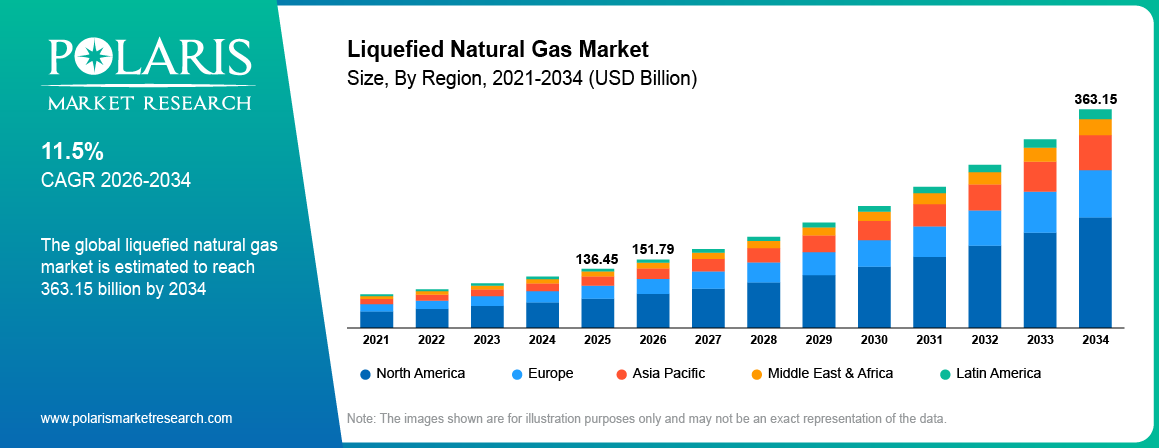
Source: Polaris Market Research Analysis
To Understand More About this Research: Download Sample Report
LNG Market Dynamics
Growing Urbanization Worldwide
The growing urbanization worldwide is projected to propel the global liquified natural gas market expansion. As per the data published by the World Bank, 4.4 billion people around the globe live in urban areas, and this is expected to double by 2050. Urban areas face high demand for electricity and ductless heating and cooling systems, which propels the use of LNG. Additionally, as cities grow, there is a greater push for cleaner energy sources to combat air pollution and meet environmental standards, positioning LNG as a crucial alternative to coal and oil. Its adaptability in various applications, such as fueling power plants, public transportation, and industrial facilities within urban areas, makes LNG critical for supporting urban growth while maintaining environmental sustainability.
Innovations in LNG Production and Distribution Technologies
The rising innovations in LNG production and distribution technologies are estimated to fuel the global liquified natural gas (LNG) market revenue. Advances in liquefaction processes have reduced production costs and increased efficiency, making LNG a more competitive energy source. Innovations in LNG storage tanks and transportation, such as larger, more efficient LNG carriers and small-scale LNG solutions, enable the supply of LNG to remote and off-grid areas. These technological improvements enhance the reliability and scalability of LNG infrastructure, encouraging its adoption across diverse sectors such as power generation, industrial use, and transportation. Therefore, as these advancements continue to lower costs and expand accessibility, they drive greater global demand for LNG as a cleaner and versatile energy alternative.
LNG as a Transportation Fuel
Transportation companies have started using LNG fuel in their marine ships, trucks, and various commercial vehicles, as LNG has been known to be a clean-burning fuel with several environmental benefits. An increase in the usage of LNG for marine vehicles leads to reduced emission of sulfur oxides, nitrogen oxides, and particulates from such vehicles, making it easy for operators to adhere to strict environmental policies and standards. LNG is now becoming a vital component of marine fuel in the shipping industry since regulations around the world continue to require reduced sulfur emissions from these vessels. In the trucking industry, long-distance trucks that run on LNG have been introduced by companies as the fuel offers them fuel efficiency and reduced emissions. With governments and transportation companies paying more attention to cutting down carbon emissions, we are likely to see a further increase in investments in LNG fuel and LNG-operated vehicles in the coming years.
Environmental Impact and Sustainability Considerations
Natural gas is thought to be a much cleaner fuel than coal and oil, since it produces less carbon dioxide, sulfur oxides, and particulate matter during combustion. However, methane leaks during extraction and transportation raise concerns because it is an extremely potent greenhouse gas. To overcome this problem, industry players are focusing on adopting various carbon-reduction techniques and methane-detection equipment.
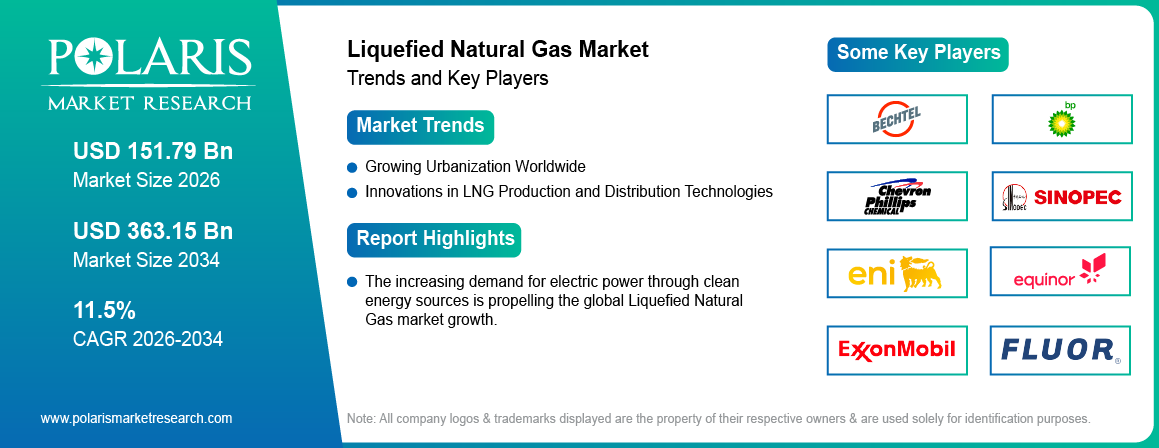
Source: Polaris Market Research Analysis
Segment Analysis
Market Evaluation by Application
In terms of application, the LNG market is divided into transportation fuel, power generation, and others. The power generation segment led with a 46.0% market share in 2025 due to the rising global demand for cleaner and more efficient energy sources. The growing shift from coal and oil-fired power plants to natural gas-powered facilities has significantly contributed to this dominance. LNG offers lower carbon emissions and higher efficiency compared to traditional fossil fuels, aligning with global initiatives to reduce greenhouse gas emissions. Many countries have prioritized Liquefied Natural Gas as a transitional energy source in their path toward renewable energy adoption, further strengthening the segment's growth. Additionally, advancements in gas turbines and combined-cycle technologies have made power plants more efficient and cost-effective, supporting the preference for Liquefied Natural Gas in electricity or power generation.
The transportation segment is anticipated to witness the fastest growth at a 11.0% CAGR during the forecast period owing to the economic and environmental advantages of LNG over diesel and heavy fuel oil. The maritime and heavy-duty trucking industries, in particular, are transitioning to gas-based fuels, including LNG, to comply with stringent emission regulations such as the International Maritime Organization's (IMO) sulfur cap. Improved infrastructure for refueling and the development of LNG-powered vehicles and vessels have also supported the growth of the segment.
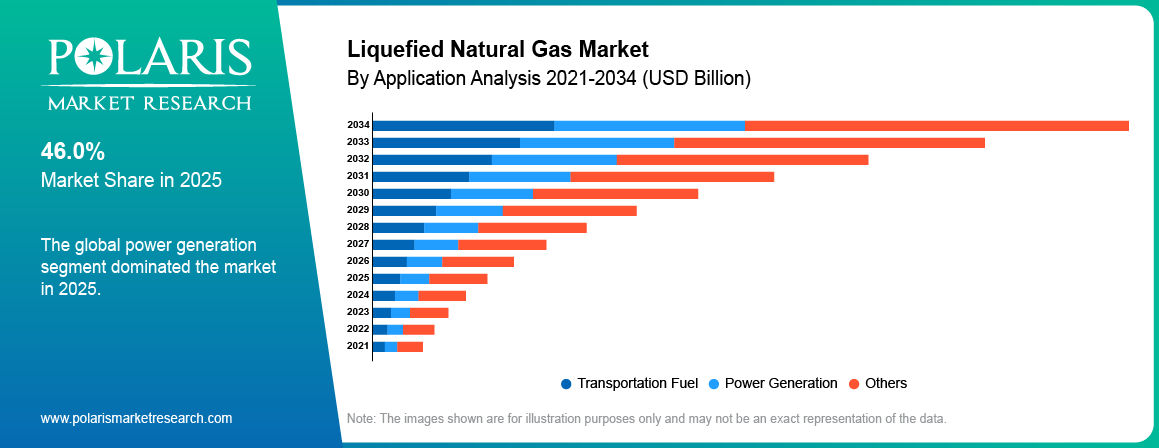
Source: Polaris Market Research Analysis
Regional Analysis
By region, the study provides the LNG market insights into North America, Europe, Asia Pacific, Latin America, and the Middle East & Africa. Asia Pacific dominated the Liquefied Natural Gas market with a 44.0% market share in 2025 due to surging energy demand and increasing investments in cleaner energy sources. Rapid urbanization in countries such as China, India, and Japan has significantly boosted the consumption of Liquefied Natural Gas for power generation, industrial processes, and residential applications. China led the regional market growth, driven by its aggressive policies to reduce coal dependency and expand natural gas infrastructure, including pipelines and LNG terminals. Additionally, rising industrialization and government incentives to adopt low-emission energy sources have contributed to Asia Pacific's dominance in the global Liquefied Natural Gas market expansion. According to the Economic Survey 2023–24, presented by the Union Minister of Finance and Corporate Affairs of India, India’s industrial sector witnessed 9.5% growth during the examined period.
The Middle East & Africa Liquefied Natural Gas market is expected to register the fastest growth at CAGR of 10.2% during the forecast period due to the presence of abundant natural gas reserves and increasing investments in export infrastructure to meet global demand. Countries such as Qatar and the UAE play a crucial role, leveraging their strategic geographic locations to expand LNG export capacity. Additionally, African nations such as Mozambique and Nigeria are rapidly developing new LNG facilities to capitalize on their vast, untapped reserves. This growth aligns with global efforts to diversify energy sources, reduce emissions, and meet the rising demand from industrializing economies. Owing to all these factors, the Middle East & Africa Liquefied Natural Gas market is expected to witness lucrative growth opportunities in the coming years.
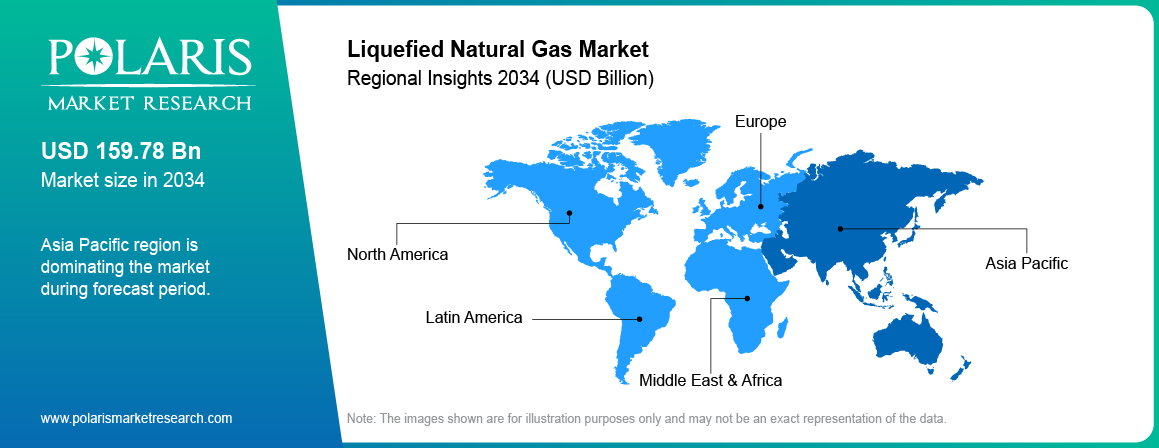
Source: Polaris Market Research Analysis
Competitive Analysis Report
Prominent market players are investing heavily in research and development to expand their offerings, which will boost the Liquefied Natural Gas market growth in the coming years. Market participants are also undertaking a variety of strategic activities to expand their global footprint, with important market developments such as innovative launches, international collaborations, higher investments, and mergers and acquisitions between organizations.
The Liquefied Natural Gas market is fragmented, with the presence of numerous global and regional market players. A few major players in the market are Eni SpA, Equinor ASA, Exxon Mobil Corporation, Gazprom Energy, PetroChina Company Limited, Shell PLC, Total S.A., British Petroleum (BP) p.l.c., Chevron Corporation, China Petroleum & Chemical Corporation, Fluor Corporation, Bechtel Corporation, Gasum AS, and TechnipFMC plc.
Exxon Mobil Corporation, commonly known as ExxonMobil, is an American multinational oil and gas company headquartered in Spring, Texas. Formed in 1999 through the merger of Exxon and Mobil, it has become one of the largest publicly traded energy providers globally, with operations spanning the entire oil and gas industry, including exploration, production, refining, and marketing. ExxonMobil is a significant player in the petrochemical sector, producing a wide range of chemicals and plastics essential for various industries. In recent years, the company has increasingly focused on liquefied natural gas (LNG) as part of its strategy to meet the world's growing energy demands while transitioning to cleaner energy sources. The company operates several LNG facilities and has established partnerships to develop new LNG projects. In October 2024, Exxon Mobil and Qatar Energy's LNG joint venture received a three-year extension to complete the construction of their Golden Pass LNG plant in Texas.
Fluor Corporation is a major US-based multinational engineering and construction firm headquartered in Irving, Texas. Established in 1912 by John Simon Fluor, the company has evolved significantly over the decades, initially focusing on building oil refineries and pipelines before diversifying into various sectors, including industrial and infrastructure projects, government services, and power generation. Fluor has made substantial investments in LNG projects in recent years, recognizing the growing demand for cleaner energy sources worldwide.
List of Key Companies
- Bechtel Corporation
- British Petroleum (BP) p.l.c.
- Chevron Corporation
- China Petroleum & Chemical Corporation
- Eni S.p.A
- Equinor ASA
- Exxon Mobil Corporation
- Fluor Corporation
- Gasum AS
- Gazprom Energy
- PetroChina Company Limited
- Shell PLC
- TechnipFMC plc
- Total S.A.
Liquefied Natural Gas Industry Developments
- May 2026: Eni announced three long-term agreements with the LNG sellers of the North Hub and South Hub gas projects for the purchase of LNG in Indonesia. The company stated that the strategic move will strengthen its global LNG portfolio. (source: eni.com)
- August 2025: Technip Energies In August, Technip Energies, in partnership with JGC, secured two FEED contracts for the INPEX Abadi LNG project located in Indonesia. (Source: ten.com)
- August 2025: Technip Energies secured a major EPC contract from Commonwealth LNG for a proposed 9.5 Mtpa export facility in Cameron Parish, Louisiana, USA. The project features six identical liquefaction trains using its SnapLNG modular technology, with FID expected in the second half of 2025 and production planned around 2029. (Source: investors.technipenergies.com)
- June 2025: BP Singapore disclosed a long-term deal with Torrent Power to provide up to 0.41 million metric tons of LNG each year from 2027 to 2036, intended to fuel Torrent’s combined-cycle, gas-powered facilities totaling 2,730 MW in capacity. (Source: torrentpower.com)
Market Segmentation
By Application Outlook (Volume, Billion Tons; Revenue, USD Billion, 2021–2034)
- Transportation Fuel
- Power Generation
- Others
By Regional Outlook (Volume, Billion Tons; Revenue, USD Billion, 2021–2034)
- North America
- US
- Canada
- Europe
- Germany
- France
- UK
- Italy
- Spain
- Netherlands
- Russia
- Rest of Europe
- Asia-Pacific
- China
- Japan
- India
- Malaysia
- South Korea
- Indonesia
- Australia
- Vietnam
- Rest of Asia Pacific
- Middle East & Africa
- Saudi Arabia
- UAE
- Israel
- South Africa
- Rest of Middle East & Africa
- Latin America
- Mexico
- Brazil
- Argentina
- Rest of Latin America
Liquefied Natural Gas Market Report Scope
| Report Attributes | Details |
| Market Size Value in 2025 | USD 136.45 billion |
| Market Size Value in 2026 | USD 151.79 billion |
| Revenue Forecast by 2034 | USD 363.15 billion |
| CAGR | 11.5 % from 2026 to 2034 |
| Base Year | 2025 |
| Historical Data | 2021–2024 |
| Forecast Period | 2026–2034 |
| Quantitative Units | Volume in Billion Tons, Revenue in USD Billion, and CAGR from 2026 to 2034 |
| Report Coverage | Revenue Forecast, Market Competitive Landscape, Growth Factors, and Trends |
| Segments Covered |
|
| Regional Scope |
|
| Competitive Landscape |
|
| Report Format |
|
| Customization | Report customization as per your requirements with respect to countries, regions, and segmentation. |
Source: Polaris Market Research Analysis
Liquefied Natural Gas Market FAQ's
• The global market size was valued at USD 136.45 billion in 2025 and is projected to grow to USD 363.15 billion by 2034.
• The global market is projected to register a CAGR of 11.5% during the forecast period.
• Asia Pacific led with a 44.0% market share in 2025.
• A few of the key players in the market are Eni SpA, Equinor ASA, Exxon Mobil Corporation, Gazprom Energy, PetroChina Company Limited, Shell PLC, Total S.A., British Petroleum (BP) p.l.c., Chevron Corporation, China Petroleum & Chemical Corporation, Fluor Corporation, Bechtel Corporation, Gasum AS, and TechnipFMC plc.
• The power generation segment dominated the market with 46.0% in 2025.
LNG is natural gas cooled to approximately 162°C into liquid form, reducing its volume to about 1/600th of its gaseous state, enabling efficient storage and long-distance transportation where pipelines are unavailable.
Key trends include accelerating global urbanization driving demand for cleaner energy sources, and continuous innovations in LNG production, storage, and distribution technologies that reduce costs and expand accessibility across diverse sectors.
Download Sample Report of Liquefied Natural Gas Market
Please fill out the form to request a customized copy of the research report.


