
Vaccine Storage & Packaging Market Size, Growth Report, 2025-2034
REPORT DETAILS
REPORT DETAILS
ABOUT THIS REPORT
Vaccine Storage & Packaging Market Summary
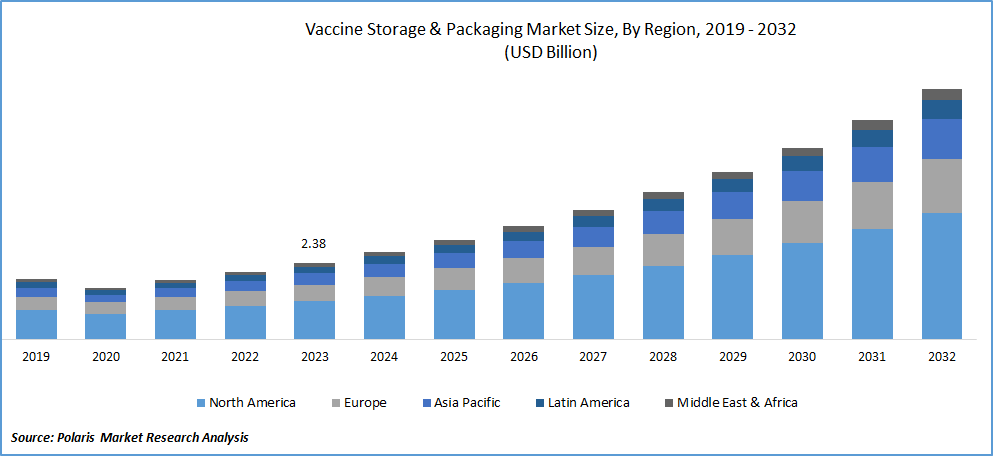
The global vaccine storage & packaging market was valued at USD 25.53 billion in 2024 and is expected to grow at a CAGR of 11.49% from 2025 to 2034. Key factors driving demand for vaccine storage & packaging include rising incidence of chronic diseases across the globe, increasing healthcare spending globally, and growing government venture into vaccination programs.
Market Statistics
Key Takeaways
- The storage segment held the largest revenue share in 2024 due to rising global immunization programs and expanded vaccination drives for COVID-19.
- The distributors segment dominated the revenue share in 2024 due to their crucial role in bridging the gap between manufacturers and healthcare providers.
- North America vaccine storage & packaging market held 38.91% of global vaccine storage & packaging market share in 2024, owing to strong healthcare infrastructure and government initiatives.
- U.S. held the largest revenue share in the North America vaccine storage & packaging landscape in 2024, due to large-scale immunization programs.
- The industry in Europe is projected to grow at a rapid CAGR from 2025 to 2034, owing to high vaccination coverage and stringent regulatory requirements.
Industry Dynamics
- The growing government venture into vaccination programs is fueling the market growth by allocating substantial funding for research and development, procurement, and distribution of vaccines to ensure public health and safety.
- The increasing healthcare spending globally is propelling the demand for vaccine storage & packaging by enabling the procurement of larger vaccine quantities and the introduction of new vaccines.
- Advancement in material science is creating a lucrative market opportunity.
- The risk of vaccine potency loss due to temperature excursions outside the recommended storage ranges, may hamper the market growth.
AI Impact
- AI enhances precision in vaccine storage by enabling real-time temperature monitoring and predictive maintenance in cold-chain logistics.
- It optimizes packaging design through data-driven simulations for better thermal protection.
- AI-powered inventory systems improve shelf-life management and reduce waste via smart expiration tracking.
- Machine learning supports supply chain resilience by forecasting demand and identifying potential disruptions.
Vaccine storage & packaging refer to the specialized processes and materials used to preserve the potency, safety, and efficacy of vaccines from the point of manufacture to administration. Proper storage typically involves maintaining vaccines within a strict temperature range, often between 2°C and 8°C, using refrigerated transport, cold boxes, and vaccine freezers as part of the "cold chain." Some vaccines, like certain mRNA-based ones, require ultra-cold storage at temperatures as low as -70°C. Packaging includes temperature-sensitive labels, insulated packaging, and tamper-evident vials to ensure integrity and prevent contamination. These measures are crucial because exposure to incorrect temperatures or physical damage can degrade vaccine components, rendering them ineffective.
Effective storage and packaging also support logistical efficiency, especially in remote or resource-limited areas, enabling timely immunization campaigns. In global health initiatives, reliable cold chain systems are essential for distributing vaccines against diseases like polio, measles, and COVID-19.
The demand for vaccine storage & packaging products is increasing due to the rising incidence of chronic diseases across the globe. World Health Organizations, in its report stated that noncommunicable diseases (NCDs) or chronic disorder killed at least 43 million people in 2021. This is driving governments and health organizations to expand immunization efforts to protect vulnerable populations from chronic diseases that can worsen their health. This expansion requires a steady and large-scale supply of vaccines, including those for influenza, pneumonia, and other infections. The increased volume and variety of vaccines in circulation is directly driving up the need for specialized storage solutions, such as ultra-low temperature freezers and smart refrigeration units, to maintain vaccine potency. Additionally, the demand for advanced packaging, like pre-filled syringes, multi-dose vials, and temperature-monitored containers are growing, as these ensure safe delivery and administration for the treatment of chronic disorder. The complexity of managing vaccines for chronic disease patients, who often require frequent or combination vaccinations, is further accelerating innovation in storage and packaging technologies. Thus, the rising burden of chronic diseases not only boosts vaccine production but also creates a robust market for efficient, reliable, and scalable storage and packaging solutions.
Drivers & Opportunities/Trends
Growing Government Venture into Vaccination Programs: The growing government venture into vaccination programs is fueling the global market. Governments worldwide such as the U.S. and India, is actively supporting associations and projects associated with vaccination, by allocating substantial funding for research and development, procurement, and distribution of vaccines to ensure public health and safety. This is leading to high adoption of vaccine storage & packaging to preserve the potency, safety, and efficacy of vaccines.
Increasing Healthcare Spending: Higher healthcare spending across the globe is enabling the procurement of larger vaccine quantities, the introduction of new vaccines, and the scaling up of vaccination campaigns. This surge in vaccine availability is directly increasing the need for reliable storage solutions, such as refrigerators, freezers, and cold chain logistics, to maintain vaccine efficacy and prevent spoilage. Health spending in the U.S. increased by 7.5% in 2023 to $4.9 trillion or $14,570 per capita. Additionally, greater investment in healthcare infrastructure is pushing for advanced packaging technologies, like temperature-controlled containers and single-dose vials that ensure safe transport and administration. Furthermore, public health emergencies and pandemic preparedness efforts, often funded by increased healthcare budgets, is accelerating the adoption of vaccine storage and packaging systems.
Segment Analysis
Function Analysis
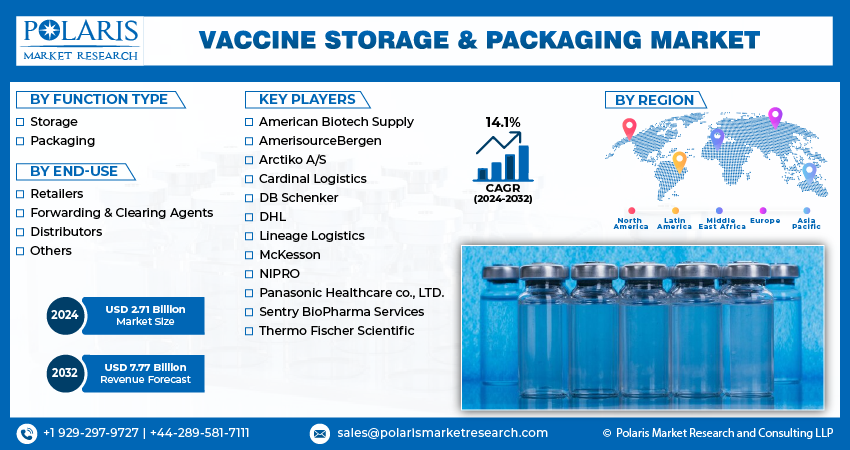
Based on function, the segmentation includes storage and packaging. The storage segment held the largest revenue share in 2024 as governments, healthcare providers, and pharmaceutical companies invested heavily in reliable cold chain infrastructure. Rising global immunization programs, expanded vaccination drives for COVID-19, and the need to distribute temperature-sensitive biologics drove significant demand for advanced storage systems. Cold storage units, ultra-low freezers, and temperature-controlled warehouses became essential to maintain vaccine potency and reduce wastage. Countries also prioritized the development of centralized storage facilities and last-mile refrigeration solutions to strengthen immunization coverage, particularly in emerging nations. The expansion of global healthcare infrastructure, coupled with increasing awareness about the importance of maintaining optimal storage conditions, further strengthen the dominance of the segment.
The packaging segment is projected to grow at a rapid pace in the coming years, owing to the rising use of advanced packaging formats such as prefilled syringes, vials, and ampoules that ensure accurate dosing and reduce contamination risks. Manufacturers are increasingly adopting smart packaging technologies, including RFID tags and temperature indicators, to track vaccine integrity across supply chains. The push for sustainable materials and innovations in packaging that extend shelf life without compromising safety also boost segment growth. Moreover, the trend toward personalized vaccines and the increasing focus on patient-centric delivery formats is making packaging a critical segment.
End Use Analysis
In terms of end use, the segmentation includes retailers, forwarding & clearing agents, distributors, and others. The distributors segment dominated the revenue share in 2024 due to their crucial role in bridging the gap between manufacturers and healthcare providers. Distributors managed large-scale logistics networks, enabling efficient handling of vaccines that require stringent temperature control. The ability of distributors to maintain robust cold chain systems and provide real-time monitoring ensured that doses reached hospitals, clinics, and immunization centers in safe and effective condition. Governments and global health organizations relied on established distribution partners to scale up vaccination programs, particularly during pandemic-driven campaigns. The expansion of healthcare infrastructure in emerging economies and the growing complexity of biologics further strengthened the dominance of distributors, who invested in advanced storage facilities and digital tracking solutions to reduce wastage and improve delivery timelines.
The retailers segment is estimated to grow a rapid pace during the forecast period owing, to the increasing shift toward decentralized immunization services and patient-centric vaccine delivery. Pharmacies, drugstores, and retail clinics continue to expand their role in providing accessible vaccination points, especially in urban and semi-urban regions. Consumers prefer these outlets for their convenience, shorter wait times, and ease of access compared to traditional hospital settings. Retailers also adopt specialized refrigeration units and digital monitoring systems to ensure compliance with safety standards, which enhances their reliability as vaccine providers. The growing acceptance of pharmacies as primary healthcare touchpoints, coupled with rising partnerships between retail chains and pharmaceutical companies, is projected to further accelerate their importance in future immunization campaigns.
Regional Analysis
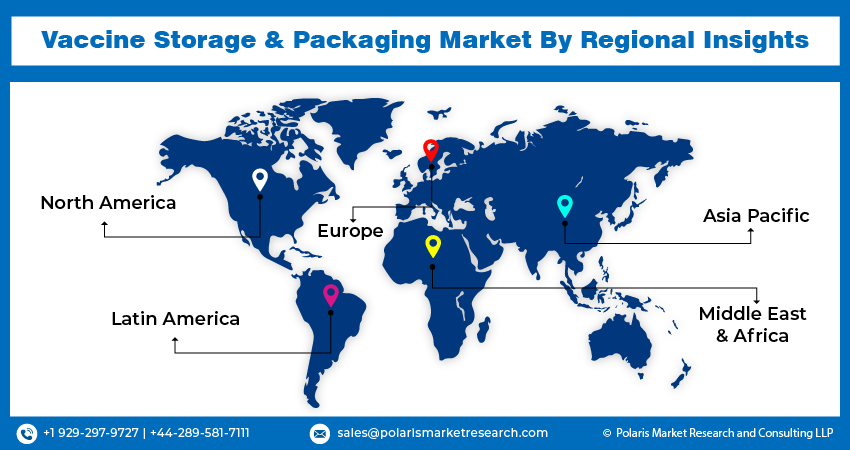
North America vaccine storage & packaging market held 38.91% of global vaccine storage & packaging market share in 2024. This dominance is attributed to strong healthcare infrastructure and government initiatives. The region emphasized temperature-controlled logistics due to the rise in mRNA-based and biologic vaccines requiring ultra-cold chain solutions. Public-private partnerships and investments in vaccine distribution networks further boosted the need for advanced packaging technologies. Regulatory standards from agencies such as the FDA ensured high safety and traceability, prompting manufacturers to adopt smart packaging with real-time monitoring capabilities.
U.S. Vaccine Storage & Packaging Market Insight
U.S. held the largest revenue share in the North America vaccine storage & packaging landscape in 2024, due to large-scale immunization programs, including routine childhood vaccinations and pandemic preparedness efforts. Federal funding through agencies such as the CDC and BARDA supported cold chain expansion and modernization. The prevalence of advanced healthcare facilities and research institutions accelerated the adoption of innovative packaging solutions such as tamper-evident vials and IoT-enabled cold boxes. Growing awareness of vaccine spoilage and supply chain inefficiencies also pushed stakeholders to invest in reliable, temperature-sensitive packaging solutions.
Asia Pacific Vaccine Storage & Packaging Market
The Asia Pacific market is projected to hold significant revenue share in 2034, driven by rising healthcare spending and increasing government focus on public health. For instance, in the total health expenditure of the India between FY15 and FY22, the share of government health expenditure has increased from 29.0 per cent to 48.0 per cent. Countries in the region are strengthening their cold chain infrastructure to support national vaccination campaigns, especially in rural and remote areas. The surge in vaccine production capacity, particularly in India and South Korea, is increasing the need for scalable and efficient packaging solutions. Additionally, collaborations with global health organizations such as WHO are promoting the adoption of cold chain equipment and temperature-stable packaging formats.
China Vaccine Storage & Packaging Market Overview
The demand for vaccine storage & packaging in China is being driven by strong government backing and strategic investments in biopharmaceutical manufacturing. The country prioritizes self-reliance in vaccine supply, leading to expanded production and distribution networks requiring robust cold chain logistics. Chinese regulators are tightening quality standards, encouraging manufacturers to implement smart labeling, anti-counterfeiting technologies, and insulated packaging. Urbanization and digital health integration are further driving innovation in tracking and maintaining vaccine integrity throughout the supply chain.
Europe Vaccine Storage & Packaging Market
The industry in Europe is projected to grow at a rapid CAGR from 2025 to 2034, owing to high vaccination coverage and stringent regulatory requirements. The EU’s focus on cross-border healthcare collaboration and pandemic resilience is leading to investments in harmonized cold chain systems. Countries in the region are adopting sustainable packaging materials and digital monitoring tools to meet environmental and safety standards. Additionally, research initiatives and public health programs are supporting the adoption of next-generation packaging solutions, including prefilled syringes and multi-dose vials.
Key Market Players & Competitive Report
The competitive landscape of vaccine storage and packaging is marked by innovation and strategic collaboration among key players such as Gerresheimer, SCHOTT Pharma, Corning, and Stevanato, who dominate in primary packaging with advanced glass and polymer vials. Companies like NIPRO and Piramal Glass strengthen supply chains with high-quality container manufacturing. Thermo Fisher Scientific and Sealed Air provide critical secondary packaging and cold-chain solutions, ensuring product integrity. B Medical Systems and Lineage, Inc. lead in temperature-controlled storage and logistics, vital for mRNA and ultra-cold chain vaccines. Amcor and Stévanato focus on sustainable, scalable packaging designs. With rising global vaccination demands, firms are investing in automation, tamper-evident technologies, and eco-friendly materials, fostering intense competition centered on reliability, scalability, and compliance with stringent regulatory standards across developed and emerging markets.
Major companies operating in the vaccine storage & packaging industry include Gerresheimer; SCHOTT Pharma AG & Co. KGaA; Sealed Air Corporation; Stevanato; B Medical Systems; Lineage, Inc.; NIPRO; Corning Incorporated; Piramal Glass; Amcor; and Thermo Fisher Scientific.
Key Companies:
- Amcor
- B Medical Systems
- Becton Dickinson
- Corning Incorporated
- Gerresheimer
- Lineage, Inc.
- NIPRO
- Piramal Glass
- SCHOTT Pharma AG & Co. KGaA
- Sealed Air Corporation
- SiO2 Materials Science
- Stevanato
- Thermo Fisher Scientific
Industry Developments
May 2025: SCHOTT Pharma, a global provider of drug containment and delivery solutions, and the Serum Institute of India (SII), the world’s largest vaccine manufacturer, announced that TPG, a leading global alternative asset management firm, will acquire a 35% stake in their joint venture, SCHOTT Poonawalla.
April 2025: the National Institute for Health and Care Research (NIHR) facility at University Hospital Southampton began the first human clinical trial in Southampton, UK, of a vaccine that remains stable at room temperature. Developed by Stablepharma, the tetanus-diphtheria vaccine SPVX02 removes the need for refrigeration or freezing, helping overcome major challenges in global vaccine distribution.
Market Segmentation
By Function Outlook (Revenue, USD Billion, 2020–2034)
- Storage
- Storage Equipment
- Refrigerator
- Freezer
- Others
- Service
- Warehouse storage
- Transportation
- Storage Equipment
- Packaging
- Type
- Vaccine Bags
- Vials & Ampoules
- Bottles
- Corrugated Boxes
- Others
- Packaging Level
- Primary
- Secondary
- Tertiary
- Type
By End Use Outlook (Revenue, USD Billion, 2020–2034)
- Retailers
- Forwarding & Clearing Agents
- Distributors
- Others
By Regional Outlook (Revenue, USD Billion, 2020–2034)
- North America
- US
- Canada
- Europe
- Germany
- France
- UK
- Italy
- Spain
- Netherlands
- Russia
- Rest of Europe
- Asia Pacific
- China
- Japan
- India
- Malaysia
- South Korea
- Indonesia
- Australia
- Vietnam
- Rest of Asia Pacific
- Middle East & Africa
- Saudi Arabia
- UAE
- Israel
- South Africa
- Rest of Middle East & Africa
- Latin America
- Mexico
- Brazil
- Argentina
- Rest of Latin America
Report Scope
| Report Attributes | Details |
| Market size value in 2024 | USD 25.53 Billion |
| Market size value in 2025 | USD 28.41 Billion |
| Revenue forecast in 2034 | USD 75.61 billion |
| CAGR | 11.49% from 2025 - 2034 |
| Base year | 2024 |
| Historical data | 2020- 2023 |
| Forecast period | 2025 - 2034 |
| Quantitative units | Revenue in USD Billion and CAGR from 2025 to 2034 |
| Segments covered |
|
| Regional scope |
|
| Customization | Report customization as per your requirements with respect to countries, region and segmentation. |
FAQ's
The global market size was valued at USD 25.53 billion in 2024 and is projected to grow to USD 75.61 billion by 2034.
The global market is projected to register a CAGR of 11.49% during the forecast period.
North America dominated the market in 2024
A few of the key players in the market are Gerresheimer; SCHOTT Pharma AG & Co. KGaA; Sealed Air Corporation; Stevanato; B Medical Systems; Lineage, Inc.; NIPRO; Corning Incorporated; Piramal Glass; Amcor; and Thermo Fisher Scientific.
The storage segment dominated the market revenue share in 2024.
The retailers segment is projected to witness the fastest growth during the forecast period.
Research Methodology
A robust system of research, verification, and forecasting designed to ensure reliable and actionable market insights.
Polaris Market Research & Consulting, Inc. uses a clear and structured approach to deliver insights that clients can rely on. The process combines detailed primary and secondary research, including direct communication with industry experts. The detailed information helps build a complete picture of market trends and developments. Secondary data is gathered from credible sources such as industry reports, company filings, government source links, and trusted organization databases. It is then cross-checked through discussions with key stakeholders across the value chain. Market size and forecasts are developed using both bottom-up and top-down methods to ensure accuracy and consistency in the final results.
1. Project Setup
Step 1 & 2:
- We start every project by clearly understanding the client’s objective or goal, then defining the market scope, and aligning regions, segments, and timelines.
- Once the foundation is set, we collect data from all-around of sources, including company reports, government databases, and paid industry platforms.
- Our research is based on secondary data, which helps us build a strong understanding of the market across regions and industries. Then we validate this information through primary research by speaking directly with industry experts, companies, and stakeholders.
- By combining secondary and primary research, we ensure that our market insights are accurate, practical, and closely aligned with real market conditions.
2. Data Collection
We gather information from both public and verified sources:
3. Data Structuring
Step 3:
- All collected data is organized into a consistent format to ensure accurate analysis. Since inputs come from multiple sources, they are standardized and aligned before use.
- The data is segmented by product, application, and region, and mapped across a defined historical period (2020–2024). All values are converted into common units (USD Mn/Bn), and volume and pricing are aligned where required to estimate revenue.
- Any overlaps or inconsistencies are reviewed and adjusted to maintain accuracy (<5% variance threshold).
- The result is a structured dataset that allows for clear comparison across regions and supports reliable analysis and forecasting.
Structured Market Dataset, USD Mn/Bn
| Region | Segment | VolumeUnits | Avg PriceUSD | RevenueUSD Mn | Share % |
|---|---|---|---|---|---|
| North America | Product A | 250 | 2.5 | 500 | 15% |
| Product A | XX | XX | XX | XX | |
| Product A | XX | XX | XX | XX | |
| Consistent methodology applied across regions | |||||
4. Market Estimation
Step 4: TOP-DOWN APPROACH
- We start with the overall market size at a global or macro level.
- The market is then narrowed down based on scope and industry relevance.
- We apply penetration rates and split the data by region and segment.
- This helps us estimate the market size for specific segments.
- The numbers are validated through cross-checks to ensure accuracy.
Step 5: BOTTOM-UP APPROACH
- We begin by analyzing data from leading companies in the market.
- Revenue data is collected and mapped across different segments.
- The data is then aggregated to estimate the total market size.
- To fill in any gaps, adjustments are made based on industry standards.
- Validation checks make sure that the results are correct.
5. Forecasting
Step 6:
At Polaris Market Research & Consulting, Inc., we employ a methodical forecasting strategy. This approach blends the analysis of historical data with real-time market validation. To forecast future trends with precision, we examine past patterns, pricing fluctuations, and the interplay of supply and demand. To ensure our conclusions reflect the present market landscape, we actively seek input from industry experts and key stakeholders.
To refine our predictions, we carefully consider critical elements such as market drivers and restraints, fluctuations in raw material costs, emerging technologies, and the production capabilities of various regions. Furthermore, we assess regulatory frameworks and potential policy shifts to gauge their potential impact on market expansion.
All this information is synthesized to generate precise forecasts for each segment and region. These forecasts illuminate the current state of the market and highlight forthcoming opportunities.
6. Validation & Triangulation
Step 7:
In the final stage, we validate all our estimates using a triangulation method, where data is cross-checked from multiple reliable sources, like company data, primary interviews, and secondary research. This helps us make sure that our numbers are correct and fit with the rest of the market.
This process involves verifying data consistency across various segments and geographic areas. It also requires comparing historical trends with the assumptions support the forecast. Any discrepancies involve adjustments to ensure everything remains aligned and dependable.
Once the data is finalized, we prepare the final outputs, including market size estimates, segment-wise breakdowns, and growth metrics. These are delivered in structured formats such as tables, charts, and data files for easy analysis and use.
We collaborate closely with clients, ensuring the final products align with their requirements. This includes offering tailored adjustments, supplementary data analyses, and continuous assistance. Furthermore, we monitor market trends post-delivery, providing updates and refinements to maintain the insights' relevance as time passes.
Triangulation Framework
Estimates are cross-verified across three sources:
Company-level data
• Primary inputs from industry participants
• Secondary benchmarks and published data
Variance maintained within +5-10%
Adjustments applied to align estimates
Segment values validated against overall market structure
Data Consistency & Integrity
Segment totals validated to 100%
Regional estimates aligned with global market size
Historical trends compared against forecast outputs
Assumptions reviewed for cross-segment and regional alignment
Final Outputs
Deliverables
Client Alignment & Support
- Deliverables are aligned with defined client requirements and scope
- Custom data cuts and segment splits are incorporated as required
- Post-delivery queries are addressed through analyst interactions
- Additional clarifications and data support are provided upon request
Client Continuity & Updates
- Market developments are tracked post-delivery to capture changes in key trends
- Updated data and revisions are provided based on new market inputs
- Additional refinements and data cuts are shared as required
- Continued analyst engagement supports evolving client requirements
Download Sample Report of Vaccine Storage & Packaging Market
Please fill out the form to request a customized copy of the research report.


