
AI Smart Glasses Market Size, Share, Trends and Forecast, 2026-2034
REPORT DETAILS
AI Smart Glasses Market Summary and Key Insights
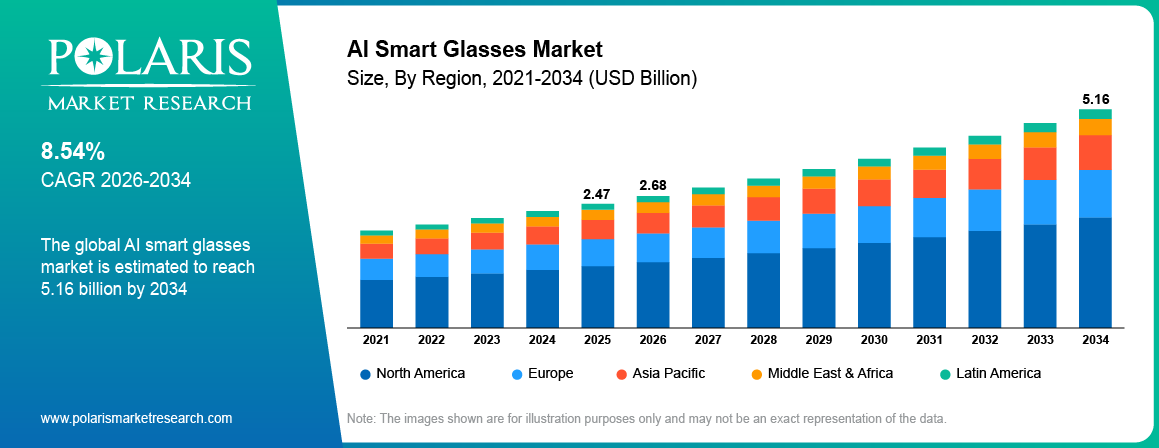
The global AI smart glasses market size was valued at USD 2.47 billion in 2025. The market is projected to grow at a CAGR of 8.54% from 2026 to 2034. Key factors driving growth include the rise in wearable tech and expanding business applications. The market is also driven by technological advancements in AI smart glasses.
Market Statistics
Key Takeaways
- North America dominated with the largest share of 37.0% in 2025. This is due to strong technology adoption in the region.
- Asia Pacific is expected to register a significant CAGR of 13.60%. The regional market growth is driven by increasing interest in smart wearables.
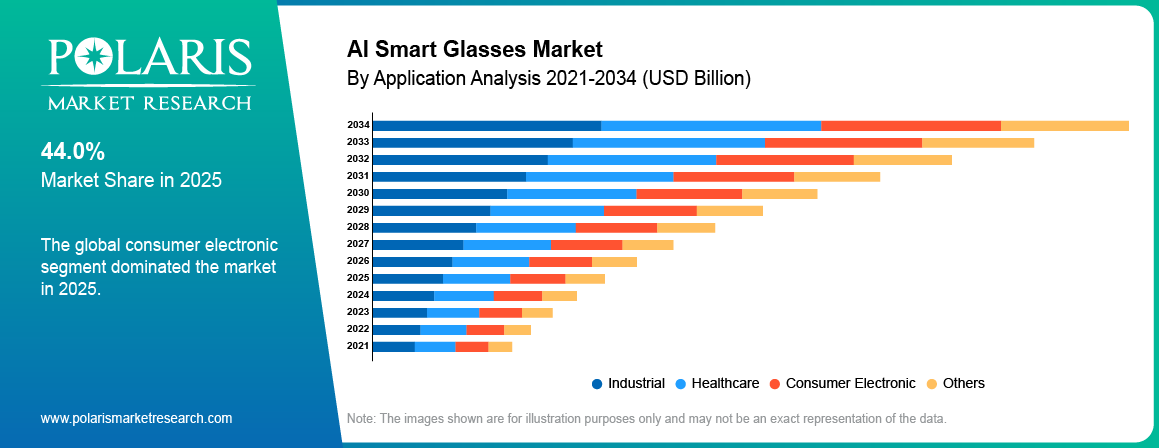
- The consumer electronics segment is expected to witness a significant share of 44.0%. The growing adoption of wearable technology contributes to the segmental market dominance.
- The healthcare segment is projected to grow at a 12.40% CAGR. The rising integration of AI for remote diagnosis and continuous patient monitoring drives the segment's growth.
Note: Figures and projections outlined in this report are the result of Polaris Market Research’s proprietary analytical processes, grounded in the latest available datasets and market observations.
Industry Dynamics
- The rise in adoption of wearable technology is driving the growth.
- Rapid adoption in businesses and industries is fueling the growth.
- Technological advancement is boosting the growth.
- High production costs limits the growth of the market.
AI Smart Glasses in Simple Terms
AI smart glasses are wearable devices that combine traditional eyewear with artificial intelligence technology. They can display information, capture photos or videos, provide navigation, and interact through voice commands. These glasses often assist with tasks, enhance productivity, or offer real-time insights for users.
The integration with advance technologies such as IoT and fitness platforms have significantly improved the product appeal. The awareness regarding personal wellness and health have increased around the world. This has increased the demand for fitness related product and integration of fitness platform in the smart glasses is expanding the industry application. Moreover, integration of IoT in the smart glasses is improving the accessibility to smart home systems, wearable health monitors, and other connected gadgets used in household, which further drives the appeal, thereby driving the industry growth.
The advancement in the artificial intelligence and augmented reality is fueling the industry growth. This advancement is significantly improving the user experience and functionality of the product. Advancement such as real-time data analysis, voice recognition, object detection, and personalized recommendations are interactions more real and appealing. This has increased the adoption of the smart glasses. Moreover, advancement in these technologies is further expanding the application of smart glasses where real time data processing is important, which further fuels the growth of the industry.
How AI Smart Glasses Work?
Data Collection from the Surrounding Environment: Images, motions, voice commands, and other types of data are collected from the user's environment using the integrated cameras and sensors.
Information Processing Using AI Technology: The AI analyzes the collected data using computer vision, machine learning, and natural language processing to understand the user's request or their surrounding environment.
Data Processing: The data is processed either through the hardware or cloud platform, which allows the glasses to give suitable responses.
Presentation of Information: The information that is relevant to the user is presented through the smart lens or an audio response system, which allows the user to get directions without interrupting their activity.
Instant Assistance: The smart glasses with AI technology provide instant suggestions, directions, translation, and other information.
AI Smart Glasses vs Smartphones
| Feature | AI Smart Glasses | Smartphones |
| Interaction | Hands-free visual and verbal interaction | Hands-on touch screen interaction |
| Information Retrieval | In-the-moment visual and audio aid | Holdable device showing information |
| Mobility | Helps users remain hands-free during work or movement | Necessitates that users must hold or reach out to their device |
| Application | Enterprise, medical, industrial, and consumer applications | General communication, entertainment, and productivity |
| User Experience | More immersive due to AI and augmented reality features | Traditional mobile computing experience |
Source: Polaris Market Research Analysis
Drivers & Opportunities
What are Factors Driving Industry Growth?
Increase in Adoption of Wearable Technology: The usage of wearable technology is rising worldwide. This rise in the wearable technology is driven by rise in digital literacy in the developed and developing regions. Further, rise in the disposable income combined with the digital literacy is supporting general population to spend on advance wearable gadgets such as smart glasses. It provides features such as hands-free access to information, real-time notifications, fitness tracking, and augmented reality experiences, which meet both personal and professional needs of the consumer. Moreover, businesses are adopting devices which improves productivity and operational efficiency, which is driving the demand for the wearable devices in business sector, thereby driving the industry growth.
Rising Application in Enterprises and Industry: Modern business and manufacturing are becoming more complex as a result of more sophisticated product designs, improved automation, and the miniaturization of devices. The increasing adoption of AI smart glasses is driven by the need for immersive, hands-free interfaces for visualization, collaboration, navigation, and real-time data analysis using augmented reality and artificial intelligence. For instance, september 2026, Omdia reported that global AI glasses shipments rose 127% year-on-year to 4.2 million units in the first half of 2026. Meta led with an 81.3% share, while camera-free Even Realities moved into second place on demand for its G2 series. (Source: Omdia via Business Wire) This strong growth in shipments is a result of the growing adoption of AI-enabled wearable devices in consumer and enterprise applications.
Smart glasses are being used more and more by businesses in logistics, healthcare, manufacturing, and other industries to help them enhance operational efficiency and reduce errors. In logistics, these devices can help workers find packages, confirm shipments, receive real-time instructions, and navigate warehouses more efficiently without interrupting their work. As a result, the demand for hands-free digital assistance and real-time information access is driving the growth of the AI smart glasses market.
AI Smart Glasses in Healthcare
AI smart glasses are increasingly becoming a significant addition to the field of medicine, enabling healthcare professionals to easily access information without taking their eyes off patients. This includes live streaming of images, medical records, and other useful patient data, which helps doctors and surgeons access the necessary information without diverting their eyes from the patient or the procedure they are performing. In addition, such technology is important for medical training, consultations, and patient monitoring, as it enables the sharing of live information.
Integration of AR Technology
Augmented reality (AR) is an essential technology that enables AI smart glasses to enhance the wearer's real-world environment by superimposing digital information. Users can thus see navigation instructions, equipment details, repair instructions, and even interactive digital information without having their hands occupied with other activities. In particular, augmented reality becomes critical for healthcare, manufacturing, logistics, education, and field services, since it provides an opportunity to offer timely help and increase accuracy and efficiency. The progress in the development of displays for augmented reality smart glasses market will enhance the user’s interaction with AI glasses.
Technological Advancements in AI Smart Glasses
Technological advances in AI-enabled smart glasses have made these devices smarter, more comfortable, and more feasible for day-to-day use. The companies behind these products are now designing more comfortable products by focusing on the development of lightweight devices that make them comfortable to wear for long periods of time. Moreover, the technological advancement in displays makes the images seen through smart glasses clearer and more realistic. Similarly, AI assistants are also becoming smarter, faster, and more capable of providing personalized recommendations and contextual information based on the user’s requirements. Furthermore, advancements in battery technology are increasing the operating hours of AI-enabled smart glasses.
Challenges in the AI Smart Glasses Market
- Production Costs: The advanced technologies used in manufacturing smart glasses are costly to produce.
- Reduced Lifespan of Batteries: Use of AI technology along with cameras and screens might reduce the life of the battery.
- Issues of Privacy and Information Security: The possibility of capturing pictures and information leads to issues of privacy and information security.
- Consumer Awareness: Many consumers lack awareness about the capabilities of AI smart glasses.
Technologies Used in Leading Products:
| Product/Brand | Advanced Technology Used |
| Meta Ray-Ban Meta AI | Voice-activated AI assistant, 12MP camera, open-ear speakers, hands-free 1080p video, real-time commands, immersive audio |
| Even G2 Smart Glasses | Multi-layer precision lenses, AI prompt display, waveguide optics, voice commands, ChatGPT/LLM integration, real-time translation, smart notifications, privacy-focused no-camera design |
| Xiaomi Smart Audio Glasses | Ergonomic wear detection, automatic pause, Bluetooth connectivity, open speaker design |
| Rokid AR Glasses | Diffractive waveguide optics, 5G/AI/AR integration, lightweight design, AI voice interaction |
| Huawei Vision Glass 2 | HarmonyOS ecosystem, Kirin AR chip, 5G+AI, virtual meeting rooms, 3D modeling |
| Xiaomi AR Glasses | Snapdragon AR2 Gen1 chip, lightweight build, gesture control, holographic navigation |
| Baidu Xiaodu AI Glasses | 16MP ultra-wide camera, AI image stabilization, first-person photo/video, Ernie LLM for Chinese NLP |
| Looktech AI Glasses | 16MP camera (4K photos), 1080p video, open-ear Hi-Fi audio, GPT-4o AI assistant, prescription lens options |
| HTC VIVE Eagle | AI horizon alignment for photography, live image translation, Bluetooth, privacy-focused auto-disable camera |
| Magic Leap AR Prototype | Waveguides, microLED display engine, ultra-lightweight optics, display hardware for all-day use |
Source: Polaris Market Research Analysis
Sustainability in Smart Wearables
With the rise of sustainability concerns in relation to the design of AI smart glasses, manufacturers have been trying to ensure that their products are designed in a way that makes them environmentally sustainable. This involves the adoption of energy-saving components in order to increase the lifespan of the product and, therefore, lower the rate of replacements. Manufacturers have been looking into recyclable materials and environmentally sustainable manufacturing techniques to reduce wastage. There are various measures being undertaken to enhance the repairability of such products, thus increasing sustainable manufacturing practices.
Segmental Insights
Why Voice Interaction Dominated in 2025?
Voice interaction segment dominated with largest share in 2025 due to rising demand in industries, logistics facilities and fitness applications. It enables users to operate the glasses without using their hands, which improves the efficiency in these applications. Users could quickly access information, take photos or videos, navigate apps, and communicate in real-time. Moreover, manufacturers are integrating AI assistants such as Alexa, Google Assistant, and Meta which is further improving the appeal of the final product. Support for multiple languages is increasing the adoption across various regions, thereby driving the segment growth.
Which Segment by Application is Expected to Witness a Significant Share?
Consumer electronic segment is expected to witness a significant share over the forecast period due to rising adoption of wearable technology. This rise in the adoption is fueled by rising disposable income and increase in the tech savvy population. It is appealing to everyday users who are looking for convenience, connectivity, and immersive digital experiences, which drives its demand in consumer electronics application. Moreover, growing trend of fitness tracking hands-free content capture, and on-the-go access to information is further boosting the demand. Manufacturers are launching products with innovative design and technologies is further improving the appeal, thereby driving the segment growth.
Use Cases of AI Smart Glasses
| Use Case | How AI Smart Glasses Are Used |
| Inventory Management in Warehouse | The warehouse staff uses smart glasses to find products, conduct inventory management and get hands-free instructions for picking. |
| Medical Assistance During Surgery | The surgeons access information about patients, medical imaging and procedural instructions without distraction from surgery. |
| Equipment Maintenance | The engineers get instructions for repair and assistance from remote experts when working on complicated equipment. |
| Photography and Communication | Consumers use smart glasses to take pictures, record videos, call people and communicate via voice commands. |
| Language Translation | Travelers get instant translation of languages and navigational instructions in different countries. |
| Remote Collaborations | The employees share live videos, get expert guidance, and cooperate remotely with other teams during inspections, maintenance, and training. |
Source: Polaris Market Research Analysis
Regional Analysis
What are Regional Statistics of Industry?
North America held the largest share of 37.0% in the AI smart glasses market in 2025 owing to rapid advancements in technology and presence of leading players such as Amazon, Meta, Google. According to Omdia, the U.S. accounted for more than half of global AI glasses shipments in the first half of 2026, with shipment volumes roughly doubling year-over-year. (Source: thenextweb.com) This highlights the region’s strong consumer acceptance and early adoption of AI-enabled wearable technologies. Strong consumer awareness coupled with the high penetration of smart wearables makes demand consistent for use in personal and professional spaces. AI smart glasses are being adopted at a fast pace by various industries, including logistics, healthcare, and manufacturing players, for enhancing their efficiency, accuracy, and safety. Further, robust R&D investments, high-tech connectivity infrastructure, and increasing demand for hands-free digital assistance are also propelling growth of the market in North America.
The Asia Pacific AI smart glasses market is projected to grow at a substantial CAGR of 13.60% over the forecast period due to factors such as increasing digital penetration, growing urban populace, and rising enthusiasm towards smart wearables. Countries like China, Japan, South Korea, and India are making substantial investments in AI, IoT technology, and AR technologies, thus providing a strong base for market growth. For instance, according to Omdia, AI glasses shipments more than quadrupled year-over-year in China during the first half of 2026, demonstrating the country’s exploding eagerness for AI-enabled eyewear. (Source: stocktitan.net) In addition, China is becoming a leading new smart glasses manufacturing base and the best place to test new forms of smart glasses. The increasing adoption of smart glasses in education, retail, healthcare, manufacturing, and other fields is driving demand even higher. Key electronics makers and continuous product innovation and price competition make this technology more and more accessible for consumers and businesses, which will boost the growth of AI smart glasses market in Asia Pacific.

Key Players & Competitive Analysis
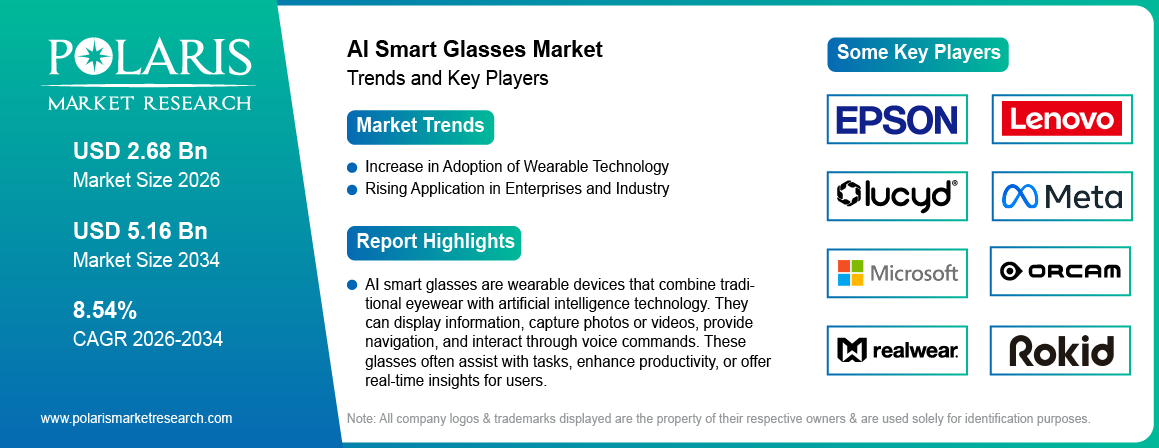
The market is competitive, with established tech giants and specialized AR firms vying for dominance. Meta and Microsoft lead in consumer and enterprise mixed-reality, while Magic Leap continues to target immersive spatial computing. Epson, Lenovo, and Vuzix focus on industrial and connected-worker segments. RealWear offers ruggedized hands‑free models, while OrCam provides assistive vision solutions. Wearable specialists like Rokid, Goertek, Lucyd, and Xreal push innovation in lightweight, AI-augmented eyewear.
Key Players
- Alibaba Group Holding Limited
- Even Realities
- Goertek Inc.
- INMO
- Innovative Eyewear, Inc. (Lucyd)
- Lenovo Group Limited
- OrCam Technologies Ltd.
- Meta Platforms, Inc.
- Rokid
- Seiko Epson Corporation
- RealWear, Inc.
- Vuzix Corporation
- Xiaomi Corporation
- Xreal
Future Outlook
The future seems promising for the AI smart glasses market as there has been an increase in the usage of wearables and the requirement of hands-free technology. Innovations in terms of AI, AR, display technologies, and battery technologies would contribute towards improving the performance of the devices. The applications of smart glasses and solutions from smart eyewear market in healthcare, manufacturing, logistics, retail, and consumer applications would drive the market forward. With innovations such as lightweight construction and advanced AI capabilities, the use of smart glasses is bound to play an important role in the digital experience.
Industry Developments
- June 2026: Meta announced its partnership with EssilorLuxottica to introduce Meta Glasses. The company stated that Meta Glasses are compatible with prescription lenses and will be available in 26 styles across a range of lenses, colors, and frames. These glasses will be powered by Muse Spark, giving users access to AI features.(source: fb.com)
- May 2026: Google officially confirmed that its Android XR platform (co-built with Samsung and Qualcomm) will power a new line of intelligent eyewear at Google I/O 2026. The companies previewed upcoming audio glasses and display glasses integrated with Gemini AI. It also highlighted its partnerships with luxury eyewear labels Gentle Monster and Warby Parker.(source: blog.google)
- November 2025, Oakley and Meta launched the Oakley Meta HSTN AI glasses in India, combining Oakley’s sporty design with Meta’s AI features. The glasses offered hands-free Ultra HD video capture, real-time assistance, fitness tracking, and Hindi voice commands.
- October 2025, Amazon launched its prototype AI-powered “Amelia” smart glasses for delivery drivers, featuring a camera, built-in display, and hands-on controls. Tested across U.S. locations, the glasses improved efficiency, enhanced package tracking, and integrated safety features for drivers’ “last mile” deliveries.
AI Smart Glasses Market Segmentation
By Type Outlook (Revenue, USD Billion, 2021–2034)
- Voice Interaction
- Visual Interaction
By Application Outlook (Revenue, USD Billion, 2021–2034)
- Industrial
- Healthcare
- Consumer electronic
- Others
By Regional Outlook (Revenue, USD Billion, 2021–2034)
- North America
- US
- Canada
- Mexico
- Europe
- Germany
- France
- UK
- Italy
- Spain
- Netherlands
- Russia
- Rest of Europe
- Asia Pacific
- China
- Japan
- India
- Malaysia
- South Korea
- Indonesia
- Australia
- Vietnam
- Rest of Asia Pacific
- Middle East & Africa
- Saudi Arabia
- UAE
- Israel
- South Africa
- Rest of Middle East & Africa
- Latin America
- Brazil
- Argentina
- Rest of Latin America
AI Smart Glasses Market Report Scope and Segmentation
| Report Attributes | Details |
| Market Size in 2025 | USD 2.47 Billion |
| Market Size in 2026 | USD 2.68 Billion |
| Revenue Forecast by 2034 | USD 5.16 Billion |
| CAGR | 8.54% from 2026 to 2034 |
| Base Year | 2025 |
| Historical Data | 2021–2024 |
| Forecast Period | 2026–2034 |
| Quantitative Units | Revenue in USD Billion and CAGR from 2026 to 2034 |
| Report Coverage | Revenue Forecast, Competitive Landscape, Growth Factors, and Industry Trends |
| Segments Covered |
|
| Regional Scope |
|
| Competitive Landscape |
|
| Report Format |
|
| Customization | Report customization as per your requirements with respect to countries, regions, and segmentation. |
Source: Polaris Market Research Analysis
AI Smart Glasses Market Frequently Asked Questions
The global market size was valued at USD 2.47 billion in 2025 and is projected to grow to USD 5.16 billion by 2034.
The global market is projected to register a CAGR of 8.54% during the forecast period.
North America dominated the market in 2025
A few of the key players in the market are Even Realities, Goertek Inc., INMO, Innovative Eyewear, Inc. (Lucyd), Lenovo Group Limited, Meta Platforms, Inc., OrCam Technologies Ltd.
The voice interaction segment dominated the market revenue share in 2025.
The Healthcare segment is projected to grow at a 12.40% CAGR.
Businesses in logistics, healthcare, and manufacturing are increasingly adopting AI smart glasses to enable hands-free access to real-time data, improve operational efficiency, and reduce errors — with applications ranging from warehouse navigation and shipment verification to surgical assistance and remote collaboration.
AI smart glasses can perceive their environment using sensors, cameras, and artificial intelligence. The glasses then process this perceived data, and the user gets instant support either visually or via audio.
The key technologies that are used in AI smart glasses are artificial intelligence, augmented reality, computer vision, voice recognition, and IoT (Internet of Things).
Market drivers include the widespread acceptance of wearable devices and the development of artificial intelligence and augmented reality technologies. The market is also benefiting from an increase in the need for hands-free computing.
Omdia reported a global shipment of 4.2 million AI glasses in the first half of 2026, up 127% year-over-year compared with the first half of 2025.
Download Sample Report of AI Smart Glasses Market
Please fill out the form to request a customized copy of the research report.


