Global Alpha-Amylase Baking Enzyme Market Size, Share & Growth Analysis Report, 2023-2032

Global Alpha-Amylase Baking Enzyme Market Size, Share & Growth Analysis Report, 2023-2032

REPORT DETAILS

Report Code: PM1193
No. of Pages: 117
Format: PDF
Published Date:
Base Year: 2022
Author: Praj Bhilare
Historical Data: 2019-2021

REPORT DETAILS

Report Code: PM1193
Published Date:
No. of Pages: 117
Historical Data: 2019-2021
Format: PDF
Author: Praj Bhilare
Base Year: 2022
Alpha-Amylase Baking Enzyme Market Share, Size, Trends, Industry Analysis Report, By Source (Fungi, Bacteria (Maltogenic, G4), Plant-Based); By Application (Breads, Cookies & Biscuits, Desserts); By Region; Segment Forecast, 2023 - 2032

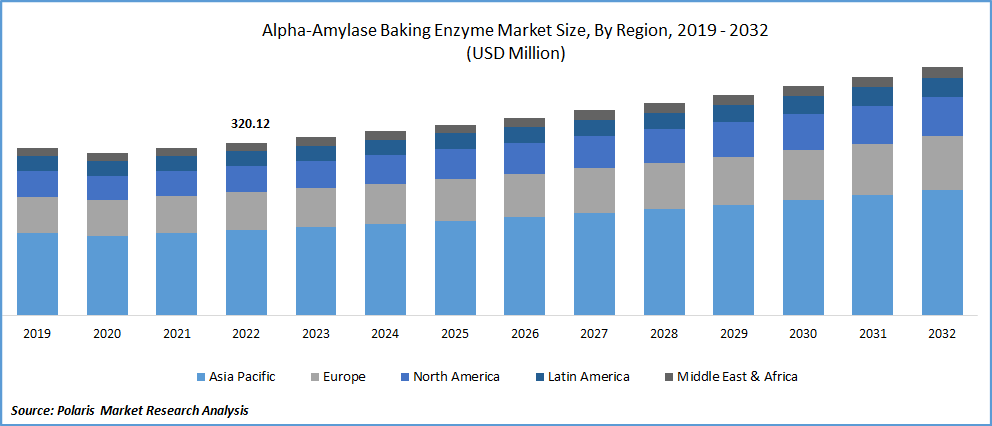
The global alpha-amylase baking enzyme market was valued at USD 320.12 million in 2022 and is expected to grow at a CAGR of 3.7% during the forecast period.

A protein hydrolysis enzyme called alpha-amylase is used to break down the alpha bonds in polysaccharides and increase the production of glucose and maltose. This enzyme finds the major application in animal feed, detergents, breweries, biofuels, sugar products, bakery products, and lab research. Bakeries use these enzymes to improve texture and increase yeast production during the formulation of the final product.

Alpha-Amylase Baking Enzyme Market Size

Know more about this report: Download Sample Report

The alpha-amylase enzyme used as a biofuel catalyst is becoming more well-liked in the chemical sector. To boost product yield and cut down on lead time, detergent manufacturing is also gaining interest. The primary reasons driving the alpha-amylase baking enzyme market are the rise in demand for enzymes in the bakery sector due to its capacity to provide characteristics such as dough enhancement, good color texture, and continuous softness, as well as new product releases.

The increased demand for convenience meals in developing nations like China and India is anticipated to encourage production processes for baked products due to rising advertising expenditures by fast food companies like McDonald's.

Due to the introduction of new products by Kellogg and Grupo Bimbo, the market for growing bakery products is predicted to continue to be a major driver in developed countries like the U.S. and Canada.

The rapid emergence of the deadly coronavirus around the world has forced countries to impose several restrictions on trade activities and lockdowns, which resulted in the closure of stores and manufacturing facilities and high disruptions in the global supply chain. With rising demand for goods with health-promoting components, however, the market for food items has remained robust. Alpha amylase is in demand from the food and beverage and pharmaceutical sectors because it is thought to have immunity-boosting qualities.

Consequently, the alpha-amylase market suffered during the initial epidemic, but sales are anticipated to improve moving forward as lockdowns across numerous nations begin to ease.

Alpha-Amylase Baking Enzyme Market

Know more about this report: Download Sample Report

Industry Dynamics

Growth Drivers
Demand for ready-to-eat food items, including bread, cookies, cakes, and biscuits, has increased significantly due to the increasingly common hectic lifestyle. In addition, growing urbanization and rising buying power have produced a fast-paced lifestyle, which is projected to boost market expansion.

Additionally, the increasing introduction of new products will probably accelerate market expansion in the future. For instance, Ritz Crackers and Oreo Cookies joined up to introduce a new RittzxOreo treat in May 2022. Market growth is anticipated as a result of these measures.

The primary factor driving the growth of the worldwide alpha-amylase market is the usage of alpha-amylase in producing a diverse variety of commodities, including animal feed, baked goods, sugar products, etc.

In addition, Alpha-amylase demand is expected to increase due to rising consumer awareness of nutritious foods and the rapid expansion of the nutraceuticals industry over the projected period.

Report Segmentation

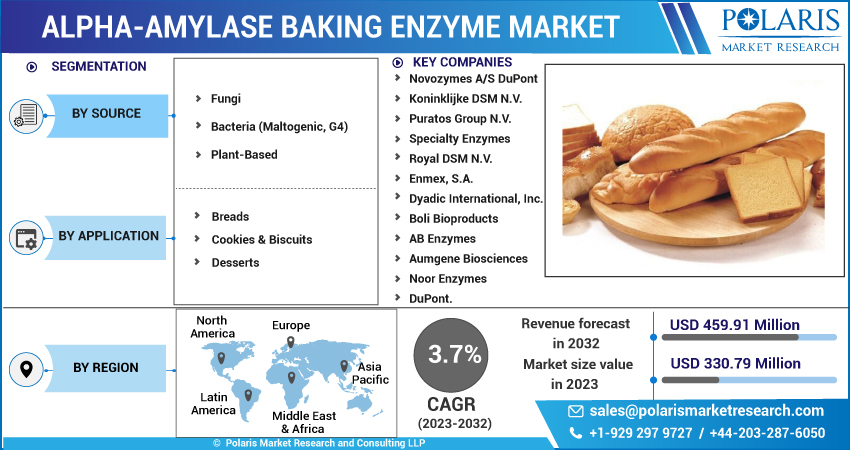
The market is primarily segmented based on source, application, and region.

By Source

By Application

By Region

  • Fungi
  • Bacteria (Maltogenic, G4)
  • Plant-Based
  • Breads
  • Cookies & Biscuits
  • Desserts
  • North America (U.S., Canada)
  • Europe (France, Germany, UK, Italy, Netherlands, Spain, Russia)
  • Asia Pacific (Japan, China, India, Malaysia, Indonesia, South Korea)
  • Latin America (Brazil, Mexico, Argentina)
  • Middle East & Africa (Saudi Arabia, UAE, Israel, South Africa)

Know more about this report: Download Sample Report

By Source, the Bacteria Segment Accounted for the Highest Market Share

The source's study predicts that the bacteria segment will dominate the worldwide alpha-amylase baking enzyme market. The excellent thermal stability of bacteria compared to other sources can be linked to its segment's expansion. To produce the ideal crumb softness during the baking process of bread, these kinds of alpha-amylase sources are combined with additional enzymes, including fungal, lipase, and xylanase.

Because G4 has a stronger anti-staling effect than other sources, including bacteria, fungus, and yeast, it is anticipated to continue to be a popular source among alpha-amylase producers. Additionally, these enzymes have the ability to maintain freshness and smoothness for a long time. For the production of food and beverage goods, enzymes and bacteria are important food additives. Since they may be able to enhance the baked goods' texture, quality, and shelf life, bakery enzymes are frequently used in the creation of many different baked goods.

By Application, Breads Segment Held the Significant Market Revenue Share

According to the application, bread is anticipated to rule the market over the forecast period. The category has expanded as a result of an increase in bakeries throughout the world and a rise in demand for prepared foods. Since bread is a key component of several commonly consumed food items, including pizza, burgers, hot dogs, and others, the category is anticipated to continue growing over the projection period.

North America Dominated the Global Market in 2022

North America dominated the global industry in 2022 and will likely maintain its dominance in the alpha-amylase baking enzyme market over the anticipated period. The North American alpha-amylase baking enzyme sector has significant potential due to capital-intensive alpha-amylase baking enzyme enterprises in the area and significant expenditures in new product launches. And also, the high frequency of bread processors like Sara Lee Corporation, Private Label, and Nature's Own is anticipated to have a substantial effect on the industry.

The expansion of bakery operations is responsible for the expansion of the marketplace. Additionally, it is anticipated that the rising number of startups in the region will significantly contribute to the market's growth throughout the assessment period. Over the next eight years, it's also expected that more enzymes will be used due to new product introductions in the frozen bread market in the United States and Canada.

Competitive Insight

Some of the major players operating in the global alpha-amylase baking enzyme market include Novozymes A/S DuPont, Koninklijke DSM N.V., Puratos Group N.V., Specialty Enzymes, Royal DSM N.V., Enmex, S.A., DE C.V., Dyadic International, Inc., Boli Bioproducts, AB Enzymes, Aumgene Biosciences, Noor Enzymes, and DuPont.

Recent Developments

  • In May 2022, Jammie Dodger biscuits with a banana flavor were introduced, according to B&M, a European Value Retail S.A.
  • In May 2022, the first baking institute opened in Panchkula, according to Winni Cakes, India's largest online gifting platform and bakery chain. The institute includes instructors from across the world and a contemporary bakery built up to teach young people.

Alpha-Amylase Baking Enzyme Market Report Scope

Report Attributes

Details

Market size value in 2023

USD 330.79 million

Revenue forecast in 2032

USD 459.91 million

CAGR

3.7% from 2023 – 2032

Base year

2022

Historical data

2019 – 2021

Forecast period

2023 – 2032

Quantitative units

Revenue in USD million and CAGR from 2023 to 2032

Segments Covered

By Source, By Application, By Region

Regional scope

North America, Europe, Asia Pacific, Latin America, Middle East & Africa

Key Companies

Novozymes A/S DuPont, Koninklijke DSM N.V., Puratos Group N.V., Specialty Enzymes, Royal DSM N.V., Enmex, S.A., DE C.V., Dyadic International, Inc., Boli Bioproducts, AB Enzymes, Aumgene Biosciences, Noor Enzymes, and DuPont.

FAQ's

The global alpha-amylase baking enzyme market size is expected to reach USD 459.91 million by 2032.

alpha-amylase baking enzyme market players are Novozymes A/S DuPont, Koninklijke DSM N.V., Puratos Group N.V., Specialty Enzymes, Royal DSM N.V., Enmex, S.A., DE C.V., Dyadic International, Inc., Boli Bioproducts, AB Enzymes, Aumgene Biosciences.

North America contribute notably towards the global alpha-amylase baking enzyme market.

The global alpha-amylase baking enzyme market expected to grow at a CAGR of 3.7% during the forecast period.

The alpha-amylase baking enzyme market key segments are source, application, and region.

Page last updated on:

Research Methodology

A robust system of research, verification, and forecasting designed to ensure reliable and actionable market insights.

Polaris Market Research & Consulting, Inc. uses a clear and structured approach to deliver insights that clients can rely on. The process combines detailed primary and secondary research, including direct communication with industry experts. The detailed information helps build a complete picture of market trends and developments. Secondary data is gathered from credible sources such as industry reports, company filings, government source links, and trusted organization databases. It is then cross-checked through discussions with key stakeholders across the value chain. Market size and forecasts are developed using both bottom-up and top-down methods to ensure accuracy and consistency in the final results.

Data
Collection Project
Setup Market
Estimation Data
Structuring Quality
Check Output Forecasting Data
Validation Our Methodological
Approach Source: Polaris Market Research

1. Project Setup

Step 1 & 2:

  • We start every project by clearly understanding the client’s objective or goal, then defining the market scope, and aligning regions, segments, and timelines.
  • Once the foundation is set, we collect data from all-around of sources, including company reports, government databases, and paid industry platforms.
  • Our research is based on secondary data, which helps us build a strong understanding of the market across regions and industries. Then we validate this information through primary research by speaking directly with industry experts, companies, and stakeholders.
  • By combining secondary and primary research, we ensure that our market insights are accurate, practical, and closely aligned with real market conditions.

2. Data Collection

We gather information from both public and verified sources:

Secondary Research 50-100+ sources reviewed Company filings (10-K, annual reports) Government databases (trade, production, import/export) Paid databases (Bloomberg, Factiva, Statista) Coverage:
60-80% of total data inputs Primary Research 25-40 interviews conducted Manufacturers Distributors / channel partners Industry experts / consultants Coverage:
30-40% validation weight Source: Polaris Market Research

3. Data Structuring

Step 3:

  • All collected data is organized into a consistent format to ensure accurate analysis. Since inputs come from multiple sources, they are standardized and aligned before use.
  • The data is segmented by product, application, and region, and mapped across a defined historical period (2020–2024). All values are converted into common units (USD Mn/Bn), and volume and pricing are aligned where required to estimate revenue.
  • Any overlaps or inconsistencies are reviewed and adjusted to maintain accuracy (<5% variance threshold).
  • The result is a structured dataset that allows for clear comparison across regions and supports reliable analysis and forecasting.

Structured Market Dataset, USD Mn/Bn

Region Segment VolumeUnits Avg PriceUSD RevenueUSD Mn Share %
North America Product A 250 2.5 500 15%
Product AXXXXXXXX
Product AXXXXXXXX

4. Market Estimation

Step 4: TOP-DOWN APPROACH

  • We start with the overall market size at a global or macro level.
  • The market is then narrowed down based on scope and industry relevance.
  • We apply penetration rates and split the data by region and segment.
  • This helps us estimate the market size for specific segments.
  • The numbers are validated through cross-checks to ensure accuracy.
Top-down Approach Macro market base Value / Volume Parent market USD-based Volume-based Units X price Market scope alignment Penetration rate 5-50% Segment & regional split Geographic breakdown Estimated market size Market size reconciliation ±5-10% variance check Final market size USD Mn / Bn Market forecasting Source: Polaris Market Research

Step 5: BOTTOM-UP APPROACH

  • We begin by analyzing data from leading companies in the market.
  • Revenue data is collected and mapped across different segments.
  • The data is then aggregated to estimate the total market size.
  • To fill in any gaps, adjustments are made based on industry standards.
  • Validation checks make sure that the results are correct.
Bottom-up Approach Company-level data 20-25 comapnies Parent market Financials Segmental analysis Segment-level aggregation 60-80% coverage Gap adjustment Benchmarks Estimated market size Market size reconciliation ±5-10% variance check Final market size USD Mn / Bn Market forecasting Source: Polaris Market Research

5. Forecasting

Step 6:

At Polaris Market Research & Consulting, Inc., we employ a methodical forecasting strategy. This approach blends the analysis of historical data with real-time market validation. To forecast future trends with precision, we examine past patterns, pricing fluctuations, and the interplay of supply and demand. To ensure our conclusions reflect the present market landscape, we actively seek input from industry experts and key stakeholders.

To refine our predictions, we carefully consider critical elements such as market drivers and restraints, fluctuations in raw material costs, emerging technologies, and the production capabilities of various regions. Furthermore, we assess regulatory frameworks and potential policy shifts to gauge their potential impact on market expansion.

All this information is synthesized to generate precise forecasts for each segment and region. These forecasts illuminate the current state of the market and highlight forthcoming opportunities.

Data - Based Assessment Growth rates are derived from multi-year performance  Pricing movement is evaluated to align value projections  Volume and value relationships are assessed across segments Historical market data is analyzed to establish baseline trends  Market - Validated Assessment Supply-side insights are incorporated to account for production and capacity trends Forecast assumptions are aligned with current market conditions Industry inputs are used to validate growth assumptions Inputs from demand-side participants are considered to reflect consumption patterns  Source: Polaris Market Research

6. Validation & Triangulation

Step 7:

In the final stage, we validate all our estimates using a triangulation method, where data is cross-checked from multiple reliable sources, like company data, primary interviews, and secondary research. This helps us make sure that our numbers are correct and fit with the rest of the market.

This process involves verifying data consistency across various segments and geographic areas. It also requires comparing historical trends with the assumptions support the forecast. Any discrepancies involve adjustments to ensure everything remains aligned and dependable.

Once the data is finalized, we prepare the final outputs, including market size estimates, segment-wise breakdowns, and growth metrics. These are delivered in structured formats such as tables, charts, and data files for easy analysis and use.

We collaborate closely with clients, ensuring the final products align with their requirements. This includes offering tailored adjustments, supplementary data analyses, and continuous assistance. Furthermore, we monitor market trends post-delivery, providing updates and refinements to maintain the insights' relevance as time passes.

Validation

Triangulation Framework

Estimates are cross-verified across three sources:

Company-level data

• Primary inputs from industry participants

• Secondary benchmarks and published data

Variance maintained within +5-10%

Adjustments applied to align estimates

Segment values validated against overall market structure

Quality Check

Data Consistency & Integrity

Segment totals validated to 100%

Regional estimates aligned with global market size

Historical trends compared against forecast outputs

Assumptions reviewed for cross-segment and regional alignment

Output & Delivery

Final Outputs

Market size estimates (USD Mn/Bn)
Segment-wise distribution (%)
Growth metrics (CAGR %)

Deliverables

Structured tables and charts
Segment-level datasets
Excel-based data files for further analysis

Client Alignment & Support

  • Deliverables are aligned with defined client requirements and scope
  • Custom data cuts and segment splits are incorporated as required
  • Post-delivery queries are addressed through analyst interactions
  • Additional clarifications and data support are provided upon request

Client Continuity & Updates

  • Market developments are tracked post-delivery to capture changes in key trends
  • Updated data and revisions are provided based on new market inputs
  • Additional refinements and data cuts are shared as required
  • Continued analyst engagement supports evolving client requirements

Secure Your Competitive Edge With Our Expert-Driven Market Insights

Gain exclusive insights and strengthen your competitive position with our tailored research solutions. Connect with our research analysts and industry experts to elevate your decision-making.

Talk To Our Analyst
Download Sample