
Automotive Lead-Acid Battery Market Size, Share, Trends | Report, 2026-2034
REPORT DETAILS
Automotive Lead-Acid Battery Market Summary
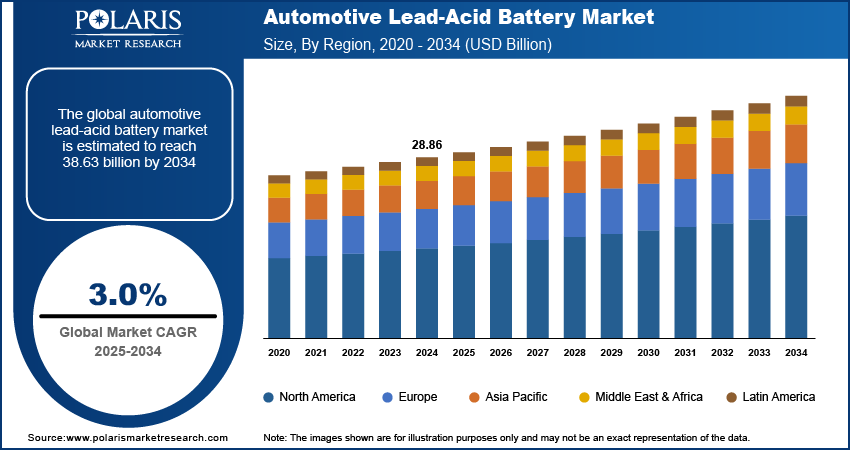
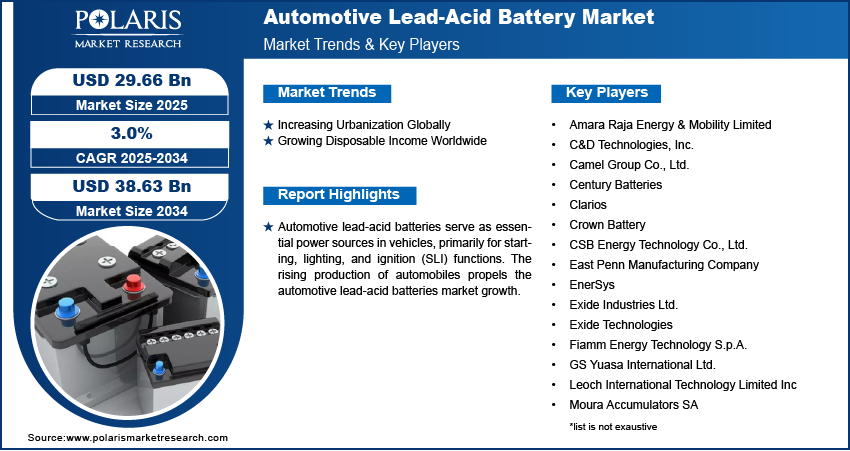
The global automotive lead-acid battery market size was valued at USD 29.72 billion in 2025. The market is projected to grow from USD 30.62 billion in 2026 to USD 38.89 billion by 2034, exhibiting a CAGR of 3.0% during 2026–2034.
Market Statistics
Key Takeaways
- Asia Pacific led the global automotive lead-acid battery industry with 41.0% revenue share in 2025. High vehicle production and rising automotive sales contributed to the dominance.
- China held the largest share 48.0% of Asia Pacific market in 2025. Rapid urbanization and expanding transportation infrastructure fueled vehicle demand, driving the requirement for lead-acid batteries.
- The Europe automotive lead-acid battery market is estimated to register the highest CAGR of 2.3% during the forecast period. This is due to the increasing demand for advanced battery technologies and stringent environmental regulations.
- The flooded batteries segment dominated the market with 61.0% share in 2025. This is due to their affordability, reliability, and widespread use in internal combustion engine (ICE) vehicles.
- The aftermarket segment accounted for 59.0% share in 2025. The growth is driven by the high replacement rate of batteries in vehicles.
*Note: Figures and projections outlined in this report are the result of Polaris Market Research’s proprietary analytical processes, grounded in the latest available datasets and market observations.
Industry Dynamics
- Rising vehicle production across the world supports steady demand for lead-acid batteries.
- Increasing disposable income of middle class population boost vehicle sales, propelling the requirement for automotive lead-acid batteries.
- Adoption of advanced variants, including AGM and EFB batteries, is increasing due to start-stop vehicle system integration.
- The rising shift toward lithium-ion batteries in electric and hybrid vehicles limits long-term growth potential.
- Rising advancements in battery technologies are expected to create lucrative market opportunities in the coming years.
AI Impact on Automotive Lead-Acid Battery Market
- Artificial intelligence is improving battery manufacturing efficiency through predictive maintenance.
- Machine learning models help optimize electrode design and material usage. It enhances battery life and performance.
- Manufacturers are using AI-driven quality control systems to detect faults early. It reduces failure rates in automotive batteries.
- Predictive analytics analyzes vehicle usage patterns and replacement cycles. It is improving aftermarket demand forecasting.
- In connected vehicles, AI-based energy management systems are extending battery life. They are optimizing charging and load distribution.
What are Automotive Lead-Acid Batteries?
Automotive lead-acid batteries serve as essential power sources in vehicles, primarily for starting, lighting, and ignition (SLI) functions. These batteries consist of lead dioxide (PbO₂) at the positive plate and spongy lead (Pb) at the negative plate, immersed in a sulfuric acid electrolyte. The design of automotive lead-acid batteries allows for high surge currents, making them particularly effective for starting engines that require significant power at ignition.
The rising production of automobiles is propelling the automotive lead-acid batteries market growth. As per the report published by the European Automobile Manufacturers' Association in 2022, 85.4 million motor vehicles were produced around the world, an increase of 5.7% compared to 2021. Automakers order more lead-acid batteries to keep up with the rising production of automobiles, as these batteries are utilized in vehicles to power SLI functions. The expansion of commercial vehicle fleets, including trucks and buses, further amplifies this demand, as these vehicles rely on powerful batteries, including lead-acid, for consistent performance. The increasing popularity of start-stop technology in luxury and electric vehicles (EVs) also drives higher adoption of advanced lead-acid batteries, such as enhanced flooded batteries (EFB) and absorbent glass mat (AGM) batteries.
Source: Polaris Market Research Analysis
The automotive lead-acid battery market demand is driven by the rising advancement in technology. Automakers are integrating modern features such as regenerative braking and advanced infotainment systems into their vehicles, which require reliable and efficient power sources. Battery manufacturers are developing enhanced flooded batteries (EFB) and absorbent glass mat (AGM) batteries to meet these evolving energy demands, making lead-acid batteries more suitable for modern vehicles. Innovations in battery design also improve charge acceptance, extend lifespan, and reduce maintenance, making them a more attractive option for both automakers and consumers. Recycling technologies have also advanced, making lead-acid batteries more sustainable and cost-effective, which further encourages their adoption.
Lead-Acid vs Lithium-Ion Batteries in Automotive
Lead-acid and lithium-ion batteries serve different roles in the automotive ecosystem. They differ in cost, performance, lifecycle, and application suitability.
Comparison Matrix
| Parameter | Lead-Acid Batteries | Lithium-Ion Batteries |
| Cost | Low cost, highly affordable for mass-market vehicles | High upfront cost but decreasing over time |
| Performance | Moderate energy density, suitable for short bursts of power (starting engines) | High energy density with superior power delivery and efficiency |
| Lifecycle | Shorter lifespan with frequent replacements (2–5 years typical) | Longer lifespan (8–15 years depending on usage and chemistry) |
| Weight | Heavier, lower energy-to-weight ratio | Lightweight with high energy efficiency |
| Charging Efficiency | Slower charging and lower efficiency | Fast charging with high efficiency |
| Applications | Widely used in ICE vehicles for starting, lighting, ignition (SLI) systems | Dominant in EVs, hybrids, and advanced energy storage systems |
| Maintenance | Requires periodic maintenance in flooded variants | Maintenance-free in most automotive applications |
Source: Polaris Market Research Analysis
Key Insight: Lead-acid batteries dominate in conventional internal combustion engine vehicles due to their low cost and reliability. However, demand for lithium-ion batteries is rapidly expanding in electric and hybrid vehicles due to superior performance and energy efficiency.
Market Dynamics
Increasing Urbanization Globally
Various regions across the world are witnessing rising urbanization. As per the data published by the World Bank, 56% of the world's population lives in cities, and is expected to double by 2050. Urbanization leads to a surge in automobile sales as people in urban areas rely on personal and public vehicles for daily commuting. This increases the need for reliable automotive batteries, such as lead-acid batteries, as these batteries provide essential power to operate various functions in vehicles, such as lighting, starting, and ignition. Traffic congestion and frequent stop-and-go driving in urban areas create greater demand for advanced lead-acid batteries, such as enhanced flooded batteries (EFB) and absorbent glass mat (AGM) batteries, which support start-stop vehicle systems. The rapid development of smart cities and infrastructure projects encourages more vehicle production and electrification, contributing to the demand for automotive lead-acid batteries. Therefore, rising urbanization across the globe boosts the automotive lead-acid battery market development.
Growing Disposable Income Worldwide
Increased disposable income drives people to prioritize vehicle ownership for convenience, status, and mobility, which leads to high adoption of lead-acid batteries as these batteries are deployed in vehicles. Increased spending power also encourages consumers to upgrade to newer models, which require reliable lead-acid batteries for ignition, lighting, and electronic systems. Additionally, higher disposable income allows vehicle owners to invest in battery replacements, choosing advanced lead-acid technologies such as absorbent glass mat (AGM) and enhanced flooded batteries (EFB) for better performance. As income levels rise, the overall demand for automobiles and the batteries that power them continues to grow. Hence, the rising disposable income of consumers propels the automotive lead-acid battery market growth.
Lead-Acid Battery Recycling & Environmental Impact
Lead-acid batteries are considered one of the most environmentally sustainable battery chemistries. This is due to their exceptionally high recyclability rate and well-established recovery systems.
- Lead-acid batteries are highly recyclable. Their recovery rates exceed 95% for lead, plastic, and sulfuric acid components.
- The recycling process supports a strong circular economy. It reuses recovered lead in the production of new batteries.
- Established reverse logistics networks collect and recycle more efficiently compared to newer battery chemistries.
- Proper recycling significantly reduces environmental hazards associated with lead disposal and soil contamination.
- The industry’s closed-loop system enhances ESG performance. This makes lead-acid batteries favorable in sustainability reporting.
Source: Polaris Market Research Analysis
Segmental Insights
Market Evaluation by Type
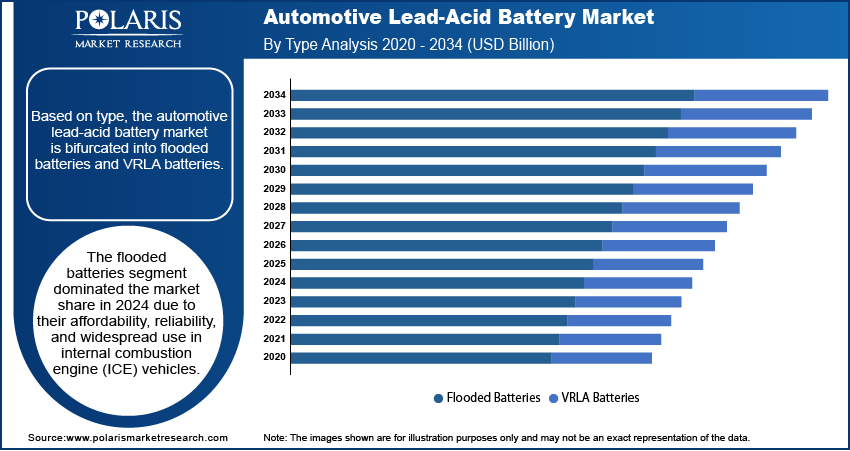
Based on type, the automotive lead-acid battery market is divided into flooded batteries and VRLA batteries. The flooded batteries segment dominated the automotive lead-acid battery market with 61.0% share in 2025, due to their affordability, reliability, and widespread use in internal combustion engine (ICE) vehicles. Flooded batteries are preferred for passenger cars, commercial vehicles, and two-wheelers as they offer a cost-effective solution for starting, lighting, and ignition (SLI) applications. The well-established manufacturing and recycling infrastructure for flooded batteries further contributed to their dominance, ensuring a steady supply and lower production costs. The ability of flooded batteries to withstand overcharging and deep cycling made them a preferred choice for conventional vehicles, especially in regions with high vehicle ownership, such as Asia Pacific and North America.
Market Outlook by End User
In terms of end user, the automotive lead-acid battery market is segregated into OEM and aftermarket. The aftermarket segment accounted for 59.0% share in 2025, owing to the high replacement rate of batteries in vehicles. Frequent battery wear and tear, exposure to extreme temperatures, and repeated charge-discharge cycles contributed to a steady demand for replacements. Vehicle owners and fleet operators replace old batteries periodically to ensure optimal performance, driving consistent demand in the segment. The increasing number of aging vehicles on the road also played a crucial role in the expansion of the aftermarket segment, as older vehicles required more frequent battery replacements. Additionally, the well-established distribution network of retailers, service centers, and e-commerce platforms made replacement purchases more accessible to aftermarket consumers, thereby propelling segment growth.
Source: Polaris Market Research Analysis
Regional Analysis
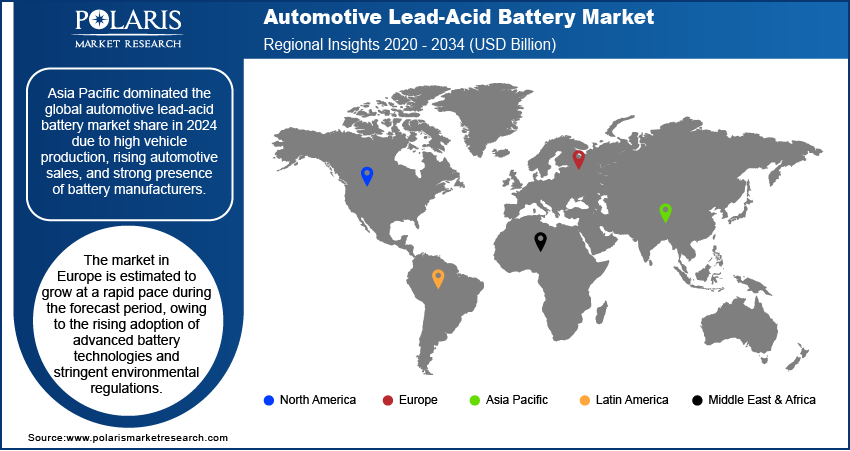
By region, the report provides automotive lead-acid battery market insight into North America, Europe, Asia Pacific, Latin America, and the Middle East & Africa. Asia Pacific dominated the global automotive lead-acid battery market with 41.0% revenue share in 2025, due to high vehicle production, rising automotive sales, and strong presence of battery manufacturers. Countries such as China, India, and Japan contributed significantly to the dominance of the region, with China leading as the largest producer and consumer of automobiles. Rapid urbanization, increasing disposable income, and expanding transportation infrastructure fueled vehicle demand, directly driving lead-acid battery sales. The well-established automotive supply chain in China, supported by government initiatives and large-scale battery recycling facilities, ensured a supply of cost-effective and sustainable lead-acid batteries. The growing demand for two-wheelers and commercial vehicles in India further boosted the automotive lead-acid battery market expansion in the country. Additionally, favorable policies promoting local manufacturing and foreign investments in the automotive sector contributed to the market growth in the region.
The Europe automotive lead-acid battery market is estimated to grow at a CAGR of 2.3% during the forecast period, owing to the rising adoption of advanced battery technologies and stringent environmental regulations. Countries such as Germany, France, and the UK are dominating this shift by focusing on fuel-efficient vehicles equipped with start-stop technology and hybrid systems. Germany, with its strong automotive industry and presence of major vehicle manufacturers, is expected to dominate the region. Automakers in Europe are increasingly integrating absorbent glass mat (AGM) and enhanced flooded batteries (EFB) to comply with strict emission standards and improve fuel efficiency. The push for sustainability and the well-developed recycling infrastructure in the region are further driving demand for lead-acid batteries. Additionally, the growing popularity of hybrid and electric vehicles, which require auxiliary lead-acid batteries for onboard electronics and safety systems, is contributing to the rising demand for lead-acid batteries in the region.
Source: Polaris Market Research Analysis
Key Players & Competitive Analysis Report
Prominent market players are investing heavily in research and development to expand their offerings, which will propel the automotive lead-acid battery market growth during the forecast period. These market participants are also undertaking a variety of strategic activities to expand their global footprint, with important market developments such as innovative launches, international collaborations, higher investments, and mergers and acquisitions between organizations.
The automotive lead-acid battery market is fragmented, with the presence of numerous global and regional market players. A few major players in the market include Amara Raja Energy & Mobility Limited; C&D Technologies, Inc.; Camel Group Co., Ltd.; Century Batteries; Clarios; Crown Battery; CSB Energy Technology Co., Ltd.; East Penn Manufacturing Company; EnerSys; Exide Technologies; Fiamm Energy Technology S.p.A.; GS Yuasa International Ltd.; Leoch International Technology Limited Inc; Moura Accumulators SA; Reem Batteries; Robert Bosch LLC; Stryten Energy; The Furukawa Battery Co., Ltd.; and Tianneng Rechargeable Battery Manufacturers.
Amara Raja Energy & Mobility Limited, formerly known as Amara Raja Batteries Limited, is an Indian multinational conglomerate headquartered in Tirupati.
Amara Raja Energy & Mobility Limited was the first company to manufacture Valve Regulated Lead-Acid (VRLA) batteries in India and is the largest manufacturer of VRLA batteries. The company supplies automotive batteries to several original equipment manufacturers (OEMs), including Maruti Suzuki, Hyundai Motors, Ford India, Tata Motors, Mahindra & Mahindra, Honda Cars India, Renault Nissan, Honda Motorcycles & Scooters India, Royal Enfield, and Bajaj Auto.
Exide Technologies is a global provider of stored energy solutions, manufacturing and distributing batteries and related equipment. Founded in 1888 as the Electric Storage Battery Company, the company develops its offerings through various battery technologies, including absorbent glass mats, enhanced cycling mats, gel, flooded, and VRLA (Valve Regulated Lead-Acid) batteries. Exide Technologies serves both OEMs and the aftermarket in the automotive sector. Their automotive batteries are used for SLI applications across two-wheelers, three-wheelers, and four-wheelers, including cars, jeeps, buses, and trucks. The company has manufacturing facilities in North America, Europe, and South Asia.
List of Key Companies
- Amara Raja Energy & Mobility Limited
- C&D Technologies, Inc.
- Camel Group Co., Ltd.
- Century Batteries
- Clarios
- Crown Battery
- CSB Energy Technology Co., Ltd.
- East Penn Manufacturing Company
- EnerSys
- Exide Technologies
- Fiamm Energy Technology S.p.A.
- GS Yuasa International Ltd.
- Leoch International Technology Limited, Inc
- Moura Accumulators SA
- Reem Batteries
- Robert Bosch LLC
- Stryten Energy
- The Furukawa Battery Co., Ltd.
- Tianneng Rechargeable Battery Manufacturers
Automotive Lead-Acid Battery Industry Developments
- October 2025: Toshiba introduced a new SCiB 24V battery pack (P25H20-3). It is a lithium-ion solution engineered for automotive, marine, and heavy equipment sectors. It offers seamless replacement of conventional lead-acid batteries. (Source: global.toshiba.com)
- March 2025: Clarios announced a $6 billion investment to expand U.S. manufacturing and strengthen battery supply chains supporting energy and critical mineral innovation. (Source: clarios.com)
- November 2024: Satya Intl partnered with Duracell to launch Duracell-branded lead-acid, tubular, inverter, and UPS batteries across Asia and Africa, targeting growing demand for premium automotive products, especially in India. (Source: duracellautocare.com)
- April 2024: GS Yuasa Corporation, a Japan-based company that manufactures and sells batteries, power systems, and other electrical equipment, announced the sales launch for the ECO.R HV auxiliary VRLA battery series for Toyota hybrid vehicles. (Source: gsyuasa.com)
Automotive Lead-Acid Battery Market Segmentation
By Type Outlook (Revenue, USD Billion, 2021–2034)
- Flooded Batteries
- VRLA Batteries
By Product Outlook (Revenue, USD Billion, 2021–2034)
- SLI Batteries
- Micro Hybrid Batteries
- Auxiliary Batteries
By Vehicle Type Outlook (Revenue, USD Billion, 2021–2034)
- Passenger Cars
- Light and Heavy Commercial Vehicles
By End User Outlook (Revenue, USD Billion, 2021–2034)
- OEM
- Aftermarket
By Regional Outlook (Revenue, USD Billion, 2021–2034)
- North America
- US
- Canada
- Europe
- Germany
- France
- UK
- Italy
- Spain
- Netherlands
- Russia
- Rest of Europe
- Asia Pacific
- China
- Japan
- India
- Malaysia
- South Korea
- Indonesia
- Australia
- Vietnam
- Rest of Asia Pacific
- Middle East & Africa
- Saudi Arabia
- UAE
- Israel
- South Africa
- Rest of Middle East & Africa
- Latin America
- Mexico
- Brazil
- Argentina
- Rest of Latin America
Automotive Lead-Acid Battery Market Report Scope
| Report Attributes | Details |
| Market Size Value in 2025 | USD 29.72 Billion |
| Revenue Forecast in 2026 | USD 30.62 Billion |
| Revenue Forecast by 2034 | USD 38.89 Billion |
| CAGR | 3.0% from 2026 to 2034 |
| Base Year | 2025 |
| Historical Data | 2021–2024 |
| Forecast Period | 2026–2034 |
| Quantitative Units | Revenue in USD Billion and CAGR from 2026 to 2034 |
| Report Coverage | Revenue Forecast, Market Competitive Landscape, Growth Factors, and Trends |
| Segments Covered |
|
| Regional Scope |
|
| Competitive Landscape |
|
| Report Format |
|
| Customization | Report customization as per your requirements with respect to countries, regions, and segmentation. |
Source: Polaris Market Research Analysis
Automotive Lead-Acid Battery Market FAQ's
The global automotive lead-acid battery market size was valued at USD 29.72 billion in 2025 and is projected to grow to USD 38.89 billion by 2034.
The global market is projected to register a CAGR of 3.0% during the forecast period.
Asia Pacific held the largest share of the global market in 2025 valued at 41.0%.
A few of the key players in the market are Amara Raja Energy & Mobility Limited; C&D Technologies, Inc.; Camel Group Co., Ltd.; Century Batteries; Clarios; Crown Battery; CSB Energy Technology Co., Ltd.; East Penn Manufacturing Company; EnerSys; Exide Industries Ltd.; Exide Technologies; Fiamm Energy Technology S.p.A.; GS Yuasa International Ltd.; Leoch International Technology Limited Inc; Moura Accumulators SA; Reem Batteries; Robert Bosch LLC; Stryten Energy; The Furukawa Battery Co., Ltd.; and Tianneng Rechargeable Battery Manufacturers.
The flooded batteries segment dominated the automotive lead-acid battery market revenue share of 61.0% in 2025.
Download Sample Report of Automotive Lead-Acid Battery Market
Please fill out the form to request a customized copy of the research report.


