
Cannabidiol Market Share, Size, Trends, Industry Analysis Report, 2026 - 2034
REPORT DETAILS
Cannabidiol Market Summary
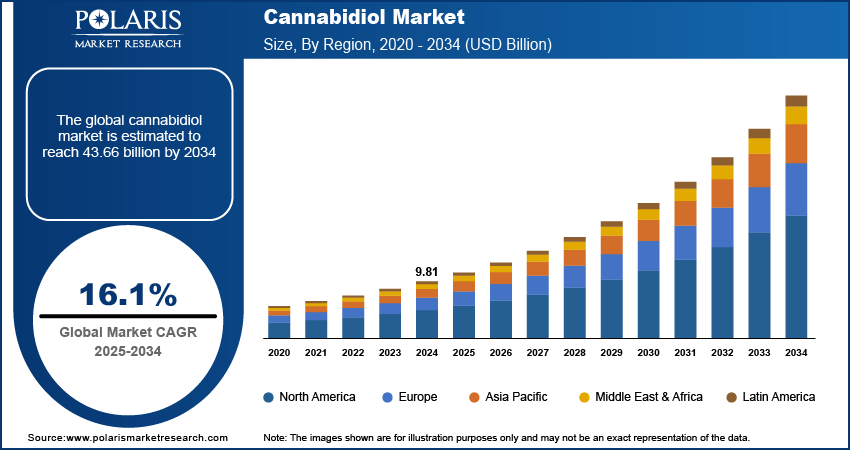
The global cannabidiol market is valued at USD 11.36 billion in 2025 and is projected to grow at a CAGR of 16.1% during the forecast period. Owing to it allay nature, the high request for CBD for healing and fitness motives is the prominent aspect driving the industry growth for cannabidiol.
Market Statistics
Key Takeaways
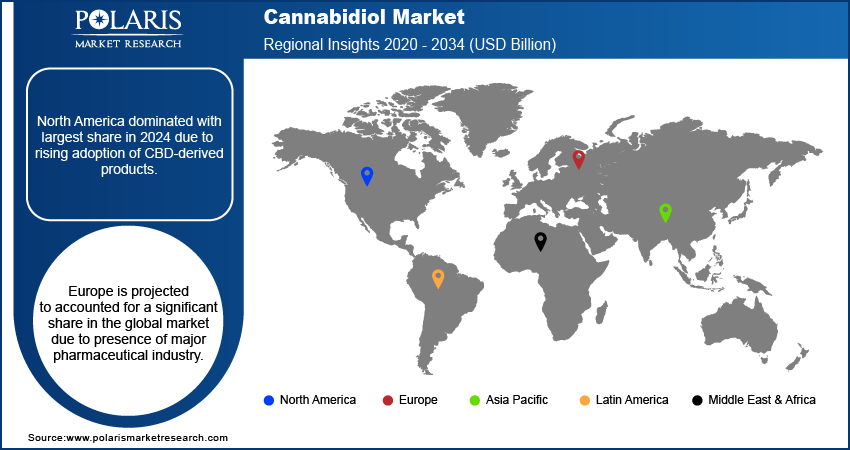
- North America dominated with the largest share of 47.64% in 2025 due to rising adoption of CBD-derived products.
- Europe is projected to accounted for a significant share of 25.21% in 2025 due to presence of major pharmaceutical industry.
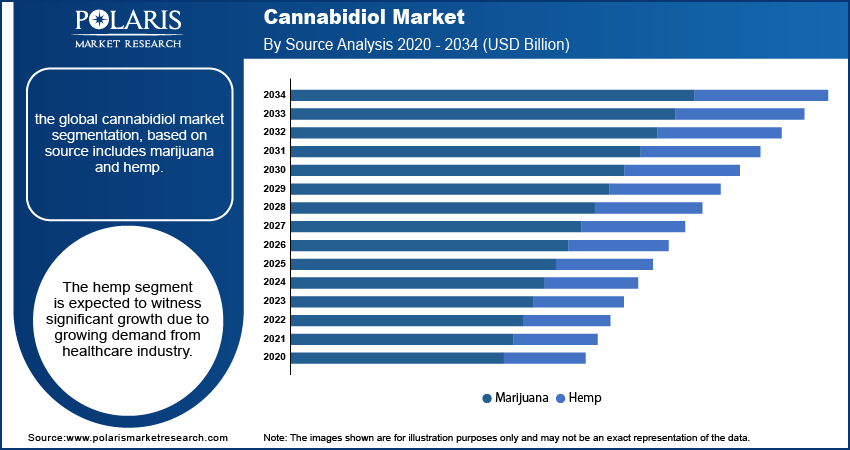
- The marijuana segment led with a 87.70% revenue share in 2025. The rise in the legalization of marijuana-obtained products for major health diagnosis applications has contributed to the segment’s leading position.
- The hemp segment is expected to witness significant growth at a 15.7% CAGR due to growing demand from the healthcare industry.
- The pharmaceutical segment led with a 20.10% revenue share in 2025, driven by continuous R&D activity.
Note: Figures and projections outlined in this report are the result of Polaris Market Research’s proprietary analytical processes, grounded in the latest available datasets and market observations.
Industry Dynamics
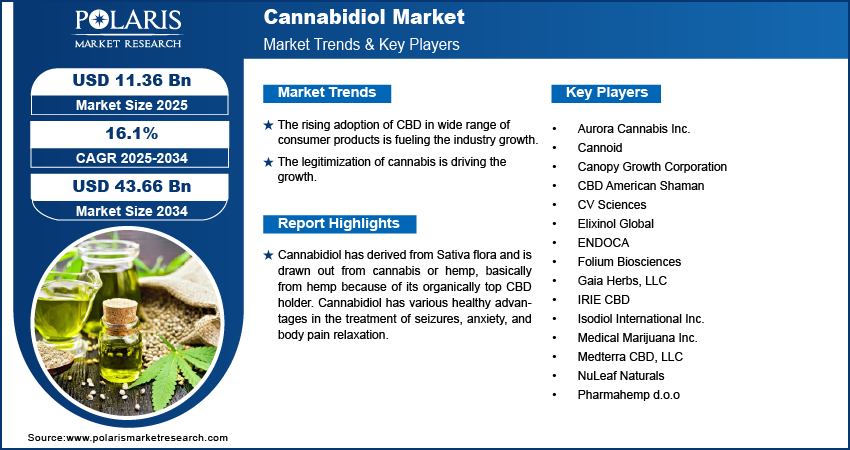
- The rising adoption of CBD in wide range of consumer products is fueling the industry growth.
- The increasing awareness of usage of cannabis in beauty care product is boosting the industry growth.
- The legitimization of cannabis is driving the growth.
- Regulatory uncertainty and inconsistent legal frameworks across countries and regions are limiting product distribution and consumer trust.
Source: Polaris Market Research Analysis
To Understand More About this Research: Download Sample Report
Cannabidiol has derived from Sativa flora and is drawn out from cannabis or hemp, basically from hemp because of its organically top CBD holder. Cannabidiol has various healthy advantages in the treatment of seizures, anxiety, and body pain relaxation.
The robust demand for remedies, medication, and other consumer & healing products prepared from cannabis and its effective well-being advantages has evolved into inflaming permissions for CBD-derived products for the public welfare. The U.S FDA (Food and Drug Administration) has validated various possible opportunities that cannabis will provide and recognized the probability of saturating it in several medical and food applications. Although, the FDA is functioning to safeguard communal health and enhance the coherence of the administrative path to produce mankind's suitable products. The cannabidiol market players are supervised on bearing out CBD to utilize the same in food, personal health care, pharmaceutical, and other remedy products are some aspects rising the growth of the global cannabidiol market during the projection period.
Clinical examinations administered on CBD have rendered its effectiveness in the diagnosis of many types of epilepsy. Emerging nations are looking to manufacture CBD-derived pharmaceuticals, which will remarkably give rise to huge demand, which in turn boost the market demand for cannabidiol.
Cannabidiol Product Types
There are various types of CBD products in different forms, such as oil, isolate, concentrate, topical, and capsules. Different people use CBD products in their own ways, depending on their purpose: for general wellbeing, for more specific uses like skincare, or as a supplement. Oil and tincture are frequently used for quick absorption, while capsule form is used for precise dosing. Topicals are frequently used for local effects, especially in use cases for skincare and pain management.
Potential Health Benefits of CBD
CBD is often known for its potential health benefits, including reducing stress, improving sleep, providing pain relief, and reducing inflammation. Its other potential uses include medicinal purposes for neurological ailments and chronic conditions. Moreover, CBD is also increasingly being used for making skin care products owing to its soothing and anti-inflammatory effects
Cannabidiol Use Case Breakdown
The uses of CBD depend on various industries. In the health and wellness sector, it is applied in nutritional supplements as well as stress-reduction products. In the pharmaceutical sector, CBD is applied in pain relievers, epilepsy, and anxiety management. It is also used in beauty products such as cream, serum, and oil to hydrate and rejuvenate the skin. It can be applied in the pet care industry to ease joint and anxiety pain in pets.
Cannabidiol vs Tetrahydrocannabinol Compared
| Factor | (CBD - Cannabidiol) | (THC - Tetrahydrocannabinol) |
| Effects | Negative (non-psychoactive) | Positive (“high”) |
| Legal | Allowed in most places (with THC limitations) | Controlled/restricted by many countries |
| Application | Medical, cosmetic and therapeutic | For recreation and medicinal purposes |
| Therapeutic effects | Treatment of anxiety, pain and insomnia | Stimulates appetite and relieves pain |
| Origin | Hemp or cannabis plants | Cannabis plants |
| Regulation level | Moderate to strict depending on region | Strict global control |
Source: Polaris Market Research Analysis
What is the Impact of Regulations on the Cannabidiol Market?
The global cannabidiol industry is witnessing stringent regulations. Rules vary according to regions and product types. Ingestible CBD products require pre-market authorization in the European Union (EU) countries and the UK. The products have prescription-only access in Japan and Australia. Also, compliance with FDA regulations is needed in the U.S. Further, THC limits remain critical across all markets. Canada allows licensed production and commercialization. On ther other side, India and the Middle East permit mostly THC-free CBD for medical and cosmetic use. Topical and cosmetic cannabidiol products face fewer restrictions, which makes them the most accessible segment across the world.
| Region/Country | Regulator | Compliance Requirements | Impact on Market |
| U.S. | FDA (Food and Drug Administration); DEA (Drug Enforcement Administration) | CBD use is legal if derived from hemp (<0.3% THC). The FDA restricts the use of CBD in food, dietary supplements, and cosmetics without approval. There are state-level variations for CBD sale and use. | Uncertainty in regulations impedes mainstream adoption of food and beverages. Hemp-derived CBD is widely used in supplements. |
| Canada | Health Canada | Cannabis Act governs cannabis products, such as CBD. Licenses are required for the production, sale, and distribution of these products. | A strong regulatory framework allows licensed production and commercialization. Production and use of edibles, oils, and extracts are tightly controlled. |
| European Union | European Commission, EFSA (European Food Safety Authority) | CBD is classified as a “novel food” if ingested. Its use requires pre-market safety evaluation and authorization. THC must be below 0.2–0.3%. | Lengthy novel food approval process hinders the CBD adoption. |
| UK | Food Standards Agency (FSA); MHRA | Novel food authorization requirement for oral CBD products. THC-free (<1 mg/day) requirement. Cosmetic products must adhere to EU Cosmetic Regulation. | Retailers are required to submit products for FSA notification to continue sales. |
| India | Narcotic Drugs & Psychotropic Substances (NDPS) Act; Food Safety and Standards Authority of India (FSSAI) | Use of THC-containing products is illegal. Hemp-derived CBD is allowed for medicinal research and cosmetics. It is subject to FSSAI approval. | The consumer market, mostly topicals and research-focused products, is in the early stages. |
| Middle East (the UAE and Saudi Arabia) | Ministry of Health; local drug enforcement authorities | Use of CBD products is mostly prohibited unless they are THC-free and approved for medical use. | Highly restrictive. The market is limited to medical channels with government approval. |
Source: Polaris Market Research Analysis
Source: Polaris Market Research Analysis
Industry Dynamics
Growth Drivers
The rising adoption of CBD in various consumer products because of the developing buyers' inclination towards CBD-derived products and compliance with therapeutics cannabidiol-based products for cancer-suffering patients to reduce pain is driving the demand. This adoption is fuel by rising awareness regarding the utilization of cannabis. Moreover, the increasing use of cannabis in beauty care products, stress relief, medical applications, food & beverages, road accident injured patients, and supplements is further fueling the growth. Furthermore, the ongoing research & development activities and huge funding by the pharmaceutical industry players to capture the largest revenue share is fueling the growth.
Additionally, the legitimization of cannabis has decreased the requirement for regular authorization from different government departments. Key industry players are preparing their eCommerce platforms (website & apps) for the legal and transparent sales of cannabidiol-prepared products, which are some factors driving the growth of the market during the forecast period.
Report Segmentation
The market is primarily segmented based on by product, application, source, and regions.
| By Product | By Application | By Source | By Region |
|
|
|
|
Source: Polaris Market Research Analysis
Know more about this report: Download Sample Report
Marijuana segment dominated with largest share in 2025
The marijuana section dominated the market in 2025 with 87.70% revenue share. The rising adoption of improved CBD-based products and the surge in the legalization of marijuana-obtained products for major health diagnosis applications are driving the growth of the segment. Moreover, the top-notch efficacy of cannabidiol procured from marijuana is a major aspect propelling the segment's growth in the gross market.
Hemp-obtained cannabidiol is expected to register lucrative growth rate of CAGR 15.7% due to the booming request from the healthcare industry and growing perception amidst end users' reference to health & fitness, plus consumer per capita income along with the government favorable policies for pharmaceutical cannabis is expected to showcase cogent impact on the huge demand for cannabidiol in the therapeutics category.
Utilization of tinctures, oils, concentrate, topical solutions, and capsules in end-user products, likely slaves, body lotions, lip balms, and succulents such as coffee, gums, chocolates, baked goods, and candies are some of the CBD-prepared products that are in huge demand from the consumer side.
Source: Polaris Market Research Analysis
Pharmaceutical sector dominated the market share in 2025
The pharmaceutical sector is one of the prominent industries that continue aiming for advancements, new product launches, and R&D activities in the market. The key players have found a massive gravity of CBD in their product production due to its large contribution, namely immunomodulatory attributes, pain reduction, and others. The rising digit of drug trials to examine the physical effects of CBD on individual health situations is expected to boost the product needs in recent years. Although, key players combined CBD oils in the mass production of CBD-derived products. These products are consumed by a huge educated and aware consumer as an anxiety and mental stress relief substitute.
North America region leads the global cannabidiol market in 2025
In North America, the existence of a great number of fitness-oriented citizens in the province, enlarging adoption of CBD-derived products, the occupancy of key industrialists, and legal authorization from the U.S. government are some of the prime aspects of developing the topographical market. North America is considered to be the ultra-competitive region for cannabis and associated outcomes, counting cannabidiol. The USA alone has the largest CBD manufacturers and sympathetic regulations towards the usage of CBD-obtained products.
The Europe is expected to witness significant growth during the forecast period due to rise in demand for the natural wellness product. Cannabidiol is used in natural wellness products because of its non-psychoactive, plant-based properties and its potential health benefits without the “high” associated with THC. Moreover, growing acceptance of CBD and change in perception is further fueling the demand in various therapeutic application. The governments in the European countries such as Germany and UK have passed regulation related to potential use of cannabis related product which further drives the growth in the region.
Source: Polaris Market Research Analysis
Competitive Insight
Some of the key players operating in the global cannabidiol (CBD) market include ENDOCA, Medical Marijuana Inc., Aurora Cannabis, Folium Biosciences, Elixinol Global, Canopy Growth Corporation, NuLeaf Naturals, IRIE CBD, Medterra CBD, LLC, CBD American Shaman, Cannoid, Isodiol International Inc., Aurora Cannabis Inc., Gaia Herbs, LLC, CV Sciences, Pharmahemp d.o.o, and others.
Recent Developments
April 2026: CBD Life Sciences Inc. released a new line of adaptogenic mushroom products. These products included gummies, capsules, coffee, and topical creams. The company did this to get into the quickly growing functional wellness market and combine its existing CBD business with natural health trends. (Source: morningstar.com)
In October 2025: CR Wellness teamed up with the well-known cannabis brand Cookies to launch a line of high-end cannabis and CBD wellness products in Brazil. This was Cookies' first foray into South America's largest market. The first products are THC/CBD tinctures and gummies that can only be bought with a prescription. They were made in full compliance with local laws and have been thoroughly tested in a lab. (Source:cannabisbusinesstimes.com)
Cannabidiol Market Report Scope
| Report Attributes | Details |
| Market size value in 2025 | USD 11.36 billion |
| Market size value in 2026 | USD 13.15 billion |
| Revenue forecast in 2034 | USD 43.66 billion |
| CAGR | 16.1% from 2026 – 2034 |
| Base year | 2025 |
| Historical data | 2021 – 2024 |
| Forecast period | 2026 – 2034 |
| Quantitative units | Revenue in USD billion and CAGR from 2026 to 2034 |
| Segments covered | Product Type, Application, Source, and Region |
| Regional scope | North America, Europe, Asia Pacific, Latin America; Middle East & Africa |
| Key companies | ENDOCA, Medical Marijuana Inc., Aurora Cannabis, Folium Biosciences, Elixinol Global, Canopy Growth Corporation, NuLeaf Naturals, IRIE CBD, Medterra CBD, LLC, CBD American Shaman, Cannoid, Isodiol International Inc., Aurora Cannabis Inc., Gaia Herbs, LLC, CV Sciences, Pharmahemp d.o.o, and others. |
Source: Polaris Market Research Analysis
Cannabidiol Market FAQ's
• The market size was valued at USD 11.36 Billion in 2025 and is projected to grow to USD 43.66 Billion by 2034.
• The market is projected to register a CAGR of 16.1% during the forecast period.
• A few of the key players in the market are ENDOCA, Medical Marijuana Inc., Aurora Cannabis, Folium Biosciences, Elixinol Global, Canopy Growth Corporation, NuLeaf Naturals, IRIE CBD, Medterra CBD, LLC, CBD American Shaman, Cannoid, Isodiol International Inc., Aurora Cannabis Inc., Gaia Herbs, LLC, CV Sciences, Pharmahemp d.o.o, and others.
• The pharmaceutical accounted for the largest market share in 2025.
• The hemp segment is expected to record significant growth.
Download Sample Report of Cannabidiol Market
Please fill out the form to request a customized copy of the research report.


