
Clinical Trial Imaging Market Trends & Revenue Forecast 2026-2034
REPORT DETAILS
Clinical Trial Imaging Market Summary
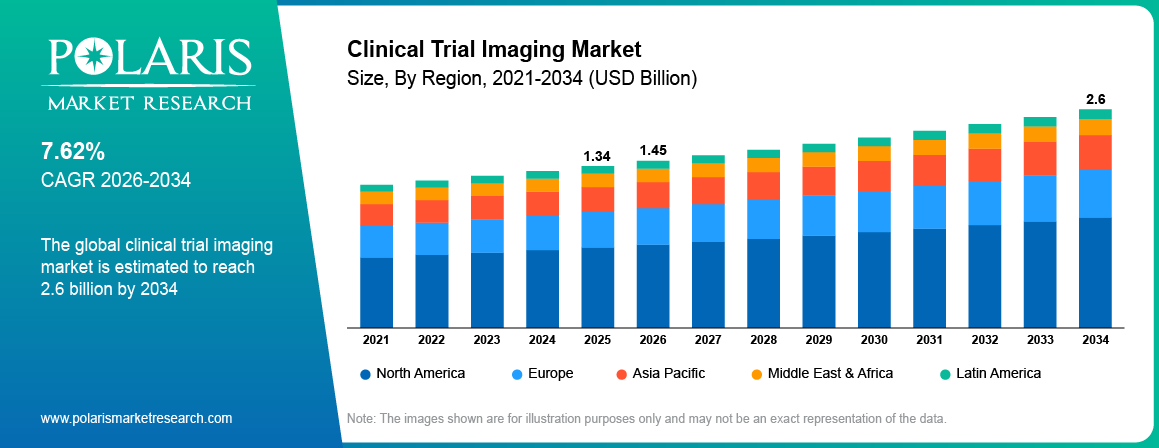
The market is anticipated to grow from USD 1.34 Billion in 2025 to USD 2.60 Billion by 2034, exhibiting the CAGR of 7.62% during the forecast period.
Market Statistics
Key Takeaways
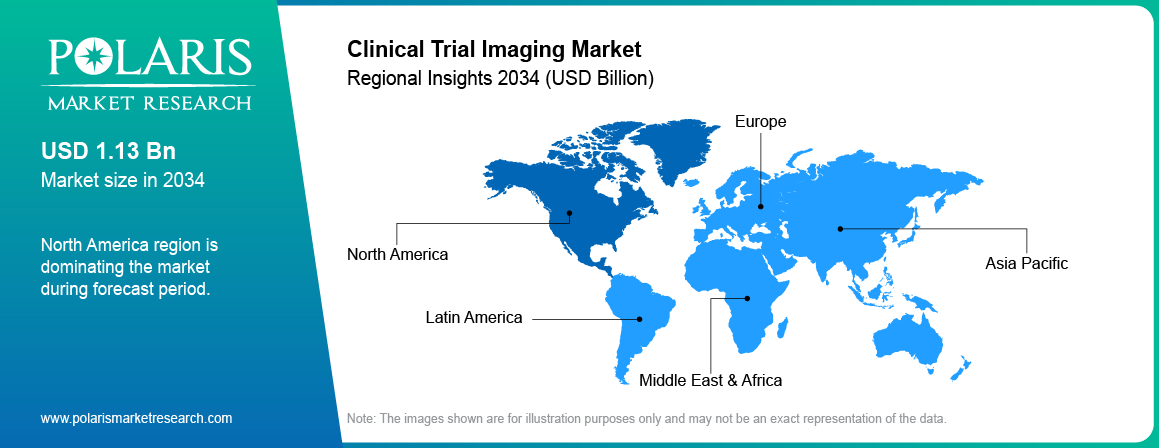
- In 2025, North America accounted for the largest market share of 43.5%. The dominance is attributed to its advanced healthcare infrastructure, strong clinical research ecosystem, and high concentration of pharmaceutical and biotechnology companies.
- The Asia Pacific clinical trial imaging market is expected to register the highest CAGR of 8.9% during the forecast period. Growth is driven by increasing investments in healthcare infrastructure, expanding clinical trial activities, and favorable regulatory reforms.
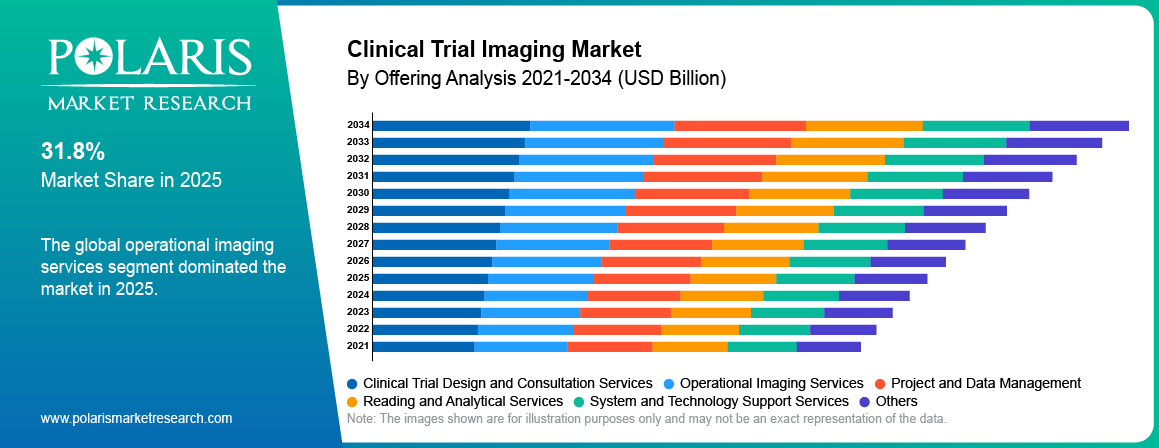
- The Operational Imaging Services segment dominated the market with 31.8% revenue share in 2025. The leading position is fueled by its essential role in image acquisition, site coordination, quality assurance, and protocol compliance throughout the clinical trial process.
- The Oncology segment held the largest revenue share of 38.6% in 2025. The high emphasis on oncology trials globally, coupled with increasing adoption of precision medicine and biomarker-based studies, continues to propel segment growth.
- The Pharmaceutical & Biotechnology Companies segment is expected to register a substantial CAGR of 9.4% during the forecast period. This growth is driven by increasing drug development initiatives, expanding biologics pipelines, and rising demand for imaging-based efficacy and safety assessments in clinical research.
Note: Figures and projections outlined in this report are the result of Polaris Market Research’s proprietary analytical processes, grounded in the latest available datasets and market observations.
Clinical Trial Imaging in Simple Terms
Clinical trial imaging is carried out for the assessment of the progression of the disease, efficiency of treatment, safety of patients, and effectiveness of therapy in clinical trials. Medical imaging is done using different modalities such as MRI, CT, PET, X-ray, and ultrasound. The process offers objective, measurable outcomes. They aid in developing drugs and approving regulations. It is also used in precision medicine efforts.
Clinical Trial Imaging Market Drivers, Opportunities and Challenges
- Increasing prevalence of chronic conditions is driving the growth of the clinical trial imaging market.
- Growing investments in pharmaceutical research and development fuel the market expansion.
- High cost of imaging services hinders the adoption of clinical trial imaging.
- Expansion of biotechnology pipelines would provide lucrative market opportunities during the forecast period.
- AI integration in medical imaging is expected to emerge as a key market trend in the coming years.
Source: Polaris Market Research Analysis
To Understand More About this Research:Download Sample Report
AI Impact on Clinical Trial Imaging Market
- AI accelerates medical image analysis by automating image interpretation.
- Machine learning improves lesion detection and measurement accuracy.
- AI minimizes variability in images across clinical trial sites.
- Deep learning improves disease progression detection. AI enables quick patient eligibility screening.
- Predictive analytics facilitates the early assessment of treatment response.
Market Introduction
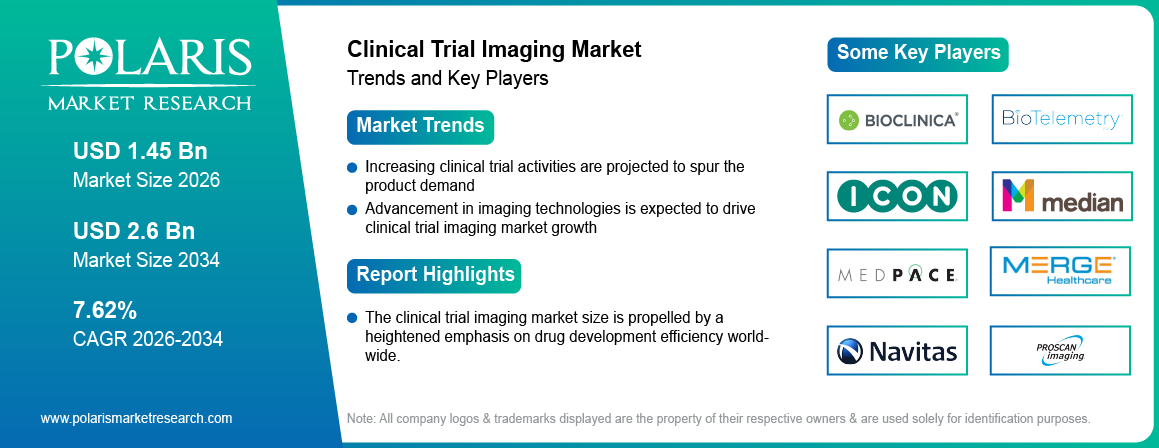
The clinical trial imaging market size is propelled by a heightened emphasis on drug development efficiency worldwide. Pharmaceutical and biotech companies are encouraged to expedite the drug development process without compromising safety and efficacy. Clinical trial imaging, utilizing modalities like MRI, CT, PET, and ultrasound, aids in visualizing and quantifying physiological changes, enhancing drug effects assessment and treatment response evaluation. Integration of imaging endpoints in trial protocols enables accurate efficacy assessment and early adverse event detection, minimizing late-stage trial failures and costs. Regulatory recognition of imaging data's significance further drives its adoption, streamlining trial processes, cutting costs, and expediting drug approvals for more efficient drug development pipelines.
In addition, companies operating in the market are introducing new products to expand market reach and strengthen their presence.
How Clinical Trial Imaging Works
- Designing of Clinical Trial Protocol: The study objective, imaging methods, and schedules for image acquisition are defined.
- Imaging Endpoints are Specified: Certain imaging parameters are chosen in order to test the treatment efficacy and safety. Patient Scans are Performed: CT, MRI, PET, ultrasonic, or X-ray scans are obtained according to the imaging protocol.
- Images Are Subjected to Central Review: Imaging experts review the scans to ensure consistent and unbiased assessments.
- Imaging Biomarker Data: This includes measurement of treatment response and imaging biomarker data.
- Results Support Clinical Decisions: Findings of the study are used to prove the efficacy of the drug.
Difference Between Clinical Trial Imaging vs Traditional Clinical Assessments
| Feature | Clinical Trial Imaging | Traditional Clinical Assessments |
| Objectivity | High; based on standardized imaging data | Moderate; relies on clinical evaluation |
| Quantitative Data | Extensive measurements and imaging metrics | Limited numerical measurements |
| Disease Monitoring | Real-time visualization of disease changes | Based mainly on clinical observation |
| Treatment Evaluation | Precise assessment of therapeutic response | Less precise and more subjective |
| Biomarker Analysis | Supports imaging biomarker identification | Limited biomarker assessment |
| Detection Sensitivity | Detects subtle anatomical and functional changes | May miss early or minor changes |
| Consistency Across Sites | High with centralized image review | Can vary between investigators |
| Regulatory Acceptance | Widely used for validated imaging endpoints | Primarily used as supportive clinical evidence |
| Data Standardization | Standardized imaging protocols ensure consistency | Greater variability in assessment methods |
| Decision Support | Enables data-driven treatment and trial decisions | Relies more on physician judgment |
Source: Polaris Market Research Analysis
- For instance, in March 2025, Clario introduced an innovative cloud-based Image Viewer tool tailored for sponsors and CROs to review clinical trial images. This new tool enables sponsors and CROs to conveniently access high-quality images promptly via an intuitive web-based imaging viewer, nearly in real-time.
The clinical trial imaging market share experiences substantial growth due to increasing demand for biomarker assessment. Biomarkers play a vital role in understanding disease mechanisms and predicting treatment responses. Imaging modalities offer non-invasive ways to visualize and quantify biomarkers in vivo, aiding in disease monitoring and treatment evaluation. Advancements in molecular imaging and AI-driven analysis streamline biomarker assessment, enhancing accuracy and efficiency. This surge in demand reflects the growing emphasis on precision medicine and personalized therapies, driving innovation in clinical trial design and therapeutic development.
Real-World Use Cases of Clinical Trial Imaging
- Assessment of Efficacy of Cancer Drugs: This involves using CT, MRI, and PET scan procedures for determining the efficacy of cancer drugs on patients.
- Neurological Disorders Clinical Study: The examination of alterations in brain structures and functions with the help of MRIs, fMRIs, and PET scans takes place in clinical studies for Alzheimer’s disease, Parkinson’s disease, multiple sclerosis, and stroke.
- Clinical Studies of Cardiovascular Drugs: Assessment of heart and vessels functions using echocardiography, CT angiography, MRIs, and intravascular imaging is performed.
Role of Imaging Biomarkers in Clinical Trial Imaging
Imaging biomarkers are becoming a core component of modern trial design. Imaging biomarkers give sponsors a non-invasive, quantifiable way to track disease progression and treatment response over the course of a trial, reducing reliance on more invasive or delayed endpoints. The rising use of imaging biomarkers corresponds well to the shift toward precision medicine, whereby determining the appropriate patient subgroup for a specific treatment could increase the likelihood of success during trials. There is also the rising regulatory acceptance of validated imaging biomarkers being used as endpoints in clinical trials.
A few applications are listed below:
- Measurement of disease progression
- Monitoring of treatment response
- Precision medicine and biomarker-based patient stratification
- Clinical endpoint support
- Early, noninvasive detection of therapeutic effect
Industry Growth Drivers
Increasing clinical trial activities are projected to spur the product demand
The increase in global clinical trial activities propels the clinical trial imaging market growth. As pharmaceutical and biotech firms develop new treatments, imaging services become crucial for assessing safety and efficacy. Various modalities like MRI, CT, PET, and ultrasound offer insights into disease progression and treatment response. Regulatory agencies mandate robust imaging data for drug approval, leading to the integration of imaging endpoints in trial protocols. Furthermore, precision medicine's rise drives demand for imaging biomarkers to identify patient subgroups benefiting from specific therapies. This emphasis on evidence-based medicine, coupled with imaging technology advancements, fuels the market expansion.
Advancement in imaging technologies is expected to drive clinical trial imaging market growth
Advancements in imaging technologies are reshaping clinical trials, fueling growth in the market. These innovations encompass MRI, CT, PET, and ultrasound, offering high-resolution images for precise disease assessment. AI and machine learning algorithms enhance image analysis, expediting drug development and reducing trial costs. Additionally, decentralized trials and remote imaging technologies are gaining traction, facilitating seamless data sharing and collaboration. These advancements drive efficiency and precision in clinical trial design and execution, enhancing drug development strategies in the pharmaceutical and biotechnology industries.
Industry Challenges
High cost of imaging services is likely to impede the market growth
The clinical trial imaging market share encounters limitations due to the high costs associated with imaging services. While imaging plays a pivotal role in clinical trials by offering insights into disease progression and treatment efficacy, the expenses involved in acquiring, maintaining, and analyzing imaging data can be prohibitive. Initial investments in advanced imaging equipment and personnel, along with regulatory compliance requirements, impose significant financial burdens on clinical trial sponsors and contract research organizations. Additionally, the need for specialized expertise and infrastructure further adds to the overall expenditure.
Source: Polaris Market Research Analysis
Report Segmentation
The market analysis is primarily segmented based on offering, modality, application, end user, and region.
| By Offering | By Modality | By Application | By End User | By Region |
|
|
|
|
|
Source: Polaris Market Research Analysis
Clinical Trial Imaging Market by Offering: Design, Operations, Data Management and Reading Services
Operational imaging services segment held considerable revenue share in 2025
The operational imaging services segment held considerable revenue share in 2025 due to their essential role throughout the trial process. Offering comprehensive solutions from image acquisition to endpoint analysis, these services ensure compliance with regulatory standards and protocol requirements. With specialized expertise, advanced technology, and flexible scalability, they cater to diverse trial needs effectively. While requiring significant initial investments, operational imaging services streamline trial operations and offer cost-effective solutions for sponsors and CROs.
Clinical Trial Imaging Market by Modality: CT, MRI, PET, Ultrasound and X-Ray
Computed tomography segment held significant revenue share in 2025
The computed tomography segment held significant revenue share in 2025 due to its diagnostic versatility and wide application spectrum across therapeutic areas like oncology, cardiology, and neurology. CT imaging provides detailed anatomical information, accurate disease assessment, and quantitative analysis capabilities, making it valuable for evaluating treatment efficacy and patient outcomes in clinical trials. Additionally, its rapid imaging acquisition enables efficient data collection and timely assessment of study endpoints, beneficial in oncology trials where CT is extensively used for tumor staging and treatment response monitoring.
MRI in Clinical Research: Neurology, Oncology and Quantitative Imaging Endpoints
Magnetic Resonance Imaging (MRI) remains one of the most widely used modalities in clinical trial imaging. MRI plays a significant role across trial types. It can produce detailed, high-resolution images of soft tissue without radiation exposure. Its versatility makes it valuable well beyond a single therapeutic area — from tracking structural changes in neurology trials to supporting tumor characterization in oncology studies. As functional and quantitative MRI techniques mature, sponsors are increasingly incorporating MRI-based endpoints into trial protocols where fine-grained, repeatable soft-tissue assessment is required.
- Neurology trial applications
- Oncology tumor characterization
- Soft tissue evaluation without radiation exposure
- Disease progression tracking over time
- Functional and quantitative imaging applications
Clinical Trial Imaging Market by Application: Oncology, Neurology and Cardiovascular Trials
Oncology segment held significant revenue share in 2025
The oncology segment held a significant revenue share in 2025. The high incidence of oncology trials globally drives demand for imaging services. Additionally, the complexity of oncology trials, necessitating frequent imaging assessments, requires specialized imaging services and expertise. Furthermore, the utilization of advanced imaging techniques such as MRI and PET-CT in oncology trials enhances growth. The growing pipeline of oncology drugs in development fuels the demand for imaging services within the oncology segment.
Clinical Trial Imaging Market by End User: Pharma, Biotech, CROs and Medical Device Companies
The demand from pharmaceutical & biotechnology companies is expected to increase during the forecast period
The demand from pharmaceutical & biotechnology companies is expected to increase during the forecast period owing to ongoing drug development initiatives requiring imaging for efficacy and safety assessments, the rise of precision medicine necessitating imaging biomarkers for patient stratification, and the development of innovative therapeutics requiring advanced imaging techniques for treatment evaluation. Additionally, regulatory requirements mandate robust imaging data for drug approvals, while the cost-effectiveness and non-invasiveness of clinical trial imaging make it an appealing option for streamlining drug development processes.
Role of CROs in Clinical Trial Imaging Outsourcing and Global Study Operations
Contract Research Organizations (CROs) are taking on a growing share of imaging operations for pharmaceutical sponsors. Clinical studies have become more complex and geographically dispersed. CROs have become central to how sponsors execute imaging-heavy trials. Rather than building in-house imaging infrastructure, pharmaceutical and biotechnology companies outsource imaging workflow management to CROs. CROs can handle centralized review and cross-site data standardization. They also can perform regulatory documentation at scale. This shift allows sponsors to maintain consistent image quality and interpretation standards across different trial sites.
Importance of Imaging Core Labs for Central Review and Multi-Site Standardization
Imaging core laboratories are an important part of ensuring uniformity in global multicenter trials. With the increasing number of sites and locations for clinical trials, one of the risks that can impact the quality of the data is variability in the way images have been taken and interpreted. This can be controlled through core imaging laboratories through standardization in reading of images. Their role has become especially important as regulators scrutinize imaging data more closely during drug approval reviews, making standardized, audit-ready reporting a practical necessity rather than a nice-to-have.
Source: Polaris Market Research Analysis
Clinical Trial Imaging Market Regional Analysis
North America Clinical Trial Imaging Market
In 2025, the North American region accounted for a significant market share. The region has an advanced healthcare infrastructure and hosts a large volume of clinical trials across various therapeutic areas. Moreover, it is home to leading pharmaceutical companies and contract research organizations, driving demand for imaging services. Stringent regulatory standards and compliance requirements emphasize the importance of imaging endpoints, further boosting utilization. Continuous technological advancements in medical imaging and collaboration between academia and industry contribute to the region's attractiveness. Additionally, significant investments in research and development initiatives by both government agencies and private organizations further propel the growth of the market in North America.
Asia-Pacific is expected to experience significant growth during the forecast period due to rapid expansion of healthcare infrastructure, increasing outsourcing of clinical trials to the region, and a burgeoning pharmaceutical and biotechnology sector. Additionally, the shift towards precision medicine and government initiatives promoting healthcare innovation is driving the demand for advanced imaging technologies. Emerging economies such as China, India, and South Korea are witnessing a surge in clinical trial activities, further fueling market growth.
Source: Polaris Market Research Analysis
Clinical Trial Imaging Market Competitive Landscape and Leading Companies
The clinical trial imaging market players encompasses various participants, and the forthcoming entry of new competitors is set to escalate competition. Established frontrunners consistently innovate their technologies to uphold a competitive edge, focusing on efficiency, dependability, and safety. These enterprises prioritize strategic initiatives like forging partnerships, enhancing product ranges, and engaging in collaborative ventures. Their goal is to surpass rivals in the sector, solidifying a notable market share.
Some of the major players operating in the global market include:
- BioClinica
- Biomedical Systems Corp
- BioTelemetry, Inc.
- Cardiovascular Imaging Technologies
- ICON plc
- Intrinsic Imaging
- IXICO plc
- Median Technologies
- Medpace
- Merge Healthcare
- Navitas Clinical Research, Inc
- ProScan Imaging
- Radiant Sage LLC
- Resonance Health
- WorldCare Clinical
Recent Developments
- April 2026: GE HealthCare announced first patient dosed in Phase 2/3 LUMINA trial for manganese-based MRI contrast agent under FDA Fast Track designation. It will further advance its innovation pipeline of novel imaging agents.(Source: gehealthcare.com)
- In January 2025, Medpace enhanced its Cincinnati imaging core lab, adding advanced MRI and OCT analysis capabilities to support clinical trials.
Clinical Trial Imaging Market Future Outlook: AI, Cloud Platforms and Imaging Biomarkers
The clinical trial imaging industry is expected to expand steadily in the coming years. Pharmaceutical companies are increasingly investing in precision medicine, oncology research, and biomarker-driven drug development. There is a rising adoption of AI-enabled image analysis, multi-modal imaging technologies, cloud-based data platforms, and advanced imaging biomarkers. Such technologies will transform clinical research. Global clinical trial activity is increasing. Clinical trial imaging will become an increasingly important component of efficient, data-driven drug development and regulatory decision-making.
Report Coverage
The clinical trial imaging market report emphasizes on key regions across the globe to provide better understanding of the product to the users. Also, the report provides market insights into recent developments, trends and analyzes the technologies that are gaining traction around the globe. Furthermore, the report covers in-depth qualitative analysis pertaining to various paradigm shifts associated with the transformation of these solutions.
The report provides detailed analysis of the market while focusing on various key aspects such as competitive analysis, offerings, modalities, applications, end users, and their futuristic growth opportunities.
Clinical Trial Imaging Market Report Scope
| Report Attributes | Details |
| Market size value in 2025 | USD 1.34 Billion |
| Market size value in 2026 | USD 1.45 Billion |
| Revenue forecast in 2034 | USD 2.60 Billion |
| CAGR | 7.62% from 2026 – 2034 |
| Base year | 2025 |
| Historical data | 2021 – 2024 |
| Forecast period | 2026 – 2034 |
| Quantitative units | Revenue in USD million and CAGR from 2026 to 2034 |
| Segments covered |
|
| Regional scope |
|
| Competitive Landscape |
|
| Report Format |
|
| Customization | Report customization as per your requirements with respect to countries, region and segmentation. |
Source: Polaris Market Research Analysis
Clinical Trial Imaging Market FAQs
key companies in Clinical Trial Imaging Market are BioClinica, BioTelemetry, Inc., Cardiovascular Imaging Technologies, ICON plc, Merge Healthcare
Global clinical trial imaging market exhibiting the CAGR of 7.62% during the forecast period.
The Clinical Trial Imaging Market report covering key segments are offering, modality, application, end user, and region.
key driving factors in Clinical Trial Imaging Market are Increasing clinical trial activities
Clinical Trial Imaging Market Size Worth $2.60 Billion By 2034
Clinical trial imaging is performed to evaluate disease progression. Clinical imaging helps evaluate treatment effectiveness. It ensures the safety of participants in medical studies. MRI, CT, PET, and ultrasonography are used for clinical imaging.
Download Sample Report of Clinical Trial Imaging Market
Please fill out the form to request a customized copy of the research report.


