
Content Management Software Market Size, Share Analysis, 2026-2034
REPORT DETAILS
Content Management Software Market Summary
The global content management software market was valued at USD 24.31 billion in 2025 and is expected to grow at a CAGR of 6.7% during the forecast period. The rising volume of content generated by individuals and businesses is a major factor fueling the demand for content management software (CMS).
Market Statistics
Key Takeaways
- North America accounted for the largest market share of 35.75% in 2025. This is due to the growing emphasis of businesses in North America on offering exceptional customer experiences.
- Asia Pacific is projected to account for a 4.5% CAGR. The surge in e-commerce has led to increased adoption of content management software solutions in the region.
- The solution segment dominated the market with a 72.3% revenue share in 2025. This is owing to the rising integration of CMS solutions with real-time collaboration features.
- The content analytics solutions is projected to register a high CAGR of 4.1%. The increased integration of advanced attribution modeling in content analytics is driving the segment’s growth.
- The IT & telecom segment accounted for a significant market revenue share of 26.5% in 2025. Growing focus on agile content development methodologies have contributed to the segment’s leading market share.
Industry Dynamics
- The ongoing digital transformation across industries has led to increased adoption of content management software solutions to manage and organize digital content in an efficient way.
- The continued expansion of digital communication and social media has increased the volume of content produced, driving market growth.
- Growing emphasis on the development of intelligent tools with advanced capabilities is creating several market opportunities.
- High costs and budget constraints may impact market growth.
AI Impact on Content Management Software Market
- The creation and maintenance of content is aided by improved headline generation and editing recommendations by AI.
- The use of AI enables effective organization of content due to its ability to categorize content automatically.
- Relevance is achieved through ensuring that the content meets the needs of the consumers.
- AI evaluates the effect of content on the consumer's behavior, thereby improving the understanding of content teams.
Source: Polaris Market Research Analysis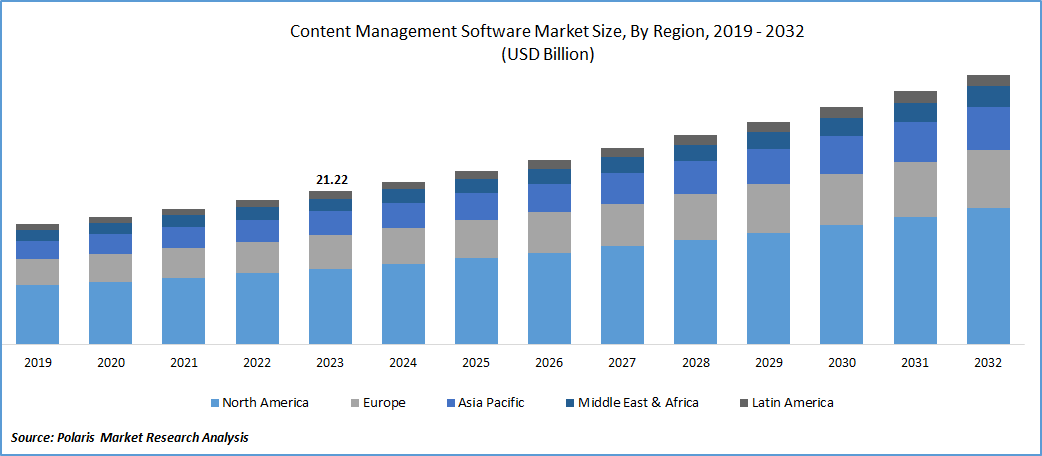
What is Content Management Software and How It Works?
Content Management Software (CMS) refers to the software that allows organizations to develop, maintain, organize, and publish content in digital form. It does not demand any advanced technical knowledge from its users. It provides a common platform for the teams to collaborate and distribute content through multiple websites, applications, and social media sites.
The working of a CMS is quite straightforward. Content creation takes place by using the editors present within the CMS framework. The content is saved in a central repository where it can be organized, categorized, and edited later on. Finally, it passes through stages of review and gets published after successful approval.
Modern CMS applications integrate analytics and marketing tools with their content management functionality. Therefore, businesses use them to provide targeted and personalized content for their customers.
With the continuous expansion of social media and digital communication channels, there is an increasing requirement for solutions capable of efficiently organizing, storing, and distributing vast amounts of digital data. Moreover, businesses are actively seeking software that can seamlessly integrate with other applications, offering improved security, visibility, collaboration, and overall efficiency. These factors are anticipated to boost the demand for CMS solutions in the coming years.
Types of Content Management Systems
| Type of CMS | Description | Key Benefit | Best Fit Use Case |
| Traditional CMS | CMS that integrates the backend for content management and the frontend for presentation | Simple and easy to use | Websites from small to medium scale |
| Headless CMS | Content backend is separated from the frontend, where it is delivered through API | Maximum flexibility and delivery across all channels | Mobile applications, Internet of Things, multi-channel content |
| Hybrid CMS | Combination of both traditional and headless CMS | flexibility and simplicity balance | for Enterprises moving to omnichannel systems |
| Enterprise CMS(ECM) | Large platforms for complicated workflows, security, and regulatory compliance | Maximum scalability and governance capabilities | Large Enterprises |
Source: Polaris Market Research Analysis
The rise of virtual assistants and smart speakers has paved the way for unexplored possibilities in voice-activated content management. Future CMS systems can harness natural language processing (NLP) and voice recognition technologies, allowing users to create, edit, and manage content using spoken commands. This hands-free approach not only improves accessibility but also creates opportunities for innovative content experiences, especially in the realms of mobile devices and the Internet of Things (IoT). Moreover, industries like retail, IT & telecom, and tourism are poised to gain substantial advantages from voice-enabled content strategies, enhancing engagement and user experience, thereby driving market growth.
The growing apprehension about data security and the escalating regulatory requirements are hastening the adoption of CMS among businesses. content management software market systems equipped with security functionalities like encryption protocols and compliance management aid organizations in complying with regulations and protecting their data from unauthorized access or breaches. This trend is contributing to a favorable market outlook.
Businesses are increasingly understanding the importance of content management in crafting personalized experiences tailored to their target audience. Content management systems are now becoming integral to marketing automation processes, bolstering market growth. This integration facilitates automatic content distribution aligned with customer behavior, ensuring that the appropriate content is delivered through diverse marketing channels at the right moment. In July 2023, Twilio Inc., collaborated with Contentful, a content management firm. This partnership aims to revolutionize omnichannel consumer engagement through data-driven personalization, empowering organizations to create tailored content experiences and enhance the customer journey.
Source: Polaris Market Research Analysis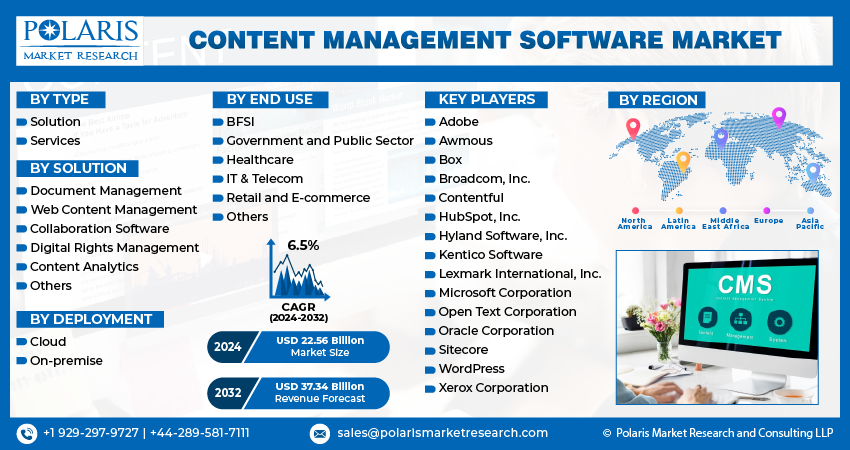
Use Cases of CMS Across Industries
| Industries | Use case | Benefits |
| eCommerce | Content management of product, catalogs, and personalized shopping experiences | Better conversion and engagement rates |
| Media & Entertainment | Article writing, video generation, and distribution of digital assets | Faster content generation and delivery |
| BFSI | Document management for compliance purposes and personalization | Compliance and secure content management |
| Healthcare | Content for patient education and documentation | Information accessibility |
| IT & Telecom | Tech documentations and content generation for various channels | More efficient content distribution |
| Marketing | Content Campaign Management and Personalized Marketing Content Creation and Distribution | Better targeting and optimizing ROI |
Source: Polaris Market Research Analysis
Growth Drivers
The Ongoing Digital Transformation Across Industries
The ongoing digital transformation across industries is a significant driver for the CMS market. Organizations are increasingly adopting CMS solutions to manage and organize their digital content efficiently.
The increasing demand for personalized and tailored content experiences has underscored the need for sophisticated software solutions. Companies are focusing on delivering personalized content to enhance customer engagement and satisfaction. Major players are strategically incorporating advanced technologies into their CMS platforms to analyze customer behavior, preferences, and demographics.
For instance, in June 2023, IBM Corporation revealed its intention to expand its ongoing partnership with Adobe. This collaboration aims to enhance creative capabilities, streamline processes, and enhance transparency by integrating cutting-edge Artificial Intelligence (AI) technologies, including Adobe Firefly and Adobe Sensei GenAI services, which are Adobe's creative generative AI models.
Report Segmentation
The market is primarily segmented based on type, solution, deployment, end use, and region.
| By Type | By Solution | By Deployment | By End Use | By Region |
|
|
|
|
|
Source: Polaris Market Research Analysis
To Understand the Scope of this Report: Request Customization
By Type Analysis
Solution Segment Held the Largest Share in 2023
Solution segment dominated the market. This dominance can be attributed to the growing integration of CMS solutions with real-time collaboration features, enabling multiple users to collaborate on content creation simultaneously. Workflow automation tools have been utilized to streamline content creation processes, covering everything from drafting to approval. Moreover, the rise of decentralized content management solutions utilizing blockchain or distributed ledger technologies is anticipated to fuel market growth. These solutions aim to enhance security, decrease reliance on centralized servers, and improve content distribution efficiency.
Services segment will grow rapidly. Managed content services, where external companies handle various aspects of content management such as updates, security, and performance monitoring, are gaining popularity among businesses. This allows organizations to focus on their core activities while ensuring their CMS operates seamlessly. Additionally, with the evolving needs of CMS users, there is a growing demand for systems that facilitate smooth content migration.
By Solution Analysis
Web Content Segment Accounted for the Largest Market Share
Web content management segment accounted for the largest market share. This is primarily driven by the integration of AI-driven content optimization and intelligent chatbots. Advanced web content management solutions utilize AI not only for personalization but also for dynamic content optimization. AI systems analyze real-time user interactions and adjust elements like images, layout, and calls-to-action to enhance engagement and conversions. Additionally, businesses are increasingly employing intelligent chatbots to enhance user engagement in these systems.
Content analytics segment will exhibit robust growth rate. This growth is driven by the increased integration of advanced attribution modeling in content analytics, linking conversions and user activities to specific content touchpoints. This allows for a more precise evaluation of how content contributes to user journeys and conversion funnels. Additionally, with the rise of visual content, there is a growing need for analytics solutions that can analyze photos and videos. Visual content analytics employs algorithms for picture recognition and video analysis to understand the impact of visual features on user engagement.
By End Use Analysis
IT & Telecom Segment Held the Most Significant Revenue Share
IT & telecom segment held a significant market share. This growth is attributed to the increasing focus on agile content development methodologies. Content management systems (CMS) that facilitate rapid content creation, iteration, and deployment are preferred in this sector due to the need for quick responses to market changes and technological advancements. Additionally, projects in the IT and telecom sectors often involve coordination among multiple teams.
BFSI segment will grow at rapid pace. CMS solutions are being adopted to enable omnichannel content delivery. This involves delivering uniform and personalized content experiences across various channels, including websites, mobile applications, email, and social media, ensuring a smooth and consistent customer journey.
Source: Polaris Market Research Analysis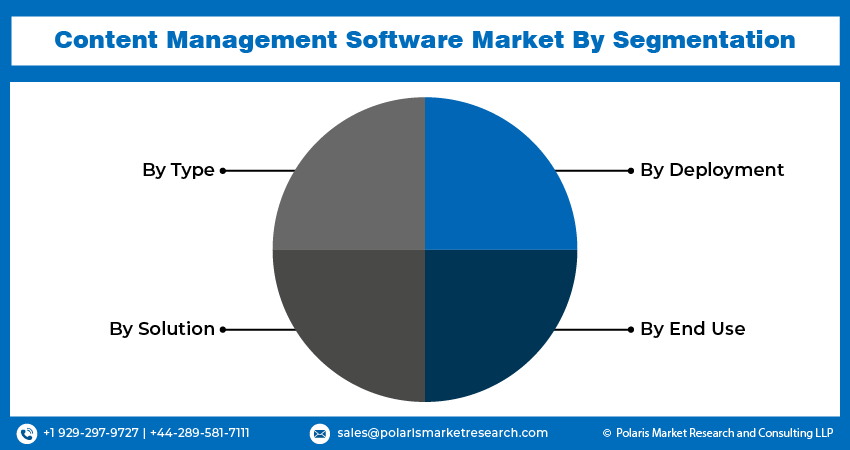
Regional Insights
North America Region Accounted for the Largest Share over the Forecast Period
The North America region witnessed the global market. Businesses in this region are placing a growing emphasis on delivering outstanding customer experiences. Consequently, CMS solutions that provide tailored content distribution, precise messaging, and smooth multichannel interactions are gaining popularity as companies focus on customer-centric strategies.
Asia pacific will grow at rapid pace. This growth is driven by the surge in e-commerce, leading to increased adoption of CMS solutions tailored to the specific needs of online businesses. Within CMS platforms, a focus is placed on enhancing content marketing capabilities to aid in product information management, content personalization, and the implementation of effective online sales strategies.
Source: Polaris Market Research Analysis
Key Market Players & Competitive Insights
Major players are dedicating substantial resources to research and development initiatives, aiming to foster growth and improve their internal business processes. For instance, in March 2023, Yext, Inc., introduced Content Generation to its Knowledge Graph product. Company claims that the Knowledge Graph stands as the industry's inaugural content management system capable of autonomously and proactively generating its own content.
Some of the major players operating in the global market include:
- Adobe
- Awmous
- Box
- Broadcom, Inc.
- Contentful
- HubSpot, Inc.
- Hyland Software, Inc.
- Kentico Software
- Lexmark International, Inc.
- Microsoft Corporation
- Open Text Corporation
- Oracle Corporation
- Sitecore
- WordPress
- Xerox Corporation
Recent Developments
- April 2026: Oracle announced the expansion of its cloud-native content and customer experience capabilities within the Oracle Fusion Cloud CX ecosystem. The new capabilities focus on unified data management and enhanced enterprise content delivery. (source: oracle.com)
- March 2026: Adobe released updates to Experience Cloud content services. According to Adobe, the new updates enable deeper AI-driven content orchestration across CMS and DAM systems. (source: experienceleague.adobe.com)
- In March 2025, Box, Inc. partnered with DataBank, a provider of automation and data solutions, to transform content management for organizations. The partnership leverages their products to deliver AI-driven solutions optimizing processes like contract lifecycle management, digital asset management, and intelligent document processing. DataBank also became an authorized Box reseller, expanding access to Box’s platform across industries. (Source: Box.com)
- In March 2025, Contentful introduced new features to enhance its CMS, offering a modern solution for large-scale digital experiences. Powered by AI, the platform focuses on data-driven personalization and integrates easily with third-party tools, helping customers deliver and optimize digital experiences faster and more efficiently. (Source: Contentful.com)
Content Management Software Market Report Scope
| Report Attributes | Details |
| Market Size in 2025 | USD 24.31 Billion |
| Market Size in 2026 | USD 25.92 Billion |
| Revenue Forecast by 2034 | USD 43.40 Billion |
| CAGR | 6.7% from 2026 – 2034 |
| Base Year | 2025 |
| Historical Data | 2021–2024 |
| Forecast Period | 2026–2034 |
| Quantitative Units | Revenue in USD Million and CAGR from 2026 to 2034 |
| Report Coverage | Revenue Forecast, Competitive Landscape, Growth Factors, and Industry Trends |
| Segments Covered | By Type, By Solution, By Deployment, By End Use, By Region |
| Regional Scope | North America, Europe, Asia Pacific, Latin America, Middle East & Africa |
| Competitive Landscape |
|
| Report Format |
|
| Customization | Report customization as per your requirements with respect to countries, region, and segmentation. |
Source: Polaris Market Research Analysis
Explore the market dynamics of the 2025 Content Management Software Market share, size, and revenue growth rate, meticulously examined in the insightful reports crafted by Polaris Market Rersearch Industry Reports. The analysis of Content Management Software Market extends to a comprehensive market forecast up to 2034, coupled with a retrospective examination. Avail yourself of a complimentary PDF download to sample this in-depth industry analysis.
Browse Our Bestselling Reports:
Kaolin Market Size, Share Research Report
Home Solar System Market Size, Share Research Report
Tissue Diagnostics Market Size, Share Research Report
Tissue Engineering Market Size, Share Research Report
Cloud-Radio Access Network (C-RAN) Market Size, Share Research Report
Content Management Software Marke FAQ's
The global content management software market size is expected to reach USD 43.40 billion by 2034
Adobe, Awmous, Box, Broadcom, Contentful, HubSpot, Hyland Software are the top market players in the market.
North America region contribute notably towards the global Content Management Software Market.
The global content management software market is expected to grow at a CAGR of 6.7% during the forecast period.
Type, solution, deployment, end use, and region are the key segments in the Content Management Software Market.
Download Sample Report of Content Management Software Marke
Please fill out the form to request a customized copy of the research report.


