
Customer Experience Management Market Size & Share Global Analysis Report, 2026-2034
REPORT DETAILS
Customer Experience Management Market Summary
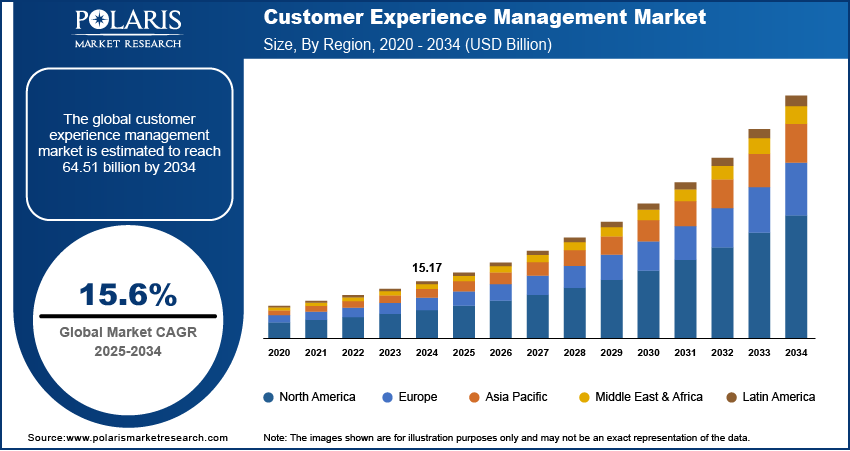
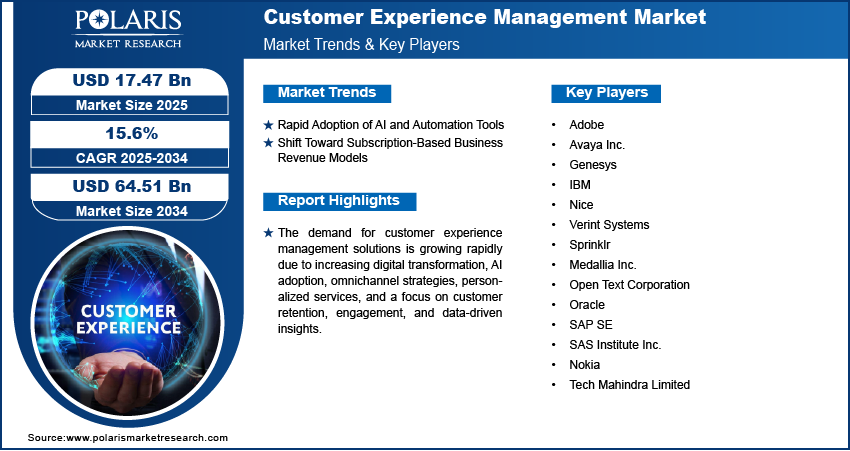
The global customer experience management market size was valued at USD 17.5 billion in 2025, growing at a CAGR of 15.7% from 2026 to 2034. The market growth is primarily fueled by the rising emphasis on customer retention and loyalty, as well as the increased demand for personalized customer engagement strategies.
Market Statistics
Key Takeaways
- North America accounted for the largest share of 49.75% in 2025. This was because countries like the US and Canada spent more on marketing and digital technologies.
- The Asia Pacific region is expected to grow the fastest, with a CAGR of 16.7%. This growth is driven by rapid technological progress and the growing use of AI-based tools by businesses in the region.
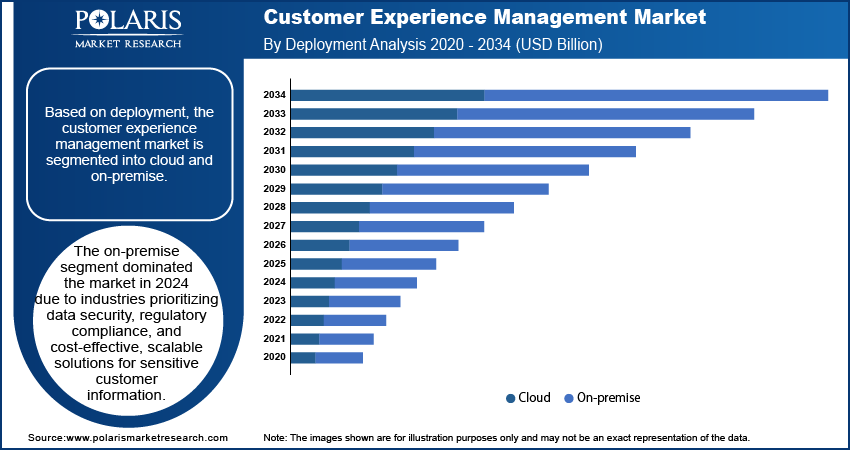
- The on-premise segment held the largest share of 64.81% in 2025. This is mainly because many organizations prefer to keep their data in-house for better security and control.
- The BFSI segment is expected to grow at a strong pace, with a CAGR of 16.1% over the forecast period. This growth is mainly due to increasing competition among banks and financial institutions, leading them to improve customer experience.
- The text analytics segment led with 38.0% revenue share in 2025. This is due to the increased need among businesses to analyze massive amounts of unstructured feedback from various touchpoints.
*Note: Figures and projections outlined in this report are the result of Polaris Market Research’s proprietary analytical processes, grounded in the latest available datasets and market observations.
Industry Dynamics
- The rapid integration of AI and automation tools, which play a key role in streamlining operations and improving customer interactions, is a key factor driving market demand.
- The shifting focus of businesses on long-term customer retention and satisfaction instead of one-time transactions is fueling market growth.
- Rising emphasis on omnichannel engagement is expected to provide several market opportunities.
- Data privacy and security concerns may hinder market expansion.
AI Impact on Customer Experience Management Market
- AI analyzes large volumes of customer interactions across channels to uncover sentiment, preferences, and behavior trends.
- Predictive analytics powered by machine learning anticipates customer needs and enables proactive service and personalized recommendations.
- AI-driven chatbots and virtual assistants deliver instant, context-aware support. This instant support improves satisfaction and reduces response times.
- The real-time feedback loops enabled by AI allow businesses to instantly fine-tune campaigns, offers, and service approaches for maximum impact.
Source: Polaris Market Research Analysis
To Understand More About this Research: Download Sample Report
What is Customer Experience Management?
Customer experience management (CEM) encompasses the strategies and tools businesses use to enhance interactions with customers throughout their journey. This approach focuses on improving satisfaction, building trust, and fostering loyalty. Companies are increasingly recognizing that delivering exceptional customer experiences is essential for staying competitive, driving the customer experience management market growth, and establishing its significance in modern business practices.
The demand for personalized customer engagement strategies is another key driver of CEM market development. Customers now expect tailored interactions that cater to their preferences, prompting businesses to adopt technologies such as artificial intelligence (AI), data analytics, and omnichannel platforms. These tools enable companies to create customized experiences that strengthen customer relationships and increase satisfaction. Personalized engagement not only boosts retention rates but also enhances the overall brand value, creating a ripple effect that drives market growth.
A strong focus on customer retention and loyalty has further fueled the growing adoption of CEM solutions. Retaining loyal customers is more cost-effective and impactful than acquiring new ones, making retention a top priority for businesses. Companies utilize customer experience tools to gain actionable insights into customer behaviors and preferences, allowing them to implement strategies that reduce churn and increase loyalty. This emphasis on retention has been a significant driver behind customer experience management market expansion, as businesses strive to create meaningful, long-term connections with their customers while ensuring sustainable growth.
CXM vs CRM systems
| Aspect | CXM (Customer Experience Management) | CRM (Customer Relationship Management) |
| Focus | Customer experience in general | Data and relationship management of customers |
| Purpose | Increased satisfaction, engagement, and loyalty | Interaction management, sales management, customer record management |
| Scope | Taking care of the entire customer journey | Primarily managing the process of selling and providing services |
| Type of data | Customer behavior data, customer feedback data, interaction data | Customer profile data, contact data, transaction data |
| Approach | The approach is driven by customer experience and focused on the customer | Driven by process and centered on data |
| Key Characteristics | Personalization, journey mapping, feedback analysis | Contact management, sales management, lead management |
| Technology | AI, analytics, omnichannel platforms | CRM system, database, automation tools |
| Result | Improved customer experience and retention | Increased sales efficiency and relationship management |
Source: Polaris Market Research Analysis
Market Dynamics
Rapid Adoption of AI and Automation Tools
AI integration plays a central role in enhancing customer interactions and streamlining operations as companies embrace advanced technologies. For instance, a recent white paper reveals that 44.74% of UAE companies are using advanced AI, positioning the nation as a leader in regional adoption. The study highlights key AI applications such as information retrieval, customer service, and personalized retail experiences, all of which are transforming how businesses interact with their customers. This surge in AI usage has amplified the demand for CEM solutions, as companies seek to leverage automation for delivering tailored, efficient, and seamless customer experiences across various industries. Thus, the rapid adoption of AI and automation tools is boosting the customer experience management market revenue.
Shift Towards Subscription-Based Business Revenue Models
Businesses are increasingly focusing on long-term customer retention and satisfaction rather than one-time transactions. This approach emphasizes personalized engagement, seamless interactions, and consistent service delivery, all of which are critical for subscription-based models. Companies rely on CEM solutions to gather real-time customer insights, enhance user journeys, and reduce churn rates. The recurring nature of subscriptions amplifies the need for proactive customer support and value-driven experiences. The growing competition across industries also motivates organizations to invest in advanced CEM tools, ensuring customer loyalty and lifetime value. As subscription billing management models expand, the customer experience management market demand continues to surge globally, shaping customer-centric business strategies.
Source: Polaris Market Research Analysis
Segment Insights
Assessment by Analytical Tools Outlook
The global customer experience management market segmentation, based on analytical tools, includes EFM software, speech analytics, text analytics, web analytics & content management, and others. The web analytics & content management segment is projected to witness the highest CAGR of 17.2% during the forecast period due to the increasing importance of personalized customer experiences. Businesses are leveraging marketing analytics software to gather real-time data on customer behavior, preferences, and interactions across digital platforms. This data enables organizations to deliver targeted and personalized content, enhancing engagement and satisfaction. Additionally, advanced content management systems streamline the creation, management, and distribution of relevant content across multiple touchpoints. The growing adoption of omnichannel strategies, C2C (consumer-to-consumer) e-commerce platforms, and digital marketing further drives demand for these solutions. As companies prioritize customer-centric strategies, they are investing significantly in tools that enhance digital experiences, thereby driving growth in this segment.
| Analytical Tool | Simple Explanation | Usage | Objective/Applications |
| EFM Software | Gathers and maintains customer feedback through multiple channels. | Get information about customer perspectives to enhance customer experience. | Surveys, customer feedback forms, customer satisfaction |
| Speech Analytics | Conducts analysis on customer calls and conversations. | To find out about customer problems and enhance service delivery. | Customer call centers and services |
| Text Analytics | Conducts analysis on written communications from customers. | To understand customer sentiments and experiences. | E-mails, chat room messages, social media comments |
| Web Analytics & Content Management | Manages the online platform activities and content. | Enhances website user experience. | Web analytics, content management |
| Others | Other types of analytical tools for customer data analysis. | Improvement of customer experience. | Data dashboards, reports |
Source: Polaris Market Research Analysis
Evaluation by Deployment Outlook
The global customer experience management market segmentation, based on deployment, includes cloud and on-premise. The on-premise segment held the largest market share of 64.81% in 2025 due to its strong appeal to industries prioritizing data security and control. Enterprises in sectors such as banking, healthcare, and government often prefer on-premise solutions to comply with stringent regulatory requirements and safeguard sensitive customer information. These systems allow organizations to maintain full ownership of their infrastructure, ensuring enhanced data privacy and customization to meet specific business needs. Additionally, many large enterprises with existing IT infrastructure find on-premise solutions more cost-effective in the long term, as they avoid recurring subscription fees. The reliability and scalability of on-premise deployments enhance their adoption, reinforcing their stronghold in the global market.
Source: Polaris Market Research Analysis
Regional Analysis
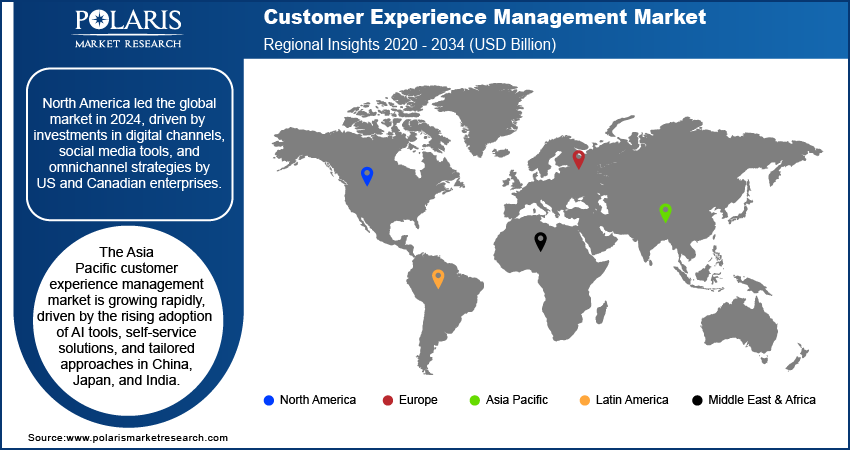
By region, the study provides customer experience management market insights into North America, Europe, Asia Pacific, Latin America, and the Middle East & Africa. North America dominated the global market with 49.75% share in 2025, driven by increasing investments in digital channels and marketing by organizations in the US and Canada. Enterprises in the region are leveraging advanced solutions, such as social monitoring, social measurement, and social middleware, to enhance customer engagement and brand presence. Social media has emerged as a key platform for collecting feedback, sharing product reviews, and increasing brand awareness. Companies such as Salesforce.com and Adobe are leading technological advancements, enabling enterprises to create social media campaigns and develop online brand communities. These efforts, coupled with a robust digital infrastructure and the adoption of omnichannel strategies, are prompting regional businesses to spend heavily on digital channels, driving market dominance.
Source: Polaris Market Research Analysis
The Asia Pacific customer experience management market is projected to witness the fastest growth at a CAGR of 16.7% from 2026 to 2034, driven by technological advancements and the adoption of AI-based tools and self-service capabilities. Solutions such as chatbots, web self-service, IVR, and online communities are enabling enterprises to better understand customer behavior, provide instant support, and deliver proactive responses. In China, the diverse culture and varying levels of customer maturity have led vendors to develop tailored CEM solutions for the market. Japan’s advanced IT infrastructure and high-speed digital connectivity facilitate both on-premises and hosted CRM solutions. Meanwhile, in India, businesses are increasingly focused on customer retention, using CEM solutions to personalize interactions and enhance loyalty. These factors are fueling the market expansion across the region.
Key Players and Competitive Insights
The competitive landscape of the customer experience management market is characterized by a mix of global leaders and regional players competing for market share through innovation, strategic partnerships, and regional expansion. Key players such as Adobe, Oracle, and others in the market leverage their robust research and development (R&D) capabilities along with extensive distribution networks to offer advanced customer experience management solutions tailored for various applications. These companies focus on continuous product innovation to improve efficiency, reliability, and scalability to meet the evolving needs of industries that require advanced customer experience management solutions. At the same time, smaller regional firms are entering the market with specialized customer experience management solutions targeting local market demands, often focusing on customized and cost-effective applications. Competitive strategies in the customer experience management market include mergers and acquisitions, collaborations with technology firms, and expanding product portfolios to enhance market share. Adobe; Avaya Inc.; Genesys; IBM; Nice; Verint Systems; Sprinklr; Medallia Inc.; Open Text Corporation; Oracle; SAP SE; SAS Institute Inc.; Nokia; Tech Mahindra Limited are among the key major players.
Adobe Inc. is a global software company offering creative, digital experience, and publishing solutions. Its products include Creative Cloud, Document Cloud, Experience Cloud, and Advertising Cloud, serving businesses, marketers, content creators, and developers.
IBM provides integrated solutions across software, consulting, infrastructure, and financing, helping businesses optimize their customer experience strategies. It offers hybrid cloud, AI platforms, server and storage solutions, and maintains strategic partnerships with companies such as Adobe, AWS, Microsoft, and Oracle.
List of Key Companies
- Adobe
- Avaya Inc.
- Genesys
- IBM
- Nice
- Verint Systems
- Sprinklr
- Medallia Inc.
- Open Text Corporation
- Oracle
- SAP SE
- SAS Institute Inc.
- Nokia
- Tech Mahindra Limited
Industry Developments
- April 2026: Zendesk expanded access to its AI agent capabilities, allowing all users to aid advanced automation features. It has also simplified setup to deliver faster and more consistent customer support across multiple channels (Source: zendesk.com)
- January 2026: Medallia collaborated with Ada to combine customer experience data with AI-powered automation. This has enabled companies to turn customer insights into real-time actions and have improved services across contact centers and digital channels. (Source: medallia.com)
- November 2025: Zendesk acquired Ultimate AI, adding multilingual chat agents that can manage complex conversations in 109 languages. (Source: zendesk.com)
- August 2024: Oracle launched an all-in-one CX management solution for telcos. The company stated that the new solution integrates AI-powered CRM, billing, CPQ, and monetization tools to streamline operations and boost revenue growth. (Source: prnewswire.com)
- September 2024: Adobe unveiled innovations in generative AI and Adobe Experience Cloud. According to Adobe, these offerings aim to enhance customer experience management by enabling personalized content, real-time insights, and journey orchestration, empowering brands to engage customers at scale. (Source: adobe.com)
Future of Customer Experience Management Market
The CXM industry is likely to experience significant growth with the application of artificial intelligence and automation in customer engagement. Organizations are paying more attention to providing personalized and instant services. The omnichannel strategy is further developing in the business environment. The integration with big data analysis is expected to enhance decision-making. Customer retention will continue to be an important goal for organizations.
Customer Experience Management Market Segmentation
By Analytical Tools Outlook (Revenue – USD Billion, 2021–2034)
- EFM Software
- Speech Analytics
- Text Analytics
- Web Analytics & Content Management
- Others
By Touch Point Type Outlook (Revenue – USD Billion, 2021–2034)
- Stores/Branches
- Call Centers
- Social Media Platform
- Mobile
- Web Services
- Others
By Deployment Outlook (Revenue – USD Billion, 2021–2034)
- Cloud
- On-Premise
By End Use Outlook (Revenue – USD Billion, 2021–2034)
- BFSI
- Retail
- Healthcare
- IT & Telecom
- Manufacturing
- Government, Energy & Utilities
- Construction, Real Estate & Property Management
- Service Business
- Others
By Regional Outlook (Revenue – USD Billion, 2021–2034)
- North America
- US
- Canada
- Europe
- Germany
- France
- UK
- Italy
- Spain
- Netherlands
- Russia
- Rest of Europe
- Asia Pacific
- China
- Japan
- India
- Malaysia
- South Korea
- Indonesia
- Australia
- Rest of Asia Pacific
- Middle East & Africa
- Saudi Arabia
- UAE
- Israel
- South Africa
- Rest of Middle East & Africa
- Latin America
- Mexico
- Brazil
- Argentina
- Rest of Latin America
Customer Experience Management Market Report Scope
| Report Attributes | Details |
| Market Size Value in 2025 | USD 17.5 billion |
| Market Size Value in 2026 | USD 20.1 billion |
| Revenue Forecast by 2034 | USD 64.5 billion |
| CAGR | 15.7% from 2026 to 2034 |
| Base Year | 2025 |
| Historical Data | 2021–2024 |
| Forecast Period | 2026–2034 |
| Quantitative Units | Revenue in USD billion and CAGR from 2026 to 2034 |
| Report Coverage | Revenue Forecast, Market Competitive Landscape, Growth Factors, and Trends |
| Segments Covered |
|
| Regional Scope |
|
| Competitive Landscape |
|
| Report Format |
|
| Customization | Report customization as per your requirements with respect to countries, regions, and segmentation. |
Source: Polaris Market Research Analysis
Customer Experience Management Market FAQ's
• The global customer experience management market size was valued at USD 17.5 billion in 2025 and is projected to grow to USD 64.5 billion by 2034.
• The global market is projected to register a CAGR of 15.7% during the forecast period.
North America dominated the global market with 49.75% share in 2025
• A few key players in the market are Adobe; Avaya Inc.; Genesys; IBM; Nice; Verint Systems; Sprinklr; Medallia Inc.; Open Text Corporation; Oracle; SAP SE; SAS Institute Inc.; Nokia; and Tech Mahindra Limited.
• The on-premise segment led the market with 69.81% share in 2025.
• The web analytics & content management segment is anticipated to register the highest growth rate of 17.2% during the forecast period.
Download Sample Report of Customer Experience Management Market
Please fill out the form to request a customized copy of the research report.


