
Dehumidifier Market Demand, Growth Analysis, 2026-2034
REPORT DETAILS
Dehumidifier Market Summary
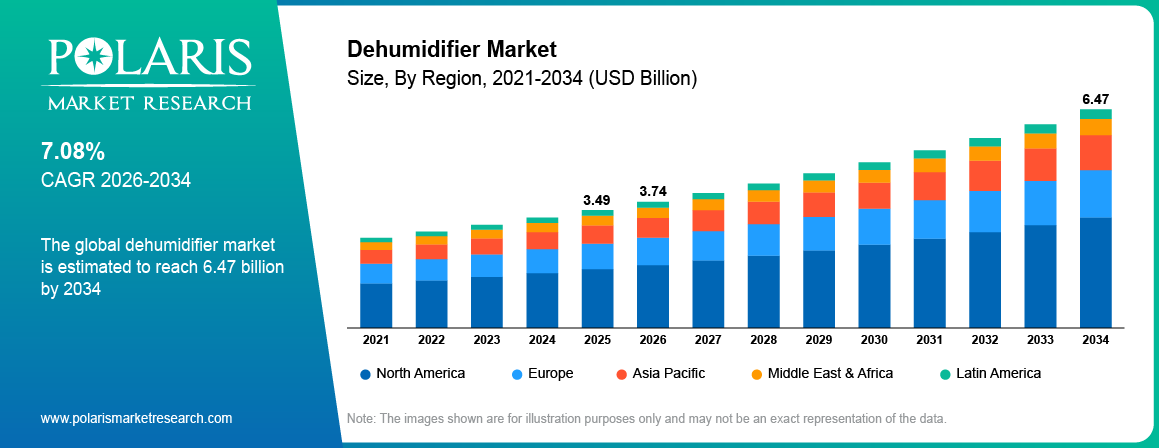
The global dehumidifier market is estimated around USD 3.49 Billion in 2025,?with consistent growth anticipated during 2026–2034. Expansion is supported by rising concerns over indoor air quality, increasing residential and commercial construction, and growing demand for humidity control technologies. The market is projected to grow at a CAGR of 7.08% during the forecast period.
Market Statistics
Key Takeaways
- North America dominated the market with a share of ~35% in 2025, driven by advanced HVAC infrastructure and increasing awareness of indoor air quality management.
- Refrigerant-type dehumidifiers accounted for approximately 38% of the market share in 2025, owing to their high reliability and efficiency in hot and humid environments.
- Portable-type dehumidifiers held around 34% of the market share in 2025, supported by their low cost, ease of installation, and strong demand in residential applications.
- Residential spaces captured nearly 41% of the market share in 2025, driven by rising awareness of indoor air quality and prevention of mold growth.
- Household moisture control accounted for about 36% of the market share in 2025, propelled by increasing installations in basements, apartments, and enclosed living spaces.
- Humidity control systems in commercial spaces are expected to grow at a CAGR of approximately 8.9% during the forecast period, supported by rising construction of offices, hotels, and healthcare facilities.
Industry Dynamics
- Increasing concerns related to indoor air quality and health hazards due to moisture are fueling the need for residential humidity control systems.
- Expanding residential housing in cities and smart home technologies are contributing to the growth in residential basement dehumidifiers.
- High energy consumption rate hinders the wider acceptance of traditional dehumidifiers in cost-sensitive markets.
- Incorporation of smart dehumidifiers is creating market opportunities for energy-saving humidity control solutions.
What is included in the Dehumidifier market?
The dehumidifier market forms an important segment of the humidity control market and broader air moisture control market, covering equipment designed to remove excess moisture from indoor spaces. Global dehumidifier market size is increasing with the growing demand for humidity control solutions among residential and commercial users.
The demand for dehumidifiers is increasing driven by the rise in humidity levels in residential areas, growth in residential construction activity, and the importance of mold prevention and indoor air quality monitoring system. Expanding use of humidity control systems in warehouses, manufacturing facilities, and food storage environments is also strengthening the air moisture control market. North America and Asia Pacific account for a large share of the dehumidifier market share due to strong residential and commercial adoption.
Source: Polaris Market Research Analysis
To Understand More About this Research:Download Sample Report
The dehumidifier market includes residential and industrial applications. Residential units provide comfort within homes, while protecting against moisture damage. Industrial units, on the other hand, provide humidity control in various manufacturing plants, storage facilities, and commercial buildings. These units have a crucial role to play in maintaining air quality while providing moisture control.
Drivers & Opportunities
Rising concerns over indoor air quality and moisture-related health risks: Increasing concerns regarding indoor air purification are boosting the use of humidity control solutions in residential and commercial environments. Excess humidity promotes mold growth, allergens, and respiratory health problems. According to the World Health Organization, there were approximately 2.9 million deaths per annum due to household air pollution in 2021, with more than 309,000 of these deaths occurring among children under the age of five years. These health issues have led to increased use of residential and portable dehumidifiers.
Growing demand from residential basements and smart homes: Residential basements and the increasing trend of smart homes are boosting the demand for dehumidifiers in the residential sector. The basements and crawl spaces in homes have a tendency to accumulate moisture levels. The need for a continuous moisture control system is met with the installation of an integrated dehumidifier with HVAC systems. Smart homes are further boosting the demand for portable dehumidifiers in the market.
Restraints & Challenges
High energy consumption: Dehumidifiers require a high amount of energy in continuous use, thereby escalating energy costs in homes and industries. Compressors, which are energy-intensive and cooling components, are further increases the operating costs of industrial dehumidification systems. These cost factors impede the adoption of dehumidification systems, particularly in cost-conscious markets, thereby restraining the growth of the dehumidification systems.
Opportunity
Smart dehumidifiers and IoT integration: Innovation in technology is generating opportunities for the smart dehumidifier industry. For instance, in January 2026, Samsung Electronics unveiled its latest lineup of inverter dehumidifiers with SmartThings IoT connectivity. The system also has an AI Saving Mode that uses environmental conditions and usage patterns to save up to 30% of energy. Such innovations strengthen adoption of energy efficient dehumidifiers and connected moisture control systems across modern smart homes.
Source: Polaris Market Research Analysis
Segmental Insights
This report offers detailed coverage of the dehumidifier market by product type, product category, application, distribution channel to help readers identify the fastest expanding and most attractive demand segments.
By Product Type
-
Refrigerant Dehumidifiers
Refrigerant dehumidifier are leading the market share due to its high level of efficiency and performance under warm and humid conditions. This type of system works well by removing moisture through condensation, thus making it suitable for use in residential and commercial settings.
-
Desiccant Dehumidifiers
Desiccant dehumidifiers is projected to grow at a rapid pace during the forecast period, due to high performance under low-temperature environments. Desiccant-type dehumidifiers have found extensive use in industrial dehumidification, such as pharmaceuticals, electronics, and cold storage.
By Product Category
-
Portable Dehumidifiers
Portable dehumidifiers segment held the largest share in the market due to the convenience and cost-effectiveness they offer. This segment is commonly used in residential areas such as bedrooms, basements, and apartments.
-
Industrial Dehumidifiers
Humidity control systems used in industry are projected to grow at highest growth rate, specifically those used for dehumidification. These units are used in manufacturing plants, warehouses, and data centers where precise humidity levels are required.
By Application
-
Residential
Residential segment for dehumidifier held the highest market size. Homeowners use dehumidifiers in basements, bathrooms, and apartments for controlling humidity levels and preventing mold growth.
-
Commercial
Commercial segment for humidity control systems is expected to grow at highest growth rate. Hotels, offices, and hospitals require controlled humidity levels for the comfort of people and for the infrastructure. The increasing number of commercial constructions has boosted the demand for advanced humidity control systems.
By Distribution Channel
-
Offline Retail
Offline retail segment has the highest market share in the appliance retail market for dehumidifiers. People generally like to purchase HVAC equipment from appliance retailers and electronic shops as they get installation advice from retailers.
-
Online Retail
Online retail segment is projected to grow rapidly during the forecast period. This is due to increasing adoption of e-commerce shopping for electronic appliances. This channel provides a wider selection of products and competitive prices.
Source: Polaris Market Research Analysis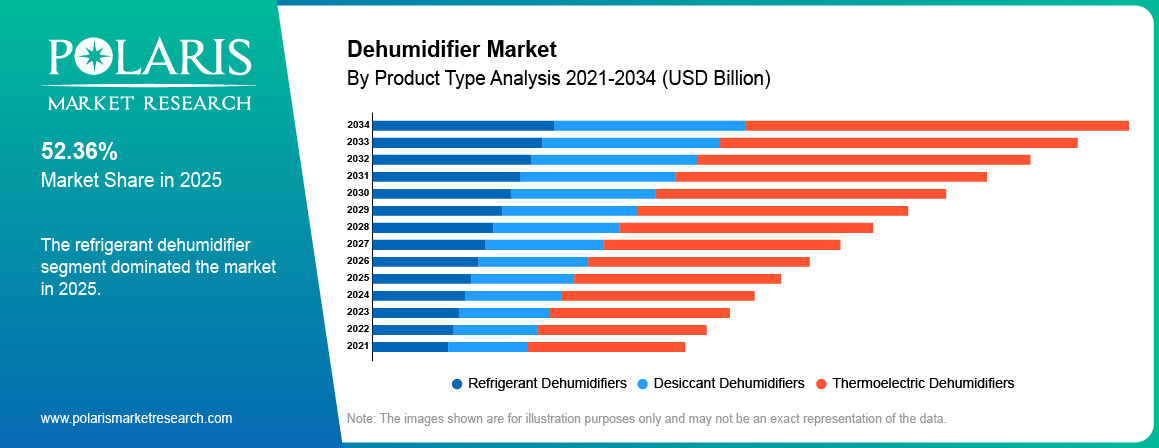
Regional Analysis
North America Dehumidifier Market Assessment
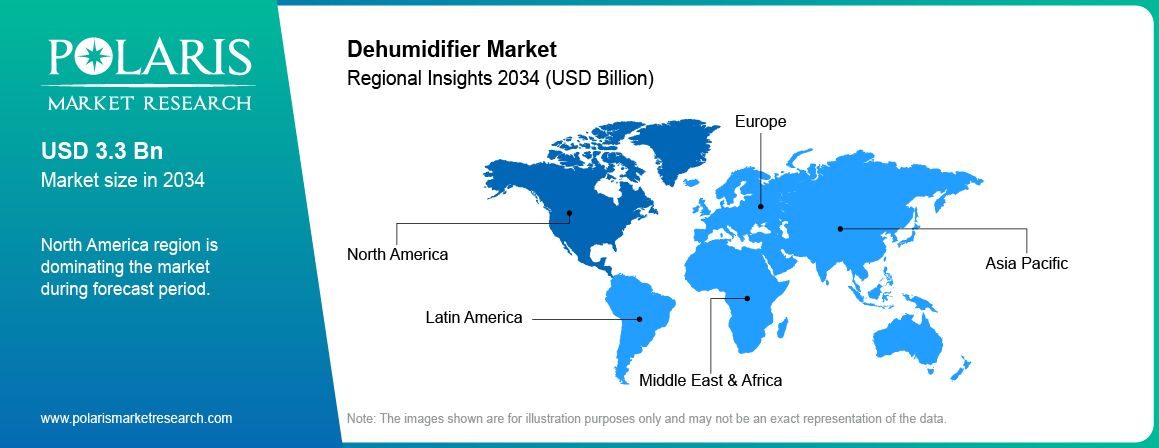
North America dominated the dehumidifier market share in 2025, due to robust HVAC infrastructure development and increasing emphasis on indoor air quality in buildings. High humidity levels and mold prevention concerns contributed to an increase in humidity control system use. In September 2025, a Clean Economy Tracker report revealed new clean energy manufacturing investments totaling USD 3.9 billion in nine US states. This has helped strengthen energy-efficient building technology development, boosting US dehumidifier market growth and indoor air quality US.
Europe Dehumidifier Market Overview
Europe humidity control market has grown due to growing smart building technology adoption and energy-efficient climate control systems. Commercial facilities and industrial plants increasingly integrated humidity control to improve building performance and air quality. This trend supported expansion in the Germany dehumidifier market and strengthened modernization within the UK HVAC market.
Asia Pacific Dehumidifier Market Insight
Asia Pacific dehumidifier market expanded rapidly due to urbanization and rising construction across China, India, and Southeast Asia. The Asian Development Bank reported that over 55% of Asia’s population is expected to live in urban areas by 2030. This growth increased demand for climate control technologies in residential and commercial buildings, strengthening China humidity control systems and the India HVAC market.
Latin America & Middle East Dehumidifier Market Assessment
Latin America dehumidifier market and Middle East HVAC systems sector expanded with growing infrastructure development and construction activity. Industrial facilities and commercial buildings increasingly used humidity control systems to avoid moisture-related damages. Regional climatic conditions also contributed to the increasing trend of dehumidification technology usage in various applications.
Source: Polaris Market Research Analysis
Key Players & Competitive Analysis Report
The competitive scenario of the global market for dehumidifiers shows that various global manufacturers of dehumidifiers, residential appliances, and humidity control devices participate in this market. The market is moderately fragmented, with strong brand competition between global manufacturers of residential appliances and manufacturers of industrial dehumidifiers, serving different market segments.
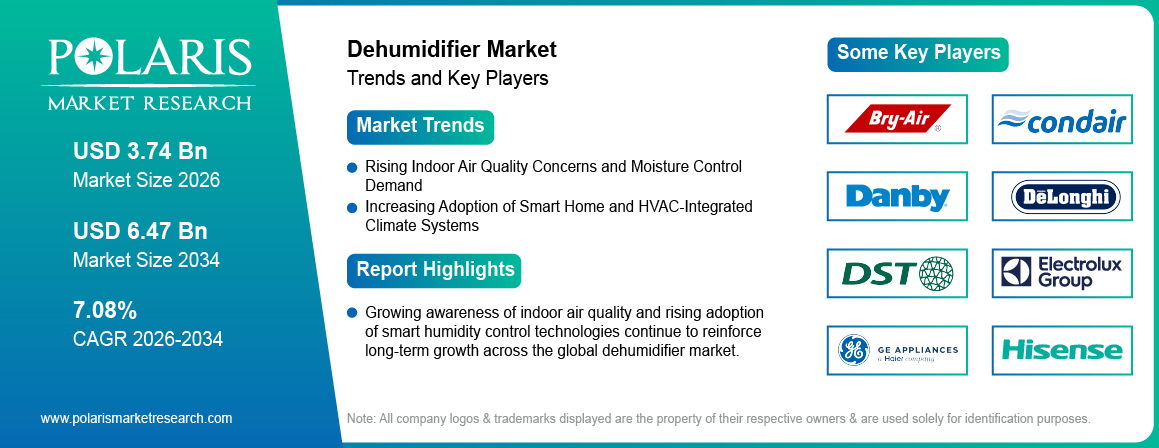
Key companies operating in the dehumidifier market include Bry-Air (Asia) Pvt. Ltd., Condair Group AG, Danby Products Ltd., De’Longhi Appliances S.r.l., DST America (DST Group), Electrolux AB, Frigidaire (Electrolux AB), GE Appliances, a Haier Company, Hisense Co., Ltd., Honeywell International Inc., LG Electronics Inc., Midea Group, Munters Group AB, Panasonic Corporation, and Whirlpool Corporation.
Key Players
- Bry-Air (Asia) Pvt. Ltd.
- Condair Group AG
- Danby Products Ltd.
- De’Longhi Appliances S.r.l.
- DST America (DST Group)
- Electrolux AB
- Frigidaire (Electrolux AB)
- GE Appliances, a Haier Company
- Hisense Co., Ltd.
- Honeywell International Inc.
- LG Electronics Inc.
- Midea Group
- Munters Group AB
- Panasonic Corporation
- Whirlpool Corporation
Premium Market Insights & Strategic Outlook
Demand Hotspots
The demand for dehumidifiers is primarily concentrated in areas with high humidity levels and densely populated housing. Tropical climate, coastal living, and apartments with low ventilation levels all contribute to moisture issues.
Technology Innovation
Technological advancements also help in boosting the performance and usage of modern dehumidifiers. There are efforts by the manufacturer to integrate smart humidity control systems with in-built sensors. There are also efforts to integrate connectivity and IoT-enabled monitoring systems for controlling and automating the system as part of an overall AI-based HVAC system.
Future Industry Outlook
Future developments in this industry are expected to be based mainly on sustainability and integrated systems for climate control. Energy-efficient products such as eco-friendly refrigerants have become a significant design consideration.
Industry Developments
- March 2026: Munters launched its MX3 and MX3 PLUS line of dehumidifiers, which is a new line of high-performance desiccant dehumidifiers designed for use in various climate control applications. This line of products resulted in a reduction of 15-20% in energy consumption, as well as 15% reduction in CO2 emission, compared to previous product platforms. (Source: munters.com)
- November 2025: Bry-Air introduced its P80x line of dehumidifiers, which is designed specifically for use in pharmaceutical companies. This product is equipped with MIRACLE Next Gen Rotor using Metal Organic Frameworks, which resulted in more than 25% increase in performance compared to traditional silica gel-based dehumidifiers. (Source: bryair.com)
Dehumidifier Market Segmentation
By Product Type Outlook (Revenue, USD Billion, 2021-2034)
- Refrigerant Dehumidifiers
- Desiccant Dehumidifiers
- Thermoelectric Dehumidifiers
By Product Category Outlook (Revenue, USD Billion, 2021-2034)
- Portable Dehumidifiers
- Whole-House Dehumidifiers
- Industrial Dehumidifiers
By Application Outlook (Revenue, USD Billion, 2021-2034)
- Residential
- Commercial
- Industrial
By Distribution Channel Outlook (Revenue, USD Billion, 2021-2034)
- Online Retail
- Offline Retail
- HVAC Dealers & Contractors
By Regional Outlook (Revenue, USD Billion, 2021-2034)
- North America
- US
- Canada
- Europe
- Germany
- France
- UK
- Italy
- Spain
- Netherlands
- Russia
- Rest of Europe
- Asia Pacific
- China
- Japan
- India
- Malaysia
- South Korea
- Indonesia
- Australia
- Vietnam
- Rest of Asia Pacific
- Middle East & Africa
- Saudi Arabia
- UAE
- Israel
- South Africa
- Rest of Middle East & Africa
- Latin America
- Mexico
- Brazil
- Argentina
- Rest of Latin America
Dehumidifier Market Report Scope
| Report Attributes | Details |
| Market Size in 2025 | USD 3.49 Billion |
| Market Size in 2026 | USD 3.74 Billion |
| Revenue Forecast by 2034 | USD 6.47 Billion |
| CAGR | 7.08% from 2026 to 2034 |
| Base Year | 2025 |
| Historical Data | 2021–2024 |
| Forecast Period | 2026–2034 |
| Quantitative Units | Revenue in USD Billion and CAGR from 2026 to 2034 |
| Report Coverage | Revenue Forecast, Competitive Landscape, Growth Factors, and Industry Trends |
| Segments Covered |
|
| Regional Scope |
|
| Competitive Landscape |
|
| Report Format |
|
| Customization | Report customization as per your requirements with respect to countries, regions, and segmentation. |
Source: Polaris Market Research Analysis
Dehumidifier Market FAQ's
The global market size was valued at USD 3.49 Billion in 2025 and is projected to grow to USD 6.47 Billion by 2034.
North America dominated the market due to high adoption rates for HVAC systems, high residential demand for dehumidifiers, and increased emphasis on indoor air quality.
Residential applications represent the largest application segment for dehumidifiers, followed by commercial and industrial humidity control applications.
Key companies include Bry-Air (Asia) Pvt. Ltd., Condair Group AG, Danby Products Ltd., De’Longhi Appliances S.r.l., Electrolux AB, GE Appliances (Haier), Hisense Co., Ltd., Honeywell International Inc., LG Electronics Inc., Midea Group, Munters Group AB, Panasonic Corporation, and Whirlpool Corporation.
Growth is fueled by the increasing concerns for indoor air quality, residential and commercial construction, and the development of smart humidity control technology.
Major types include refrigerant, desiccant, and thermoelectric dehumidifiers, each suited to particular levels of humidity and application needs.
Industries such as pharmaceuticals, electronics manufacturing, food processing, warehousing, and chemical production use industrial dehumidifiers to maintain controlled humidity conditions.
Download Sample Report of Dehumidifier Market
Please fill out the form to request a customized copy of the research report.


