
Digital Printing for Tableware Market Growth Report 2026-2034
REPORT DETAILS
Digital printing for tableware Market Summary
The global digital printing for tableware market was valued at USD 332.98 million in 2025 and is expected to grow at a CAGR of 7.20% during the forecast period.
Market Statistics
Key Takeaways
-
The UV ink segment is anticipated to hold the largest market share of 48.67% during the forecast period, driven by the increasing adoption of digital printing technologies for customized tableware designs, superior print durability, and enhanced color quality.
-
The ceramic and porcelain segment dominated the market in 2025, accounting for 39.84% of the total revenue share, owing to their widespread use in premium tableware products and growing demand for aesthetically appealing printed designs.
-
North America dominated the global digital printing for tableware market in 2025 with a revenue share of 34.26%, supported by strong consumer demand for personalized tableware, advanced printing infrastructure, and a well-established hospitality sector.
-
Asia Pacific is anticipated to register the highest CAGR of 8.91% during the forecast period, driven by expanding ceramic manufacturing industries, rising disposable incomes, and increasing adoption of customized tableware products across China, India, and Southeast Asia.
Key factors responsible for the market growth of digital printing, which is facilitated by higher viscosity fluids, are poised to transform various industries, spanning from vehicle decoration to textiles, packaging, inkjet technology, and printed electronics, unlocking extensive opportunities for manufacturers. Inkjet technology is diverse for various materials such as ceramic tile, paper, plastic, glass, textiles, and metal, and its recent application in additives embracing digital printing.
Furthermore, recent advancements in higher viscosity inks boosting the demand for digital printings; for example, Xaar’s latest 2002 printheads, featuring enhanced manufacturing processes and High Laydown Technology, offer cost-effective, high-quality printing and coating for various industrial applications with a through-flow ink path and high uniformity.
Source: Polaris Market Research Analysis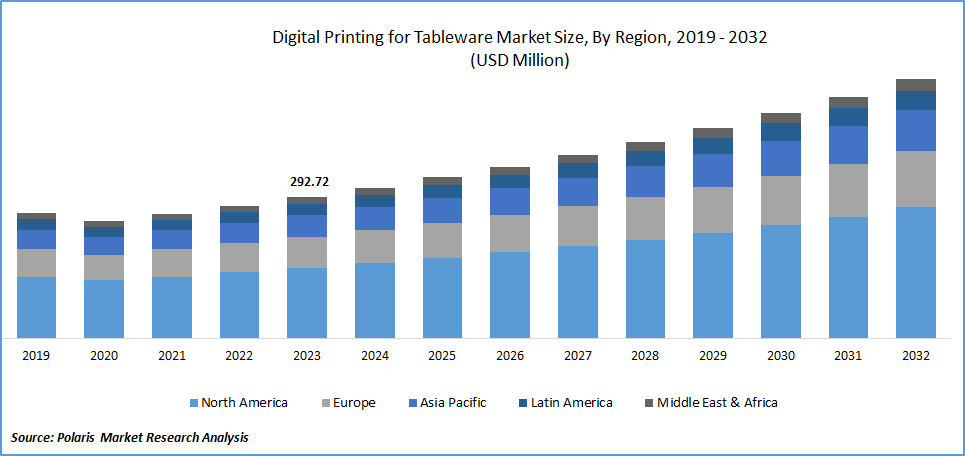
To Understand More About this Research: Download Sample Report
In addition, in November 2023, digital printing technology is anticipated to accelerate for packaging by its operation efficiency, waste reduction compared to analog systems, ongoing improvements by equipment manufacturers, and reduced upfront costs facilitating a swift digital transition. Digital printing technology is poised to disrupt packaging qualitatively and quantitatively, offering advantages such as rapid realization of decorative designs from concept to printed image and a significant reduction in waste.
Some of the players in the market are taking initiatives to launch new technologies and expanding their technological advancements for high-quality printing solutions.
- For instance, In July 2023, SCREEN Graphic Solutions launched a series of label and packaging printing solutions at Labelexpo Europe 2023, featuring Truepress LABEL 350UV SAI technology in collaboration with Nilpeter, addressing industry trends with a focus on paper-based packaging over plastic for integrated digital printing and embellishment.
Beyond material concerns, ensuring compliance with food safety regulations is crucial in the tableware industry. Manufacturers must guarantee that inks and printing methods on food-contact products meet established standards. The utilization of digital printing offers a flexible solution for brands seeking unique and personalized tableware options. Manufacturers can produce customized tableware in both small production runs and mass production, contributing to the overall market growth.
Source: Polaris Market Research Analysis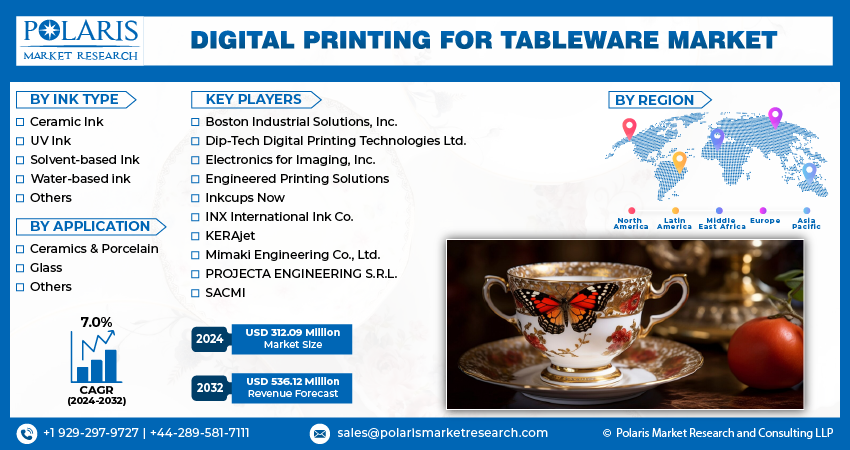
Growth Drivers
-
The rapid advancement of digital printing technology and the growing demand for customized solutions
Digital printing has experienced rapid and revolutionary market growth driven by rising technological advancement. Traditional printing methods are being replaced by digital printing technology due to their enhanced speed, versatility, and precision. The capabilities of digital printing techniques have improved high-performance printers and advancements in laser and inkjet printing technologies. Also, in this industry, some industry players are adopting digital printing due to its premium print quality and faster production speeds. For example, in October 2023, at PRINTING United Expo 2023 in Atlanta, Georgia, Vanguard Digital Printing Systems unveiled the VK3220T-HS, their newest UV-LED flatbed printer. This printer boasts ultra-high production capabilities and innovative features.
At the same time, the market is experiencing a surge in demand for personalized printing solutions. Both consumers and businesses are seeking personalized and custom products, ranging from apparel and decor to packaging and promotional materials. For example, In December 2023, Brands elevate packaging through digital printing's customizable and consumer-connecting options, meeting the growing demand for unique features and prompting investments in digital inkjet printing technologies across the supply chain.
Product Specification Comparison
| Specification | KERAJet Plates | SACMI DHD Series |
| Manufacturer | KERAJet S.A. – Tableware Digital Printing Solutions | SACMI Group – Digital High Definition (DHD) Printers for Tableware |
| Application | Digital decoration of ceramic tableware using multiple inks and effects. | Digital printing of flatware, plates and similar tableware surfaces with vision-guided centering. |
| Ink Support / Colour Bars | Up to 12 fluids / print bars with individual control and quick-change capability (e.g., colours, glazes, UV, effects). | Up to 12 extractable color bars for multi-color printing. |
| Print Resolution | Vertical resolution from 360 to 400 dpi (printer dependent); horizontal resolution variable. | Maximum resolution around 400 dpi (industry standard) with real-time data processing. |
| Max Printing Speed / Throughput | Up to 90 m/min (high productivity for industrial lines). | Up to 40 m/min at 400 dpi (varies by model). |
| Print Width / Format | Configurable modules; multi-head technology with flexible layout options. | Max printing width up to ~2024 mm depending on model (DHD908 to DHD2008). |
| Automation & Control Features | • Automatic purging and cleaning system | • Vision system for centering and alignment |
| Ink & Printhead Tech | Compatible with certified inks; meniscus differential pressure control; temperature-controlled ink units. | Heads with cleaning/evacuation systems to maximize productivity and reliability. |
| Software / Workflow Support | System that integrates Amiga technology and print control software (for production coordination). | Supports color management systems and data flow integration with production lines. |
| Primary Industrial Benefit | High flexibility for decorative effects, multi-ink combinations, and high throughput. | Wide format capability and integration with vision systems for accurate decoration on variable tableware shapes. |
Source: Polaris Market Research Analysis
Report Segmentation
The market is primarily segmented based on ink type, application, and region.
| By Ink Type | By Application | By Region |
|
|
|
Source: Polaris Market Research Analysis
To Understand the Scope of this Report: Request Customization
By Ink Type
-
The UV ink segment is anticipated to hold the largest market share during the forecast period.
The UV ink segment is accounted to hold the largest market share over the forecast period. UV ink segment is propelled by its multiple advantages for printing on various substrates, including glass, metal, ceramic, acrylic, polycarbonate, flexible packaging, polystyrene, MDF, PVC, and thermoforming plastics, showing their versatility with inkjet printing systems. UV inks provide properties such as instance curing, adhesion, high print quality, color density, light fastness, and absence of volatile organic compounds. Even in high-speed printing, UV ink achieves vibrant and detailed print results.
Solvent-based inks segment is expected to hold the highest growth in the market. Solvent-based inks are recognized for their capacity to produce durable prints on a variety of materials, including plastics, glass, and ceramics. This means that the patterns on tableware can withstand regular washings and daily wear and tear.
Solvent inks are excellent at offering strong durability, especially in harsh environmental conditions, and they also show excellent resistance to heat and abrasion. This makes them incredibly well-suited for a wide range of applications, such as outdoor signage, packaging, and other products. Their versatility includes producing high-impact graphics like car wraps, billboards, banners, and adhesive decals, in addition to printing jobs like packaging, labeling, and coding. These qualities of solvent-based ink are rising demand for this segment.
By Application
-
The ceramic and porcelain segment dominated the market share in 2025.
The ceramic and porcelain segment dominated the market share and is expected to maintain its leadership during the entire forecast period. Ceramic and porcelain are widely utilized in tableware for digital printing as these materials boast strength, scratch resistance, and the ability to withstand high temperatures, making them highly sought-after in the food service industry. The glossy and smooth surface of ceramic and porcelain enhances their printability, facilitating the reproduction of intricate, high-quality designs. These distinctive attributes of ceramic and porcelain contribute significantly to the ongoing expansion of this market segment.
The glass segment is anticipated to hold the highest market growth rate over the forecasted period. Glass is becoming a growing trend in the creation of digitally printed tableware because of its sleek and translucent qualities. Glass not only gives a contemporary and sophisticated aesthetic but it also makes it possible to create distinctive and eye-catching designs, which is one reason because this market is seeing an increase in demand. Glass's transparency offers a unique surface on which digital printing can be applied, allowing for the creation of sophisticated and personalized tableware.
Source: Polaris Market Research Analysis
Regional Insights
-
North America region dominated the global market analysis in 2025.
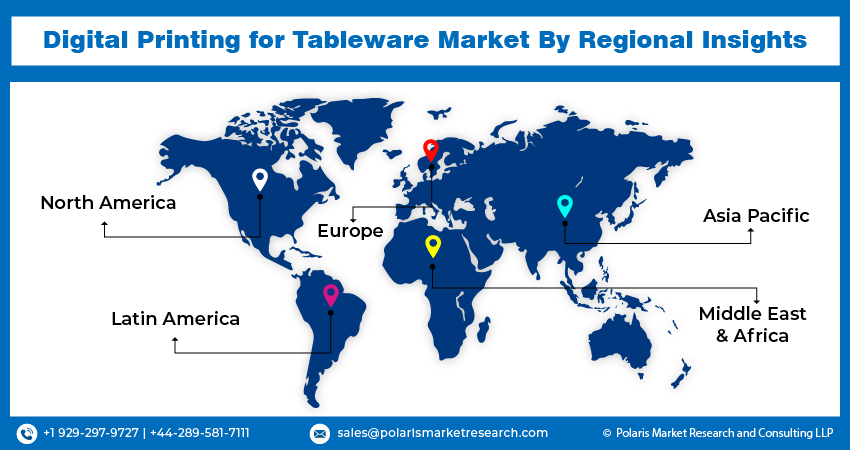
North America dominated the market share in 2025. The region is growing at a rapid pace due to shifting consumer preferences, technology breakthroughs, and the demand for more individualized and effective printing solutions. For instance, in the retail sector, customers have begun to recognize and respond highly to labels and packaging that are personalized for themselves. Furthermore, In January 2019, Tetra Pak full-color digital printing on beverage carton packages, partnering with Koenig & Bauer, offering enhanced customization, flexibility, and quicker design-to-print processes for beverage brands.
The implementation of digital printing technologies, such as toner- and inkjet-based systems, has enabled companies to expedite market demands and optimize their printing procedures. Moreover, the expansion of digital printing in North America is attributed to the development of e-commerce and online marketing.
Asia Pacific region is anticipated to hold the highest CAGR during the forecast period. Digital printing technology is gaining popularity in various industries, including the production of tableware in China, Japan, India, and South Korea. For instance, In May 2022, HP India debuted three digital presses, including the flagship HP Indigo 15K, HP Indigo 100K, and HP Indigo 6K at Printpack India 2022, with a notable presence and positive industry response. Moreover, the region has a strong manufacturing infrastructure, technological advancements, and a rising demand for customized and unique designs.
Source: Polaris Market Research Analysis
Key Market Players & Competitive Insights
Key players in the market are investing in research and development to enhance digital printing technologies, with a focus on improving UV-curable and water-based inks. The ability to offer high-quality, sustainable, and customizable solutions for various tableware materials has become a critical factor in driving competitiveness. Advancements in digital printing technologies have led to increased efficiency and reduced production costs, making it a more attractive option for manufacturers.
Some of the major players operating in the global market include:
- Boston Industrial Solutions, Inc.
- Dip-Tech Digital Printing Technologies Ltd.
- Electronics for Imaging, Inc.
- Engineered Printing Solutions
- Inkcups Now
- INX International Ink Co.
- KERAjet
- Mimaki Engineering Co., Ltd.
- PROJECTA ENGINEERING S.R.L.
- SACMI
Recent Developments
In March 2024, HP Inc. (HP Development Company, L.P.) launched its latest range of digital printing presses and intelligent solutions, featuring the HP Indigo 120K Digital Press. This advanced printing system is built for high-demand commercial environments, capable of producing up to 4,600 B2 sheets per hour. Leveraging Liquid Electrophotography Extended (LEPx) technology, it offers superior automation, efficiency, and ease of use, setting a new benchmark for high-volume digital printing.
In March 2024, Mimaki Engineering Co., Ltd. introduced TRAPIS, a next-generation, eco-friendly textile printing system. The TRAPIS system uses a heat transfer process to transfer designs from special paper onto fabrics, minimizing wastewater and reducing water usage. This innovative approach ensures efficient and precise design transfers while supporting sustainable practices in textile printing.
Digital Printing for Tableware Market Report Scope
| Report Attributes | Details |
| Market size value in 2025 | USD 332.98 million |
| Market size value in 2026 | USD 355.58 million |
| Revenue Forecast in 2034 | USD 618.63 million |
| CAGR | 7.20% from 2026 – 2034 |
| Base year | 2025 |
| Historical data | 2021 – 2024 |
| Forecast period | 2026 – 2034 |
| Quantitative units | Revenue in USD million and CAGR from 2026 to 2034 |
| Segments Covered | By Ink Type, By Application, By Region |
| Regional scope | North America, Europe, Asia Pacific, Latin America, Middle East & Africa |
| Customization | Report customization as per your requirements with respect to countries, regions, and segmentation. |
Source: Polaris Market Research Analysis
Digital Printing for Tableware Market FAQ's
key companies in Digital Printing for Tableware Market are Boston Industrial Solutions, Dip-Tech Digital Printing, Electronics for Imaging., Engineered Printing Solutions, Inkcups Now, and SACMI
The global digital printing for tableware market is expected to grow at a CAGR of 7.20% during the forecast period.
Digital Printing for Tableware Market report covering key segments are ink type, application, and region.
the key driving factors in Digital Printing for Tableware Market is rapid advancement of digital printing technology and the growing demand for customized solutions
The global digital printing for tableware market size is expected to reach USD 618.63 million by 2034.
Available ink types include UV Ink (largest segment offering instant curing), Solvent-based Ink (fastest growing), Ceramic Ink, Water-based Ink, providing durability for various substrates and applications.
North America dominates the market due to technological advancements and customization demand. Asia Pacific shows highest CAGR driven by manufacturing infrastructure in China, Japan, India, and South Korea.
Download Sample Report of Digital Printing for Tableware Market
Please fill out the form to request a customized copy of the research report.


