
Digital Signature Market Share, Industry Size, Trends, Opportunity, 2026-2034
REPORT DETAILS
Digital Signature Market Summary
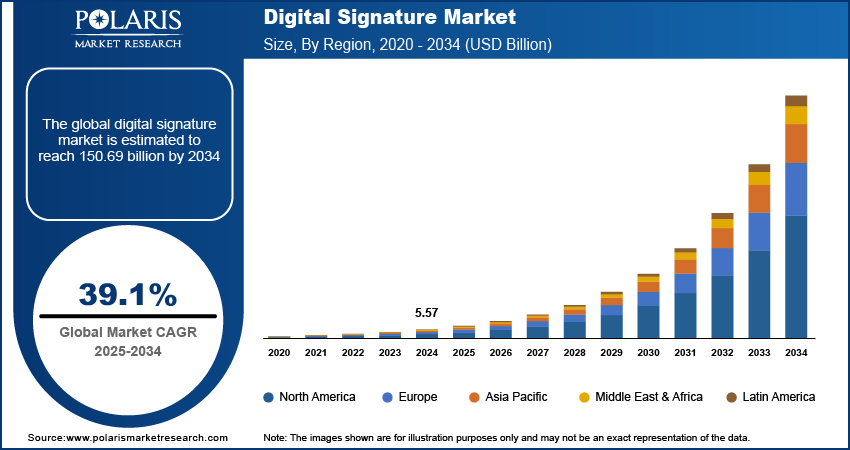
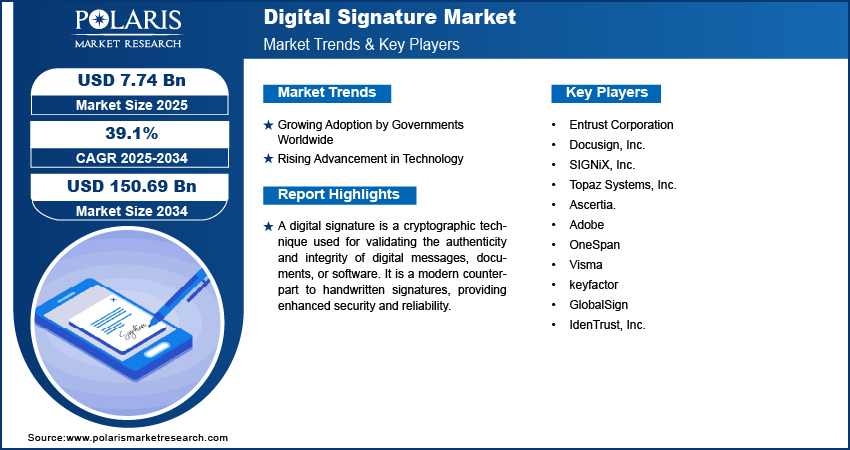
The global digital signature market size was valued at USD 7.74 billion in 2025. The market is projected to account for a CAGR of 39.10% from 2026 to 2034. The market is driven by rising demand for secure and efficient document authentication and increasing adoption of cloud services. The market is also benefiting from the growth in e-commerce and remote work, and the need to reduce paper usage and streamline business processes globally.
Market Statistics
Key Takeaways
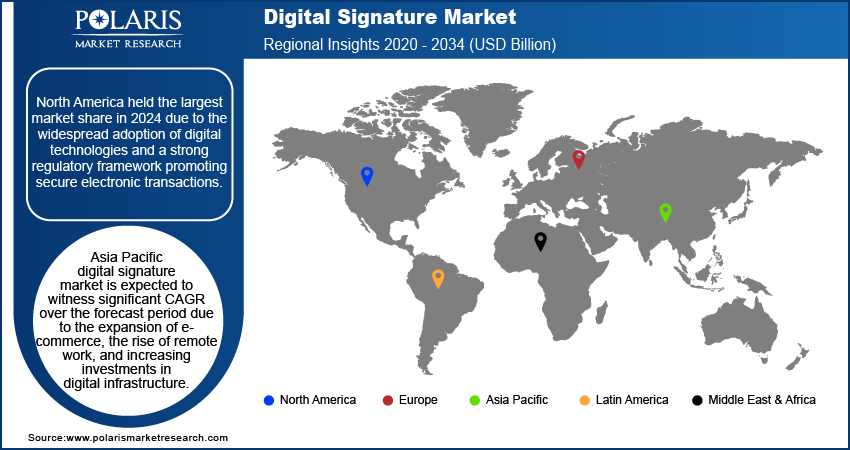
- North America led the market with a 38.23% share in 2025. This is due to the widespread adoption of digital technologies in the region.
- Asia Pacific is expected to grow significantly at a 39.10% CAGR. This is due to the expansion of e-commerce and increased investments in digital infrastructure.
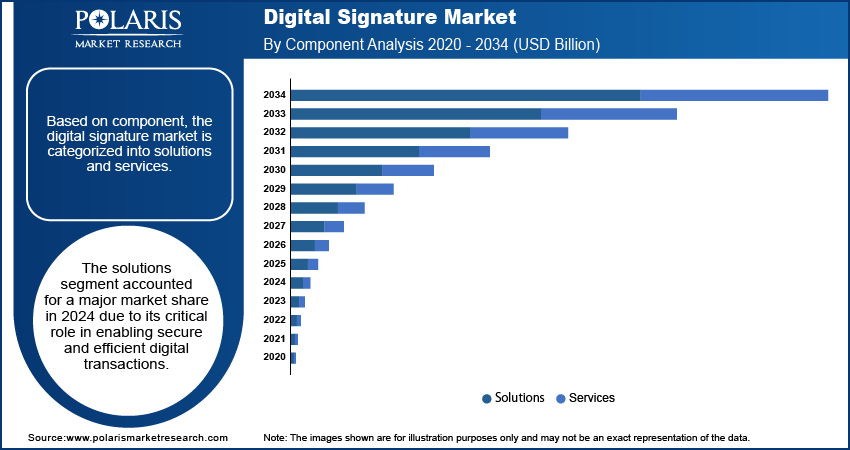
- The solutions segment held a major market share of 52.45% in 2025. The segment's dominance is driven by its essential role in enabling secure digital transactions.
- The businesses segment dominated the market with 76.80% share in 2025. The growing shift toward digital transformation and paperless workflows supports its leading position.
- The advanced electronic signatures (AES) segment led with a 45.50% revenue share in 2025. AES is widely preferred due to its robust cryptographic security and high compliance standards.
Note: Figures and projections outlined in this report are the result of Polaris Market Research’s proprietary analytical processes, grounded in the latest available datasets and market observations.
Industry Dynamics
- The growing adoption of digital transformation and increasing demand for secure, paperless workflows are driving the use of digital signatures.
- The expansion of e-commerce and the rise in remote work are accelerating the need for efficient electronic transaction solutions.
- Concerns around data privacy and cybersecurity risks are limiting adoption in some sectors.
- Integration of blockchain technology offers opportunities for enhanced security and trust in digital signatures.
AI Impact on Digital Signature Market
- AI makes verification of digital signatures more efficient by recognizing signs of fraud and irregularity.
- It increases the speed of document processing through automated verification and approval of signatures.
- AI enhances security by identifying forged or tampered documents in real time.
- It enhances the user experience by improving convenience when signing on to digital platforms.
Source: Polaris Market Research Analysis
To Understand More About this Research: Download Sample Report
A digital signature is a cryptographic technique used to validate the authenticity and integrity of digital messages, documents, or software. It is a modern counterpart to handwritten signatures, providing enhanced security and reliability. Digital signatures are based on public key infrastructure (PKI), which utilizes asymmetric cryptography to generate a pair of keys. Their primary functions include ensuring data integrity, providing non-repudiation, and authenticating the identity of the signer.
The increasing adoption of smartphones is propelling the global digital signature market growth. State of Mobile Internet Connectivity Report 2023 shows that over half (54%) of the global population owns a smartphone. Smartphones, equipped with internet connectivity, biometric authentication, and advanced security features, provide an ideal platform for executing and verifying digital signatures. The convenience and efficiency of digital signatures have become necessary as more individuals and businesses rely on smartphones for everyday tasks such as signing contracts, authorizing payments, or submitting official documents. Furthermore, the integration of digital signature capabilities into widely used mobile applications and platforms simplifies processes, enhances trust, and meets the growing demand for secure, paperless workflows. This shift towards mobile-driven digitalization drives digital signature adoption across sectors such as banking, e-commerce, healthcare, and government services.
The market demand is driven by the growing usage of the internet. Internet usage leads to increased online interactions, such as remote work, e-commerce, and digital payments, creating a need for secure and reliable methods to authenticate identities and validate transactions. Digital signatures provide a legally recognized and tamper-proof way to sign documents and agreements over the Internet, ensuring trust and efficiency in online processes. Moreover, as Internet usage expands to include cloud-based services, online contract management, and cross-border transactions, digital signatures become essential for streamlining workflows and maintaining compliance with global regulations. This surge in internet reliance drives the adoption of digital signature solutions across industries and countries.
Digital Signature vs Electronic Signature
| Feature | Digital Signature | Electronic Signature |
| Security | High (uses encryption) | Moderate |
| Authentication | High-level verification | Basic verification |
| Legal Acceptability | High in regulated fields | Dependent on laws |
| Technology | Cryptographic algorithm | Simple digital signature |
| Use Cases | Banking, governmental, legal | Generic business transactions |
Source: Polaris Market Research Analysis
Market Dynamics
Growing Adoption by Governments Worldwide
The growing adoption by governments worldwide is projected to propel the global market. The government of India is promoting the use of digital signatures in official interactions by recognizing digital signatures ('signatures) under the Information Technology Act, 2000 ('IT Act'). Governments worldwide are increasingly implementing digital signature solutions for e-governance initiatives, including online tax filing, identity verification, business registrations, and public procurement. These applications enhance operational efficiency, reduce paperwork, and ensure the authenticity and integrity of sensitive transactions.
Rising Advancement in Technology
The rising advancements in technology are estimated to fuel the global digital signature market. Innovations such as cloud-based digital signature platforms, integration with widely used software, and the incorporation of advanced security features such as blockchain technology and biometric authentication make digital signatures more reliable and appealing. Additionally, user-friendly interfaces, mobile compatibility, and the ability to integrate with emerging technologies such as AI and machine learning simplify adoption for businesses and individuals. These advancements address diverse industry needs, from streamlining workflows to improving regulatory compliance, thereby expanding the application of digital signatures across sectors such as finance, healthcare, legal, and e-commerce.
Growth of Remote Work and Paperless Business Operations
The rise of remote working and the shift towards the digitization of businesses have facilitated the use of digital signatures. As organizations conduct their operations within fragmented spaces, there is a need for swift verification of documents. Organizations are shifting away from manual paper-based procedures in favor of more efficient ones that can be conducted with speed. Digitization also encourages cooperation between different stakeholders within the organization who are located at various places, while maintaining the legitimacy and security of all documents.
Source: Polaris Market Research Analysis
Segment Analysis
By Component
Based on component, the digital signature market is categorized into solutions and services. The solutions segment accounted for a major market share of 52.45% in 2025 due to its critical role in enabling secure and efficient digital transactions. Businesses across industries prioritized software-based offerings that integrate seamlessly with existing workflows, such as document management systems, email platforms, and cloud services. The increasing reliance on electronic document signing and authentication, coupled with the growing demand for compliance with global regulatory standards, contributed to the dominance of the segment. Organizations value the ease of deployment and scalability that solutions provide, allowing them to meet the rising volume of digital interactions without compromising security or operational efficiency.
By End User
In terms of end user, the digital signature market is divided into individuals, businesses, and organizations. The business segment dominated the market with 76.80% share in 2025 due to the increasing shift toward digital transformation and paperless workflows. Companies across industries embraced secure signing solutions to streamline processes such as contract management, vendor agreements, and customer onboarding. The need to enhance operational efficiency, reduce costs associated with physical documentation, and meet compliance requirements fueled adoption in the segment. Businesses prioritized solutions that integrate with their existing infrastructure and scale with their operations, making these tools a core component of their digital strategies.
Source: Polaris Market Research Analysis
Regional Insights
By region, the study covers North America, Europe, Asia Pacific, Latin America, and the Middle East & Africa. North America held the largest market share of 38.23% in 2025 due to the widespread adoption of digital technologies and a strong regulatory framework promoting secure electronic transactions. Businesses and organizations across the US and Canada prioritized solutions that enhanced operational efficiency and reduced dependency on paper-based processes. They ensured compliance with laws such as the ESIGN Act and UETA in the US and PIPEDA in Canada. The region's well-established IT infrastructure and high internet penetration further facilitated the adoption of secure signing tools such as digital signatures, thereby contributing to market expansion.
Asia Pacific digital signature market is expected to witness significant CAGR of 39.21% over the forecast period due to the expansion of e-commerce, the rise of remote work, and increasing investments in digital infrastructure. Governments in countries such as India, China, and Japan are implementing initiatives to digitize public services and promote secure online transactions, creating significant opportunities for digital signatures. China, with its rapid technological advancements and large-scale adoption of digital solutions across sectors, is leading the region's growth. The presence of a vast consumer base, increasing awareness of secure transaction tools, and supportive government policies position Asia Pacific as a key region in the market.
Source: Polaris Market Research Analysis
Market Players & Competitive Analysis Report
Major market players are investing heavily in research and development in order to expand their offerings, which will help the market grow even more. Market participants are also undertaking a variety of strategic activities to expand their global footprint, with important market developments including innovative launches, international collaborations, higher investments, and mergers and acquisitions between organizations.
The digital signature industry is fragmented, with the presence of numerous global and regional market players. Major players in the market include Entrust Corporation; Docusign, Inc.; SIGNiX, Inc.; Topaz Systems, Inc.; Ascertia.; Adobe; OneSpan; Visma; keyfactor; GlobalSign; and IdenTrust, Inc.
Entrust Corporation is a prominent player in identity-centric security solutions, specializing in digital signatures, secure payments, and data protection. Founded in 1994 and headquartered in Shakopee, Minnesota, Entrust has evolved significantly over the years, particularly after its rebranding in 2020 to emphasize its focus on secure identities and transactions. The company serves clients in more than 150 countries, making it a key provider of digital security solutions globally. In November 2023, Entrust launched e-signature software with ID verification for high-value transactions.
Docusign, Inc. is a major US-based software company headquartered in San Francisco, California, specializing in electronic signature solutions and digital transaction management. Founded in 2003 by Court Lorenzini, Tom Gonser, and Eric Ranft, DocuSign has transformed how organizations manage electronic agreements, providing a platform that enables users to sign documents securely from virtually any device. The company operates in 180 countries, processing billions of electronic signatures that comply with global regulations such as the US ESIGN Act and the European Union's eIDAS regulation.
Key Companies
- Entrust Corporation
- Docusign, Inc.
- SIGNiX, Inc.
- Topaz Systems, Inc.
- Ascertia.
- Adobe
- OneSpan
- Visma
- keyfactor
- GlobalSign
- IdenTrust, Inc.
Market Developments
March 2026: Zoho introduced delegated signing for Zoho Sign. Delegated signing gives an individual the ability to assign another member within their organization to sign contracts on their behalf. (source: zoho.com)
Market Segmentation
By Component Outlook (Revenue, USD Billion, 2021 - 2034)
- Solutions
- Services
By Level Outlook (Revenue, USD Billion, 2021 - 2034)
- Advanced Electronic Signatures (AES)
- Qualified Electronic Signatures (QES)
By Deployment Outlook (Revenue, USD Billion, 2021 - 2034)
- Cloud
- On-premise
By End User Outlook (Revenue, USD Billion, 2021 - 2034)
- Individuals
- Businesses
- Organizations
By Industry Vertical Outlook (Revenue, USD Billion, 2020 – 2034)
- BFSI
- Health Care & Life Science
- IT & Telecom
- Government
- Retail
- Others
By Regional Outlook (Revenue, USD Billion, 2021 - 2034)
- North America
- US
- Canada
- Europe
- Germany
- France
- UK
- Italy
- Spain
- Netherlands
- Russia
- Rest of Europe
- Asia Pacific
- China
- Japan
- India
- Malaysia
- South Korea
- Indonesia
- Australia
- Rest of Asia Pacific
- Middle East & Africa
- Saudi Arabia
- UAE
- Israel
- South Africa
- Rest of Middle East & Africa
- Latin America
- Mexico
- Brazil
- Argentina
- Rest of Latin America
Report Scope
| Report Attributes | Details |
| Market Size Value in 2025 | USD 7.74 billion |
| Market Size Value in 2026 | USD 9.54 billion |
| Revenue Forecast in 2034 | USD 150.69 billion |
| CAGR | 39.1 % from 2026 to 2034 |
| Base Year | 2025 |
| Historical Data | 2021– 2024 |
| Forecast Period | 2026 – 2034 |
| Quantitative Units | Revenue in USD Billion and CAGR from 2026 to 2034 |
| Report Coverage | Revenue Forecast, Market Competitive Landscape, Growth Factors, and Industry Trends |
| Segments Covered |
|
| Regional Scope |
|
| Competitive Landscape |
|
| Report Format |
|
| Customization | Report customization as per your requirements with respect to countries, regions, and segmentation. |
Source: Polaris Market Research Analysis
Digital Signature Market FAQ's
The global digital signature market size was valued at USD 7.74 billion in 2025 and is projected to grow to USD 150.69 billion by 2034.
The global market is projected to grow at a CAGR of 39.1% during the forecast period.
North America had the largest share of 38.23% in 2025.
Some of the key players in the market are Entrust Corporation; Docusign, Inc.; SIGNiX, Inc.; Topaz Systems, Inc.; Ascertia.; Adobe; OneSpan; Visma; keyfactor; GlobalSign; and IdenTrust, Inc.
The business segment held the largest market share of 76.80% in the global market in 2025.
The solution segment dominated the digital signature market in 2025 with 52.45% share.
Download Sample Report of Digital Signature Market
Please fill out the form to request a customized copy of the research report.


