
Digital Workplace Market Share, Size, Trends, Industry Analysis Report, 2026 - 2034
REPORT DETAILS
Digital Workplace Market Summary
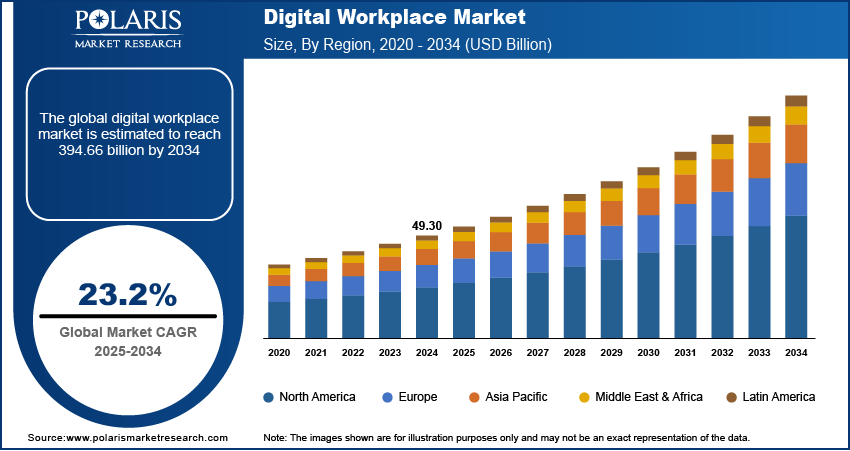
The global digital workplace market is valued at USD 60.46 billion in 2025 and is projected to grow at a CAGR of 23.2% during the forecast period. The growing adoption of cloud-based applications in many sectors, along with the higher flexibility of employees concerning work-life balance is driving the market growth. In addition, rising trend of BYOD (bring your own device) technology and business mobility by organizations further contribute to market growth
Market Statistics
Key Takeaways
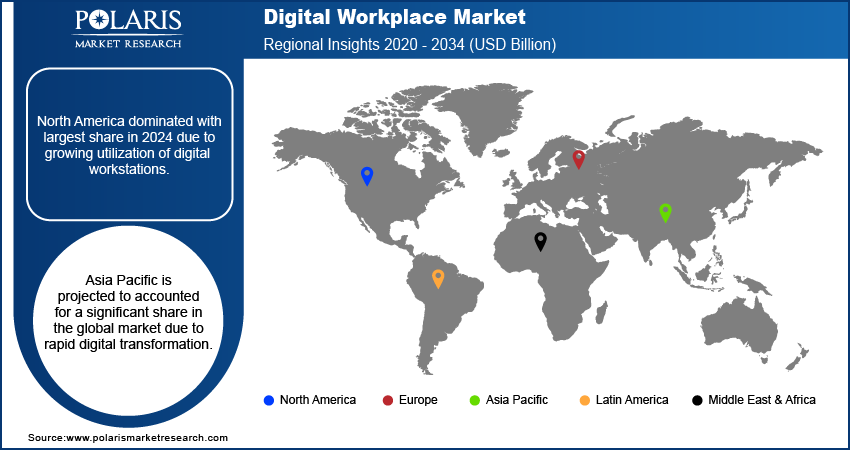
- North America dominated with largest share of 45.10% in 2025 due to growing utilization of digital workstations.
- Asia Pacific is projected to accounted for a significant share of 21.4% in the global market due to rapid digital transformation.
- The BFSI segment is expected to witness significant growth of CAGR 22.93% during the forecast period due to increasing application of digital workplace services and solutions in the BFSI industry.
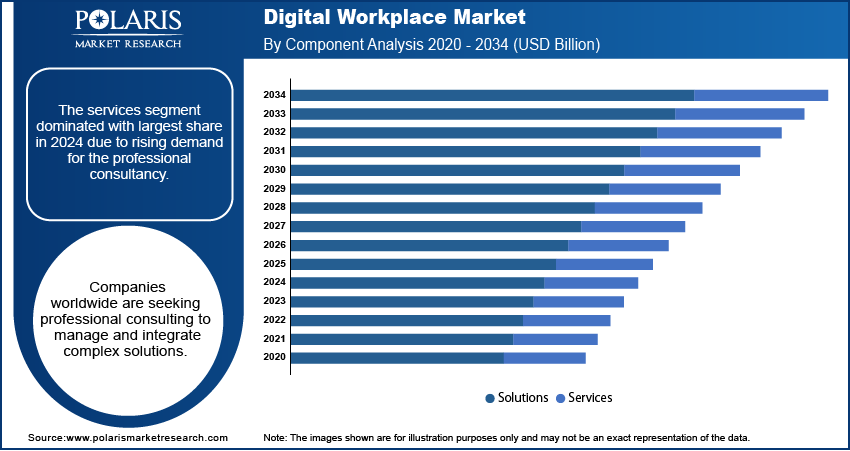
- The services segment accounted for the largest share of 61.04% in 2025 driven by rising need for professional consulting for complex solution integration.
Note: Figures and projections outlined in this report are the result of Polaris Market Research’s proprietary analytical processes, grounded in the latest available datasets and market observations
Industry Dynamics
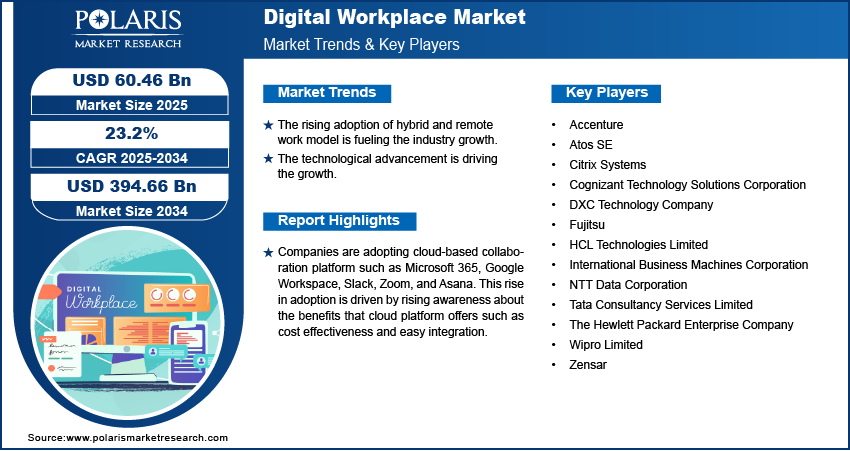
- The rising adoption of hybrid and remote work model is fueling the industry growth.
- The growing adoption of cloud-based collaboration model is boosting the industry growth.
- The technological advancement is driving the growth.
- High implementation costs and integration challenges with existing legacy systems is limiting the growth.
Source: Polaris Market Research Analysis
To Understand More About this Research: Download Sample Report
Impact of AI on Industry
- Improves productivity through automation in repetitive task such as scheduling, data entry, and ticketing.
- Improve collaboration through intelligent virtual assistants such as Microsoft Copilot.
- Enables advance cybersecurity and threat detection by identifying and responding to anomalies.
What is a Digital Workplace?
The digital workplace is a technology-driven virtual work environment. It integrates collaboration tools, cloud platforms, communication systems, AI-powered productivity applications, and employee experience solutions. These support remote, hybrid, and office-based work models. Digital workplace enables seamless workforce collaboration, workflow automation, and knowledge sharing. It also facilitates enterprise productivity optimization across organizations and industries.
Digital Workplace vs Traditional Workplace
| Parameter | Digital Workplace | Traditional Workplace |
| Remote Accessibility | Enables employees to work from anywhere through cloud-based platforms and secure remote access tools | Primarily dependent on physical office presence and on-site infrastructure |
| Cloud Collaboration | Supports real-time collaboration through shared documents, virtual meetings, and integrated digital platforms | Collaboration mainly occurs through in-person meetings, local systems, and manual file sharing |
| Workflow Automation | Uses AI, analytics, and automation tools to streamline repetitive tasks and business processes | Relies heavily on manual workflows, paper-based processes, and human intervention |
| Communication Speed | Provides instant communication through messaging apps, video conferencing, and unified communication systems | Communication is often slower due to reliance on physical meetings, emails, and traditional channels |
| Operational Flexibility | Easily adapts to hybrid work models, scalable operations, and changing workforce requirements | Limited flexibility due to fixed office infrastructure and location-dependent operations |
| Employee Productivity | Enhances productivity through digital tools, automation, centralized data access, and flexible work environments | Productivity may be constrained by commuting, limited accessibility, and less integrated systems |
| End Users | IT & telecom, BFSI, healthcare, retail, education, manufacturing, media, and government organizations managing remote or hybrid workforces | Traditional offices, administrative departments, on-site manufacturing facilities, and businesses dependent on centralized workplace operations |
Source: Polaris Market Research Analysis
Companies are adopting cloud-based collaboration platform such as Microsoft 365, Google Workspace, Slack, Zoom, and Asana. This rise in adoption is driven by rising awareness about the benefits that cloud platform offers such as cost effectiveness and easy integration. This cloud-based platform cuts operational cost as companies avoid investing in physical infrastructure and offers a subscription model, which makes them scalable and affordable. This flexibility and ease of use are driving more companies to adopt digital workplace solutions, thereby driving the growth of the industry.
Source: Polaris Market Research Analysis
Industry Dynamics
Growth Drivers
Companies worldwide are shifting to the remote of hybrid model. This rise in the remote work model is fueled after the covid-19 emergence when companies had to shut the workplace in order to curb disease infection. Currently companies have realized the advantages of remote work place model such as less operational expenditure and improved work efficiency. This rise in the remote and hybrid workplace model is driving the demand for the efficient tools that enables collaboration between employees. This has led to rise in adoption of Microsoft Teams, Zoom, Google Workspace, and Slack to facilitate real-time communication, project management, and team collaboration across locations. This has further fueled the demand for the unified platform to access files and manage workflow, which drives the demand, thereby driving the industry growth.
Report Segmentation
The market is primarily segmented by component, type, application, and region.
| By Component | By Solution | By End User | By Region |
|
|
|
|
Source: Polaris Market Research Analysis
Source: Polaris Market Research Analysis
Service Segment Accounted for the Largest Share of 61.04% in 2025
The services segment dominated with largest share in 2025 due to rising demand for the professional consultancy. Companies worldwide are seeking professional consulting to manage and integrate complex solutions. Moreover, the demand for the customization in the complex tools is rising. This rise in demand for the customization is prompting companies to seek professional consulting and implementation. Services like consulting, integration, training, and managed support help businesses transition smoothly to cloud-based tools and hybrid work environments, thereby driving the growth in the segment.
The BFSI segment is Expected to Witness Significant Growth of CAGR 22.93%
The BFSI is expected to witness signifiucant growth duriung the forecast period due to the increasing application of digital workplace services and solutions in the BFSI Industry. Mass deployment of digital workstations supports lowering office expenses and other associated functional expenditures are driving the adoption in the BFSI sector. Digital workplace certifies administrative regulations, and improves operative capability in the BFSI industry, which further drives the adoption, thereby driving the growth in the segment.
Technological Advancements in Digital Workplace Platforms
| Technology | Key Features | Business Benefits |
| AI Copilots | AI-powered assistants for task management, meeting summaries, scheduling, and content generation | Improves employee productivity, reduces manual workload, and enhances decision-making efficiency |
| Generative AI | Automated content creation, document drafting, code generation, and conversational AI support | Accelerates workflows, improves collaboration, and enhances workplace efficiency |
| Intelligent Automation | Robotic process automation (RPA), AI-driven workflows, and automated business processes | Reduces operational costs, minimizes human errors, and improves process speed |
| Cloud-Native Collaboration | Real-time communication, cloud storage, remote accessibility, and integrated workplace applications | Enables seamless hybrid work, scalable operations, and global workforce connectivity |
| Unified Communication Platforms | Integration of messaging, video conferencing, email, and project management tools | Enhances communication speed, collaboration efficiency, and employee engagement |
| AI-Driven Analytics | Predictive analytics, workforce insights, and intelligent reporting systems | Supports data-driven decision-making and operational optimization |
| Employee Experience Platforms | Personalized dashboards, digital HR tools, wellness monitoring, and engagement applications | Improves employee satisfaction, retention, and workplace experience |
| Immersive Communication Technologies | AR, VR, and mixed reality-based collaboration and virtual workspaces | Enables interactive training, virtual meetings, and enhanced remote collaboration |
| Cybersecurity & Zero-Trust Architecture | Identity management, endpoint security, multi-factor authentication, and secure cloud access | Strengthens enterprise data protection and supports secure remote working environments |
| Smart Workflow Orchestration | Automated task coordination, workflow optimization, and cross-platform integration | Enhances operational agility, improves efficiency, and streamlines enterprise processes |
Source: Polaris Market Research Analysis
North America Accounted for Largest Share of 45.10% in 2025
North America dominated with largest share in 2025 due to the increasing utilization of digital workstations across SMEs and big enterprises in the region. North America is the global hub for many startup companies, medium-level companies, and large organizations. The growing evolution of social connections from trade, along with the surge in the shift towards IoT, cloud computing, and the application of vital technology such as big data, AI, and automation techniques, is propelling regional growth.
The Asia Pacific region is expected to witness significant growth of CAGR 21.4% during the forecast period due to the growing adoption of working from home and remote working culture. The region is home of large number of cmpanies operating in retail, IT and banking sector. This large number of companies in the region is driving the demand for the digital workplace tools. Moreover, rising investment in the end use industries is supporting companies to spend on advance digital workplace tools. This in turn drives the demand and thereby fuels the industry growth in the region.
Source: Polaris Market Research Analysis
Competitive Insight
Some of the key players operating in the global market include Fujitsu, Citrix Systems, Atos SE, Fujitsu Limited, Inc, IBM, Accenture, NTT Data Corporation, Zensar, The Hewlett Packard Enterprise Company, HCL Technologies Limited, Tata Consultancy Services Limited, DXC Technology Company, International Business Machines Corporation, Cognizant Technology Solutions Corporation, Wipro Limited, and Others.
List Of Key Companies:
- Fujitsu
- Citrix Systems
- Atos SE
- Fujitsu Limited, Inc.
- IBM
- Accenture
- NTT Data Corporation
- Zensar
- The Hewlett Packard Enterprise Company
- HCL Technologies Limited
- Tata Consultancy Services Limited
- DXC Technology Company
- International Business Machines Corporation
- Cognizant Technology Solutions Corporation
- Wipro Limited
- Others
Recent Developments
- April 2026: Kyndryl announced the Kyndryl Digital Twin for the Workplace. Its new AI-powered capability helps organizations avoid workflow disruption. They assist in anticipating and resolving technology issues. (source: kyndryl.com).
Digital Workplace Market Report Scope
| Report Attributes | Details |
| Market size value in 2025 | USD 60.46 billion |
| Market size value in 2026 | USD 81.21 billion |
| Revenue forecast in 2034 | USD 394.66 billion |
| CAGR | 23.2% from 2026 - 2034 |
| Base year | 2025 |
| Historical data | 2021 - 2024 |
| Forecast period | 2026 - 2034 |
| Quantitative units | Revenue in USD billion and CAGR from 2026 to 2034 |
| Segments covered | Component, Solution, End User, and Region |
| Regional scope | North America, Europe, Asia Pacific, Latin America, Middle East & Africa |
| Key companies | Fujitsu, Citrix Systems, Atos SE, Fujitsu Limited, Inc, IBM, Accenture, NTT Data Corporation, Zensar, The Hewlett Packard Enterprise Company, HCL Technologies Limited, Tata Consultancy Services Limited, DXC Technology Company, International Business Machines Corporation, Cognizant Technology Solutions Corporation, and Wipro Limited. |
Source: Polaris Market Research Analysis
Digital Workplace Market FAQ's
• The market size was valued at USD 60.46 Billion in 2025 and is projected to grow to USD 394.66 Billion by 2034.
• The market is projected to register a CAGR of 23.2% during the forecast period.
• A few of the key players in the market are Citrix Systems, Atos SE, Fujitsu Limited, Inc, IBM, Accenture, NTT Data Corporation, Zensar, The Hewlett Packard Enterprise Company, HCL Technologies Limited, Tata Consultancy Services Limited, DXC Technology Company, International Business Machines Corporation, Cognizant Technology Solutions Corporation, and Wipro Limited.
• The service accounted for the largest market share of 61.04% in 2025.
• The BFSI segment is expected to record significant growth of CAGR 22.93%.
Download Sample Report of Digital Workplace Market
Please fill out the form to request a customized copy of the research report.


