
Electric Three-Wheeler Market Size, Share & Forecast 2026-2034
REPORT DETAILS
Electric Three-Wheeler Market Overview
The global electric three-wheeler market is estimated around USD 2.57 Billion in 2025,with consistent growth anticipated during 2026–2034. Rising government support for electric mobility, expanding charging infrastructure, and increasing demand for affordable last-mile transportation solutions are supporting market expansion. The market is projected to grow at a CAGR of 4.96% during the forecast period.
Market Statistics
Key Takeaways
- Asia Pacific dominated the market with 75.1% share in 2025 supported by extensive electric rickshaw deployment and strong EV manufacturing activity.
- Passenger electric three-wheelers segment dominated the market with 53.8% share in 2025 due to strong adoption across urban public transportation networks.
- Lithium-ion batteries segment dominated the market accounting for 44.7% share in 2025 driven by longer lifecycle and improved charging efficiency.
- Cargo electric three-wheelers segment is projected to grow at the fastest CAGR of 5.2% during the forecast period owing to increasing e-commerce and hyperlocal delivery demand.
- Major companies operating in the market include Atul Auto Limited, Bajaj Auto Limited, Hero Electric, Mahindra & Mahindra Limited, and Piaggio Group.
*Note: Figures and projections outlined in this report are the result of Polaris Market Research’s proprietary analytical processes, grounded in the latest available datasets and market observations.
Industry Dynamics
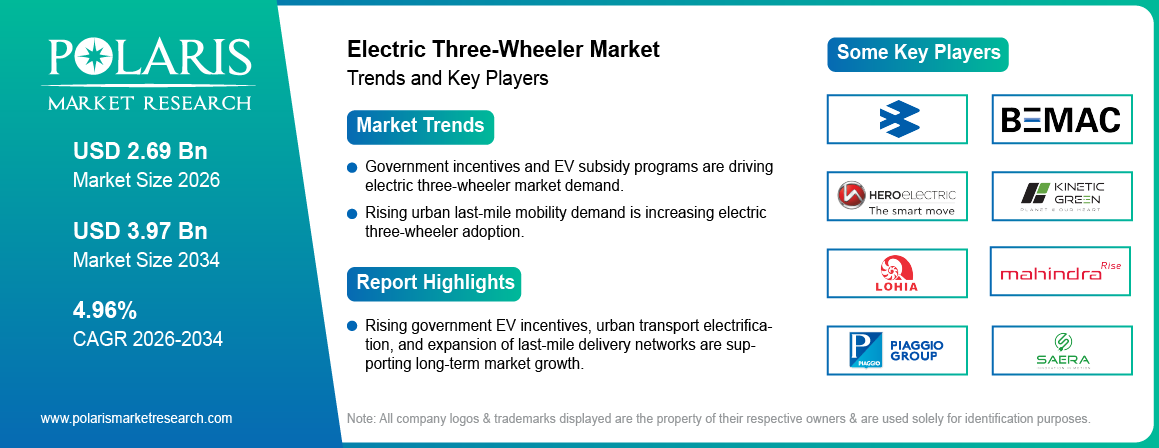
- Government incentives and EV subsidy programs are driving electric three-wheeler market growth.
- Rising urban last-mile mobility demand is increasing electric three-wheeler adoption.
- Charging infrastructure limitations are restraining market expansion.
- Expansion of e-commerce delivery networks is creating growth opportunities.
What is an Electric Three-Wheeler (E3W)? Types: E-Rickshaw, Electric Auto-Rickshaw, Cargo Tuk-Tuk & EV Applications
Electric three-wheelers are battery-powered vehicles designed for passenger transportation and cargo delivery applications across urban and semi-urban regions. These vehicles operate using electric drivetrains and rechargeable battery systems, offering lower emissions and reduced operating costs compared to internal combustion engine vehicles. Electric three-wheelers are heavily employed within the transport sectors such as passengers transport, logistics, ride-hailing services, and last-mile deliveries.
The value chain for the electric three-wheeler industry includes suppliers of raw materials, producers of batteries, electric drive system manufacturers, original equipment manufacturers, providers of EV charging stations, distributors, fleet operators, and consumers. The battery systems, telematics technology, motors, motor control, and charging systems form part of the electric mobility system for passengers and goods.
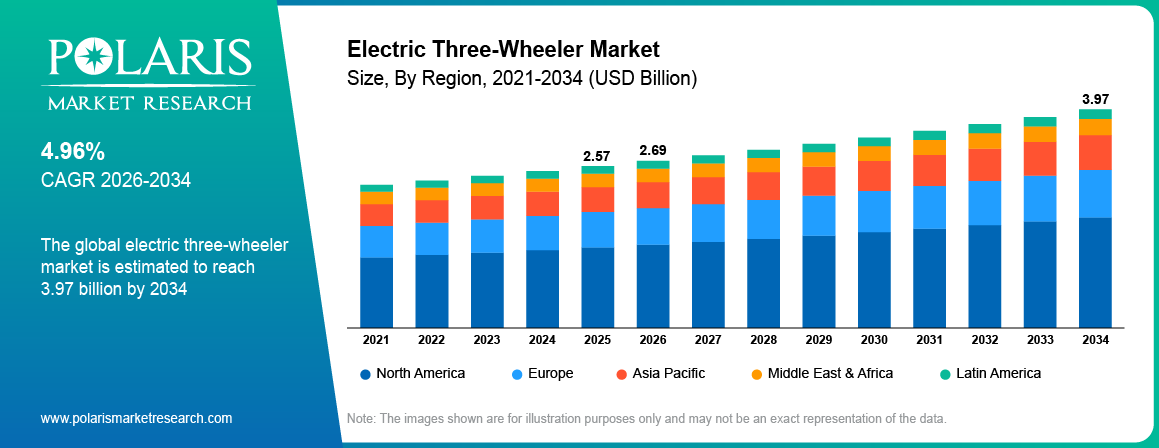
The growth in fuel prices, traffic congestion, and the government’s efforts towards sustainable transportation are helping the electric three-wheeler market grow. The usage of battery swapping technology and AI in managing fleets is contributing positively to the operation and efficiency of fleet managers. Urban logistics and e-commerce deliveries have been contributing to demand for electric cargo three-wheelers.
Electric Three-Wheeler Market Dynamics: Drivers, Restraints & Opportunities
Government Incentives & EV Subsidies — India FAME II, PM E-Drive & China EV Policies:
Government assistance continues to be the most potent driver for the expansion of the electric three-wheeler sector The Indian government announced the FAME-II program with the budget of about USD 1.2 billion to boost the usage of EVs in the country. Further, there were incentives provided worth approximately USD 116 per kWh in favor of electric three-wheelers with batteries that had an energy storage capacity of about 5 kWh. Governments have started using EV subsidy schemes, tax incentives, and production within their jurisdictions in order to reduce the cost of acquiring EVs.
Rising Urban Last-Mile Mobility & E-Commerce Delivery Demand Driving E3W Adoption:
Urbanization and rising need for cost-effective public transport is driving the use of electric three-wheelers in developing countries. According to the UN, about 55% of the world’s population resides in urban regions, and this percentage is projected to increase to 68% by 2050, with approximately 90% of the total urban population growth expected to occur in Asia and Africa. The passenger electric three-wheeler is used increasingly for urban commuting and shared services due to cost-effectiveness and small size.
Restraints & Challenges
Charging Infrastructure Gaps & Battery Replacement Costs in Emerging Markets:
Lack of charging infrastructure facilities pose a significant problem for the use of electric three wheelers in a number of developing countries. Non-standard charging infrastructure, range anxiety, and battery issues pose a problem in the commercial adoption of three wheelers. Transport business owners encounter financial problems in relation to battery replacement and installation of charging infrastructure. The dependence on lead acid batteries poses another restriction.
Opportunity
E-Commerce & Hyperlocal Last-Mile Delivery Network Expansion Driving Cargo E3W Demand:
Rapid growth in e-commerce and hyper-local delivery networks has resulted in various profitable prospects for cargo electric three wheelers. Logistics firms are opting for electric delivery vehicles to decrease their dependency on fuel and follow emissions standards in urban areas. Cargo electric three-wheelers have lower operational and maintenance cost than standard delivery vehicles.
Electric Three-Wheeler Market Segmentation Analysis
This report offers an exhaustive study of the global electric three-wheeler market in terms of its vehicle type, battery type, and application in order to find the most revenue-yielding and growth segments.
Electric Three-Wheeler Market by Vehicle Type: Passenger Carrier (E-Rickshaw) vs. Cargo/Goods Carrier
-
Passenger Electric Three-Wheelers
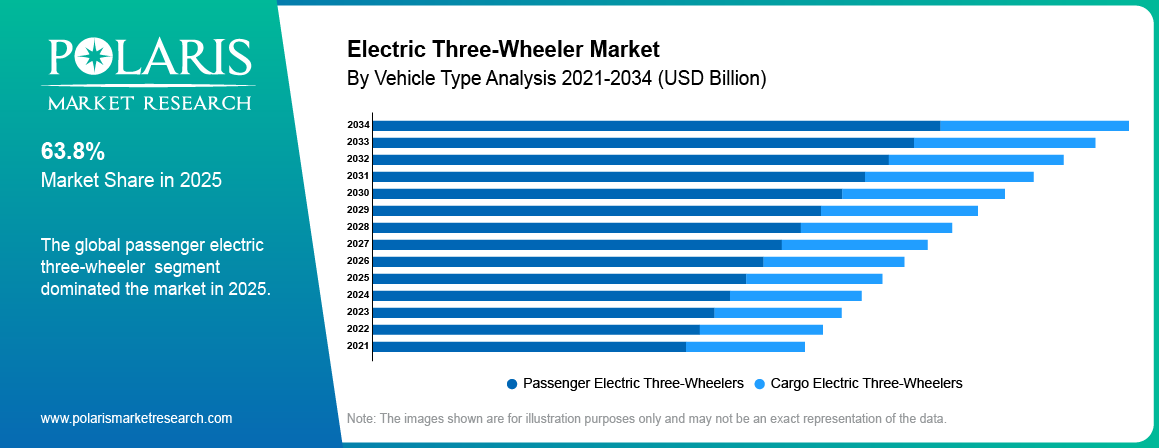
The passenger electric three-wheeler segment emerged as the leading category of 63.8% share in 2025, driven by the widespread use of such vehicles within urban public transport systems and ride-sharing initiatives. Passenger auto-rickshaws offer cheap and eco-friendly transportation alternatives for commuters in developing countries. The trend towards growing electrification requirements and urban mobility initiatives is fueling the segment’s growth.
-
Cargo Electric Three-Wheelers
The cargo electric three-wheelers are likely to record the highest CAGR of 5.2% over the forecast period due to increasing adoption of sustainable urban logistics and last-mile delivery services. The rise in investments made by e-commerce firms, retail chains, and food delivery companies in electric cargo three-wheelers has further strengthened their popularity.
Electric Three-Wheeler Market by Battery: Lithium-Ion vs. Lead-Acid & Battery Capacity (Below 3kWh, 3-6kWh, Above 6kWh)
-
Lithium-Ion Batteries
Lithium-ion batteries segment led the market share of 44.7% in 2025 owing to its advantages such as high energy density, charging efficiency, and long lifecycle. It was observed that more battery suppliers were focusing on local production and battery-swapping solutions to make their products affordable and decrease supply dependence.
-
Lead-Acid Batteries
The lead-acid batteries are expected to grow at highest CAGR of 4.0% over the forecasted period due to cheaper upfront costs and extensive usage in various cost sensitive regions. Lead acid battery-powered electric vehicles are preferred by small fleet operators and rural transportation companies for their cost-effective transport.
Electric Three-Wheeler Market by Application: Passenger Transport, Logistics & Delivery, Ride-Hailing & Urban Freight
-
Passenger Transportation
Passenger transportation was the largest segment in 2025 valued at 49.0% share due to rising demand for economic mobility. Electric passenger carriers are increasingly deployed across metropolitan and semi-urban regions to reduce emissions and lower transportation costs.
-
Logistics & Delivery
Logistics & delivery is projected to grow at the fastest CAGR of 5.7% during the forecast period owing to rapid expansion of e-commerce, grocery delivery, and hyperlocal logistics networks. Fleet operators are increasingly adopting electric cargo three-wheelers to improve delivery efficiency and reduce operating expenses.
Regional Analysis
Asia Pacific Electric Three-Wheeler Market: India, China & Southeast Asia EV Adoption (75.1% Global Share)
Asia Pacific electric three-wheeler market dominated the global market with 75.1% share in 2025 driven by extensive electric rickshaw deployment, favorable government policies, and strong EV manufacturing expansion across India, China, Bangladesh, and Southeast Asia. According to the International Trade Administration, China accounted for nearly 75% of global electric vehicle production in 2025, strengthening its position as the world’s largest EV manufacturing hub. Electric three-wheelers have continued to be in high demand in India owing to subsidies and increase in the need for urban transport, while China continues to dominate in terms of battery manufacturing and production of EVs.
Europe Electric Three-Wheeler Market Overview
Europe electric three-wheelers market is experiencing steady growth capturing 10.9% share owing to rising deployment of environmentally-friendly transport policies and initiatives focused on sustainability in cities. The EU Fit for 55 policy framework as well as the Automotive and Clean Industrial Deal aim at cutting down transport emissions by about 90 percent by 2050 compared to the 1990 figures. Rising investments in smart mobility infrastructure and green transportation programs are supporting regional demand.
North America Electric Three-Wheeler Market Assessment
North America electric three-wheeler market is experiencing growing demand at a CAGR of 3.8% due to expansion of e-commerce logistics and rising investments in compact electric delivery vehicles across the US and Canada. Amazon co-founded the Climate Pledge in 2019 and committed to achieving net-zero carbon emissions by 2040, while also partnering with Rivian to deploy 100,000 electric delivery vehicles by 2030. Fleet operators are increasingly exploring electric micro-mobility platforms to improve urban delivery efficiency and reduce emissions.

Competitive Landscape
Key Players & Competitive Strategies
The electric three-wheeler industry is highly fragmented owing to the existence of regional original equipment manufacturers (OEMs), electric mobility companies, and traditional automobile manufacturers. Competitive advantage is determined by battery efficiency, pricing, charging system integration, range of operation, and ability to manage fleet operations. Players are making efforts in strategic alliances, manufacturing expansion in localities, AI-based telematics, and battery swapping systems.
Some major players of the electric three-wheeler market are Atul Auto Limited, Bajaj Auto Limited, BEMAC, Gayam Motor Works Private Limited, Hero Electric (Hero Eco Group), Kinetic Green Energy & Power Solutions Limited, Lohia Auto Industries, Mahindra & Mahindra Limited, Mahindra Electric Mobility Limited, Piaggio Group S.p.A., Piaggio & C. S.p.A. (Piaggio Group), Romai Electric Vehicles, Saera Electric Auto Private Limited, Scooters India Limited, and Terra Motors Corporation.
Premium Insights
The electric three-wheeler market is experiencing rapid changes driven by the increasing mobility needs in urban environments, the development of last mile deliveries, and increasing governmental support towards sustainability in transport. In the future, market development will be determined by a number of trends, including:
- Technologies enabling autonomous delivery in logistics services
- Smart city mobilities through intelligent transport systems
- AI-powered optimization in terms of routing and energy use
- Subscription models based on batteries, cutting down initial ownership costs of vehicles
- Predictive maintenance technologies optimizing vehicle operation
The industry is slowly transitioning from competing in terms of vehicles to a focus on complete mobility ecosystems driven by software, chargers, fleet management, and intelligence. Connected mobility solutions are growing in importance as they help fleets operate more efficiently while keeping maintenance costs down and improving battery efficiency.
Electric three-wheelers are seen as increasingly crucial elements in sustainable urban mobility planning, especially within highly-populated cities where emissions-free and cost-effective modes of transport are getting greater recognition. Growth in e-commerce and shared mobility services is further strengthening long-term market potential.
Key Players
- Atul Auto Limited
- Bajaj Auto Limited
- BEMAC
- Gayam Motor Works Private Limited
- Hero Electric (Hero Eco Group)
- Kinetic Green Energy & Power Solutions Limited
- Lohia Auto Industries
- Mahindra & Mahindra Limited
- Mahindra Electric Mobility Limited
- Piaggio Group S.p.A.
- Piaggio & C. S.p.A. (Piaggio Group)
- Romai Electric Vehicles
- Saera Electric Auto Private Limited
- Scooters India Limited
- Terra Motors Corporation
Industry Developments
- April 2026: Bajaj Auto unveiled its WEGO line-up of electric three-wheelers for both passenger and cargo categories in India, featuring electric three-wheelers that are certified to have a driving range of up to 296 km, coupled with enhanced battery management systems and regenerative braking systems. [source: autocarpro.com]
- March 2024: Gaius Automotive launched Rapide 3 electric three-wheeler following the receipt of the iF Design Award 2024. This is due to the increasing recognition of high-tech electric last-mile delivery three-wheelers equipped with unique tilt mechanism technology, enhanced range, and significant cargo-carrying capacity. [source: gaiusauto.com]
Electric Three-Wheeler Market Segmentation
By Vehicle Type Outlook (Revenue, USD Billion, 2021–2034)
- Passenger Electric Three-Wheelers
- Cargo Electric Three-Wheelers
By Battery Type Outlook (Revenue, USD Billion, 2021–2034)
- Lithium-Ion Batteries
- Lead-Acid Batteries
By Application Outlook (Revenue, USD Billion, 2021–2034)
- Passenger Transportation
- Logistics & Delivery
- Ride-Hailing
- Urban Freight
By Regional Outlook (Revenue, USD Billion, 2021-2034)
- North America
- US
- Canada
- Europe
- Germany
- France
- UK
- Italy
- Spain
- Netherlands
- Russia
- Rest of Europe
- Asia Pacific
- China
- Japan
- India
- Malaysia
- South Korea
- Indonesia
- Australia
- Vietnam
- Rest of Asia Pacific
- Middle East & Africa
- Saudi Arabia
- UAE
- Israel
- South Africa
- Rest of Middle East & Africa
- Latin America
- Mexico
- Brazil
- Argentina
- Rest of Latin America
Electric Three-Wheeler Market Report Scope
| Report Attributes | Details |
| Market Size in 2025 | USD 2.57 Billion |
| Market Size in 2026 | USD 2.69 Billion |
| Revenue Forecast by 2034 | USD 3.97 Billion |
| CAGR | 4.96% from 2026 to 2034 |
| Base Year | 2025 |
| Historical Data | 2021–2024 |
| Forecast Period | 2026–2034 |
| Quantitative Units | Revenue in USD Billion and CAGR from 2026 to 2034 |
| Report Coverage | Revenue Forecast, Competitive Landscape, Growth Factors, and Industry Trends |
| Segments Covered |
|
| Regional Scope |
|
| Competitive Landscape |
|
| Report Format |
|
| Customization | Report customization as per your requirements with respect to countries, regions, and segmentation. |
Source: Polaris Market Research Analysis
Electric Three-Wheeler Market FAQ's
The global market size was valued at USD 2.57 Billion in 2025 and is projected to reach USD 3.97 Billion by 2034 at a CAGR of 4.96%.
Asia Pacific dominated the market in 2025 capturing 75.1% share driven by strong electric rickshaw deployment and favorable EV policies.
Passenger electric three-wheelers dominated the market with 63.8% share in 2025 owing to increasing urban mobility demand and public transportation adoption.
Major companies operating in the market include Atul Auto Limited, Bajaj Auto Limited, Hero Electric, Mahindra & Mahindra Limited, and Piaggio Group.
Growing number of subsidies for electric vehicle adoption, higher prices of gasoline, and increasing demand for urban deliveries have been driving growth in the market.
Cargo electric three-wheelers have benefits such as low operational costs, enhanced maneuverability, and sustainability.
The market outlook remains positive due to expansion of smart mobility infrastructure, AI-enabled fleet optimization, and battery swapping ecosystems.
Download Sample Report of Electric Three-Wheeler Market
Please fill out the form to request a customized copy of the research report.


