
Endobronchial Valves Market Size, Analysis Report, 2026-2034
REPORT DETAILS
Endobronchial Valves Market Summary
The global endobronchial valves market was valued at USD 190.64 million in 2025 and is expected to grow at a CAGR of 6.0% during the forecast period. The growth of the industry is driven by rising cases of lung related disorder, and technological advancement.
Market Statistics
The rising prevalence of lung-related health issues among the population is creating concerns among healthcare providers and scientists. According to the report published in the American Journal of Respiratory and Critical Care Medicine, around 3 million people are passing away due to chronic obstructive pulmonary disease (COPD). This will necessitate the demand for healthcare providers for the treatment, in turn medical devices, including endobronchial valves.
Source: Polaris Market Research Analysis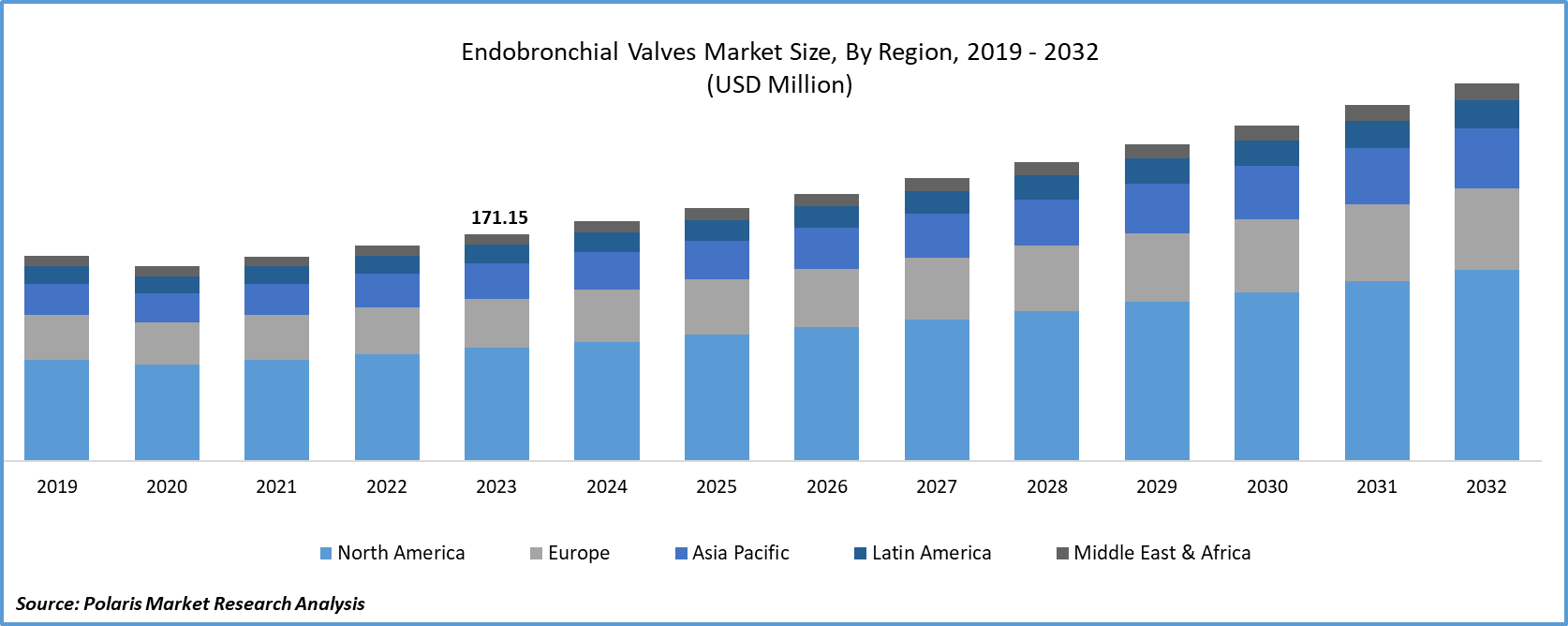
To Understand More About this Research: Download Sample Report
Based on American Lung Association research findings, in 2020, 12.5 million new cases were registered, while 148,5123 deaths were noted in the United States. This will facilitate the need for endobronchial valves, compared to the traditional open surgeries due to less trauma in the body. According to the WHO International Clinical Trials Registry Platform, there are 600 clinical trials that are hiring patients for COPD. This signifies the increasing number of clinical studies on discovering effective treatment procedures for COPD. The ongoing research studies in the medical field are expected to propel the growth of the endobronchial valves during the forecast timeframe.
For instance, in November 2022, the study published in MDPI focused on bronchoscopic management in treating COPD and evaluated the advancements in therapy.
Moreover, the rising awareness among people about bronchoscopic lung volume reduction in treating lung-related health problems is driving the growth of the endobronchial valve market.
However, the higher costs associated with bronchoscopic valves due to the presence of lower-market players providing these devices are expected to hamper market expansion.
Growth Drivers
The Rising Prevalence of Lung-Related Issues is Primarily Attributable to Tobacco Smoking
Rising tobacco smoking is one of the crucial factors leading to lung issues among the population. Based on the World Health Organization (WHO) fact sheets, in 2020, around 22.3% of the global population used tobacco, constituting 36.8% of men and 7.8% of women. Cigarette smoking weakens lungs among people and is likely to cause swelling in air tubes and destroy air sacs, contributing to COPD.
COPD makes people experience shortness of breath as the lungs are diseased, leading to the trapping of air in the damaged part, which is known as hyperinflation of the lungs, making it difficult to inhale fresh air. Endobronchial valves are known to help patients in improving the functioning of their lungs by freeing up air from damaged part by redirecting to fresh air to healthier part. The growing number of smokers worldwide may necessitate the need for endobronchial valves in the coming years.
A study published in Science Direct conducted retrospective research to evaluate the use of endobronchial valves in reducing the complications of pneumothorax by breaking down the placement of zephyr endobronchial valves into two procedures. This is conducted in 15 pulmonology departments in France, involving 96 patients. The results of the study noticed a 12.5% incidence of pneumothorax with a significant reduction in other complications, along with not altering the benefits associated with treating emphysema.
Further clinical trials are required to test its significance. As more studies evolve to improve patients' health outcomes, there will be a positive potential for endobronchial valve utilization in treating lung-related health issues. The effectiveness of bronchial valves in reducing lung volume reduction treatment compared to other devices is expected to foster their demand in the market.
Trends in Endobronchial Valves
| Trend | Description of new direction |
| Guideline‑endorsed therapy with high evidence rating | EBV‑based bronchoscopic lung volume reduction (BLVR) is now guideline therapy for severe emphysema with severe hyperinflation and no relevant collateral ventilation, carrying the highest evidence rating among bronchoscopic interventions. |
| Strong RCT and meta‑analysis data on efficacy and safety | Multiple randomized controlled trials and recent meta‑analyses show clinically meaningful improvements in FEV₁, 6‑minute walk distance, dyspnea, quality of life, and BODE index, with acceptable safety when patients are appropriately selected. |
| Broader application to homogeneous emphysema and cardiac effects | New data show benefits in patients with severe homogeneous emphysema (not only heterogeneous) and suggest that reducing hyperinflation via EBVs can improve cardiac function by relieving thoracic pressure. |
| Consensus‑based patient selection and procedural guidance | International expert consensus statements provide detailed recommendations on patient selection (e.g., fissure completeness, absence of collateral ventilation), target‑lobe choice, and peri‑procedural management to standardize practice. |
| Ongoing real‑world and long‑term outcome data | Real‑world registries and follow‑up studies show sustained benefits in lung function and symptoms up to 2 years, while also documenting complication patterns (notably pneumothorax, COPD exacerbations, pneumonia). |
Source: Polaris Market Research Analysis
Source: Polaris Market Research Analysis
Report Segmentation
The market is primarily segmented based on product type, end-user, and region.
| By Product Type | By End User | By Region |
|
|
|
Source: Polaris Market Research Analysis
To Understand the Scope of this Report: Request Customization
By Product Type Analysis
Duckbill-Shaped Segment is Expected to Experience the Highest Segmental Growth During the Forecast Period
The duckbill-shaped endobronchial valves segment will grow rapidly, mainly driven by the rising adoption among manufacturers due to appealing benefits. Zephyr valve, a first minimally invasive device, duckbill-shaped attached to a nickel-titanium self-expanding retainer surrounded by a silicone membrane, got approval from the United States Food and Drug Administration (FDA).
The umbrella-shaped endobronchial valves segment dominated the market, due to its ability to improve the flow of air naturally through and around the value. The spiration valve system has followed this design, with nitinol fame covered by a polymer membrane, which received pre-market approval from the FDA in 2018. In a clinical trial conducted by Emprove, it was shown to be effective with improvements in functioning, volume reduction of the lungs, and quality of life.
By End User Analysis
Hospitals Segment Witnessed the Largest Market Share in 2025
The hospitals segment accounted for the largest market share. These insertion procedures for endobronchial valves are highly conducted by pulmonologists in hospitals. The increasing cases of COPD and lung-related health issues are driving the adoption of these devices among healthcare providers. The clinical research center segment is expected to grow at the fastest rate over the next few years on account of the rapid increase in research trials related to COPD using endobronchial valves.
Source: Polaris Market Research Analysis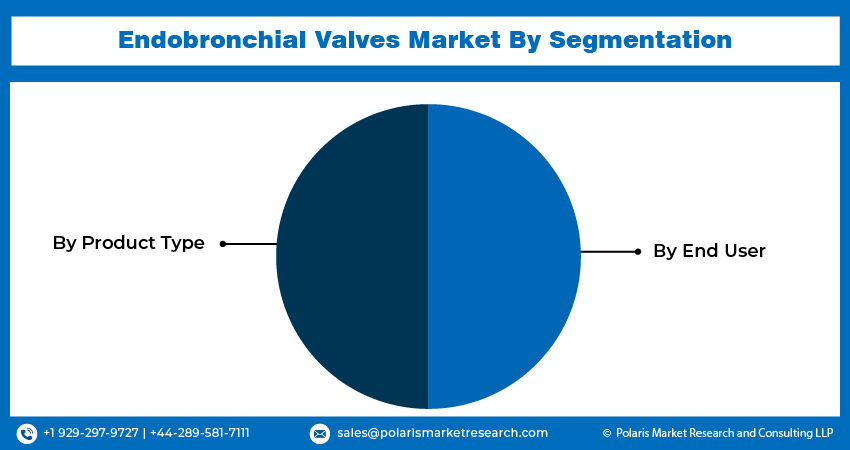
Regional Insights
North America Region Held the Largest Share of the Global Market in 2025
The North America region registered the global market. This growth is attributable to the increasing number of cases of COPD in the region. Around 16 million people in the United States are highly affected by chronic obstructive pulmonary disease. This is leading to a decrease in quality of life and issues with breathing. Pulmonologists and scientists are working to tackle this issue by following Zephyr and spiration valves, which received approval from the FDA. The rising clinical trials and scientific studies in this region, along with the higher lung-related problems faced by the population, are expected to continue their share in the world.
The Asia Pacific region will grow with the rapid pace, owing to the growing elderly population in this region. The demographic shift characterized by lower birth rates, followed by upward growth in the older population in this region, may register significant lung issues, contributing to the demand for endobronchial valve devices in the region. Furthermore, the leading health issues in Asia Pacific, such as respiratory viruses (influenza and tuberculosis), occupational lung diseases, and increasing air pollution, are expected to show significant demand for endobronchial valves in the projected timeframe. The ongoing studies on treating these diseases are likely to stimulate the application of endobronchial valves in the marketplace.
Source: Polaris Market Research Analysis
Key Market Players & Competitive Insights
The endobronchial valve market is highly consolidated as it is in an emerging stage in the marketplace. The ongoing investment and expansion activities among the key market players, such as collaborations, partnerships, mergers, and acquisitions to gain a competitive advantage and increase global market share with a view to enhancing their capability in building efficient devices, are driving the expansion of the global market. The continual technological adoption by companies in medical device manufacturing is likely to fuel advancements in endobronchial valves during the forecast period.
Some of the major players operating in the global market include:
- Boston Scientific Corporation
- Broncus Medical Inc.
- BTG International Ltd.
- EndoStim Inc.
- Olympus Corporation
- PneumRx Inc.
- Pulmonx Corporation
- Spiration Inc.
Recent Developments
- In May 2022, a study published in the ATS Journal on innovations in the COPD management department focused on evaluating the application of bronchoscopic lung volume reduction using endobronchial valves in decreasing hyperinflation and enhancing respiratory functions among severe emphysema patients.
Endobronchial Valves Market Report Scope
| Report Attributes | Details |
| Market size in 2025 | USD 190.64 million |
| Market size in 2026 | USD 201.43 million |
| Revenue forecast in 2034 | USD 321.53 million |
| CAGR | 6.0% from 2026 – 2034 |
| Base year | 2025 |
| Historical data | 2021 – 2024 |
| Forecast period | 2026 – 2034 |
| Quantitative units | Revenue in USD million and CAGR from 2026 to 2034 |
| Segments covered | By Product Type, By End User, By Region |
| Regional scope | North America, Europe, Asia Pacific, Latin America, Middle East & Africa |
| Customization | Report customization as per your requirements with respect to countries, region, and segmentation. |
Source: Polaris Market Research Analysis
Endobronchial Valves Market FAQ's
key companies in endobronchial valves market are Boston Scientific Corporation, Broncus Medical, EndoStim, Olympus Corporation
The global endobronchial valves market is expected to grow at a CAGR of 6.0% during the forecast period.
The endobronchial valves market report covering key segments are product type, end user and region.
key driving factors in endobronchial valves market are rising prevalence of lung-related issues is primarily attributable to tobacco smoking
The global endobronchial valves market size is expected to reach USD 321.53 million by 2034
Download Sample Report of Endobronchial Valves Market Size, Analysis Report, 2026-2034
Please fill out the form to request a customized copy of the research report.


