
Finance Cloud Market Size, Share, Trends and Forecast, 2026–2034
REPORT DETAILS
Finance Cloud Market Summary
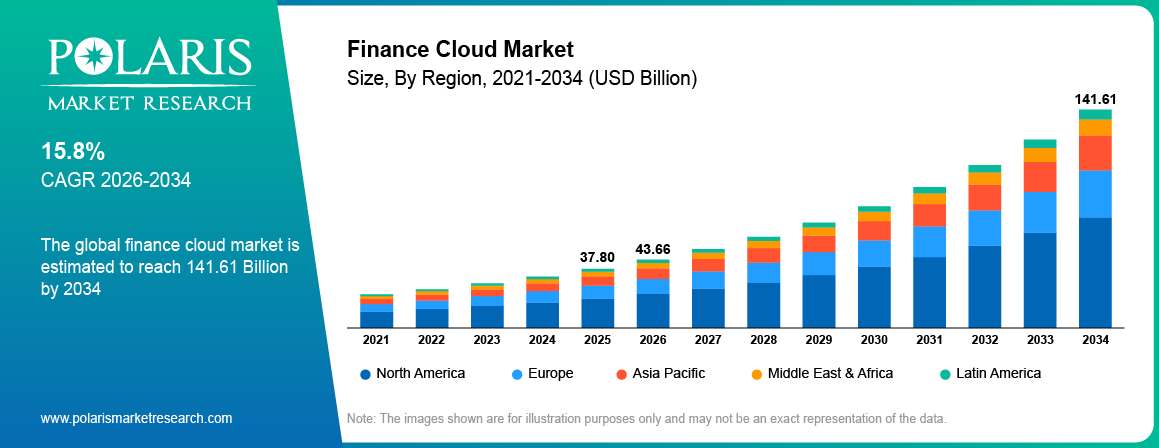
The global finance cloud market was valued at USD 37.80 billion in 2025 and is expected to grow at a CAGR of 15.8% during the forecast period.
Market Statistics
Key Takeaways
- North America accounted for 40.20% of the market revenue in 2025. Strong cloud adoption in financial institutions supported its leading position.
- Asia Pacific is expected to grow at a CAGR of 18.40% during 2026–2034. Growth is driven by digital banking and financial inclusion initiatives.
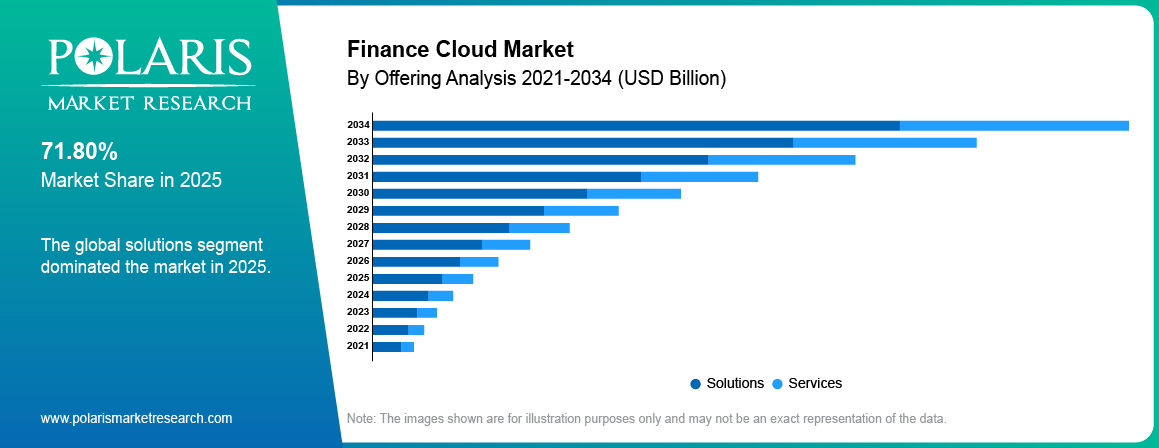
- The Solutions segment held 71.80% of the market revenue in 2025. Demand for customized cloud solutions supported the segment’s growth.
- The Services segment is projected to grow at a CAGR of 17.30% during 2026–2034. More financial firms are adopting managed cloud services.
- The Wealth Management segment accounted for 40% of the market revenue in 2025. Rising demand for investment services supported growth.
- The Public Cloud segment is projected to record a CAGR of 40% during 2026-2034. The adoption is increased due to reduced costs and improved scalability.
Note: Figures and projections outlined in this report are the result of Polaris Market Research’s proprietary analytical processes, grounded in the latest available datasets and market observations.
What is Finance Cloud?
Finance cloud refers to cloud-based platforms, infrastructure, and software solutions built for banks, insurance companies, investment firms, and other financial institutions. These solutions support secure data storage, regulatory compliance, digital banking, risk management, analytics, and operational efficiency while providing scalable and flexible cloud environments.
How Finance Cloud Works
Finance cloud works through a simple process:
- Workload migration: Financial institutions move selected data, applications, and workloads to the cloud.
- Cloud infrastructure: Cloud systems provide the storage and computing resources needed to run financial operations.
- Application integration: Financial applications are connected with banking, payment, analytics, and other business systems.
- Security and compliance: Security controls protect data and systems. Compliance measures help meet financial regulations.
- Analytics and automation: Cloud tools help analyze data and automate routine tasks.
- Service delivery: Banks and financial firms use cloud systems to deliver digital services to customers.
- Monitoring and optimization: Organizations monitor performance, security, and costs. They make changes when needed to improve operations.
Market Overview
The financial sector is undergoing a significant transition with technological advancements at the global level. The current move in the world is towards the adoption of cloud computing in the financial space, influenced by its scalability, security, compliance, and affordability. The faster processing speed is building its footprints in banking, insurance, and other financial institutions.
In 2025, the American Bankers Association reported that banks are using cloud services more widely. Cloud helps banks build digital services, improve security, replace old systems, and support business growth (Source: bankingjournal.aba.com).
In 2026, PwC reported that financial institutions have adopted cloud at scale. Banks and other financial firms are now using cloud and AI to improve business value, reduce costs, and support new services. Source: pwc.com
- In May 2026, SAP introduced its SAP Business AI Platform at SAP Sapphire 2026. The platform brings together business data, AI, and enterprise applications in one environment. SAP said the platform is designed to help businesses use AI in their daily operations and improve efficiency (Source: news.sap.com).
Moreover, financial institutions are utilizing technology to automate most of the tasks with the evolution of artificial intelligence, machine learning, and deep learning with a view to lowering fraudulent activities and protecting their businesses
However, the challenges of data safety, protection, and governance, as well as the higher initial investments and maintenance costs, are key factors contributing to the slower adoption of cloud computing among financial institutions.
Market Dynamics
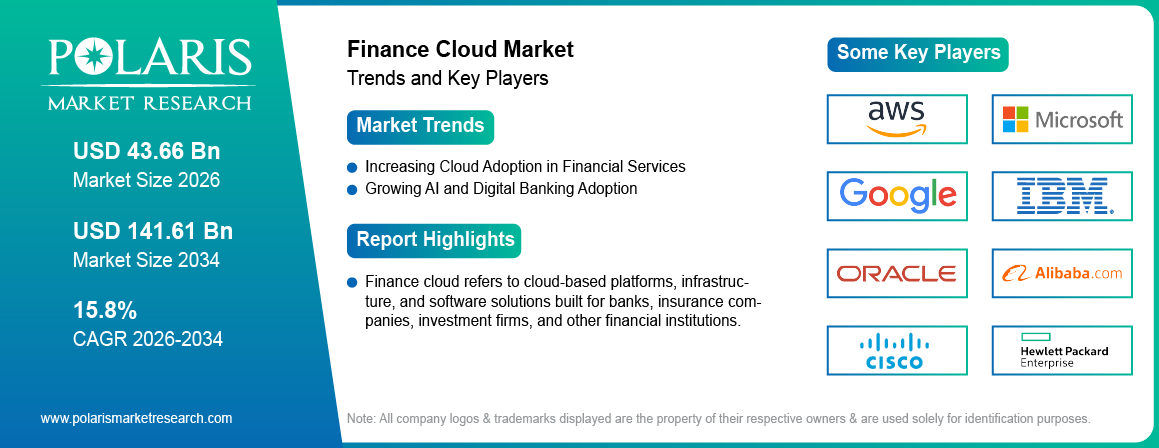
Market Driver- Increasing Cloud Adoption in Financial Services
Financial institutions are moving more workloads to the cloud. Cloud systems help banks manage data, run applications, and support digital services. They also help reduce the need for large on-premise systems. Cloud adoption gives financial institutions more flexibility as their technology needs grow. It also supports faster changes and better use of digital tools.
For example, KPMG’s 2025 Global Tech Report found that 82% of financial services organizations prioritized investment in XaaS, which includes cloud-based services. The report also found that nearly one-third of respondents had reduced technology debt and total cost of ownership through public cloud or XaaS (Source: assets.kpmg.com).
Market Driver- Growing AI and Digital Banking Adoption
AI and digital banking are becoming more important across financial services. Banks are using digital tools to improve customer service and daily operations. AI can also support fraud detection, risk analysis, and data management. Cloud platforms provide the computing power and data access needed for these services. As banks expand their digital and AI programs, demand for cloud infrastructure is also expected to increase.
For example, Microsoft reported in 2025 that 36% of financial services firms planned AI use cases within the next two years to create new business models, products, or services (Source: microsoft.com).
Market Opportunity- Expansion of Cloud-Based Financial Services
Financial services are becoming more digital across banking, payments, insurance, and investment services. This is creating demand for technology that can support more users, data, and transactions. Cloud platforms can help financial firms launch and manage digital services without depending only on traditional infrastructure. Fintech companies also need flexible systems as they expand into new markets and services. This creates opportunities for cloud providers across a wide range of financial applications.
Market Opportunity- Cloud Migration for AI and Banking Modernization — Market Opportunity
Many financial institutions are working to replace older technology systems. Cloud migration gives them a way to modernize their IT infrastructure. It can also support AI, analytics, automation, and better data management. Financial firms can move workloads to the cloud based on their business needs. This creates opportunities for providers offering cloud migration, security, data, and application services.
Market Restraint- Data Security and Compliance Concerns
Data security remains a major concern for financial institutions. Banks and financial firms handle sensitive customer, payment, and business data. They must also follow strict rules for data protection, reporting, and risk management. These requirements can make cloud migration more complex. Financial institutions may need more time and resources to check security and compliance before moving important workloads to the cloud. This can slow adoption, especially for organizations with older systems and complex technology environments.
Artificial Intelligence & Advanced Analytics in Finance Cloud
AI and advanced analytics are becoming more common in finance cloud solutions. Cloud platforms help financial firms manage the data and computing power needed for these tools. AI can support fraud detection, risk analysis, and customer insights. Analytics can help firms understand data and make better decisions. These tools can also support automation and more personalized financial services. However, AI is an emerging capability and is not part of every finance cloud solution.
Regulatory Compliance & Governance
Financial firms must follow strict rules for data and operations. Cloud platforms can support data privacy, regulatory reporting, and data residency needs. They can also help firms keep records and track activities for audits. Strong risk management and governance are important when using cloud services. However, using the cloud does not automatically ensure compliance. Financial institutions must set proper controls and follow all relevant rules.
Cybersecurity in Finance Cloud Environments
Financial firms need strong security when they use cloud services. Encryption helps protect sensitive financial data. Identity and access controls help limit who can access systems and data. Multi-factor authentication adds another layer of protection. Zero-trust principles, threat detection, and regular monitoring can help identify and manage security risks. Backup systems and strong recovery plans can also support business continuity.
Core Banking Modernization
Many banks still use older core banking systems. Cloud technology can help modernize these systems over time. It can improve scalability and make it easier to add new services. Cloud platforms can also support better integration with other banking applications. This can help banks improve service delivery and respond faster to changing customer needs.
Cloud-Based Payments & Transaction Processing
Cloud platforms can support digital payments and transaction processing. They can handle large transaction volumes and support changing demand. Payment APIs can also connect banks with payment platforms and other financial services. Real-time processing can help deliver faster payment services. Cloud infrastructure can also support the growth of digital payment systems.
Wealth Management & Investment Applications
Wealth management is an important application area for finance cloud solutions. Cloud platforms can support portfolio management and investment analytics. They can also help firms manage client data and improve client engagement. Financial advisors can use cloud-based tools to access information and support investment decisions. These services can improve the way wealth management firms deliver their services.
Finance Cloud in Insurance Services
Insurance companies can use cloud platforms across different business functions. Cloud systems can support claims processing and underwriting activities. They can also help with policy administration and customer management. Analytics can help insurers study customer and business data. These tools can improve efficiency and support better service delivery.
Open Banking & API Ecosystems
Open banking depends on secure data sharing between financial service providers. Cloud platforms can support secure API connections between banks, fintech companies, and other partners. APIs can help different systems exchange data and services. This can support new financial products and partnerships. Strong security and access controls are important when sharing financial data.
Enhancing Customer Experience Through Cloud
Cloud technology can help financial firms improve customer services. It supports digital banking across mobile, web, and other channels. Cloud-based systems can also help speed up customer onboarding. Data and analytics can support more personalized services. This can help firms provide faster and more responsive customer experiences.
Operational Efficiency & Cost Reduction
Cloud solutions can help financial firms use technology resources more efficiently. They can reduce the need for large on-premise infrastructure. Cloud systems can also support automation of routine tasks. Better resource use can help control infrastructure and operating costs. These benefits can improve overall operational efficiency.
Financial Data Management & Analytics
Financial firms handle large amounts of customer and business data. Cloud platforms can provide centralized storage for this data. They can also support real-time analytics and business intelligence. These tools can help firms prepare reports and understand business performance. Better access to data can support faster and more informed decisions.
Sustainability & Green Data Centers
Cloud infrastructure can support sustainability efforts in financial services. Shared cloud infrastructure may help improve the use of computing resources. It can also reduce the need for each organization to maintain its own large data center. However, the actual environmental benefit depends on how the cloud infrastructure is designed and managed. Financial firms should consider energy use and other sustainability factors when selecting cloud providers.
Finance Cloud vs Traditional Banking Infrastructure
| Feature | Finance Cloud | Traditional Banking Infrastructure |
| Scalability | Easy to increase or reduce resources | Limited and requires hardware upgrades |
| Cost Efficiency | Lower upfront cost and pay-as-you-use | High setup and maintenance costs |
| Security Management | Built-in security with regular updates | Managed mainly by the organization |
| Deployment Speed | Fast deployment in days or weeks | Longer deployment, often takes months |
| Innovation Capabilities | Easy to add AI, analytics, and new services | Slower to adopt new technologies |
| Maintenance Requirements | Cloud provider handles most maintenance | Internal IT team manages maintenance |
| Regulatory Compliance | Supports compliance with built-in tools | Compliance is managed manually or with separate systems |
Source: Polaris Market Research Analysis
Rise of Multi-Cloud Strategies
Financial institutions are using more than one cloud provider for different needs. Multi-cloud can improve flexibility and reduce dependence on one provider. It can also help distribute workloads and support business continuity. However, managing several cloud platforms can be complex. Firms need strong integration, security, and governance to manage these environments properly.
Blockchain & Cloud Integration
Blockchain is an emerging area in finance cloud. Cloud platforms can support blockchain workloads and related financial applications. They can also provide the computing resources needed for digital assets and smart contracts. Financial firms can explore these technologies without building all infrastructure on their own. Adoption will depend on business needs, regulation, security, and technology readiness.
Integration Across Financial Ecosystems
Financial institutions use many systems for their daily operations. Cloud platforms can help connect banking systems, payment platforms, CRM tools, analytics, cybersecurity solutions, and regulatory systems. APIs can allow these systems to exchange data and services. Shared data flows can also improve access to information across business functions. Strong security and governance are needed to manage these connections.
Emerging Technologies in Finance Cloud
New technologies are expanding the role of cloud in financial services. Generative AI and machine learning can support data analysis and automation. Cloud-native banking can help firms build and update services faster. Open banking APIs can improve connections between financial providers. Blockchain, real-time analytics, intelligent automation, and digital identity can support new financial services. These technologies are still developing, and their use will vary across financial institutions.
Report Segmentation
The market is primarily segmented based on offering, application, deployment model, organization size, end user and region.
| By Offering | By Application | By Deployment Model | By Organization Size | By End User | By Region |
|
|
|
|
|
|
Source: Polaris Market Research Analysis
By Offering Analysis
The services segment is expected to grow rapidly, with a CAGR of 17.30% in the forecast period, due to prevalence of outsourcing from experienced professionals. The services segment offers cloud solutions without the need for installation or maintenance. The services managed professional segment is expected to witness dominant growth, which is highly influenced by its cost effectiveness.
The solutions segment led the market in 2025 with revenue share of 71.80%, largely attributable to its ability to offer a customized consumer experience with an accurate and speedy response, enabling financial institutions to meet their consumer demand effectively.
By Application Analysis
The wealth management segment accounted for the largest market share of 19.40% in 2025. The growth of this segment is mainly driven by the rising demand for investment and wealth creation services among the population.
The asset management segment is expected to grow at the fastest rate over the next few years on account of the rapid increase in the need for real-time asset tracking, incredible insights, and the convenience of cloud systems.
By Deployment Model Analysis
The public cloud segment held a significant market share in revenue in 2025. The segment is expected to grow at a CAGR of 15.20% from 2026-2034., which is highly accelerated due to its ability to assist in cost-cutting procedures as it charges for the only services utilised by the financial company. Its flexibility, scalability, and pay-as-you go model are gaining traction from more companies.
By Organization Size Analysis
The large enterprises segment accounted for a significant growth share in 2025 and is expected to continue its trend in the coming years. This is attributable to its effectiveness in providing enhanced streamlining of business operations with appealing insights, which are essential in key decision-making.
Small and medium enterprises are expected to notice significant growth in the marketplace owing to ongoing preferences towards the adoption of the latest technologies to promote efficient business operations with lower investment.
By End User Analysis
The banking segment witnessed a higher growth share over other end users in 2025, which is likely to stimulate its growth trajectory during the forecast period. This can be inferred from the increased consumer satisfaction, accessibility, and ease of operation with the penetration of internet users. One example is the unified payment interface (UPI).
Insurance and financial services provider segments are projected to witness reasonable growth in the coming years due to increasing concerns about uncertainty and the ability to provide alluring insights by automating repetitive tasks. The finance cloud facilitates risk assessment capability, which can promote smooth operations for investment banks.
Finance Cloud Use Cases
| Use Case | Real-World Example |
| Digital Banking Platforms | Customers open accounts and access banking services online. |
| Mobile Banking Applications | Users transfer money, pay bills, and check balances through mobile apps. |
| Fraud Detection Systems | Banks identify unusual transactions and block suspicious payments. |
| Financial Analytics Platforms | Financial institutions analyze customer data to support business decisions. |
| Insurance Claim Processing | Insurance companies process and track claims more quickly. |
| Wealth Management Services | Investment firms provide portfolio tracking and financial planning tools. |
| Regulatory Reporting Automation | Financial institutions automatically prepare and submit compliance reports. |
| Payment Processing Solutions | Banks and payment providers process secure online and digital payments. |
Source: Polaris Market Research Analysis
Regional Insights
North America region registered the largest share of the global market in 2025
North America dominated the global market in 2025 with 40.20% of the total market. The growth of the segment market can be largely attributed to the presence of robust infrastructure, and the higher rate of internet users is encouraging financial institutions to adopt cloud computing to provide customized and qualitative services to their customers.
Asia Pacific Region to Witness the Fastest Market Growth
The Asia Pacific region is expected to be the fastest-growing region, with a CAGR of 18.40% during the projected period, owing to the growing government initiatives to promote financial inclusion in countries like India. The prevalence of global expansion activities by major players is showing a positive impact in the region.
For instance, in 2026, IndusInd Bank launched a new UPI processing platform with a cloud-ready design. The platform offers up to 75% more scalability and 30% faster recovery. This shows how Indian banks are using cloud technology to support digital payments and banking services (Source: indusind.bank.in). Furthermore, a Jaipur -based AU small finance company announced the 30% improvement in vehicle automation processes with the cloud adoption. This ongoing trend is likely to stimulate the demand for cloud computing for financial services in the region in the projected time frame.
Europe region is driven by banking modernization and regulatory compliance
Europe is focusing on banking modernization and stronger digital services. Cloud platforms can help banks improve system flexibility and resilience. Data privacy is also an important concern for financial institutions. Regulatory requirements continue to shape cloud adoption across the region.
Latin America region is seeing growth in digital financial services
Digital financial services are growing across Latin America. Banks and fintech companies are adopting cloud solutions to support digital banking and payments. Cloud technology can also help modernize older financial systems. This creates opportunities for cloud adoption as financial services become more digital.
Middle East & Africa region is seeing growth in digital banking and cloud adoption
Digital banking is expanding across the Middle East and Africa. Financial institutions are investing in modern technology to improve access to digital services. Cloud platforms can support banking modernization and help manage growing digital workloads. Rising technology investment is creating new opportunities for cloud adoption in the region.
Key Market Players & Competitive Insights
The finance cloud market is fragmented with the presence of several market players and is anticipated to witness competition due to the rising research and development activities to deploy advanced cloud computing systems. Collaborations and partnerships among the companies have been rising over the years, with a view to utilizing collaborative power to build efficient financial solutions. For instance, in 2025, Wells Fargo expanded its partnership with Google Cloud to use AI across its banking operations. The partnership aims to help employees find information faster, automate routine tasks, and improve customer service (Source: newsroom.wf.com).
Key Players in the Finance Cloud Market
- AWS
- Microsoft
- IBM
- Oracle
- Alibaba
- Cisco
- HPE
- Huawei
- DXC Technology
- Nutanix
- OVHcloud
Challenges in Finance Cloud Market
The finance cloud market faces several challenges despite its strong growth. Data security and privacy remain major concerns for financial institutions handling sensitive customer information. Meeting changing regulatory requirements across different countries also adds complexity. Many organizations still rely on legacy systems that are difficult to integrate with cloud platforms. High migration costs, vendor lock-in risks, and ongoing compliance management can slow adoption. In addition, a shortage of skilled cloud professionals makes deployment and management more challenging.
Recent Developments
- July 2026: Karnataka Bank partnered with CredAble to launch a fully digital Supply Chain Finance (SCF) platform. The cloud-based platform simplifies working capital financing for MSMEs, speeds up loan processing, and strengthens the bank’s digital finance capabilities. (Source: imesofindia.indiatimes.com)
- May 2026: HCLTech launched its Autonomous Finance Platform built on Google Cloud’s Gemini Enterprise. The platform automates finance and accounting processes such as invoice management, order-to-cash, and financial planning, helping organizations reduce manual work and improve operational efficiency. (Source: hcltech.com)
Future of The Finance Cloud Market
The finance cloud market is expected to grow steadily as banks and other financial institutions continue their digital transformation. More organizations will replace legacy systems with cloud-based platforms to improve efficiency and customer service. The use of AI, open banking, cloud-native applications, and data analytics will continue to increase. At the same time, stronger cybersecurity and regulatory compliance will remain key priorities. These trends will make finance cloud an important part of future financial services.
Finance Cloud Market Report Scope
| Report Attributes | Details |
| Market size value in 2025 | USD 37.80 billion |
| Market size value in 2026 | USD 43.66 billion |
| Revenue forecast in 2034 | USD 141.61 billion |
| CAGR | 15.8% from 2026 – 2034 |
| Base year | 2025 |
| Historical data | 2021 – 2024 |
| Forecast period | 2026 – 2034 |
| Quantitative units | Revenue in USD million/billion and CAGR from 2026 to 2034 |
| Segments covered | By Offering, By Application, By Deployment Model, By Organization Size, By End User, By Region |
| Regional scope | North America, Europe, Asia Pacific, Latin America, Middle East & Africa |
| Customization | Report customization as per your requirements with respect to countries, region and segmentation. |
Source: Polaris Market Research Analysis
Finance Cloud Market FAQ's
The key companies in Finance Cloud System Market include Acumatica, Alibaba, AtemisCloud, AWS, Cisco,
The global finance cloud market is expected to grow at a CAGR of 15.8% during the forecast period.
Finance Cloud Market report covering key segments are offering, application, deployment model, organization size, end user and region.
The key driving factors in Finance Cloud System Market are Increasing awareness about the benefits associated with cloud computing in finance
Finance Cloud Market Size Worth $ 141.61 Billion By 2034.
The public cloud segment is projected to hold a larger revenue share due to its scalability, cost-effectiveness, and ongoing need for real-time financial reporting by institutions.
The wealth management segment accounted for the largest market share in 2023, driven by the rising demand for investment and wealth creation services among the global population.
A finance cloud is a cloud platform for financial institutions. It helps manage data and banking services securely.
Banks use the cloud to reduce costs and improve efficiency. It also supports faster digital services.
Finance cloud platforms improve security and scalability. They also simplify operations and support compliance.
Download Sample Report of Finance Cloud Market
Please fill out the form to request a customized copy of the research report.


