
Flexible Battery Market Size, & Trend Analysis Report, 2026-2034
REPORT DETAILS
Flexible Battery Market Summary
The global flexible battery market is estimated around USD 111.37 million in 2025, with consistent growth anticipated during 2026–2034. This growth is driven by rising demand for lightweight, bendable, and ultra-thin power storage solutions across wearable electronics, healthcare devices, and foldable consumer electronics. The market is projected to grow at a CAGR of 24.78% during the forecast period.
Market Statistics
Key Takeaways
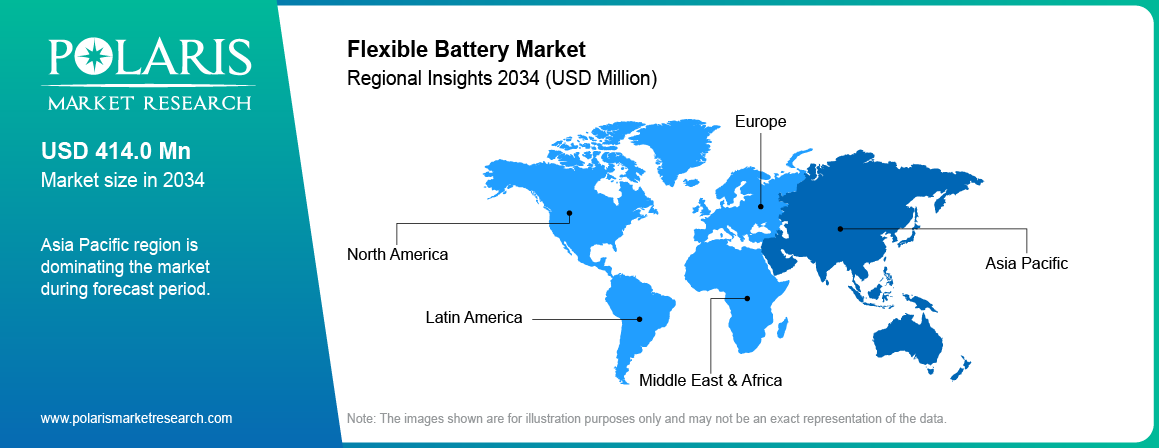
- Asia Pacific dominated the market in 2025, accounting for approximately 38.26% of the total market share due to strong electronics manufacturing infrastructure and extensive battery production capabilities.
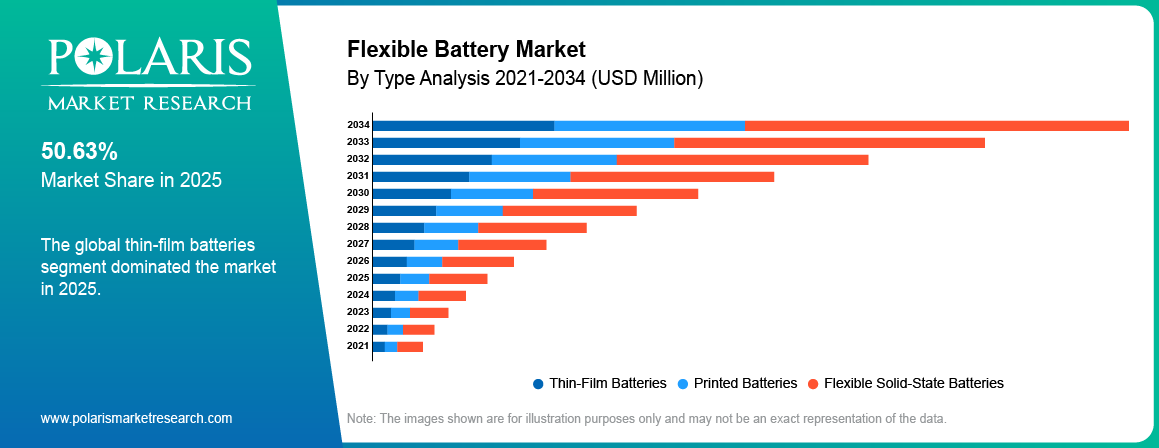
- The thin-film batteries segment dominated the market in 2025, holding nearly 38.74% market share owing to strong demand from wearable electronics and compact smart devices.
- The rechargeable batteries segment accounted for approximately 61.38% market share in 2025 driven by increasing adoption across consumer electronics, medical devices, and IoT applications.
- The flexible solid-state batteries segment is projected to register the fastest CAGR of nearly 18.42% during the forecast period due to higher safety, improved energy density, and enhanced flexibility characteristics.
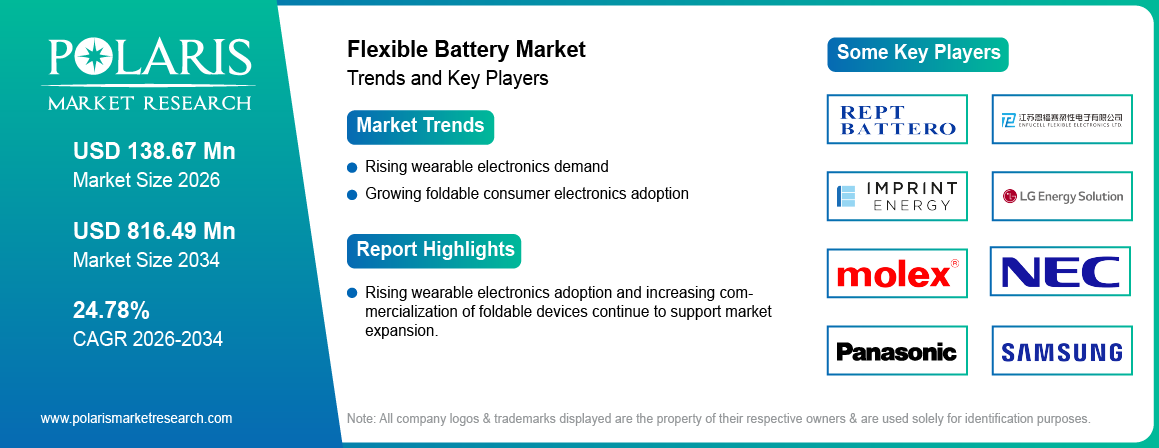
- Major companies operating in the market include REPT BATTERO Energy Co., Enfucell, Imprint Energy, Jenax Inc., LG Energy Solution, and others.
Industry Dynamics
- Rising wearable electronics adoption increases demand for flexible energy storage systems.
- Growing investments in foldable smartphones support commercialization of flexible batteries.
- Manufacturing complexity and high production costs continue to create commercialization challenges.
- Flexible solid-state battery development creates long-term market opportunities.
What is Flexible Battery?
Flexible batteries refer to bendable and lightweight energy storage devices designed to operate under folding, stretching, and twisting conditions. These batteries are widely used in wearable electronics, smart healthcare patches, IoT sensors, foldable smartphones, and connected packaging systems. The flexible batteries helps to achieve compactness in design and facilitate portability in modern electronics.
Value chain activities include raw material suppliers, producers of battery components, manufacturers of printed electronics, OEMs, distribution networks, and consumers. Raw materials suppliers provide the conductive ink, lithium, and flexible substrate materials required in manufacturing batteries. Manufacturers make thin-film and printed batteries for wearable and foldable applications.
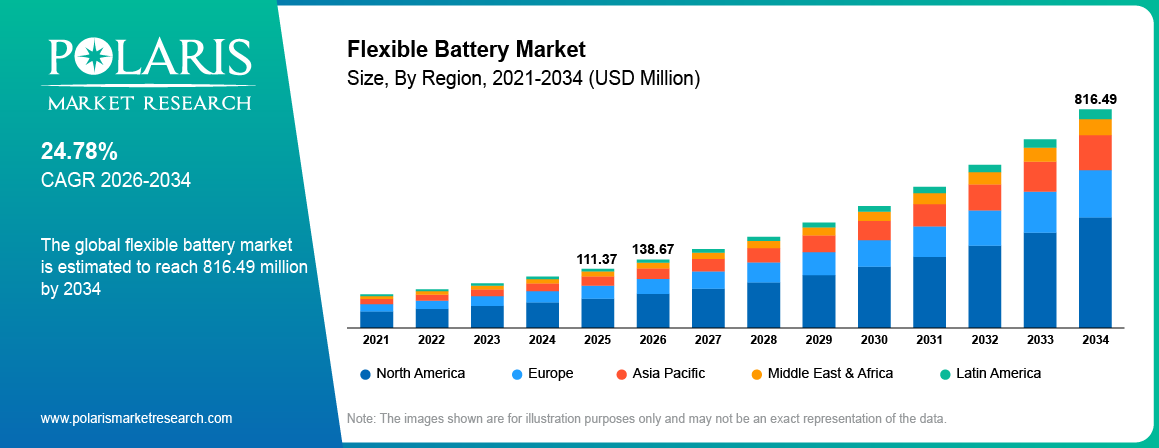
Market growth is attributed to increasing demands for small electronic gadgets and wearable technological gadgets. The electronics sector is making huge investments in energy storage solutions that are highly efficient and flexible. Growth in the use of Internet of Things consumer gadgets is expected to play a major role in market growth.
Drivers & Opportunities
Rising Demand for Wearable Electronics: The increasing adoption of smartwatches, fitness wearables, AR/VR wearables, and health care wearables is fueling the growing demand for flexible batteries. Conventional rigid batteries face certain drawbacks in wearable electronics. The use of flexible batteries offers some advantages, particularly for wearable electronics. There has been increased attention towards the development of ultra-thin batteries for wearable electronics by technology firms. For instance, Samsung Electro-Mechanics launched an all-solid-state battery for wearable electronics in September 2024.
Growing Commercialization of Foldable Consumer Electronics: The increasing use of folding phones, bendable displays, and intelligent fabrics creates a rising demand for smaller and flexible battery solutions. In March 2026, OPPO launched Find N6 as a new model of a folding phone with bendable display and enhanced battery performance. The consumer electronic firms are focusing on implementing light-weighted power sources in their architectural devices. Batteries with flexibility ensure longer life span of devices and efficient utilization of spaces.
Restraints & Challenges
Manufacturing Complexity and High Production Costs: The commercialization of flexible batteries faces technical difficulties in manufacturing and production costs. The production of printed batteries and flexible solid-state batteries necessitates highly advanced engineering techniques and materials. The challenge lies in keeping flexibility while maintaining longevity and energy density during repeated flexion of the batteries. The production costs of these batteries have remained high.
Opportunity
Flexible Solid-State Battery Development: Flexible solid-state batteries have opened up new avenues of opportunities in the segments of wearable health care devices, consumer electronics, and IoT. In March 2026, Arkema showcased advanced materials that helps in the production of flexible solid-state batteries at InterBattery 2026. This battery technology is more flexible and safer than lithium-ion batteries. Battery manufacturers are increasing investments in advanced electrolyte technologies and solid-state materials.
Segmental Insights
The report provides a comprehensive analysis of the flexible battery market by type, chargeability, and application to pinpoint the key revenue generating and growth segments.
By Type
-
Thin-Film Batteries
The thin-film batteries segment held the largest share in the global market in 2025 owing to high application among wearable electronic devices and small-scale IoT devices. Thin film batteries are lightweight and ultra-thin. Electronics manufacturers continue to increase adoption of lithium thin-film battery technologies. Rising investments in connected consumer devices continue to support segment growth.
-
Flexible Solid-State Batteries
The flexible solid-state batteries segment is projected to grow at the fastest CAGR during the forecast period due to superior safety and higher energy density. These batteries offer enhanced flexibility and operational stability compared to traditional lithium-ion batteries. Corporations are making more investments in advanced battery technologies and flexible electrolytes. The rising usage of such batteries in next-generation wearables fuels growth within the market.
By Chargeability
-
Rechargeable Batteries
Rechargeable batteries segment held the largest share of the market in 2025 as a result of increasing adoption in consumer devices and wearable health devices. Flexible batteries have become common in smartwatches, patches, and wearable health systems. Consumers are increasingly preferring sustainable and reusable electronic products. Rising deployment across connected wearable devices continues to support segment demand.
-
Single-Use Batteries
Single-use batteries segment is projected to grow at the fastest CAGR during the forecast period due to increasing use in smart packaging, RFID systems, and disposable medical devices. These batteries provide compact size and lower manufacturing costs for short-term applications. Packaging companies are expected to increase their spending on connected packaging solutions. Disposable healthcare electronics have continued to drive segment growth.
By Application
-
Wearable Electronics
The wearable electronics segment dominated the market in 2025 as a result of rising demand for smartwatches, fitness trackers, and wearable health devices. Flexible batteries helps in the creation of lighter weight devices that come in small sizes. Consumer electronics manufacturers are prioritizing rechargeable ultra-thin battery integration. Rising global wearable device shipments continue to support segment growth.
-
Healthcare Devices
Healthcare devices segment is projected to grow at the fastest CAGR during the forecast period due to increasing adoption of biosensors, smart healthcare patches, and remote patient monitoring systems. Flexible batteries improve patient comfort and support compact medical device integration. Healthcare providers continue to increase investments in connected monitoring technologies. Rising demand for precision medicine and remote diagnostics continues to support market growth.
Regional Analysis
Asia Pacific Flexible Battery Market Overview
Asia Pacific dominated the flexible battery market in 2025 due to strong electronics manufacturing infrastructure across China, Japan, South Korea, and Taiwan. Chinese Ministry of Industry and Information Technology reported China’s smartphone production reached 1.02 billion units, while integrated circuit output rose 10.2% year-on-year to 386.6 billion units during January to October 2025. Regional companies are increasing investments in flexible battery R&D and foldable electronics commercialization. Rising production of connected consumer devices continues to support regional market growth.
North America Flexible Battery Market Insights
North America is projected to witness strong growth during the forecast period due to increasing investments in wearable healthcare technologies and advanced battery materials research. The US continues to support battery innovation through partnerships between universities, startups, and medical technology firms. Commercialization efforts within healthcare and IoT markets have continued to fuel region-level growth. In September 2025, Beam Global filed a US patent for its flexible smart battery system meant to enhance scalability and power efficiency.
Europe Flexible Battery Market Insights
Europe is experiencing stable growth due to the growing demand for environmentally sustainable and recyclable battery solutions. Countries such as Germany, France, and the UK have continued their growth in investment in green electronics manufacturing. There is an increasing emphasis on the development of sustainable batteries due to regulations, resulting in the innovation of low-environmental impact energy storage solutions. According to the European Commission, worldwide battery demand was expected to grow 14 times until 2030, when 17% of this demand is projected to come from the EU, which resulted in the introduction of the Batteries Regulation in August 2023.
Competitive Landscape & Key Players
The flexible battery industry is fragmented moderately due to the availability of global players manufacturing batteries, printed electronics manufacturers, and regional technology vendors in the field. Competitiveness among them relies on innovation, energy density, price competitiveness, manufacturing capabilities, and flexibility of the battery. The strategy adopted by the firms is strategic partnerships, acquisitions, launches, and research & development investment. Investments in flexible solid-state batteries and scalable production technologies continue to increase globally.
Premium Insights
Smart Wearable Electronics Expansion
Wearable healthcare devices, smart textiles, and connected fitness products continue to increase demand for ultra-thin flexible battery technologies. Battery manufacturers are increasingly adopting lightweight rechargeable batteries for use in compact electronics devices.
Sustainable Battery Innovation
Battery manufacturers are increasing investments in recyclable materials and environmentally responsible production technologies. Sustainable battery development is expected to become an important competitive factor during the forecast period.
Future Flexible Energy Storage Technologies
Self-healing battery materials, graphene-based electrodes, and advanced solid-state systems are expected to reshape future market competition. The continuous improvement of batteries' lifespan and capacity is expected to help in creating the next generation of devices.
Key Players
- REPT BATTERO Energy Co.
- Enfucell
- Imprint Energy
- Jenax Inc.
- LG Energy Solution
- Molex LLC
- NEC Corporation
- Panasonic Holdings Corporation
- Samsung SDI
- STMicroelectronics
- Ultralife Corporation
- Varta AG
Industry Developments
- May 2026: Cavotec introduced its PowerAccESS battery system, a versatile and scalable energy storage technology that helps achieve sustainable and emission-free port crane operations. [source: www.cavotec.com]
- May 2026: Festool expanded its cordless lineup with flexible battery systems that improve tool compatibility, runtime, and jobsite efficiency. [source: www.prnewswire.com]
Flexible Battery Market Segmentation
By Type Outlook (Revenue, USD Million, 2021-2034)
- Thin-Film Batteries
- Printed Batteries
- Flexible Solid-State Batteries
By Chargeability Outlook (Revenue, USD Million, 2021-2034)
- Rechargeable Batteries
- Single-Use Batteries
By Application Outlook (Revenue, USD Million, 2021-2034)
- Wearable Electronics
- Healthcare Devices
- Consumer Electronics
- Smart Packaging
- IoT Sensors
By Regional Outlook (Revenue, USD Million, 2021-2034)
- North America
- US
- Canada
- Europe
- Germany
- France
- UK
- Italy
- Spain
- Netherlands
- Russia
- Rest of Europe
- Asia Pacific
- China
- Japan
- India
- Malaysia
- South Korea
- Indonesia
- Australia
- Vietnam
- Rest of Asia Pacific
- Middle East & Africa
- Saudi Arabia
- UAE
- Israel
- South Africa
- Rest of Middle East & Africa
- Latin America
- Mexico
- Brazil
- Argentina
- Rest of Latin America
Flexible Battery Market Report Scope
| Report Attributes | Details |
| Market Size in 2025 | USD 111.37 Million |
| Market Size in 2026 | USD 138.67 Million |
| Revenue Forecast by 2034 | USD 816.49 Million |
| CAGR | 24.78% from 2026 to 2034 |
| Base Year | 2025 |
| Historical Data | 2021–2024 |
| Forecast Period | 2026–2034 |
| Quantitative Units | Revenue in USD Million and CAGR from 2026 to 2034 |
| Report Coverage | Revenue Forecast, Competitive Landscape, Growth Factors, and Industry Trends |
| Segments Covered |
|
| Regional Scope |
|
| Competitive Landscape |
|
| Report Format |
|
| Customization | Report customization as per your requirements with respect to countries, regions, and segmentation. |
Source: Polaris Market Research Analysis
Flexible Battery Market FAQ's
The global market size was valued at USD 111.37 million in 2025 and is projected to grow to USD 816.49 million by 2034.
Asia Pacific dominated the market in 2025 due to strong electronics manufacturing infrastructure.
Major applications include wearable electronics, healthcare devices, consumer electronics, smart packaging, and IoT sensors.
A few of the key players in the market are REPT BATTERO Energy Co., Enfucell, Imprint Energy, Jenax Inc., LG Energy Solution, Molex LLC, NEC Corporation, Panasonic Holdings Corporation, Samsung SDI, STMicroelectronics, Ultralife Corporation, and Varta AG, and others.
Market growth is driven by rising demand for wearable electronics and foldable consumer devices.
Thin-film batteries dominated the market in 2025 due to strong demand from wearable electronics.
Flexible solid-state batteries and advanced wearable technologies are expected to support future market growth.
Download Sample Report of Flexible Battery Market
Please fill out the form to request a customized copy of the research report.


