
Functional Food Probiotics Market Size, Share Analysis Report, 2026-2034
REPORT DETAILS
Functional Food Probiotics Market Summary
The global functional food probiotics market size was valued at USD 56.77 billion in 2025, growing at a CAGR of 8.05% from 2026–2034. Key factors driving the growth is due to rising consumer awareness of gut health and digestive wellness and growth in preventive healthcare and self-medication trends.
Market Statistics
Key Takeaways
- North America accounted for the largest share of the functional food probiotics market, with 56.88% of the share in 2025. This is due to the large number of pharmaceutical manufacturers, as well as contract development and manufacturing?organizations (CDMOs) and biotechnology companies.
- The market in Europe is expected to grow with a CAGR of 9.0% during the forecast period. This is driven by increasing investments and rising adoption of automation technologies by the pharmaceutical manufacturers from across the region.
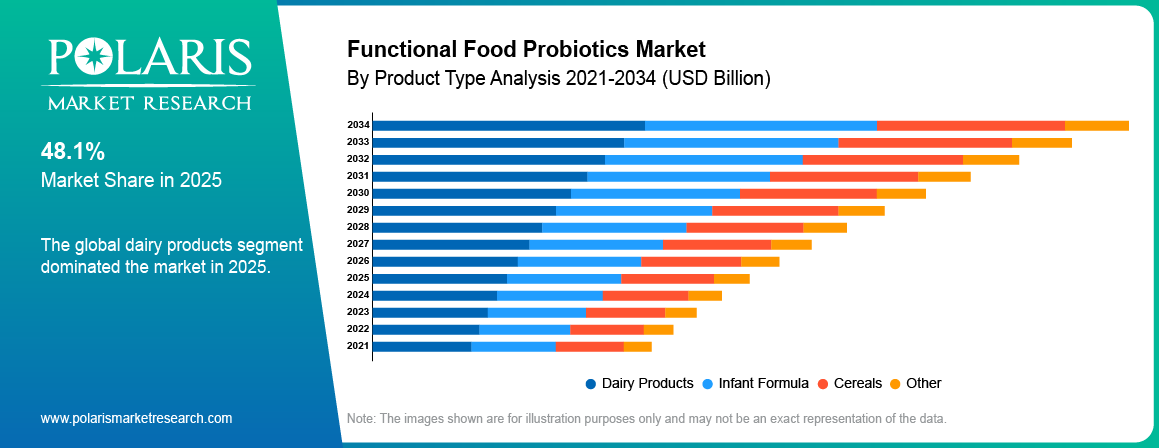
- Based on product type, the dairy products segment accounted for 48.1% share of the market due to the rising consumption of yogurt, fermented milk and cultured beverages which naturally promote probiotic strain survival and activity.
- Based on ingredient, the yeast segment is anticipated to witness the fastest growth at a CAGR of 8.21% due to its increasing use in functional food applications.
Industry Dynamics
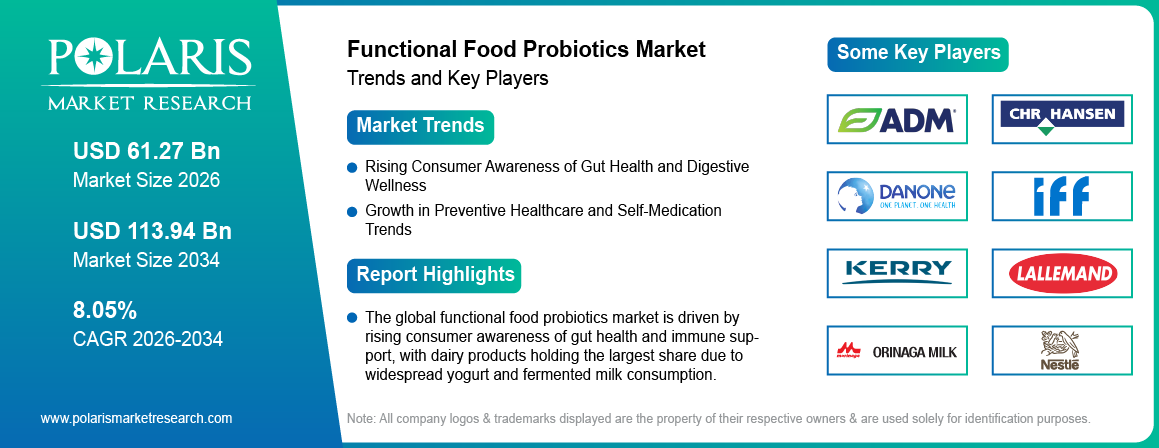
- Rising consumer awareness of gut health and digestive wellness drives the market growth.
- Growth in preventive healthcare and self-medication trends boost the market expansion.
- Maintaining probiotic viability and stability throughout food processing, storage, and shelf life creates challenges.
- Expansion into non-dairy and plant-based functional food formats to capture lactose-intolerant and vegan consumer segments is an opportunity for the market.
Source: Polaris Market Research Analysis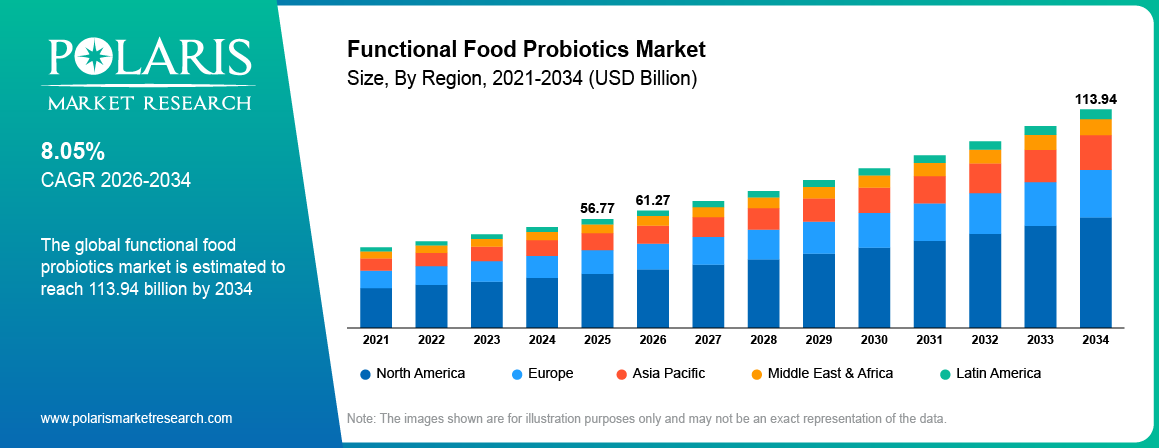
To Understand More About this Research:Download Sample Report
What are Functional Food Probiotics?
Functional food probiotics are live beneficial bacteria that are added through a process or during manufacturing to enhance the health benefits of the food. Increasing demand to strengthen immunity is contributing to the growth of the functional food probiotics market. Preventative healthcare is being prioritized by consumers, and they look for foods that can provide additional health benefits beyond nutrition. Probiotic fortified foods agents have been considered to promote good gut health which is associated with a strong immune system. Consumers are looking for probiotic-rich foods such as kefir, kimchi, sauerkraut and kombucha in their daily regimens due the connection between the gut microbiome and immune system response enhancement. In February 2022, Indian researchers developed a next-generation probiotic that extended Caenorhabditis elegans lifespan by 27.81%. The bacterium improved immunity, memory, gut integrity and oxidative stress tolerance, which suggest applications in healthy aging. Therefore, food companies are aiming to innovate with functional food formulations offering immune-strengthening probiotics.
The growth of probiotic ingredients in dairy products, infant formula and cereal is also contributing to market growth. While traditionally found in fermented ingredients in dairy products, probiotics are being added to other food categories to appeal to more consumers. Food producers are developing probiotic product formats that are stable and provide convenient and attractive options also from a consumption perspective. The addition of probiotics to cereal and baby food products indicates a growing belief in their beneficial effects on health and that they are safe to be consumed by all ages. This diversification into different food applications is allowing companies to expand their product holdings and capitalize on changing consumer preferences for functional nutrition.
Drivers & Opportunities
What are Factors Driving Industry Growth?
Rising Consumer Awareness of Gut Health and Digestive Wellness: This is due to increased awareness of the role of the gut microbiome on general health has driven consumers to focus more on digestive health and nutrition. Scientific driven discussion and public health messaging around gut health and immunity, metabolic processes, has proved this science. As a result, now, more than ever, consumers are aiming for food that can help them digest well in their daily meals. According to a 2025 U.S. Department of Health and Human Services report digestive diseases accounted for 66 billion visits to physicians as the primary diagnosis in ambulatory care, highlighting the need for good health. Probiotic-enriched functional foods are widely accepted as a hard to beat natural and simple solution for the maintenance of gut microbial homeostasis. This focus on gut health is leading food makers to increase the range of probiotic-infused products to meet evolving consumer tastes.
Growth in Preventive Healthcare and Self-Medication Trends: Consumers are progressively moving towards active health management with dietary behaviors that promote long-term wellness rather than relying on medical treatments. The probiotics in functional food are now being treated as the new beneficial ingredient due to the health supporting advantages without any pharmaceutical intervention. Additionally, more people are including probiotic-rich products into their everyday meals as a means to maintain digestive equilibrium and improve overall health. The shift towards more patient-oriented healthcare is increasing demand for functional foods providing augmented physiological benefits. Therefore, food manufacturers place more importance on probiotic related product development to meet demand for a growing taste for preventive nutrition.
Source: Polaris Market Research Analysis
Segmental Insights
Which Segment by Product type Dominated in 2025?
In 2025, the dairy products segment accounted for 48.1% share of the market. This is due to the nutrients and other components of the matrix which contribute to the stability of the microorganisms throughout storage and ingestion. Products such as yogurt, fermented milk and cultured beverages, naturally promote probiotic strain survival and activity and are generally accepted by consumer. Familiarity of consumers with fermented dairy products has also driven a steady consumption among all age groups. Food companies are also continuing to innovate in the dairy space with new probiotic-enriched formulations and flavors. Consequently, probiotic dairy products are the most established and widely accepted means to deliver probiotic benefits in the daily diet.
Which Segment by ingredient is Expected to Witness a Significant Share?
The yeast segment is anticipated to witness the fastest growth at a CAGR of 8.21%. This is owing to its increasing use in functional food applications. Probiotic yeast strains are emerging for the support of digestive balance with superior stability in multiple processing and storage conditions. Unlike some bacterial strains, probiotics based on yeast are resistant to heat and can endure extreme conditions including temperature variations and levels of acid. This characteristic allows the manufacturers of food to incorporate them into a wider range of products without adversely affecting the quality of the product. Increasingly, research into the health benefiting properties of probiotic yeast is driving its application in ingredients for functional foods. Thus, probiotic products based on yeasts are gaining recognition as potential, and sometimes complementary solutions in the functional food probiotics area.
How dry Segment Contributing to the Market Growth?
The dry segment dominated the market owing to its greater stability and longer shelf life, as well as simple handling during processing and distribution. Dry formulation of probiotics are significantly preferred as it enables to maintain the viability of the probiotic strains while minimizing the chance of deterioration during storage. These forms can also be added more easily to different food products such as powders, cereals, and retail functional food. Furthermore, dry forms allow for more flexible transportation and storage than liquid forms, especially in large scale food manufacturing. Food producers also prefer the dry form of products as the use of them in formulation is easier and the resulting product quality is stable. As a result, the dry sub segment is expected to maintain its dominance in the functional food probiotics market.
Source: Polaris Market Research Analysis
Regional Analysis
What are Regional Statistics of Industry?
North America
North America is expected to witness the fastest growth during the forecast period, with a CAGR of 7.96%. This is attributed to the increasing inclination of consumers towards health and functional food products. In the region, strong demand for digestive, immune and general wellbeing enhancing food is driving strain and probiotic fortification across numerous food product categories. Food producers in the region are also increasingly turning to product innovation, catering to changing dietary trends with varied probiotic formulations. Organized retail chains and developed food processing industry have a positive influence on the availability and accessibility of probiotic enriched foods in the country. The U.S. is a major contributor to the regional growth owing to high awareness of consumers towards gut health and inclination for preventive nutrition. In the U.S., the number of food and beverage processing establishments totaled 42,708 in 2022, as reported by the U.S.Department of Commerce. The country also exhibits a mature functional food landscape that facilitates the ongoing product development and introduction of probiotic-based food products.
Asia Pacific
The Asia Pacific market held the largest revenue share of 40.0% in 2025. This growth is driven by high consumption of fermented products in the region's population has naturally made consumers more receptive to probiotic-enriched functional food. Growth is also being driven by rapid urbanization, changing eating habits and increasing awareness of digestive health, causing popular demand for functional food probiotics. Also, the growth of the food processing industry and increasing availability of packaged functional food are some of the factors attributing to the growth of the market in the region. China is a major demand driver owing to the huge population and growing preference for nutrition-based food products. The country is also experiencing rising demand for functional foods that maintain digestive well-being and general health, which is now prompting more consumers to embrace food products that are enriched with probiotics.

Source: Polaris Market Research Analysis
Key Players & Competitive Analysis
Some of the major players are Archer Daniels Midland (ADM); Chr. Hansen A/S (Novonesis); Danone S.A.; International Flavors & Fragrances (IFF); Kerry Group plc; Lallemand Inc.; Morinaga Milk Industry Co., Ltd.; Nestlé S.A.; Probi AB; Yakult Honsha Co., Ltd.
Functional food probiotics industry is a growing market with the presence of many multinational food companies as well as excellence biotechnology companies. Danone S.A. and Nestlé S.A. are major companies in the consumer facing sector, well recognized in dairy and infant formula and with strong distribution channels. Yakult Honsha Co., Ltd. possesses a tightly focused market space with its single-strain fermented milk product. On the side of ingredient supply, Chr. Hansen A/S (Novonesis), and International Flavors & Fragrances (IFF) are the foremost probiotic strain developers that supply scientifically validated cultures to third party producers. Kerry Group plc is distinctive with its spore-forming GanedenBC30, that boasts superior stability in processed foods. Archer Daniels Midland (ADM), Lallemand Inc. and more offer wide ranges of both ingredients and finished products. Morinaga Milk Industry Co., Ltd. and Probi AB concentrate on strain-specific developments, especially for infant and digestive well-being. Strain efficacy, formulation stability, regulatory approvals and strategic alliances with food manufacturers are among the competitive points.
Key Players
- Archer Daniels Midland (ADM)
- Chr. Hansen A/S (Novonesis)
- Danone S.A.
- International Flavors & Fragrances (IFF)
- Kerry Group plc
- Lallemand Inc.
- Morinaga Milk Industry Co., Ltd.
- Nestlé S.A.
- Probi AB
- Yakult Honsha Co., Ltd.
Industry Developments
- November 2025: Probi has extended its probiotic range into two completely new categories: Sports & Active Nutrition and Pet Health. This introduction takes Probi’s clinically documented biotic solutions outside the classic functional food platform.
- February 2025: ADM and Asahi Group Foods collaborated for the postbiotic Lactobacillus gasseri CP2305 to market, which has been the subject of eight human clinical trials focusing on stress, mood, and sleep.
Functional Food Probiotics Market Segmentation
By Product Type Outlook (Revenue, USD Billion, 2021–2034)
- Dairy Products
- Infant Formula
- Cereals
- Other Functional Food
By Ingredient Outlook (Revenue, USD Billion, 2021–2034)
- Bacteria
- Lactobacillus Species
- Lactobacillus acidophilus
- Lactobacillus rhamnosus
- Others
- Bifidobacterium Species
- Streptococcus thermophilus
- Lactobacillus Species
- Yeast
- Saccharomyces boulardii
- Other
By Distribution Channel Outlook (Revenue, USD Billion, 2021–2034)
- Hypermarkets/Supermarkets
- Pharmacies/Drugstores
- Specialty Stores
- Online
- Convenience Stores/Small Retail Formats
By Form Outlook (Revenue, USD Billion, 2021–2034)
- Dry
- Liquid
By Regional Outlook (Revenue, USD Billion, 2021–2034)
- North America
- U.S.
- Canada
- Europe
- Germany
- France
- UK
- Italy
- Spain
- Netherlands
- Russia
- Rest of Europe
- Asia Pacific
- China
- Japan
- India
- Malaysia
- South Korea
- Indonesia
- Australia
- Vietnam
- Rest of Asia Pacific
- Middle East & Africa
- Saudi Arabia
- UAE
- Israel
- South Africa
- Rest of Middle East & Africa
- Latin America
- Mexico
- Brazil
- Argentina
- Rest of Latin America
Functional Food Probiotics Market Report Scope
| Report Attributes | Details |
| Market Size in 2025 | USD 56.77 Billion |
| Market Size in 2026 | USD 61.27 Billion |
| Revenue Forecast by 2034 | USD 113.94 Billion |
| CAGR | 8.05% from 2026 to 2034 |
| Base Year | 2025 |
| Historical Data | 2021–2024 |
| Forecast Period | 2026–2034 |
| Quantitative Units | Revenue in USD Billion and CAGR from 2026 to 2034 |
| Report Coverage | Revenue Forecast, Competitive Landscape, Growth Factors, and Industry Trends |
| Segments Covered |
|
| Country Scope |
|
| Competitive Landscape |
|
| Report Format |
|
| Customization | Report customization as per your requirements with respect to countries, regions, and segmentation. |
Source: Polaris Market Research Analysis
Functional Food Probiotics Market FAQ's
Functional Food Probiotics market is projected to grow from USD 56.77 billion in 2025 to USD 113.94 billion by 2034.
Key ingredient include bacteria and yeast.
Major players include Archer Daniels Midland (ADM); Chr. Hansen A/S (Novonesis); Danone S.A.; International Flavors & Fragrances (IFF); Kerry Group plc; Lallemand Inc.; Morinaga Milk Industry Co., Ltd.; Nestlé S.A.; Probi AB; Yakult Honsha Co., Ltd
Rising consumer awareness of gut health and digestive wellness, growth in preventive healthcare and self-medication trends.
Difficulty of maintaining strain stability and viability throughout production, storage, and shelf life
Download Sample Report of Functional Food Probiotics Market
Please fill out the form to request a customized copy of the research report.


