
Soda Ash Market Research Report - Trend, Analysis and Forecast, 2026-2034
REPORT DETAILS
What is the Soda Ash Market Size?
The global soda ash market size was valued at USD 18.09 billion in 2025. According to our soda ash market forecast, the industry is projected to grow at a CAGR of 3.5% from 2026 to 2034. Rising glass production and growing detergent demand are driving steady growth in the market. From an industry perspective, the global soda ash market is driven by increasing demand from the glass, detergents, chemicals, and solar glass industries. The growing preference for natural soda ash, which has a lower carbon footprint, is also shaping the industry outlook, particularly in North America and the Asia Pacific.
Market Statistics
Key Takeaways
- The dense segment dominated the soda ash market with a revenue share of 65.0% in 2025. This is due to the high use of dense soda ash in glass and detergent production.
- The soaps and detergents segment is growing fastest with a CAGR of 2.9% as cleaning product manufacturing expands.
- North America is expected to expand at a CAGR of 2.5%. The regional dominance is attributed to strong demand for soda ash from glass and detergent manufacturers.
- The U.S. market is driven by strong glass manufacturing capacity and growing demand for solar glass.
- The Asia Pacific captured largest revenue share of 47.0% in 2025. This is due to the increasing production of detergents and infrastructure development are among the factors driving the market in the region.
- The China and India markets are growing due to capacity expansion and industrial consumption.
Industry Dynamics
- Increasing glass and detergent manufacturing is fueling continuous demand for soda ash.
- Growing chemical manufacturing and solar PV glass manufacturing are increasing market use.
- Technological developments in energy-efficient manufacturing processes are improving production efficiency.
- Supply-side factors driving the growth of the market include the availability of raw materials, logistics, and trade.
- Factors such as energy prices and freight rates have a direct impact on the pricing of soda ash, particularly in areas where synthetic soda ash is produced.
- Trona-based natural soda ash provides more stable pricing and lower emissions. This supports long-term soda ash market opportunities.
What is Soda Ash?
Soda ash is an essential industrial chemical known as sodium carbonate (Na₂CO₃). It is increasingly used in manufacturing and processing industries. Soda ash is available in natural and synthetic forms. It is considered a key raw material in producing glass, detergents, chemicals, and water treatment solutions.
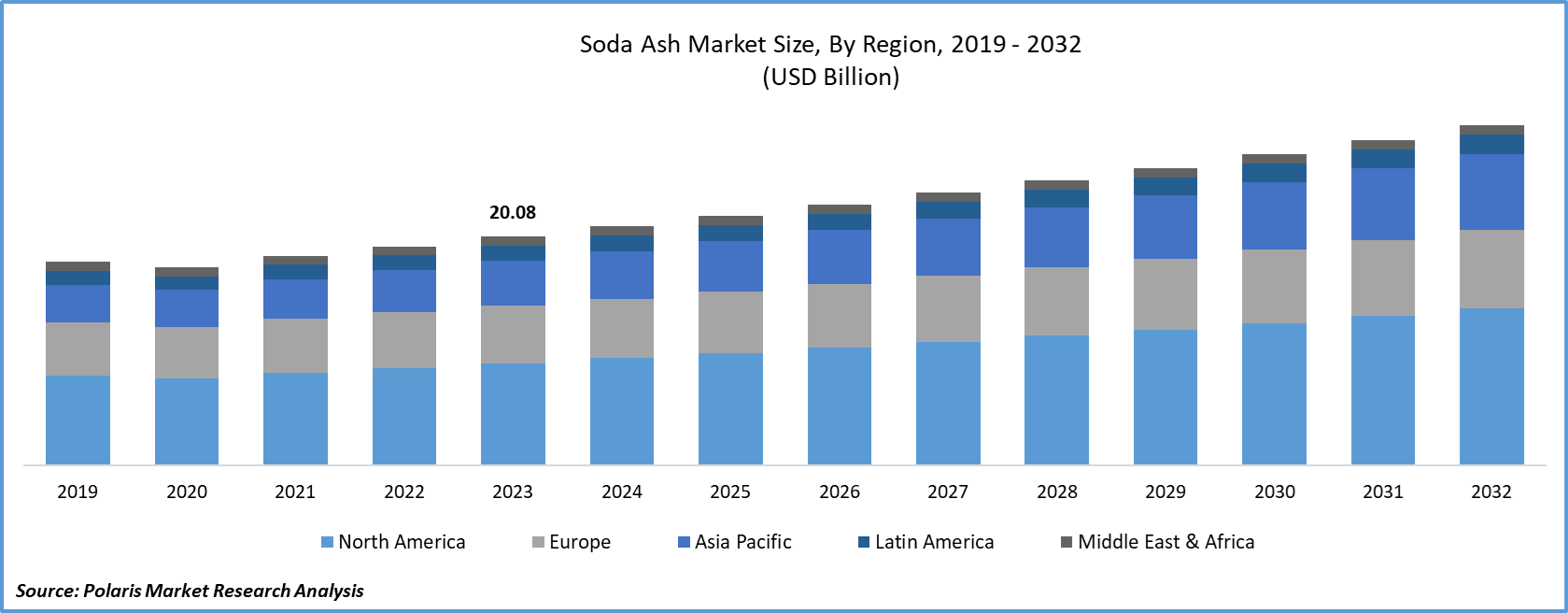
Market expansion is driven by rising glass production for solar panels and by infrastructure development. The rise in the production of detergents and chemicals in the Asia Pacific is also fueling the market. The adoption of energy-efficient and sustainable production processes is making soda ash more cost-effective. For example, in January 2025, GHCL Ltd. was granted environmental clearance by the Ministry of Environment in India for its new greenfield soda ash plant in Kutch with a capacity of 1.1 million tons per annum.
Fluctuating raw material prices and tight environmental legislation hinder the process. On the contrary, growing trends of low-carbon process innovation and increasing investments in trona-based natural soda ash create future prospects globally.
Why Soda Ash is Important?
Soda ash supports multiple major industries, especially construction, automotive, and consumer goods through glass production. It plays a key role in chemical processing, environmental applications, and industrial efficiency. These benefits make it a critical raw material for global manufacturing and sustainable development.
Main Uses and Industrial Applications of Soda Ash
| Main Use | Application of Soda Ash |
| Glass Manufacturing | Used to lower the melting point of silica, improving energy efficiency and production speed in flat glass, container glass, and fiberglass manufacturing. |
| Detergents and Soaps | Acts as a water softener and cleaning agent, helping improve the effectiveness of detergents, soaps, and household cleaning products. |
| Chemicals Production | Serves as a raw material in producing sodium bicarbonate, sodium silicates, sodium phosphates, and other industrial chemicals. |
| Water Treatment | Helps regulate pH levels, soften water, and remove impurities in municipal and industrial water treatment processes. |
| Pulp and Paper | Used in paper manufacturing for chemical pulping processes and pH control, improving product quality and processing efficiency. |
| Metallurgy | Applied in metal refining and processing to remove impurities and support efficient extraction in steel and non-ferrous metal industries. |
| Textile Processing | Used in dyeing and finishing processes to maintain alkaline conditions and improve dye absorption in fabrics. |
| Food Industry | Utilized in limited food-grade applications such as acidity regulation and as an ingredient in certain food processing operations. |
Source: Polaris Market Research Analysis
Drivers & Opportunities
Which Factors are Driving the Market Growth?
Increasing Glass Production Driving Consumption
The rise in glass production, especially in the automotive and construction sectors, has driven demand for soda ash. According to OICA data, global vehicle sales rose from 92.1 million in 2019 to 95.3 million in 2024, a 3.6% increase. The material is an essential component in the manufacturing of flat and container glass used in vehicles and buildings. Expansion in infrastructure and electric vehicle production continues to support steady consumption.
Growing Detergent Demand Supporting Market Expansion
The increasing demand for detergents and soap has enhanced the usage of soda ash. Its use as a major component in detergent production has driven steady market growth. The growing population in urban areas and rising awareness of hygiene have also contributed to the demand increase. According to the United Nations, the movement of people from rural to urban areas is expected to add an additional 2.5 billion to the number of people in urban areas by 2050.
Segmental Insights
Density Analysis
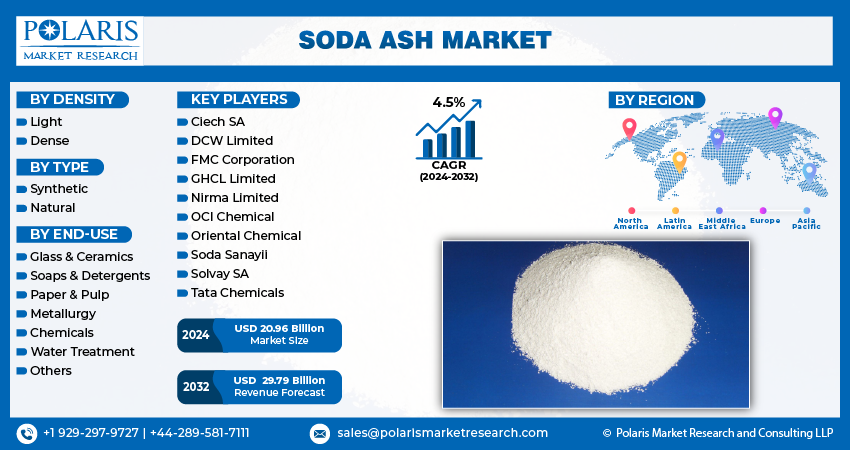
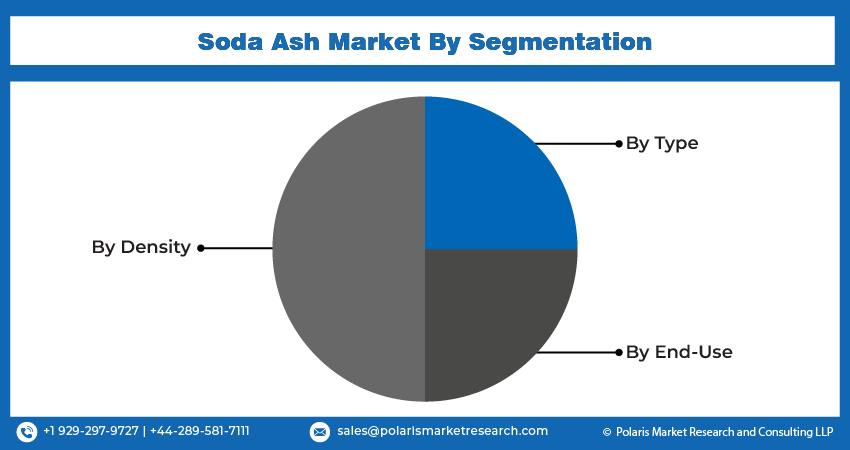
By density, the market is divided into light and dense. The dense segment led the revenue with 65.0% share in 2025 due to its widespread use in glass and laundry detergent manufacturing. Dense soda ash is often used in large glass production because of its high bulk density, making it easier to handle and preventing losses during transportation. In addition, its high purity and stability make it suitable for large-scale soda ash industrial applications.
The light soda ash segment is expected to register the highest growth rate due to its increasing use in chemical processing and water treatment. Additionally, its low bulk density makes it economical to transport.
Type Analysis
Based on type, the market is segmented into synthetic and natural. The natural soda ash segment dominated with a share of 24.0% in 2025, owing to abundant trona reserves and lower production costs. The production of natural soda ash has many environmental advantages compared to the production of synthetic soda ash, including lower energy consumption and lower carbon emissions, which are in line with the global trends of soda ash sustainability.
The synthetic soda ash market is expected to grow at the fastest rate because of capacity expansion in the Asia Pacific. In addition, the use of synthetic soda ash is increasing in the glass and chemical industries because of improved process efficiency.
End User Analysis
Based on end user, the market is segmented into glass & ceramics, soaps & detergents, paper & pulp, metallurgy, chemicals, water treatment, and other end user. The glass and ceramics segment accounted for the largest share of 42.0% in 2025, driven by high demand from the construction and automotive industries. Additionally, rising solar glass production further contributed to the segment’s dominance.
The soaps and detergents segment is expected to register the highest growth rate. This is due to increasing awareness of personal hygiene and the production of detergents. Additionally, the rising urban population is fueling segment demand.
Regional Analysis
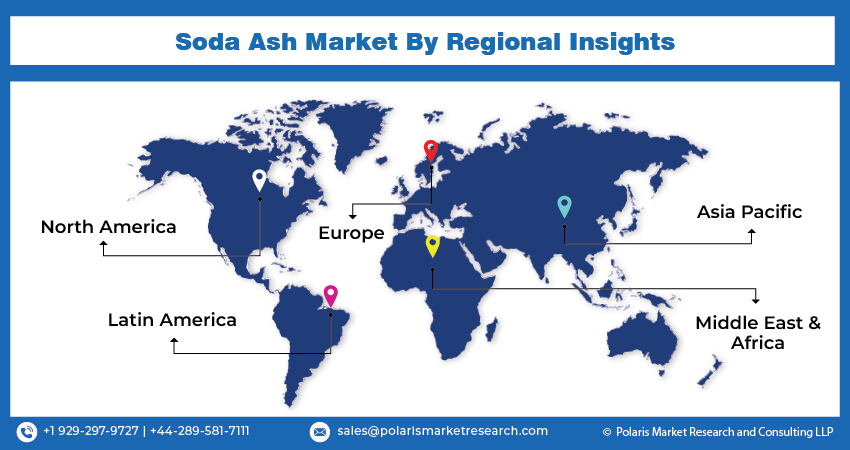
North America is expected to grow with a CAGR of 18.0%, during the forecast period. This is due to high demand from glass and detergent companies in the U.S. and Canada. Additionally, growth in flat glass production for solar and construction applications contributed to regional demand. The U.S. is a major player in the global market and exports due to its large natural trona deposits in Wyoming. The supply chain's efficiency and strong export volumes make North America an important hub for the global market.
The U.S. Soda Ash Market Insights
The U.S. is the major factor due to abundant natural trona resources and strong glass manufacturing capacity. In addition, rising investments in renewable energy are increasing demand for solar glass, which uses soda ash. According to the IEA, clean energy investments reached USD 60 billion in 2024, as investments in fossil fuels dropped below 40%, while U.S. battery production accounted for 8% of the world’s share, and its solar PV capacity tripled to 42 GW.
Europe Soda Ash Market Assessment
Europe is also expected to register a substantial market share of 2.4%, due to the demand for flat glass in the automotive and architectural sectors. According to JATO, new passenger car registrations in Europe (EU, EFTA, and UK) increased by 5% to 790,177 units in August 2025, compared to 752,847 units in August 2024. In addition, the rise in the installation of solar panels in Germany, France, and Italy led to an increase in the use of soda ash in the production of solar glass.
Asia Pacific Soda Ash Market Trends
The Asia Pacific market idominated the market capturing 47.0% share in 2025, driven by the fast-growing industrialization and increasing glass production in China and India. In addition, the growing use of detergents and construction activities is driving market growth.
China Soda Ash Market Overview
China is expanding rapidly due to high soda ash consumption in the glass, chemical, and soap/detergent industries. The float glass production in China totaled 50.25 million tons from January to November 2024, up 3.9% from the previous year, according to Qingdao Creation Classic Glass Co., Ltd. Additionally, rising production and export activity are fueling the market.
Sustainability & ESG Impact
Environmental policies and sustainability strategies for businesses are also influencing the soda ash industry. Companies are putting more effort into improving energy efficiency and reducing carbon emissions. There is also a focus on reducing water usage in their production processes. Businesses are also evaluating their sourcing and processing strategies to comply with tougher environmental policies. In this scenario, natural soda ash is particularly notable for its environmental friendliness. It helps companies achieve low-carbon soda ash manufacturing and provides long-term growth prospects for the market.
Key Players & Competitive Analysis
Competition in the soda ash industry is characterized by a major producer’s emphasis on capacity enhancement and energy-efficient technology, which stimulates production and cost-effectiveness. In addition, collaboration and regional supply chain integration also enhance global access.
Some of the major firms in the soda ash sector are Qemetica SA, Ciner Resources Corporation, DCW Limited, GHCL Limited, Hubei Yihua Group Co., Ltd., OCI Company Ltd., Nirma Ltd., Sanyo Chemical Industries Ltd., Tata Chemicals, Solvay, Eti Soda Elektrik, Kayavlon Impex Pvt. Ltd., WE Soda Ltd., Fluechem LTD., Sudarshan Group, and Prakash Chemicals International Private Ltd.
List of Key Companies
- Ciner Group
- DCW Limited
- Eti Soda Elektrik
- Fluechem Ltd.
- GHCL Limited
- Hubei Yihua Group Co., Ltd.
- Kayavlon Impex Pvt. Ltd.
- Nirma Ltd.
- OCI Company Ltd.
- Prakash Chemicals International Private Ltd.
- Qemetica SA
- Sanyo Chemical Industries Ltd.
- Solvay
- Sudarshan Group
- Tata Chemicals
- WE Soda Ltd.
Soda Ash Industry Developments
March 2026: Tata Chemicals Limited announced that it had reached 1 million tonnes of soda ash production in its Mithapur Facility, Gujarat, India in FY 2025–2026 (Source: tatachemicals.com)
October 2025: Solvay introduced an IUCN biodiversity pilot at its soda ash plant in France to set science-based conservation targets. (Source: solvay.com)
August 2025: Egypt secured financing for a USD 490 million soda-ash plant in New Alamein City, with plans for an annual capacity of 600,000 tons. (Source: amcham.org)
Future Outlook
The soda ash market outlook is positive. The market is driven by increasing demand for solar glass production, rising electric vehicle production, and ongoing global infrastructure development. With rising investments in renewable energy sources, demand for high-quality glass and materials is growing, in turn supporting demand for soda ash. At the same time, there is a growing emphasis on adopting circular economy principles, including recycling and resource efficiency. This is promoting sustainable production and consumption practices. All these soda ash market trends are expected to contribute to the market's growth and provide stable market opportunities in 2034.
Soda Ash Market Segmentation
By Density Outlook (Revenue, USD Billion, 2021–2034)
- Light
- Dense
By Type Outlook (Revenue, USD Billion, 2021–2034)
- Synthetic
- Natural
By End User Outlook (Revenue, USD Billion, 2021–2034)
- Glass & Ceramics
- Soaps & Detergents
- Paper & Pulp
- Metallurgy
- Chemicals
- Water Treatment
- Other End User
By Regional Outlook (Revenue, USD Billion, 2021–2034)
- North America
- US
- Canada
- Europe
- Germany
- France
- UK
- Italy
- Spain
- Netherlands
- Russia
- Rest of Europe
- Asia Pacific
- China
- Japan
- India
- Malaysia
- South Korea
- Indonesia
- Australia
- Vietnam
- Rest of Asia Pacific
- Middle East & Africa
- Saudi Arabia
- UAE
- Israel
- South Africa
- Rest of Middle East & Africa
- Latin America
- Mexico
- Brazil
- Argentina
- Rest of Latin America
Soda Ash Market Report Scope
| Report Attributes | Details |
| Market Size in 2025 | USD 18.09 billion |
| Market Size in 2026 | USD 18.69 billion |
| Revenue Forecast by 2034 | USD 24.65 billion |
| CAGR | 3.5% |
| Base Year | 2025 |
| Historical Data | 2021–2024 |
| Forecast Period | 2026–2034 |
| Quantitative Units | Revenue in USD billion, and CAGR from 2026 to 2034 |
| Report Coverage | Revenue Forecast, Market Competitive Landscape, Growth Factors, and Trends |
| Segments Covered |
|
| Regional Scope |
|
| Competitive Landscape | Soda Ash Industry Trend Analysis (2025) Company profiles/industry participants profiling include company overview, financial information, product/service benchmarking, and recent developments |
| Report Format | PDF + Excel |
| Customization | Report customization as per your requirements with respect to countries, regions, and segmentation. |
Source: Polaris Market Research Analysis
Soda Ash Market FAQ's
The global soda ash market was valued at USD 18.09 billion in 2025. It is projected to reach USD 24.65 billion by 2034, growing at a 3.5% CAGR.
The market for soda ash is driven by rising demand for glass and expanding detergent manufacturing. The market is also benefiting from increasing water treatment applications.
The glass and ceramics segment accounted for the largest share in 2025, driven by high demand from the construction and automotive industries.
Soda ash is primarily used in the manufacturing of glass and soap. It also finds applications in detergent production and water treatment.
North America leads the soda ash industry. This is due to high demand from glass and detergent companies in the U.S. and Canada.
The global market size was valued at USD 17.52 billion in 2024 and is projected to grow to USD 24.65 billion by 2034.
The global market is projected to register a CAGR of 3.5% during the forecast period.
North America led in 2024, driven by strong glass and detergent manufacturing capacity and steady demand from construction and automotive industries.
A few of the key players in the market are Qemetica SA, Ciner resources corporation, DCW Limited, GHCL Limited, Hubei Yihua Group Co., Ltd., OCI Company Ltd. Nirma Ltd., Sanyo chemical industries ltd., Tata Chemicals, Solvay, Eti Soda Elektrik, Kayavlon Impex Pvt. Ltd., WE Soda Ltd., Fluechem LTD., Sudarshan Group, and Prakash Chemicals International Private Ltd.
The dense segment dominated due to high consumption in glass and detergent manufacturing across industrial applications.
The soaps and detergents is fastest growing segment with expanding cleaning product manufacturing and rising hygiene awareness.
Download Sample Report of Soda Ash Market
Please fill out the form to request a customized copy of the research report.


